Ahrefs vs Semrush vs Ubersuggest (2026): Which SEO Tool Is Actually Worth Your Money?
Three tools, dozens of client projects, and one honest answer for each type of user — not a feature list copied from a pricing page.
Semrush · Overall winner 👑
Ubersuggest · Best value
If you’ve narrowed your SEO software search down to Ahrefs, Semrush, and Ubersuggest, you’re already looking at three of the biggest names in the industry. The challenge isn’t finding features — it’s figuring out which platform actually fits the way you work, your budget, and your long-term SEO goals.
I’ve used all three across real client projects: local plumbers, SaaS startups, affiliate blogs pulling six figures a month, and enterprise ecommerce sites pushing millions of pages. Each tool has genuinely impressed me in certain areas and genuinely frustrated me in others. That’s what this guide is based on — not a list of features copied from each platform’s pricing page.
Here’s what you actually need to know.
Each block is one section, sized by how long it is. The orange block is the longest: Feature-by-Feature Deep Dive (about 11 min). Tap a block to jump.
Quick Verdict
Don’t want to read 10,000 words? Here’s the short version.
| Category | Winner | Why It Wins |
|---|---|---|
| Overall Winner | Semrush | Broadest toolset, best for most use cases |
| Best Value | Ubersuggest | Affordable lifetime deal, good for beginners |
| Best for Beginners | Ubersuggest | Simplest UI, lowest barrier to entry |
| Best for Agencies | Semrush | White-label reports, multi-client management |
| Best for Ecommerce | Semrush | PLA research, product listing ad data |
| Best for Bloggers | Ahrefs | Content Explorer, best content gap tool |
| Best for Local SEO | Semrush | Local pack tracking, Google Business data |
| Best Keyword Database | Semrush | 21B+ keywords, largest indexed database |
| Best Backlink Tool | Ahrefs | Largest live backlink index, deepest analysis |
| Best AI Features | Semrush | AI writing assistant, content brief tool |
| Best Reporting | Semrush | Custom report builder, PDF exports, scheduling |
| Best Affordable Option | Ubersuggest | Lifetime plans starting at $120 |
| Best Lifetime Value | Ahrefs | Deep data quality justifies premium price |
| Avoid Ahrefs If | — | Budget is tight — most expensive option with no free trial |
| Avoid Semrush If | — | You need one simple tool — can feel overwhelming without a plan |
| Avoid Ubersuggest If | — | You need enterprise data — depth lags behind Ahrefs & Semrush |
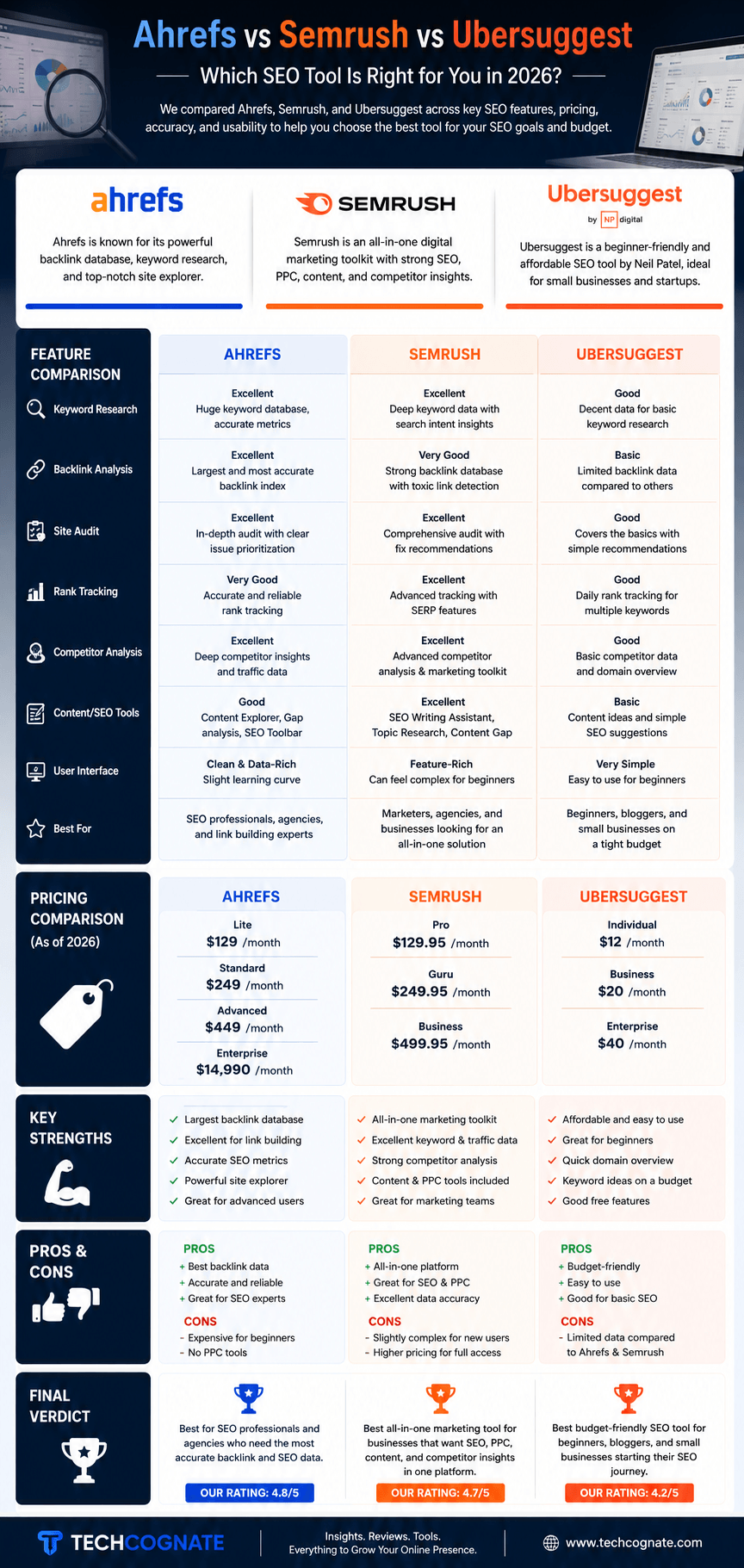
At-a-glance: how Ahrefs, Semrush, and Ubersuggest stack up in 2026.
Meet the Contenders
Ahrefs launched in 2010 as a backlink analysis tool and gradually evolved into one of the most respected full-suite SEO platforms on the market. The company is Singapore-based and founder-led, which means it doesn’t answer to VC pressure or public shareholders. That independence shows in the product — Ahrefs tends to focus on data depth over flashy marketing features.
Its backlink index is widely considered the most accurate and frequently updated in the industry. SEOs who do serious link building rely on Ahrefs almost religiously. But it’s also become a powerhouse for content research through its Content Explorer, one of the most underrated features in any SEO tool. If you’re a blogger, affiliate marketer, or content strategist who wants to understand what content performs in any niche, Ahrefs is where you go.
Semrush was founded in 2008 and went public in 2021. It’s one of the most feature-rich platforms in digital marketing — not just SEO, but also PPC, social media, content marketing, competitive intelligence, PR, and local SEO. If you work at an agency or run in-house marketing for a mid-size company, Semrush is probably already on your radar.
The platform has the largest keyword database of the three (21+ billion keywords) and some of the most robust competitor analysis features available anywhere. Its reporting suite is exceptional for client work. The downside? There’s a real learning curve, and the pricing can stack up quickly once you start adding seats and features.
Ubersuggest was acquired by digital marketing personality Neil Patel in 2017 and rebuilt from a simple keyword suggestion tool into a broader SEO suite. It’s the youngest and most budget-friendly option of the three, offering both monthly subscriptions and one-time lifetime license deals.
What Ubersuggest does well is accessibility. The interface is clean, the data is digestible, and the learning curve is almost flat. For someone just getting started with SEO — a blogger, a small business owner, a solopreneur — Ubersuggest removes a lot of the friction that makes Ahrefs and Semrush intimidating.
The trade-off is data depth. Ubersuggest’s keyword database and backlink index are smaller. Traffic estimates can be less accurate for niche sites. For power users managing large sites or client portfolios, you’ll eventually outgrow it.
Full Feature Comparison: 50+ Data Points
Here’s a side-by-side breakdown across every major dimension that matters to real SEO work.
| Feature | Ahrefs | Semrush | Ubersuggest |
|---|---|---|---|
| Pricing (Monthly) | $129–$449+ | $139.95–$499.95+ | $12–$40/mo or lifetime |
| Annual Discount | ~20% off | ~17% off | ~33% off |
| Lifetime Deal | No | No | Yes ($120–$400) |
| Free Plan | Limited tools only | 14-day free trial | Freemium (limited) |
| Free Trial | No (pay upfront) | Yes (14 days) | Yes (limited free tier) |
| Refund Policy | No refunds | No refunds | 30-day money-back |
| Ease of Use | Moderate | Moderate–High | Easy |
| Learning Curve | Medium | Medium–Steep | Low |
| Keyword Database | ~20B keywords | 21B+ keywords | ~1B keywords |
| Keyword Difficulty | Accurate (UR-based) | Accurate (competitive data) | Basic estimate |
| Keyword Data Update | Weekly | Weekly–Daily | Weekly |
| Traffic Estimates | Good | Good–Excellent | Decent |
| Backlink Database | Largest live index | Large, slightly smaller | Limited |
| Backlink Update Freq. | 15–30 min re-crawl | Daily | Weekly |
| Broken Link Finder | Yes | Yes | Limited |
| Referring Domains | Yes | Yes | Yes (limited) |
| Site Audit | Excellent | Excellent | Basic |
| Technical SEO | Strong | Strongest | Basic |
| Core Web Vitals | Yes | Yes | Limited |
| Crawl Budget | Yes | Yes | No |
| Rank Tracking | Daily (paid tiers) | Daily | Daily (limited) |
| Rank Tracking Locations | 100+ countries | 140+ countries | Limited |
| Local Rank Tracking | Zip code level | City/zip level | City level |
| Competitor Analysis | Excellent | Excellent | Basic |
| Content Gap Tool | Excellent | Good | Limited |
| Content Explorer | Yes (unique feature) | Topic Research | No |
| Content Optimization | Basic (paid add-on) | SEO Writing Assistant | Basic |
| AI Writing Features | Limited | Yes (ContentShake) | Yes (AI writer) |
| PPC Data | Limited | Excellent | Basic |
| Ad Research | Basic | Full PPC suite | Limited |
| Local SEO Tools | Limited | Full local suite | Basic |
| GBP Management | No | Yes | No |
| API Access | Yes (all plans) | Yes (Business+) | Yes (Business plan) |
| White Label Reports | No | Yes (Agency kits) | Yes (Business plan) |
| PDF Reports | Basic | Excellent | Basic |
| Custom Reports | Limited | Yes | Limited |
| Report Scheduling | No | Yes | No |
| Team Seats | From $40/user | From $45/user | From $5/user |
| Chrome Extension | Yes (SEO Toolbar) | Yes (SEO Toolkit) | Yes |
| Google Integrations | GA4, GSC | GA4, GSC | Google GSC |
| Mobile App | No | No | No |
| Historical Data | Yes (all plans) | Yes (paid tiers) | Limited |
| Export Limits | Plan-based | Plan-based | Limited on free |
| Customer Support | Chat, Email | Chat, Email, Phone (Pro) | Chat, Email |
| Support Quality | Good | Good–Excellent | Average |
| Academy / Learning | Ahrefs Academy | Semrush Academy | Neil Patel Blog |
| Community | Active (Twitter/YouTube) | Large community | Moderate |
| Enterprise Plan | Custom | Custom (Business+) | No enterprise tier |
| Overall Data Accuracy | Excellent | Excellent | Good (lower depth) |
| Uptime / Speed | Fast | Fast | Fast |
| Overall Score | 9.1/10 | 9.3/10 | 7.4/10 |
Feature-by-Feature Deep Dive
1Keyword Research
Keyword research is the foundation of SEO, and all three tools approach it differently.
Ahrefs’ Keywords Explorer is excellent. You enter a seed keyword and get search volume, keyword difficulty, clicks-per-search, SERP features, and a detailed SERP history. The keyword difficulty score (KD) is based on the referring domains pointing to the top-ranking pages — which is one of the more meaningful difficulty metrics you’ll find. Ahrefs also shows you the “parent topic” for any keyword, helping you avoid writing three separate articles for queries that belong under one umbrella.
Semrush’s Keyword Magic Tool is the most powerful of the three. With 21B+ keywords in the database, you can find micro-niche opportunities that Ahrefs might miss. Semrush also clusters related keywords by intent — a huge time saver if you’re building topical authority across a large site. The Keyword Gap tool (now called Keyword Opportunity) lets you compare your rankings against up to five competitors simultaneously.
Ubersuggest’s keyword tool is functional but shallower. Volume estimates can be less reliable for niche topics. It works fine for basic keyword discovery, but if you’re running a competitive affiliate site or a large ecommerce catalog, you’ll hit the limits quickly.
For keyword research depth, Semrush edges ahead on raw database size. Ahrefs wins on data quality and KD accuracy. Ubersuggest is good enough for small projects.
2Backlink Analysis
This is Ahrefs’ territory. No debate needed.
Ahrefs re-crawls pages every 15–30 minutes and maintains what’s widely considered the largest live backlink index in the industry. When you analyze a competitor’s backlink profile in Ahrefs, you’re getting as close to real-time as any SEO tool offers. The Link Intersect feature (now Backlink Gap) shows you which sites link to three or more of your competitors but not to you — a goldmine for link building outreach.
Semrush’s backlink database is large and reliable. You get referring domains, anchor text, link type, and authority scores. Semrush’s Backlink Audit tool is particularly useful for identifying toxic links before a penalty strikes. For agencies managing link profiles for multiple clients, Semrush’s reporting integration makes the workflow smoother.
Ubersuggest shows backlink data but the index is significantly smaller. For a new blogger checking if their guest posts indexed correctly, it’s fine. For serious link analysis on competitive terms, it’s not the right tool. See our roundup of the best link building tools for more options beyond these three.
Ahrefs is the backlink analysis gold standard. Semrush is a solid second. Ubersuggest is not built for serious backlink work.
3Site Audit & Technical SEO
Technical SEO problems — slow pages, broken links, crawl errors, duplicate content, missing tags — are invisible to most site owners until they cause ranking drops. A good site audit catches these proactively.
Semrush’s Site Audit tool is the most comprehensive of the three. It checks for 130+ technical issues categorized by severity. The crawl visualizer helps you understand your internal linking structure. Core Web Vitals integration gives you performance data alongside SEO issues. For agencies doing technical audits as part of onboarding, Semrush is the go-to.
Ahrefs’ Site Audit is excellent and covers most major technical issues. Where Ahrefs stands out is the Content Quality report — it flags thin content, duplicate content, and pages with low organic traffic that could be weighing down your site. The JavaScript rendering is handled well, which matters more than ever with modern SPAs.
Ubersuggest’s audit tool covers the basics — broken links, SSL issues, missing meta tags — but doesn’t go deep enough for complex technical SEO. It’s a good starting point for a beginner who just wants to know if their site has obvious issues.
Semrush wins on technical breadth. Ahrefs wins on content quality diagnostics. Ubersuggest is fine for a quick health check.
4Competitor Research
Understanding what’s working for your competitors is often the fastest path to growing your own organic traffic.
Both Ahrefs and Semrush are outstanding for competitor analysis, but they approach it differently. Ahrefs excels at showing you exactly which content earns backlinks and which content drives traffic. You can drop a competitor’s URL into Site Explorer and see their top organic pages, their referring domains, and the anchor texts people use when linking to them. The Content Gap tool shows you which keywords competitors rank for that you don’t.
Semrush’s competitor tools go broader. Traffic Analytics estimates total site visits, traffic sources, bounce rates, and geographic distribution. The EyeOn feature monitors competitor content and ad activity in real time. For businesses that compete in PPC as well as organic search, Semrush gives you a full picture that Ahrefs can’t match.
Ubersuggest’s competitor analysis is surface-level by comparison. You can see estimated traffic, top keywords, and some backlink data. Useful for a quick gut-check but not for building a serious competitive SEO strategy.
Ahrefs for content and link competitor analysis. Semrush for full-funnel competitive intelligence. Ubersuggest for casual competitive research.
5Content Marketing
Content research and strategy have become central to SEO, and this is where Ahrefs really shines.
Ahrefs Content Explorer is genuinely one-of-a-kind. You can search across billions of indexed web pages to find the content that earns the most backlinks and social shares in any niche. You can filter by domain rating, organic traffic, publication date, and language. It’s the tool I use when I need to identify what topics to chase in a new vertical — it tells you what the internet actually cares about, not just what gets searched.
Semrush counters with its Topic Research tool and the ContentShake AI tool. Topic Research shows content ideas organized by subtopics and questions, pulled from real SERP data. ContentShake uses AI to generate content briefs, draft articles, and optimize existing content for target keywords. If your team publishes at scale and needs an end-to-end workflow from ideation to optimization, Semrush has built more infrastructure around that process.
Ubersuggest offers basic content ideas through its Content Ideas feature, which surfaces popular posts in your niche. It’s useful but lacks the depth and filtering power of either Ahrefs or Semrush.
Ahrefs wins for content discovery and research. Semrush wins for content production workflow and AI-assisted writing.
6Rank Tracking
Knowing where your keywords rank — and how those rankings change over time — is a basic SEO function that all three tools handle reasonably well.
Ahrefs’ Rank Tracker updates daily on paid plans and supports tracking across 170+ countries. You can track at the city or zip code level for local SEO clients. The SERP history chart shows how rankings have shifted over time alongside algorithm update markers, which is genuinely useful for diagnosing traffic drops.
Semrush’s Position Tracking is similarly capable. You get daily updates, location targeting down to city and zip code, device segmentation (desktop vs. mobile), and SERP feature visibility (featured snippets, local packs, etc.). One standout feature is the Cannibalization report, which flags when multiple pages are competing for the same keyword.
Ubersuggest includes daily rank tracking on paid plans, and the interface makes it easy to see winners and losers at a glance. The tracked keyword limit is lower than Ahrefs and Semrush on comparable plans.
Semrush has a slight edge with SERP feature tracking and cannibalization reporting. Ahrefs is a close second. Ubersuggest works well for smaller sites.
7AI Features
All three tools have added AI capabilities, but they’re not all equally useful.
Semrush has gone furthest with AI. ContentShake AI generates full article drafts from a topic input, optimizes content for target keywords, and suggests improvements to existing content. The AI Writing Assistant integrates with Google Docs. These features are actually useful in a production workflow — not just novelty integrations.
Ahrefs has been more restrained with AI. As of 2026, Ahrefs uses AI in some diagnostic and suggestion areas but hasn’t built a full AI content suite. The data and analysis features remain the focus.
Ubersuggest includes an AI writer that can draft content based on keywords. It’s entry-level but functional for someone who needs a starting point for blog content.
Semrush leads on AI-powered content creation. Ahrefs prioritizes data over AI. Ubersuggest’s AI writer works for basic content needs.
8Local SEO
For businesses that depend on local search visibility — restaurants, contractors, dentists, law firms — local SEO tools matter a lot.
Semrush’s local SEO suite is the strongest here by a significant margin. It includes a Listing Management tool to manage your Google Business Profile and citations across directories, local rank tracking at the zip code level, a GBP audit, and a heatmap tool that shows your pack visibility across different parts of a city. This is a product designed for agencies managing local SEO at scale.
Ahrefs handles local keyword research and rank tracking well, but it doesn’t have the citation management, GBP integration, or heatmap features that Semrush offers. You’d need to supplement Ahrefs with a dedicated local SEO tool like BrightLocal or Whitespark.
Ubersuggest offers basic local keyword targeting but no real local SEO infrastructure.
Semrush wins local SEO, and it’s not close. Ahrefs is fine for local keyword research. Ubersuggest is not a local SEO tool.
9PPC Research
If you run paid search campaigns alongside your SEO work, data integration matters.
Semrush was originally built as a competitive intelligence tool for PPC and that heritage shows. The Advertising Research section gives you competitor ad history, ad copy, landing pages, and estimated ad spend. You can see which keywords competitors bid on, what their ads say, and how long they’ve been running the same creative. For a performance marketing team that does both SEO and PPC, Semrush is the natural choice.
Ahrefs shows some PPC data — paid keywords, ad copies, estimated CPC — but it’s clearly secondary to the organic SEO focus. If PPC research is a core workflow, Ahrefs isn’t the right tool.
Ubersuggest includes basic CPC data alongside keyword metrics, which is useful when evaluating whether a keyword is worth targeting organically.
Semrush owns PPC research. It’s not in Ahrefs’ or Ubersuggest’s core competency.
10Reporting & Client Management
If you work with clients or manage multiple stakeholders, reporting capabilities directly impact how much time you spend on communication versus actual work.
Semrush’s reporting suite is the most developed. You get drag-and-drop custom report builders, white-label branding options, scheduled PDF delivery, and agency-specific features like the Agency Growth Kit. My Reports in Semrush is a genuine time saver for agencies — you build the report once and it delivers itself to the client every week.
Ahrefs’ reporting is functional but not as polished for client-facing work. You can export data and build dashboards in Google Data Studio, but you’re doing more manual work compared to Semrush.
Ubersuggest offers PDF reports that are clean enough for basic client communication. The Business plan includes white-label reporting, which is impressive at that price point.
Semrush is the clear choice for agency reporting. Ahrefs requires more manual effort. Ubersuggest punches above its weight for small agencies.
11Pricing Deep Dive
Let’s talk numbers, because this is often the deciding factor.
Ahrefs Pricing (2026)
- Lite: $129/month — 1 user, 5 projects, 750 tracked keywords, 100K crawl credits
- Standard: $249/month — 1 user, 20 projects, 2,000 keywords, 500K crawl credits
- Advanced: $449/month — 3 users, 50 projects, 5,000 keywords, 1.5M crawl credits
- Enterprise: Custom pricing for large teams
- Annual billing saves approximately 20%
- No free trial. No refunds.
Semrush Pricing (2026)
- Pro: $139.95/month — 5 projects, 500 keywords, 10K results per report
- Guru: $249.95/month — 15 projects, 1,500 keywords, historical data, content tools
- Business: $499.95/month — 40 projects, 5,000 keywords, API, white-label reports
- Annual billing saves approximately 17%
- 14-day free trial available
- Additional users: $45/month each (Pro), $80 (Guru), $100 (Business)
Ubersuggest Pricing (2026)
- Individual: $12/month — 1 domain, 150 tracked keywords
- Business: $20/month — 7 domains, 300 tracked keywords
- Enterprise: $40/month — unlimited domains, 900 tracked keywords
- Lifetime deals: $120 / $200 / $400 (one-time, same tiers)
- 30-day money-back guarantee
- Limited free plan available
Semrush’s per-user fees add up fast for teams. Ahrefs’ Lite plan restricts historical data access. Ubersuggest’s tracked keyword limits are low even on the Enterprise plan.
12Ease of Use & Learning Curve
Ubersuggest is the most beginner-friendly. The interface is simple, the vocabulary is plain, and you can get meaningful data within minutes of signing up. If you’ve never used an SEO tool before, start here.
Ahrefs has a moderate learning curve. The interface is well-designed and logical, but the sheer volume of data and features means it takes a few weeks to feel comfortable. Ahrefs Academy is excellent — free courses that walk you through the tool and SEO strategy simultaneously.
Semrush has the steepest learning curve of the three, largely because it does the most. You’ll find yourself accidentally in sections you didn’t know existed. The Semrush Academy is comprehensive, and the platform has extensive documentation, but plan for a real investment in learning time if you’re new to it.
13Data Accuracy
No SEO tool shows you perfectly accurate data — they’re all working with estimates and sampling. But accuracy levels vary.
Ahrefs and Semrush are both considered highly accurate by the SEO community, with Ahrefs generally receiving more praise for backlink accuracy and Semrush for keyword volume estimates on high-traffic terms. For smaller niche sites with lower traffic volumes, both tools tend to underestimate.
Ubersuggest’s data accuracy is lower across the board. Keyword volume estimates are less reliable for niche topics, traffic estimates can vary significantly from Google Search Console reality, and backlink data is often incomplete.
For production SEO work, trust Ahrefs or Semrush. Use Ubersuggest as a direction indicator, not a precise measurement tool.
Best Tool for Different Users
Best for Beginners
Ubersuggest is the right starting point for someone learning SEO. The interface doesn’t overwhelm you with data points, the UI is intuitive, and the price point removes financial risk. The lifetime deal is particularly good value if you’re planning to learn SEO over the next year or two.
Once you start managing more than one site and need more accurate data, that’s when Ahrefs or Semrush become worth the investment.
Start with Ubersuggest. Graduate to Ahrefs or Semrush when you hit the data ceiling.
Best for Bloggers
Bloggers live and die by content strategy and keyword research. Ahrefs is the blogger’s SEO tool.
Content Explorer alone is worth the subscription. You can find viral content ideas in any niche, identify low-competition topics with real traffic potential, and discover which content earns backlinks that you can then reverse-engineer. The Keywords Explorer makes it easy to build a content calendar around semantic clusters.
Ahrefs Standard plan for serious bloggers. Ubersuggest as a starter tool.
Best for Affiliate Marketing
Affiliate marketers need three things: keyword research to find purchase-intent queries, backlink analysis to understand link requirements, and competitor research to identify what’s working in their niche. Ahrefs delivers all three at the highest level.
The ability to analyze a competitor affiliate site — see what keywords drive their traffic, what content earns their links, and what topics they haven’t covered yet — is exactly how you build an affiliate business that can sustain itself.
Ahrefs Standard is the affiliate marketer’s workhorse.
Best for Agencies
Agencies need client reporting, multi-project management, white-label features, and the full breadth of data to advise clients across different industries. Semrush is built for this.
The Agency Growth Kit, white-label reporting, scheduled PDF delivery, and the depth of PPC + SEO data in one place makes Semrush the clear choice for agencies billing for both organic and paid traffic services. The Business plan is expensive, but when you spread it across client billings, the math works.
Semrush Business plan for established agencies. Semrush Guru for growing agencies. Consider supplementing with Ahrefs for backlink work.
Best for Ecommerce
Ecommerce SEO involves keyword research at massive scale (product titles, category pages, buying intent queries), technical SEO for large crawlable catalogs, and understanding PLA (Product Listing Ad) competitors. Semrush handles all three.
Semrush’s market analysis tools give you a view into who’s dominating paid shopping results. The technical audit handles large-scale crawls. Keyword Magic Tool’s filtering by intent helps you separate buyers from browsers.
Ahrefs is also very good for ecommerce — especially for identifying link acquisition opportunities for product and category pages. Many ecommerce teams run both.
Semrush for full ecommerce SEO + PPC coverage. Ahrefs for link-building focused ecommerce strategies.
Best for Local Businesses
Local businesses need to rank in the Google Map Pack, manage citations, and track rankings at a hyper-local level. Semrush’s local SEO tools are purpose-built for this.
The Listing Management tool pushes your business information to 70+ directories simultaneously. The local heatmap shows you exactly where in a city your business is and isn’t visible. These are features that local SEO agencies specifically use when serving brick-and-mortar clients.
Semrush with the Local SEO add-on for local businesses and local SEO agencies.
Best for SaaS Companies
SaaS companies doing content marketing need to dominate informational, commercial, and comparison keywords at scale. Ahrefs Content Explorer and Keywords Explorer help you build a comprehensive topical authority strategy. Semrush’s content marketing workflow tools help larger content teams execute that strategy efficiently.
Ahrefs for strategy and research. Semrush for production at scale.
Best for Freelancers
Freelancers need to show value to clients without spending a disproportionate chunk of revenue on tools. Ubersuggest’s lifetime deal is genuinely compelling here — pay once, use indefinitely. For freelancers doing higher-end SEO consulting, Ahrefs Standard is the most focused and efficient single tool.
Ubersuggest lifetime for budget-conscious freelancers. Ahrefs Standard for experienced SEO consultants.
Best for Enterprise
Enterprise SEO means managing hundreds of thousands of pages, complex technical architectures, large teams with different access levels, and detailed performance reporting up the chain. Semrush Enterprise and Ahrefs Enterprise both offer custom plans with API access, increased crawl limits, and dedicated support.
Semrush has an edge in the enterprise space due to its broader feature set — market research, PR tools, competitive landscape reporting, and the ability to serve marketing teams beyond just the SEO function.
Semrush Enterprise for full marketing teams. Ahrefs Enterprise for SEO-focused enterprise teams.
Honest Pros and Cons
Ahrefs — Pros and Cons
✓ Pros
- Largest and most frequently updated backlink index in the industry
- Content Explorer is genuinely unique — no other tool comes close
- Keyword Explorer with accurate keyword difficulty based on real ranking data
- Clean, logical interface that experienced SEOs find efficient
- Ahrefs Academy is free, comprehensive, and excellent for skill development
- Data tends to be more stable and reliable than competitors for niche sites
- Independent company focused on product quality over investor growth metrics
✗ Cons
- Most expensive of the three — no free trial, no refunds
- Limited PPC and advertising research features
- No client reporting suite or white-label capabilities
- Local SEO tools are limited compared to Semrush
- AI content features are behind Semrush’s offering
- No social media or PR tools
Semrush — Pros and Cons
✓ Pros
- Largest keyword database at 21B+ keywords
- Best-in-class agency reporting with white-label and scheduling
- Full PPC research suite alongside organic SEO tools
- Local SEO tools are the strongest of the three
- AI content tools (ContentShake) are production-ready
- 14-day free trial reduces risk when evaluating
- Most versatile platform — covers SEO, PPC, social, PR, and content
✗ Cons
- Steepest learning curve — can be overwhelming for new users
- Per-user pricing adds up quickly for growing teams
- No refunds after the trial period ends
- Backlink index, while large, is generally considered less precise than Ahrefs
- Some features (Local SEO, ContentShake) cost extra beyond base plan
Ubersuggest — Pros and Cons
✓ Pros
- Most affordable option — lifetime deals eliminate recurring cost
- Easiest to use — minimal learning curve, beginner-friendly
- 30-day money-back guarantee reduces risk
- Good enough for basic SEO needs — keywords, audits, tracking
- Neil Patel brand means strong educational content ecosystem
- White-label reports available on the Business plan
✗ Cons
- Smaller keyword and backlink databases than Ahrefs and Semrush
- Traffic estimates can be inaccurate, especially for niche sites
- No Content Explorer equivalent — missing key content research capability
- Technical SEO audit is surface-level for complex sites
- Limited tracked keywords even on Enterprise plan
- Data accuracy concerns for professional client reporting
Real Testing Workflows
Finding Low-Competition Keywords
In Ahrefs, I typically start with Keywords Explorer, enter a broad seed term, then filter by KD under 20 and volume over 500. From there, I look at the SERP for promising terms to check whether the top-ranking pages are weak domains I can realistically compete with. Ahrefs makes this efficient.
In Semrush, I use Keyword Magic Tool with intent filter set to informational or commercial depending on the goal. Semrush’s clustering features are better for finding groups of related keywords to build pillar content.
In Ubersuggest, the same workflow works but with shallower results. It’s fine for identifying obvious low-competition opportunities but misses the nuanced difficulty signals you get from Ahrefs.
Running a Competitor Backlink Audit
For this, I always use Ahrefs. Drop a competitor domain into Site Explorer, go to Backlinks, filter to DoFollow only, sort by DR, and start building an outreach list from the highest-authority referring domains. The Link Intersect (Backlink Gap) feature then shows you which of those same sites link to other competitors — a prioritized opportunity list in minutes.
Identifying Content Gaps
Ahrefs’ Content Gap tool is the most reliable for this. Enter your domain against three to five competitors and Ahrefs shows you every keyword they rank for that you don’t — organized by traffic potential. In Semrush, the Keyword Gap tool does the same thing with the additional benefit of volume trend data.
Technical Site Audit Workflow
I run initial audits in Semrush because the severity classification and issue explanations are the most actionable. After addressing Semrush’s critical issues, I’ll run the same site through Ahrefs’ Site Audit to catch anything content-quality related that Semrush might not flag. Using both tools for a full technical site audit is what I recommend to clients who can afford it.
Category-by-Category Scorecard
| Category | Winner | Key Reason |
|---|---|---|
| Keyword Research | Semrush | Largest database, intent clustering |
| Backlink Analysis | Ahrefs | Largest live index, fastest re-crawl |
| Technical SEO | Semrush | 130+ checks, Core Web Vitals, crawl visualizer |
| Content Research | Ahrefs | Content Explorer is unique and powerful |
| Content Production AI | Semrush | ContentShake AI is production-ready |
| Competitor Analysis | Semrush | Traffic Analytics, ad research, social data |
| Rank Tracking | Semrush | SERP features, cannibalization reports |
| Local SEO | Semrush | Listing management, GBP, local heatmap |
| PPC Research | Semrush | Full ad history, landing pages, estimated spend |
| Client Reporting | Semrush | White-label, scheduling, custom report builder |
| Ease of Use | Ubersuggest | Simplest UI, lowest learning curve |
| Value for Money | Ubersuggest | Lifetime deal, lowest total cost of ownership |
| Data Accuracy | Ahrefs | Backlink precision and stable organic data estimates |
| Agency Workflow | Semrush | Multi-client, white-label, Agency Growth Kit |
Decision Tree: Which Tool Should You Choose?
Work through these scenarios to find your answer.
What Real Users Say
Ahrefs
Ahrefs consistently earns high praise for data quality and backlink accuracy. Users frequently call it the most reliable tool for link building research. The Content Explorer feature gets mentioned in almost every positive review from content strategists and bloggers. Common complaints center on price — the Lite plan feels limited for the cost, and there’s no free trial or refund option, which creates friction for new users evaluating the tool. Advanced users tend to stick with Ahrefs long-term; beginners often feel priced out.
Semrush
Semrush reviews are consistently positive on feature breadth and agency workflow. Users appreciate having everything in one place — SEO, PPC, social, PR — and the reporting tools get specific praise from agency professionals. The most common criticism is complexity. New users often describe feeling overwhelmed during onboarding. Per-user pricing is also a recurring pain point for growing teams. Users who stick with Semrush long enough to learn it tend to rate it very highly.
Ubersuggest
Ubersuggest reviews split between two camps. Beginners and small business owners love the simplicity and the lifetime deal pricing. More experienced SEOs point to data accuracy limitations and eventually outgrow it. The 30-day money-back guarantee is frequently mentioned positively. The biggest consistent complaint is keyword tracking limits on lower plans and occasional inaccuracies in traffic estimation. Neil Patel’s educational content ecosystem is seen as a meaningful bonus.
Final Recommendation
✓ Choose Ahrefs if:
You do serious link building. You run a content-heavy site and want to discover what actually earns links and traffic in your niche. You value data accuracy over feature breadth. You can afford $129/month and don’t need a trial. You’re a blogger, affiliate marketer, or content strategist who wants the sharpest SEO research tool available.
✓ Choose Semrush if:
You need the most complete digital marketing platform available. You manage SEO and PPC together. You run an agency and need client reporting, white-label features, and multi-project management. You work in local SEO. You want AI-powered content tools in the same platform as your SEO data. You want a free trial before committing.
✓ Choose Ubersuggest if:
You’re learning SEO and don’t want to overpay while you build skills. You run a small site with basic SEO needs. You want to pay once and never pay again (lifetime deal). You’re a freelancer working with clients who don’t require advanced analytics. You want the most approachable interface with the lowest barrier to entry.
✗ Avoid Ahrefs if:
You’re on a tight budget. You need a refund option or free trial. You work in local SEO or PPC research. You need white-label client reports.
✗ Avoid Semrush if:
You’re a beginner who will feel paralyzed by too many options. You only need basic keyword research and rank tracking. You’re not willing to invest time in learning the platform.
✗ Avoid Ubersuggest if:
You work with multiple clients and need accurate, professional-grade data. You run competitive affiliate sites where data precision matters. You do serious link building outreach. You’re managing enterprise-level technical SEO.
Frequently Asked Questions
Conclusion: The Right Tool for the Right Job
After using all three platforms across dozens of client projects, here’s the honest summary: there is no single winner for every situation. But there is almost always a clear winner for your situation.
Ahrefs is the tool SEOs trust when they need accurate data and world-class backlink intelligence. If link building, content research, and competitive content analysis are central to your strategy, Ahrefs earns its price. The lack of a trial is frustrating, but the product quality makes it defensible.
Semrush is the tool that does the most. If you’re an agency, a marketing team, an ecommerce business, or anyone who needs SEO and PPC intelligence in one place with polished client-facing reporting, Semrush is the right choice. The learning curve is real, but the ceiling is high.
Ubersuggest is the tool that removes financial friction and complexity for people who are starting out or managing smaller sites. The lifetime deal is genuinely compelling. The data limitations are real but acceptable at the price point. Don’t dismiss it as a toy — it’s a legitimate tool for legitimate SEO needs at the right scale.
Most professionals eventually land on one primary tool and supplement with free tools and one secondary subscription. Ahrefs for data, Semrush for reporting, and GSC for ground truth is a combination I’ve seen work well across hundreds of client engagements.
Still unsure? Take advantage of the options available to you. Semrush offers a 14-day free trial. Ubersuggest has a 30-day money-back guarantee. Ahrefs has free tools through Ahrefs Webmaster Tools. Test them on a real project with real keywords and let the data — and your workflow — tell you which one fits.
Choose Ahrefs
- Link building & content research
- Bloggers & affiliate marketers
- When data accuracy is paramount
Choose Semrush
- Agency reporting & full marketing
- Ecommerce + PPC research
- Local SEO & multi-location clients
Choose Ubersuggest
- Beginners & budget-conscious SEOs
- Small sites, one-time payment
- Simple monthly SEO tasks at low cost
Whichever tool you choose, the best SEO software is the one you actually use consistently. Pick the one that fits your workflow and your budget, then go build something worth ranking.
Related Reading
Ahrefs Review 2026: Features, Pricing & Is It Worth It?Tool review
→
Semrush Review 2026: The Complete BreakdownTool review
→
Mangools Review 2026: Is It a Good Ahrefs Alternative?Tool review
→
Best Link Building Tools in 2026Guide
→
The Complete Technical SEO ChecklistGuide
→
How to Run an SEO Competitor AnalysisGuide
→

Jaykishan Panchal
Founder, TechCognate · SEO Strategist & WordPress Expert
Jaykishan Panchal is the founder of TechCognate and an SEO strategist with 15+ years of hands-on experience driving organic growth for businesses worldwide. He specialises in technical SEO, content strategy and GEO (Generative Engine Optimisation), helping brands stay visible in both traditional search and AI-driven discovery.
- Technical SEO
- Content Strategy
- AI & GEO
- Google Ads
- E-Commerce SEO