Ahrefs vs Semrush vs Moz vs SpyFu: The Definitive Comparison Guide
Choosing an SEO platform isn’t easy anymore. Ten years ago there were only a handful of serious options. Today, Ahrefs, Semrush, Moz, and SpyFu all promise better rankings, smarter keyword research, stronger backlink analysis, and competitive insights — but they each excel in very different areas. The wrong pick can cost you hundreds of dollars a month and months of wasted effort.
After using all four tools across real client projects — ranging from a 500-page Shopify store to a 60-client agency to a niche affiliate blog with 400 posts — I’ve developed a strong sense of where each platform genuinely shines and where it falls short. This isn’t a surface-level spec sheet comparison. It’s a buying guide built around real use cases.
Here’s what this guide covers: a full feature-by-feature breakdown, pricing analysis, learning curve rating, AI SEO capabilities, GEO readiness, and specific recommendations for agencies, freelancers, bloggers, ecommerce stores, local businesses, and enterprise teams. By the end, you’ll know exactly which tool fits your situation.
How I Evaluated These Tools
I tested all four tools across the following scenarios:
Evaluation criteria included keyword database size and accuracy, backlink index freshness, rank tracking speed and precision, technical site audit depth, AI feature quality, ease of use for beginners vs. advanced users, customer support quality, and value for money at each pricing tier.
Quick Verdict: Best Tool by Category
Not sure where to start? Here’s the fast answer before we go deep.
| Category | Winner | Why |
|---|---|---|
| Best Overall | Semrush | Most comprehensive toolset covering SEO, PPC, content, and social in one platform |
| Best for Backlinks | Ahrefs | Largest, most frequently updated backlink index in the industry |
| Best for Agencies | Semrush | White-label reports, client portals, collaboration tools, and multi-project support |
| Best for PPC Research | SpyFu | Deep Google Ads competitor intelligence at a fraction of the cost of rivals |
| Best for Beginners | Moz Pro | Gentlest learning curve, best onboarding, DA metric is easy to understand |
| Best for Local SEO | Semrush + Moz | Both offer local listing tools; Moz Local is strong for citations specifically |
| Best for Bloggers | Ahrefs | Content Explorer and keyword research are unbeatable for niche content strategy |
| Best for Ecommerce | Semrush | Product listing insights, PLA research, Shopping ads data alongside organic SEO |
| Best for AI SEO | Semrush | Most advanced AI writing, content optimization, and semantic SEO features |
| Best Budget Option | SpyFu | Starts at $39/month; best ROI for PPC-focused users and solopreneurs |
| Best Enterprise Tool | Semrush | Enterprise plan covers large crawl limits, API, team permissions, and custom reports |
| Best Keyword Research | Ahrefs | Keywords Explorer with parent topic mapping, SERP history, and traffic potential |
Full Feature Comparison Table: Ahrefs vs Semrush vs Moz vs SpyFu
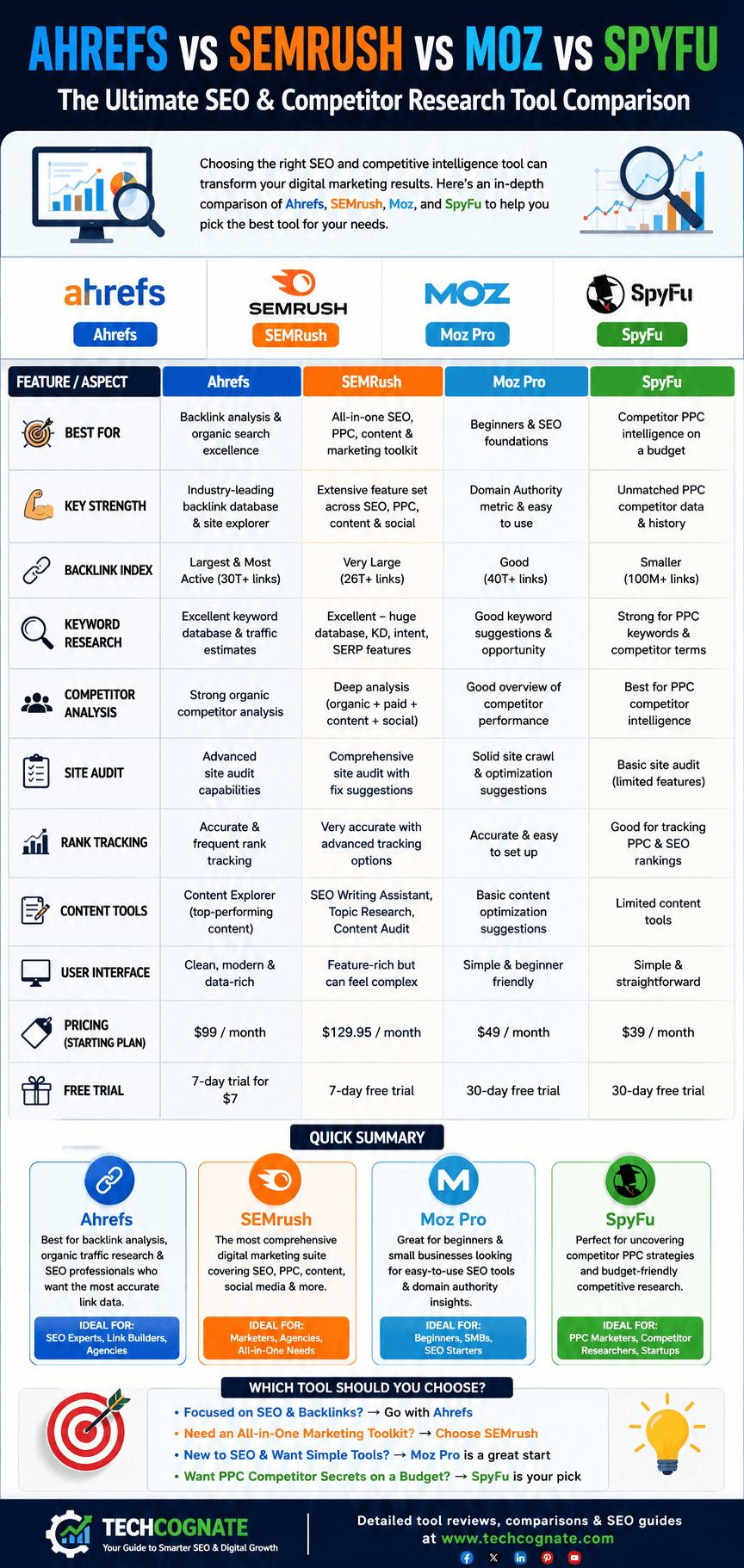
This table covers 50+ comparison factors across pricing, features, databases, and usability. Use this as your go-to quick reference. For deeper dives into any single matchup, see our dedicated Ahrefs vs Semrush, Ahrefs vs Moz, and SpyFu vs Semrush comparisons.
| Feature / Factor | Ahrefs | Semrush | Moz Pro | SpyFu |
|---|---|---|---|---|
| Starting Price (Monthly) | $129/mo | $139.95/mo | $99/mo | $39/mo |
| Annual Discount | ~20% off | ~17% off | ~20% off | ~40% off |
| Free Plan / Trial | Free Webmaster Tools | 7-day free trial | 30-day free trial | Limited free version |
| Keyword Database Size | 28+ billion keywords | 25+ billion keywords | ~1.25 billion keywords | ~7 billion keywords |
| Backlink Index Size | 35+ trillion links | 43+ trillion links | ~40 trillion links | ~2 trillion links |
| Backlink Update Frequency | Every 15–30 min | Daily updates | Weekly updates | Monthly updates |
| Rank Tracking | Yes (daily) | Yes (daily) | Yes (daily) | Yes (weekly) |
| Site Audit / Crawler | Yes | Yes | Yes | Limited |
| Technical SEO Tools | Strong | Very Strong | Moderate | Weak |
| Keyword Difficulty Score | Yes (0–100) | Yes (0–100) | Yes (0–100) | Yes |
| Search Volume Data | Yes | Yes | Yes | Yes |
| SERP Analysis | Yes (deep) | Yes (deep) | Yes (moderate) | Basic |
| Competitor Research | Yes | Yes | Yes | Yes (PPC focused) |
| PPC / Google Ads Data | Basic | Comprehensive | Minimal | Excellent |
| Content Marketing Tools | Content Explorer | Content Marketing Toolkit | Moz Content | Limited |
| Content Gap / Keyword Gap | Yes | Yes | Limited | Yes |
| Link Intersect Tool | Yes | Yes | No | No |
| AI Writing Assistant | No | Yes (SEO Writing Asst.) | No | No |
| AI Content Optimization | Limited | Yes | Limited | No |
| Local SEO Tools | Basic | Yes | Moz Local (separate) | No |
| Local Listings Management | No | Yes | Yes (Moz Local) | No |
| GBP / Map Pack Tracking | No | Yes | Yes | No |
| White-Label Reports | No | Yes (Agency plans) | No | No |
| Client Reporting | Basic | Comprehensive | Basic | Basic |
| API Access | Yes (paid add-on) | Yes (paid add-on) | Yes (paid) | Yes (paid) |
| Zapier / Integrations | Limited | Extensive | Limited | Limited |
| Looker Studio Connector | Yes | Yes | Yes | No |
| Chrome Extension | Yes (SEO Toolbar) | Yes (Semrush ext.) | Yes (MozBar) | Yes |
| Mobile App | No | Yes | No | No |
| Team Seats (base plan) | 1 user | 1 user | 1 user | 1 user |
| Max Projects (base plan) | 5 projects | 5 projects | 3 campaigns | Unlimited |
| Historical Data | Yes (deep) | Yes | Limited | Yes (PPC history) |
| Traffic Estimation Accuracy | High | High | Moderate | Moderate |
| Ecommerce SEO Features | Moderate | Strong | Basic | Weak |
| International SEO | Strong | Strong | Moderate | Weak |
| Schema Markup Tools | No | Limited | No | No |
| Learning Curve | Steep | Steep | Gentle | Easy |
| User Interface Quality | Clean, fast | Feature-dense | Simple | Dated |
| Customer Support | Email / Chat | Phone, email, chat | Email / Chat | Email / Chat |
| Founded | 2011 | 2008 | 2004 | 2006 |
| Headquarters | Singapore | Boston, USA | Seattle, USA | San Diego, USA |
| Best For | Backlinks, Content | All-in-one, Agencies | Beginners, Local SEO | PPC, Budget users |
Ahrefs: Deep Dive Review
Ahrefs started as a backlink analysis tool in 2011 and has since grown into one of the most powerful all-around SEO platforms available. It’s still the gold standard for backlink data, and its Keywords Explorer is arguably the best keyword research tool on the market. Read our full Ahrefs review for a deeper breakdown, or keep reading below. If your SEO strategy revolves around content marketing, link building, and competitive analysis, Ahrefs deserves a very close look.
Who Ahrefs Is For
Ahrefs is the go-to for anyone who lives and breathes content-driven SEO. If you’re building a topical authority strategy, hunting link opportunities, analyzing competitor content gaps, or trying to find the most-linked-to pages in your niche, Ahrefs handles all of this better than any other tool. It’s particularly powerful for:
It’s less ideal if you’re primarily a paid search advertiser, managing local citations, or need a single all-in-one platform for content creation and SEO strategy. For those use cases, Semrush has a stronger offering.
Ahrefs Standout Features
Site Explorer
Site Explorer is Ahrefs’s flagship feature. Paste any domain, subdomain, or URL and get a full breakdown of organic search traffic, backlink profile, top-ranking pages, and paid search data. What sets it apart is the historical data — you can see traffic trends going back years, which is invaluable when evaluating domains for link building or acquisition.
Here’s what surprised me the first time I really dug in: the ‘Best by Links’ report inside Site Explorer is one of the most underutilized tools in SEO. It shows you which pages on a competitor’s site earn the most backlinks, which tells you exactly what type of content your target audience shares and links to. That insight alone is worth the subscription.
Keywords Explorer
Ahrefs Keywords Explorer covers 28+ billion keywords across Google, Bing, YouTube, Amazon, and other search engines. The interface is fast, clean, and packed with useful metrics. What I particularly appreciate is the ‘Traffic Potential’ metric, which estimates not just how much traffic the exact keyword gets, but how much traffic a page ranking #1 for that keyword would likely get from all related queries.
The Parent Topic feature is also excellent. Instead of treating every keyword variation as its own separate target, it groups semantically related keywords and tells you which parent topic a keyword belongs to. This is a genuine time-saver when building content calendars.
Content Explorer
Content Explorer lets you search through Ahrefs’s index of over 14 billion web pages by topic, domain, author, or language. You can filter by social shares, backlinks, organic traffic, domain rating, and publication date. It’s the best tool available for content ideation based on what already works in your niche. I’ve used it to find underperforming competitor pages, viral topics in adjacent niches, and untapped content angles that none of my competitors had covered.
Site Audit
Ahrefs Site Audit is solid. It crawls your site and surfaces technical SEO issues including broken links, redirect chains, missing meta tags, slow pages, duplicate content, and canonicalization problems. The visual crawl map is particularly helpful for understanding internal link structure. It’s not quite as detailed as Screaming Frog, but it’s more than adequate for most content-focused websites.
Rank Tracker
Ahrefs tracks keyword positions with daily updates and shows historical rank movements over time. The share of voice metric tells you what percentage of organic clicks in your tracked keyword set your site is capturing. You can also see SERP feature tracking (featured snippets, People Also Ask, image packs) and compare your rankings against up to five competitors.
Ahrefs Pricing Breakdown
| Plan | Monthly Price | Annual Price | Keywords Tracked | Crawl Credits/Month | Users |
|---|---|---|---|---|---|
| Lite | $129 | $108/mo | 750 | 100,000 | 1 |
| Standard | $249 | $208/mo | 2,000 | 500,000 | 1 |
| Advanced | $449 | $374/mo | 5,000 | 1,500,000 | 1 |
| Enterprise | Custom | Custom | Custom | Unlimited | Custom |
One thing many reviews overlook: Ahrefs doesn’t have a meaningful free trial for its full platform. They do offer Ahrefs Webmaster Tools for free, which gives you access to Site Explorer and Site Audit for domains you verify ownership of. This is genuinely useful but limited compared to the paid features.
Ahrefs Pros and Cons
| Pros | Cons |
|---|---|
| ✓ Best-in-class backlink index depth | ✗ No PPC or Google Ads intelligence |
| ✓ Keywords Explorer with traffic potential estimates | ✗ Expensive at entry level ($129/mo) |
| ✓ Content Explorer for data-driven content ideation | ✗ No AI writing or content optimization features |
| ✓ Fast, clean, intuitive interface | ✗ Limited white-label or client reporting features |
| ✓ Excellent historical data going back years | ✗ No phone support |
| ✓ Free Ahrefs Webmaster Tools for site owners | ✗ Local SEO features are basic compared to Semrush/Moz |
| ✓ Daily rank tracking updates | ✗ No social media tracking |
| ✓ Strong educational resources (Ahrefs Academy) | ✗ No mobile app |
Semrush: Deep Dive Review
Semrush is the Swiss Army knife of SEO tools. Founded in 2008 and now used by over 10 million marketing professionals worldwide, it’s the most comprehensive marketing platform on this list. What started as an SEO tool has evolved into a full digital marketing suite covering SEO, PPC, social media, content marketing, competitive intelligence, and even PR monitoring. Our full Semrush review covers the platform in even more depth.
If you need one platform to manage everything across SEO and digital marketing, Semrush is the closest thing to a universal solution. The tradeoff is complexity — there’s a significant learning curve — but once you’re comfortable with it, the platform is incredibly powerful.
Who Semrush Is For
Semrush works best for users who need more than just SEO. If your team spans SEO, PPC, social media, and content creation, Semrush gives you a unified data environment that eliminates the need for five separate tools. Specifically strong for:
Semrush Standout Features
Domain Overview & Organic Research
Semrush’s Domain Overview gives you a 360-degree snapshot of any website: estimated organic traffic, keyword rankings, top pages, backlink authority score, paid traffic estimate, and display advertising. The organic research tool lets you drill into any competitor’s top keywords, their ranking positions, estimated traffic value, and historical trend data.
One thing I genuinely appreciate: Semrush’s traffic estimates tend to be more conservative and arguably more accurate than some competitors. They weight estimates by click-through rates, not just search volume, which gives you a more realistic picture of actual visitors vs. just keyword impressions.
Keyword Magic Tool
The Keyword Magic Tool is Semrush’s keyword research hub. With 25+ billion keywords across 140+ countries, it’s massive. You can filter by keyword difficulty, search volume, CPC, competitive density, intent type (informational, navigational, transactional, commercial), SERP features, word count, and dozens of other parameters.
The question-based keyword filter is particularly useful for targeting featured snippets and People Also Ask opportunities. You can find hundreds of question keywords in minutes and cluster them by intent for a content calendar in a fraction of the time it would take manually.
Backlink Analytics & Audit
Semrush now claims the largest backlink index in the industry at 43+ trillion links. Their Authority Score (Semrush’s version of domain rating/DA) is useful for quick comparisons, though as with any third-party metric, it shouldn’t be the only factor in link evaluation. The backlink audit tool flags potentially toxic links and gives you options to disavow directly within the platform.
Content Marketing Toolkit
This is where Semrush really differentiates from Ahrefs. The Content Marketing Toolkit includes the SEO Writing Assistant (which gives you real-time recommendations as you write), Topic Research (for content ideation), the Content Audit tool (for refreshing underperforming content), and the Post Tracking tool (for monitoring how specific articles perform over time).
The SEO Writing Assistant integrates with WordPress via a plugin, which makes it extremely practical for content teams. You get a readability score, target keyword usage, recommended semantically related keywords, tone of voice consistency check, and originality check — all in real time.
Advertising Intelligence
This is the area where Semrush has the most complete picture outside of SpyFu for PPC research. You can see competitor Google Ads copy, landing pages, estimated spend, historical ad performance, and keyword bid data. For SaaS companies or ecommerce brands running aggressive paid search campaigns, this data is extremely valuable. SpyFu still goes deeper on historical PPC analysis, but Semrush’s broader context (seeing PPC data alongside SEO data) is a significant advantage.
Agency-Specific Features
Semrush’s agency-specific features are worth calling out separately because they’re genuinely well-built. The Agency Growth Kit (available as a paid add-on) includes white-label reports, a client portal where clients can log in to view their own dashboards, a CRM for managing client relationships, and a leads database for prospecting new clients. If you’re running a six-figure agency, these features alone might justify the Semrush subscription.
Semrush Pricing Breakdown
| Plan | Monthly Price | Annual Price | Keywords Tracked | Projects | Users |
|---|---|---|---|---|---|
| Pro | $139.95 | $117.33/mo | 500 | 5 | 1 |
| Guru | $249.95 | $208.33/mo | 1,500 | 15 | 1 |
| Business | $499.95 | $416.66/mo | 5,000 | 40 | 3 |
| Enterprise | Custom | Custom | Custom | Custom | Custom |
Important note: Semrush charges separately for additional user seats. At the Pro level, adding even one team member costs $45/month extra. For agencies with multiple team members, this adds up quickly and can make Semrush significantly more expensive than advertised. Factor this in when comparing total costs.
Semrush Pros and Cons
| Pros | Cons |
|---|---|
| ✓ Most comprehensive all-in-one marketing platform | ✗ Gets expensive fast with multiple users |
| ✓ Best PPC intelligence after SpyFu | ✗ Steep learning curve for new users |
| ✓ AI-powered content optimization tools | ✗ Interface can feel overwhelming |
| ✓ Strong white-label reporting for agencies | ✗ Traffic estimates can vary from real GA data |
| ✓ Largest backlink index claimed (43T+) | ✗ Some features feel like paid upsells |
| ✓ Daily rank tracking with SERP features | ✗ Mobile app is limited compared to web |
| ✓ Content Marketing Toolkit is industry-leading | ✗ Local SEO requires separate Listing Management tool |
| ✓ Semrush Academy free training resources | ✗ API requires Business plan or higher |
Moz Pro: Deep Dive Review
Moz is the granddaddy of SEO tools. Founded in 2004, it’s the oldest platform on this list and the company that essentially invented the concept of Domain Authority (DA) — a metric that, love it or hate it, has become an industry standard for quickly gauging website credibility. See our full Moz review for more detail.
These days, Moz Pro isn’t the feature-richest or the data-heaviest tool on the market, but it still serves a very specific audience exceptionally well: SEO beginners and small businesses who want a clean, approachable platform without being buried in data they don’t understand.
Who Moz Pro Is For
Moz works best for SEO beginners, small business owners, and local SEO practitioners. If you’re just starting out in SEO and want a tool that won’t overwhelm you, Moz is the gentlest on-ramp available. Specifically useful for:
Moz Pro Standout Features
Domain Authority (DA)
This is Moz’s legacy contribution to the SEO industry. Domain Authority is a 0–100 logarithmic score that predicts how likely a domain is to rank in Google search results. While it’s not a Google metric and shouldn’t be used as a direct ranking signal, DA has become the universal shorthand for website credibility in the industry.
Virtually every client I’ve worked with understands DA before they understand any other metric. That makes Moz uniquely valuable as a client communication tool — even if you’re doing your analysis in Ahrefs or Semrush, Moz’s DA is often the metric clients want to see in their monthly reports.
Keyword Explorer
Moz’s Keyword Explorer is solid but smaller than Ahrefs or Semrush with approximately 1.25 billion keywords. The organic CTR estimate is useful — it adjusts keyword value based on how many clicks actually go to organic results vs. ads and SERP features. Priority Score combines volume, difficulty, and opportunity into a single actionable metric, which beginners find helpful for prioritizing where to focus.
Link Explorer
Link Explorer shows backlink data with Moz’s own metrics: Domain Authority, Page Authority, and Spam Score. The database is smaller and updates less frequently than Ahrefs or Semrush, but the interface is very clean and easy to navigate. For agencies presenting link data to clients, the Spam Score metric is particularly useful for quickly identifying toxic link risks.
Rank Tracking (Moz Campaigns)
Moz tracks keyword rankings via Campaigns. You set up a campaign for each website, add your keywords, and monitor daily ranking changes. The visual reporting is clean and client-friendly. One useful feature: the Share of Voice metric shows how your ranking presence across all tracked keywords compares to competitors in the same keyword set.
On-Page Optimization
The On-Page Grader scores individual pages against a target keyword and gives specific recommendations for improvement: title tag, meta description, heading tags, content length, internal links, and more. It’s a bit basic compared to Semrush’s SEO Writing Assistant, but useful for quick page audits.
Moz Pro Pricing Breakdown
| Plan | Monthly Price | Annual Price | Keyword Rankings | Crawled Pages/Month | Users |
|---|---|---|---|---|---|
| Starter | $99 | $79/mo | 50 | 20,000 | 1 |
| Standard | $179 | $143/mo | 300 | 400,000 | 1 |
| Medium | $299 | $239/mo | 1,500 | 2,000,000 | 2 |
| Large | $599 | $479/mo | 3,000 | 5,000,000 | 3 |
Moz Local is a separate product from Moz Pro. It starts at $16/month per location for basic listing management and goes up to $33/month for comprehensive citation building and monitoring. If local SEO is your primary need, the Moz Local + Moz Pro combination is worth pricing out against Semrush’s all-in-one offering. Our local SEO ranking factors guide breaks down what to prioritize.
Moz Pro Pros and Cons
| Pros | Cons |
|---|---|
| ✓ Gentlest learning curve of all four tools | ✗ Smallest keyword and backlink databases |
| ✓ DA is universally recognized client metric | ✗ Slower backlink index updates (weekly) |
| ✓ Best 30-day free trial in the group | ✗ Fewer features than Ahrefs or Semrush |
| ✓ Strong Moz community and blog (Whiteboard Friday) | ✗ No AI writing or content tools |
| ✓ Clean, simple interface | ✗ Technical SEO audit is less deep than rivals |
| ✓ Moz Local is excellent for citation management | ✗ No PPC or advertising data |
| ✓ Responsive customer support | ✗ Limited integrations compared to Semrush |
| ✓ Affordable Starter plan at $99/month | ✗ Limited historical data depth |
SpyFu: Deep Dive Review
SpyFu is the outlier on this list. Where Ahrefs, Semrush, and Moz are primarily SEO tools that also cover PPC, SpyFu is primarily a PPC intelligence tool that also covers SEO. That distinction matters enormously when you’re deciding whether it belongs in your stack. Read our full SpyFu review for the complete picture.
Founded in 2006 and headquartered in San Diego, SpyFu has carved out a very specific niche: affordable, deep competitive intelligence for Google Ads advertisers. If you’re spending money on paid search and want to know exactly what your competitors are bidding on, what their ads say, and how their PPC strategy has evolved over time, SpyFu is unmatched at its price point.
Who SpyFu Is For
SpyFu serves a specific and underserved audience: budget-conscious marketers who need PPC competitive intelligence without paying for a full Semrush license. Ideal for:
SpyFu Standout Features
PPC Competitor Research
This is where SpyFu absolutely shines. You can enter any domain and immediately see every Google Ad that domain has ever run, the keywords they’ve bid on historically, their estimated monthly PPC budget, their top-performing ad copy, and which landing pages they use for each ad group. SpyFu claims to have 17 years of historical PPC data — something no other tool on this list comes close to matching.
Here’s what surprised me when I first used SpyFu: you can see competitor ad copy going back to 2007. That level of historical context lets you identify which messaging angles have worked consistently over years versus what’s been tested and abandoned. For conversion copywriting research, it’s genuinely useful.
Kombat (Keyword Overlap Analysis)
Kombat is SpyFu’s unique competitor overlap tool. You enter your domain and two competitor domains, and it creates a Venn diagram showing which keywords you share with each competitor and which are unique to each. The shared keywords are prime targets to protect or improve; the competitors’ unique keywords are opportunities you haven’t explored. It’s a visually intuitive way to identify keyword gaps quickly.
SEO Research
SpyFu’s organic research covers keyword rankings, estimated organic traffic, and top competing pages. The database is smaller than Ahrefs or Semrush, but adequate for competitive research in most niches. The ‘Ranking History’ feature shows how a domain’s rankings have shifted over time, which can highlight manual penalty recoveries or algorithm impact.
AdWords Advisor
This feature recommends Google Ads keywords you should bid on based on competitor activity and your existing keyword footprint. It’s a practical tool for small business owners who are building out their PPC keyword lists without a dedicated paid search team.
SpyFu Pricing Breakdown
| Plan | Monthly Price | Annual Price | Results per Search | Data Exports | Users |
|---|---|---|---|---|---|
| Basic | $39 | $16/mo (billed ann.) | 10,000 | Unlimited rows | 1 |
| Professional | $79 | $36/mo (billed ann.) | Unlimited | Unlimited | 5 |
| Team | $299 | $149/mo (billed ann.) | Unlimited | Unlimited | Unlimited |
SpyFu’s annual pricing is genuinely aggressive — at $16/month billed annually, the Basic plan is the cheapest entry in this comparison by a significant margin. If you primarily need PPC intelligence and basic SEO research, this price-to-value ratio is hard to beat.
SpyFu Pros and Cons
| Pros | Cons |
|---|---|
| ✓ Most affordable entry price ($39/mo) | ✗ Smallest backlink database of the four |
| ✓ Best PPC competitor intelligence available | ✗ No technical SEO / site audit tool |
| ✓ 17+ years of historical ad data | ✗ Dated, less intuitive interface |
| ✓ Unlimited exports on Professional plan | ✗ Smaller keyword database than rivals |
| ✓ Kombat overlap tool is uniquely useful | ✗ No rank tracking on Basic plan |
| ✓ Good for quick competitor PPC audits | ✗ No AI features or content tools |
| ✓ Agencies can use for prospect PPC analysis | ✗ Limited integrations |
| ✓ Free version gives basic data without signup | ✗ Traffic estimates less reliable for small sites |
Feature-by-Feature Comparison
Now that we’ve covered each tool individually, let’s compare them head-to-head across every major feature category. This is where the differences really start to matter for specific use cases.
Keyword Research Comparison
Keyword research is the foundation of any SEO strategy, and the quality of a tool’s keyword data will make or break your content planning. Here’s how all four tools stack up.
| Factor | Ahrefs | Semrush | Moz Pro | SpyFu |
|---|---|---|---|---|
| Database Size | 28B+ keywords | 25B+ keywords | ~1.25B keywords | ~7B keywords |
| Countries Covered | 190+ | 140+ | 170+ | 80+ |
| Keyword Difficulty Score | 0–100 (accurate) | 0–100 (accurate) | 0–100 (good) | 0–100 (basic) |
| Search Volume Accuracy | High | High | Moderate | Moderate |
| Traffic Potential Metric | Yes (unique) | No | No | No |
| Search Intent Classification | Basic | Yes (4 types) | No | No |
| Question Keywords Filter | Yes | Yes | Yes | Basic |
| SERP History | Yes | Yes | Limited | No |
| CPC Data | Yes | Yes | No | Yes (strong) |
| Parent Topic Grouping | Yes | No | No | No |
| Global Volume Data | Yes | Yes | Limited | No |
| Keyword Lists / Export | Yes | Yes | Yes | Yes |
Winner: Ahrefs — for the Traffic Potential metric and Parent Topic grouping alone.
Runner-Up: Semrush — more granular intent data and integrates keyword research with content tools.
Takeaway: For pure keyword research depth, Ahrefs has the edge. For integrated content workflow, Semrush wins.
Backlink Analysis Comparison
Your backlink profile is one of Google’s most powerful ranking signals, which makes the quality of a tool’s link index critical for link building, competitive analysis, and penalty detection. See our best link building tools guide for more on this.
| Factor | Ahrefs | Semrush | Moz Pro | SpyFu |
|---|---|---|---|---|
| Index Size | 35T+ links | 43T+ links | ~40T links | ~2T links |
| Update Frequency | Every 15–30 min | Daily | Weekly | Monthly |
| Link Quality Metric | DR / UR | Authority Score | DA / PA / SS | Domain Strength |
| Toxic Link Detection | Yes | Yes (Audit tool) | Yes (Spam Score) | No |
| Disavow File Builder | Yes | Yes | Yes | No |
| Link Intersect Tool | Yes | Yes | No | No |
| Broken Link Finder | Yes | Yes | Yes | No |
| Anchor Text Analysis | Yes | Yes | Yes | Basic |
| New / Lost Link Alerts | Yes | Yes | Yes | No |
| Historical Link Data | Yes (years) | Yes | Limited | Limited |
| Link Prospecting | Yes | Yes | Basic | No |
Winner: Ahrefs — update frequency (every 15-30 min) is unmatched and makes it most reliable for fresh link data.
Runner-Up: Semrush — largest claimed index, with strong audit and toxic link tools.
Takeaway: For active link building campaigns, Ahrefs’s update frequency matters. For comprehensive link auditing, Semrush is equally strong.
Rank Tracking Comparison
Rank tracking tells you where your pages rank in search results for target keywords. The quality, accuracy, and update frequency of rank tracking data can significantly affect the decisions you make about content and optimization priorities.
| Factor | Ahrefs | Semrush | Moz Pro | SpyFu |
|---|---|---|---|---|
| Update Frequency | Daily | Daily | Daily | Weekly |
| Locations Supported | 170+ countries | 190+ countries | 170+ countries | US/UK focus |
| Device Tracking | Desktop + Mobile | Desktop + Mobile | Desktop + Mobile | Desktop only |
| SERP Feature Tracking | Yes | Yes | Yes | Limited |
| Share of Voice Metric | Yes | Yes | Yes | No |
| Competitor Comparison | Up to 5 | Up to 5 | Up to 5 | Up to 3 |
| Local Rank Tracking | Limited | Yes (city-level) | Yes | No |
| Historical Data | Yes | Yes | Yes | Limited |
| Rank Change Alerts | Yes | Yes | Yes | No |
| Visualization / Charts | Excellent | Excellent | Good | Basic |
Winner: Tie — Ahrefs and Semrush both offer excellent daily rank tracking with similar feature sets.
Runner-Up: SpyFu’s weekly updates make it less suitable for monitoring active campaigns or testing optimization changes.
Takeaway: Moz, Ahrefs, and Semrush are all strong here. SpyFu lags due to weekly updates only.
Technical SEO & Site Audit Comparison
Technical SEO issues can tank your rankings regardless of how good your content and links are. A strong site audit tool is essential for identifying crawlability issues, Core Web Vitals problems, and structural weaknesses. Our technical SEO checklist covers the fundamentals if you want a refresher.
| Factor | Ahrefs | Semrush | Moz Pro | SpyFu |
|---|---|---|---|---|
| Site Crawl Depth | Deep | Very Deep | Moderate | Minimal |
| Crawl Budget Analysis | Yes | Yes | No | No |
| Core Web Vitals | Yes | Yes | Limited | No |
| Broken Link Detection | Yes | Yes | Yes | No |
| Redirect Chains | Yes | Yes | Yes | No |
| Duplicate Content | Yes | Yes | Yes | No |
| Canonicalization Issues | Yes | Yes | Yes | No |
| HTTPS / SSL Check | Yes | Yes | Yes | No |
| Schema Markup Analysis | Limited | Yes | No | No |
| Structured Data Issues | No | Yes | No | No |
| Log File Analysis | No | No | No | No |
| JavaScript Rendering | Yes | Yes | Limited | No |
| Hreflang Validation | Yes | Yes | No | No |
| Page Speed Insights | Yes | Yes | Limited | No |
Winner: Semrush — most comprehensive technical audit with schema analysis, structured data, and broader issue coverage.
Runner-Up: Ahrefs — strong across all major technical areas, especially crawl analysis and visual site maps.
Takeaway: If technical SEO depth is critical (enterprise sites, large ecommerce), Semrush has the edge. SpyFu is not suitable for technical SEO work.
Content Marketing Tools Comparison
Content is still the primary vehicle for organic traffic. How well each tool supports the content marketing workflow — from ideation to optimization to performance tracking — matters enormously for content teams.
| Factor | Ahrefs | Semrush | Moz Pro | SpyFu |
|---|---|---|---|---|
| Content Ideation | Content Explorer | Topic Research | No | No |
| AI Writing Assistant | No | Yes (Writing Asst.) | No | No |
| Real-time Content Optimization | No | Yes (SEO Writing Asst.) | On-Page Grader | No |
| Content Gap Analysis | Yes | Yes | Limited | No |
| Content Performance Tracking | Yes (via Site Explorer) | Yes (Post Tracking) | Limited | No |
| Content Audit Tool | Yes | Yes | No | No |
| Topic Clustering / Mapping | Limited | Yes | No | No |
| Internal Linking Suggestions | Limited | Yes | No | No |
| Editorial Calendar Integration | No | No | No | No |
Winner: Semrush — by a significant margin for end-to-end content marketing workflow.
Runner-Up: Ahrefs — Content Explorer is the best tool for data-driven content ideation.
Takeaway: If you’re building a content machine, Semrush’s content toolkit is the most complete. Ahrefs excels at the research phase but doesn’t assist with creation or optimization.
PPC & Advertising Research Comparison
Running Google Ads alongside SEO is standard practice for most marketing teams. Understanding which tools give you the best competitive intelligence on paid search can save significant ad spend.
| Factor | Ahrefs | Semrush | Moz Pro | SpyFu |
|---|---|---|---|---|
| Competitor Ad Copy | No | Yes | No | Yes (17+ years) |
| Historical PPC Data | No | Yes (limited) | No | Yes (since 2007) |
| Keyword CPC Data | Yes | Yes | No | Yes |
| PLA / Shopping Ads | No | Yes | No | Basic |
| Ad Budget Estimation | No | Yes | No | Yes |
| Ad Group Analysis | No | Yes | No | Yes |
| Landing Page Analysis | No | Yes | No | Yes |
| Google Ads Recommendations | No | Yes | No | Yes (Advisor) |
| Bing Ads Research | No | Limited | No | Yes |
Winner: SpyFu — for historical depth and PPC-specific features at a fraction of the cost.
Runner-Up: Semrush — best for combining PPC intelligence with organic and content data in one place.
Takeaway: For dedicated PPC competitive research, SpyFu wins. For a unified view of organic + paid, Semrush is stronger.
AI SEO & GEO Optimization Comparison
AI SEO is no longer a future concept — it’s a present reality. With Google AI Overviews appearing for a growing percentage of searches, ChatGPT driving referral traffic, Perplexity citing trusted sources, and Gemini powering answer-based results, optimizing for AI-generated answers is now part of every serious SEO strategy. Our AI SEO guide covers this shift in full. Here’s how each tool supports it.
AI SEO Features Comparison
| AI SEO Factor | Ahrefs | Semrush | Moz Pro | SpyFu |
|---|---|---|---|---|
| AI Writing Assistant | No | Yes | No | No |
| AI Content Optimization | No | Yes (Writing Asst.) | No | No |
| AI-Powered Topic Suggestions | No | Yes | No | No |
| Semantic Keyword Suggestions | Limited | Yes | Limited | No |
| Entity Recognition Support | Limited | Yes (via content tool) | No | No |
| AI Overview Monitoring | No | Limited | No | No |
| Content Scoring / Grading | No | Yes | Basic (On-Page Grader) | No |
| LLM Citation Optimization | No | No | No | No |
| Structured Data Assistance | No | Limited | No | No |
| AI Search Traffic Tracking | No | Limited | No | No |
GEO: Optimizing for AI-Generated Answers
Generative Engine Optimization (GEO) is the practice of structuring content so it gets cited by AI systems like ChatGPT, Perplexity, Claude, Google AI Overviews, and Gemini. This is a rapidly evolving discipline, and none of the four tools on this list have fully caught up to it yet. However, they do provide features that support GEO best practices indirectly. See our full breakdown of what Generative Engine Optimization (GEO) is and how it differs from traditional SEO in our SEO vs GEO vs AEO vs LLMO comparison.
What GEO Requires (and Where Each Tool Helps)
GEO relies on structured, factual, citable content with clear entity relationships, authoritative backlinks, and strong topical coverage. Here’s how each tool contributes to those requirements:
Entity SEO and Knowledge Graph Readiness
Entity SEO — optimizing for how Google and AI systems understand entities (people, places, things, concepts) and their relationships — is becoming increasingly critical. Google’s Knowledge Graph underpins how AI systems understand your brand and content.
None of the four tools directly manage your Knowledge Panel or entity relationships in the Google Knowledge Graph. However, Semrush’s structured content tools and semantic keyword features come closest to supporting an entity-first SEO approach. For dedicated entity SEO work, you’ll likely need additional tools like Google Search Console, Schema markup validators, and Kalicube Pro.
Preparing Your Content for AI Overviews
Here’s what’s working in 2026 for AI Overview visibility, based on testing across multiple sites:
Real Use Cases: Which Tool Is Right for You?
Generic recommendations only go so far. Here are specific tool recommendations for real-world situations, based on actual experience managing these scenarios.
For ecommerce SEO, you need to balance technical SEO (product page crawlability, duplicate content from faceted navigation, site speed), keyword research (product and category keywords with transactional intent), and competitor analysis across both organic and paid search.
Semrush wins here because it gives you Google Shopping intelligence alongside organic SEO data. You can see competitor PLA (Product Listing Ad) strategies, keyword coverage gaps across your product catalog, and technical audit results — all from one dashboard. Pair it with Google Search Console for query data and you have a complete ecommerce SEO system. See our ecommerce SEO and Shopify SEO guides for the full playbook.
Agency workflows require white-label reports, client-friendly dashboards, multiple project management, team permissions, and scalable data limits. Semrush’s Agency Growth Kit addresses all of these. The client portal lets clients log in and view their own performance data, which reduces the time you spend answering ‘how are we doing?’ emails.
The main downside is cost — adding team members to Semrush gets expensive fast. Run the numbers with your team size before committing. Some agencies use Semrush for reporting and Ahrefs for daily research work, using both tools complementarily.
Affiliate SEO lives and dies on keyword research and content strategy. You need to find keywords with buying intent, understand the link profiles of pages you’re trying to outrank, and find content gaps your competitors haven’t covered. Ahrefs handles all three better than any other tool.
Content Explorer lets you find the most-linked content in your niche, Keywords Explorer shows you traffic potential at the topic level (not just keyword level), and Site Explorer lets you reverse-engineer exactly how competitors rank for money keywords. For a solo affiliate blogger, the Standard plan at $249/month is a significant investment, but the ROI is there if you’re generating consistent traffic.
Ahrefs Keywords Explorer covers YouTube as well as Google, giving you keyword data for both platforms. More importantly, the parent topic feature helps you identify which videos to create to build authority in a search topic cluster — the same principles apply to YouTube channel growth.
B2B SaaS SEO is heavily content-marketing driven. You need to build topical authority across a niche, attract high-intent visitors with commercial keywords, and convert on landing pages. Both Ahrefs and Semrush are strong here. Ahrefs is better if your primary channel is content/link building. Semrush is better if you’re also running paid search campaigns or need content optimization assistance. See our B2B SEO strategies guide for more.
For local businesses, the game is Google Business Profile rankings, local keyword visibility, and citation consistency. Moz Local is the best citation management tool in this comparison, and Moz Pro gives you rank tracking and competitor monitoring at an accessible price point. Semrush also has solid local tools if you need broader SEO coverage. Our Google Business Profile optimization guide walks through the setup.
Enterprise SEO needs team permissions, high crawl limits, API access, advanced reporting, and ideally integration with enterprise analytics tools like Looker Studio or Tableau. Semrush’s enterprise tier covers all of these. For very large technical websites (500k+ pages), you’ll likely need Screaming Frog alongside any of these tools for deep crawl analysis. Read more in our enterprise SEO guide.
If budget is your primary constraint, SpyFu at $39/month gives you solid competitive research and PPC data. Moz Starter at $99/month with a free 30-day trial gives you a full-featured SEO platform at the most accessible price in this group. Both are genuine tools, not stripped-down versions. The limitations are database size and feature depth, not software quality.
Local SEO Comparison
Local SEO is a specialized discipline that requires different tools and metrics than national or global SEO. Let’s break down how each platform supports local search optimization. For a step-by-step approach, see our local SEO ranking factors and local SEO audit checklist.
| Local SEO Feature | Ahrefs | Semrush | Moz Pro | SpyFu |
|---|---|---|---|---|
| Local Keyword Research | Yes (with location filters) | Yes (strong) | Yes | Limited |
| Local Rank Tracking | Limited | Yes (city-level) | Yes | No |
| GBP / GMB Support | No | Yes | Limited | No |
| Map Pack Tracking | No | Yes | Yes | No |
| Local Citation Management | No | Yes (Listing Mgmt.) | Yes (Moz Local) | No |
| Citation Consistency Audit | No | Yes | Yes | No |
| NAP Consistency Check | No | Yes | Yes | No |
| Review Monitoring | No | Yes | Limited | No |
| Competitor Local Analysis | Basic | Yes | Yes | No |
| Local Schema Support | No | Limited | No | No |
For pure local SEO, Semrush and Moz are your best bets. Semrush integrates local SEO into its broader platform, while Moz offers the dedicated Moz Local product for citation management. Ahrefs is usable for local keyword research but lacks the map pack and GBP tools that local SEO campaigns need.
Comparison by User Type
Agency Comparison
Agencies need different things than individual users. Key requirements: white-label reports, multi-client management, team collaboration, scalable limits, and ideally a client-facing portal.
| Agency Feature | Ahrefs | Semrush | Moz Pro | SpyFu |
|---|---|---|---|---|
| White-Label Reports | No | Yes (Agency plans) | No | No |
| Client Reporting | Basic PDF | Comprehensive | Basic | Basic |
| Client Portal | No | Yes | No | No |
| Multi-Project Support | Yes | Yes | Yes | Yes |
| Team Seats | Add-on ($) | Add-on ($) | Add-on ($) | 5 on Prof. |
| Permissions / User Roles | Limited | Yes | No | No |
| Agency CRM | No | Yes (add-on) | No | No |
| Agency-Specific Pricing | No | Yes | No | No |
| Bulk Reporting | Limited | Yes | No | No |
| API for Custom Dashboards | Yes (add-on) | Yes (Business+) | Yes (paid) | Yes (paid) |
Agency verdict: Semrush wins clearly. The Agency Growth Kit, client portal, white-label reports, and built-in CRM make it the most agency-optimized platform. Ahrefs is often used alongside Semrush by agencies for its superior backlink and content research.
Blogger & Content Creator Comparison
| Blogger Feature | Ahrefs | Semrush | Moz Pro | SpyFu |
|---|---|---|---|---|
| Keyword Research Quality | Excellent | Excellent | Good | Moderate |
| Content Ideation Tools | Content Explorer | Topic Research | Limited | No |
| Affiliate Keyword Data | Yes (CPC) | Yes (CPC) | Limited | Yes |
| Competitor Content Analysis | Yes | Yes | Limited | Basic |
| Internal Link Analysis | Yes | Yes | Yes | No |
| Content Gap Analysis | Yes | Yes | Limited | No |
| Learning Curve | Moderate | Steep | Easy | Easy |
| Entry Price | $129/mo | $139.95/mo | $99/mo | $39/mo |
| Value for Solo Blogger | High (if writing focused) | High (if broader needs) | Good (beginner) | Good (budget) |
Blogger verdict: Ahrefs is the choice for serious content-first SEO. The $129/month entry price is steep for solo bloggers, but the traffic potential data and Content Explorer are genuinely unmatched for keyword-driven content planning.
Pricing & Value Analysis
Price matters, but value matters more. Here’s a true cost-of-ownership comparison across different user types and team sizes. If pricing across the whole SEO category is what you’re after, our SEO pricing breakdown covers more tools.
Solo User / Freelancer Cost Comparison
| Tool | Cheapest Monthly | Cheapest Annual | What You Get | Verdict |
|---|---|---|---|---|
| Ahrefs | $129/mo | $108/mo | 750 keyword tracks, 5 projects, 100k crawl credits | Expensive but powerful |
| Semrush | $139.95/mo | $117.33/mo | 500 keyword tracks, 5 projects, basic reports | Similar value to Ahrefs |
| Moz Pro | $99/mo | $79/mo | 50 keyword tracks, 3 campaigns, 20k crawls | Most affordable full platform |
| SpyFu | $39/mo | $16/mo | 10k results/search, unlimited exports, basic rank tracking | Best budget pick |
Learning Curve Rating
| Tool | Beginner | Intermediate | Advanced | Overall |
|---|---|---|---|---|
| Ahrefs | 6/10 | 9/10 | 9/10 | Moderate-Steep |
| Semrush | 5/10 | 8/10 | 10/10 | Steep |
| Moz Pro | 9/10 | 7/10 | 7/10 | Gentle |
| SpyFu | 8/10 | 7/10 | 6/10 | Easy |
Learning curve note: Both Ahrefs and Semrush offer free training academies. Ahrefs Academy and Semrush Academy are genuinely high-quality resources that significantly reduce the ramp-up time for new users. If you’re budget-limited and choosing between them, factor in the quality of educational resources — both are excellent.
SEO Tool Decision Tree
Use this step-by-step guide to identify the right tool for your situation.
Alternatives Worth Considering
Ahrefs, Semrush, Moz, and SpyFu don’t cover every possible need or budget. Here are strong alternatives depending on your situation.
| Tool | Best For | Starting Price | Key Differentiator |
|---|---|---|---|
| SE Ranking | Mid-market agencies | $65/mo | White-label reports at a lower price than Semrush |
| Mangools (KWFinder) | Keyword research beginners | $29/mo | Simple, focused keyword research at low cost |
| Serpstat | Budget all-in-one | $59/mo | Covers SEO + PPC at lower price than Semrush |
| Majestic SEO | Backlink specialists | $49.99/mo | Trust Flow / Citation Flow unique metrics |
| Screaming Frog | Technical SEO audits | $259/year | Deepest site crawl available; industry standard |
| Ubersuggest | Beginners on budget | $29/mo | Simple interface; Neil Patel brand recognition |
| Raven Tools | Client reporting | $49/mo | White-label reporting + multi-channel data |
| SEO PowerSuite | Desktop power users | $299/year | One-time license; no monthly subscription |
| Google Search Console | First-party data | Free | Real click and impression data from Google |
| Google Analytics | Traffic analysis | Free | First-party website analytics; integrates with GSC |
One insight worth sharing: most serious SEO professionals don’t rely on just one tool. A common and cost-effective setup is Google Search Console (free) + Ahrefs or Semrush (for deep research) + Screaming Frog (for technical audits). This combination covers every major SEO need without any single subscription trying to do everything. If you want more head-to-head detail on any of these, check our Ahrefs vs Majestic, SE Ranking vs Semrush, and Serpstat vs Semrush vs Ahrefs comparisons.
Frequently Asked Questions (30 FAQs)
These are the questions real SEOs ask when evaluating these tools. Honest answers based on experience with all four platforms.
Expert Verdict & Final Recommendations
After testing all four tools across dozens of real-world scenarios, here’s my honest conclusion: there’s no single best SEO tool. The right tool is the one that matches your workflow, your team’s skills, and your primary use cases.
Final Recommendations by User Type
| Category | Winner | Why |
|---|---|---|
| Agency (Large) | Semrush | White-label reports, client portal, team features, and all-in-one coverage |
| Agency (Small) | Ahrefs + SpyFu | Deep SEO research + PPC data at lower combined cost than Semrush |
| Ecommerce SEO | Semrush | PLA research, Shopping ads, technical audit, and content tools in one place |
| Affiliate Blogger | Ahrefs | Best keyword research and content ideation for niche content strategies |
| Local Business | Moz Pro + Moz Local | Most approachable platform with best citation management tool |
| Freelancer (Budget) | SpyFu | Best ROI at $39/month; adequate for most competitive research needs |
| Freelancer (Organic) | Ahrefs Lite | Best keyword and backlink data at entry level |
| SaaS Startup | Ahrefs or Semrush | Both serve content-driven B2B SEO well; choose based on team size and PPC needs |
| Enterprise | Semrush Enterprise | Team permissions, API, high limits, and comprehensive feature set |
| SEO Beginner | Moz Pro | Gentlest learning curve and best free trial (30 days) |
| Link Builder | Ahrefs | Fastest backlink index updates and best link prospecting tools |
| Content Marketer | Semrush | AI writing, topic research, content audit, and SEO optimization in one toolkit |
| PPC Manager | SpyFu | 17+ years of PPC history at a price no competitor can match |
| Technical SEO | Semrush + Screaming Frog | Semrush for broad audit; Screaming Frog for deep crawl on large sites |
A Note on Using Multiple Tools
The most common setup among experienced SEO professionals isn’t one tool — it’s a deliberate combination. Here are the most effective stacks we’ve seen:
The Bottom Line
If you can only choose one tool, choose based on your primary need: Ahrefs for content and link building, Semrush for everything else, Moz for accessibility and local SEO, or SpyFu for budget-friendly PPC intelligence. If you can invest in two tools, Ahrefs + Semrush is the most powerful combination in the industry. Curious how that pairing stacks up in detail? Read our dedicated Ahrefs vs Semrush vs Moz comparison.
Whatever you choose, the tool is only as good as the strategy behind it. Consistent keyword research, systematic content production, methodical link building, and regular technical audits outperform any single software subscription. For the fundamentals, start with our SEO competitor analysis and link building strategies guides.
Disclosure: TechCognate may earn a commission if you sign up for a tool through links on this page, at no extra cost to you. Pricing and features were accurate at the time of publishing and are based on hands-on testing; they may have changed since. This does not influence which tool we recommend for each use case.