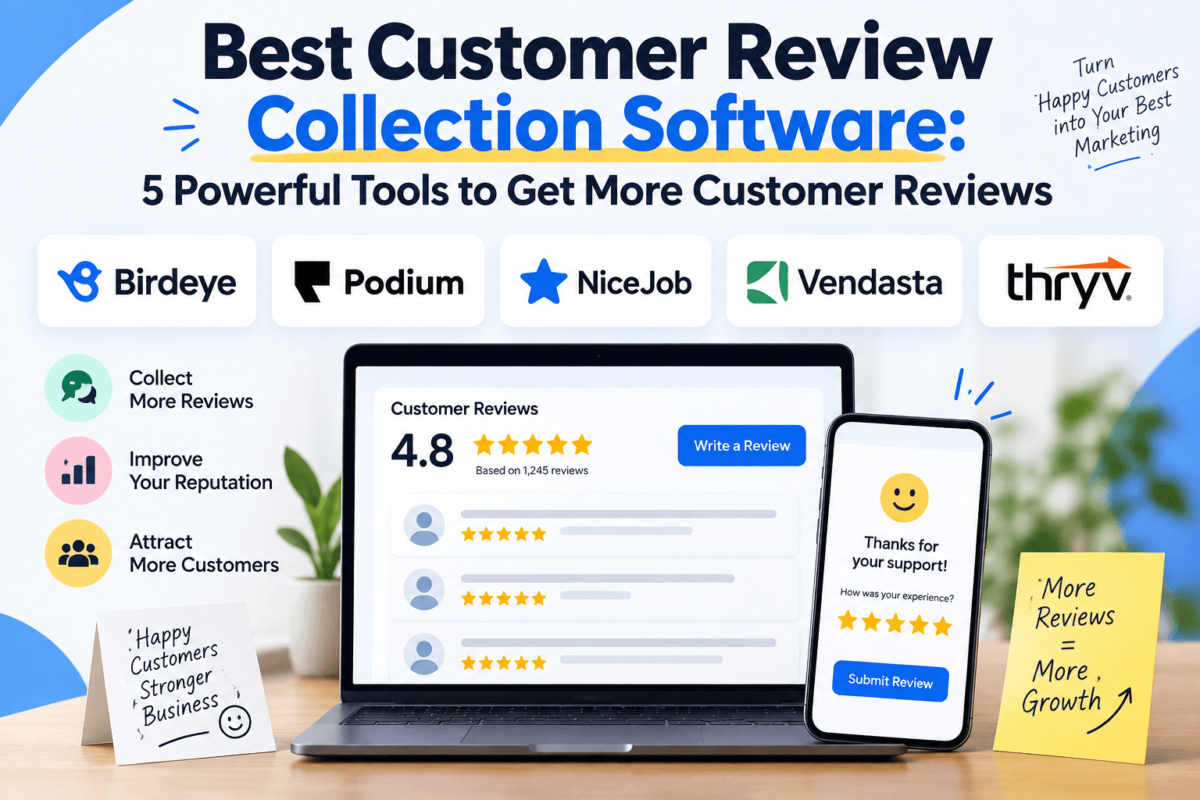
Best Customer Review Collection Software: 5 Powerful Tools to Get More Customer Reviews
A side-by-side look at five platforms that automate the process of asking customers for reviews, so you can compare features and pricing before you pick one.
Last updated: September 2026
A customer finishes a job, tells you it was great, and says they’ll leave a review. A week goes by. Then a month. The review never shows up — not because they didn’t mean it, but because leaving a review takes more effort than most people plan for once they’re back in their own day.
That gap between “I’ll leave a review” and actually doing it is exactly what review collection software is built to close. Instead of relying on customers to remember, these platforms send the request automatically, at the right moment, through the channel a customer is most likely to act on.
Below, we compare five platforms that businesses use for this: Birdeye, Podium, NiceJob, Vendasta, and Thryv. Each takes a different approach — some are built specifically around reviews, others fold review requests into a bigger business management platform — so the right pick depends less on which tool is “best” and more on what kind of business you’re running.
Quick Comparison: Best Customer Review Collection Software
| Software | Best For | Review Requests | Automation | Starting Price* |
|---|---|---|---|---|
| Birdeye | Multi-location brands & franchises | SMS, email, kiosk | AI-driven agents | $299/mo per location |
| Podium | Local businesses wanting reviews + texting | SMS, email | AI Employee assistant | Custom quote (~$399/mo+) |
| NiceJob | Small home service businesses | SMS, email | Automated invite sequences | $75/mo |
| Vendasta | Agencies managing multiple SMB clients | SMS, email | Workflow automation | ~$99/mo (partner-based) |
| Thryv | Solo/small businesses wanting one all-in-one platform | SMS, email | Built into CRM workflows | Custom quote (~$199/mo+) |
*Pricing changes often and can vary by plan, location count, and contract length. Check each provider’s current pricing page before you buy.
What Is Customer Review Collection Software?
Customer review collection software is a platform that automatically asks customers for feedback after a purchase, appointment, or service call, usually by text or email, and routes that feedback toward the review sites that matter most to the business — typically Google, Facebook, or an industry-specific site.
It’s different from simply asking customers manually. A manual request depends on someone remembering to send it, and a customer remembering to act on it. Review collection software removes both dependencies: the request goes out on a set trigger (like a closed invoice or completed appointment), the message is consistent every time, and the business can see who responded and who didn’t without chasing anyone down.
Most platforms in this category also do some amount of review monitoring — pulling in reviews as they’re posted so the business can see and respond to them in one place, rather than checking five different review sites by hand.
How Does Customer Review Collection Software Work?
The exact steps vary by platform, but the general workflow looks like this:
- A customer completes a purchase, appointment, or service call.
- Their contact information enters the platform, usually through a CRM or point-of-sale integration, or a staff member adds it manually.
- The software sends an automated review request by text message, email, or both.
- The customer taps a link that takes them straight to a review site, skipping the step of searching for the business themselves.
- The customer leaves a review or, on some platforms, private feedback first if the experience wasn’t positive.
- The business sees the new review in a shared dashboard and can respond to it.
- If the customer doesn’t respond, most platforms send one or two automated follow-ups before stopping.
SMS requests tend to get opened faster than email, which is why most of the tools below lead with texting. Email still matters for businesses whose customers prefer it, or as a backup channel when a text doesn’t land.
What to Look for in Customer Review Collection Software
Automated Review Requests
This is the core feature. Without automation, you’re back to relying on staff to remember to ask, which is exactly the problem this software solves.
SMS and Email Requests
Text messages generally get read and acted on faster. Email costs less to send and works better for customers who don’t want business texts. The strongest platforms give you both and let you choose per customer.
Google Review Integration
For local businesses, Google reviews carry the most weight for both customers and local search rankings. A direct link into your Google Business Profile review flow removes a step that otherwise loses people.
Review Monitoring
Collection gets the reviews in. Monitoring tells you when a new one lands anywhere, positive or negative, so you can respond quickly — especially important for negative reviews, where a fast, professional reply matters.
Multi-Location Support
If you run more than one location, you’ll want per-location reporting and the ability to roll everything up into one view, rather than logging into separate accounts — the same kind of centralized visibility multi-location SEO tools provide for rankings, not just reviews.
CRM and POS Integrations
Integrations with tools like Jobber, ServiceTitan, QuickBooks, or your point-of-sale system mean review requests trigger automatically off a completed job or sale, instead of a staff member entering contacts by hand. If your CRM is where that customer data already lives, check how directly it connects before you buy.
Review Analytics
Trend reporting — review volume over time, average rating by location, response rate — helps you see whether your review requests are actually working, not just whether reviews are trickling in.
Customizable Review Requests
The ability to adjust wording, timing, and branding on your requests keeps them from feeling like a form email, which tends to improve response rates.
Ease of Use
A platform with more features isn’t automatically the better fit. If your team won’t use it consistently because it’s complicated, a simpler tool that actually gets used will outperform it.
Pricing
Compare total cost, not just the advertised starting price. Several platforms in this space price per location or require a custom quote, so the number on the homepage isn’t always what you’ll pay.
1. Birdeye
Birdeye is built around an AI-agent layer that handles review requests, review responses, listings, and social posting across every location a business operates. It’s the most feature-dense platform on this list and the one most clearly built for organizations managing reputation at scale rather than a single storefront.
Key review collection features:
- ✓ Automated SMS and email review requests
- ✓ AI agents that can draft review responses
- ✓ Review monitoring across 200+ sites
- ✓ Listings management bundled in
- ✓ Competitive benchmarking against other locations or competitors
- ✓ Multi-location dashboard and reporting
Pros
|
Cons
|
Pricing: Starter runs $299/month per location, Growth is $349/month, and Dominate is $449/month. Businesses with four or more locations move to custom Premium pricing. There’s no free plan. Pricing is subject to change — check Birdeye’s current pricing page for the latest numbers.
Who is Birdeye best for? Multi-location healthcare groups, retail chains, franchises, and enterprise brands that need reputation management standardized across many locations. It’s more platform than most single-location small businesses need.
Want to see how Birdeye fits a multi-location reputation strategy?
Explore its current features and pricing directly on Birdeye’s site.
Visit Birdeye2. Podium
Podium started as a text-messaging tool for local businesses and built review collection into that same inbox. The pitch is less “review software” and more “one inbox for every customer conversation,” with reviews as one piece of a broader communication and lead-generation platform. Its “AI Employee” feature can handle review requests and basic lead qualification without a staff member sending each message.
Key review collection features:
- ✓ Automated SMS and email review requests
- ✓ AI Employee assistant for requests and lead follow-up
- ✓ Review requests sent from the same inbox as customer texts and calls
- ✓ Integrated payments and webchat
- ✓ 100+ integrations, including field service and automotive tools
Pros
|
Cons
|
Pricing: Podium has moved to custom, quote-based pricing. Publicly reported figures put plans in roughly the $399–$599+/month range across three tiers, but you’ll need to contact Podium directly for a quote based on your business.
Who is Podium best for? Local businesses — auto dealers, field service companies, retailers — that want review requests folded into a broader texting and lead-capture tool rather than run as a separate app.
Curious whether Podium fits how your team already texts customers?
See Podium’s current features and request a quote.
Explore Podium3. NiceJob
NiceJob does one thing and keeps the rest of the platform light: it automates review request campaigns after a job is marked complete. It connects directly to home-service scheduling tools like Jobber, Housecall Pro, and ServiceTitan, so a request can go out the moment a job closes without anyone touching a keyboard. It’s also the least expensive platform on this list by a wide margin.
Key review collection features:
- ✓ Automated SMS and email review invites
- ✓ Connects to 10+ review channels
- ✓ Direct integrations with Jobber, Housecall Pro, ServiceTitan, and QuickBooks
- ✓ AI-drafted review replies (Pro plan)
- ✓ Website widgets that display reviews automatically
Pros
|
Cons
|
Pricing: The Reviews plan is $75/month and the Pro plan is $125/month. Both include a 14-day free trial with no credit card required and no long-term contract. Confirm current pricing on NiceJob’s site before signing up.
Who is NiceJob best for? Single-location and small multi-crew home service businesses that want review requests running automatically in the background without managing a complex platform.
Want the simplest way to automate review requests after every job?
Check out NiceJob and try the 14-day free trial.
Explore NiceJob4. Vendasta
Vendasta works differently from the other four tools here: it’s sold mainly through channel partners — agencies, media companies, and consultants — rather than directly to a single business owner in most cases. Review requests and monitoring are one part of a larger white-label platform that also covers local SEO tools, marketing analytics, and a marketplace of resellable digital products — the same bundled approach you’ll see in business listing management platforms built for agencies. If you’re an agency serving several SMB clients, that bundling is the appeal; if you’re a single-location business owner, it’s likely more platform than you need.
Key review collection features:
- ✓ Automated review request campaigns via SMS and email
- ✓ Review monitoring and response tools
- ✓ White-label reporting agencies can present under their own brand
- ✓ Bundled with local SEO tools and a marketplace of add-on products
- ✓ Multi-client dashboard built for managing many businesses at once
Pros
|
Cons
|
Pricing: Third-party listings show Vendasta starting around $99/month, but Vendasta is typically sold through partner agencies with tiered, negotiated pricing rather than a simple public price list. Contact Vendasta directly for current pricing that matches how you’d actually buy it.
Who is Vendasta best for? Agencies, consultants, and franchisors managing reputation across multiple client businesses, not a single independent business shopping for its own review tool.
Managing reviews for more than one business?
See how Vendasta’s partner platform handles reputation across multiple clients.
Explore Vendasta5. Thryv
Thryv isn’t primarily a review tool — it’s a small business operating platform that happens to include reputation management alongside CRM, online scheduling, invoicing, payments, and social media posting. For an owner who’s currently juggling five separate apps, folding review requests into the same system they already use for booking and invoicing can be worth more than a dedicated review tool with deeper features.
Key review collection features:
- ✓ Automated review requests via SMS and email
- ✓ Review monitoring and response across Google, Facebook, Yelp, and more
- ✓ Requests can trigger off completed appointments or invoices in the same platform
- ✓ Bundled with CRM, scheduling, invoicing, and social media tools
Pros
|
Cons
|
Pricing: Thryv uses quote-based pricing, with publicly reported figures generally landing in the $199–$499+/month range depending on plan and features. You’ll need to book a demo for pricing specific to your business.
Who is Thryv best for? Owner-operators who want reviews, scheduling, invoicing, and client communication running through a single platform rather than separate tools.
Want reviews handled inside your existing business platform?
See what Thryv includes beyond reputation management.
Explore ThryvFeature-by-Feature Comparison
| Platform | SMS | Google Reviews | Monitoring | Multi-Location | Analytics | |
|---|---|---|---|---|---|---|
| Birdeye | Yes | Yes | Yes | Yes | Yes | Advanced |
| Podium | Yes | Yes | Yes | Yes | Yes | Standard |
| NiceJob | Yes | Yes | Yes | Limited | Depends on plan | Basic |
| Vendasta | Yes | Yes | Yes | Yes | Yes (via partner) | Standard |
| Thryv | Yes | Yes | Yes | Yes | Depends on plan | Basic |
Feature availability can change between plan tiers. Confirm what’s included in the specific plan you’re considering before you buy.
Which Customer Review Collection Software Is Best for Your Business?
Rather than naming one overall winner, here’s how these five tend to line up by business type:
| Local businesses | NiceJob for simple, low-cost automation. Podium if you also want customer texting and lead capture in the same tool. Pair either with local citation tools if your listings need cleanup too. |
| Home service businesses | NiceJob, largely because of its direct integrations with Jobber, Housecall Pro, and ServiceTitan, which trigger requests automatically when a job closes. |
| Agencies | Vendasta, since it’s built specifically for managing reputation across many client accounts with white-label reporting. |
| Multi-location businesses | Birdeye, for centralized reporting and consistency across many locations, even though it costs more per location than the others. |
| Small businesses wanting one all-in-one platform | Thryv, if you’d rather have reviews handled inside the same platform running your CRM and invoicing than manage a separate tool. |
Customer Review Collection vs. Review Management: What’s the Difference?
Review collection is the process of getting customers to submit reviews in the first place — sending the request, following up, and making it as easy as possible for them to leave feedback.
Review management picks up after that: monitoring reviews as they come in, responding to them, tracking trends over time, and using that feedback to improve the business.
All five platforms in this comparison combine both to some degree, though the balance differs. NiceJob leans more heavily toward collection with lighter monitoring, while Birdeye and Vendasta put more weight on the management side with deeper reputation monitoring and reporting tools. If responding to reviews quickly is the bigger priority for your business, it’s worth comparing dedicated AI review response tools too.
How to Get More Customer Reviews Automatically
Software handles the sending, but a few habits make a real difference in how many customers actually respond:
- Send the request shortly after the job or purchase is complete, while the experience is still fresh.
- Use SMS when your customers are likely to have their phone on them right after the interaction.
- Keep the message short — a couple of sentences and a direct link outperform a long ask.
- Personalize the request with the customer’s name and, where relevant, the service they received.
- Send one automated follow-up if there’s no response, then stop — repeated requests tend to annoy rather than convert.
- Follow the policies of whichever review platform you’re requesting reviews on. Google and Yelp both prohibit incentivized or gated reviews, and getting flagged can mean losing reviews you already earned.
It also helps to pair review requests with basic Google Business Profile upkeep and consistent business information across the web, since both affect how much weight new reviews carry in local search.
None of this guarantees more reviews — response rates still depend on your industry, your customers, and how good the underlying experience actually was. Software removes the friction of asking; it doesn’t replace the need to earn the review in the first place.
Pros and Cons of Using Review Collection Software
Pros
|
Cons
|
Frequently Asked Questions
What is the best customer review collection software?
There isn’t a single best option — it depends on your business. NiceJob is the simplest and cheapest for a single-location small business. Birdeye fits multi-location brands. Vendasta is built for agencies managing multiple clients. Podium and Thryv both bundle reviews into a broader communication or business-management platform. Match the tool to how your business actually operates rather than picking by price or feature count alone.
How does customer review collection software work?
After a purchase or completed job, the software automatically sends a text or email asking the customer for a review, usually with a direct link to Google or another review site. The business can then track responses and monitor new reviews from a shared dashboard.
Can review software automatically request Google reviews?
Yes, all five platforms covered here can link customers directly to a Google review form. The exact setup varies — some require connecting your Google Business Profile first — so check each platform’s specific Google integration before signing up.
Can review collection software send SMS requests?
Yes. All five tools support SMS review requests alongside email, and SMS is generally the higher-converting channel since text messages tend to get opened faster than email.
Is review collection software worth it for a small business?
For most small businesses that rely on local search and word of mouth, yes — the time saved on manual follow-up and the increase in consistent review volume usually justifies the monthly cost, especially with a lower-priced option like NiceJob. Businesses with very few repeat customers may see less benefit relative to the cost.
What is the difference between review collection and review management?
Review collection is getting customers to leave reviews in the first place. Review management is what happens after — monitoring, responding to, and analyzing those reviews over time. Most platforms, including all five here, do at least some of both.
How can businesses get more Google reviews?
Ask shortly after the service is complete, make the request as short as possible, link directly to your Google review form, and follow up once if there’s no response. Our Google reviews strategy guide covers this in more depth. Avoid offering incentives for reviews or filtering out unhappy customers before they can leave one — both violate Google’s policies and can get your listing penalized.
Can review software respond to customer reviews?
Yes. Birdeye, Vendasta, and Thryv all include review response tools, and NiceJob offers AI-drafted replies on its Pro plan. Podium supports responding to reviews from the same inbox used for customer texting.
How much does customer review collection software cost?
It ranges widely. NiceJob starts at $75/month, Birdeye starts at $299/month per location, and Podium, Vendasta, and Thryv all use custom, quote-based pricing that varies by business size and features. Check each provider’s current pricing page, since plans and rates change.
Final Thoughts: Which Customer Review Collection Software Should You Choose?
The five tools here solve the same basic problem — getting customers to actually leave the review they meant to — but they solve it for different kinds of businesses. NiceJob is the pick if you want the lowest cost and the least complexity. Birdeye makes sense once you’re managing reputation across several locations. Podium fits if texting is already central to how you talk to customers. Vendasta is built for agencies, not individual business owners. And Thryv is worth a look if you’d rather have reviews live inside the same platform running your scheduling and invoicing.
Whichever direction you lean, most of these offer a free trial or a demo — worth using before committing to a monthly cost that, for a few of these platforms, isn’t small.