Best Live Chat Software (2026): 5 Best Tools Compared
You’ve got about ten seconds. That’s roughly how long a visitor will wait on your site before they either find an answer or click away — often to a competitor who answers faster. A slow reply doesn’t just cost you a conversation. It costs you the sale.
That’s the entire case for live chat software in one paragraph. It turns “I’ll email them later” into “let’s sort this out right now.” And in 2026, with AI chatbots handling first-response duties around the clock, live chat has quietly become one of the highest-converting, lowest-cost support channels a business can run.
The problem is picking the right tool. Some platforms are built for scrappy startups that just want a chat widget. Others are full customer messaging platforms with AI agents, help desks, and CRM built in — and the price tag to match. Choose wrong and you’re either overpaying for features you’ll never touch, or you’ve boxed yourself into a tool that can’t grow with you.
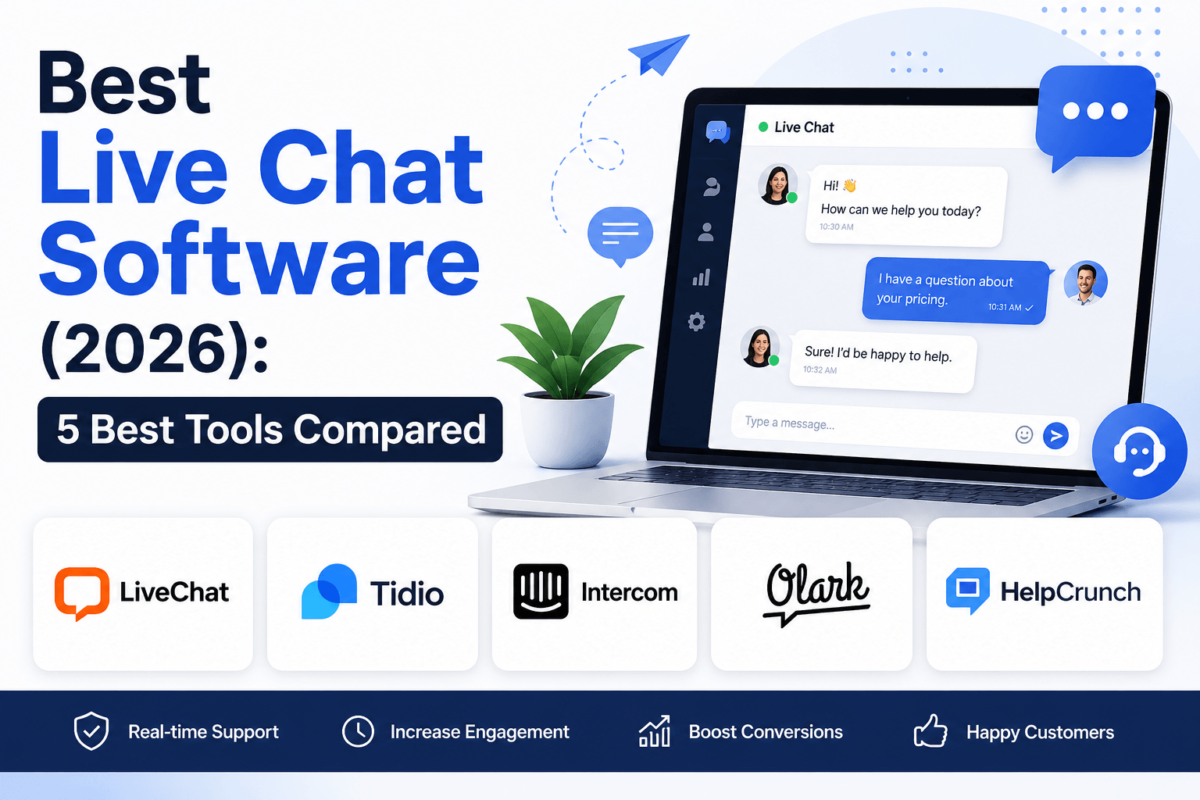
We tested and compared five live chat platforms that consistently show up at the top of buyer shortlists in 2026 — LiveChat, Tidio, Intercom, Olark, and HelpCrunch — and broke down exactly who each one is built for, what it costs, and where it falls short. By the end, you’ll know which one fits your budget, your business size, and the way your customers actually want to talk to you.
Quick Answer: Best Live Chat Software in 2026
- Best Overall: LiveChat — the most complete, reliable live chat platform for most businesses
- Best Budget Option: Tidio — generous free plan and low-cost paid tiers for small teams
- Best AI Features: Intercom — Fin AI agent resolves tickets without human intervention
- Best for Ecommerce: Tidio — built-in Shopify integration and AI shopping assistant
- Best for Enterprise: Intercom — scalable messaging platform with deep automation
- Best for Agencies: LiveChat — multi-brand support and detailed reporting
- Best for WordPress: HelpCrunch — lightweight widget, simple plugin setup
- Best for Startups: Olark — simple, no-frills chat that’s fast to launch
- Best Value: HelpCrunch — help desk, chat, and automation in one affordable plan
- Best Customer Support: LiveChat — consistently praised for responsive, knowledgeable support
Live Chat Software Comparison Table
Here’s how all five tools stack up side by side before we dig into the details.
| Tool | Starting Price | Free Plan | AI Chatbot | Help Desk | Best For |
|---|---|---|---|---|---|
| LiveChat | $20/agent/mo | 14-day trial only | Yes (add-on) | Yes | Overall reliability & agencies |
| Tidio | $29/mo | Yes, limited | Yes (Lyro AI) | Yes | Small business & ecommerce |
| Intercom | $29/seat/mo | No | Yes (Fin AI) | Yes | SaaS & enterprise |
| Olark | $29/mo | No | Limited | Basic | Simple, fast setup |
| HelpCrunch | $18/seat/mo | 14-day trial only | Yes (AI Copilot) | Yes | WordPress & value seekers |
Pricing reflects publicly listed starting rates at the time of writing and can change — always confirm current pricing on the provider’s site before buying.
1. LiveChat — Best Overall Live Chat Software
LiveChat has been around since 2002, and it shows — in a good way. This is one of the most mature, dependable products in the category, built specifically for support and sales teams that need chat to just work, every single time, with almost no downtime.
What sets LiveChat apart isn’t flashy AI marketing. It’s the fundamentals: a fast, stable widget, a clean agent dashboard, and reporting deep enough that support managers can actually prove ROI to leadership. It integrates with well over 200 apps, including most major email marketing platforms and CRMs, so it slots into an existing stack without a fight.
Key Features
- Smart chat routing that sends visitors to the right agent based on skill, department, or workload
- Built-in ticketing so conversations that go unanswered don’t just vanish
- Detailed analytics covering chat volume, response time, agent performance, and customer ratings
- Eye-catcher and greeting automation to proactively engage visitors before they bounce
- Native mobile apps for iOS and Android so agents can respond from anywhere
|
Pros
|
Cons
|
Pricing: Plans start around $20/agent/month billed annually, scaling up through Team, Business, and Enterprise tiers as you add automation, reporting depth, and AI. There’s a 14-day free trial but no free-forever tier.
Best For: Established small-to-midsize businesses and support agencies that need a proven, high-uptime chat platform and are willing to pay for reliability.
Bottom Line: If chat is mission-critical to your revenue and you can’t afford flaky widgets or slow support responses, LiveChat is the safest bet on this list. It’s not the cheapest, but it’s the one least likely to let you down.
2. Tidio — Best Budget Live Chat Software
Tidio built its name on ecommerce, and it’s still where the platform shines brightest. If you’re running a Shopify or WooCommerce store and want live chat plus a genuinely useful AI assistant without a five-figure annual bill, Tidio is very hard to beat.
The standout feature is Lyro, Tidio’s AI chatbot, which handles common pre- and post-sale questions — order status, return policy, shipping times — in natural conversation, and hands off to a human the moment it’s out of its depth. For stores that get a lot of repetitive questions, that alone can cut response times dramatically. It pairs neatly with a solid ecommerce SEO strategy, since faster support tends to reduce bounce and improve on-site engagement signals.
Key Features
- Lyro AI chatbot that answers FAQs conversationally and learns from your help center content
- Native Shopify and WooCommerce integrations with order lookup inside the chat window
- Visual chatbot flow builder for automating common conversation paths without code
- Ticketing system included even on lower-cost plans
- Multilingual support for stores selling to international audiences
|
Pros
|
Cons
|
Pricing: A free plan covers basic live chat for small volumes. Paid plans start around $29/month and scale based on the number of Lyro AI conversations and automation flows you need.
Best For: Ecommerce stores, small businesses, and solo founders who want AI-assisted chat without enterprise pricing.
Bottom Line: Tidio is the sensible starting point for most small businesses — capable enough to grow with you, cheap enough that you won’t feel it in the budget.
3. Intercom — Best AI Features & Best for Enterprise
Intercom isn’t really “live chat software” anymore in the traditional sense — it’s a full customer messaging platform, and the chat widget is just the front door. That’s exactly why it earns a spot here: for businesses that want AI doing the heavy lifting, Intercom is currently the category leader.
The headline feature is Fin, Intercom’s AI agent. Unlike basic chatbots that follow rigid decision trees, Fin reads your existing help content and resolves genuinely complex support questions on its own — often without a human ever seeing the conversation. For SaaS companies and larger support teams drowning in repetitive tickets, that changes the math on staffing entirely.
Key Features
- Fin AI Agent that autonomously resolves tickets using your knowledge base and past conversations
- Unified inbox combining chat, email, and social messaging in one thread per customer
- Product tours and in-app messaging for onboarding and feature announcements
- Advanced workflow automation that can route, tag, and escalate conversations automatically
- Deep CRM and product analytics integrations built for scaling SaaS teams
|
Pros
|
Cons
|
Pricing: Essential plans start around $29/seat/month, with Advanced and Expert tiers adding automation depth and Fin AI resolutions billed separately per conversation.
Best For: SaaS companies, product-led businesses, and enterprise support teams that need AI to absorb ticket volume, not just a chat widget.
Bottom Line: Intercom costs more, but for companies with real support volume, the AI resolution rate can offset that cost fast. It’s the platform to grow into, not necessarily the one to start with.
4. Olark — Best for Startups & Simplicity
Olark deliberately does less than its competitors, and for a specific type of buyer, that’s the entire appeal. There’s no bloated feature list to wade through — just a fast, reliable chat widget, simple visitor targeting, and integrations with the CRMs and help desks small teams already use.
If you’ve ever set up software and immediately felt overwhelmed by settings you’ll never use, Olark is the antidote. It’s built for founders and small support teams who want to be live and answering customers within the hour, not spending a week in onboarding calls.
Key Features
- Real-time visitor insights showing what page a visitor is on and how they got there
- Automated targeted chat messages triggered by visitor behavior
- Simple integrations with Salesforce, HubSpot, Zendesk, and Google Analytics
- Custom pre-chat and offline forms to capture leads even when no agent is available
- Straightforward reporting covering chat volume, satisfaction, and response time
|
Pros
|
Cons
|
Pricing: Plans start around $29/month for a single seat, scaling with the number of agents and level of automation and reporting.
Best For: Early-stage startups, solo founders, and small teams who want live chat live today without a learning curve.
Bottom Line: Olark won’t out-feature Intercom or Tidio, and it doesn’t try to. If simplicity and speed to launch matter more than AI bells and whistles, it’s a perfectly solid choice.
5. HelpCrunch — Best Value & Best for WordPress
HelpCrunch sits in a genuinely useful middle ground: it bundles live chat, a shared help desk inbox, a knowledge base, and basic marketing automation into one product for meaningfully less than Intercom or LiveChat charge for similar functionality.
For WordPress site owners specifically, the appeal is practical — the widget is lightweight, doesn’t noticeably slow page load, and installs cleanly through a plugin or a simple script tag. Combined with a solid WordPress plugin stack, it’s an easy way to add real-time support without touching a developer.
Key Features
- AI Copilot that drafts suggested replies for agents and can auto-answer common questions
- Shared inbox combining chat, email, and social messages in one thread
- Built-in knowledge base tool for self-service articles
- Email marketing and pop-ups included even on mid-tier plans
- Lightweight widget with minimal impact on page load speed
|
Pros
|
Cons
|
Pricing: Plans start around $18/seat/month for Basic, with Pro and Unlimited tiers adding automation, the AI Copilot, and multiple communication channels.
Best For: WordPress site owners, small businesses, and anyone who wants chat and a help desk in one affordable plan.
Bottom Line: HelpCrunch punches well above its price point. If your budget is tight but you still want help desk features alongside chat, it’s one of the strongest value picks available.
What Is Live Chat Software?
Live chat software is a tool that adds a real-time messaging widget to your website, letting visitors talk directly to a support agent, salesperson, or AI chatbot without leaving the page or picking up a phone. It typically lives as a small chat bubble in the corner of the screen.
Early live chat tools in the 2000s were little more than glorified instant messengers bolted onto a website. Over the past decade, they’ve evolved into full customer messaging platforms that combine live chat with chatbots, ticketing, knowledge bases, and — most recently — generative AI agents that can hold entire conversations and resolve issues without a human ever stepping in.
Modern live chat software is also increasingly omnichannel, meaning the same inbox handles conversations that start on your website, in an app, over WhatsApp, or through Instagram DMs, all threaded together under one customer profile.
Benefits of Live Chat Software
- Faster support: chat replies typically happen in minutes, compared to hours for email
- More sales: businesses that add live chat commonly see conversion lifts, since visitors get shipping, sizing, or pricing questions answered before they abandon the cart
- Lower support costs: a single agent can handle several chats at once, and AI chatbots now absorb a large share of repetitive questions automatically
- Higher customer satisfaction: chat consistently scores above email and phone support in customer satisfaction surveys
- Built-in lead generation: proactive chat triggers and pre-chat forms capture contact details from visitors who’d otherwise leave anonymously
- Better retention: customers who get quick, helpful answers are more likely to return and buy again
- Actionable analytics: chat transcripts reveal exactly what questions and objections come up most, which is useful for both product and marketing teams
How AI Is Changing Live Chat
AI has moved from a nice-to-have to the defining feature separating live chat platforms in 2026. Industry research from Tidio shows well over half of businesses now pair live chat with an AI chatbot rather than running live chat alone, and tools like Chatbot.com report that bots can now field roughly 80% of routine, repetitive questions — freeing human agents for the conversations that actually need a person.
Here’s what’s changed specifically:
- AI agents, not just bots: tools like Intercom’s Fin and Tidio’s Lyro read your help documentation and hold natural, resolution-focused conversations instead of following rigid scripts
- Intent detection: AI increasingly identifies what a visitor actually wants — a refund, a demo, a bug report — and routes the conversation accordingly
- Multilingual support on autopilot: AI chat can now respond fluently in dozens of languages without hiring native-speaking agents
- Smart routing: conversations get sent to the agent best equipped to handle them, based on topic, sentiment, or customer value
- Automated summaries and knowledge retrieval: agents get AI-generated context on a customer’s history the moment a chat starts, instead of scrolling through past tickets
- Sentiment analysis: platforms flag frustrated customers in real time so managers can step in before a conversation escalates
That said, AI hasn’t fully replaced human agents, nor should it try to. Research from Freshworks found that a majority of customers still prefer talking to a human when a question gets complicated — the winning formula in 2026 is AI handling volume and speed, with humans stepping in for nuance and empathy.
Live Chat vs. Other Support Channels
Live chat rarely replaces every other support channel entirely — most businesses run it alongside email, phone, and a help desk. Here’s how it compares to each.
| Channel | Response Speed | Typical CSAT | Best Used For |
|---|---|---|---|
| Live Chat | Seconds to minutes | ~73–88% | Quick questions, pre-sale support |
| Chatbots | Instant | Varies by design | FAQs, 24/7 coverage, first triage |
| Help Desk / Email | Hours | ~61% | Complex, non-urgent issues |
| Phone Support | Minutes (with hold time) | ~44% | High-emotion or urgent issues |
Live chat vs. chatbots: Live chat connects a visitor to a human; a chatbot handles the conversation with rules or AI, no human required. Most modern platforms blend both — a bot greets and triages, then hands off to a human agent when needed.
Live chat vs. help desk: A help desk manages asynchronous tickets (usually via email) that can sit for hours or days. Live chat is synchronous — the customer expects a reply while they’re still on the page. Most of the tools above bundle both.
Live chat vs. email support: Email is better for detailed, non-urgent issues that need documentation. Live chat wins on speed and satisfaction for anything time-sensitive, especially pre-purchase questions where hesitation kills conversions.
Live chat vs. phone support: Phone still wins for emotionally charged or highly complex issues where tone matters. But according to Tidio’s research, a large share of customers actively choose chat over phone specifically to avoid hold times — phone use is declining across most demographics as chat and messaging apps take over as the default.
How to Choose Live Chat Software
Before you commit to a plan, run the decision through these filters:
- Budget: know your realistic monthly spend per agent, including AI conversation overages, before you fall in love with a feature list
- Business size: a two-person startup and a 50-agent support team need fundamentally different tools — don’t over-buy or under-buy
- Support volume: high chat volume justifies AI resolution tools; low volume makes them an unnecessary cost
- Integrations: confirm the tool connects cleanly with your CRM, ecommerce platform, and help desk before signing up
- AI capabilities: decide whether you need a basic FAQ bot or a full AI agent that can resolve tickets end-to-end
- Reporting: if you need to justify the spend to leadership, make sure the analytics are detailed enough to prove it
- Scalability: pick a tool that won’t force a painful migration once you outgrow the entry plan
- Ease of use: agents who fight the interface will resent the tool and respond slower — test the trial with your actual team
- Security and compliance: especially important for healthcare, legal, and finance sites handling sensitive customer data
- Customization: check that the widget can be styled to match your brand instead of looking like an obvious bolt-on
Best Live Chat Software by Business Type
| Business Type | Recommended Tool |
|---|---|
| Small Business | Tidio or HelpCrunch |
| Startups | Olark or Tidio |
| Enterprise | Intercom |
| Agencies | LiveChat |
| Freelancers & Solopreneurs | Tidio (free plan) |
| WordPress Sites | HelpCrunch |
| Shopify / WooCommerce | Tidio |
| Healthcare & Legal | LiveChat (compliance-friendly, high uptime) |
| Education | HelpCrunch or Olark |
| SaaS & B2B | Intercom |
| B2C / Ecommerce | Tidio |
Live Chat Statistics for 2026
Numbers make the case for live chat better than opinions do. Here’s a categorized rundown pulled from recent industry research.
Customer Satisfaction & Expectations
- Live chat consistently earns a satisfaction score around 73%, compared to 61% for email and 44% for phone support, according to Freshworks’ live chat research.
- Some studies, including Zendesk’s CX Trends research, put live chat satisfaction even higher — in the mid-80% range — reinforcing that chat is the most consistently well-reviewed digital support channel.
- Freshworks found that responding within 5 to 10 seconds pushes satisfaction rates up to roughly 84.7%.
- Forrester research cited by GreetNow found that 63% of consumers say they’re more likely to return to a website that offers live chat.
Conversion & Sales Impact
- Businesses that add live chat commonly report a 20% lift in conversions, based on aggregate vendor data cited by Forrester and multiple industry reports.
- Forrester’s long-running research finds visitors who engage with chat convert at roughly 2.8 to 3 times the rate of visitors who don’t.
- Chat during checkout has been linked to roughly a 9% reduction in cart abandonment in cross-vendor research compiled by Swell and referenced against Baymard Institute’s abandonment benchmarks.
- Mobile chat users convert at notably higher rates than mobile visitors who don’t chat, according to Freshworks and 99firms research.
AI & Automation Adoption
- Over half of businesses now combine live chat with an AI chatbot rather than running chat alone, per Tidio’s internal data.
- AI chatbots can resolve roughly 80% of routine, repetitive support questions, according to Chatbot.com.
- Adding chatbot automation has been shown to cut overall support costs by roughly 30%, per Chatbot.com’s research.
- Despite AI’s growth, a majority of customers still say they prefer a human agent once a question gets complicated, per Freshworks’ consumer research.
Cost & Efficiency
- Live chat interactions cost roughly 15–33% less than resolving the same issue over the phone, according to SQ Magazine’s cost analysis.
- Live chat resolution has been reported as up to 13 times faster than resolving the same issue through email or web forms, per Freshworks.
- 42% of customers say avoiding phone hold times is their main reason for preferring chat, according to Tidio’s research.
Mobile & Behavior Trends
- A large and growing share of live chat sessions now start on smartphones and tablets rather than desktop, per Nextiva’s 2026 research.
- Shoppers aged 18–34 show a significantly stronger preference for live chat over phone support compared to older demographics, according to SQ Magazine.
- The most active chat window tends to fall between late morning and early afternoon, when a large share of daily chat volume occurs, according to 99firms.
Figures vary by study and methodology — treat these as directional industry benchmarks rather than guaranteed results for your specific business.
Real-World Use Cases
- Ecommerce stores use live chat to rescue abandoned carts, answer sizing and shipping questions instantly, and recommend products mid-conversation.
- SaaS companies lean on AI agents like Fin to handle onboarding questions and bug reports at scale, saving human agents for churn-risk conversations.
- Insurance companies use chat to walk prospects through coverage questions before they abandon a quote form — a channel closely tied to lead generation software for capturing and following up on leads.
- Credit monitoring services use chat to answer account-security questions quickly, since customers in this category tend to be especially wary of long wait times.
- Law firms use chat as a low-pressure first point of contact, qualifying leads before booking a consultation call.
- Healthcare clinics use chat for appointment scheduling questions and basic intake, reducing phone line congestion.
- Agencies and consultants use chat to qualify inbound inquiries in real time instead of losing them to a contact form nobody checks daily.
- Educational institutions use chat to answer enrollment and admissions questions from prospective students browsing outside office hours.
- Nonprofits use chat to answer donor questions in the moment, which can meaningfully improve donation completion rates.
Common Live Chat Mistakes to Avoid
- Choosing by price alone: the cheapest plan often lacks the automation or reporting you’ll need within six months, forcing a costly migration.
- Ignoring AI capabilities: a tool with no meaningful AI roadmap will fall behind fast as customer expectations around instant answers keep rising.
- Understaffing chat hours: a chat widget that shows “online” but goes unanswered does more damage to trust than not having chat at all.
- Skipping proactive messaging: waiting for visitors to initiate chat leaves conversions on the table — a well-timed automated greeting converts better.
- Overusing chatbots: forcing every visitor through a rigid bot flow before reaching a human frustrates customers who just want a quick answer.
- Ignoring analytics: chat transcripts are a goldmine of product and marketing insight that most businesses never review.
- Neglecting the mobile experience: with most chat sessions now starting on mobile, a widget that’s clunky on a small screen actively costs you conversations.
Expert Buying Guide
A few things separate a smooth live chat rollout from a frustrating one:
- Pricing models: per-seat pricing punishes growing teams; per-conversation or AI-usage pricing can spike unpredictably — read the fine print on both.
- Hidden costs: AI resolutions, extra integrations, and advanced reporting are frequently gated behind add-ons or higher tiers.
- Onboarding and implementation: some platforms are live in minutes; others need real configuration time — factor that into your launch timeline.
- Integration depth: confirm two-way sync with your CRM and help desk, not just a one-way data dump.
- Support quality from the vendor itself: test their support team during your trial — how they treat you as a prospect often predicts how they’ll treat you as a customer.
- AI roadmap: ask what’s shipping next, not just what exists today — this space is moving fast and a stagnant roadmap is a warning sign.
- Vendor reputation: check independent review sites, not just testimonials on the vendor’s own homepage.
- Uptime history: a chat tool that goes down during peak traffic is worse than no chat tool at all.
- Scalability: pick a platform with headroom, so growth doesn’t force a disruptive switch a year from now.
Frequently Asked Questions
What is the best live chat software overall?
LiveChat is the best overall pick for most businesses thanks to its reliability, deep reporting, and wide integration library.
Which live chat software is best for small businesses?
Tidio and HelpCrunch are the strongest fits for small businesses, offering solid features at a fraction of enterprise pricing.
Is free live chat software worth it?
A free plan like Tidio’s is worth using if you have low chat volume, but most free tiers cap agent seats and conversations, so growing businesses usually outgrow them quickly.
Does live chat actually increase sales?
Yes. Industry research consistently links live chat to higher conversion rates, largely because it removes hesitation at the exact moment a visitor has a purchase question.
Can AI chatbots fully replace human support agents?
Not entirely. AI now resolves a large share of routine questions, but most customers still want a human for complex, emotional, or high-stakes issues.
Which live chat software integrates with Shopify?
Tidio has the deepest native Shopify integration among the tools compared here, including in-chat order lookup and product recommendations.
Can live chat reduce support costs?
Yes — chat is generally cheaper per interaction than phone support, and AI automation further reduces the number of conversations that need a human agent.
How secure is live chat software?
Reputable providers encrypt chat data in transit and offer compliance certifications, but the level varies by vendor and plan — always confirm compliance details if you handle sensitive customer data.
Does adding live chat affect SEO or Google rankings?
Live chat itself isn’t a direct ranking factor, but it can indirectly help by improving on-site engagement and reducing bounce rate — both signals tied to conversion rate optimization, which overlaps with the user-experience signals Google does consider.
What’s the difference between live chat and a chatbot?
Live chat connects a visitor to a human agent in real time; a chatbot uses rules or AI to hold the conversation without a person involved, though most platforms now blend the two.
Do I need live chat if I already have a chatbot?
Most businesses benefit from both — a chatbot handles instant, repetitive questions, while live chat lets a human step in the moment a conversation needs judgment a bot can’t provide.
How much does live chat software typically cost?
Entry plans generally run $18–$30 per agent per month, with AI features and advanced automation often priced separately on top of that base.
Is live chat software hard to install on WordPress?
No — most providers, including HelpCrunch and Tidio, offer a WordPress plugin or a simple script tag that installs in a few minutes with no coding required.
Can I use live chat software for lead generation, not just support?
Yes — proactive chat triggers and pre-chat forms are widely used to capture contact information from visitors who wouldn’t otherwise fill out a form.
Which live chat tool has the best AI agent?
Intercom’s Fin is currently the most capable AI agent among the tools compared here, built specifically to resolve tickets autonomously rather than just answer FAQs.
Should agencies use a different tool than in-house teams?
Agencies managing multiple client accounts tend to prefer LiveChat for its multi-brand support and granular reporting, which makes it easier to prove value across several clients at once.
Final Verdict
There’s no single “best” live chat software — there’s the best one for where your business actually is right now. If you want the safest, most dependable all-rounder, go with LiveChat. If budget is tight or you’re running an ecommerce store, Tidio gives you the most for the least. If AI-driven resolution and scale matter more than upfront cost, Intercom is built for that. If you just want chat live today with zero complexity, Olark gets you there fastest. And if you want chat plus a help desk without paying enterprise prices, HelpCrunch is the strongest value on this list.
Whichever you choose, don’t skip the free trial. Every tool above offers one, and the fastest way to know if a platform fits your team is to run real conversations through it for a week before you commit a card number.
Disclosure: This article contains affiliate links. If you sign up for a tool through one of our links, we may earn a commission at no extra cost to you. We only recommend software we’ve researched and believe delivers genuine value — our opinions are our own.