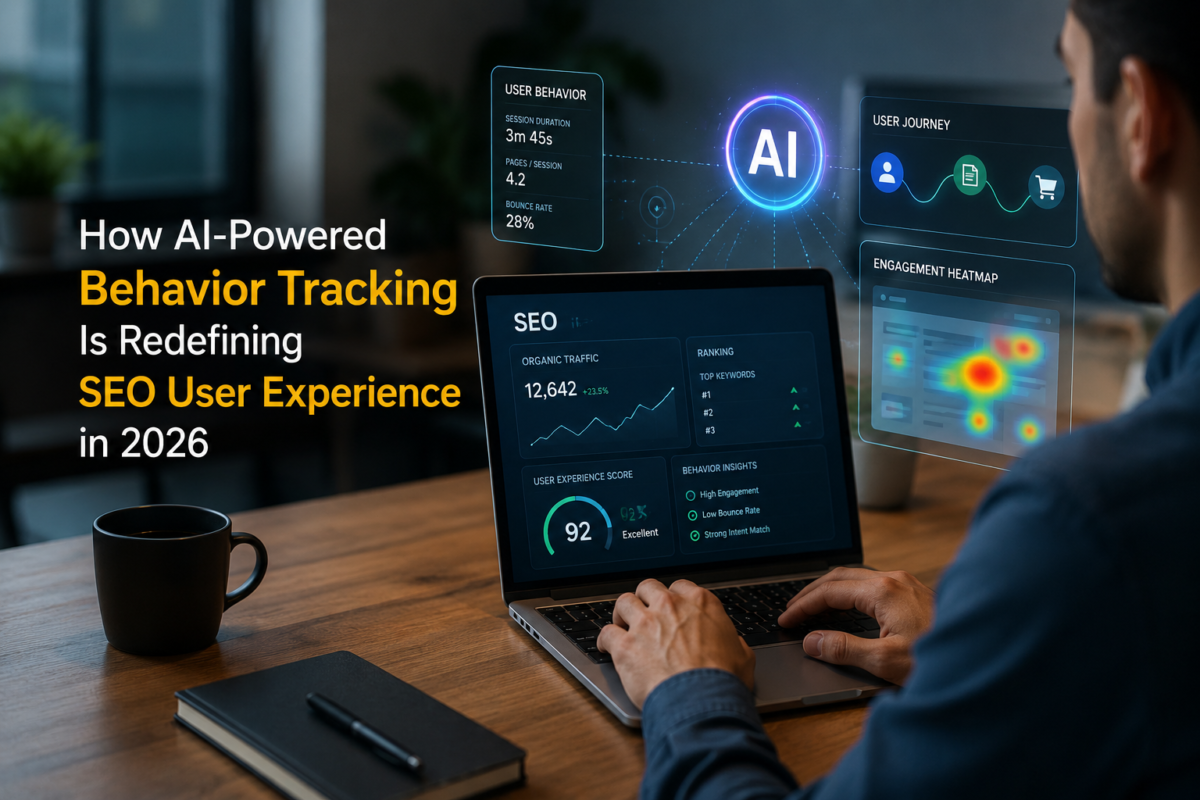
How AI-Powered Behavior Tracking Is Redefining SEO User Experience in 2026
From dwell time to navigation paths — how machine learning turns raw user data into your most powerful ranking tool.
Behavior tracking with AI is the process of collecting and interpreting user actions — clicks, scroll depth, dwell time — using machine learning to understand intent. In 2026, it directly influences SEO by feeding search algorithms with real engagement signals, enabling smarter content optimization and more personalized user experiences that improve rankings.
AI-driven behavior tracking has moved from a nice-to-have feature to a core pillar of modern SEO strategy. By analyzing how users actually interact with content — not just whether they arrived — AI systems surface actionable insights that traditional analytics simply miss. The key benefits include deep personalization at scale, higher engagement rates, and stronger behavioral signals that search engines increasingly use to evaluate content quality. Google’s evolving algorithms now weigh on-page behavior heavily — pages with strong dwell time, low bounce rates, and meaningful scroll depth consistently outperform those optimized purely for keywords. As search evolves in 2026, behavior tracking with AI is the bridge between raw user data and genuinely useful, high-ranking content experiences.
1What Is AI Behavior Tracking?
Behavior tracking with AI refers to the systematic collection of user interaction data on a website, processed through machine learning models to extract meaningful patterns and predict intent. Unlike standard web analytics — which mostly tells you how many people visited a page — AI behavior tracking tells you what they did while they were there and, more importantly, why.
Traditional tools count visits and exits. AI-powered systems understand the journey: where attention dropped, which elements drove action, what sequence of interactions preceded a conversion. This depth of understanding is what makes behavior tracking with AI a genuine game-changer for SEO user experience in 2026.
2Types of Behavioral Data AI Tracks
Modern AI analytics platforms monitor several key data points simultaneously:
Clicks and Tap Interactions
Every click tells a story. AI maps click patterns across pages to identify which CTAs convert, which links confuse users, and which placements go completely ignored. Over time, these patterns inform layout decisions that improve both UX and SEO engagement signals.
Scroll Depth
How far a user scrolls through a page reveals whether your content holds attention. If 70% of visitors drop off at the same paragraph, that is a clear signal — either the content structure needs work, or you are attracting the wrong audience. AI identifies these thresholds automatically and flags them for optimization.
Dwell Time
Dwell time — the duration between a user clicking your result in search and returning to the SERP — is one of the strongest implicit ranking signals available. AI behavior tracking separates meaningful time-on-page from passive tab-open inactivity, giving you a cleaner picture of true content engagement.
Navigation Paths
Understanding how users move through your site — which pages lead to conversions, which create dead ends, which trigger exits — allows AI to build predictive navigation models. These insights help you redesign information architecture around how real users think, not how site owners assume they think.
3How AI Interprets User Intent
Raw behavioral data is noise without interpretation. This is where machine learning earns its place. AI models analyze behavioral sequences — not individual actions, but the full pattern of how a session unfolds — to infer user intent with far greater accuracy than keyword matching alone.
For example: a user who lands on a product comparison page, scrolls to the pricing section, clicks a “Learn More” link, and spends four minutes reading a features breakdown is displaying high purchase intent. An AI system can identify this pattern in real time, adjusting the on-page experience — surfacing a relevant offer, adjusting the CTA prominence — in ways that directly improve both conversion rates and SEO engagement metrics.
4The Role of Behavior Tracking in SEO
Engagement Signals That Influence Rankings
Search engines in 2026 are significantly more sophisticated in their use of behavioral signals. Metrics like pogo-sticking (clicking back to search results immediately), time-on-site, and page-depth-per-session are interpreted as quality indicators. AI behavior tracking lets you monitor these signals proactively — before they damage your rankings.
Content Optimization Through Behavioral Feedback
AI analytics can tell you which sections of a 2,000-word article hold attention and which cause drop-off. Armed with this data, content teams can restructure articles, add visual breaks at drop-off points, strengthen weak paragraphs, or insert internal links where users typically pause — resulting in measurable improvements in both engagement and organic visibility.
Predictive UX for SEO Advantage
Predictive UX uses historical behavioral patterns to anticipate what a user will need before they explicitly ask for it. A blog that surfaces the next logical article — based on reading behavior, not just category — keeps users on-site longer, increases page depth, and sends powerful positive signals to search engines.
5Real-World Applications
E-commerce platforms use behavior tracking to personalize product feeds in real time. AI can surface articles, guides, or tools based on a visitor’s browsing behavior, dramatically increasing time-on-site and return visit rates.
Media platforms and SaaS tools use AI-driven recommendations to reduce churn and increase session depth. For SEO purposes, a strong recommendation engine means more pages indexed per visit and stronger internal link equity flow.
Some platforms serve different page layouts to different audience segments based on behavioral data — reducing bounce rate, one of the most impactful SEO UX metrics available.
6How to Implement AI Behavior Tracking: A Practical Guide
Getting started with behavior tracking with AI does not require a data science team. Here is a practical implementation roadmap:
Before collecting any data, identify what you want to improve. Are you targeting higher dwell time, lower bounce rate, or better conversion paths? Clear goals determine which behavioral signals to prioritize and which metrics will indicate success.
Platforms such as Microsoft Clarity (free heatmaps and session recordings), Hotjar, FullStory, or enterprise options like Adobe Analytics with AI add-ons offer built-in machine learning layers. Choose based on your traffic volume, budget, and the depth of behavioral data you need.
Install tracking scripts across all key pages — landing pages, blog posts, product pages, and conversion funnels. Ensure you are capturing scroll depth, click events, session duration, and navigation sequences. Give the system at least four weeks to accumulate a statistically meaningful dataset before drawing conclusions.
Most platforms offer out-of-the-box AI models for intent classification, anomaly detection, and churn prediction. For larger sites with unique behavioral patterns, custom model training using tools like Google’s Vertex AI or AWS SageMaker can yield more precise insights aligned to your specific audience.
Cross-reference behavioral data with Google Search Console and your rank tracking tool. Identify correlations between behavioral metrics (dwell time, scroll depth) and ranking performance. Pages with strong behavioral signals that still rank poorly may have technical SEO issues; pages that rank well but show weak engagement are at risk of losing position.
Act on what the data shows. Restructure articles with high drop-off rates, test new CTA placements, add visual elements at attention-drop zones, and improve internal linking based on navigation path data. Every change should be driven by behavioral evidence, not assumption.
AI behavior tracking is not a one-time audit. Set up monthly review cycles: analyze new behavioral data, update content accordingly, monitor ranking changes, and refine your AI models as your audience grows. The sites that consistently outperform in SEO in 2026 treat this as an ongoing operational system, not a periodic project.
7Traditional Analytics vs. AI Behavior Tracking
| Feature | Traditional Analytics | AI Behavior Tracking |
|---|---|---|
| Data Depth | Sessions, pageviews, bounce rate — surface-level metrics only | Scroll depth, click maps, rage clicks, attention zones, session replays, and intent signals |
| Real-Time Insights | Limited; delayed reporting with manual dashboards | Live behavioral feeds with automatic anomaly alerts and instant pattern recognition |
| Personalization | Segment-based; broad audience groupings | Individual-level personalization driven by live behavioral patterns and predictive modeling |
| Predictive Capabilities | None; purely retrospective | Predicts churn risk, likely next actions, conversion probability, and content performance |
| SEO Impact | Indirect; requires manual interpretation to connect to rankings | Directly informs content optimization, UX improvements, and engagement signals that feed ranking algorithms |
| Setup Complexity | Low; basic tag installation | Moderate; requires thoughtful event configuration, but most platforms offer guided setup |
| Actionability | Tells you what happened | Tells you what happened, why it happened, and what to do about it |
8Frequently Asked Questions
Behavior tracking with AI is no longer a fringe strategy reserved for large tech teams. In 2026, it is one of the clearest paths to sustainable SEO performance — because it aligns your site with what users actually experience, not just what algorithms theoretically reward. Search continues to evolve in one consistent direction: toward understanding and rewarding genuine user value. AI behavior tracking is how you measure and deliver that value at scale — through personalization, predictive UX, and content optimization grounded in real user data. The sites that invest in this approach now will be significantly ahead of those still relying on keyword density and backlink volume alone. The future of SEO user experience is behavioral, and AI is the engine that makes it actionable.