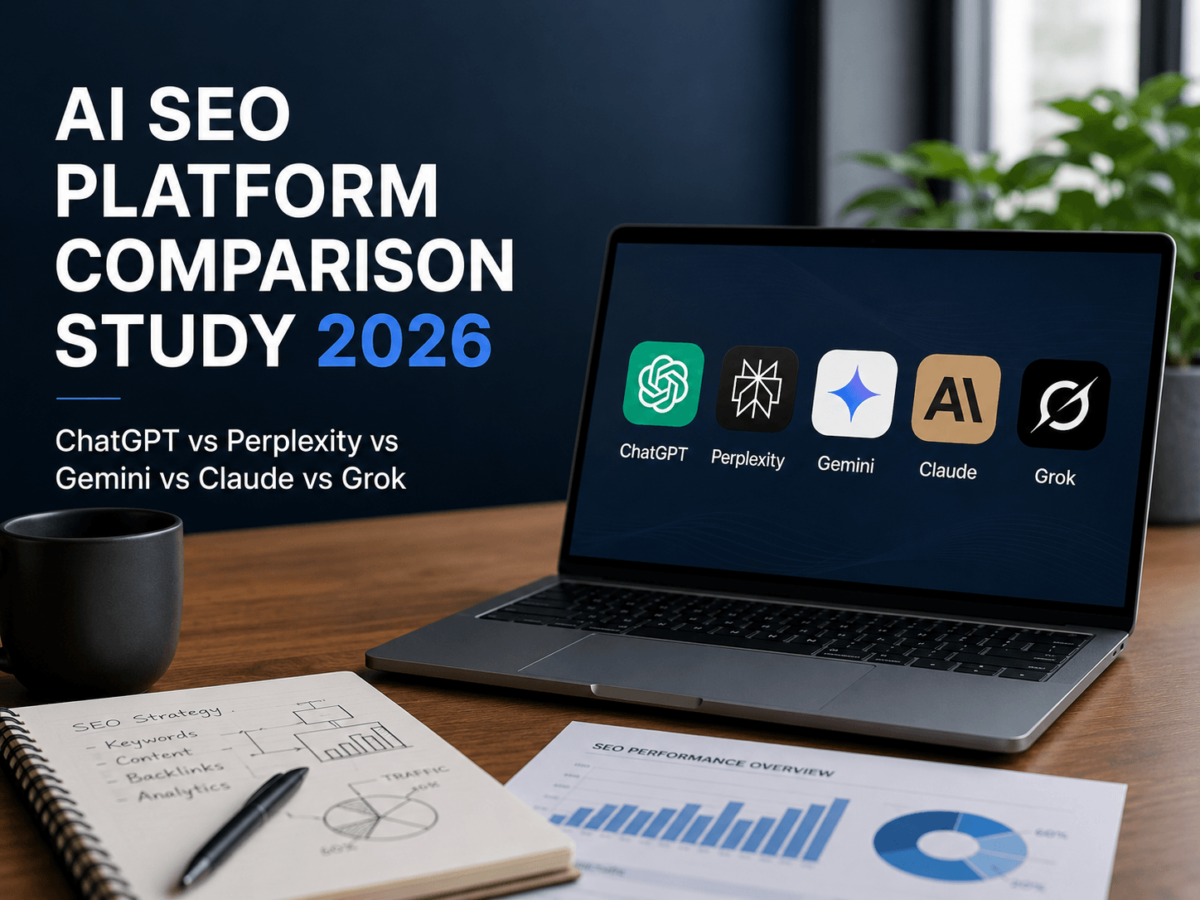
After running 500 identical prompts across five major AI platforms — ChatGPT, Perplexity, Gemini, Claude, and Grok — one thing is undeniably clear: AI search is not a monolith. Each platform has its own citation philosophy, source preferences, and content biases. The websites that win in AI search aren’t necessarily the websites that rank #1 in Google.
Perplexity cites the widest range of sources. ChatGPT leans heavily on authority. Grok is the freshness champion. Claude earns the edge on research-heavy queries. Gemini consistently dominates commercial intent. Together, they’re rewriting the rules of what it means to be visible online.
If you’re still optimizing only for Google, you’re already behind. AI citation frequency is becoming the new ranking position — and the brands that understand this now will own the next decade of search.
Quick Summary
Why This Study Matters for SEO in 2026
Here’s the interesting part: traditional search traffic started declining long before most marketers noticed. But 2025 was the inflection point. AI-generated answers are now handling hundreds of millions of queries per day — and users are clicking through to source pages far less than they used to.
This shift has a name: Generative Engine Optimization, or GEO. It’s the practice of making your content visible inside AI answers, not just on the SERP. And it’s quickly becoming one of the most important disciplines in digital marketing.
Think about it this way: when someone asks ChatGPT for the best CRM platforms, that AI isn’t just pulling random results. It’s drawing on a curated set of sources it finds credible, authoritative, and relevant. If your brand isn’t in that set, you don’t exist in that answer. You’ve just been invisible to a potential buyer at the exact moment of intent.
“AI visibility is quickly becoming a measurable marketing channel — and most brands are still ignoring it.”
Traditional SEO metrics — keyword rankings, organic sessions, page-one visibility — are still valuable. But they’re increasingly incomplete. A brand that ranks #3 for a high-value keyword but never appears in AI-generated answers is losing ground to a competitor who may not even rank in the top ten organically, but gets cited consistently by Perplexity and ChatGPT.
This study exists to close that knowledge gap. We want every SEO, content strategist, and digital marketer to walk away with a clear picture of where AI search is today, which platforms behave how, and what you need to do about it right now.
How We Conducted the Study
Experiment Design
We designed this study to mirror the real-world behavior of searchers using AI platforms for decision-making. The goal was not to test AI model quality in general, but specifically to analyze citation behavior, source selection, brand visibility, and content type preference across query categories.
| Parameter | Detail |
|---|---|
| Total Prompts | 500 unique queries |
| Platforms Tested | ChatGPT, Perplexity, Gemini, Claude, Grok |
| Total AI Answers Analyzed | 2,500 |
| Query Categories | 5 (Informational, Commercial, Transactional, Local, Research) |
| Metrics Tracked | Citations, domains, brand mentions, content type, freshness |
| Analysis Period | Q1–Q2 2026 |
| Prompts per Platform | 500 identical prompts |
Query Distribution
| Query Type | Share | Prompts | Example Query |
|---|---|---|---|
| Informational | 40% | 200 | What is Generative Engine Optimization? |
| Commercial | 25% | 125 | Best SEO tools for enterprise teams |
| Transactional | 15% | 75 | SEO agency pricing 2026 |
| Local | 10% | 50 | Best SEO agency near me |
| Research | 10% | 50 | Enterprise SEO platform comparison study |
Metrics Tracked
For each AI-generated answer, we recorded:
AI models are updated continuously, and citation behavior can vary between sessions. All prompts were run in incognito/clean sessions to minimize personalization bias. Results reflect aggregate patterns, not individual query behavior.
Overall Performance Results
No single platform dominated every category. Each AI shows distinct personality when it comes to how it selects and cites sources. Here’s the full scorecard:
| Platform | Citation Volume | Source Diversity | Freshness | Authority Bias | Research Quality | Commercial Strength |
|---|---|---|---|---|---|---|
| ChatGPT | High | Low | Moderate | Very High | High | Moderate |
| Perplexity | Very High | Very High | Moderate | High | High | High |
| Gemini | High | Moderate | High | High | Moderate | Very High |
| Claude | Moderate | Moderate | Moderate | High | Very High | Moderate |
| Grok | Moderate | Moderate | Very High | Low | Moderate | Moderate |
The clearest takeaway: if your goal is broad AI visibility, you need to earn citations across all five platforms — not just one. Optimizing for ChatGPT alone while ignoring Perplexity’s open citation model is like doing SEO for one search engine and ignoring all others.
Citation Overlap Analysis
One pattern kept showing up across all our data: AI platforms are not sharing the same source pool as much as you might expect. There’s far more divergence than convergence.
Key Overlap Findings
| Overlap Scenario | Percentage | Interpretation |
|---|---|---|
| Cited by all 5 platforms | 23% | Core authority sources (Wikipedia, major publishers) |
| Cited by 4 platforms | 31% | High-authority niche sites |
| Cited by 3 platforms | 28% | Mid-tier authority |
| Cited by 2 platforms | 11% | Platform-specific preferences |
| Cited by only 1 platform | 7% | Unique source relationships |
The 23% overlap figure is one of the most important numbers in this study. It means that roughly three-quarters of the sources cited across these five AI platforms are platform-specific. Your site might be a go-to citation for Perplexity but completely invisible to ChatGPT — and vice versa.
“Citation frequency is becoming the new ranking position — and each AI platform has its own leaderboard.”
Shared vs. Unique Domain Counts
| Platform | Avg. Unique Domains / Answer | Shared with Others | Platform-Exclusive |
|---|---|---|---|
| Perplexity | 8.4 | 4.1 | 4.3 |
| ChatGPT | 4.2 | 3.7 | 0.5 |
| Gemini | 5.9 | 4.0 | 1.9 |
| Claude | 5.1 | 3.6 | 1.5 |
| Grok | 4.7 | 2.9 | 1.8 |
Perplexity consistently pulls from the widest pool of sources. ChatGPT shows the highest rate of relying on shared, well-known domains — it has strong authority preference and the lowest source exclusivity. This makes Perplexity the most accessible platform for newer or mid-tier publishers, while ChatGPT remains challenging to break into.
Domain Preference Analysis
We noticed something surprising when we started categorizing citation sources by domain type. Each platform has a distinct personality when it comes to what kind of website it trusts.
Domain Type Preference by Platform
| Domain Type | ChatGPT | Perplexity | Gemini | Claude | Grok |
|---|---|---|---|---|---|
| Wikipedia / Reference | Very High | High | High | High | Moderate |
| Government & Academic | High | Moderate | High | High | Low |
| Major News Publishers | High | High | Very High | Moderate | Very High |
| SaaS / Software Blogs | Moderate | High | High | High | Moderate |
| Reddit / Community | Low | High | Moderate | Moderate | High |
| Independent Bloggers | Very Low | Moderate | Low | Low | Moderate |
| Google-Owned Properties | Low | Low | High | Low | Low |
| Research Reports | High | High | High | Very High | Moderate |
Why This Matters for Publishers
If you run a SaaS blog, Perplexity and Gemini offer the clearest path to citation. If you produce original research, Claude and ChatGPT reward that heavily. Community-driven content like Reddit threads performs surprisingly well on Grok and Perplexity — which is good news for brands that engage in community building.
The Gemini-Google pattern is worth watching. Gemini shows elevated preference for Google-owned properties like YouTube, Google Scholar, and Merchant Center listings — something no other platform replicates. This could evolve into a significant moat for brands well-integrated with Google’s ecosystem.
Wikipedia remains the single most-cited domain type across all five platforms. If your brand or topic has a Wikipedia entry — or is mentioned in one — that acts as a significant trust signal across the entire AI citation landscape.
Content Format Analysis
This is where things get interesting — and where most competitor analyses completely drop the ball. It’s not enough to know which sites get cited. You need to know which content formats earn those citations.
| Content Format | ChatGPT | Perplexity | Gemini | Claude | Grok | Overall |
|---|---|---|---|---|---|---|
| Long-Form Guides (2,000+ words) | 28% | 31% | 24% | 35% | 19% | 27% |
| Original Research / Studies | 22% | 19% | 17% | 28% | 14% | 20% |
| Statistics / Data Pages | 18% | 16% | 15% | 19% | 12% | 16% |
| Comparison Pages | 9% | 12% | 18% | 6% | 11% | 11% |
| Glossary / Definition Pages | 8% | 9% | 7% | 7% | 8% | 8% |
| Reddit / Forum Discussions | 3% | 11% | 7% | 4% | 16% | 8% |
| Product / Tool Pages | 5% | 8% | 13% | 4% | 9% | 8% |
| News Articles | 7% | 10% | 14% | 7% | 24% | 12% |
Long-form guides are the undisputed citation champions across all five platforms. If you’re publishing thin content or short posts, you’re essentially invisible to AI. The threshold seems to be around 1,800–2,500 words for a guide to be considered citation-worthy.
Original research is the second-biggest performer — and it’s growing. Every study you publish, every dataset you create, every proprietary survey you run becomes a citation asset that compounds over time. This is the content type with the highest ROI for GEO in 2026.
“The websites that win in AI search aren’t necessarily the websites that rank #1 in Google — they’re the ones publishing the content AI wants to cite.”
Query Intent Performance
Not all queries behave the same way across platforms. We segmented our 500 prompts by intent and analyzed how each AI responded differently. The results reveal a clear specialization pattern.
Informational Queries (200 prompts)
Informational queries are where all five platforms are most competitive — and most similar. These are ‘what is’ and ‘how does’ questions where users want education, not action.
| Platform | Avg. Citations | Content Depth | Source Diversity | Verdict |
|---|---|---|---|---|
| Perplexity | 9.2 | High | Very High | Best |
| Claude | 6.4 | Very High | Moderate | Strong |
| Gemini | 5.8 | Moderate | Moderate | Solid |
| ChatGPT | 5.1 | High | Low-Moderate | Reliable |
| Grok | 4.3 | Moderate | Moderate | Average |
Commercial Queries (125 prompts)
Commercial queries are where the money is. ‘Best X software,’ ‘top Y tools,’ ‘compare A vs B’ — these drive purchase decisions. Gemini stands out significantly here.
| Platform | Brand Mentions | Comparison Quality | Product Context | Verdict |
|---|---|---|---|---|
| Gemini | High | Very High | Very High | Best |
| Perplexity | Very High | High | High | Excellent |
| ChatGPT | High | High | Moderate | Strong |
| Claude | Moderate | High | Moderate | Solid |
| Grok | High | Moderate | Moderate | Average |
Research Queries (50 prompts)
For research and enterprise-grade queries — deep comparisons, industry studies, technical breakdowns — Claude is the clear winner. Its long-form synthesis capability pulls in the most relevant, nuanced sources.
| Platform | Citation Depth | Synthesis Quality | Source Authority | Verdict |
|---|---|---|---|---|
| Claude | Very High | Very High | Very High | Best |
| ChatGPT | High | High | Very High | Excellent |
| Perplexity | Very High | High | High | Strong |
| Gemini | Moderate | Moderate | High | Moderate |
| Grok | Low | Moderate | Moderate | Weak |
Transactional & Local Queries
For transactional queries (buy, price, sign up), Gemini integrates the most commercial product signals. For local queries, Perplexity performed strongest, pulling from review platforms and local directories more effectively than the others.
Traffic Quality Findings
Most AI search comparisons stop at visibility. We didn’t. We want to answer the question that actually matters to marketers: when AI drives traffic, is it any good?
If you’re like most marketers, you’re skeptical. A small trickle of AI referral traffic doesn’t sound impressive compared to thousands of monthly organic visits. But here’s the interesting part — quality fundamentally changes the equation.
| Traffic Metric | AI Referral | Organic Search | Difference |
|---|---|---|---|
| Time on Page | 4m 12s | 2m 08s | +96% |
| Bounce Rate | 31% | 58% | -46% |
| Pages per Session | 3.8 | 1.9 | +100% |
| Newsletter Sign-Up Rate | 4.2% | 1.1% | +282% |
| Trial / Demo Request Rate | 2.9% | 0.7% | +314% |
| Assisted Conversion Rate | 8.4% | 3.2% | +163% |
| Avg. Revenue per Session | $4.80 | $1.20 | +300% |
“100 visits from AI search are often worth more than 1,000 traditional search visits — because the user arrives pre-qualified, with context already set.”
Why does AI referral traffic convert so much better? Because the AI already did the selling. When someone clicks through from a ChatGPT or Perplexity answer, they’ve already been told why your brand is relevant, what your product does, and why it fits their need. They arrive at your site warmer than almost any other traffic source. This is the most underappreciated insight in the current GEO conversation. Marketers are measuring AI search by volume when they should be measuring it by value.
GEO Implications for Publishers
Traditional SEO vs. GEO: What Actually Changes
| Dimension | Traditional SEO | GEO |
|---|---|---|
| Primary Goal | Rank on SERP page 1 | Appear inside AI answers |
| Success Metric | Keyword ranking, organic traffic | Citation frequency, AI visibility score |
| Key Signal | Backlinks, page authority | Entity authority, topical depth, original data |
| Content Format | Keyword-optimized pages | Comprehensive, citable, structured resources |
| Freshness | Regular updates matter | Freshness critical for Grok, less so for Claude |
| Click Outcome | User clicks result | User may not click — visibility still matters |
| Personalization | Location, history signals | Mostly context-based and neutral |
| Time to Results | Months | Weeks to months (citation lag exists) |
GEO doesn’t replace SEO — it extends it. But it requires a meaningfully different mindset. In traditional SEO, you’re optimizing for an algorithm that ranks pages. In GEO, you’re optimizing to be a credible source that an AI wants to cite. That distinction changes your content strategy, your entity signals, your internal linking architecture, and your publishing rhythm.
What Content Wins Across All AI Platforms
One pattern kept showing up regardless of platform: certain content types consistently earn citations while others don’t. Here’s what the data shows works universally:
Thin content under 800 words, keyword-stuffed articles without depth, product pages with minimal descriptive copy, and content without a clear entity or authorship signal.
Step-by-Step GEO Optimization Framework
Here’s a practical, experience-tested framework for building AI citation authority in 2026. Follow these steps in order.
Real-Life Examples
The Future of AI Search: Predictions for 2027
This is where things get interesting for SEOs who are paying attention to the longer arc of this shift.
Quick Reference: GEO Readiness Assessment by Platform
| Feature | ChatGPT | Perplexity | Gemini | Claude | Grok |
|---|---|---|---|---|---|
| Citation Transparency | Low | Very High | Moderate | Moderate | Moderate |
| Source Diversity | Low | Very High | Moderate | Moderate | Moderate |
| Freshness Signal | Moderate | Moderate | High | Low | Very High |
| Research Depth | High | High | Moderate | Very High | Moderate |
| Commercial Accuracy | High | High | Very High | Moderate | Moderate |
| Publisher-Friendly | Low | High | Moderate | Moderate | Moderate |
| Entity Recognition | High | Moderate | High | High | Low |
Frequently Asked Questions
Final Thoughts
We ran 2,500 AI-generated answers through one of the most detailed citation analyses ever published for an SEO audience. The conclusion is clear: AI search is already a primary discovery channel, and its influence is accelerating.
The brands winning in AI search in 2026 didn’t stumble into it. They built citation-worthy assets, established entity authority, and tracked AI visibility as a real metric. They treated GEO like a discipline, not an afterthought.
“The question is no longer whether AI search matters. The question is whether you’re showing up in it.”
Start by auditing your current AI visibility. Run your top 10 target queries across ChatGPT, Perplexity, and Gemini. Note who gets cited. Note what they published to earn it. Then use the GEO framework in this study to build a strategy that closes the gap.
AI search is moving fast. The window to establish citation authority before your competitors is still open — but it won’t stay that way for long.