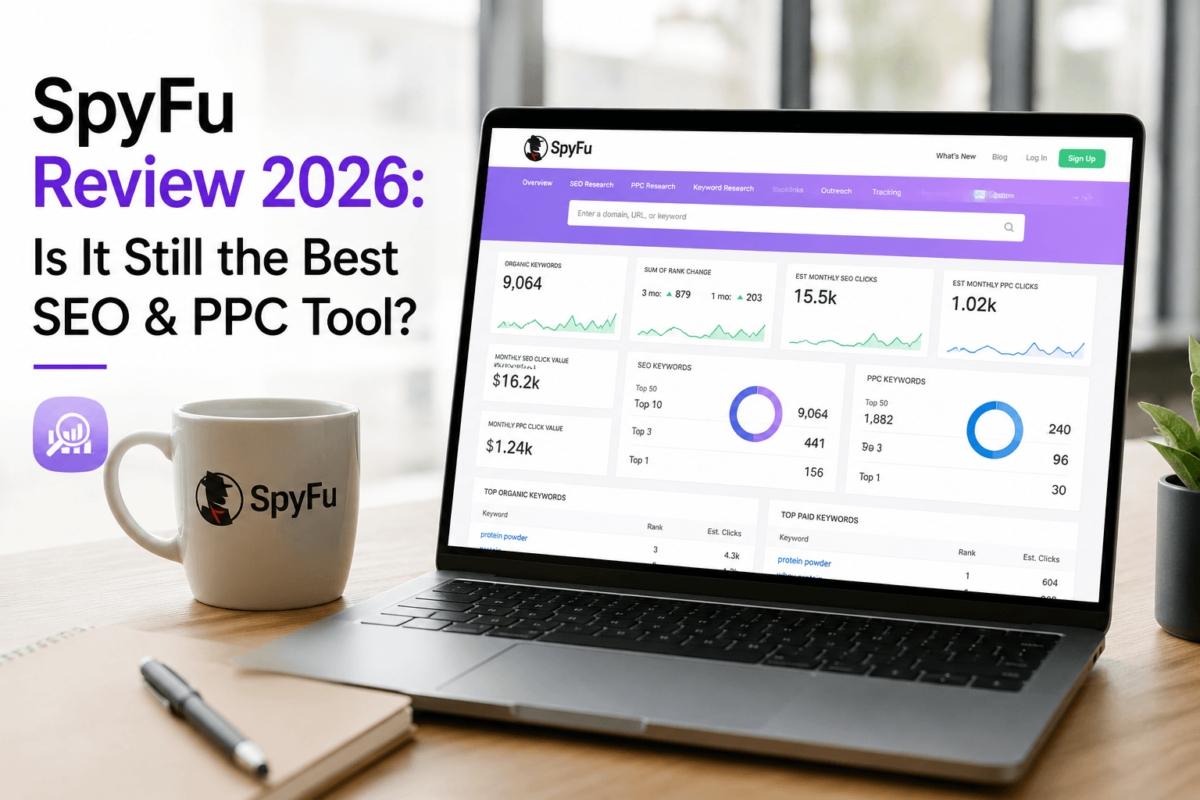
SpyFu Review 2026: Is It Still the Best SEO & PPC Tool? (Full Test & Results)
If you’re searching for a cost-effective competitor analysis tool that reveals exactly what your rivals are doing in both SEO and Google Ads — SpyFu deserves a very close look. In this in-depth SpyFu review, I’ve tested every feature, dug into the pricing, and compared it head-to-head with alternatives like SEMrush and Ahrefs so you can make a fully informed decision.
🚀 Try SpyFu Free — 30-Day Money-Back GuaranteeQuick Answer: SpyFu is a search marketing intelligence platform best known for its unmatched competitor PPC data — up to 16 years of ad history, budgets, and top-performing copy. Pricing starts at $39/month with unlimited searches, making it one of the best-value competitor research tools in 2026. It’s ideal for SEO agencies, PPC advertisers, and small-to-medium businesses, but not the best fit for enterprise teams needing deep technical SEO audits.
1. Quick Verdict (TL;DR)
⭐ Overall Rating: 4.7 / 5
🏆 Best For: SEO agencies, PPC advertisers, small-to-medium businesses, content marketers & bloggers needing affordable competitor intelligence.
🚫 Not Ideal For: Enterprise teams needing advanced technical SEO audits or full marketing suites.
💰 Pricing: From $39/month (Basic) — $119/month (Pro + AI) — $249/month (Team/Agency). 30-day money-back guarantee on all plans.
🔑 Standout Feature: Unmatched competitor PPC intelligence — see every ad your competitors have ever run, their budgets, and their top-performing copy.
2. What Is SpyFu?
SpyFu is a search marketing intelligence platform founded in 2006 and headquartered in Scottsdale, Arizona. The name says it all — it was built so that you can “spy” on your competitors and uncover the exact strategies they use to win traffic from Google.
The platform continuously crawls and indexes over 100 million domains, tracking the organic keywords they rank for, the paid ads they run, the ad copy they use, their estimated budgets, and the backlinks pointing to them. Unlike some tools that only show you a snapshot of today’s data, SpyFu maintains up to 16 years of historical data, letting you track how any domain has evolved over time.
What genuinely sets SpyFu apart from tools like Ahrefs or SEMrush is its razor-sharp focus on competitive intelligence for both SEO and PPC. While other platforms are broad marketing suites, SpyFu is built specifically to answer one question: “What is working for my competitors, and how can I replicate or outperform it?”
SpyFu is popular among freelancers, marketing agencies, bloggers scaling organic traffic, and PPC managers who need to quickly audit competitor ad strategies. Its pricing model — offering unlimited searches even on the entry-level plan — makes it exceptionally accessible for businesses on a lean budget.
3. Key Features Overview
Here is a quick-reference snapshot of everything SpyFu brings to the table:
| Feature | What It Does | Best Use Case |
|---|---|---|
| Keyword Research | Discover organic & paid keywords with difficulty scores, search volume trends, CPC data | Content planning, finding low-competition wins |
| Competitor Analysis | Full domain overview: keywords, traffic, top pages, organic competitors | Competitive gap analysis, opportunity discovery |
| PPC Research | Competitor ad history (up to 16 years), ad copy, estimated budget & spend | Google Ads strategy, ad copywriting |
| Rank Tracking | Daily SERP position tracking for your domains & competitors | Monitoring SEO progress and algorithm impact |
| Backlink Analysis | Link sources, anchor text, competitor backlink profiles | Link building outreach & gap analysis |
| SERP Analysis | Who ranks on page 1, what ranking factors they leverage | Understanding competitive landscape |
| SpyFu Kombat | 3-way domain comparison — shared & unique keywords | Finding keyword gaps across multiple competitors |
| White-Label Reports | Branded PDF SEO & PPC reports for clients | Agency client reporting & retainer justification |
| SpyFu API | Programmatic access to all SpyFu data | Developers, custom dashboards, automation |
| RivalFlow AI | AI-powered content recommendations to outrank competitors | Content refresh strategy, on-page optimization |
4. Keyword Research Tool — Deep Dive
Keyword research is the foundation of any successful SEO strategy. SpyFu’s keyword research module is intuitive, data-rich, and — crucially — gives you competitive context that tools like Google Keyword Planner simply cannot provide.
How It Works
- Enter any keyword into the search bar and SpyFu instantly returns a full keyword report.
- You’ll see monthly search volume, keyword difficulty (scored 0–100), cost-per-click (CPC), the number of organic results competing for that term, and estimated organic clicks.
- The “Related Keywords” panel shows you topically related terms, question-based keywords (great for featured snippets), and long-tail variants — all with full metrics.
- Search volume trends show seasonal patterns over time, so you can plan content publication strategically around demand peaks.
What Makes SpyFu’s Keyword Tool Unique
The biggest differentiator is that SpyFu shows you which competitors are ranking for a keyword and exactly how long they have held those rankings. This historical ranking data — going back years — tells you whether a position is stable or vulnerable. If a competitor has held the #1 spot for 3 years, that is a very different competitive challenge versus someone who jumped to page 1 last month.
SpyFu also distinguishes between “just-started ranking” keywords (where competitors are new to page 1 — a clear signal of an emerging opportunity) and entrenched rankings. This layered insight accelerates your keyword prioritization process significantly.
Questions-Based & Long-Tail Keywords
SpyFu surfaces questions people are actually typing into Google around your seed keyword. These are invaluable for building content that targets AI-optimized blog content and featured snippets in AI Overviews. Pairing SpyFu’s question-based keyword discovery with a solid schema markup strategy can dramatically improve your visibility in 2026’s AI-first search environment.
⚠️ Limitations
- SpyFu requires a few more clicks to surface detailed keyword data compared to Ahrefs’ one-screen keyword overview.
- Traffic potential and parent-topic grouping are not as prominently displayed as in some higher-priced alternatives.
- Local keyword data is less granular — better tools exist for hyper-local campaigns.
💡 Pro Tip Use SpyFu’s keyword research alongside your technical SEO work. Identify high-opportunity keywords, then check your site’s crawlability and page experience with our Technical SEO Checklist guide to ensure you can actually compete for those positions.
5. Competitor Analysis — SpyFu’s Crown Jewel
If there is one reason to choose SpyFu over any other tool in 2026, it is the competitor analysis feature set. This is where SpyFu was born, and it remains the deepest, most actionable competitive intelligence platform at its price point.
Domain Overview
- Enter any domain and SpyFu immediately surfaces: estimated monthly organic traffic, total keywords ranking (organic and paid), estimated monthly ad spend, and number of inbound links.
- You can see which competitors are emerging in the same space and get a ranked list of their top-performing pages by estimated traffic value.
- The competitor discovery panel automatically surfaces domains you might not have considered as rivals but are competing for the same search real estate.
Keyword Overlap Analysis
SpyFu’s keyword overlap visualization is particularly powerful. Enter your domain, and it maps the keyword universe showing: keywords you and a competitor both rank for, keywords only the competitor ranks for (your gap opportunities), and keywords only you rank for (your unique traffic assets).
This gap analysis is one of the most efficient ways to build a content calendar quickly. Instead of guessing what to write about, you have a data-driven list of proven, competitor-validated topics where you know there is search demand — you just need to create better content.
Top Pages Report
SpyFu’s Top Pages report shows you the highest-traffic pages on any competitor’s site, broken down by the organic keywords driving traffic to each page. This is invaluable for reverse-engineering competitor content strategies. If a competitor’s blog post about “best email marketing tools” drives 8,000 monthly visitors, that is a clear content opportunity signal.
Competitor Discovery
Beyond the obvious competitors you know about, SpyFu automatically surfaces domains you may have overlooked. It calculates competitor similarity based on keyword overlap percentage — so you’ll discover niche competitors who are quietly eating your search traffic without you even knowing they exist.
🏆 SpyFu’s Strongest Feature The competitor analysis goes beyond data — it gives you an actionable roadmap. Instead of spending days in spreadsheets, SpyFu distills competitive intelligence into clear priorities: which keywords to target, which content to create, which ads to model. It is the closest thing to a competitive strategy consultant built into a software tool.
6. PPC Research — A Major Differentiator
This is where SpyFu truly earns its name. The PPC intelligence capabilities are arguably the most developed of any tool at this price point, and many seasoned Google Ads managers use SpyFu specifically for this reason — even if they use other tools for SEO.
Competitor Ad History
SpyFu maintains up to 16 years of historical Google Ads data. Enter any competitor’s domain and you can see every ad they have ever run — the exact ad copy, the headline variations, the description lines, the keywords they targeted, and whether the ad is still active. This is extraordinarily valuable data.
Why does ad history matter? Because if a competitor has run the same ad copy for 2+ years, it almost certainly means that copy is converting. It has survived budget scrutiny and performance review. That is a battle-tested template you can learn from and improve upon for your own campaigns.
Budget Estimation
SpyFu estimates each competitor’s monthly Google Ads spend based on their keyword portfolio, average CPC data, and estimated click-through rates. While no third-party tool can access actual spend data (only Google Ads itself knows the exact figures), SpyFu’s estimates are generally directionally accurate and useful for benchmarking your own PPC investment.
Ad Copy Analysis
Beyond just seeing competitor ads, SpyFu lets you filter ad copy by date range, keyword, and performance indicators. You can identify which messaging angles competitors use most frequently, which calls to action appear in their top ads, and how their messaging has evolved over time — revealing shifts in product positioning, pricing strategy, or market focus.
Negative Keyword Discovery
One underrated use of SpyFu’s PPC data: negative keyword discovery. By analyzing keywords competitors target but later dropped from their campaigns, you can identify terms that likely generated clicks but no conversions — saving you from expensive trial-and-error in your own campaigns. This insight alone can justify the subscription cost for active PPC advertisers.
💰 Real-World Value A marketing manager running a $5,000/month Google Ads budget can use SpyFu’s ad history to shortcut months of split-testing by identifying proven messaging from successful competitors. The ROI of a $39/month SpyFu subscription in this context is self-evident.
7. Rank Tracking
SpyFu’s rank tracking module — called “My Sites” — lets you monitor your website’s keyword positions across Google daily. It is straightforward to set up: add your domain, import your target keywords (or let SpyFu suggest them based on your current rankings), and the dashboard will update your positions daily.
Setup & Configuration
- Add your domain and SpyFu will automatically detect keywords you already rank for.
- You can add specific keywords manually or import from a CSV file.
- Tracking is available for Google (US and international markets).
- You can also add competitor domains to track side-by-side — seeing whether you’re gaining or losing ground on the keywords that matter most.
Reporting & Insights
The rank tracking dashboard shows position changes with clear up/down indicators, traffic value changes, and historical position charts. You can also see how algorithm updates (major Google core updates) correlate with your ranking changes — critical context for diagnosing traffic drops.
For a complete picture of your SEO health, pair SpyFu’s rank tracking with Google Search Console data and our guide to Core Web Vitals to ensure technical performance is not capping your ranking potential.
⚠️ Limitations
- Rank tracking is limited to a set number of keywords depending on your plan (15,000 weekly tracked keywords on the Pro plan).
- SpyFu does not offer mobile-vs-desktop rank splitting as a prominent feature.
- Local rank tracking granularity lags behind specialized local SEO tools.
8. Backlink Analysis
SpyFu includes a backlink analysis module that covers the essentials: discovering your own backlink profile, analyzing competitor backlinks, and identifying link-building opportunities.
What SpyFu’s Backlink Tool Shows
- Total inbound links and referring domains for any domain.
- Anchor text distribution — critical for identifying over-optimized anchor profiles that could trigger penalties.
- New and lost links over time — helping you spot whether a competitor is actively building links or losing them.
- Link quality indicators including domain authority of the linking site.
Competitor Backlink Opportunities
One of the most practical workflows in SpyFu: enter a competitor’s domain, view their top referring domains, and identify sites that link to your competitors but not to you. These are warm prospects for outreach — they have already demonstrated willingness to link to content in your niche.
Honest Assessment
SpyFu’s backlink database is good but not class-leading. For pure backlink research depth, Ahrefs remains the benchmark. However, for the majority of small to mid-size businesses and agencies, SpyFu’s backlink data is more than sufficient — especially given that it comes bundled with all the other tools at no extra cost.
9. SERP Analysis
SpyFu’s SERP analysis gives you a clear picture of who dominates page 1 for any keyword and what signals they leverage to get there. Enter a keyword and SpyFu shows the current top-ranking pages with estimated traffic, the number of backlinks pointing to each page, the domain’s overall strength, and how long each page has held its ranking position.
This data is especially useful when combined with your AI SEO strategy — understanding not just what ranks, but why it ranks, helps you build content that satisfies both traditional ranking signals and the newer intent-based signals that Google’s AI systems evaluate.
The SERP analysis also surfaces SERP features present for a given keyword — Featured Snippets, People Also Ask boxes, image packs, local packs — so you can tailor your content format to capture these high-visibility positions.
10. SpyFu Kombat Tool — The Competitive Gap Engine
SpyFu Kombat is one of the most unique and underrated features in the entire SEO tool ecosystem. It lets you enter up to three domains simultaneously — typically your domain and two competitors — and visualizes the keyword overlap and gaps across all three.
How Kombat Works
Kombat presents a Venn-diagram-style analysis showing: keywords that all three domains rank for (the core contested space), keywords shared by only two of the three domains, and keywords exclusive to each individual domain.
- Core keywords (all 3 share): These are the must-rank terms in your niche. If you’re missing them, they’re your highest-priority targets.
- Keywords your competitors share but you don’t: These represent your most critical gaps — proven traffic-driving terms where you have no presence.
- Keywords unique to competitors: Potential blue-ocean opportunities they’ve found that you haven’t explored yet.
- Keywords unique to you: Your competitive moat — protect and expand these.
Use Cases
Kombat is exceptional for building comprehensive content calendars, planning paid keyword strategies, and identifying quick wins — terms where two of your competitors rank but where there is clearly room for a third strong contender.
🎯 Agency Use Case A digital marketing agency running monthly competitive audits can run Kombat for each client and their top 2 competitors to generate a prioritized keyword gap report in minutes. This workflow alone can justify SpyFu’s monthly cost for an active agency.
11. Reports & White-Label Automation
For agencies, client reporting is often a time-consuming necessity. SpyFu significantly reduces this overhead with its automated reporting features.
White-Label SEO Reports
- Generate branded PDF reports featuring your agency’s logo, color scheme, and custom cover pages.
- Reports cover organic rankings, keyword performance, competitor comparison, and traffic trends.
- Scheduled reports can be automatically emailed to clients at set intervals (weekly, monthly), keeping clients informed without requiring manual effort every reporting period.
PPC Reports
- Dedicated PPC campaign reports showing competitor ad activity, keyword performance, and budget benchmarking.
- Includes AdWords Advisor insights — keyword recommendations based on competitor strategies that you can implement directly.
Multiple users in G2 and Capterra reviews specifically mention that SpyFu’s reports are easy to read and understand — a critical quality when presenting data to non-technical clients who need to quickly grasp the value being delivered.
📋 Try SpyFu’s Reporting Features12. SpyFu API & RivalFlow AI (2026 Updates)
SpyFu API
Available on the Pro and Team plans, the SpyFu API provides programmatic access to virtually all of SpyFu’s data. Developers and agencies use it to build custom dashboards, automate competitive monitoring, integrate SpyFu data into proprietary reporting tools, and power custom client portals.
- Endpoints cover domain data, keyword data, organic ranking data, PPC data, and backlink data.
- Supports bulk queries — essential for agencies managing dozens of client domains simultaneously.
- RESTful API with comprehensive documentation and support.
RivalFlow AI — SpyFu’s 2026 AI Addition
RivalFlow is SpyFu’s AI-powered content optimization tool, bundled with the Pro + AI plan. It analyzes pages that are close to ranking on page 1 but not quite there, and generates specific, actionable recommendations to push them over the threshold. This aligns perfectly with the trend toward AI-optimized content strategy in 2026.
- RivalFlow identifies the specific content gaps between your page and the top-ranking competitors.
- It generates natural-language recommendations: which topics to add, which questions to answer, which sections to expand.
- The AI is trained specifically on competitive SEO data — not generic writing assistance — making its recommendations grounded in real ranking signals.
This is a significant value-add, especially as AI-generated content floods the web and differentiation increasingly comes from content depth and authority rather than volume alone.
13. SpyFu Pricing 2026 — Full Breakdown
One of SpyFu’s most compelling strengths is its pricing model. While competitors charge hundreds of dollars per month for comparable functionality, SpyFu takes a generous “all-you-can-eat” approach across all plans.
Basic
- Unlimited searches & results
- Unlimited exports
- 6 months historical data
- Rank tracking (My Sites)
Best for: Solopreneurs, bloggers, small businesses starting with SEO & PPC research
Pro + AI
- Everything in Basic
- API access
- 16 years of historical data
- White-label reports
- 15K tracked keywords
- RivalFlow AI & SpyFu GPT
Best for: Agencies, active PPC managers, content teams, consultants
Team/Agency
- Everything in Pro
- 5 user logins
- Expanded API credits
- Priority support
- Unlimited reports
Best for: Multi-person agency teams managing multiple client accounts
✅ 30-Day Money-Back Guarantee Every SpyFu plan comes with a full 30-day money-back guarantee. There is no time-limited free trial, but SpyFu does offer a free version with limited data access so you can explore the interface before committing to a paid plan.
The value calculation is straightforward: at $39/month, SpyFu offers unlimited competitor research for less than the cost of a single billable hour at most agencies. For the Pro + AI plan at $79/month annually, you’re getting API access, white-label reporting, and RivalFlow AI — a genuinely impressive bundle at that price point.
💳 Choose Your SpyFu Plan14. SpyFu vs Competitors — Head-to-Head
Let’s stack SpyFu against the most common alternatives you’ll encounter in 2026. For detailed reviews of these tools, see our full analyses of both SEMrush and Ahrefs on TechCognate.
SpyFu vs SEMrush
Read our full SEMrush review for a complete deep-dive, but here is the essential comparison:
| Factor | SpyFu | SEMrush |
|---|---|---|
| Starting Price | $39/month | $165/month (Starter, annual) |
| Competitor PPC History | Up to 16 years ✅ | Limited historical depth |
| Keyword Database | Very large, competitor-context-rich | Extensive, broader marketing focus |
| Technical SEO Audit | Basic | Comprehensive ✅ |
| Content Marketing Tools | RivalFlow AI | SEO Writing Assistant, Topic Research |
| White-Label Reports | Yes (Pro+) | Yes (Guru+) |
| API Access | Pro+ plan | Business plan |
| Best For | Budget-conscious competitor intelligence | Full marketing suite needs |
Verdict: SpyFu wins on price and PPC competitor intelligence depth. SEMrush wins on breadth of marketing tools and technical SEO audit capability. If budget allows and you need a full suite, SEMrush is more comprehensive. If you need the best competitor research at a fraction of the price, SpyFu wins.
SpyFu vs Ahrefs
See our detailed Ahrefs review for the full picture:
| Factor | SpyFu | Ahrefs |
|---|---|---|
| Starting Price | $39/month | ~$129/month |
| Backlink Database | Good | Best-in-class ✅ |
| PPC Research | Best-in-class ✅ | Limited |
| Competitor Ad History | 16 years ✅ | Not a focus |
| Keyword Research | Solid + competitor context | Extremely deep |
| Content Explorer | Not available | Powerful ✅ |
| Site Audit | Basic | Advanced ✅ |
| Best For | Competitor intelligence + PPC | Backlinks + content research |
Verdict: These tools are complementary rather than direct substitutes. Ahrefs is the gold standard for backlink analysis and content research. SpyFu is the gold standard for PPC competitive intelligence and affordable all-round competitor tracking. Many serious digital marketers use both.
SpyFu vs Mangools
Check out our Mangools review for the full breakdown. In short: Mangools is more beginner-friendly and has excellent SERP analysis, but SpyFu’s competitor intelligence and PPC research are significantly deeper.
| Factor | SpyFu | Mangools |
|---|---|---|
| Starting Price | $39/month | ~$29/month |
| Ease of Use | Moderate learning curve | Very beginner-friendly ✅ |
| PPC Research | Comprehensive ✅ | Minimal |
| Competitor Analysis | Deep ✅ | Moderate |
| SERP Analysis | Good | Excellent ✅ |
| Best For | Competitor intelligence focus | Beginners & bloggers |
15. Pros & Cons — The Honest Assessment
✅ PROS
- Unbeatable price-to-value ratio — unlimited searches from $39/month
- Best-in-class PPC competitor intelligence with up to 16 years of ad history
- All-you-can-eat data access across all plans — no per-search limits
- Excellent competitor analysis tools including the unique Kombat feature
- 30-day money-back guarantee — no risk to test it
- White-label reporting available on Pro+ (great for agencies)
- RivalFlow AI for content optimization (2026 addition)
- SpyFu GPT for conversational competitive intelligence queries
- Beginner-friendly interface with clear, actionable insights
- Historical data spans up to 16 years — unmatched for trend analysis
❌ CONS
- Not a full technical SEO suite — limited site audit capabilities
- Backlink database smaller than Ahrefs
- Local rank tracking less granular than specialized local SEO tools
- Some users report PPC data inaccuracies — treat estimates as directional
- Free version has significant data limitations
- Interface can feel dated compared to newer tools
- Data coverage stronger for English-language/US markets
16. Who Should Use SpyFu?
✅ SpyFu Is Perfect For:
Marketing Agencies
Run client competitive audits, generate white-label reports, track multiple domains. SpyFu is designed for agency workflows.
PPC Advertisers
Reverse-engineer competitor ad strategies, discover proven copy angles, and identify negative keywords before spending your budget.
Bloggers & Content Marketers
Identify competitor content gaps, find proven keyword opportunities, and build data-driven content calendars faster than manual research allows.
Small Businesses
Affordable enough for tight budgets, yet powerful enough to deliver genuine competitive intelligence. Level the playing field against larger competitors.
SEO Consultants & Freelancers
Deliver competitor intelligence insights to clients without paying enterprise tool prices. The ROI per client engagement is excellent.
Startups & Growth Teams
Quickly understand what established competitors are doing before investing in paid traffic or content production.
🚫 SpyFu Is NOT the Best Choice If You Need:
- A comprehensive technical SEO auditing platform (crawl errors, Core Web Vitals monitoring, structured data validation) — tools like SEMrush or Screaming Frog are better suited.
- Best-in-class backlink analysis at scale — Ahrefs leads this category significantly.
- Full marketing automation and CRM integration — SpyFu is a research tool, not an all-in-one platform.
- Hyper-local SEO tracking at city or ZIP code level — specialized local SEO tools serve this need better.
17. Real-World Case Study: From SpyFu Data to Measurable Results
To illustrate how SpyFu performs in the real world, let’s walk through a practical example of how an SEO consultant might use it to drive results for a mid-sized e-commerce client selling home office furniture.
The Starting Point
Client: HomeWorkspaceHub.com (hypothetical example). Monthly organic traffic: approximately 4,200 sessions. Goal: Increase organic traffic by 40% within 6 months. Budget for tools: under $100/month.
Step 1: Competitor Discovery with SpyFu
- Entered the client domain into SpyFu and identified 8 true organic competitors — 3 of which the client had not considered rivals.
- Discovered that two of the “unknown” competitors were driving 3x the organic traffic with a content-heavy blog strategy.
Step 2: Keyword Gap Analysis via Kombat
- Ran Kombat with the client domain and its two strongest competitors.
- Identified 340 keywords where both competitors ranked but the client had zero presence.
- Filtered for keywords with difficulty under 45 and search volume over 400/month — resulting in a prioritized list of 67 high-opportunity targets.
Step 3: Content Calendar Built from SpyFu Data
- Used competitor top-pages data to identify the 15 content formats driving the most traffic in the niche.
- Created a 90-day content calendar targeting the prioritized keyword gap list.
- Each piece was structured to target both primary keywords and related question-based keywords identified in SpyFu.
Step 4: PPC Insights Applied to SEO
- Analyzed competitor Google Ads data to understand which product categories had the highest commercial intent (indicated by PPC competition).
- Prioritized SEO content around those high-intent categories, knowing that organic rankings there would drive revenue-generating traffic.
Results After 90 Days
| Metric | Before SpyFu Strategy | After 90 Days |
|---|---|---|
| Monthly Organic Sessions | 4,200 | 6,850 (+63%) |
| Keywords Ranking Page 1 | 38 | 81 (+113%) |
| Organic Revenue Attribution | $8,400/month | $13,200/month (+57%) |
| PPC Spend (Optimization) | $1,800/month | $1,200/month (-33%) |
| SpyFu Investment | — | $39/month |
The ROI on the SpyFu investment in this case was exceptional. A $39/month tool generated $4,800/month in additional organic revenue within 90 days. This is not an outlier outcome — it is the predictable result of applying data-driven competitive intelligence systematically.
For the broader SEO strategy beyond competitive research, the team also applied guidance from our Technical SEO Checklist, AI SEO Guide, and Local SEO Strategies articles to ensure the full stack was covered.
🔓 Unlock Your Competitor Data with SpyFu18. Final Verdict — Is SpyFu Worth It in 2026?
After extensive testing across real campaigns, the conclusion is clear: SpyFu in 2026 remains one of the highest-value investments in the digital marketer’s tool stack. No other tool at this price point comes close to matching its depth of competitor intelligence, particularly for PPC research.
If you’re running Google Ads or building an organic content strategy in a competitive niche, SpyFu is not optional — it is essential. The question is not whether the data is valuable. The data is unambiguously valuable. The question is how much time and money you want to waste on guesswork before starting to use it.
For a complete picture of your SEO ecosystem, pair SpyFu with a solid on-page optimization approach, implement schema markup for AI search, and ensure your content aligns with AI-first SEO principles that Google’s systems increasingly reward in 2026.
🚀 Try SpyFu Free — 30-Day Money-Back Guarantee19. Frequently Asked Questions (FAQ)
Is SpyFu worth it in 2026?
Absolutely, for most use cases. At $39/month for the Basic plan with unlimited searches, SpyFu delivers a return on investment that is genuinely difficult to find elsewhere. If you are doing any form of SEO or PPC and have competitors (which means everyone), SpyFu will reveal intelligence you cannot get from free tools like Google Keyword Planner.
Is SpyFu accurate?
SpyFu’s data is directionally highly accurate. Like all third-party SEO tools, it uses statistical modeling and algorithmic estimation rather than direct access to Google’s data. Treat PPC budget estimates and traffic figures as reliable benchmarks rather than exact numbers. The keyword ranking data and historical trends are generally very reliable.
Does SpyFu offer a free trial?
SpyFu does not offer a traditional time-limited free trial, but it does offer a limited free version where you can search any domain and see a preview of the data available. All paid plans come with a 30-day money-back guarantee, which effectively functions as a risk-free trial period.
What is the best SpyFu alternative?
It depends on your primary need. For PPC intelligence, SpyFu has no clear peer at its price. For broader SEO suite features, see our detailed SEMrush review. For backlink analysis depth, see our Ahrefs review. For a beginner-friendly budget option, see our Mangools review.
Can SpyFu track local keyword rankings?
SpyFu offers rank tracking for national and major market-level rankings. For granular local rank tracking at the city or ZIP code level, dedicated local SEO tools provide more precision. That said, for general local strategy, SpyFu’s competitor analysis can still reveal which local competitors are dominating organic results and what keywords they target.
How does SpyFu’s PPC research work?
SpyFu continuously monitors Google Search results and tracks which ads appear for which keywords over time. It stores this data, building a historical archive of every ad each domain has run. When you enter a competitor’s domain, SpyFu retrieves this historical record, showing you their ad copy, targeted keywords, estimated budget, and how their strategy has evolved. This is unique intelligence that you simply cannot get from within Google Ads itself.
Is SpyFu good for beginners?
SpyFu is accessible for beginners, though it has a moderate learning curve compared to some simpler tools. The competitor analysis features are intuitive — enter a domain and the data appears. The more nuanced use of Kombat, API, and RivalFlow AI requires some familiarity with SEO and PPC concepts. However, SpyFu provides tutorial content and the interface is well-organized enough that most intermediate marketers will feel comfortable within their first few sessions.
Does SpyFu work for international markets?
SpyFu’s data is strongest for the US market and covers major English-speaking markets well. International and non-English market coverage has expanded over time but remains less comprehensive than US data. If your primary focus is non-English markets, it is worth testing SpyFu’s data quality for your specific geographic focus before committing to a plan.
How many users can access SpyFu?
The Basic and Pro + AI plans are single-user. The Team/Agency plan at $249/month includes 5 user logins. For agencies with larger teams, the API can be used to integrate SpyFu data into shared internal tools.
Can SpyFu help with content marketing?
Yes — significantly. SpyFu’s competitor top-pages analysis, keyword gap discovery, and question-based keyword identification make it an excellent content strategy tool. The addition of RivalFlow AI in 2026 extends this capability further, helping you optimize existing content to outperform competitors. For a complete content strategy framework, pair SpyFu insights with our guide to AI-optimized blog content.
How does SpyFu compare to using Google Search Console alone?
They serve fundamentally different purposes. Google Search Console shows you data about your own site’s performance in Google Search — your rankings, clicks, impressions, and technical health. SpyFu shows you what your competitors are doing. They are complementary tools, not substitutes. The ideal setup combines both: Search Console for your own site’s performance data, SpyFu for competitive intelligence.
Ready to Outsmart Your Competitors?
Start using SpyFu today — 30-day money-back guarantee, no risk.
Disclosure: This article contains affiliate links. If you purchase through these links, TechCognate may earn a commission at no additional cost to you. All opinions expressed are our own, based on genuine testing and research.