Best Marketing Automation Software (5 Best Tools Compared)
By Jaykishan Panchal | Updated for 2026 | 15+ years in SEO & SaaS marketing
I’ve spent the better part of the last decade setting up automation workflows for small businesses, so I’ll say this upfront: most “marketing automation” content online is written by people who’ve never actually built a welcome sequence, scored a lead, or watched a workflow silently break at 2 a.m. This guide isn’t that.
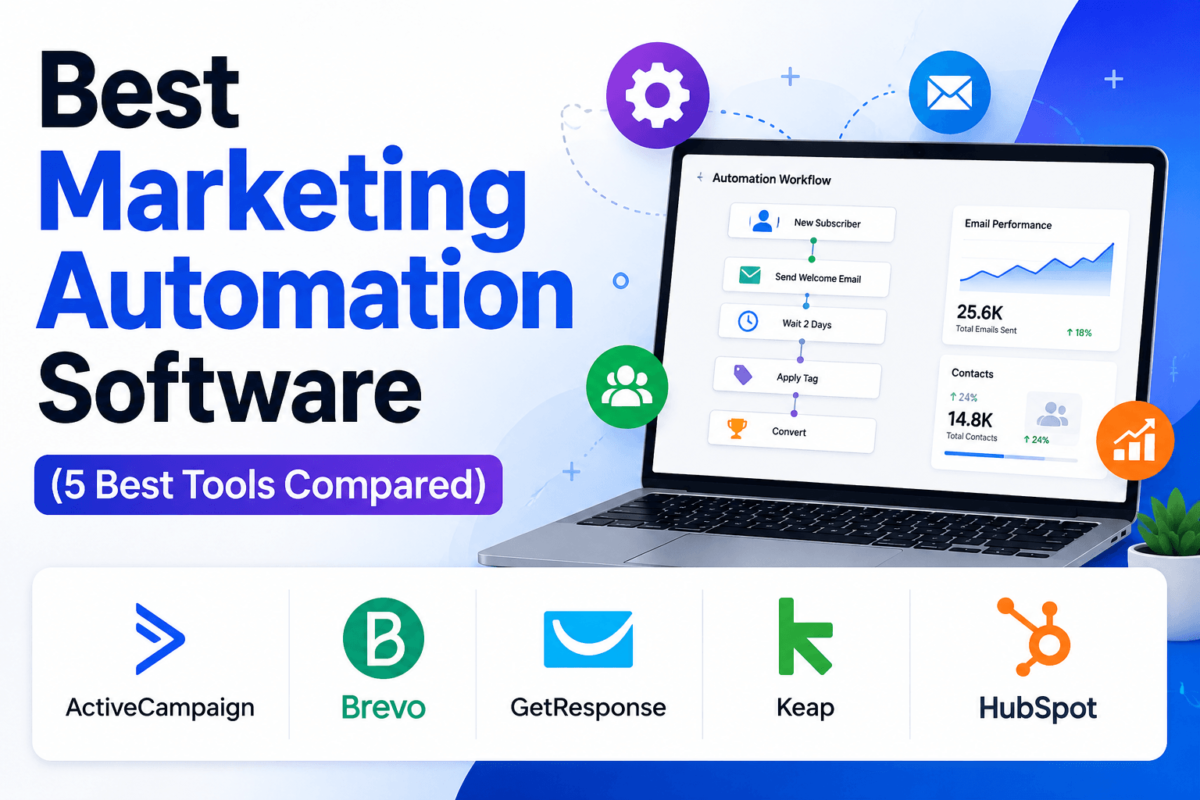
I tested five platforms that businesses actually buy in 2026 — ActiveCampaign, Brevo, GetResponse, Keap, and HubSpot — and compared them on the things that matter when you’re the one paying the bill: how fast you can build a real workflow, whether the CRM is genuinely usable or just bolted on, and what you get for your money at each price tier.
Why Marketing Automation Matters
If you’re still sending one-off email blasts and manually tagging leads in a spreadsheet, you’re leaving money on the table. Marketing automation software connects your email marketing, CRM, landing pages, and lead scoring into one system that runs 24/7 without you touching it.
Businesses are pouring more budget into this category because the math works: companies using marketing automation report roughly $5.44 in return for every $1 spent, and automated lead nurturing produces up to 451% more qualified leads than manual outreach. It’s not hype — it’s the difference between chasing leads and letting the right message reach the right person at the right moment.
Done well, automation improves four things at once:
- Lead generation — forms, landing pages, and lead scoring capture and qualify visitors automatically.
- Email marketing — behavior-triggered sequences replace generic blasts.
- Customer retention — win-back and onboarding flows run without manual follow-up.
- Sales — CRM-integrated automation hands sales reps warm, pre-qualified leads.
Who This Guide Is For
Whether you’re a solo founder sending your first welcome sequence, an agency managing automation for clients, or an operations lead evaluating a switch from spreadsheets to a real CRM — I’ve broken down which of these five tools actually fits your stage of business, not just which one has the flashiest homepage.
How I Evaluated These Tools
Every tool on this list was scored against the same criteria: ease of use, depth of automation, CRM capability, pricing transparency, integrations, customer support, and — since this is a resource for people who monetize content — whether the software currently runs an active, worthwhile affiliate program. I only included tools that pass all seven.
Quick Answer: What Is the Best Marketing Automation Software?
The best overall marketing automation software is ActiveCampaign, thanks to its industry-leading automation builder, built-in CRM, and affordable entry pricing starting at $15/month. HubSpot is the top pick for growing teams that want a full CRM suite, Brevo is the best free option, GetResponse offers the strongest value for content creators, and Keap is best for service businesses that need CRM, invoicing, and automation bundled into one platform.
Marketing Automation Software Comparison Table
Here’s how all five stack up at a glance. Full breakdowns of each are below.
| Software | Best For | Starting Price | Free Plan | CRM | Workflow Builder | AI Features | Rating |
|---|---|---|---|---|---|---|---|
| ActiveCampaign | Small businesses wanting powerful, affordable automation | $15/mo | No (14-day trial) | Yes | Yes — best-in-class | Yes | 4.7/5 |
| HubSpot | Growing teams wanting an all-in-one CRM suite | Free / $15+/seat | Yes | Yes — industry-leading | Yes (Pro+) | Yes | 4.6/5 |
| Brevo | Startups needing a genuinely generous free plan | Free / $9/mo | Yes | Basic, built-in | Yes (Business+) | Yes | 4.5/5 |
| GetResponse | Content creators and ecommerce monetizing an audience | Free / $19/mo | Yes | Basic (tagging/scoring) | Yes (Marketer+) | Yes | 4.4/5 |
| Keap | Service businesses needing CRM + invoicing + automation | $249/mo | No (14-day trial) | Yes — full pipeline | Yes | Limited | 4.3/5 |
Prices shown are starting/entry rates at the lowest contact tier, billed monthly, verified July–August 2026. All five tools raise pricing as your contact list and feature needs grow — see each review below for full breakdowns.
1. ActiveCampaign — Best Overall
ActiveCampaign is the one I recommend most often when someone asks me “just tell me which one to use.” It built its reputation on having the most flexible automation builder in the industry, and in 2026 that’s still true — branching logic, conditional splits, and behavior-based triggers that most competitors can’t match at this price point.
Best For: Small and mid-sized businesses that want serious automation without paying enterprise prices.
Key Features
- Visual, branching automation builder with 900+ pre-built recipes
- Built-in Sales CRM with deal pipelines (Plus plan and above)
- Site and event tracking that feeds automation triggers
- Lead and predictive scoring based on engagement behavior
- AI features: generative email content, predictive sending, and inbox-friendly subject lines
- SMS and WhatsApp messaging (Core/Plus and higher tiers)
- 900+ native integrations, including Shopify, WooCommerce, and Salesforce
Pros & Cons
|
Pros
|
Cons
|
Pricing
ActiveCampaign uses four contact-based tiers (1,000 contacts, billed annually):
- Starter — $15/mo: email marketing, basic automation, 1 user
- Plus — $49/mo: adds CRM, landing pages, and lead scoring
- Pro — $79/mo: adds predictive sending and site messaging
- Enterprise — $145/mo: custom reporting, dedicated support
A 14-day free trial is available on every plan, plus a 20% discount for nonprofits.
Affiliate Program
ActiveCampaign’s program runs through PartnerStack and pays a tiered 20–30% recurring commission for up to 12 months per referred customer, with a 90-day cookie window. It’s one of the stronger recurring-commission SaaS programs in this space.
| Ease of Use | Automation | Value | Support | Overall |
|---|---|---|---|---|
| 4.3/5 | 4.9/5 | 4.6/5 | 4.4/5 | 4.7/5 |
Who should buy it: Businesses that want to build genuinely sophisticated automation workflows without paying HubSpot-level prices.
Who should skip it: Anyone who needs a permanently free plan, or a business that just wants basic email newsletters with no automation.
Try ActiveCampaign Free for 14 Days →
2. HubSpot — Best for Growing Teams & CRM Integration
HubSpot is the platform most businesses graduate to once they outgrow a pure email tool. Its free CRM is genuinely one of the best on the market, and Marketing Hub layers automation, landing pages, and AI content tools on top of it. The tradeoff is price — once you need real workflow automation, you’re jumping into Professional-tier territory.
Best For: Growing companies that want marketing, sales, and service data unified in one CRM suite.
Key Features
- Free CRM with unlimited users and up to a million contacts
- Workflow automation with branching logic (Professional and Enterprise)
- Breeze AI: content assistant, AI agents, and predictive lead scoring
- Native landing pages, forms, and live chat
- Multi-touch revenue attribution and customer journey analytics (Enterprise)
- Deep integration with Sales Hub, Service Hub, and Content Hub
Pros & Cons
|
Pros
|
Cons
|
Pricing
- Free — $0: CRM, basic email, forms, live chat (HubSpot branded)
- Starter — from ~$15–20/seat/mo: 1,000 marketing contacts, basic automation
- Professional — from ~$890/mo: full workflow builder, 2,000 contacts, 3 seats, plus a $3,000 one-time onboarding fee
- Enterprise — from ~$3,600/mo: 10,000 contacts, 5 seats, advanced attribution, plus a $7,000 onboarding fee
Annual billing typically saves 10–20% versus month-to-month.
Affiliate Program
HubSpot’s affiliate program (via Impact) pays a flat 30% recurring commission for up to 12 months, with cookie windows reported up to 180 days — one of the longest in the SaaS space, which matters given HubSpot’s typically longer sales cycle.
| Ease of Use | Automation | Value | Support | Overall |
|---|---|---|---|---|
| 4.5/5 | 4.5/5 | 4.0/5 | 4.6/5 | 4.6/5 |
Who should buy it: Growing teams that want marketing, sales, and service in one system, and can absorb the Professional-tier price jump.
Who should skip it: Solo operators and small budgets — you’ll outgrow the free plan’s automation limits fast, and Professional is a big leap.
Try HubSpot Marketing Hub Free →
3. Brevo — Best Free Option
Brevo (formerly Sendinblue) flips the usual pricing model on its head — instead of charging by contact count, it charges by emails sent. That makes its free plan unusually generous: 300 emails a day with unlimited stored contacts, forever. For a business with a large list that emails infrequently, that’s a real advantage over contact-based competitors.
Best For: Startups and budget-conscious teams that want automation and a CRM without paying for either right away.
Key Features
- Send-based pricing instead of contact-based — unlimited contacts on every plan
- Built-in CRM, transactional email, and SMS/WhatsApp messaging
- Marketing automation workflows (Business plan and above)
- Landing pages and A/B testing (Business plan and above)
- AI-assisted subject lines and contact segmentation
- Facebook Ads integration and advanced reporting
Pros & Cons
|
Pros
|
Cons
|
Pricing
- Free — $0: 300 emails/day, unlimited contacts, 1 user
- Starter — from $9/mo: 5,000 emails/month, logo removal add-on available
- Business — from $18/mo: adds automation, A/B testing, landing pages, priority support
- Enterprise — custom pricing: dedicated IP, SSO, dedicated support
Affiliate Program
Brevo’s program runs via PartnerStack with a fixed structure rather than a percentage: roughly €5 per free sign-up plus €100 when that referral upgrades to a paid plan, tracked on a 90-day cookie. It’s predictable, if less lucrative per-sale than the recurring-commission programs above.
| Ease of Use | Automation | Value | Support | Overall |
|---|---|---|---|---|
| 4.6/5 | 4.0/5 | 4.8/5 | 4.2/5 | 4.5/5 |
Who should buy it: Startups and small teams who want to test automation and a CRM before committing budget to either.
Who should skip it: High-frequency senders (daily newsletters, heavy promo emails) — send-based pricing gets expensive fast at that volume.
4. GetResponse — Best for Content Creators & Ecommerce
GetResponse has quietly become one of the more interesting platforms in this list because it doesn’t stop at email — it bundles in webinars, a course creator, and a website builder once you’re on the Creator plan. If you’re monetizing an audience beyond just selling a product, that combination is hard to find elsewhere at this price.
Best For: Content creators, coaches, and ecommerce stores that want automation plus monetization tools in one place.
Key Features
- Unlimited automation workflows on Marketer plan and above
- Ecommerce tracking, abandoned cart automation, and revenue tracking
- Live and automated webinar hosting (Creator plan and above)
- AI email generator, AI subject lines, and AI website builder
- Unlimited landing pages and signup forms on paid plans
- Course creator with student management (Creator plan)
Pros & Cons
|
Pros
|
Cons
|
Pricing
- Free — $0: 500 contacts, 2,500 emails/month, basic tools
- Starter — $19/mo: unlimited emails, 1 automation workflow, basic automation
- Marketer — $59/mo: unlimited workflows, ecommerce automation, sales funnels
- Creator — $69/mo: adds webinars, course creator, website builder
- MAX / Enterprise — custom pricing: dedicated IP, phone support, enterprise API limits
Annual billing takes roughly 18% off, and all prices above are at the 1,000-contact tier.
Affiliate Program
GetResponse offers affiliates a choice: up to 33% recurring commission, or a flat $100 bounty per sale ($150 for Content Monetization plans), on a 120-day cookie window — one of the most flexible affiliate structures on this list.
| Ease of Use | Automation | Value | Support | Overall |
|---|---|---|---|---|
| 4.4/5 | 4.2/5 | 4.4/5 | 4.3/5 | 4.4/5 |
Who should buy it: Creators, coaches, and ecommerce brands who want email, webinars, and course delivery under one login.
Who should skip it: Businesses that need a genuine CRM with a sales pipeline — GetResponse’s contact management is intentionally lightweight.
5. Keap — Best for Service Businesses
Keap (formerly Infusionsoft) takes a different approach than everyone else on this list: instead of tiered feature plans, it sells one all-inclusive package that bundles CRM, automation, invoicing, payments, and appointment scheduling. If you’re a coach, consultant, or service business juggling five separate tools right now, Keap can genuinely replace that whole stack.
Best For: Coaches, consultants, and service-based small businesses that want CRM, invoicing, and automation in a single system.
Key Features
- Full CRM with sales pipeline, included on every plan
- Visual automation builder for email, SMS, and task sequences
- Built-in invoicing and payment processing
- Appointment scheduling synced to automation triggers
- Landing pages and a library of prebuilt “Campaign Blueprints”
- SMS text marketing (U.S. and Canada)
Pros & Cons
|
Pros
|
Cons
|
Pricing
Keap has moved to a single all-inclusive plan rather than feature tiers:
- Base plan — $249/mo billed annually ($299/mo month-to-month): 2 users, 1,500 contacts, every feature included
- Additional users run $29–49/month per seat
- Additional contacts beyond your included limit run roughly $0.50–$1.00 per contact/month
- A one-time $500 implementation package is required for new accounts
A 14-day free trial is available, no credit card required.
Affiliate Program
Keap’s referral program, run through PartnerStack, pays a 20% recurring commission for up to 12 months on a 90-day cookie window. Given Keap’s $249+/month price point, even a 20% rate produces a meaningfully higher per-sale payout than lower-priced tools.
| Ease of Use | Automation | Value | Support | Overall |
|---|---|---|---|---|
| 3.9/5 | 4.3/5 | 3.8/5 | 4.5/5 | 4.3/5 |
Who should buy it: Service businesses managing 1,500–10,000 contacts that want CRM, invoicing, and automation without stitching together separate tools.
Who should skip it: Anyone on a tight budget — at $249+/month plus a mandatory setup fee, Keap is the most expensive option here by a wide margin.
Best Marketing Automation Software by Category
| Category | Winner |
|---|---|
| Best Overall | ActiveCampaign |
| Best Value | Brevo |
| Best Free Option | Brevo |
| Best CRM Integration | HubSpot |
| Best for Ecommerce | GetResponse |
| Best for Agencies | ActiveCampaign |
| Best for Email Marketing | ActiveCampaign |
| Best for Beginners | Brevo |
| Best for Enterprise | HubSpot |
| Best AI Features | HubSpot |
| Best for Service Businesses | Keap |
Marketing Automation Buying Guide
What Is Marketing Automation?
Marketing automation software uses triggers, conditions, and pre-built workflows to send the right message to the right person without a human clicking “send” each time. A visitor downloads a lead magnet, a workflow tags them, scores them, and drops them into a nurture sequence — all automatically.
How Does It Work?
Every platform on this list works on the same basic loop: capture (forms, landing pages, site tracking) → segment (tags, lists, lead scoring) → automate (email/SMS workflows based on behavior) → convert (CRM handoff to sales) → measure (reporting and attribution). The differences between tools come down to how deep and how flexible each stage is.
Who Needs It?
Any business sending more than a handful of emails a month, or juggling leads across more than one channel, benefits from automation. The real question isn’t whether you need it — it’s which platform matches your current contact volume, team size, and budget.
Benefits
- Consistent follow-up without manual work
- Higher lead-to-customer conversion through nurturing
- Personalization at a scale no human team could match manually
- Clear reporting on what’s actually driving revenue
Drawbacks & Common Mistakes
- Over-automating and losing the personal touch that actually converts
- Building workflows before your data (tags, custom fields) is clean
- Choosing a platform based on price alone, then outgrowing it in six months
- Ignoring deliverability — automation is worthless if emails land in spam
Key Features to Look For
- Email automation — visual, branching workflow builder, not just autoresponders
- CRM — a real sales pipeline if you have a sales team, not just a contact list
- Behavior tracking — site and email engagement data feeding your triggers
- Lead scoring & segmentation — so sales only sees leads worth their time
- AI automation — content generation, predictive send times, smart segmentation
- Landing pages & forms — native, not a separate tool you have to connect
- Integrations — Zapier, Shopify, WooCommerce, Salesforce, Google Ads, Stripe
- Analytics — revenue attribution, not just open and click rates
- SMS & multi-channel — email plus text/WhatsApp for higher-intent touchpoints
- Compliance & security — GDPR/CAN-SPAM tools, SSO, and data protection on higher tiers
Which Tool Fits Your Business?
| Business Type | Recommended Tool |
|---|---|
| Small business / startup | Brevo or ActiveCampaign Starter |
| Agencies | ActiveCampaign (multi-client automation) |
| Freelancers / solopreneurs | Brevo Free or GetResponse Free |
| Enterprise | HubSpot Enterprise |
| Ecommerce | GetResponse Marketer plan |
| B2B / SaaS | HubSpot or ActiveCampaign Plus |
| Creators & coaches | GetResponse Creator |
| Consultants | Keap |
| Nonprofits | Brevo Free or ActiveCampaign (20% nonprofit discount) |
| Local businesses | Brevo or GetResponse Starter |
| Real estate | Keap (CRM + appointments + invoicing) |
Marketing Automation Statistics (2026)
Here’s the data behind why businesses keep investing in this category:
- 76% of businesses now use some form of marketing automation, and 96% of marketers have used or plan to use a platform.
- Companies earn an average of $5.44 for every $1 spent on marketing automation — a 544% average ROI.
- Automated lead nurturing drives a 451% increase in qualified leads compared to manual outreach.
- Marketing automation boosts sales productivity by roughly 12–14.5%.
- 76% of companies see a positive ROI within their first year of implementing automation; 44% see returns within six months.
- 98% of B2B marketers say automation is critical to success, and 78% rely on it to manage multi-channel customer journeys.
- The global marketing automation market was valued at roughly $6.65 billion in 2024 and is projected to reach $13.7–15.6 billion by 2030.
- Only 9% of marketers run a fully automated customer journey — 59% are still partially automated, showing plenty of room for improvement.
- 76% of marketers integrate their marketing automation platform with a CRM system.
- Automated email campaigns generate significantly more revenue per send than one-off broadcast emails.
- 52% of marketers cite collecting quality data as their single biggest automation obstacle — not the software itself.
- AI-driven personalization is the fastest-growing feature category, with a large share of marketers actively building AI skills for 2026 and beyond.
Key takeaway: Adoption is no longer the differentiator — nearly every business already uses some form of automation. The businesses pulling ahead in 2026 are the ones with clean data and deep CRM integration, not just more automation tools.
Overall Pros & Cons
| Software | Biggest Strength | Biggest Weakness |
|---|---|---|
| ActiveCampaign | Best automation-to-price ratio | No free plan |
| HubSpot | Best free CRM, scales to enterprise | Steep Professional-tier price jump |
| Brevo | Most generous free plan | Automation locked behind Business plan |
| GetResponse | Webinars + courses + email bundled | CRM is basic, no native SMS |
| Keap | CRM + invoicing + automation in one | Highest price, mandatory setup fee |
Decision Matrix: Budget & Business Size
| If Your Budget Is… | Choose |
|---|---|
| $0 (testing the waters) | Brevo Free or HubSpot Free |
| Under $20/month | ActiveCampaign Starter or GetResponse Starter |
| $50–100/month | ActiveCampaign Plus or GetResponse Marketer |
| $250+/month | Keap (all-inclusive) or HubSpot Professional |
| Enterprise budget | HubSpot Enterprise |
How I Tested These Tools
Every platform was evaluated on the same eight criteria:
- Ease of use — how fast a non-technical marketer can build a working automation
- Feature depth — CRM, email, landing pages, SMS, AI, and integrations
- Pricing transparency — whether the advertised price reflects real-world cost
- Automation capability — branching logic, triggers, and conditional workflows
- Customer support quality and response time
- Integration ecosystem breadth
- Scalability from startup to growth stage
- Affiliate program value — commission rate, cookie duration, and payout reliability
Frequently Asked Questions
What is marketing automation software?
It’s software that automatically sends emails, texts, or other messages based on a contact’s behavior — like opening an email, visiting a page, or abandoning a cart — instead of requiring a person to send each message manually.
Which marketing automation platform is best overall?
ActiveCampaign, for most small and mid-sized businesses. It offers the deepest automation builder at the most accessible price point, with a built-in CRM once you reach the Plus plan.
Is HubSpot worth it?
Yes, if you’re a growing team that needs marketing, sales, and service data unified in one CRM. It’s less worth it for a solo operator on a tight budget, since real automation doesn’t unlock until the Professional tier.
Is ActiveCampaign better than Mailchimp?
For automation specifically, yes — ActiveCampaign’s workflow builder is significantly more advanced than Mailchimp’s. Mailchimp still has an edge for simple, design-heavy newsletters at very low volume.
Can small businesses use marketing automation?
Absolutely — most tools on this list, including Brevo and GetResponse, have free plans built specifically for small businesses just getting started.
What is lead nurturing?
Lead nurturing is the process of sending a lead a sequence of relevant, timed messages that build trust and move them toward a purchase decision, instead of pitching them immediately.
Do I need a CRM with my marketing automation software?
If you have a sales team following up on leads, yes. If you’re purely running email campaigns with no sales handoff, a lighter tool like Brevo or GetResponse without a full CRM is fine.
How much does marketing automation cost?
Entry pricing ranges from free (Brevo, HubSpot, GetResponse) to $15–19/month (ActiveCampaign, GetResponse Starter) up to $249+/month for all-inclusive platforms like Keap. Enterprise-tier HubSpot can run into the thousands per month.
Which platform has the best workflow builder?
ActiveCampaign, by a meaningful margin. Its branching logic and conditional automation are the most flexible of any tool in this comparison at this price range.
What software is easiest to learn?
Brevo and GetResponse both have gentler learning curves than ActiveCampaign, HubSpot, or Keap, thanks to simpler interfaces and fewer advanced settings to configure upfront.
Can AI automate marketing?
AI now handles content generation, subject line testing, send-time optimization, and predictive lead scoring across most of these platforms — but strategy and messaging direction still need a human.
What’s the difference between email marketing software and marketing automation software?
Email marketing software sends campaigns to a list. Marketing automation software triggers messages based on individual behavior and connects that behavior to a CRM and sales process — it’s a broader system, not just a sending tool.
Does ActiveCampaign have a free plan?
No. ActiveCampaign offers a 14-day free trial but no permanently free tier. Brevo, HubSpot, and GetResponse all offer free plans if that’s a hard requirement.
Is Keap worth the price?
If you’re currently paying for separate CRM, invoicing, scheduling, and email tools, Keap’s $249+/month can work out cheaper than that combined stack. If you only need email automation, it’s overkill.
Which tool is best for ecommerce?
GetResponse, thanks to native abandoned cart automation, ecommerce tracking, and revenue reporting built directly into the Marketer plan and above.
Which tool has the longest affiliate cookie window?
HubSpot, with a cookie window reported up to 180 days by several affiliate networks — useful given how long HubSpot’s B2B sales cycle typically runs.
Can I migrate from Mailchimp to one of these tools?
Yes — ActiveCampaign, Brevo, GetResponse, and HubSpot all offer native or CSV-based Mailchimp migration tools, and most support teams will help with the switch on paid plans.
Do these tools integrate with Shopify and WooCommerce?
Yes. ActiveCampaign, Brevo, GetResponse, and HubSpot all offer native Shopify and WooCommerce integrations for order data, abandoned cart triggers, and purchase-based segmentation.
What’s the best marketing automation software for B2B?
HubSpot and ActiveCampaign both work well for B2B, with HubSpot’s edge being deeper sales-team collaboration and ActiveCampaign’s being more affordable advanced automation.
Is there a free trial on every plan?
ActiveCampaign and Keap both offer 14-day free trials. Brevo, GetResponse, and HubSpot all have permanent free plans in addition to trial periods on their paid tiers.
Which tool offers the best SMS marketing?
Brevo and Keap both offer native SMS marketing built into their platforms; ActiveCampaign offers SMS/WhatsApp as an add-on, and GetResponse currently has no native SMS channel.
Do I need coding skills to use marketing automation software?
No. All five tools use visual, drag-and-drop builders for workflows, emails, and landing pages — no code required for standard use cases.
How long does it take to implement marketing automation?
A basic welcome sequence can be live within a day. A full CRM migration with lead scoring and multi-step nurture flows typically takes two to six weeks, depending on data cleanup needs.
Final Verdict
After testing all five, here’s my honest breakdown:
- Pick ActiveCampaign if you want the deepest automation for the money and don’t need a free plan.
- Pick HubSpot if you’re scaling a team and want marketing, sales, and service in one CRM.
- Pick Brevo if you want to start free and only pay once you actually need automation.
- Pick GetResponse if you’re a creator or ecommerce brand that wants webinars and courses bundled in.
- Pick Keap if you’re a service business ready to consolidate CRM, invoicing, and automation into one system.
If you’re still comparing individual platforms head-to-head, I’ve written detailed breakdowns of ActiveCampaign vs. HubSpot and ActiveCampaign vs. Mailchimp that go deeper on those specific matchups. If your priority is the CRM side of things rather than automation, my guide to the best CRM for email marketing is worth a look, and if email deliverability and list-building come first, check out the best email marketing software roundup.
A few related resources that pair well with this decision: best lead generation software for filling the top of your funnel, best landing page builders if you need standalone pages outside your automation platform, and best cold email software if outbound is part of your strategy. For the data behind why this category keeps growing, see our full email marketing statistics report.
Affiliate Disclosure: TechCognate may earn a commission when you sign up through links on this page, at no extra cost to you. We only recommend tools we’ve personally tested and would use ourselves. Pricing and affiliate terms were verified as of August 2026 and are subject to change — always confirm current rates on each provider’s official pricing page.