Best GEO Tools (2026): 5 Generative Engine Optimization Platforms We Recommend
By Jaykishan Panchal, Founder of TechCognate | Updated August 2026
Type a product question into ChatGPT today, and there’s a decent chance you’ll never see a traditional search results page at all. You’ll just get an answer, with a handful of brands quietly baked into it. Is your brand one of them?
That question is exactly what Generative Engine Optimization (GEO) tools exist to answer. GEO is the practice of optimizing your content so AI systems like ChatGPT, Google Gemini, Perplexity, and Google’s AI Overviews actually cite, quote, or recommend you when someone asks a question in your niche. Traditional SEO still matters, but it was built for a world of ten blue links. GEO is built for a world where the “link” is a paragraph the AI wrote itself, and you’re either mentioned inside it or you’re invisible.
That shift is why GEO tools have exploded over the past year. Rankings on page one used to be something you could check with a rank tracker and a bit of patience. AI answers change by the hour, differ by model, and don’t leave you a URL to inspect. You genuinely can’t manage what you can’t see, and most brands can’t see their AI visibility at all without dedicated software.
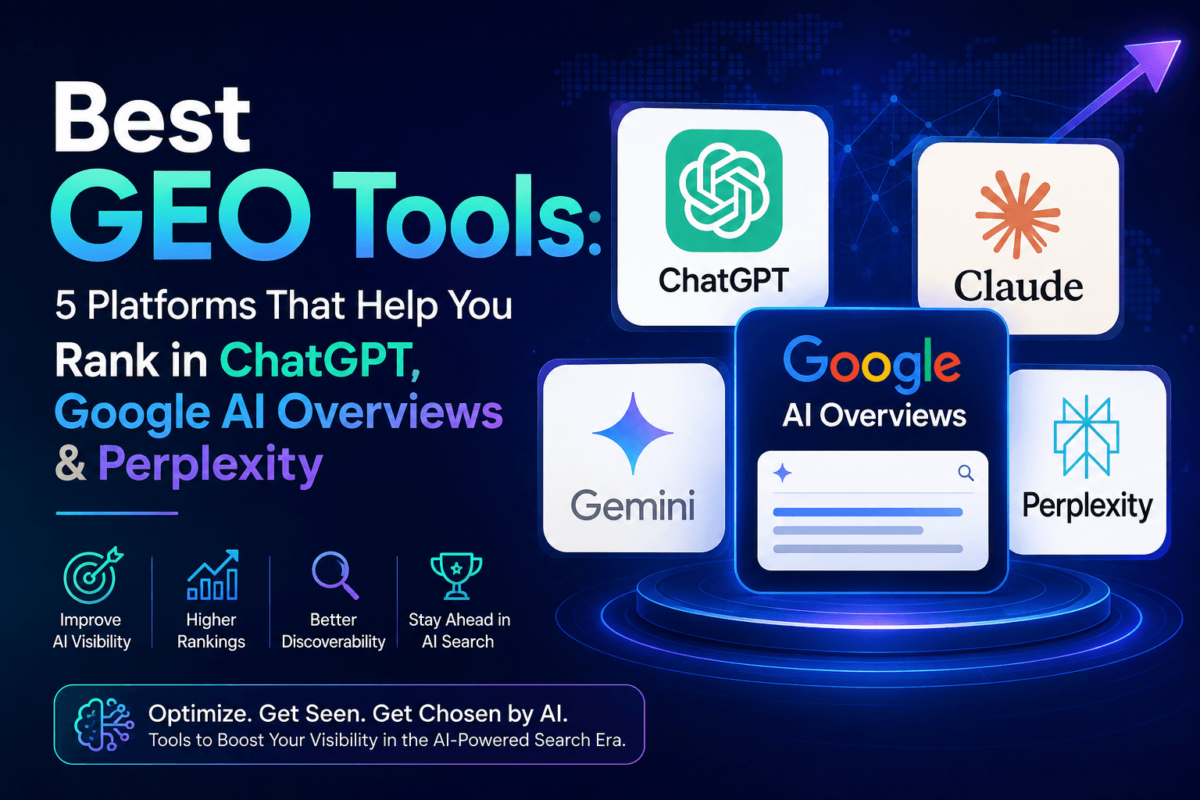
We researched the GEO software market against a strict set of criteria (below), and narrowed it down to five platforms that combine real AI visibility tracking, content and entity optimization, and an active affiliate program: Semrush AI Visibility Toolkit, Surfer SEO, Writesonic, SE Ranking, and Otterly AI. Here’s how each one stacks up, and which is the right fit for your budget and team.
Best GEO Tools at a Glance
The short answer: Semrush AI Visibility Toolkit is the best all-around GEO tool if you want AI tracking alongside a full SEO suite. Otterly AI is the best purpose-built option if AI search monitoring is your only priority. Here’s the full lineup:
| Tool | Best For | Starting Price | Affiliate Program |
|---|---|---|---|
| Semrush AI Visibility Toolkit | Teams already using Semrush for SEO | $99/mo per domain | Yes – up to $300/sale |
| Surfer SEO | Content teams optimizing articles for AI citations | $99/mo (+$95/mo AI Tracker) | Yes – recurring commission |
| Writesonic | Combining GEO tracking with AI content creation | From ~$79–99/mo | Yes – 30% recurring |
| SE Ranking | Budget-friendly agencies wanting SEO + AI in one tool | From ~$65–104/mo | Yes – 30% recurring |
| Otterly AI | Purpose-built AI search monitoring, nothing else | $29/mo (Lite) | Yes – 20% for 12 months |
Pricing changes frequently in this category. We verified every figure above in August 2026, but confirm current rates on each vendor’s pricing page before you subscribe.
What Is GEO (Generative Engine Optimization)?
What is GEO? Generative Engine Optimization is the practice of structuring and promoting content so AI systems like ChatGPT, Gemini, and Perplexity cite, quote, or recommend it when generating an answer. Where SEO optimizes for a ranked list of links, GEO optimizes for a spot inside the answer itself.
Traditional search engines rank pages and let you decide which one to click. AI search engines skip that step. They read dozens of sources, synthesize them into a single answer, and hand it to the user directly. That’s a completely different game, and it’s why GEO and SEO require different playbooks even though they share a lot of DNA.
Three things matter far more in GEO than they ever did in classic SEO:
- Entity recognition – AI models need to clearly understand who you are, what you do, and how you relate to other known entities in your space before they’ll cite you confidently.
- Topical authority – a single optimized page rarely earns a citation on its own. AI models tend to pull from sites that cover a subject in depth, across many connected pieces of content.
- Structured content – clear headings, direct-answer paragraphs, definitions, and schema markup make it far easier for a model to lift a clean, quotable answer out of your page.
What is AI visibility? AI visibility is how often, and how favorably, your brand shows up when people ask AI systems questions related to your industry — whether that’s a direct mention, a citation, or a product recommendation.
This is also where Answer Engine Optimization (AEO) gets mentioned in the same breath as GEO, and honestly, the two overlap enough that most tools treat them as one workflow. If you want the full breakdown of how these terms differ (and where SEO, GEO, AEO, and LLMO actually diverge), that’s worth a separate read. For this article, what matters is simpler: GEO tools measure and improve your presence inside AI-generated answers, and that’s a job traditional rank trackers were never built to do.
What is entity SEO? Entity SEO is the practice of building a clear, consistent, machine-readable identity for your brand, people, and products — through schema, consistent naming, and authoritative mentions — so search and AI systems can confidently connect the dots about who you are.
How We Chose the Best GEO Tools
The GEO category is crowded, and a lot of “AI visibility” tools are really just SEO trackers with a new label on the box. We evaluated each platform against product documentation, published pricing, and verified affiliate terms, then filtered the list down using these criteria:
- Real AI visibility tracking – monitors actual AI-generated answers across ChatGPT, Perplexity, Gemini, or Google AI Overviews, not just a simulated score.
- Entity and content optimization – gives you a clear next step, not just a dashboard of numbers.
- SERP analysis capabilities – still connects GEO work back to traditional search performance.
- Schema and reporting support – helps you act on findings and show clients or stakeholders real progress.
- Active, verifiable affiliate program – every tool on this list has a live, publicly documented affiliate or referral program as of August 2026.
- Market reputation – established usage, industry recognition, or a track record that goes beyond a single funding announcement.
Worth noting: several well-known “pure GEO” specialists — Profound, Peec AI, and AthenaHQ among them — are genuinely strong products, but we couldn’t verify a public, self-serve affiliate program for any of them at the time of writing. Their partner programs are application-gated for agencies rather than open to content publishers, so they didn’t make this list. If that changes, we’ll update this piece. For a broader look at where traditional SEO tools fit into this picture, our guide to the best SEO tools is a useful companion to this one.
1. Semrush AI Visibility Toolkit
Why We Chose It
Semrush needs no introduction — it’s used by more than 10 million marketers and roughly 30% of Fortune 500 companies, and it just became the first major traditional SEO platform to ship a dedicated AI Visibility Toolkit. If your team already lives inside Semrush for keyword research and competitor analysis, bolting on AI visibility tracking is the path of least resistance, and it means your GEO data sits right next to your traditional rankings instead of in a separate tab.
The platform’s pending acquisition by Adobe (approved by shareholders and regulators through early 2026) also signals something worth noting: AI visibility tracking is being treated as core marketing infrastructure now, not a side experiment. For a deeper look at how Semrush stacks up against the other major suite, see our Semrush vs Ahrefs comparison.
Key Features
- Tracks brand mentions across ChatGPT, Google AI Overviews, Gemini, and Perplexity
- Prompt Research and Competitor Research to see who’s winning the same AI queries you care about
- AI Search Site Audit that flags technical blockers preventing AI crawlers from reading your site
- Brand Performance reporting tied to specific locations and languages, with 68,000+ region options
- Full integration with Semrush’s existing keyword research, backlink, and site audit tools
Pros & Cons
| Pros | Cons |
|---|---|
|
|
Pricing
The AI Visibility Toolkit is a standalone add-on at $99/month per domain, covering 25 tracked prompts, with no free trial. Extra prompts run +$60/month per 50, and extra domains are +$99/month each. You can also get AI visibility bundled with core SEO tools starting around $117/month, or step up to Semrush One (Starter to Advanced) at $199–$549/month for the full suite plus AI tracking.
Best For
Agencies and in-house teams that are already running Semrush for traditional SEO and want AI visibility reporting in the same dashboard, without adding a separate vendor.
2. Surfer SEO
Why We Chose It
Surfer built its reputation on content optimization — over 150,000 marketers use its Content Editor to score articles against top-ranking pages before they hit publish. In 2026, Surfer extended that same real-time scoring logic into AI search with its AI Tracker add-on, which means you can optimize a page for Google rankings and AI citations inside the same workflow. That’s a genuinely useful combination if content production, not just monitoring, is your bottleneck. We cover the platform in more depth in our full Surfer SEO review.
Key Features
- AI Tracker monitors brand visibility across ChatGPT and Perplexity, with rank-drop alerts
- Content Editor gives a real-time 0–100 content score based on NLP terms, structure, and word count
- SERP Analyzer breaks down exactly what’s ranking for a keyword and why
- AI Search Guidelines built into the editor for content designed to be citation-ready
- Native integrations with WordPress and Google Docs
Pros & Cons
| Pros | Cons |
|---|---|
|
|
Pricing
Essential starts at $99/month ($79/month billed annually) with 30 Content Editor articles and 5 AI articles. Scale runs $219/month ($175/month annually) with unlimited sites and team members. Enterprise starts around $999/month. The AI Tracker add-on for AI search visibility is roughly $95/month for 25 tracked prompts.
Best For
Content teams and agencies who produce their own articles and want to optimize each one for both Google rankings and AI citations before it ever gets published.
3. Writesonic
Why We Chose It
Writesonic has quietly repositioned itself from an AI writing tool into what it now calls an “AI Search Visibility Platform,” and the shift is more than marketing copy. Its GEO module draws on a proprietary dataset of over 120 million AI chatbot conversations to estimate real prompt volume, then pairs that tracking with an AI Article Writer so you can act on the gaps it finds without switching tools. If you want tracking and content production under one login, Writesonic is the most complete option on this list. It also holds up well against dedicated writing tools — see our best AI writing tools roundup for context.
Key Features
- GEO tracking across ChatGPT, Perplexity, Gemini, Google AI Overviews, Claude, Copilot, Grok, and Meta AI
- ChatGPT Shopping tracking for ecommerce brands watching AI-generated product results
- AI Article Writer and Chatsonic for research-backed drafting
- SEO Checker and Optimizer scoring content 0–100 against on-page factors
- Brand sentiment tracking and competitor comparison inside AI answers
Pros & Cons
| Pros | Cons |
|---|---|
|
|
Pricing
Starter begins around $79–99/month with ChatGPT-only visibility tracking. The mid tier, which unlocks Gemini and Google AI Overviews tracking, runs roughly $199–249/month depending on billing cycle. The top self-serve tier is around $399–499/month, with custom Enterprise and Agency pricing above that. Published figures vary slightly by source, so confirm current tiers before you buy.
Best For
Marketing teams and agencies that want AI visibility tracking and AI-assisted content production in a single platform, especially ecommerce brands watching ChatGPT Shopping results.
4. SE Ranking
Why We Chose It
SE Ranking has always been the value pick against Semrush and Ahrefs, and that positioning carries over neatly into GEO. Rather than charging specialist-tool prices for AI tracking, SE Ranking folds an AI Results Tracker into its existing plans, so agencies already using it for rank tracking and site audits get AI visibility without a second invoice. For a direct pricing comparison, our SE Ranking vs Semrush breakdown is worth a look, and our full SE Ranking review covers the rest of the platform.
Key Features
- AI Results Tracker covering Google AI Overviews and Google AI Mode inside core plans
- SE Visible, a standalone product adding ChatGPT tracking with weekly refresh
- Full traditional SEO suite – keyword tracking, backlink audits, technical site audits
- White-label reporting built for agencies managing multiple client accounts
- Flat, published pricing rather than sales-negotiated agency tiers
Pros & Cons
| Pros | Cons |
|---|---|
|
|
Pricing
Core SE Ranking plans with the built-in AI Results Tracker start around $65–104/month depending on billing cycle and which third-party tracker you check (SE Ranking’s own published entry pricing runs lower than some independent trackers cite). The standalone AI-only product, SE Visible, is $189/month for ChatGPT and Google AI Mode coverage. A custom Enterprise tier is available above that.
Best For
Small agencies and in-house teams that want traditional SEO and AI visibility bundled together without paying enterprise prices for either.
5. Otterly AI
Why We Chose It
Otterly AI was one of the first platforms built entirely around AI search monitoring, and it shows — it’s picked up a 2025 Gartner Cool Vendor distinction and won Best AI Search Software Solution at the 2026 European Search Awards. Unlike the other four tools here, Otterly doesn’t try to be an SEO suite or a writing assistant. It does one job — tracking your AI brand visibility — and it does it at a genuinely accessible price, which makes it the easiest starting point if you’re testing GEO for the first time.
Key Features
- Daily tracking across ChatGPT, Perplexity, Google AI Overviews, and Microsoft Copilot
- Brand Visibility Index and historical citation tracking to spot trends over time
- Multi-country tracking across 50+ markets, included even on the entry plan
- Built-in AI keyword research tool for finding the prompts worth tracking
- Google AI Mode and Gemini available as add-on coverage
Pros & Cons
| Pros | Cons |
|---|---|
|
|
Pricing
Lite is $29/month for 15 tracked prompts. Standard runs $189/month for 100 prompts. Premium is $489/month for 400 prompts. There’s no traditional SEO suite bundled in at any tier — this is AI visibility tracking only.
Best For
Solo marketers, small businesses, and content publishers who want to start tracking AI visibility without committing to a full SEO suite they may not need.
How to Choose the Right GEO Tool
All five of these tools are legitimate picks, but the right one depends on what you’re actually trying to solve. Here’s how we’d point different readers:
| If you’re a… | Start with… |
|---|---|
| Agency already using Semrush or SE Ranking | Semrush AI Visibility Toolkit or SE Ranking |
| Content team publishing regularly for organic traffic | Surfer SEO |
| Small team that needs writing help and tracking together | Writesonic |
| Budget-conscious agency managing several client sites | SE Ranking |
| Solo marketer or small business testing GEO for the first time | Otterly AI |
If you’re still mapping out your broader AI search strategy before you commit budget to a tool, our AI SEO checklist and AI SEO guide are good places to start. And if you’re building out AI visibility programmatically across many pages, our programmatic SEO with AI guide walks through the workflow.
Frequently Asked Questions
What is the best GEO tool overall?
Semrush AI Visibility Toolkit is the best overall pick for teams that want AI tracking alongside a full SEO suite. If you want a purpose-built, lower-cost option, Otterly AI is the strongest dedicated alternative.
What is Generative Engine Optimization (GEO)?
GEO is the practice of optimizing content so AI systems like ChatGPT, Gemini, and Perplexity cite or recommend it inside generated answers, rather than optimizing purely for a ranked list of links.
How is GEO different from traditional SEO?
SEO measures rankings and clicks on a results page. GEO measures whether your brand gets mentioned, cited, or recommended inside an AI-generated answer, where there’s no ranked position to track at all.
Can traditional SEO improve AI rankings too?
Yes, to a point. Strong topical authority, clean technical SEO, and structured content all help AI models find and trust your pages. But SEO alone won’t tell you whether you’re actually being cited in AI answers — that’s what dedicated GEO tools are for.
Which GEO tool is best for agencies?
SE Ranking and Semrush both offer white-label reporting and multi-client management, making them the most practical choices for agencies reporting AI visibility to several clients at once.
Do I need a GEO tool if I already use Semrush or Ahrefs?
If your SEO suite includes AI visibility tracking, like Semrush’s toolkit, you may not need a separate tool. If it doesn’t, or the coverage is limited, a dedicated add-on or standalone platform fills that gap.
How much do GEO tools cost?
Entry-level GEO tracking starts around $29–99 a month for a limited number of prompts. Mid-tier plans with broader engine coverage run $150–250 a month, and enterprise plans with unlimited tracking can reach $500 or more.
Can GEO tools guarantee my brand will be cited by ChatGPT or AI Overviews?
No. These tools track and help you improve your visibility, but no platform can guarantee a citation. AI models decide what to cite based on their own training and retrieval systems, which no vendor fully controls.
What AI engines do these tools track?
Coverage varies by tool and plan. Most track ChatGPT and Google AI Overviews at minimum, with Perplexity, Gemini, Copilot, and Claude available on higher tiers or as add-ons, depending on the platform.
Is GEO worth investing in right now?
If any meaningful share of your audience uses AI assistants to research or shop, yes. Visibility inside AI answers is becoming a real traffic and trust channel, and it’s far easier to build a presence early than to catch up later.
Final Verdict
GEO isn’t a fad tacked onto SEO — it’s what happens to search when the answer arrives before the click. Every tool on this list gives you a real way to measure that shift instead of guessing at it.
Semrush AI Visibility Toolkit is our top pick for teams that want AI tracking folded into an SEO platform they already trust. Surfer SEO wins if content optimization is your real bottleneck. Writesonic is the strongest all-in-one for tracking plus content creation. SE Ranking is the value pick for budget-conscious agencies. And Otterly AI is the cleanest starting point if you just want to know where you stand in AI search before spending on anything else.
Whichever you pick, the goal is the same: stop guessing whether AI search engines know your brand exists, and start measuring it. For more on tracking that traffic once it starts arriving, see our guide on tracking traffic from AI search platforms.
This article contains affiliate links, marked with a “Try” button and an outbound link icon convention on this site. If you subscribe to a tool through one of these links, TechCognate may earn a commission at no additional cost to you. This does not influence which tools we choose to cover or how we rate them. Pricing and affiliate terms were verified in August 2026 and are subject to change — always confirm current details on each vendor’s site before purchasing.