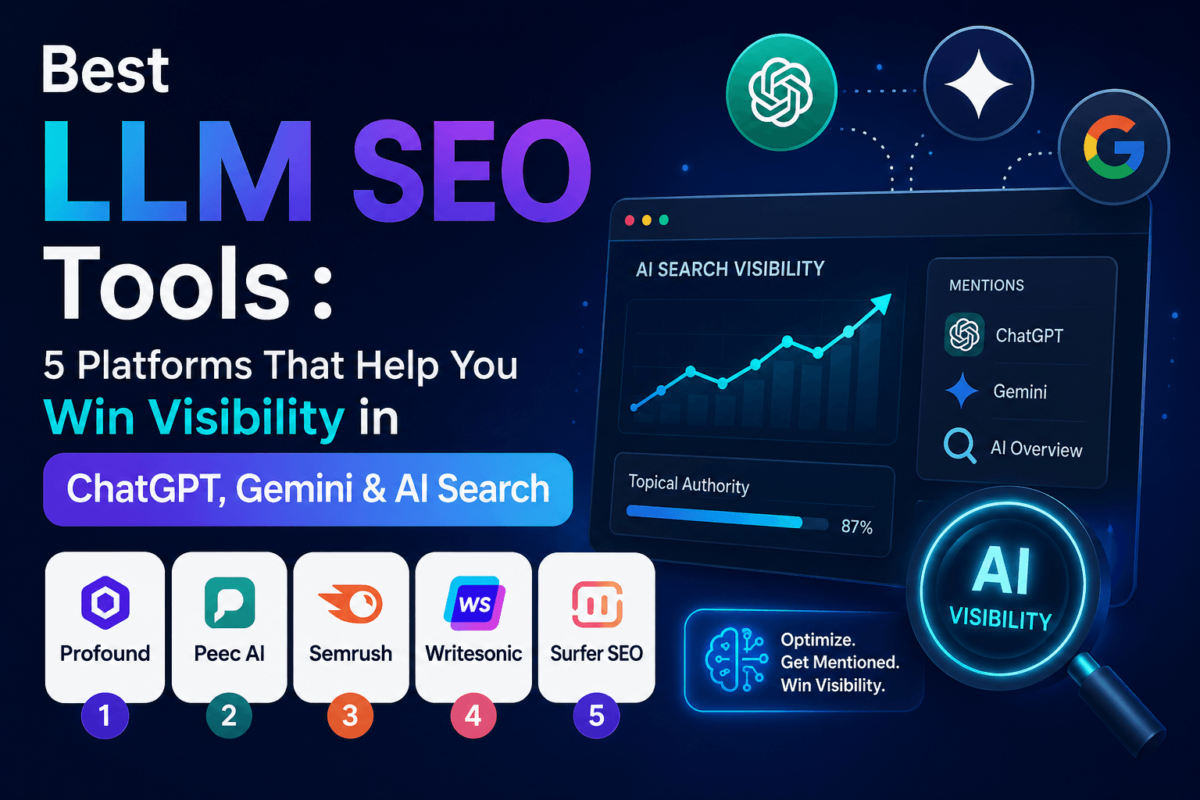
Best LLM SEO Tools (2026): 5 Tools We Tested & Actually Recommend
By Jaykishan Panchal · Founder, TechCognate · Updated August 2026
Quick Answer
The best LLM SEO tool for most brands in 2026 is Semrush, because its AI Visibility Toolkit sits inside the same dashboard most SEO professionals already use for keyword research and site audits. If you need a dedicated, enterprise-grade AI visibility platform, Profound is the strongest pure-play option. Want a lighter, more affordable way to track how your brand shows up in ChatGPT, Gemini, and Perplexity? Start with Peec AI. Writesonic pairs AI visibility tracking with content generation, and Surfer SEO remains the strongest choice for optimizing the entity-rich, semantically complete content that actually gets cited by AI models in the first place.
Is traditional SEO enough in 2026? For a growing number of brands, the honest answer is no.
You do everything right. You climb to the first page of Google. Your rankings hold steady, quarter after quarter. And your organic traffic still drops.
What changed isn’t your SEO. It’s where people are searching. Millions of people now ask ChatGPT, Gemini, Perplexity, and Google’s AI Overviews for the same product recommendations, buying advice, and how-to guidance they used to type into a search box. Those answers get generated, not linked — and if your brand isn’t part of the retrieval index or the citation list a model pulls from, you simply don’t exist in that conversation.
That’s the gap Large Language Model (LLM) SEO tools are built to close. They don’t replace your rank tracker or your backlink checker. They add a layer on top: tracking whether your brand gets mentioned inside AI-generated answers, which sources those answers are citing, and what you can actually do about it if you’re being left out.
In this guide, we’ll compare the five best LLM SEO tools that actually help brands increase visibility across ChatGPT, Gemini, Claude, and other AI search platforms — what each one does well, where it falls short, and which one fits your team, whether you’re in-house, at an agency, or running your own affiliate content site.
What Are LLM SEO Tools?
LLM SEO tools are software platforms that track, analyze, and help you improve how your brand appears inside AI-generated answers — the responses you get from ChatGPT, Gemini, Claude, Perplexity, and Google’s AI Overviews when someone asks a question instead of typing a search query. If you want the longer explainer, we cover the fundamentals in our full guide to LLM SEO.
These tools work differently from the SEO software you already know. A traditional keyword rank tracker tells you where a page sits on Google’s page one. An LLM SEO tool tells you something closer to: was your brand mentioned at all when someone asked an AI model to recommend a project management tool, a CRM, or a pair of running shoes — and if so, which page did the model pull that recommendation from?
That second question matters because of how these models actually retrieve information. Most AI search systems combine what they learned during training with Retrieval-Augmented Generation (RAG) — a process where the model pulls in fresh content from the live web at the moment you ask a question, then blends that retrieved content into its answer. The pages a model retrieves and cites become your new SERP. If you don’t understand what’s shaping that retrieval, you can’t influence it.
This is where Generative Engine Optimization (GEO) and Answer Engine Optimization (AEO) come in. GEO focuses on making your content easier for generative models to understand, extract, and cite — clear entity definitions, structured data, and content that answers a question directly instead of burying the answer six paragraphs in. AEO overlaps heavily with GEO but leans more toward optimizing for the exact answer format a model or voice assistant is likely to surface. Both sit inside the broader discipline most people just call AI SEO.
Why do AI citations matter so much? Because unlike a traditional search click, an AI citation often replaces the click entirely. The user gets an answer inside the chat window and never visits your site — which is exactly why tracking AI search traffic has become its own skill, separate from tracking referral traffic from Google.
How We Selected the Best LLM SEO Tools
Dozens of tools now claim to do “AI SEO” or “AI visibility tracking.” Most of them are rebadged rank trackers with a ChatGPT logo bolted on. We narrowed this list down to five platforms that earn a real spot on a marketer’s stack, judged against five criteria.
AI Visibility Tracking
Can the tool actually track how often — and how favorably — your brand gets mentioned when real people ask ChatGPT, Gemini, Perplexity, or Google AI Overviews questions related to your category? We prioritized tools that monitor multiple models, not just one, since brand visibility can vary wildly between engines.
Citation Monitoring
AI answers cite sources, even when they don’t link to them the way a search result does. We looked for tools that show you exactly which domains and pages a model pulled from — because that’s the closest thing LLM SEO has to a keyword ranking report.
Competitive Intelligence
Knowing your own visibility score is only half the picture. We wanted tools that benchmark you against named competitors inside the same AI conversations, so you can see who’s winning the citations you’re losing.
Content Optimization
Tracking is diagnostic. A genuinely useful tool also tells you what to do about a visibility gap — which pages to update, which entities to define more clearly, or which structured data is missing.
Reporting and Analytics
Finally, we checked whether each platform turns raw visibility data into something you can report to a client or a CMO — dashboards, exportable data, and trend lines that show whether your GEO work is actually moving the needle.
Quick Comparison Table
Here’s how all five tools stack up before we go deep on each one.
| Tool | Best For | AI Search Tracking | Content Optimization | Starting Price | Affiliate Program |
|---|---|---|---|---|---|
| Profound | Enterprise AI visibility | ChatGPT, Gemini, Perplexity, Claude & more | AI Agents & recommendations | ~$99/mo | Partner program (PartnerStack) |
| Peec AI | AI search analytics on a budget | ChatGPT, Perplexity, Gemini, Copilot, Google AI Mode | Actions roadmap (beta) | ~$95/mo | Referral program (20% rev share) |
| Semrush | Combining traditional SEO + LLM SEO | AI Visibility Toolkit add-on | ContentShake AI + Content Toolkit | $139.95/mo (+$99/mo add-on) | Yes (Impact.com, up to $300/sale) |
| Writesonic | AI content + GEO execution | Up to 10 AI platforms | AI Article Writer + SEO Checker | $79/mo | Yes (30% recurring) |
| Surfer SEO | Content optimization & entity SEO | Built-in AI Tracker | Content Editor + Topical Map | ~$49/mo | Yes (tiered CPA, PartnerStack) |
Overall Winner
Profound
If you can only choose one tool from this list, choose Profound. It’s the most complete, most actively developed AI visibility platform available in 2026, built by the team that created the Answer Engine Optimization category it still leads. Budget-conscious teams should start with Peec AI or Semrush instead — but if AI visibility is core to your brand’s marketing strategy, Profound is worth the investment.
5 Best LLM SEO Tools in 2026
Profound — Best Overall LLM SEO Platform
Profound is the platform that arguably created the Answer Engine Optimization category. Founded in 2024, it’s already reached unicorn status and works with enterprise names like Target, Walmart, and MongoDB. If your team needs to know exactly how your brand is represented inside ChatGPT, Perplexity, Gemini, Claude, and half a dozen other AI platforms — down to which prompts trigger a mention and which competitors are winning the citations you’re not — Profound is built for that scale.
It’s not a lightweight tool, and it isn’t trying to be. Profound positions itself as a full marketing intelligence layer for the AI-search era, with autonomous “Agents” that can act on the insights it surfaces instead of just reporting them.
Key Features
- Real-time AI visibility monitoring across ChatGPT, Gemini, Perplexity, Claude, Copilot, and other major models
- Citation tracking that shows exactly which pages and domains an AI model pulled from to answer a prompt
- Brand mention and sentiment analysis inside AI conversations
- Competitive benchmarking against named competitors, prompt by prompt
- Autonomous AI Agents that can flag — and act on — visibility drops
Pros
- The deepest multi-model coverage of any tool on this list
- Built specifically for enterprise reporting, not bolted onto an existing SEO suite
- Strong investor backing and a fast product-release cadence
Cons
- Pricing scales quickly once you need more than one domain or a handful of tracked prompts
- Built for teams with dedicated marketing analytics resources, not solo operators
- No permanently free plan
Pricing: Profound’s published pricing starts at roughly $99/month for a single-brand plan, with Team, Enterprise, and Agency tiers priced by how many AI engines and prompts you need to track. Enterprise pricing is custom and generally requires a sales conversation. Always confirm current tiers on Profound’s own pricing page.
Best for: enterprise marketing teams and agencies managing AI visibility for well-known brands, where the budget for a dedicated platform already exists.
Peec AI — Best for AI Search Analytics
Peec AI is the tool we’d point a leaner team toward if Profound feels like overkill. The Berlin-based startup has grown fast — more than 2,500 teams, including Hugo Boss and TUI, now use it — and its 4.9-star G2 rating reflects a product that does one job cleanly: showing you how your brand shows up across AI search, without burying that insight under a dozen features you’ll never touch.
Setup takes minutes, not weeks. Point it at your domain, and Peec AI builds a brand profile, suggests relevant prompts for your category, and starts tracking visibility, ranking position, and sentiment across the AI platforms your buyers are actually using.
Key Features
- AI mention tracking across ChatGPT, Perplexity, Gemini, Copilot, and Google AI Mode
- Source-level citation analysis down to the exact URL an AI model referenced
- Prompt monitoring with suggested prompts and search-volume data to prioritize what to track
- Competitor comparisons by model, region, or audience segment
- An Actions feature (beta) that turns visibility data into a prioritized to-do list
Pros
- Clean, fast interface with a genuinely short learning curve
- Unlimited users on every plan, which is rare in this category
- Transparent, publicly posted pricing
Cons
- Lighter on content-execution features than Writesonic or Surfer SEO
- Lower-tier plans cap you at tracking only three AI models at once
- Less brand recognition than Profound or Semrush among enterprise buyers
Pricing: Peec AI starts at roughly $95/month for its Starter brand plan (about $80/month billed annually), with an Agency plan from around $245/month. Every tier includes unlimited seats.
Best for: lean marketing teams and boutique agencies that want dedicated AI visibility tracking without an enterprise price tag.
Semrush — Best for Combining Traditional SEO and LLM SEO
If you already run Semrush for keyword research and site audits, you don’t need to add another login to start tracking AI visibility — you just turn on the AI Visibility Toolkit. That’s the single biggest argument for Semrush over a dedicated point solution: your traditional SEO data and your LLM SEO data live in the same dashboard, next to the same domain history you’ve already built up.
Semrush was acquired by Adobe in a deal that closed in April 2026, folding its SEO, GEO, and Answer Engine Optimization data into Adobe’s broader Experience Cloud. For most SEO professionals, day-to-day usage hasn’t changed — Semrush still ships new AI visibility features on a regular cadence, and its affiliate program is still active.
Key Features
- Full keyword research, position tracking, and competitor analysis — the tools you already know
- AI Visibility Toolkit: tracks brand mentions across ChatGPT, Google AI Overviews, Google AI Mode, Gemini, and Perplexity
- Prompt Research, similar to keyword research but built for AI-search topics and intent
- ContentShake AI for AI-assisted content creation and optimization
- Competitor Research and Brand Performance reporting inside the same toolkit
Why traditional SEO still matters for AI search: it’s tempting to treat LLM SEO as a replacement for traditional SEO. It isn’t. Most AI models still lean heavily on Google’s index and on pages that already rank well for the same query the old-fashioned way. Strong technical SEO, backlinks, and topical authority remain the foundation AI visibility gets built on top of — which is exactly why a combined toolkit like Semrush’s makes sense for most teams instead of running two disconnected platforms.
Pros
- One login for both traditional SEO and AI visibility tracking
- The largest keyword and competitive database of any tool on this list
- Backed by Adobe’s resources following the April 2026 acquisition
Cons
- The AI Visibility Toolkit is a separate paid add-on, not included in core plans
- Base tier only tracks 25 prompts for one domain
- Can feel like a lot of tool for a team that only needs AI visibility tracking
Pricing: Semrush’s core Pro plan starts at $139.95/month. The AI Visibility Toolkit is a separate add-on at roughly $99/month per domain (25 tracked prompts), or you can get both bundled into a Semrush One plan starting around $199/month.
Best for: SEO professionals and agencies who want AI visibility tracking without adding a second subscription and a second dashboard to their workflow. For a deeper look at how it stacks up elsewhere, see our Semrush vs Ahrefs comparison.
Writesonic — Best for AI Content Optimization
Writesonic used to be known purely as an AI writing tool. In 2026, it repositioned itself as an AI Search Visibility Platform — and that shift matters, because it’s now one of the only tools on this list that both tracks your AI visibility and gives you the content-generation horsepower to close the gaps it finds.
That combination makes it a strong fit for content teams and agencies who don’t just want a dashboard telling them they’re invisible in Gemini — they want to draft, optimize, and publish the fix in the same platform.
Key Features
- GEO tracking across up to 10 AI platforms, including ChatGPT, Gemini, and Google AI Overviews
- AI Article Writer for structured, SEO-scored long-form drafts
- Chatsonic, a research-grounded AI assistant that pulls live web data into its answers
- Built-in SEO Checker and site audits with AI-generated fixes
- Brand Voice customization to keep AI-generated content on-brand across a team
Pros
- Rare combination of AI visibility tracking and AI content generation in one subscription
- Fast path from “we’re invisible in ChatGPT” to a published fix
- 30% recurring affiliate commission makes it easy to recommend to your own audience
Cons
- Entry-level plan only tracks one AI platform (ChatGPT)
- AI-generated drafts still need human editing before publishing
- Pricing jumps significantly between tiers ($79 to $199 to $399)
Pricing: Writesonic starts at $79/month (Starter, billed annually), with Basic at $199/month and Growth at $399/month. Enterprise pricing is custom.
Best for: content teams and affiliate publishers who want to fix an AI visibility gap with content, not just diagnose it. If content production is your bigger bottleneck than tracking, pair this with our best content marketing tools roundup.
Surfer SEO — Best for Content Optimization and Entity SEO
Surfer SEO earned its reputation as a content optimization tool years before “GEO” was a term anyone used, and that foundation is exactly why it still belongs on this list. AI models tend to cite content that’s clearly structured, semantically complete, and unambiguous about which entities it’s talking about — which is precisely what Surfer’s Content Editor has always scored content on.
In 2026, Surfer added an AI Tracker directly into the platform, so you’re no longer optimizing blind — you can see whether the entity-rich, topically complete pages Surfer helps you build are actually showing up when AI models answer questions in your niche.
Key Features
- Content Editor with real-time scoring against top-ranking and AI-cited pages
- Semantic and entity optimization suggestions based on what’s missing from your draft
- Topical Map for planning entity-complete content clusters instead of one-off articles
- Built-in AI Tracker to monitor how optimized pages perform in AI search
- Content Audit and Grow Flow for ongoing optimization of existing pages
Pros
- The strongest entity and semantic SEO scoring of any tool on this list
- Genuinely useful for both traditional SEO and GEO from the same content brief
- Lower entry price than Profound, Peec AI, or Writesonic
Cons
- Not a dedicated AI visibility monitoring tool — the AI Tracker sits on top of a content platform, not the other way around
- Credit-based plans can run out fast for high-volume publishers
- Plan names and pricing have changed more than once in the past year, so confirm current tiers before subscribing
Pricing: Surfer SEO’s published pricing runs from about $49/month on its entry-level plan up to roughly $299/month on its top self-serve tier, with a custom Enterprise tier above that. Pricing and plan names have shifted more than once in the past year, so double-check the current lineup before you buy.
Best for: content teams and SEO professionals who want their content optimization tool and their AI visibility tracker to be the same tool. We go deeper on this in our full Surfer SEO review.
Traditional SEO vs LLM SEO Tools
These two disciplines aren’t competitors — they’re layers. Here’s how the focus shifts between them.
| Feature | Traditional SEO | LLM SEO |
|---|---|---|
| Rankings | Position on Google’s search results pages | Frequency of AI citations & mentions |
| AI citations | Not tracked | Core metric |
| Search visibility | Clicks, impressions, click-through rate | Share of voice inside AI-generated answers |
| Brand mentions | Backlinks & branded search volume | Sentiment and context inside AI-generated text |
| Answer generation | You control the page; Google links to it | The AI model paraphrases your content — often with no click at all |
In practice, the brands winning in AI search are the same ones that already invested in strong technical SEO and topical authority. LLM SEO tools don’t replace that work — they show you whether it’s actually paying off in the places your customers are now asking questions.
How to Choose the Right LLM SEO Tool
The “best” tool depends entirely on who’s using it. Here’s how we’d point five different types of teams, based on the criteria in our own AI SEO checklist.
Agencies
If you’re managing AI visibility for multiple clients, Peec AI’s unlimited seats and clean multi-brand reporting make it easier to scale across accounts than tools priced per domain. Profound is worth the upgrade once a client’s budget and stakes justify enterprise-grade reporting.
Content Teams
Content teams already producing at volume should start with Surfer SEO or Writesonic — both pair optimization with tracking, so you’re not exporting a visibility report into a separate content brief tool.
Enterprise Brands
Enterprise brands with a known name to protect — and a marketing analytics team to act on the data — get the most out of Profound’s depth and its Agent-driven workflow. Pair it with the strategies in our AI brand visibility guide.
Affiliate Marketers
If you run affiliate content sites, Semrush is the pragmatic choice: you’re likely already using it for keyword research, and turning on the AI Visibility Toolkit means you can watch whether AI models are citing your reviews the way Google used to rank them.
Small Businesses
Small businesses on a tighter budget should start with Peec AI’s Starter plan or Surfer SEO’s entry-level tier before committing to anything enterprise-priced. You don’t need to track every AI model on day one — start with the two or three where your customers actually search.
Frequently Asked Questions
What is an LLM SEO tool?
An LLM SEO tool tracks and helps improve how often — and how favorably — your brand appears inside AI-generated answers from platforms like ChatGPT, Gemini, Claude, and Perplexity. Instead of measuring where you rank on a search results page, it measures whether you get mentioned or cited when someone asks an AI model a question related to your business.
How does LLM SEO differ from traditional SEO?
Traditional SEO optimizes for search engine rankings and click-through traffic. LLM SEO — sometimes called GEO or AEO — optimizes for being cited or mentioned inside an AI-generated answer, where there’s often no click at all. The two disciplines overlap heavily on technical and content fundamentals, but LLM SEO adds a new layer of tracking and optimization on top.
Which tool is best for ChatGPT optimization?
Profound and Peec AI both track ChatGPT specifically, alongside other models, and both show you which pages ChatGPT is citing for your category’s most important prompts. If you’d rather have ChatGPT tracking bundled with the SEO tools you already use, Semrush’s AI Visibility Toolkit covers it too. Our ChatGPT SEO guide covers the content side of that equation.
Can AI search tools replace traditional SEO platforms?
No. Every tool on this list still depends on the same foundation traditional SEO builds — technical health, backlinks, and topical authority. AI models tend to cite pages that already carry credibility signals; an LLM SEO tool helps you see and improve your presence on top of that foundation, not instead of it.
Are LLM SEO tools worth the investment?
For any brand where AI-driven discovery already influences buying decisions — which now includes a large and growing share of shoppers researching bigger purchases — yes. The investment is smaller than most traditional SEO tool budgets, and the visibility gap only gets more expensive to close the longer it goes untracked.
How do AI search engines choose citations?
Most AI search platforms combine what they learned during training with retrieval-augmented generation, pulling in current web content at the moment you ask a question. Pages that are clearly structured, unambiguous about the entities they cover, and already trusted by traditional search tend to get pulled into that retrieval step and cited more often.
Which AI platforms should brands optimize for?
Start with ChatGPT, Google’s AI Overviews, and Gemini, since they currently reach the widest audiences. Perplexity and Claude are worth tracking too, especially for B2B and technical audiences that skew toward power users. Most of the tools on this list let you track all of them from one dashboard instead of forcing you to pick just one.
Key Takeaways
Key Takeaways
- LLM SEO tools track whether your brand gets mentioned or cited inside AI-generated answers from ChatGPT, Gemini, Claude, and Perplexity — not just where you rank on Google.
- Profound is the strongest dedicated AI visibility platform for enterprise brands; Peec AI is the lightest, most affordable way to start.
- Semrush is the practical pick if you want AI visibility tracking inside the SEO tool you already pay for.
- Writesonic and Surfer SEO both pair content optimization with AI visibility tracking, closing the loop between diagnosis and fix.
- Traditional SEO fundamentals — technical health, backlinks, topical authority — still shape what AI models choose to cite, so LLM SEO tools add a layer on top rather than replacing your existing stack.
None of these five tools is objectively “the best” — the right one depends on whether you’re diagnosing a visibility problem, fixing one with content, or trying to do both from a single login. Start with the tool that matches where your team already spends its time, track your numbers for a full quarter, and adjust from there. AI search isn’t going away, and the brands that start measuring their visibility now will have a significant head start over the ones still waiting for a “better time” to begin.
Affiliate Disclosure: TechCognate may earn a commission if you sign up for a tool through the links in this article, at no extra cost to you. We only recommend tools we’ve researched and would use ourselves, and our opinions are our own.