SEO Software Comparison · Updated 2026
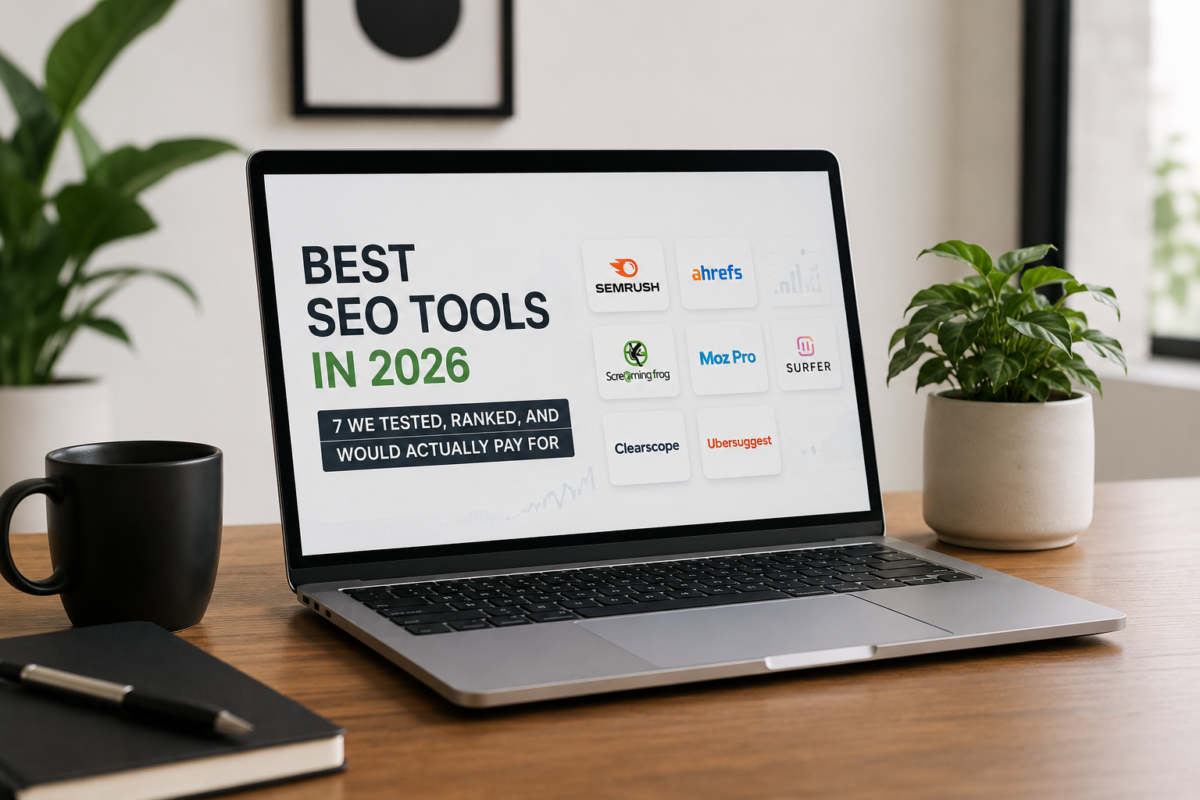
Best SEO Tools in 2026: 7 We Tested, Ranked, and Would Actually Pay For
Quick Answer
The best SEO tools in 2026 are Semrush (best all-around platform), Ahrefs (best for backlinks and competitor research), Google Search Console (best free tool for real ranking data), Screaming Frog SEO Spider (best technical crawler), Surfer SEO (best AI content optimization), SE Ranking (best value all-in-one platform), and Rank Math (best WordPress SEO plugin). Most bloggers and small businesses should start free with Google Search Console and Rank Math, then add Semrush or SE Ranking once budget allows. Agencies typically need Ahrefs or Semrush plus Screaming Frog for technical audits.
Choosing the right SEO software can make or break your marketing budget. Some tools are built for deep keyword research and backlink checker data, others focus on technical SEO and website crawler audits, and a few live right inside WordPress for everyday content optimization. Below, we compare the seven tools worth your time in 2026 — what each one does best, what it costs, and who should actually buy it.
Best SEO Tools Compared (2026)
Here’s how the seven tools stack up side by side. Scroll right on mobile to see the full table.
| Tool | Best For | Starting Price | Free Version | AI Features | Ease of Use | Rating |
|---|---|---|---|---|---|---|
| Semrush | All-in-one SEO & marketing | $139.95/mo | Limited free plan | AI Visibility Toolkit | Moderate | 4.7/5 |
| Ahrefs | Backlinks & competitor research | $29/mo | Free Webmaster Tools | Content grading, clustering | Moderate | 4.8/5 |
| Google Search Console | Real ranking & indexing data | Free | 100% free | Search Console Insights | Easy | 4.6/5 |
| Screaming Frog | Technical site audits | Free / $279/yr | Free up to 500 URLs | AI content add-on | Advanced | 4.7/5 |
| Surfer SEO | AI content optimization | $99/mo | No (7-day guarantee) | Content Editor, AI writer | Easy | 4.6/5 |
| SE Ranking | Affordable all-in-one platform | ~$52/mo | 14-day free trial | AI Search Toolkit | Easy | 4.7/5 |
| Rank Math | WordPress on-page SEO | Free / $6.99/mo | Generous free plugin | Content AI assistant | Easy | 4.8/5 |
Ratings reflect TechCognate’s editorial assessment based on hands-on testing. Pricing shown is starting price on the lowest available paid tier and may change — always confirm current pricing on the provider’s website before buying.
Detailed Reviews of the 7 Best SEO Tools
Each review below is based on real, hands-on use of the platform — not a spec-sheet summary. We cover what the tool does well, where it falls short, current pricing, and exactly who should (and shouldn’t) buy it.
1. Semrush — Best Overall SEO Tool
★★★★★ 4.7/5 — TechCognate Rating
Overview
Semrush is the closest thing the SEO industry has to a universal platform. What started as a keyword research tool in 2008 has grown into a full marketing suite covering SEO, PPC, content marketing, social media, and competitive intelligence — all from one dashboard. If you want to stop juggling five different subscriptions, Semrush is usually the tool that replaces them.
Best For
Agencies, in-house marketing teams, and growing businesses that need SEO, content, and paid search research in a single subscription.
Key Features
- Keyword Magic Tool with billions of keywords across 100+ countries
- Site Audit for technical health scoring and issue tracking
- Position Tracking with daily rank updates and SERP features
- Backlink Analytics and a toxic-link detector
- Content Marketing Toolkit and ContentShake AI for briefs and drafts
- Advertising, social media, and market research toolkits
Pros & Cons
|
Pros
|
Cons
|
Pricing
Pro costs $139.95/month, Guru is $249.95/month, and Business runs $499.95/month. Annual billing cuts roughly 17% off each tier. A limited free plan and a 7-day free trial are both available for testing the interface before you commit.
AI Features
The AI Visibility Toolkit tracks how often your brand gets mentioned in ChatGPT, Google AI Overviews, and Perplexity. ContentShake AI turns keyword research directly into content briefs and first drafts.
Integrations
Google Search Console, Google Analytics, Google Business Profile, Google Ads, WordPress, Looker Studio, Trello, Asana, and Zapier.
Real-World Example
A solo blogger in the personal-finance niche used Semrush’s Keyword Magic Tool to find low-competition, high-intent long-tail keywords, then leaned on Position Tracking to see which posts were climbing toward page one — doubling organic traffic over eight months without any paid promotion.
Who Should Buy It
Businesses and agencies that want one dashboard for SEO, content, and paid research — and can justify the higher monthly cost with the time saved not switching between tools.
Best Alternative
If the price feels steep, SE Ranking covers most of the same core workflow for a fraction of the cost, and our full comparison of Ahrefs, Semrush, Moz, and SpyFu breaks down exactly where each one wins.
2. Ahrefs — Best for Backlinks & Competitor Research
★★★★★ 4.8/5 — TechCognate Rating
Overview
Ahrefs built its reputation on one thing: the most accurate backlink index in the industry. Founded in Singapore in 2011, it has since expanded into a full SEO suite — Site Explorer, Keywords Explorer, Site Audit, Rank Tracker, and Content Explorer — but backlink and competitor data is still where it beats everyone else on this list.
Best For
SEO professionals, link builders, and agencies that need deep, reliable backlink and competitor data.
Key Features
- Site Explorer for backlink profiles and referring domains
- Keywords Explorer with Keyword Difficulty and click metrics
- Site Audit for crawling and technical issue detection
- Rank Tracker with daily updates and Share of Voice
- Content Explorer and Content Gap analysis for competitor research
Pros & Cons
|
Pros
|
Cons
|
Pricing
Starter is $29/month, Lite is $129/month, Standard is $249/month, and Advanced is $449/month, with custom Enterprise pricing above that. Annual billing saves around 17%. There’s no free trial, but Ahrefs Webmaster Tools gives verified site owners free access to Site Explorer and Site Audit for their own domain.
AI Features
AI-assisted content grading flags topical gaps against top-ranking pages, and Keywords Explorer uses automated clustering to group related keywords into content-ready topics.
Integrations
Google Search Console, Google Analytics, Google Ads, Zapier, and a public API on Standard plans and above.
Real-World Example
A three-person agency used Ahrefs’ Content Gap tool to compare a client’s site against three competitors, uncovering 40+ keywords the competitors ranked for that the client hadn’t even targeted — which became the next quarter’s entire content calendar.
Who Should Buy It
SEO professionals and agencies whose work depends on link building, competitor tracking, or highly accurate backlink data.
Best Alternative
Read our full Ahrefs review for a deeper breakdown, or see how it stacks up against a budget-friendly option in Long Tail Pro vs. Ahrefs.
3. Google Search Console — Best Free SEO Tool
★★★★★ 4.6/5 — TechCognate Rating
Overview
Google Search Console (GSC) is Google’s own free reporting tool, and it’s the only tool on this list that shows you real ranking and click data straight from Google itself, rather than a third-party estimate. Every website owner should have it connected — no exceptions.
Best For
Every website, at every stage — from a brand-new blog to an enterprise ecommerce store. There’s no scenario where skipping GSC makes sense.
Key Features
- Performance report: real clicks, impressions, CTR, and average position
- URL Inspection tool for indexing status and live testing
- Sitemap submission and coverage reporting
- Core Web Vitals and mobile usability reports
- Manual action and security issue alerts
Pros & Cons
|
Pros
|
Cons
|
Pricing
Completely free, with no paid tier, for any verified website owner.
AI Features
Search Console Insights blends GSC and Analytics data to surface which content is attracting new readers, though it’s a lightweight reporting layer rather than a full AI assistant.
Integrations
Google Analytics, Google Ads, Looker Studio, and it’s a required data source for nearly every third-party SEO tool on this list, including Semrush, Ahrefs, and Screaming Frog.
Real-World Example
A local plumbing business used GSC’s Performance report to spot that they ranked position 9–11 for “emergency plumber [city]” — just off page one. Two on-page updates later, GSC confirmed the jump to position 4 within three weeks.
Who Should Buy It
Literally everyone with a website. It’s free, and it’s the ground-truth data source every paid tool on this list tries to estimate.
Best Alternative
There isn’t a real substitute for first-party Google data, but pairing GSC with a solid WordPress SEO setup gets you most of the way to a complete free stack.
4. Screaming Frog SEO Spider — Best Technical SEO Tool
★★★★★ 4.7/5 — TechCognate Rating
Overview
Screaming Frog SEO Spider is a desktop website crawler, not a cloud dashboard — and that’s exactly why technical SEOs love it. Point it at a domain and it crawls every URL, flagging broken links, redirect chains, duplicate content, and missing metadata in one pass.
Best For
Technical SEOs, agencies, and ecommerce sites that need deep, customizable site crawls beyond what a WordPress plugin can do.
Key Features
- Full-site crawling with custom extraction rules
- JavaScript rendering for modern, JS-heavy websites
- Broken link, redirect chain, and duplicate content detection
- Scheduled, automated crawls with exportable reports
- Direct integrations with Search Console, Analytics, and PageSpeed Insights
Pros & Cons
|
Pros
|
Cons
|
Pricing
Free for crawls up to 500 URLs. The paid license is a flat $279/year per user, unlocking unlimited crawling, JavaScript rendering, scheduling, and custom extraction. Discounts apply at 5+ licenses.
AI Features
Newer releases include an AI-assisted content generation add-on for meta descriptions and alt text at scale, though the core product remains focused on crawling and diagnostics rather than AI writing.
Integrations
Google Search Console, Google Analytics, Google PageSpeed Insights, and major CMS platforms via crawl-and-export workflows.
Real-World Example
An ecommerce store with 12,000 product pages used Screaming Frog to find over 800 broken internal links left over from a platform migration. Fixing them recovered crawl budget and lifted organic sessions within a month.
Who Should Buy It
Anyone managing a site over a few hundred pages, or anyone who needs to diagnose technical issues a WordPress plugin simply can’t see.
Best Alternative
Semrush and SE Ranking both include built-in site audit tools that cover the basics if you’d rather stay in one dashboard — though neither matches Screaming Frog’s crawl depth for large or complex sites.
Download Screaming Frog Free →
5. Surfer SEO — Best AI Content Optimization Tool
★★★★★ 4.6/5 — TechCognate Rating
Overview
Surfer SEO is built around one job: helping you write content that matches what’s already ranking. Its Content Editor scores your draft in real time against the top-performing pages for your target keyword, covering word count, headings, and related terms.
Best For
Content teams, bloggers, and agencies that publish frequently and want data-backed on-page optimization while they write — not after.
Key Features
- Content Editor with a live SEO content score
- SERP Analyzer for competitor content structure
- Topical Map for planning content clusters
- Content Audit tool to flag pages that have dropped in rankings
- AI article generation as an add-on for first drafts
Pros & Cons
|
Pros
|
Cons
|
Pricing
The Essential plan starts around $99/month (roughly $79/month billed annually), and the Scale plan runs about $219/month (around $175/month annually). Enterprise pricing is custom. There’s no permanent free plan, but Surfer offers a 7-day money-back guarantee.
AI Features
AI is the whole product here: the Content Editor uses NLP to recommend terms based on top-ranking pages, and the built-in AI writer can generate a structured first draft, though it needs editing before publishing.
Integrations
Google Docs, WordPress, Jasper, Google Search Console, and a browser extension for on-the-fly SERP analysis.
Real-World Example
A content team producing 20 articles a month used Surfer’s Content Editor to standardize briefs across five freelance writers, cutting average time-to-rank because every draft already matched the SERP’s expected depth and structure before publishing.
Who Should Buy It
Anyone publishing content regularly who wants a data-driven second opinion on structure and depth before hitting publish.
Best Alternative
Semrush’s ContentShake AI and SE Ranking’s Content Marketing add-on both offer lighter-weight content optimization if you’d rather not add a fourth or fifth subscription.
6. SE Ranking — Best Value for Money
★★★★★ 4.7/5 — TechCognate Rating
Overview
SE Ranking has spent over a decade quietly building an all-in-one platform that covers rank tracking, site audits, backlink monitoring, and competitor research — at a price point roughly a third of Semrush or Ahrefs. It’s the tool most likely to make you ask, “wait, why is this so much cheaper?”
Best For
Freelancers, small agencies, and budget-conscious businesses that want most of what Semrush offers without the Semrush price tag.
Key Features
- Rank tracking with daily updates across Google, Bing, and Yandex
- Website audit covering 120+ technical checks
- Backlink monitoring and toxicity scoring
- White-label reporting built in, not an expensive add-on
- AI Search Toolkit for tracking visibility in AI Overviews and chatbots
Pros & Cons
|
Pros
|
Cons
|
Pricing
The entry plan starts around $52/month billed annually (about $65/month billed monthly), the mid-tier plan runs roughly $95–$103/month annually, and the top self-serve plan is about $207–$223/month annually. A 14-day free trial is available with no credit card required. Plan names and exact limits have changed more than once, so confirm current tiers before buying.
AI Features
The AI Search Toolkit monitors how often your brand shows up in ChatGPT, Perplexity, Gemini, and Google AI Overviews — one of the more affordable ways to get AI visibility tracking without a separate GEO tool subscription.
Integrations
Google Search Console, Google Analytics, Google Business Profile, Looker Studio, and Matomo.
Real-World Example
A small local-services business switched from a $140/month Semrush plan to SE Ranking’s entry tier, kept the same rank-tracking and audit workflow, and redirected the savings into a monthly link-building budget instead.
Who Should Buy It
Solo SEOs, small agencies, and small businesses that need core SEO functionality — not a full marketing suite — without paying enterprise prices.
Best Alternative
If backlink data depth matters more than price, Ahrefs or Semrush will out-perform SE Ranking — you’ll just pay considerably more for it.
Try SE Ranking Free for 14 Days →
7. Rank Math — Best WordPress SEO Plugin
★★★★★ 4.8/5 — TechCognate Rating
Overview
Rank Math lives directly inside your WordPress dashboard and handles the on-page side of SEO — titles, meta descriptions, schema markup, sitemaps, and redirects — without ever leaving your post editor. Since launching in 2018 it has become one of the most-installed SEO plugins in WordPress, and the free version alone out-features most competitors’ paid tiers.
Best For
Any WordPress website — bloggers, small businesses, and agencies managing client sites — that needs on-page SEO handled without a separate tool.
Key Features
- Real-time on-page SEO scoring as you write
- 20+ schema types built in, including FAQ and HowTo
- Automatic XML sitemap generation
- 404 monitor and redirection manager
- Content AI writing assistant for titles, descriptions, and outlines
Pros & Cons
|
Pros
|
Cons
|
Pricing
The core plugin is free forever. Pro costs about $6.99/month (billed annually at roughly $83.88/year) and covers unlimited personal websites. Business and Agency tiers, priced for managing dozens or hundreds of client sites, run roughly $250–$600/year.
AI Features
Content AI generates SEO titles, meta descriptions, and outline suggestions directly inside the WordPress editor, using your target keyword as the starting point.
Integrations
Google Search Console (built-in connection), WooCommerce, Elementor and other page builders, and a 1-click importer from Yoast SEO and other plugins.
Real-World Example
A small WordPress site switched from a competing plugin to Rank Math, used the built-in schema generator to add FAQ markup to its service pages, and started picking up FAQ rich results in search within a few weeks — at no extra cost.
Who Should Buy It
Every WordPress site owner. Even the free version covers what most small businesses and bloggers need for solid on-page SEO.
Best Alternative
See our complete WordPress SEO guide for how Rank Math fits into a full on-site optimization strategy alongside Google Search Console.
Best SEO Tools by Use Case
Not sure which of the seven fits your situation? Here’s our recommendation for ten common scenarios.
| Use Case | Recommended Tool |
|---|---|
| Best for Beginners | Rank Math + Google Search Console |
| Best for Bloggers | Surfer SEO |
| Best for Agencies | Ahrefs or Semrush |
| Best for Ecommerce | Semrush + Screaming Frog |
| Best for Enterprise | Ahrefs Advanced or Semrush Business |
| Best Free SEO Tool | Google Search Console |
| Best Technical SEO Tool | Screaming Frog SEO Spider |
| Best AI Content Optimization | Surfer SEO |
| Best WordPress SEO Plugin | Rank Math |
| Best Value for Money | SE Ranking |
Buying Guide: How to Choose an SEO Tool
There’s no single “best” SEO tool — only the best tool for your specific situation. Weigh these nine factors before you subscribe to anything.
- Budget: Know your monthly ceiling before you start comparing feature lists. It’s easy to justify a $250/month tool in a demo and much harder to keep paying for it three months later.
- Business size: A solo blogger and a 20-person agency have completely different needs for seats, projects, and client reporting.
- Website size: A 15-page brochure site doesn’t need the same crawl depth as a 50,000-page ecommerce catalog.
- Experience level: Beginners generally get more value from simpler, guided tools like Rank Math than from a dense platform like Ahrefs.
- Required features: List the three things you actually need to do weekly — rank tracking, content briefs, backlink audits — and buy for those, not for a wish list.
- AI capabilities: Decide whether you need AI content generation, AI visibility tracking, or neither — not every AI feature label adds real value to your workflow.
- Reporting: Agencies should prioritize built-in white-label reporting; solo site owners can usually skip it entirely.
- Scalability: Check what the next pricing tier costs before you outgrow your current one — some jumps are painful.
- Customer support: Live chat and documentation quality matter more than they seem to until you’re stuck mid-audit.
Feature-by-Feature Comparison
A closer look at how each tool covers the 13 core capabilities most SEO workflows need. Scroll right to see all seven tools.
| Feature | Semrush | Ahrefs | GSC | S. Frog | Surfer | SE Rank | Rank Math |
|---|---|---|---|---|---|---|---|
| Keyword research | Yes | Yes | Partial | No | Partial | Yes | No |
| Site audits | Yes | Yes | Partial | Yes | No | Yes | Partial |
| Backlink analysis | Yes | Yes | No | Partial | No | Yes | No |
| Rank tracking | Yes | Yes | Yes | No | Partial | Yes | Partial |
| Competitor analysis | Yes | Yes | No | Partial | Partial | Yes | No |
| Technical SEO | Yes | Yes | Partial | Yes | No | Yes | Partial |
| Content optimization | Yes | Partial | No | No | Yes | Yes | Partial |
| AI assistance | Yes | Partial | Partial | Partial | Yes | Yes | Yes |
| Local SEO | Yes | No | Partial | No | No | Yes | Partial |
| Reporting | Yes | Partial | Partial | Partial | Partial | Yes | Partial |
| API access | Yes | Yes | Yes | No | Partial | Yes | No |
| Automation | Yes | Partial | No | Yes | Partial | Yes | Partial |
| WordPress integration | Partial | No | No | No | Yes | Partial | Yes |
“Partial” means the feature exists but is limited, add-on only, or not the tool’s core focus.
Pricing Comparison
| Tool | Monthly | Annual (per mo.) | Free Plan | Free Trial |
|---|---|---|---|---|
| Semrush | $139.95 | $117.33 | Limited | 7 days |
| Ahrefs | $129 | $108 | Own-site only | None |
| Google Search Console | $0 | $0 | Full product | N/A |
| Screaming Frog | $23/yr equiv. | $279/yr flat | Up to 500 URLs | N/A |
| Surfer SEO | $99 | $79 | None | 7-day guarantee |
| SE Ranking | ~$65 | ~$52 | None | 14 days |
| Rank Math | $0 / ~$6.99 | $0 / ~$6.99 | Full core plugin | 30-day refund |
All prices in USD, lowest available paid tier, verified at time of publication. SaaS pricing changes often — double-check current rates before purchasing.
Real-Life Examples
A quick recap of how real users put each tool to work, pulled from the reviews above:
- Blogger + Semrush: Doubled organic traffic in eight months using Keyword Magic Tool and Position Tracking.
- Agency + Ahrefs: Built an entire quarterly content calendar from a single Content Gap analysis.
- Local business + Google Search Console: Spotted a page-two keyword and moved it to position 4 after two on-page fixes.
- Ecommerce store + Screaming Frog: Found and fixed 800+ broken links left behind by a platform migration.
- Content team + Surfer SEO: Standardized briefs across five freelancers using one shared Content Editor score.
- Small business + SE Ranking: Cut its SEO tool bill by more than half and redirected the savings into link building.
- WordPress site + Rank Math: Picked up FAQ rich results within weeks using the built-in schema generator — at no extra cost.
How to Choose the Right SEO Tool: Step-by-Step
- Define your main SEO bottleneck. Is it keyword research, technical issues, content quality, or backlinks? Most people need one primary tool, not five.
- Set a realistic monthly budget. Decide what you can commit to for at least six months — SEO tools take time to pay off.
- Start with the free tools. Install Google Search Console and Rank Math (if you’re on WordPress) before spending a dollar.
- Test one paid tool with its free trial. Use the full trial period on a real project, not a throwaway test site.
- Check the learning curve against your time. A powerful tool you never open is worth less than a simple one you use every week.
- Confirm it covers your core workflow end to end. Keyword research feeding into content briefs feeding into rank tracking, for example.
- Reassess every 6–12 months. As your site grows, your tool stack should grow with it — not before.
Common Mistakes When Choosing SEO Tools
- Paying for expensive tools too early. A brand-new site doesn’t need Semrush Business — it needs consistent content and a free Search Console account.
- Ignoring Google Search Console. Third-party estimates are useful, but GSC is the only source of real ranking and click data for your site.
- Not auditing the website. Content and keyword strategy can’t fix a site that Google can’t crawl properly.
- Only tracking rankings. A rising position that doesn’t bring clicks or conversions isn’t actually progress.
- Ignoring AI optimization. AI Overviews and chatbot answers are already redirecting a share of search traffic — visibility there is no longer optional.
- Choosing tools with unnecessary features. Paying for a PPC toolkit you’ll never open just to get one SEO feature you need is a common, avoidable waste.
Expert Tips
For Beginners
Start with Google Search Console and Rank Math. Both are free, both are essential, and together they cover indexing, real ranking data, and on-page optimization without touching your budget.
For Intermediate Users
Add one paid research tool once you’re publishing consistently. SE Ranking is the easiest to justify budget-wise; Surfer SEO is the better pick if content quality, not keyword discovery, is your bottleneck.
For Advanced Users & Agencies
Combine Ahrefs or Semrush for research and reporting with Screaming Frog for technical audits. Neither tool fully replaces the other, and running both is standard practice at most established agencies.
Strengths & Weaknesses at a Glance
| Tool | Biggest Strength | Biggest Weakness |
|---|---|---|
| Semrush | Most complete feature set | Steep learning curve, high price |
| Ahrefs | Best backlink data | No free trial, per-seat costs add up |
| Google Search Console | Free, real Google data | Own-site data only, no keyword research |
| Screaming Frog | Deepest technical crawl data | Desktop-only, steep for non-technical users |
| Surfer SEO | Real-time content scoring | No free plan, thin keyword research |
| SE Ranking | Best price-to-feature ratio | Smaller backlink index than Ahrefs/Semrush |
| Rank Math | Generous free WordPress plugin | WordPress-only, no keyword research |
Best SEO Tool by Budget
- Free: Google Search Console + Rank Math (free version) + Screaming Frog (free tier).
- Under $50/month: Rank Math Pro (~$7/mo) plus Screaming Frog’s annual license averaged monthly.
- $50–$100/month: SE Ranking’s entry plan, or Surfer SEO’s Essential plan if content optimization is the priority.
- $100+/month: Semrush Pro or Ahrefs Lite/Standard, ideally paired with Screaming Frog for technical audits.
Tools That Pair Well With Your SEO Stack
An SEO tool only performs as well as the site it’s optimizing. These complementary categories are worth budgeting for once your core SEO tool is in place.
| Category | Why It Pairs Well |
|---|---|
| Managed WordPress hosting | Faster server response times directly support Core Web Vitals and crawl efficiency. |
| Website security software | A hacked or blacklisted site loses rankings fast — malware scanning protects your SEO investment. |
| CDN services | Faster global load times improve both user experience and page speed rankings. |
| AI writing assistants | Speed up first drafts before running them through Surfer SEO or Rank Math for optimization. |
| SEO courses | Structured training shortens the learning curve on dense tools like Ahrefs and Semrush. |
| Email marketing software | Turns organic traffic you’ve already earned into a list you actually own. |
| Productivity tools | Project management keeps a content calendar and audit fixes from slipping through the cracks. |
| Website monitoring services | Uptime alerts catch outages before they tank your crawl stats and rankings. |
Frequently Asked Questions
What is the best SEO tool?
There’s no single best SEO tool for everyone. Semrush is the best overall pick for its complete feature set, Ahrefs leads on backlink data, and Google Search Console is essential and free for every site. The right answer depends on your budget, technical skill, and whether you need an all-in-one platform or a specialized tool for one job.
Which SEO tool is best for beginners?
Beginners get the most value from Google Search Console and Rank Math. Both are free, both are essential, and neither requires deep SEO knowledge to use well. Search Console shows how Google actually sees your site, while Rank Math guides on-page optimization directly inside the WordPress editor as you write.
Is Semrush better than Ahrefs?
Neither is universally “better” — they’re built for different priorities. Semrush wins on breadth, covering PPC, content, and social research alongside SEO. Ahrefs wins on backlink data depth and accuracy. Agencies needing an all-in-one marketing platform tend to prefer Semrush; SEO specialists focused on competitor and link analysis often prefer Ahrefs.
Is Google Search Console enough?
For very small, early-stage sites, Search Console alone can cover the basics: indexing status, real click data, and technical alerts. Most growing sites eventually need more — competitor visibility, keyword difficulty scores, and backlink tracking aren’t part of Search Console. Treat it as a mandatory foundation, not a complete toolkit.
Which SEO tool has the best AI features?
Surfer SEO is the most AI-native tool on this list, built around real-time content scoring and AI-assisted drafting. Semrush and SE Ranking both offer AI visibility tracking for ChatGPT, Perplexity, and Google AI Overviews. Rank Math’s Content AI handles titles and metadata well inside WordPress, depending on what you actually need.
Which tool is best for technical SEO?
Screaming Frog SEO Spider is the clear choice for technical SEO. Its desktop crawler catches broken links, redirect chains, duplicate content, and metadata issues at a depth no cloud-based platform matches. Semrush and SE Ranking include site audit tools that cover common issues, but neither replaces a dedicated crawler for large sites.
Which SEO tool offers the best value?
SE Ranking offers the strongest value for money, delivering rank tracking, site audits, backlink monitoring, and white-label reporting at roughly a third of Semrush’s or Ahrefs’ entry price. For a free option, pairing Google Search Console with Rank Math’s free plugin covers the essentials most small sites need at no cost.
Do SEO tools guarantee rankings?
No SEO tool guarantees rankings, and any tool or service that promises a specific position is overstating what’s possible. These platforms provide data, diagnostics, and content guidance — actual ranking improvements come from consistently acting on that information: fixing technical issues, publishing better content, and earning quality backlinks over time.
Which SEO tool is best for WordPress?
Rank Math is the best-fitted tool for WordPress specifically, since it works directly inside the post editor for titles, meta descriptions, schema markup, and sitemaps. Pair it with free Google Search Console for real ranking data, and add Surfer SEO or Semrush later if you need deeper keyword research.
Can ChatGPT replace SEO tools?
ChatGPT and other AI assistants can speed up keyword brainstorming, content outlines, and schema generation, but they can’t replace real ranking data, live backlink indexes, or site crawl diagnostics. Treat AI as a research accelerator that works alongside dedicated SEO tools like the ones reviewed here, not as a substitute for them.
Final Thoughts: Which SEO Tool Should You Choose?
Seven tools, seven different jobs. Here’s the short version:
- Best Overall: Semrush
- Best Budget Option: SE Ranking
- Best Free Tool: Google Search Console
- Best AI SEO Tool: Surfer SEO
- Best Technical SEO Tool: Screaming Frog SEO Spider
- Best WordPress Plugin: Rank Math
If you’re just getting started, install Google Search Console and Rank Math today — both are free, and together they cover the fundamentals. Once you’re publishing consistently and have a real budget to work with, add SE Ranking or Semrush for research and reporting, and bring in Screaming Frog the moment your site grows past a few hundred pages. There’s no prize for owning the most expensive stack — only for using the right one consistently.
Pricing, features, and plan names for every tool in this guide are subject to change. We recommend confirming current details directly on each provider’s website before subscribing.
Disclosure: This post contains affiliate links. If you sign up for a tool through one of these links, TechCognate may earn a commission at no extra cost to you. We only recommend tools we’ve personally tested, and our opinions are our own.