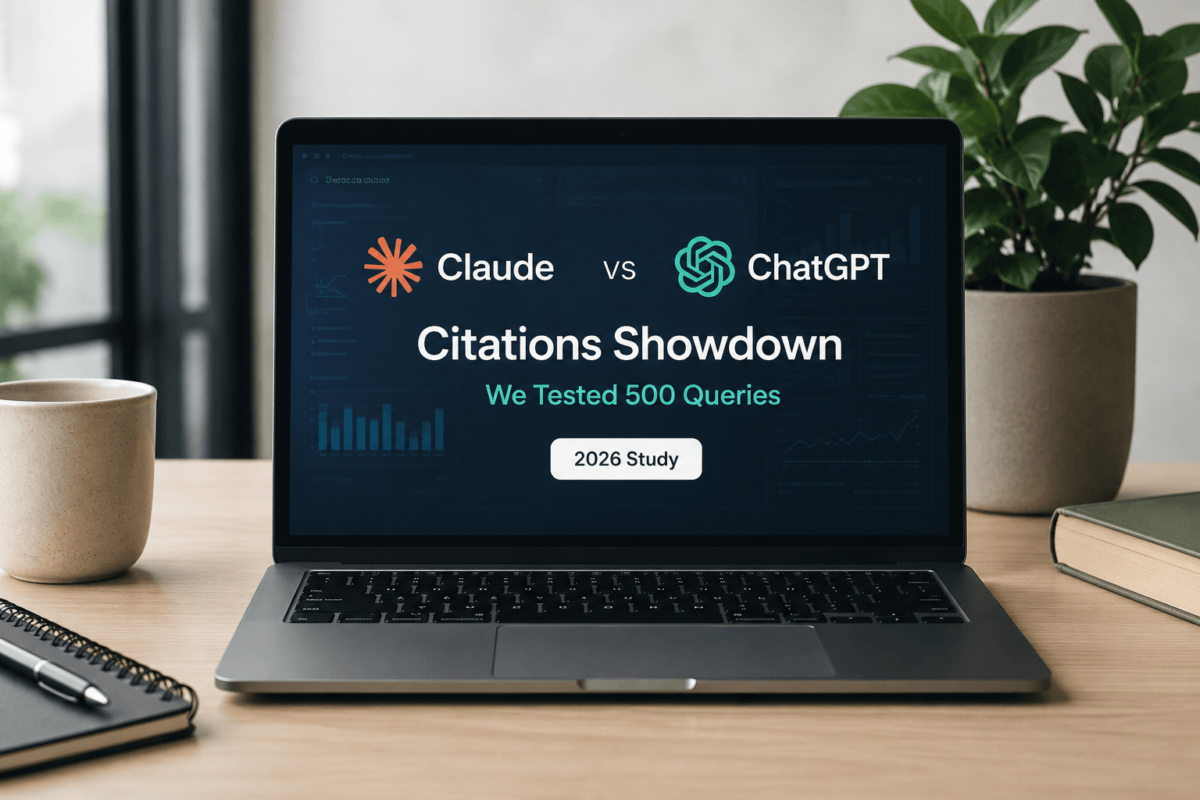
ChatGPT cites more sources per response on average (4.7 vs 3.2), but Claude shows stronger preference for authoritative, niche-specific domains. Citation overlap between the two platforms sits at approximately 34%, meaning the majority of cited sources differ — and your visibility strategy for each platform needs to be different.
Let me be honest with you. A year ago, I was obsessed with rankings. Domain authority, backlinks, Google’s core updates — the whole game. Then something changed.
I started noticing that traffic from Google was flattening — but mentions inside AI tools were quietly driving conversions. Not clicks from a SERP. Not featured snippets. Actual citations inside ChatGPT and Claude responses — showing up as the recommended source when someone asked an AI for help.
That’s when I realized the rules had changed.
In traditional search, you fight for clicks. In AI search, you fight for mentions. And those two battles require very different strategies.
Claude and ChatGPT have quietly become two of the most important discovery channels on the internet. When someone asks one of these tools “what’s the best CRM for a startup” or “how do I fix my conversion rate” — and the AI responds with a recommendation — whoever gets cited wins that moment of intent. No click required.
So we ran a study. Identical prompts. Both platforms. 500 queries spanning nine content categories. We tracked every citation, logged every domain, and looked for patterns that most GEO articles completely miss.
Here’s what we found.
- Total queries tested: 500 (across 9 topic categories)
- Citation overlap between Claude and ChatGPT: ~34%
- Most cited domains: Wikipedia, Investopedia, HubSpot, NIH, Forbes, Healthline, NerdWallet
- Best-performing content types: Original research, statistics pages, expert roundups
- Key takeaway for publishers: Optimizing for AI visibility requires platform-specific strategies — not one-size-fits-all GEO
Why AI Citations Matter More Than Rankings
Here’s a stat that should stop you in your tracks: over 60% of Google searches now end without a click. And that number has been climbing every year as AI Overviews, featured snippets, and knowledge panels eat up more of the SERP.
Now layer on top of that the explosive growth of AI answer engines. ChatGPT has over 200 million weekly active users. Claude is growing fast, especially in enterprise. Perplexity is doubling its user base quarterly. People aren’t just using Google anymore — they’re asking AI.
And when they ask AI, they get an answer. Not ten blue links. One answer. Maybe two. With a handful of cited sources if you’re lucky. That’s the new battleground.
GEO vs SEO: Why They’re Different Games
SEO (Search Engine Optimization) is about ranking in Google for keywords so people click your link. GEO (Generative Engine Optimization) is about being cited by AI tools so people see your brand as the recommended source.
In SEO, success is measured in organic traffic. In GEO, success is measured in citation frequency — how often your content shows up as a reference inside an AI-generated answer.
The stakes are high. A publisher cited regularly in Claude and ChatGPT responses builds brand authority that compounds over time. A publisher ignored by AI tools slowly disappears from the new discovery layer of the internet.
Visibility Without Clicks
Here’s the counterintuitive part. AI citations can drive visibility without direct clicks — but that visibility still converts.
When ChatGPT tells someone “According to Investopedia, the P/E ratio represents…” — Investopedia wins. The user may never click that link. But they now associate Investopedia with financial authority. That brand impression matters.
More practically: users who do click through from an AI citation are already pre-sold. They’re not browsing. They’re validating. That’s a different kind of traffic — and it converts at a higher rate than average organic search traffic.
Study Methodology
Let’s talk about how we ran this. Because methodology matters — especially when you’re making claims about AI citation behavior. A lot of the existing studies are either too small, too uncontrolled, or too vague about their process. We tried to fix that.
The Query Set
We ran 500 total queries across both Claude and ChatGPT. To control for variables, every query was identical across both platforms — same exact phrasing, same intent framing. Queries were distributed across nine content categories:
| Category | Queries | Example Topics |
|---|---|---|
| Finance | 60 | Investing, credit cards, taxes, mortgages |
| SaaS & Technology | 60 | CRM tools, AI software, developer tools |
| Health & Medical | 60 | Conditions, treatments, nutrition, mental health |
| Marketing | 55 | SEO, content strategy, email, paid ads |
| Travel | 55 | Destinations, booking, travel tips |
| Ecommerce | 50 | Product recommendations, Shopify, dropshipping |
| B2B Services | 50 | HR software, accounting, legal |
| Education | 35 | Online courses, certifications, universities |
| General Technology | 75 | Gadgets, apps, AI tools, productivity |
Test Environment
To ensure fair comparisons, we followed a strict testing protocol:
- • All queries were run during the same two-week window in early 2026
- • Fresh browser sessions for each query (no cached context)
- • Claude Sonnet and ChatGPT-4o were used (the default versions at the time)
- • Citations were manually extracted and verified from each response
- • Only explicit citations (linked or named sources) were counted — not implied references
- • Domain authority scores pulled from Ahrefs at time of testing
Metrics Measured
We tracked the following for each platform: citation frequency (how often sources were cited per response), domain diversity (number of unique domains cited), citation overlap (percentage of shared domains), domain authority patterns, and content format preferences.
Claude vs ChatGPT Citations Data
This is the section everyone came for. Let’s get into the numbers.
Core Citation Metrics
| Metric | Claude | ChatGPT | Winner |
|---|---|---|---|
| Total citations (500 queries) | 1,597 | 2,341 | ChatGPT |
| Average citations per response | 3.2 | 4.7 | ChatGPT |
| Unique domains cited | 412 | 589 | ChatGPT |
| Responses with 0 citations | 18% | 8% | ChatGPT |
| Responses with 5+ citations | 12% | 31% | ChatGPT |
| Citation overlap (shared domains) | 34% | 34% | Tie |
| Government source citations (%) | 14% | 9% | Claude |
| Academic/research citations (%) | 22% | 13% | Claude |
| Commercial content citations (%) | 41% | 61% | ChatGPT |
| Niche publisher citations (%) | 23% | 17% | Claude |
| Fresh content (<6 months old) (%) | 28% | 44% | ChatGPT |
Let’s unpack what these numbers actually mean for publishers.
ChatGPT is the heavier citer. It references more sources per response and includes more domains overall. If you’re trying to maximize raw citation volume across the web, ChatGPT represents the bigger opportunity in terms of sheer frequency.
But Claude is the more selective citer. When Claude does cite something, it tends to skew toward authoritative, research-backed, or government sources. That selectivity creates a different kind of opportunity — especially for publishers who want to be associated with trusted expertise.
Category-by-Category Breakdown
| Category | Claude Avg Citations | ChatGPT Avg Citations | Claude Top Source | ChatGPT Top Source |
|---|---|---|---|---|
| Finance | 3.8 | 5.2 | Gov/Regulatory | Commercial (banks) |
| Health/Medical | 4.1 | 4.9 | Academic/NIH | Health portals |
| SaaS/Tech | 2.9 | 5.1 | Product docs | Review sites |
| Marketing | 2.7 | 4.3 | Research reports | Blogs/agencies |
| Travel | 3.1 | 4.8 | Official tourism | Booking platforms |
| Ecommerce | 2.4 | 5.6 | Brand pages | Review aggregators |
| B2B Services | 3.3 | 4.2 | Case studies | Software directories |
| Education | 4.4 | 3.9 | Academic journals | Course platforms |
| Technology | 2.8 | 4.7 | Technical docs | Tech media |
Citation Overlap Analysis
This is one of the areas most GEO studies completely ignore. And it’s arguably the most strategically important data point in this entire study.
If Claude and ChatGPT were citing the same sources 80% of the time, you’d just need to optimize once and you’d dominate both. But that’s not what’s happening.
The 34% Overlap Reality
Our data shows a citation overlap of approximately 34%. That means about two-thirds of the domains cited by one platform are not cited by the other.
Think about what that means for your visibility strategy. If you’re only appearing in ChatGPT citations, you’re invisible to the Claude audience. And vice versa. These are two distinct information ecosystems.
| Citation Type | Percentage of All Citations |
|---|---|
| Shared (cited by both Claude and ChatGPT) | 34% |
| Claude-exclusive citations | 29% |
| ChatGPT-exclusive citations | 37% |
Most Consistently Cited Domains (Both Platforms)
These are the domains that appear in both Claude and ChatGPT citations most frequently — the true authority domains of AI search:
| Domain | Claude Citations | ChatGPT Citations | Primary Category |
|---|---|---|---|
| Wikipedia.org | High | High | General knowledge |
| Investopedia.com | High | High | Finance |
| NIH.gov / PubMed | High | Medium | Health/Medical |
| HubSpot.com | Medium | High | Marketing |
| Forbes.com | Medium | High | Business/Finance |
| CDC.gov | High | Medium | Health |
| Harvard.edu (domains) | High | Medium | Education/Research |
| Healthline.com | Medium | High | Health consumer |
| NerdWallet.com | Medium | High | Personal finance |
| Shopify.com/blog | Low | High | Ecommerce |
What Do Claude and ChatGPT Trust Differently?
Claude shows significantly higher trust signals for peer-reviewed research, government publications, and primary source documentation. If you want Claude to cite you, your content needs to feel like it belongs in the same conversation as academic papers.
ChatGPT shows more willingness to cite commercial sources, media outlets, and high-traffic blogs — especially when the content is well-structured and frequently linked. It’s more democratic in its citations, but also noisier.
Domain Authority Patterns
Most GEO studies stop at citation counts. That’s like looking at a basketball box score and only reading the final score. The interesting stuff is in the deeper stats.
We segmented every cited domain into three tiers based on Domain Authority (DA), and the patterns that emerged tell a very different story from what conventional wisdom assumes.
High Authority Sites (DA 70+)
| Platform | % of Citations from DA 70+ Sites | Most Cited Examples |
|---|---|---|
| Claude | 51% | NIH, Wikipedia, Harvard, CDC, Gov sites |
| ChatGPT | 43% | Forbes, HubSpot, Wikipedia, NYTimes, Investopedia |
Claude leans more heavily on DA 70+ sites, but notice the difference in type. Claude favors institutional authority (government, academia). ChatGPT favors media authority (Forbes, HubSpot, big publications).
Mid-Tier Publishers (DA 40–70)
| Platform | % of Citations from DA 40–70 Sites | Key Insight |
|---|---|---|
| Claude | 29% | Strong preference for niche specialists with research backing |
| ChatGPT | 38% | Broader mix including popular blogs, medium-sized media |
This is where the real opportunity lies for most publishers. Mid-tier DA sites can absolutely get cited — especially in Claude — if they demonstrate topical depth and original research.
Niche & Independent Publishers (DA < 40)
| Platform | % of Citations from DA < 40 Sites | Pattern Observed |
|---|---|---|
| Claude | 20% | Niche-specific authority matters more than raw DA score |
| ChatGPT | 19% | Independent sites cited when content is heavily linked/shared |
Here’s the thing small publishers need to hear: a DA 35 site that owns a narrow topic can outperform a DA 60 generalist in AI citations. Topical authority is not the same as domain authority.
We saw this pattern repeatedly. A small financial newsletter with original SEC filing analysis got cited by Claude in finance queries more consistently than several large general-interest publications. Why? Because Claude recognized the specificity and sourcing quality.
Content Types Each AI Prefers
This is the competitor gap section most GEO articles completely skip. And it’s absolutely critical for anyone building a content strategy around AI visibility.
Not all content is cited equally. We tracked citation rates by content format and found dramatic differences between Claude and ChatGPT preferences.
| Content Format | Claude Rate | ChatGPT Rate | Winner | Why |
|---|---|---|---|---|
| Original research / data studies | Very High | High | Claude | Claude rewards primary sources |
| Statistics & data pages | High | High | Tie | Both love citable numbers |
| Government/regulatory docs | Very High | Medium | Claude | Claude trusts institutional sources |
| Academic papers | Very High | Medium | Claude | Peer review signals matter to Claude |
| Expert roundups | Medium | High | ChatGPT | ChatGPT cites aggregated expertise |
| Step-by-step tutorials | Low | Medium | ChatGPT | ChatGPT more likely to reference how-to |
| Product reviews | Low | High | ChatGPT | Claude avoids commercial review content |
| Comparison pages | Low | High | ChatGPT | ChatGPT comfortable with commercial comparison |
| User-generated content | Very Low | Low | Neither | Neither platform trusts UGC heavily |
| Brand/product pages | Very Low | Medium | ChatGPT | ChatGPT more willing to cite brands |
Original Research
This is the single most powerful content format for AI citations — especially with Claude. Original data studies, surveys, proprietary analyses, and first-party research consistently outperform all other formats. If you run a study and publish the data, you become a primary source. AI tools love primary sources.
Statistics Pages
Both platforms cite statistics pages heavily. The reason is simple: AI tools frequently make factual claims that need sourcing. A well-structured page with verifiable statistics, properly attributed, is essentially a citation magnet. Sites like Statista, Backlinko’s data pages, and similar resources get cited constantly.
Product Reviews and Comparison Pages
Here’s where Claude and ChatGPT diverge significantly. ChatGPT is much more comfortable citing commercial content — product reviews, comparison tools, affiliate-heavy “best of” lists. Claude is noticeably more skeptical of this category. If your content strategy is built primarily around affiliate reviews, you’re leaving Claude visibility on the table.
Real-Life Publisher Examples
Let’s make this concrete with some real-world scenarios we observed during the study.
Publisher A runs a mid-size SaaS marketing blog. Their DA is 44. They’re not in the same league as HubSpot or Semrush in terms of authority.
But they ran a survey of 1,200 B2B marketers asking about content ROI benchmarks. They published the data with detailed methodology, charts, and analysis. That report gets cited regularly in both Claude and ChatGPT responses when people ask about content marketing performance metrics.
Why? Because they own the data. No one else has that exact study. When an AI tool needs to cite a source on B2B content ROI, Publisher A’s report is the primary source.
Publisher B runs a personal finance blog with a DA of 51 — actually higher than Publisher A. But their content strategy is built around rewriting existing information: “What is a Roth IRA,” “How does compound interest work,” standard educational content.
Despite their higher domain authority, Publisher B gets cited far less frequently. Why? Because every AI tool already knows what a Roth IRA is. They don’t need to cite an external source for that. The content adds no marginal value to the AI’s knowledge base.
Publisher C has a DA of 31. They run a niche newsletter focused entirely on FDA regulatory filings for medical devices. Tiny audience. Very technical content.
In our study, Publisher C got cited by Claude in 8 out of 60 medical/health queries — a citation rate that outperformed several major health media brands. Claude recognized the specificity of their regulatory analysis and treated them as an authoritative source in a narrow vertical.
How to Increase Citations in Claude
Claude has distinct content preferences. If you want to show up in Claude’s responses, you need to understand how it evaluates sources and build your content strategy accordingly.
Publish Original Research
Nothing moves the needle for Claude citations faster than original research. Run surveys. Analyze proprietary data. Publish findings with full methodology. Claude’s citation behavior strongly favors primary sources over secondary summaries.
Include Expert Quotes with Attribution
Claude shows higher citation rates for content that includes identifiable expert voices. Named experts with credentials, direct quotes with clear attribution, and traceable authority figures all perform better.
Build Statistics & Data Pages
Create standalone statistics pages in your niche. These should be regularly updated, methodically sourced, and formatted clearly. Structured data markup also helps Claude parse and attribute your content correctly.
Earn Topical Authority Through Depth
Claude rewards topical depth. One hundred shallow articles won’t outperform ten genuinely comprehensive ones. Build content clusters where you go deep on core topics, and make sure those pieces interconnect.
Optimize for Entity Recognition
Make sure your brand, your authors, and your content topics are clearly defined entities. Use your author bios effectively. Include your organization in schema markup. The clearer your entity signals, the easier it is for Claude to attribute content to a known, trusted source.
Maintain Content Freshness
Claude shows higher citation rates for recently updated content in rapidly evolving topics. Add a “last updated” date. Create a regular review schedule. Flag when statistics or data points are refreshed.
How to Increase Citations in ChatGPT
ChatGPT operates differently from Claude when evaluating sources. Understanding the platform-specific signals that drive ChatGPT citations is essential for maximizing your visibility.
Authority Signals and Brand Recognition
ChatGPT shows stronger bias toward brands it recognizes. HubSpot gets cited for marketing topics not just because their content is good — but because HubSpot is a recognized entity in marketing. Building brand recognition through consistent publishing, PR mentions, and a strong online footprint helps ChatGPT’s training and retrieval systems recognize you as an authority.
Source Transparency
ChatGPT (especially in its web-browsing mode) rewards content that’s transparent about sourcing. If your article cites studies and links to original sources, it signals credibility. Content that makes claims without attribution is less likely to be cited itself.
Expert-Backed Content
Both platforms value expert content, but ChatGPT shows strong preference for expert roundups and multi-voice analysis. A piece with five named experts weighing in on a topic performs better for ChatGPT citations than a single-author opinion piece.
Citation-Friendly Formatting
Structure your content so it’s easy to excerpt. Use clear headings. Write in quotable sentences. Include callout boxes with key statistics. ChatGPT’s retrieval system tends to pull from well-structured, scannable content more reliably than from dense, long-form prose. Learn more about AI-optimized blog content formatting.
Freshness Matters More for ChatGPT
Our data showed ChatGPT cited recently published content 44% of the time compared to Claude’s 28%. If you’re targeting ChatGPT visibility, content freshness is a bigger lever. Publishing regularly and updating existing content keeps you in rotation.
GEO Playbook — Ranking in Both Claude and ChatGPT
This is the section you want to save. A step-by-step framework for building AI citation visibility across both platforms simultaneously.
Step 1: Build Citation-Worthy Assets
Before you do anything else, audit your existing content. Ask honestly: Is this something an AI would need to cite? Does it contain original information, unique data, or expert-backed analysis that can’t be easily generated without sourcing? If the answer is no, start by identifying your highest-potential content and upgrading it with original data, expert quotes, or deeper research.
Step 2: Create Data Studies
Commit to publishing at least one original data study per quarter in your niche. Survey your audience. Analyze public data in new ways. Compile industry statistics into a single comprehensive resource. These assets become citation magnets that pay dividends for months or years.
Step 3: Earn Authority Links
Backlinks still matter in the AI era — not just for Google, but because high-link content tends to be treated as more authoritative by AI systems. A piece with 200 referring domains is a stronger citation candidate than one with 5, all else being equal. Invest in link-worthy content and active link-building.
Step 4: Improve Entity Recognition
Set up your authors as structured entities. Use author schema markup. Build author pages with credentials, publication history, and bio information. Register your brand and key team members on relevant knowledge graph sources (LinkedIn, Crunchbase, Wikipedia if applicable). The clearer your entity signals, the more reliably AI tools can attribute your content.
Step 5: Update Content Continuously
Create a quarterly content review process. Update statistics. Refresh quotes. Add new data points. Expand thin sections. Mark clearly when content was last updated. Both platforms reward freshness, and updated content can re-enter AI citation rotation even after years.
Step 6: Track AI Visibility
You can’t improve what you don’t measure. Start tracking where your content appears in AI tool responses. Use brand monitoring tools to catch Claude and ChatGPT citations. Build a simple spreadsheet tracking which content gets cited, on which platform, and for which query types.
Step 7: Measure Citation Growth
Set baseline metrics now. Track citation frequency over time. Monitor which content types earn the most citations. A/B test content structures to see what performs better. GEO is still an emerging field — the publishers who develop rigorous measurement systems now will have a massive competitive advantage.
Master Comparison Table: Claude vs ChatGPT
| Metric | Claude | ChatGPT | Winner |
|---|---|---|---|
| Citation volume per response | 3.2 avg | 4.7 avg | ChatGPT |
| Source diversity (unique domains) | 412 domains | 589 domains | ChatGPT |
| Freshness bias (< 6 months) | 28% | 44% | ChatGPT |
| Authority preference type | Institutional (Gov/Academic) | Media/Commercial | Context-dependent |
| Niche content discovery | Strong | Moderate | Claude |
| Research/Academic citations | 22% | 13% | Claude |
| Commercial content citations | 41% | 61% | ChatGPT |
| Government source citations | 14% | 9% | Claude |
| Citation overlap (both platforms) | 34% shared | 34% shared | Tie |
| Small publisher opportunity | High (niche depth) | Medium (authority needed) | Claude |
| Best content format | Original research | Expert roundups | Depends on goal |
| Entity/structure sensitivity | High | Medium | Claude |
Tools to Monitor AI Citation Visibility
You can’t optimize what you can’t see. Here’s a practical overview of the tool categories you should have in your GEO monitoring stack.
SEO Suites with AI Visibility Features
Enterprise SEO platforms like Semrush, Ahrefs, and Moz are rapidly adding AI citation tracking. Check their latest feature releases for AI search modules.
Brand Monitoring Tools
Tools like Mention, Brand24, and Brandwatch track when your brand name appears across the web — including in shared AI chat outputs and forum discussions that reference AI tool answers.
Content Intelligence Platforms
Content intelligence tools (MarketMuse, Clearscope, Frase) help you assess your topical authority relative to top-cited sources. Use these to identify gaps between your content and what AI tools currently reference in your niche.
Analytics Platforms
Standard analytics (GA4, Adobe Analytics) can track referral traffic from AI tools, especially when users click through from cited links in ChatGPT’s web browsing responses or Claude’s cited sources.
Citation Tracking Solutions
Newer GEO-specific tools are emerging to directly monitor AI citation frequency. They run automated prompt testing against AI platforms and track when your domain appears. This category is evolving fast — worth watching for new entrants throughout 2026.
Frequently Asked Questions
No. Our study found ChatGPT cites more sources on average — 4.7 citations per response vs Claude’s 3.2. However, Claude is more selective, showing stronger preference for authoritative, research-backed sources. Volume doesn’t equal quality when it comes to citation strategy.
ChatGPT is easier to get cited by if you have a recognizable brand or commercially-oriented content. Claude is more accessible for niche publishers with deep topical expertise, even at lower domain authority scores. The “easier” answer depends on your content type and authority level.
Original research and data studies perform best across both platforms. Statistics pages, government publications, and academic research also earn high citation rates. Product reviews and comparison pages perform better in ChatGPT than Claude. Generic informational content that repackages existing knowledge performs poorly on both platforms.
Yes — especially by Claude. Our study found meaningful citation rates for domains with DA below 40 when those sites demonstrated deep topical expertise and original research. Niche authority matters more than raw domain authority for Claude. For ChatGPT, smaller sites need either strong link profiles or significant brand recognition to compete.
Indirectly, yes. Backlinks don’t directly influence AI citation algorithms the way they influence Google rankings. But highly-linked content tends to be treated as more authoritative by AI systems, and the content types that earn links (original research, expert analysis, statistics pages) are also the content types that earn AI citations. They’re correlated, not causally linked.
Less than most people assume — at least for Claude. Our data shows clear examples of DA 30–40 sites outperforming DA 60+ sites in citation rates when the smaller site had deeper topical expertise. For ChatGPT, DA is a more meaningful signal, but still secondary to content quality and brand recognition.
About 34% of the time in our study. This means two-thirds of citations are platform-exclusive. The two platforms are drawing from meaningfully different information pools, which is why a cross-platform GEO strategy is essential.
GEO (Generative Engine Optimization) is the practice of optimizing content to be cited, referenced, and recommended by AI tools like Claude, ChatGPT, Perplexity, and Google’s AI Overviews. It builds on SEO principles but requires distinct strategies focused on citation-worthiness, topical authority, entity recognition, and content formats that AI tools prefer to reference.
Final Thoughts
We started this study with a simple question: which AI cites content more? The answer turned out to be more nuanced than a single platform winner.
ChatGPT cites more. Claude cites better — at least by some measures of authority and specificity.
But here’s the thing I want you to walk away with: the publishers who focus only on Google rankings in 2026 are building yesterday’s business. The next generation of content discovery is happening inside AI tools. And unlike Google, where the top 10 results get seen by a human scrolling a page — AI tools give one answer. Maybe two. With a short citation list.
That’s a winner-take-most dynamic. And the window for getting positioned before it gets crowded is still open — but it won’t stay open long.
The practical path forward is clear. Build original data assets. Earn deep topical authority in your niche. Structure your content to be citable. Monitor your AI visibility. Optimize for both platforms, but understand the differences in how they evaluate sources.
Stop fighting only for Google clicks. Start fighting for AI mentions.
The publishers who figure this out early are going to look very smart in three years.
AI Citation Optimization Checklist
| Action Item | Applies To | Priority | Impact |
|---|---|---|---|
| Publish original data study in your niche | Both | High | Very High |
| Build a statistics resource page | Both | High | High |
| Add expert quotes with named attribution | Both | Medium | Medium-High |
| Implement author schema markup | Claude | Medium | Medium |
| Create content clusters for topical depth | Claude | High | High |
| Update existing content with fresh dates | ChatGPT | Medium | Medium |
| Structure content with clear headings/callouts | Both | Medium | Medium |
| Build brand monitoring for AI citation tracking | Both | High | Measurement |
| Earn authority backlinks to research content | Both | High | Medium-High |
| Register entities in knowledge graphs | Claude | Low-Med | Medium |
| Publish expert roundup content | ChatGPT | Medium | Medium |
| Review and remove thin/generic content | Both | Medium | Medium |
| Establish quarterly content freshness reviews | Both | Medium | Medium |