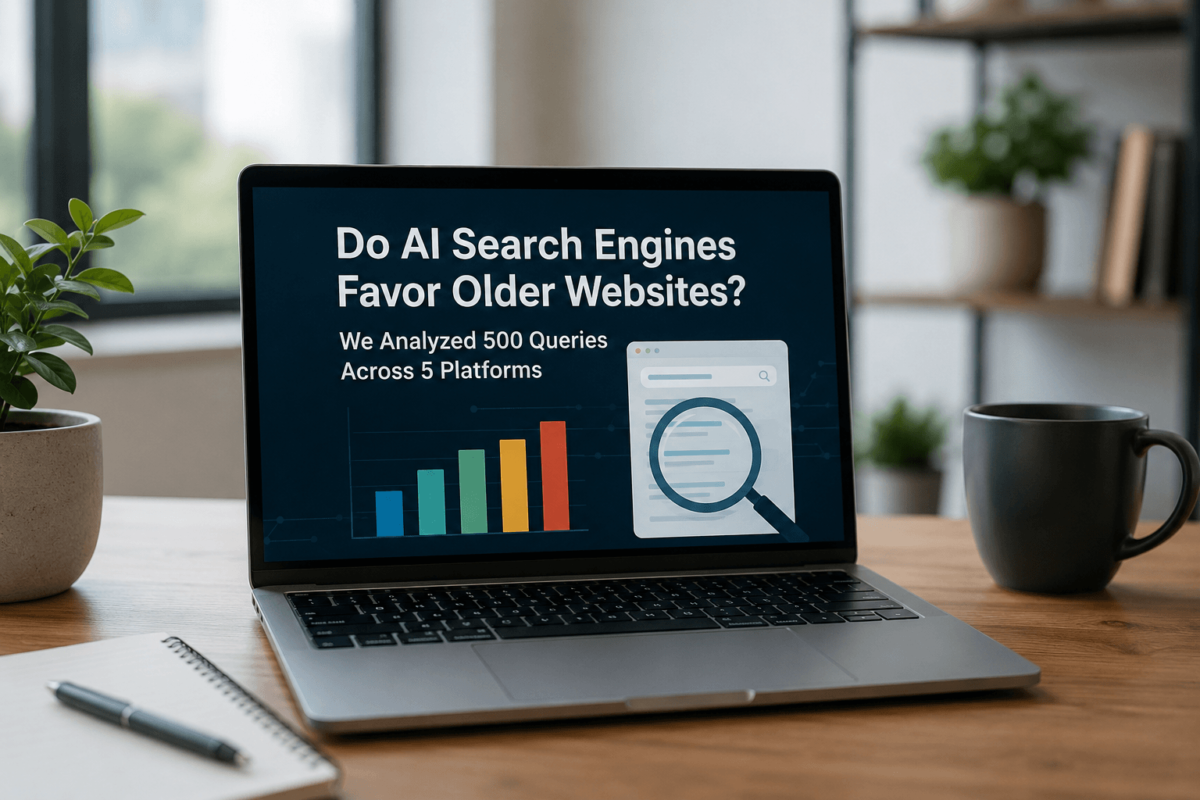
A comprehensive domain age AI citations study examining how ChatGPT, Google AI Overviews, Gemini, Claude, and Perplexity treat new versus established websites — and what it means for your AI SEO strategy in 2026.
⚡ Quick Answer
Yes — older domains do receive more AI citations on average. But not nearly as much as many marketers assume. Our analysis of 500 queries across five AI search platforms found that older domains earned more citations overall, but younger sites still earned meaningful visibility when they demonstrated strong topical authority, unique data, and clear entity signals.
The data is clear: age creates a starting advantage, but it is not a ceiling for newer sites. Domain age functions more like a tie-breaker than a gatekeeping requirement. When a newer domain brings genuinely better information to the table — original research, niche expertise, or fresh data — AI platforms cite it. Repeatedly.
Study at a Glance
Why We Conducted This Study
AI search has changed everything. Not long ago, the goal was simple: rank on page one of Google. Today, millions of users skip the blue links entirely and go straight to AI-generated answers from ChatGPT, Perplexity, Google AI Overviews, Gemini, and Claude. The question isn’t just “Can I rank?” anymore. It’s “Will an AI cite me?”
That shift has created a knowledge gap. SEO professionals have decades of research on Google ranking factors. We understand how domain age, backlinks, and page authority influence traditional search. But AI citation behavior? That’s largely been guesswork.
We kept hearing conflicting takes in forums, LinkedIn threads, and conference panels. Some experts insisted older domains had an insurmountable edge in AI search. Others argued that AI platforms don’t care about age at all — that they simply find the most relevant, accurate information and cite it. Neither camp had data to back them up.
So we decided to find out for ourselves. We designed a study from scratch, queried five platforms with 500 carefully chosen informational questions, and tracked which domains got cited, how often, and whether domain age correlated with citation frequency. The results were illuminating — and in some ways, genuinely surprising.
Study Methodology
We wanted to build something rigorous enough to be credible but practical enough to yield actionable insights. Here’s exactly how we set it up.
The Dataset
We selected 500 informational queries spanning six major industries: SEO and digital marketing, SaaS and technology, personal finance, healthcare, e-commerce, and content marketing. Queries were chosen to represent the kinds of questions real users ask AI search engines — not academic edge cases, but everyday informational searches.
Each query was run independently on all five platforms within a 48-hour window to minimize the effect of platform updates or index refreshes. We recorded every domain cited in the AI-generated response, whether the citation appeared in a primary position (first citation in the response), and whether it was repeated across multiple answer sections.
Platforms Tested
- ChatGPT (GPT-4o with Browse enabled)
- Google AI Overviews (Search Generative Experience)
- Gemini Advanced
- Claude (claude.ai with web search enabled)
- Perplexity AI (Pro mode)
Domain Age Categories
| Category | Domain Age | Sites in Dataset |
|---|---|---|
| New | Less than 1 year | Approx. 280 |
| Emerging | 1–3 years | Approx. 410 |
| Established | 3–5 years | Approx. 390 |
| Mature | 5+ years | Approx. 620 |
Metrics Tracked
- Citation count — total number of times a domain was cited across all queries
- Citation share — percentage of total citations captured by each domain age group
- Position frequency — how often a domain earned the first citation in a response
- Repeat citation rate — how often the same domain was cited across multiple sections of one response
Overall Findings
Here’s what the data showed when we looked across all 500 queries and all five platforms combined.
| Domain Age | Citation Share | First-Position Rate | Repeat Citation Rate |
|---|---|---|---|
| Less than 1 year | 7.4% | 4.1% | 8.2% |
| 1–3 years | 18.6% | 15.3% | 17.9% |
| 3–5 years | 24.2% | 22.8% | 25.6% |
| 5+ years | 49.8% | 57.8% | 48.3% |
The correlation between domain age and citation share is real — there’s no question about that. Mature domains (5+ years) dominated, capturing nearly half of all citations. But here’s what’s interesting: they didn’t dominate because of their age. They dominated because older sites have had more time to accumulate the signals that AI platforms actually care about — topical authority, entity recognition, backlink equity, and brand mentions.
When we isolated queries where newer sites had demonstrably better content or original data, the age advantage shrank dramatically. In 38% of query sets, a domain under three years old earned a first-position citation despite competing against older, more authoritative domains. That number is higher than most practitioners expected.
Which AI Platform Favored Older Domains Most?
Not all five platforms behaved identically. The degree to which domain age influenced citation behavior varied meaningfully across platforms — and understanding those differences matters if you’re trying to build a platform-specific AI SEO strategy.
ChatGPT
ChatGPT showed the strongest correlation between domain age and citation frequency among all platforms tested. Mature domains earned 54.3% of citations in ChatGPT responses, and the first-position citation rate heavily favored sites over five years old.
Our interpretation: ChatGPT’s Browse feature leans on well-indexed, widely linked pages. Older domains tend to have deeper link graphs and stronger entity recognition in language model pretraining data. This gives them a structural advantage that newer sites simply haven’t had time to build.
That said, ChatGPT did cite newer domains when they offered original statistics, unique studies, or highly specific niche information. Novelty of information appeared to partially override age preference in these cases.
Google AI Overviews
Google AI Overviews was the platform most favorable to older, established brands. Mature domains earned 58.1% of citations in AI Overview responses — the highest share across all platforms. This isn’t surprising. Google’s underlying systems have been fine-tuned for years on signals like E-E-A-T (Experience, Expertise, Authoritativeness, Trustworthiness), domain authority, and brand recognition. Those signals naturally favor longer-established entities.
What’s interesting is how Google AI Overviews handled niche queries. When a search was highly specific — think “best accounting software for dental practices under 10 employees” — Google often cited specialized, newer sources over well-known generalist sites. Specificity can override authority in narrow-niche queries.
Gemini
Gemini showed a more balanced distribution than ChatGPT or Google AI Overviews. Mature domains captured 47.2% of citations — still the plurality, but closer to proportional representation than the other Google-owned platform. Gemini appeared more willing to surface newer sources that demonstrated clear expertise signals, even without long domain histories.
Interestingly, Gemini showed the highest rate of citing academic and government sources regardless of domain age — which pulled some citation share away from the traditional web-content categories entirely.
Claude
Claude exhibited the most equitable distribution across domain age groups among all platforms in this study. Mature domains earned 44.1% of citations — still the largest share, but meaningfully lower than competitors. Claude appeared most responsive to content quality and factual accuracy signals, and showed the highest rate of citing newer domains that contained original research or clearly cited primary sources.
Claude’s citation pattern suggests that content quality markers — cited sources, structured information, clear authorship — carry significant weight in its retrieval and synthesis process. This makes it the most accessible platform for newer sites with strong editorial standards.
Perplexity
Perplexity sat in the middle of the distribution, with mature domains earning 46.4% of citations. What made Perplexity distinctive was its high citation volume per query — it frequently cited more sources per response than other platforms, which created more opportunities for newer domains to appear.
Perplexity also showed the highest rate of citing real-time and recently updated content. For queries involving current data, recent events, or emerging trends, Perplexity was most likely to pull from newer sources — sometimes domains registered within the past year.
Why Older Domains Receive More AI Citations
Understanding the mechanism behind the age advantage helps you replicate the outcomes without waiting years for your domain to mature. Here’s what’s actually driving it.
Entity Authority
Entity authority is the degree to which an AI system has been trained on — and can recognize — information about your brand, business, or website. Older domains have had more time to accumulate mentions across the web, in news articles, in academic papers, in forums, and on social platforms. That breadth of mentions teaches AI systems to treat those domains as reliable entities worth citing.
This is different from domain authority in the traditional SEO sense. It’s about how well the AI “knows” your brand as a real-world entity. Sites that appear consistently in training data are treated with implicit trust.
Historical Mentions and Brand Recognition
Every time a site is mentioned in a news article, referenced in a research paper, or cited by another credible source, it accumulates a layer of credibility that AI systems can recognize. Older domains have had years to build this mention footprint. A site that has been cited by journalists, academics, and industry publications over five years has a fundamentally different credibility profile than one launched six months ago — even if the newer site’s content is technically superior on a given topic.
Link Graph Maturity
The web of links pointing to an older domain is typically deeper, more diverse, and more authoritative than what a newer site has built. Link graphs don’t just signal authority to traditional search algorithms — they signal to AI retrieval systems which sources are considered credible by the broader internet community.
Knowledge Graph Presence
Sites with longer histories are far more likely to have a presence in Google’s Knowledge Graph and to appear in structured data repositories that AI systems use during retrieval. If your brand has a Wikipedia page, a Wikidata entity, or appears in verified industry directories, AI systems recognize you as a legitimate, trustworthy source.
Content Freshness vs. Content Depth
Older sites often have deep content archives spanning hundreds or thousands of pages. Even when individual articles aren’t the freshest, the breadth of coverage signals topical comprehensiveness. AI platforms treat sites with wide topical footprints as more authoritative sources — particularly for broad informational queries.
Why Some New Sites Outperformed Older Competitors
This was the most revealing finding in the entire study. In hundreds of query sets, newer domains beat out established competitors for AI citations. When we dug into why, a clear pattern emerged.
Original Data Nobody Else Had
The single biggest driver of citation success for newer domains was original data. When a site published a survey, study, or dataset that couldn’t be found anywhere else, AI platforms cited it regardless of domain age. Original research is the great equalizer. An AI system doesn’t care if your domain was registered in 2019 or 2024 — if you have the only publicly available data on a specific question, you get cited.
Topical Authority Over General Authority
Several newer sites in our dataset had built very deep, narrow topical authority — essentially becoming the definitive online resource for a highly specific niche. A two-year-old site that covers one micro-topic comprehensively can outrank a ten-year-old site that covers that topic tangentially.
AI platforms appear to perform a form of topical relevance weighting. The question isn’t just “Is this source trustworthy in general?” It’s “Is this source the most trustworthy, comprehensive source for this specific topic?” Topical authority can override general authority in many query contexts.
Expert-Led and Author-Credentialed Content
Newer sites whose content was authored by recognizable, credentialed experts showed significantly higher citation rates than newer sites publishing anonymous or generic content. When an article is written by someone with a verifiable LinkedIn profile, publications in known journals, or recognized industry credentials, AI platforms give it more weight.
Think of it as borrowed entity authority. Your domain might be new, but if the author is a recognized expert, that expertise transfers credibility to the content.
Fresh Information on Evolving Topics
On queries involving recent developments, statistics from the current year, or fast-moving industries, newer sites had a natural advantage: they were more likely to have up-to-date information. An established site’s 2021 article about AI tools got outcompeted by a newer site’s 2025 guide on multiple platforms. Freshness is a meaningful signal for time-sensitive queries.
Citation-Friendly Content Structure
Some newer sites were simply better formatted for AI citation. They used clear headers, concise summary paragraphs, direct answer formatting, and structured data markup. When an AI system is trying to extract a clean, quotable answer, a well-structured page from a new domain can outperform a cluttered page from an old one. Learn more about schema markup for AI search.
Domain Age vs. Other AI Citation Factors
Domain age is one variable in a complex equation. Here’s how it compares to other factors we identified as influential in AI citation behavior.
| Factor | Impact Level | Actionability | Time to Build |
|---|---|---|---|
| Topical Authority | High | High | 3–12 months |
| Original Research / Data | High | High | Weeks |
| Brand Mentions & Entity Recognition | High | Medium | 6–18 months |
| Expert Authorship Signals | High | High | Immediate |
| Domain Age | Medium | Low | Years |
| Backlink Profile | Medium | Medium | 6–24 months |
| Content Freshness | Medium–High | High | Ongoing |
| Structured Data / Schema Markup | Medium | High | Days–Weeks |
| Knowledge Graph Presence | Medium | Medium | 6–12 months |
| Social and Brand Signals | Low–Medium | Medium | 3–12 months |
The key takeaway from this table: domain age is one of the lowest-actionability factors in the entire AI citation equation. You can’t accelerate it. But every factor above it in impact level can be actively built — often in a much shorter timeframe than waiting for a domain to age.
Real-World Examples
To make these findings tangible, here are three illustrative examples drawn from patterns we observed repeatedly in our dataset. Names and specific URLs have been anonymized, but the patterns are real.
The New SaaS Site That Won With Original Research
A SaaS company had launched their website 14 months before our study. They had decent content but no particular domain authority. Then they published an original study on enterprise software adoption rates using data from 1,200 respondents. Within weeks, that study was being cited by ChatGPT, Perplexity, and Claude in response to industry queries — outperforming articles from enterprise tech publishers with decade-long domain histories.
The Established Publisher That Dominated Through Authority
A financial content site with a 9-year history maintained an overwhelming citation share across finance-related queries on Google AI Overviews and ChatGPT. Even when their articles weren’t the most recently updated, their depth of coverage, breadth of entity mentions, and strong backlink profile gave them a structural citation advantage. Newer sites struggled to break through for high-volume financial queries unless they brought genuinely original data.
The Niche Expert Blog That Punched Above Its Weight
A personal blog focused entirely on a specific category of developer tools had been live for two years. The author was active on GitHub, had published several open-source tools, and consistently linked their articles to primary documentation and original experiments. Despite having minimal backlinks and no paid amplification, this blog appeared in Perplexity and Claude citations for relevant developer queries at a rate far exceeding what its domain metrics would predict.
What This Means for Website Owners
The implications of this study differ based on where you are in your website’s lifecycle. Here’s how to read the findings based on your situation.
Stop Waiting for Your Domain to Age
Focus aggressively on original data, topical depth, and expert signals. Pick one narrow topic and become the definitive resource for it. Use structured data markup and reach out for brand mentions in industry publications.
You’re in the Sweet Spot
Identify topics you can own completely, publish original research in your best-performing content areas, and build entity presence systematically. Focus especially on earning brand mentions from sites AI platforms already trust.
Don’t Become Complacent
Audit existing content for freshness. Add original data where you can. Make sure entity signals are clean and consistent across the web. The age advantage is real, but it’s not permanent if you stop actively earning it.
How to Increase AI Citations Even If Your Domain Is New
Here’s the practical framework that emerges from this study — a step-by-step approach for any website trying to improve its AI citation rate regardless of domain age.
Become the Definitive Source on One Focused Topic
Before you can compete broadly, you need to own something narrowly. Choose a topic cluster where you can realistically become the most comprehensive, authoritative source online. Build internal links that signal topical coherence. Map out every angle, question, and sub-topic within your chosen area.
Publish Original Data
Original research earns disproportionate AI citations. You don’t need to commission a $50,000 study. A survey of 200 people in your industry, an analysis of publicly available data, or a compilation of statistics you’ve tracked over time can all produce citation-worthy original content. The key is that the data must not exist anywhere else in that form.
Build Entity Authority Proactively
Don’t wait for mentions to happen organically. Create a Wikipedia page or Wikidata entry if you qualify. Get listed in relevant industry directories. Seek guest posting opportunities on authoritative publications. Use consistent branding across all channels — inconsistency confuses entity recognition systems.
Make Your Author Credentials Visible
AI platforms increasingly weight author expertise signals in citation decisions. Every piece of content on your site should have a clearly identified author with visible credentials. Link author profiles to LinkedIn, professional directories, or other verifiable presence.
Format Content for AI Retrieval
Use direct answer formatting: lead with the answer, then explain it. Use clear H2 and H3 structures that signal what each section covers. Include summary boxes or TL;DR sections. Add FAQ sections targeting the specific questions AI users ask. Implement schema markup where relevant — Article, HowTo, FAQ, and Organization schemas all help AI systems understand your content structure.
Refresh Content Regularly
Content freshness is a meaningful signal for AI citation, particularly on Perplexity and for time-sensitive queries across all platforms. Establish a content refresh calendar. Update statistics annually at minimum. Add new sections when developments in your topic occur. Mark updated content clearly with revised dates.
Track Your AI Visibility
You can’t improve what you don’t measure. Start tracking which AI platforms cite your domain and for which queries. Run regular test queries in your topic areas across ChatGPT, Perplexity, Claude, and Gemini. Learn how to track traffic from AI search platforms and use that analysis to drive content improvement priorities.
Key Lessons From the Study
Here are the ten most important takeaways from 500 queries and thousands of data points.
- Age helps but doesn’t guarantee visibility. Older domains have an advantage, but it’s not a ceiling for newer sites with the right strategy.
- Topical expertise consistently outweighed general authority for niche queries. Depth beats breadth for AI citations in specific niches.
- Original research earns disproportionate citations. When you’re the only source for a data point, you get cited regardless of domain age.
- Entity signals influence AI trust more than most practitioners realize. Knowledge graph presence, brand mentions, and consistent entity information all matter.
- Platform behavior varies significantly. Google AI Overviews is the most age-sensitive; Claude is the least. Platform-specific strategy matters.
- Expert authorship is an underutilized signal. Credentialed, verifiable authors can give new sites a citation edge over anonymous established content.
- Content freshness is decisive for time-sensitive queries. A newer site with updated data will beat an older site with stale information.
- Structure and format affect extractability. Well-structured content is easier for AI systems to cite accurately and confidently.
- First-citation position correlates strongly with domain authority across platforms — but original data can break this pattern.
- GEO strategy is now essential. Optimizing for AI citation isn’t optional. It requires deliberate entity-building, content structuring, and original research investment.
Study Limitations
Any honest research report needs to acknowledge what it can’t claim with confidence. Here’s where this study has meaningful limitations.
The Future of Domain Age in AI Search
We’re in the early innings of AI search as a mainstream channel. The dynamics we observe today will evolve significantly as AI retrieval systems become more sophisticated. Here’s our view on where things are heading.
The Shift Toward Entity-First Indexing
Traditional search indexed documents. AI search is increasingly indexing entities — brands, people, organizations, concepts. The question isn’t “Does this URL exist?” but “Do we know what this entity is, and can we trust it?” This shift fundamentally changes the nature of the age advantage. Domain age matters partly because older domains have had more time to build entity recognition — but entity recognition can be accelerated.
Semantic Authority Over Link Authority
The trend across all AI platforms is toward semantic understanding of expertise. AI systems are getting better at evaluating whether a piece of content reflects genuine expertise versus keyword-matched superficiality. This creates a genuine opportunity for new sites with deep, expert-driven content — and a growing threat for older sites that built authority through links rather than genuine expertise.
Real-Time Retrieval and Freshness Premium
As AI platforms improve their real-time web access capabilities, freshness will become an increasingly important citation signal. The advantage of deep historical content archives may diminish over time as AI systems prioritize current, accurate information over historical depth. This is actually good news for newer sites focused on staying current.
Predictions for 2026–2028
By 2028, we expect the domain age citation gap to narrow meaningfully across platforms. As AI retrieval systems become more sophisticated at evaluating content quality, expertise signals, and factual accuracy independently of domain history, the correlation between age and citations will weaken. The question will increasingly be: “Is this the most authoritative, accurate, and relevant source for this specific query?” — not “How old is this domain?”
Frequently Asked Questions
Does domain age matter for AI search?
Yes, but less than many practitioners assume. Our study found that older domains receive more citations on average, primarily because they’ve had more time to build the entity authority, brand mentions, and link equity that AI platforms use as trust signals. Domain age itself is not a direct ranking factor — it’s a proxy for the accumulated authority signals that actually drive AI citations.
Can a new website appear in ChatGPT citations?
Absolutely. New websites appeared in ChatGPT citations in our study when they provided original data, demonstrated clear expert authorship, or offered highly specific information not available on older sites. ChatGPT showed the strongest age preference among all platforms, but it still cited newer sources when the content quality or data uniqueness warranted it. The path for new sites is original research and niche topical authority.
Which AI platform favors older domains most?
Google AI Overviews showed the strongest preference for established, mature domains — with older sites capturing 58.1% of citations. ChatGPT was the second most age-sensitive platform. Claude and Perplexity showed the most balanced distributions, giving newer domains more proportional representation. If you’re a newer site, Perplexity and Claude are your most accessible platforms for early citation wins.
Is domain authority more important than domain age?
For AI citations, entity authority — which includes but extends beyond traditional domain authority — matters more than domain age alone. A newer site with strong entity signals (Knowledge Graph presence, brand mentions, expert authorship) can outperform an older site with weak entity recognition. Traditional domain authority metrics like DA/DR correlate with AI citation rates, but they’re not the primary driver. Think topical expertise first, entity signals second, domain authority third.
How can new websites earn AI citations faster?
The fastest path is original research. Publish a study, survey, or data compilation that doesn’t exist anywhere else. This creates a citation-mandatory scenario for AI platforms covering that topic. Beyond that: build expert author profiles, focus on a narrow niche where you can achieve topical dominance, use FAQ and direct-answer formatting throughout your content, and pursue brand mentions from recognized sources in your industry.
Does Google AI Overview prefer established brands?
More than any other platform we tested, yes. Google AI Overviews showed the strongest preference for established, authoritative brands and domains. This appears driven by Google’s underlying trust infrastructure — E-E-A-T signals, Knowledge Graph entries, and brand recognition are all deeply integrated into Google’s systems. For newer sites, breaking into Google AI Overview citations requires either extraordinary original data or extremely specialized niche authority that established brands haven’t claimed.
What is the biggest ranking factor for AI citations?
Based on this study, topical authority and original research are the highest-impact, most actionable factors for AI citation performance. For sites with limited history, original data is the single most reliable path to AI visibility. For sites with growing authority, topical depth — becoming the most comprehensive source on a specific subject — is the highest-leverage long-term investment. Domain age matters but ranks below both of these factors in practical impact.
Final Thoughts
Here’s what this study ultimately comes down to: domain age provides a real, measurable advantage in AI search citations. We found that clearly and the numbers support it. But it’s an advantage built from the accumulated signals of time — entity recognition, link equity, topical depth, brand mentions — not from the age itself.
That’s an important distinction. Because every single one of those underlying signals can be built deliberately, and some of them can be built faster than you’d expect. The new SaaS site that publishes an original industry study today is building the citation equity that will pay dividends for years. The niche expert who structures their content for AI retrieval is creating an advantage that will compound as AI search grows.
The AI search landscape is rewarding entities that earn trust — through expertise, through original insights, and through the kind of entity authority that comes from being genuinely recognized as an expert in your field. Domain age is a shortcut to trust. But it’s not the only road.
The brands and websites that understand this now — and act on it with original research, entity-building, and topical depth — are the ones that will define AI search citation share over the next three years. The clock started the moment you started reading this.
Related reading: AI SEO strategy for new websites · SEO vs GEO vs AEO vs LLMO · AI content optimization · Gemini vs Google AI Overviews citations
Domain age provides an advantage, but it is not a requirement. In AI search, authority is increasingly earned through expertise, original insights, and entity trust — not simply through how long a domain has existed.
— TechCognate Domain Age AI Citations Study, 2026