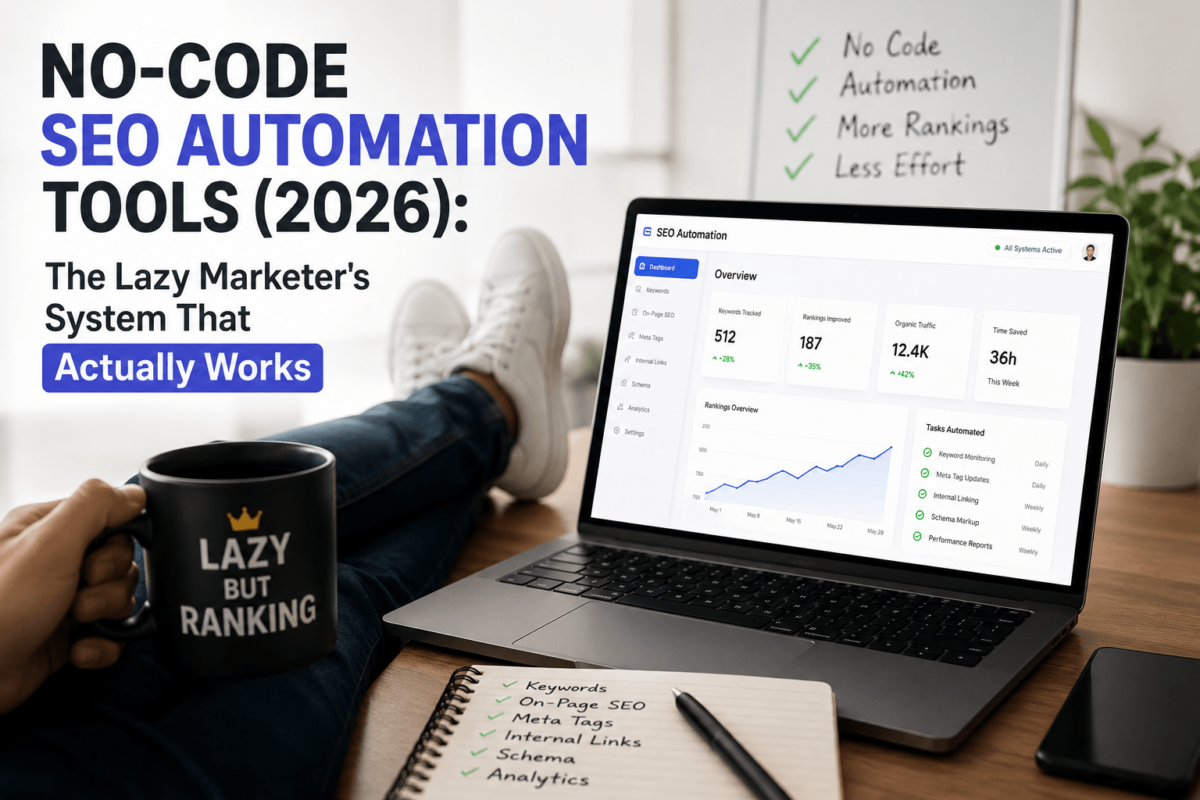
How I Combine APIs for SEO Automation (2026 Proven Framework That Saves 10+ Hours Weekly)
Combining APIs for SEO automation means connecting tools like keyword research, content generation, SERP tracking, and auto-indexing into one seamless workflow. Instead of jumping between five tabs and copy-pasting data all day, you build a system that does the heavy lifting for you. The result? More content, better rankings, and a lot more time back in your week.
- API automation replaces repetitive manual SEO tasks like keyword research, content briefs, and publishing
- The right API stack connects keyword data, AI writing, SERP tracking, and indexing in one flow
- Businesses using API-driven SEO workflows report saving 10–20 hours per week
- No-code tools like Make and Zapier let non-developers build powerful API pipelines
- API automation scales content output from 5 posts/month to 50+ without hiring more people
- Affiliate and programmatic SEO sites see the biggest ROI from automated API workflows
- The biggest mistake is automating without a strategy — quality still wins in 2026
Why Combining APIs Is the Backbone of Modern SEO Automation
Ever feel like you’re copying data between five tools just to publish one blog post? You pull keywords from one platform, paste them into a content brief tool, generate the draft in another, manually add internal links, then upload everything to WordPress. That’s not a workflow — that’s a hamster wheel.
Manual SEO was fine when you were managing 10 pages. But the moment you want to scale — 50 pages, 200 pages, 1,000 pages — the cracks show fast. You hit a wall that no amount of late nights can fix.
Here’s the real problem: SEO in 2026 is a volume game backed by quality. Google rewards consistent, well-structured content published regularly. If you’re doing everything by hand, you simply can’t keep up. APIs solve this by letting your tools talk to each other automatically. One trigger starts a chain reaction — keyword data flows into a content generator, the draft gets enriched with SERP data, internal links get assigned, and the post gets published and submitted for indexing. All without you touching a thing.
That’s not theory. That’s what the top SEO operators are actually doing right now.
What Most SEO Guides Get Wrong About APIs
Most articles about APIs for SEO read like a computer science textbook. They explain what an API is (a bridge between software — yes, we know), list a few tools, and call it a day. Zero workflows. Zero ROI discussion. Zero real-world application.
Here’s what they consistently miss:
- No actual workflow maps — they tell you APIs can connect tools but never show you how
- No ROI framing — what’s the point of automation if you can’t tie it to traffic and revenue?
- Too technical, too fast — most writers assume you’re a developer. Most SEOs aren’t.
- No monetization angle — especially for affiliate sites, faster publishing = faster rankings = faster commissions
- They ignore no-code options — Make, Zapier, and Pabbly make API connections accessible to everyone
This guide fills those gaps. Every section ties back to one question: does this help you rank faster and earn more with less manual effort?
The Core API Stack for SEO Automation (2026)
1. Keyword Data APIs
Tools like DataForSEO, SEMrush API, and Ahrefs API give you programmatic access to keyword volumes, competition scores, and SERP data. Instead of logging in and exporting CSVs, you pull fresh data directly into your workflow. Use these to automatically feed keyword clusters into your content pipeline.
2. Content Generation APIs
The Anthropic API (Claude) and OpenAI API are the workhorses here. Feed them a keyword cluster and a content brief, and they output structured drafts at scale. The key is pairing them with solid prompting templates that reflect your brand voice and content structure. This is where most of the time savings happen.
3. SERP Tracking APIs
ValueSERP, SerpAPI, and the DataForSEO SERP API let you check rankings, monitor featured snippets, and track competitor movements automatically. Connect these to a dashboard or Google Sheet and you have a live ranking monitor without manual checks.
4. Indexing APIs
Google’s Indexing API (primarily for job postings and livestreams, but widely used for speed), IndexNow, and tools like Omega Indexer push your new content to search engines faster. Publishing a post and waiting weeks to get indexed is old news — these APIs get eyes on your content in hours.
5. Internal Linking APIs
Tools like Link Whisper and custom scripts using your CMS API can automatically suggest and insert internal links based on topical relevance. This is one of the most underused automation opportunities in SEO right now.
Real-Life Example: How I Automated My SEO Workflow Using APIs
A few years back, I was running a mid-size affiliate site in the personal finance space. Publishing three posts a week meant three full days of research, writing, editing, and uploading. I was the bottleneck, and I knew it.
Here’s what the before looked like: manually pulling keywords from Ahrefs, writing briefs in Google Docs, generating drafts with an AI tool, editing, formatting in WordPress, adding internal links by memory, and then hoping Google would crawl the page sometime that month.
After building an API-connected workflow using Make (formerly Integromat), DataForSEO for keyword data, the Anthropic API for drafts, and IndexNow for instant indexing, everything changed. A single form submission now triggers the entire pipeline. Keyword data gets pulled, a brief is generated, a draft is written, formatted, and queued — all within minutes.
The results: content output tripled. Time spent per post dropped from 4 hours to under 45 minutes (mostly editing and QA). Rankings improved because we were publishing consistently, not sporadically. The biggest mistake along the way? Trying to automate too much too fast without validating the content quality at each step. Lesson learned: build in human review checkpoints, especially in the editing stage.
Step-by-Step Guide to Combining APIs for SEO Automation
Define Your SEO Workflow
Before touching a single API, map out your current process on paper. What are the exact steps from keyword idea to published post? Identify where you spend the most time — that’s where automation will have the biggest impact.
Choose the Right APIs
Don’t try to automate everything at once. Start with one pain point. If keyword research eats your mornings, start with a keyword data API. If writing takes forever, start with a content generation API. Match the tool to the bottleneck.
Connect Tools with Make, Zapier, or Custom Scripts
Make and Zapier let you connect APIs visually without writing code. Set up triggers (like a new row in a Google Sheet) that kick off automated actions (like sending data to an AI API and writing the response back). For more complex workflows, a lightweight Python script using the requests library works beautifully.
Automate Content Creation
Use your content generation API to produce structured drafts based on keyword data and a template prompt. Always include SEO directives in your prompt: target keyword in H1, semantic keywords throughout, FAQ section, meta description. The cleaner your prompt, the less editing you’ll need.
Automate Publishing and Indexing
Use your CMS API (WordPress REST API is the most common) to auto-publish posts from your workflow. Connect IndexNow or another indexing API to notify search engines the moment content goes live. This two-step combo eliminates two of the most tedious parts of the publishing process.
Monitor and Optimize
Plug your SERP tracking API into a live dashboard. Watch which pages are gaining traction, which keywords are moving, and where there are gaps. Feed that data back into your keyword research pipeline and repeat. This creates a compounding feedback loop that gets smarter over time.
Best API Combinations for Different Use Cases
🛒 Affiliate SEO Sites
DataForSEO + Claude API + WordPress REST API + IndexNow. This combo lets you build out product review clusters at speed. Keyword data flows in, review-style drafts come out, posts go live and get indexed fast. Affiliate sites thrive on consistent volume — this setup delivers it.
📍 Local SEO
Google My Business API + SERP API + CMS API. Automate local citation monitoring, review response templates, and location-page creation for multi-location businesses. One setup, dozens of location pages managed hands-off.
⚙️ Programmatic SEO
A database (Airtable or Google Sheets) + template + CMS API is the classic programmatic stack. Pull structured data, merge it with a page template, and publish thousands of location or comparison pages automatically.
🏢 Content Scaling for Agencies
Client keyword data + Claude API + Google Docs API (for client review) + WordPress API. Automate the brief-to-draft process, send drafts to clients for approval in Docs, then auto-publish approved content. This alone can double an agency’s output without adding headcount.
Manual SEO vs. API Automation: A Comparison
| Approach | Manual SEO | Basic Tools | API Automation |
|---|---|---|---|
| Time per post | 4–6 hours | 2–3 hours | 30–60 min |
| Scalability | Very Low | Moderate | Very High |
| Monthly Cost | $0–$50 | $100–$300 | $200–$500 |
| ROI Potential | Low | Medium | Very High |
| Consistency | Inconsistent | Moderate | Highly Consistent |
Common Mistakes to Avoid
- Over-automating without a strategy: Automation amplifies whatever you feed it. Garbage prompts = garbage content at scale. Always validate quality before scaling.
- Using too many APIs at once: Start with one or two connections. Get them stable, then add more. Complexity kills momentum.
- Ignoring content quality: Google’s quality signals are smarter than ever in 2026. Thin, templated content that used to rank won’t cut it. Always build in an editing step.
- Not tracking ROI: If you can’t connect your automation spend to traffic or revenue growth, you’re flying blind. Set up basic attribution from day one.
- Skipping error handling: APIs fail. Build in fallback logic and alerts so a failed call doesn’t silently break your entire workflow overnight.
How API Automation Helps You Monetize Faster
Here’s the math that makes affiliate SEOs love API automation: more content published faster = more pages indexed = more keywords ranking = more clicks = more commissions. That’s not a complicated equation, but the bottleneck has always been the content creation step.
When you automate keyword research and content generation with APIs, you can go from a seed keyword list to 20 published posts in a weekend instead of a month. For affiliate sites especially, that velocity compounds. Early rankings beget more rankings. More internal links flow to your money pages. Topical authority builds faster.
Top tools worth exploring for this workflow include DataForSEO (keyword and SERP data), the Anthropic or OpenAI API (content generation), WordPress REST API (publishing), and IndexNow (instant indexing). Most offer free tiers or low-cost entry points, making this accessible even for solo operators running tight budgets.
The bottom line on ROI: If you can go from 5 posts/month to 30 posts/month with the same budget, and even half of those posts rank, you’re compounding your authority and revenue simultaneously. API automation isn’t an expense — it’s leverage.
Frequently Asked Questions
Final Thoughts
If you’re still doing SEO manually in 2026, you’re not just working harder — you’re falling behind. The people outranking you aren’t necessarily smarter or more experienced. They’ve just built systems that do the work at scale while they focus on strategy.
The good news? You don’t need to be a developer or spend a fortune to get started. Pick one bottleneck in your current SEO workflow, find the right API for it, and connect it using a tool like Make or Zapier. That’s it. One automation. One less thing eating your time every week.
Once you see it working, you’ll never go back to doing it manually. Start small, stay consistent, and let the APIs do the grinding.