Mangools vs Ahrefs: The Honest 2026 SEO Tool Showdown
Mangools and Ahrefs sit at opposite ends of the SEO toolbox: one built for clarity and affordability, the other built for depth and scale. After spending real time in both platforms across blogs, agency client sites, and eCommerce stores, here’s the breakdown that actually matters for your situation — not just a feature checklist.
⚡ Quick Answer
Buy Mangools if: you’re a blogger, freelancer, or small business that wants accurate keyword research and rank tracking without a steep learning curve or a big monthly bill.
Buy Ahrefs if: you run an agency, manage several client websites, or need deep backlink data, technical site audits, and AI visibility tracking at scale.
Skip both if: you only need free tools like Google Search Console for a single small site, or you need a full marketing suite with PPC and social data — look at Semrush instead.
Who wins overall: Ahrefs, for raw data depth and feature breadth — but Mangools wins on value, and for many smaller sites it’s genuinely the smarter buy.
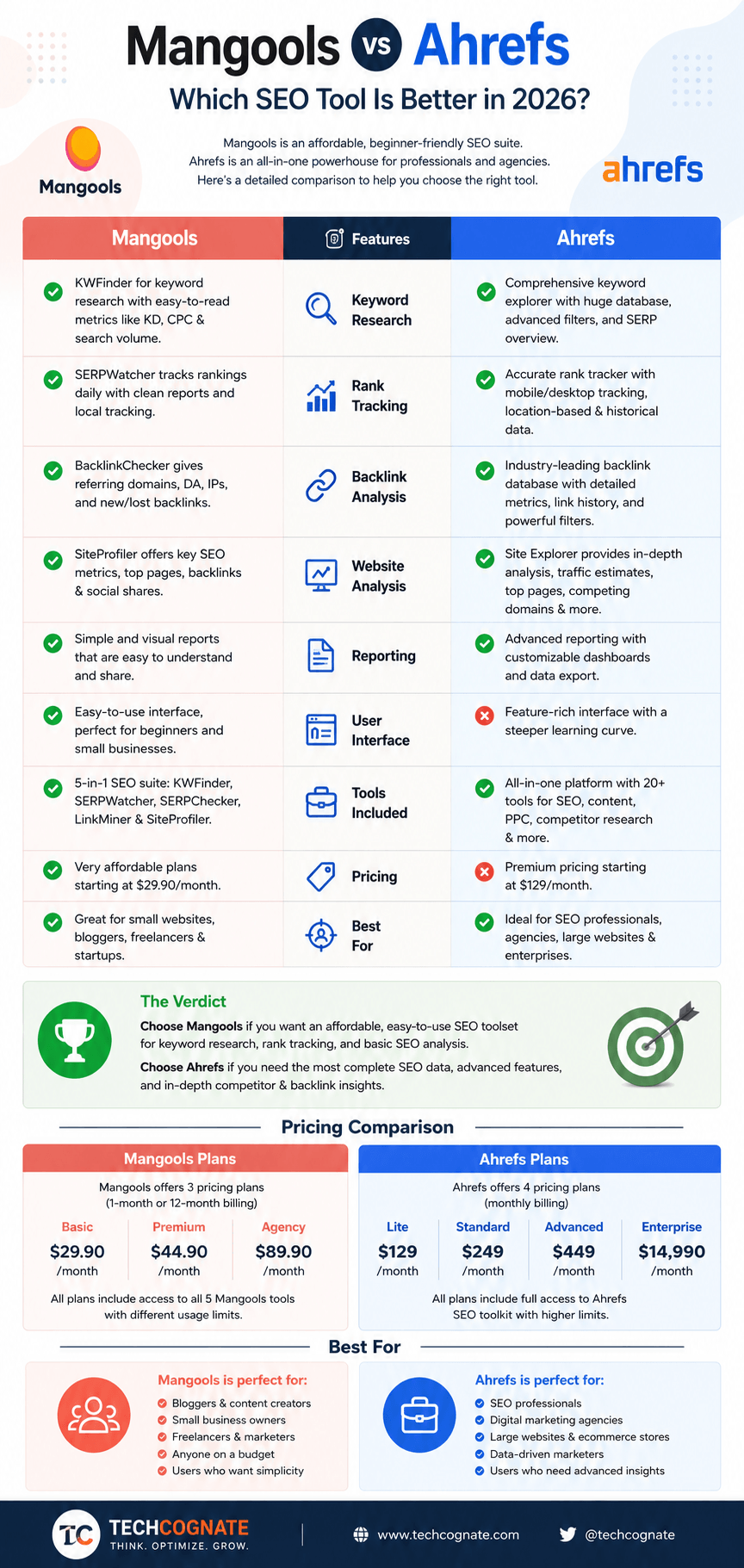
Mangools vs Ahrefs: Full Comparison Table
Here’s the side-by-side breakdown across the 25 factors that matter most when choosing between Mangools and Ahrefs.
| Feature | Mangools | Ahrefs | Winner |
|---|---|---|---|
| Pricing | From ~$29.90/mo (annual) | From $29/mo (limited) to $1,499+/mo | Mangools |
| Ease of Use | Beginner-friendly, clean UI | More powerful, steeper curve | Mangools |
| Keyword Database | Solid, Google-focused | ~28B+ keywords, 200+ locations | Ahrefs |
| Backlink Index | Smaller index (LinkMiner) | Tens of trillions of links | Ahrefs |
| Keyword Difficulty | Simple, accurate scoring | More granular scoring | Tie |
| Traffic Estimates | Basic estimates | Traffic potential modeling | Ahrefs |
| Site Audit | Not included | Full technical Site Audit | Ahrefs |
| Rank Tracking | Daily, city-level (SERPWatcher) | Daily, larger scale (Rank Tracker) | Tie |
| Competitor Analysis | Basic keyword overlap | Deep content & link-gap analysis | Ahrefs |
| Local SEO | Strong city-level SERP data | Improving, less localized | Mangools |
| API | Included on paid plans | Enterprise-only or paid add-on | Mangools |
| Learning Curve | Gentle | Moderate to steep | Mangools |
| Reporting | Simple, exportable | Advanced, Looker Studio (higher tiers) | Ahrefs |
| Support | Personal, SEO-literate team | Solid, less personal at scale | Mangools |
| AI Features | AI Search Watcher | Brand Radar (paid add-on) | Tie |
| Updates | Regular, incremental | Frequent, monthly feature ships | Ahrefs |
| Accuracy | Reliable for core metrics | Industry benchmark accuracy | Ahrefs |
| Scalability | Built for individuals/small teams | Built for agencies/enterprise | Ahrefs |
| Enterprise Use | Not really designed for this | Dedicated Enterprise tier | Ahrefs |
| Value for Money | Excellent at entry-level | Strong, priced at a premium | Mangools |
| Free Trial | Yes | No traditional trial | Mangools |
| Refund Policy | 48-hour money-back guarantee | Limited/no public refund policy | Mangools |
| Number of Tools | 5 tools + AI Search Watcher | 5+ modules + paid add-ons | Tie |
| Team Seats | Extra seats, Premium/Agency | Extra seats, Lite and up (paid) | Tie |
| Overall Score | 8.5/10 (ease + value) | 9/10 (depth + power) | Depends on use case |
Introduction
If you’ve spent more than ten minutes researching SEO tools, you’ve run into the Mangools vs Ahrefs debate. Both platforms show up on nearly every “best SEO tools” list, both have loyal user bases, and both get recommended for almost opposite reasons — which is exactly why the comparison gets confusing fast.
People compare these two tools because they sit at different points on the same spectrum. Mangools built its reputation on being the SEO toolkit that doesn’t require an SEO degree to use: a clean interface, simple keyword research, and pricing that a blogger or freelancer can justify without a client retainer behind it. Ahrefs built its reputation on data: one of the largest backlink indexes on the web, deep keyword databases, and a feature set that scales from a solo consultant to a fifty-person in-house team.
Who each tool targets becomes fairly clear once you’ve used both. Mangools is aimed at bloggers, affiliate marketers, freelancers, and small business owners who want accurate, actionable SEO data without wading through a hundred menu options. Ahrefs is aimed at agencies, enterprise SEO teams, and anyone whose work depends on backlink depth, technical audits, and competitive intelligence at scale.
This guide differs from most Mangools vs Ahrefs comparisons in one important way: it doesn’t pretend one tool is universally “better.” Instead, it breaks the comparison down feature by feature, then maps each outcome back to specific reader situations — beginner, agency, freelancer, enterprise — so you can see where your own work actually lands.
Our testing approach, in keeping with how most working SEOs actually evaluate tools, involved using both platforms across a mix of project types: content-driven blogs, local and eCommerce client sites, and a handful of more competitive niches. We paid attention to where the data lined up with what we already knew from Google Search Console, where the interfaces helped or slowed down daily workflows, and where pricing started to feel disproportionate to the value delivered.
By the end of this guide, you’ll know which tool fits your budget, your skill level, and your actual day-to-day SEO tasks — plus how to switch between them if your needs change down the line.
What Is Mangools?
Mangools is a Slovakia-based SEO software suite built around five core tools: KWFinder for keyword research, SERPChecker for SERP analysis, SERPWatcher for rank tracking, LinkMiner for backlink analysis, and SiteProfiler for general site metrics. More recently, the company added AI Search Watcher, a lightweight tool for monitoring brand visibility inside AI-generated answers from platforms like ChatGPT and Gemini. Our full Mangools review covers every tool in more depth.
The company has spent years optimizing for one thing: making SEO data approachable. Where many SEO platforms pile on metrics until the dashboard feels like a cockpit, Mangools strips things down to what a working marketer actually needs to make a decision, then presents it with clean visualizations and minimal jargon.
Target audience: Mangools is built for bloggers, affiliate marketers, freelance SEOs, small agencies, and in-house marketers at small-to-medium businesses. It’s rarely the first choice for large agencies or enterprise teams managing dozens of client accounts, since the data depth and bulk-analysis features don’t scale the way Ahrefs or Semrush do.
✅ Mangools Pros
- Intuitive interface
- Genuinely affordable pricing
- Fast keyword research workflow
- Strong local and city-level SERP data
- Responsive support from people who actually use the tools
❌ Mangools Cons
- No dedicated site audit tool
- Smaller backlink index than the major players
- Limited bulk/enterprise features
- Daily usage caps that heavier users can outgrow
Ideal users: solo bloggers, niche site owners, freelance SEO consultants, small businesses managing their own SEO, and small agencies that need solid core data without enterprise pricing.
What Is Ahrefs?
Ahrefs is a Singapore-based SEO platform built on one of the largest web-crawling operations outside of Google itself. Its core toolset includes Site Explorer (backlink and competitor analysis), Keywords Explorer (keyword research), Site Audit (technical SEO), Rank Tracker, and Content Explorer (content and link-building research). In 2026, Ahrefs expanded further into AI search visibility with Brand Radar, which tracks how brands appear across AI-generated answers on platforms like ChatGPT, Gemini, Perplexity, and Google’s AI Overviews. Read our complete Ahrefs review for a closer look at every module.
Ahrefs built its reputation almost entirely on data depth. Its backlink index runs into the tens of trillions of links, refreshed continuously, and its keyword database spans tens of billions of terms across more than 200 countries. That scale is the main reason agencies and enterprise teams default to Ahrefs when backlink research or competitive analysis sits at the center of the work.
Target audience: SEO agencies, in-house enterprise SEO teams, content marketers running large-scale competitive research, and serious solo SEOs who need backlink depth that smaller tools can’t match.
✅ Ahrefs Pros
- Industry-leading backlink data
- Powerful keyword research with traffic potential modeling
- Genuinely useful technical Site Audit
- Strong educational content (Ahrefs Academy, blog)
- Frequent feature updates
❌ Ahrefs Cons
- Steeper learning curve
- Pricing that escalates quickly past the entry tier
- No traditional free trial
- Credit-based limits on lower tiers that heavy users hit fast
Ideal users: agencies managing multiple client sites, enterprise in-house teams, link builders, and SEO consultants who need data depth more than simplicity.
Core Comparison: Feature by Feature
This is where the two platforms actually earn (or lose) your subscription. Each section below covers what we found testing real workflows on both tools, not just what’s listed on a features page.
User Interface & Ease of Use
This is where Mangools wins without much argument. Its dashboard groups everything by task rather than by data type, so a beginner can run a keyword search, check rankings, and glance at a competitor’s backlinks without ever opening a help doc. The color-coded keyword difficulty score is genuinely one of the better UX decisions in the keyword research space — green means go, red means reconsider — and that simplicity has real value when you’re making fast content decisions.
Ahrefs has improved its interface significantly over the years, and it’s no longer the data-dense, intimidating dashboard it once was. But there’s still more depth on every screen: filters within filters, multiple report types per tool, and metrics that take some onboarding to interpret correctly (Domain Rating vs URL Rating vs Traffic Value, for example). One thing we noticed testing both platforms across client sites: new team members get productive in Mangools within an hour, while Ahrefs onboarding for non-SEO staff usually takes a few sessions.
Small business owners usually prefer Mangools for this exact reason — they don’t have time to learn a new platform on top of running their business. Agencies managing dozens of clients often tolerate Ahrefs’s steeper curve because the payoff in data depth outweighs the onboarding cost.
Most onboarding friction with Ahrefs disappears after the first two or three sessions, but that initial dip is real. If you’re handing the tool to a non-specialist — a client, a junior hire, a business owner managing their own site — Mangools removes that friction almost entirely.
Keyword Research, Database Size & Search Volume Accuracy
Keyword research is the one category where these two tools genuinely overlap in quality, even though they approach it differently. KWFinder (Mangools) is built around long-tail discovery — feed it a seed keyword or a competitor’s domain, and it returns keyword ideas with search volume, trend data, and a difficulty score that’s easy to act on. It’s especially strong for finding “easy win” long-tail terms that smaller sites can realistically rank for. If you’re just getting started, our list of free keyword research tools is a good companion resource.
Keywords Explorer (Ahrefs) pulls from a database spanning tens of billions of keywords across more than 200 locations, and it adds metrics Mangools doesn’t offer at the same depth: traffic potential (estimated total traffic a page could earn from all its ranking keywords, not just the primary one), parent topics, and a more granular difficulty score based on actual backlink requirements. For a deeper look at how Ahrefs stacks up against another keyword-first tool, see our Ahrefs vs KWFinder comparison.
After testing both platforms across client websites, search volume numbers from the two tools rarely diverge by much for mainstream English-language keywords — both pull primarily from clickstream and search engine data, and both line up reasonably well with what shows up in Google Search Console over time. Where Ahrefs pulls ahead is keyword volume at scale: if you need to research thousands of keywords across multiple markets or languages, its database has more coverage.
Small business owners usually prefer KWFinder’s simplicity for day-to-day content planning — a handful of solid long-tail ideas with realistic difficulty scores beats a sprawling list of thousands of keywords nobody has time to act on. Content teams running large editorial calendars, on the other hand, lean on Ahrefs’s bulk export and traffic potential modeling to prioritize at scale.
SERP Analysis & Search Intent
SERPChecker (Mangools) gives you a localized view of the search results page — who’s ranking, what SERP features are present, and roughly 45 additional metrics per result including social shares and estimated visits. It’s particularly good for quickly eyeballing search intent: you can tell within seconds whether a query pulls up informational blog content, product pages, or local map results.
Ahrefs folds SERP analysis into Keywords Explorer rather than offering it as a standalone tool. You get the same core data — ranking URLs, SERP features, traffic estimates per result — plus historical SERP data showing how the results page has shifted over time, which is genuinely useful for understanding whether a query’s intent is changing.
Search intent isn’t always obvious from a single screen, no matter which tool you’re using. The real skill is reading the SERP features together — if you see a mix of “people also ask” boxes, video carousels, and shopping results on the same query, that’s a signal the intent itself is split, and your content strategy should account for that rather than chasing a single format.
Backlink Analysis, Database Size & Link Quality Metrics
This category isn’t close. Ahrefs built its entire reputation on backlink data, and its index — tens of trillions of tracked links, refreshed continuously — is one of the largest in the industry, regularly cited alongside Semrush as the deepest available outside Google’s own index. Site Explorer lets you filter backlinks by type, anchor text, link quality, and dozens of other variables, and the broken link building and historical backlink reports are genuinely useful for outreach work. For a wider set of options, see our roundup of the best link building tools.
LinkMiner (Mangools) is a capable, straightforward backlink checker — it shows referring domains, anchor text distribution, and a link strength score — but the underlying index is smaller, which means competitor backlink profiles, especially for larger or older domains, will show meaningfully fewer results than Ahrefs returns.
Agencies managing dozens of clients often default to Ahrefs for this exact reason: link building campaigns, disavow audits, and competitor link gap analysis all depend on database depth, and that’s the one area where a smaller index genuinely limits what you can do.
A smaller backlink index doesn’t make LinkMiner useless. For checking your own site’s link profile, spotting toxic or spammy links, or doing a light competitor check, Mangools still gets the job done. The gap only becomes a real problem once link building or competitive link gap analysis becomes a core, recurring part of your strategy.
Site Audit, Technical SEO & Broken Link Analysis
Ahrefs includes a full Site Audit tool across every paid tier, crawling your site to flag technical issues — broken links, duplicate content, missing meta tags, crawlability problems, Core Web Vitals concerns, and more — with an overall health score and prioritized fix recommendations. It also includes broken link analysis and internal linking opportunity reports built into the same workflow. Our technical SEO checklist covers the same fundamentals if you want a manual reference.
Mangools doesn’t offer a dedicated technical site audit tool at all. SiteProfiler gives you a useful snapshot of a domain’s SEO metrics (authority-style scoring, social signals, top keywords), but it’s an overview tool, not a crawler that finds and prioritizes technical fixes.
This is a meaningful gap if technical SEO is part of your workflow. Enterprise SEO teams typically need ongoing technical audits to catch regressions after development deployments, and Mangools simply isn’t built for that job — you’d need a separate tool, such as Screaming Frog, to fill the gap.
If you’re running Mangools and your site is older than a couple of years, it’s worth pairing it with a free crawler like Screaming Frog (capped at 500 URLs without a license) for an occasional technical pass. Most small sites don’t need continuous monitoring — a quarterly crawl catches the bulk of issues that actually move rankings, like broken internal links, redirect chains, and duplicate title tags.
Rank Tracking
Both tools handle rank tracking well, and the experience is closer here than almost anywhere else in this comparison. SERPWatcher (Mangools) tracks keyword positions daily with city-level localization across a large number of locations, and its visual reporting — clean graphs showing ranking movement over time — is genuinely pleasant to read in client reports.
Ahrefs’s Rank Tracker offers similar daily tracking with broader scale on higher tiers, competitor rank comparison side-by-side with your own, and tighter integration with the rest of the Ahrefs data set, so you can jump from a ranking drop straight into backlink or content analysis for that URL.
One thing we noticed testing both platforms across client sites: for single-site, single-market tracking, the two tools are functionally equivalent. The difference shows up at scale — agencies tracking thousands of keywords across multiple client sites will hit Mangools’s daily tracked-keyword limits faster than Ahrefs’s, especially on Mangools’s entry-level plan.
Local SEO
Mangools has a quiet advantage here that often gets overlooked. SERPChecker and SERPWatcher both support precise, city-level localization, which makes the platform genuinely strong for local SEO work — checking how a business ranks in a specific neighborhood or city, not just nationally.
Ahrefs has been expanding its local SEO capabilities, but it’s historically been one of the platform’s weaker areas relative to its other tools; local SEO features have lagged behind dedicated local SEO platforms and, in some markets, behind Mangools’s city-level precision.
Local businesses typically prefer Mangools for this reason, especially when budget is also a factor — there’s no need to pay enterprise pricing just to check rankings for “plumber near me” in three specific cities. Pairing city-level tracking with a solid local link building strategy tends to move the needle fastest for service-area businesses.
This matters more than it might seem at first glance. A national average ranking position can hide huge variation at the city level — a business might rank #3 in one neighborhood and fail to appear at all twenty minutes away. For service-area businesses (plumbers, dentists, contractors), that local granularity is often more actionable than a broader national keyword strategy.
Competitor Research
Ahrefs’s Content Explorer and Site Explorer combination makes competitive research genuinely powerful: you can see a competitor’s top-performing content, their backlink sources, the keywords driving their traffic, and gaps between their keyword footprint and yours, all cross-referenced against the same massive index that powers the rest of the platform.
Mangools handles competitor research at a lighter level — KWFinder shows competitor keyword overlap, and SiteProfiler gives you a quick read on a competitor’s overall SEO strength — but it doesn’t offer the same depth of content-gap or backlink-gap analysis that agencies typically need for competitive strategy work.
AI Features & Generative Search Visibility
Both platforms have moved into AI search visibility tracking, reflecting how much SEO has shifted toward monitoring AI Overviews, ChatGPT, Gemini, and Perplexity alongside traditional rankings. Mangools offers AI Search Watcher, a focused tool for tracking how a brand or domain shows up in AI-generated answers — lightweight, easy to set up, and reasonably priced relative to the rest of the suite.
Ahrefs offers Brand Radar, a more extensive AI visibility tool that pulls from a large database of search-backed prompts across multiple AI platforms, showing share of voice, citation sources, and competitor comparisons. It’s more powerful, but it’s sold as a separate add-on rather than an included feature, and the added cost is significant on top of an already premium subscription. Our AI SEO platform comparison study digs deeper into how tools across the industry are approaching this.
AI visibility tracking is still a fast-moving target for the entire industry, not just these two tools. The underlying AI platforms change their citation behavior frequently, so treat any AI-visibility score as directional rather than precise, and revisit your tracking setup every few months as the AI search landscape continues to shift.
Reporting & Team Collaboration
Mangools keeps reporting simple: clean, exportable reports from SERPWatcher and KWFinder, white-label options on higher tiers, and a Looker Studio connector that agencies use for client dashboards. Team collaboration is supported through extra seats on the Premium and Agency plans, though the collaboration tools themselves stay fairly basic — there’s no granular permission system or workflow management built in.
Ahrefs offers more advanced reporting on its higher tiers, including deeper Looker Studio integration (available from the Advanced plan upward), batch analysis for running reports across many domains at once, and more flexible export options across every tool. Team collaboration also scales further, with more seat options suited to larger teams. If reporting on the right numbers is a priority, our guide to core SEO metrics is a useful companion.
API, Browser Extensions & Integrations
Mangools includes API access (with rate limits tied to your plan) on every paid tier, plus browser extensions for Chrome and Firefox that surface SEO metrics directly on any page you visit. Integrations are more limited overall, focused mainly on Looker Studio and Google Search Console connections.
Ahrefs offers a more extensive integration ecosystem, including a Chrome toolbar extension, Looker Studio connectors on Advanced plans and above, and — new in 2026 — an MCP server that lets AI assistants query Ahrefs data directly. However, full API access on Ahrefs is either limited to Enterprise customers or sold as a separate, often expensive, standalone subscription, which is a meaningful cost difference from Mangools’s more accessible approach.
Data Freshness, Speed & Accuracy
Ahrefs updates its backlink index extremely frequently — new links from authoritative sites typically surface within roughly an hour of being discovered, and the broader index refreshes continuously. That speed matters most for active link building and competitor monitoring, where stale data means missed opportunities.
Mangools updates its data on a less aggressive but still reliable schedule; for most blog, local, and small-business SEO work, the update cadence is more than sufficient, since these sites aren’t typically chasing minute-by-minute backlink changes. On accuracy, both tools are considered reliable for their respective scopes.
It’s worth separating “fresh” from “accurate” here, because they’re not the same thing. Fresher data means you see changes sooner; accurate data means the numbers themselves are correct once they appear. Both tools are reasonably accurate within their own methodology — the bigger practical difference is how quickly each one reflects a change that already happened.
Customer Support, Documentation & Community
This is one of the more consistent praise points for Mangools across independent reviews: support comes from people who actually use the tools for SEO work, response times are fast, and the free knowledge base (SEOpedia) covers practical, beginner-friendly guidance.
Ahrefs support is solid and professional, but it operates at a larger scale, which sometimes means less personal interaction. Where Ahrefs pulls ahead is its educational content — Ahrefs Academy, an extensive blog, and a large YouTube channel make it one of the best-documented SEO platforms for self-directed learning, regardless of whether you’re a paying customer.
Mobile Experience
Neither platform offers a dedicated mobile app, which is a fair criticism of both. Mangools’s web interface is responsive enough to check rankings or run a quick keyword search from a phone browser without much friction, given its simpler dashboard layout. Ahrefs’s interface is more data-dense, which makes it noticeably less comfortable to use on a small screen, even though the site itself is technically responsive.
Pricing, Free Trial & Refund Policy
Pricing is where the two tools diverge most sharply, and it deserves its own breakdown.
Three tiers — Basic, Premium, and Agency — with monthly pricing roughly $49 to $129, dropping to roughly $29.90 to $89.90/month on annual billing (check Mangools’s official pricing page for current rates, since promotions shift periodically). Every tier includes all five core tools; the differences are in daily usage limits and extra seats. Includes a free trial and a 48-hour money-back guarantee.
A wider tier structure: $29/month Starter with limited credits, Lite at $129/month, Standard at $249/month, Advanced at $449/month, and custom Enterprise pricing well above $1,000/month — all with roughly 17% savings on annual billing. No traditional free trial; closest options are free Ahrefs Webmaster Tools or the low-cost Starter plan. No broad public refund policy.
If your budget is under $50/month, Mangools is realistically your only option between these two. If you’re already spending $130 or more per month on SEO tools, Ahrefs’s data depth starts to justify the price difference, particularly for agencies billing that cost back to clients. For a broader budget picture, our Ahrefs vs Semrush comparison covers a similar premium-tier decision.
Hidden Costs to Watch For
List price rarely tells the full story on either platform. On Mangools, the main hidden cost is hitting your daily usage cap mid-project — there’s no pay-as-you-go overage option, so you either wait until the next day or upgrade a tier. On Ahrefs, the bigger watch-outs are the credit system on Starter and Lite (which active users burn through fast), additional user seats priced separately from the base plan, and full API access sitting outside the standard subscription entirely. Budget-conscious freelancers in particular should map out their actual monthly usage against each plan’s stated limits before committing to annual billing on either platform.
Real-World Use Cases: Best For Your Situation
Feature comparisons only tell half the story. The table below maps each tool to the audience it actually fits best, based on the workflows those users run day to day.
| Audience | Recommended Tool | Why |
|---|---|---|
| Bloggers | Mangools | Affordable, fast keyword research for content planning |
| Affiliate marketers | Mangools | Long-tail keyword discovery without paying for backlink depth they don’t need |
| Agencies | Ahrefs | Backlink depth and reporting scale needed across multiple clients |
| Freelancers | Mangools → Ahrefs | Budget-friendly entry point that can scale as the client roster grows |
| Small businesses | Mangools | Core SEO data without enterprise pricing or complexity |
| Local businesses | Mangools | City-level SERP and rank tracking precision |
| eCommerce | Ahrefs | Technical site audits and competitive backlink research at scale |
| Enterprise | Ahrefs | Built for scale, team seats, and deep reporting |
| SaaS companies | Ahrefs | Competitive keyword and content-gap analysis for crowded markets |
| Content marketers | Ahrefs | Content Explorer and traffic potential modeling for content strategy |
| YouTubers | Mangools | Lightweight keyword research for video titles and descriptions |
| Digital marketers | Either | Mangools for solo work, Ahrefs for broader, multi-channel campaigns |
| Students learning SEO | Mangools | Lower cost and gentler learning curve for hands-on skill-building |
Decision Matrix
If you’re still unsure, match your situation against the rows below. This isn’t meant to replace the detailed comparisons above — it’s a fast reference for when you already know your role and budget and just want a direct answer.
| If You Are… | Buy… | Reason | Example |
|---|---|---|---|
| Beginner | Mangools | Simple UI and lower cost | First SEO project |
| Agency | Ahrefs | Advanced backlink and client research | Managing 20+ websites |
| Budget-conscious freelancer | Mangools | Affordable keyword research | Side business |
| Enterprise SEO manager | Ahrefs | Scalable data and advanced features | Large in-house team |
| Local business owner | Mangools | City-level rank tracking | Single-location service business |
| Content-first blogger | Mangools | Fast, focused keyword research | Niche content site |
| Link building specialist | Ahrefs | Largest backlink index available | Outreach-heavy campaigns |
| eCommerce SEO lead | Ahrefs | Technical audits at scale | Multi-category online store |
Performance Scores
These ratings reflect our hands-on testing and editorial judgment across both platforms, not an official benchmark from either company — use them as a directional guide rather than a precise score.
| Category | Mangools (/10) | Ahrefs (/10) |
|---|---|---|
| Ease of Use | 9.5 | 7.0 |
| Keyword Research | 8.5 | 9.5 |
| Backlinks | 6.0 | 9.5 |
| Technical SEO | 3.0 | 9.0 |
| Content Research | 6.0 | 9.0 |
| Accuracy | 8.0 | 9.5 |
| Reporting | 7.0 | 9.0 |
| Support | 9.0 | 7.5 |
| Pricing | 9.0 | 6.0 |
| Value | 9.0 | 8.0 |
| Beginner Friendly | 9.5 | 6.5 |
| Agency Friendly | 6.0 | 9.5 |
| Overall | 7.9 | 8.4 |
A quick way to read this table: Mangools clusters its strongest scores around ease of use, pricing, and support — the factors that matter most when you’re just getting started or working with a tight budget. Ahrefs clusters its strongest scores around data depth and scale — backlinks, technical SEO, and agency-readiness — the factors that matter most once you’re managing multiple sites or competing in a crowded niche.
Alternatives to Mangools and Ahrefs
Neither tool is the right fit for everyone. Here’s when each of these alternatives makes more sense.
Semrush
The closest like-for-like alternative to Ahrefs, with comparable backlink depth and a much broader toolset that includes PPC research, social media tools, and content marketing features.
Choose Semrush over both Mangools and Ahrefs if SEO is one piece of a larger marketing stack rather than the whole job. Pricing sits close to Ahrefs at the entry level, but Semrush typically includes a short free trial.
SE Ranking
Sits between Mangools and Ahrefs on both price and depth, with solid rank tracking, site audit, and increasingly strong AI search visibility tracking.
A reasonable middle-ground pick for small agencies that have outgrown Mangools but aren’t ready for Ahrefs’s pricing tiers, particularly since it includes white-label reporting at a lower entry cost.
Moz Pro
Pioneered the Domain Authority metric and remains a reasonable, mid-priced option for rank tracking and basic auditing, though its backlink index is smaller than Ahrefs’s.
Its strength is more in brand recognition and ease of explaining metrics to non-SEO stakeholders — useful if you’re reporting to clients or executives who already know what “DA” means.
Serpstat
A budget-friendly, generous all-in-one alternative with strong project limits, making it a reasonable middle ground for agencies that find Ahrefs too expensive but want more than Mangools offers.
Covers keyword research, backlink analysis, site audit, and rank tracking in one subscription, which appeals to teams that want a single tool rather than stacking Mangools with Screaming Frog.
SpyFu
Focuses heavily on competitor PPC and organic keyword history, which makes it a strong supplementary tool for paid search research rather than a full Mangools or Ahrefs replacement.
If your work blends SEO and PPC competitor research, SpyFu’s historical ad and keyword data fills a gap that neither Mangools nor Ahrefs covers particularly well.
Ubersuggest
The most budget-conscious option on this list, useful for very early-stage bloggers and solopreneurs who need basic keyword ideas but aren’t ready to invest in either Mangools or Ahrefs yet.
A reasonable stepping stone, but most users outgrow it quickly once they need more accurate difficulty scoring or any meaningful backlink data.
Majestic
Specializes exclusively in backlink data and is worth pairing with Mangools if you need deeper link analysis without upgrading to a full Ahrefs subscription.
Its Trust Flow and Citation Flow metrics offer a different lens on link quality than Ahrefs’s Domain Rating, which some link builders prefer to cross-reference.
Screaming Frog
A desktop crawler built specifically for technical SEO audits — exactly the gap Mangools leaves open. Many Mangools users pair it with Screaming Frog rather than switching to Ahrefs purely for site audits.
It’s a one-time purchase rather than a subscription for the paid tier, which makes it a cost-effective way to add technical crawling to a Mangools-based workflow.
Surfer SEO
Focuses on on-page content optimization and works well alongside either Mangools or Ahrefs rather than replacing them; it’s a content-scoring layer, not a keyword or backlink research tool.
Content teams often pair Surfer with whichever keyword tool they already use — it doesn’t compete directly with either Mangools or Ahrefs.
BrightEdge
An enterprise SEO platform priced well above both Mangools and Ahrefs, built for large organizations that need workflow automation and revenue attribution rather than standalone keyword or backlink research.
It’s rarely a fair comparison point for individuals or small teams — BrightEdge is sold through enterprise sales contracts and priced accordingly.
Migration Guide: Switching Between the Two
If your needs grow past what Mangools offers — usually triggered by needing technical site audits or deeper backlink data — moving to Ahrefs is straightforward, though it does mean rebuilding rather than transferring most of your setup, since neither platform offers a direct import feature.
Switching from Mangools to Ahrefs
- Export your tracked keyword list from SERPWatcher before canceling, since rank tracking history doesn’t transfer.
- Rebuild your project list manually in Ahrefs’s Rank Tracker and Site Explorer — there’s no bulk-import tool between platforms.
- Re-add your tracked keywords in Ahrefs’s Rank Tracker; expect to lose historical ranking data from Mangools.
- Pull a backlink export from LinkMiner for reference, then let Ahrefs’s larger index rebuild a fuller picture.
- Set up Site Audit immediately, since this is the main capability gap you’re solving by switching.
Switching from Ahrefs to Mangools
This usually happens for cost reasons rather than feature needs, so the checklist is shorter.
- Export your keyword and ranking data from Ahrefs’s Rank Tracker for your own records.
- Pull a backlink export from Site Explorer if you want a reference snapshot before the index resets in Mangools.
- Rebuild your tracked keyword list in SERPWatcher.
- Accept that you’ll lose technical Site Audit functionality; budget for Screaming Frog or another crawler if technical SEO is still part of your workflow.
- Set realistic expectations on data depth going forward, especially for backlink research.
Common Mistakes to Avoid
- Choosing based only on price: the cheapest tool isn’t a bargain if it can’t do the job you actually need — skipping Site Audit when technical SEO is core to your work, for example.
- Ignoring data limits: daily or monthly caps on keyword lookups and tracked keywords can quietly throttle your workflow on lower tiers of either platform.
- Buying features you never use: Ahrefs’s higher tiers bundle reporting and API features that go unused by solo users; Mangools’s Agency plan adds seats that smaller operations don’t need.
- Not testing workflows: read reviews, but actually run your own keyword research and rank tracking tasks during a trial before committing to annual billing.
- Ignoring team size: a single freelancer rarely needs Ahrefs’s Advanced plan, and a ten-person agency will outgrow Mangools’s Basic plan within months.
Frequently Asked Questions
Is Mangools better than Ahrefs?
Neither is universally better — Mangools wins on affordability and ease of use, Ahrefs wins on data depth and feature scale. The right choice depends on your budget, skill level, and whether technical SEO and large-scale backlink research are part of your workflow.
Which tool is more accurate?
Both are considered reliable within their scope. Ahrefs’s backlink and keyword data is widely cited as an industry benchmark for accuracy and freshness; Mangools’s keyword volume figures track closely with Google Search Console for smaller sites.
Which has better keyword research?
Ahrefs offers a larger database and more advanced metrics like traffic potential; Mangools offers a faster, simpler workflow that’s easier to act on quickly, especially for long-tail keyword discovery.
Which has the largest backlink database?
Ahrefs, by a significant margin. Its index spans tens of trillions of tracked links, refreshed continuously, compared to Mangools’s smaller LinkMiner database.
Which tool is easier to use?
Mangools, clearly. Its interface is built around simplicity, and most users become productive within an hour, compared to a steeper onboarding curve with Ahrefs.
Can beginners use Ahrefs?
Yes, but expect a learning curve. Ahrefs Academy and the platform’s extensive documentation help, but beginners typically find Mangools more approachable for their first SEO tool.
Is Mangools enough for blogging?
For most bloggers, yes. Keyword research, rank tracking, and basic competitor analysis cover the core needs of content-driven blogs without paying for backlink depth most bloggers won’t use.
Is Ahrefs worth the money?
For agencies, enterprise teams, and serious link builders, generally yes. For solo bloggers or small businesses on a tight budget, the price often outweighs the added value over Mangools.
Can I cancel anytime?
Yes, both platforms allow you to cancel a subscription at any time through your account settings; cancellation typically takes effect at the end of the current billing period.
Does Mangools offer a free trial?
Yes, Mangools offers a free trial along with a 48-hour money-back guarantee, making it low-risk to test before committing to a paid plan.
Does Ahrefs offer a free trial?
No, Ahrefs does not currently offer a traditional free trial. The closest options are the free Ahrefs Webmaster Tools for verified domains or the low-cost Starter plan.
Can agencies use Mangools?
Smaller agencies managing a handful of clients can use Mangools comfortably, but agencies managing dozens of accounts typically outgrow its data limits and feature set.
Which tool is best for eCommerce?
Ahrefs, mainly because of its technical Site Audit and deeper competitive backlink research, both of which matter more for larger product catalogs and competitive eCommerce niches.
Which tool is best for local SEO?
Mangools, thanks to its precise city-level SERP and rank tracking data, which is more relevant to local SEO work than Ahrefs’s broader, less localized approach.
Which tool has AI features?
Both. Mangools offers AI Search Watcher; Ahrefs offers the more extensive Brand Radar, sold as a separate add-on, for tracking brand visibility across AI-generated answers.
Can I switch later?
Yes, though there’s no direct data migration between the two platforms — you’ll need to manually rebuild projects, tracked keywords, and rank tracking history when switching.
Does Mangools have a technical site audit tool?
No, Mangools does not include a dedicated technical SEO crawler. Many users pair it with Screaming Frog to fill that gap.
Does Ahrefs include rank tracking?
Yes, Ahrefs’s Rank Tracker is included on every paid plan, with daily updates and the ability to compare your rankings directly against competitors.
What’s the cheapest way to start with Ahrefs?
The $29/month Starter plan, though it comes with limited credits and doesn’t include rank tracking, which is only available from the Lite tier upward.
What’s the cheapest way to start with Mangools?
The Basic plan on annual billing, which runs in the roughly $29.90/month range and includes all five core Mangools tools.
Is there a free version of either tool?
Neither offers a permanently free full-feature plan. Ahrefs offers free Webmaster Tools for verified domains; Mangools offers a limited free trial period instead.
Which tool has better customer support?
Mangools is consistently praised for personal, SEO-literate support with fast response times. Ahrefs support is solid but operates at a larger scale with less personal interaction.
Does Mangools support multiple users?
Yes, extra seats are available on the Premium and Agency plans, though collaboration features remain fairly basic compared to Ahrefs’s team tools.
Does Ahrefs support multiple users?
Yes, from the Advanced plan upward, with additional seats available as a paid add-on; Lite and Standard plans include only one user seat by default.
Which tool updates its data faster?
Ahrefs, particularly for backlink data, which refreshes continuously and surfaces new authoritative links within roughly an hour of discovery.
Can I use both tools together?
Yes, and many agencies do — using Ahrefs for backlink-heavy and technical work while keeping Mangools for fast keyword research and local rank tracking on smaller projects.
Which tool is better for affiliate marketers?
Mangools, for most affiliate sites, since long-tail keyword discovery and rank tracking matter more than enterprise-scale backlink data for typical affiliate content strategies.
Which tool is better for SaaS companies?
Ahrefs, generally, because SaaS keyword competition tends to be intense, and the deeper competitive and content-gap analysis tools help identify realistic ranking opportunities.
Does Mangools offer an API?
Yes, API access is included on every paid Mangools plan, with rate limits tied to your subscription tier.
Does Ahrefs offer an API?
Yes, but full API access is either Enterprise-only or sold as a separate subscription, which adds meaningful cost on top of a standard plan.
Which tool has a better refund policy?
Mangools, with a clear 48-hour money-back guarantee. Ahrefs does not publish a broad refund policy, making the lower-cost Starter plan the safer way to test it first.
Is Mangools or Ahrefs better for YouTube SEO?
Mangools’s KWFinder is a lighter, faster option for video keyword and description research; Ahrefs doesn’t specialize in video platform keyword data the same way.
Which tool has better reporting features?
Ahrefs, particularly on its higher tiers, with deeper Looker Studio integration and batch reporting across multiple domains. Mangools keeps reporting simpler but still client-ready.
Is Ahrefs good for competitor analysis?
Yes, this is one of Ahrefs’s strongest areas — Content Explorer and Site Explorer together provide deep competitor content, keyword, and backlink gap analysis.
Is Mangools good for competitor analysis?
It covers the basics — competitor keyword overlap and a general SEO strength snapshot — but lacks the depth Ahrefs offers for content and backlink gap analysis.
Which tool is better for a small local business website?
Mangools, without much debate. The cost and feature set are proportionate to the size and competitive scope of a small local site.
Which tool is better for a large eCommerce site?
Ahrefs, mainly for its technical Site Audit and ability to handle the scale of crawling, backlink research, and keyword tracking that larger sites require.
Do either of these tools replace Google Search Console?
No. Both Mangools and Ahrefs are meant to complement Google Search Console with broader competitive and keyword data, not replace the first-party data it provides.
Which tool is better for students learning SEO?
Mangools, due to its lower price and gentler learning curve, makes it a more practical starting point for learning core SEO concepts hands-on.
Does either tool offer white-label reporting?
Yes, both offer white-label or branded reporting options, though Ahrefs’s reporting tools are more extensive on higher-tier plans.
Which tool has more historical data?
Ahrefs, particularly on its Standard and Advanced plans, which include up to several years of historical backlink and ranking data; Mangools’s historical depth is more limited.
Is KWFinder part of Mangools?
Yes, KWFinder is one of the five core tools within the Mangools suite, alongside SERPChecker, SERPWatcher, LinkMiner, and SiteProfiler.
What does Ahrefs’s Domain Rating measure?
Domain Rating (DR) is Ahrefs’s proprietary metric estimating the overall strength of a website’s backlink profile on a 0–100 scale, used as a rough proxy for authority.
Does Mangools have an equivalent to Domain Rating?
SiteProfiler provides comparable authority-style metrics, though the underlying backlink index is smaller, so the scores aren’t directly comparable to Ahrefs’s Domain Rating.
Which tool should a complete SEO beginner buy first?
Mangools. Its lower price and simpler interface make it a much more forgiving way to learn core SEO skills before potentially graduating to Ahrefs as needs grow.
How long does it take to learn Mangools?
Most users feel comfortable running keyword research, rank tracking, and basic backlink checks within a single afternoon. The interface is built around a handful of focused tools rather than one sprawling dashboard, which keeps the learning curve short.
How long does it take to learn Ahrefs?
Expect a few weeks to feel fully fluent, given the breadth of the platform. Most users can run basic keyword and competitor research within the first session, but unlocking the full value of Site Explorer, Content Explorer, and the reporting tools takes longer.
Does Mangools track keyword rankings on mobile search results?
SERPWatcher focuses primarily on desktop and standard search rankings; mobile-specific rank tracking is more limited compared to Ahrefs’s broader device-segmented tracking options on higher tiers.
Can I export data from both tools?
Yes. Both platforms support CSV and similar export formats across their core tools, which makes it straightforward to move keyword lists, backlink data, or rank tracking history into a spreadsheet or another reporting system.
Which tool is better for niche site building?
Mangools, for most niche site builders. The keyword research workflow is fast and the pricing fits the lower revenue ceiling typical of early-stage niche sites, before backlink-heavy strategies become the priority.
Does either tool offer a money-back guarantee?
Mangools offers a clear 48-hour money-back guarantee on paid plans. Ahrefs doesn’t publish a broad guarantee, which is why testing on the lower-cost Starter plan first is the safer approach.
Is Mangools owned by the same company as any other SEO tool?
No, Mangools is an independently operated SEO software company based in Slovakia, separate from Ahrefs and other major SEO platforms covered in this guide.
What happens to my data if I downgrade my plan on either tool?
On both platforms, downgrading typically restricts access to higher-tier features and limits, but historical project data is generally retained rather than deleted, though exact retention policies are worth confirming directly with support before downgrading.
Final Verdict
Don’t simply pick the platform with more checkmarks. Match the tool to the size, budget, and complexity of the work you’re actually doing today, not the agency you might run someday.
| Category | Winner | Why |
|---|---|---|
| Best Overall | Ahrefs | Deepest data and broadest feature set across every core SEO discipline |
| Best Budget Tool | Mangools | Full SEO suite for a fraction of Ahrefs’s entry-level pricing |
| Best for Beginners | Mangools | Gentle learning curve and approachable interface |
| Best for Agencies | Ahrefs | Scale, reporting depth, and backlink research agencies depend on |
| Best for Bloggers | Mangools | Fast, affordable keyword research without unnecessary complexity |
| Best for Freelancers | Mangools → Ahrefs | Budget-friendly entry point that can grow with the business |
| Best for eCommerce | Ahrefs | Technical Site Audit and competitive backlink depth at scale |
| Best for Enterprises | Ahrefs | Built for team scale, reporting, and enterprise data needs |
| Best Value | Mangools | Strongest feature-to-price ratio for smaller-scale SEO work |
| Editor’s Choice | Ahrefs | If budget allows, the more complete platform for serious SEO work |
If you’re starting out, managing a single site, or watching every dollar of marketing spend, Mangools gets you most of the way there for a fraction of the cost. If SEO is core to your business — an agency, an enterprise team, or a competitive eCommerce brand — Ahrefs’s data depth justifies the higher price tag. Plenty of working SEOs end up using both: Mangools for fast day-to-day keyword and rank work, Ahrefs for the backlink-heavy, technical projects that need real depth.
Ready to Choose?
Pick the path that matches where you are right now:
Or compare full pricing details and read in-depth single-tool reviews before deciding — linked below.