Moz Pro vs Semrush (2026):
Which SEO Tool Is Actually Worth Your Money?
An in-depth, experience-driven comparison for SEO professionals, agencies, bloggers, and growing businesses
|
🏆 BEST FOR
Bloggers & Beginners
|
🏆 BEST FOR
Agencies & Professionals
|
Every few months, the same debate resurfaces in SEO communities: Moz Pro or Semrush? It sounds like a simple question until you’re the one about to hand over your credit card details for a $139/month subscription.
I’ve worked with both platforms on client projects ranging from local pizza shops to SaaS companies burning through six-figure ad budgets. They’re both legitimate, powerful tools. But they are not the same tool, and choosing the wrong one can cost you more than money — it costs you workflow, time, and accurate data.
Here’s what tends to happen: beginners gravitate toward Moz because its Domain Authority metric feels familiar and the interface is less intimidating. Agencies and growth-focused teams almost always end up on Semrush because the breadth of its data is hard to match. But there’s plenty of nuance in between.
This guide covers everything — feature by feature, price by price, use case by use case. Whether you’re a blogger trying to justify a $100/month tool spend or an agency evaluating a platform for 50 clients, by the end of this you’ll know exactly which platform fits your workflow, budget, and SEO goals.
Quick Verdict (TL;DR)
| Category | Winner | Why |
| Best Overall | Semrush | Unmatched breadth of SEO, PPC, and content tools |
| Best Value | Semrush | More data per dollar at Pro tier vs Moz’s equivalent |
| Best for Agencies | Semrush | White-label reports, client management, 40+ tools |
| Best for Bloggers | Moz Pro | Simpler UI, solid keyword research, less overwhelming |
| Best for Local SEO | Semrush | Local SEO toolkit, listing management, GBP tracking |
| Best for Enterprise | Semrush | API, large crawl limits, automation, custom reports |
| Best Keyword Research | Semrush | 25B+ keyword database vs Moz’s ~500M |
| Best Backlink Database | Semrush | 43T+ links vs Moz’s index; fresher updates |
| Best Site Audits | Semrush | More checks, faster crawls, actionable prioritization |
| Best Rank Tracking | Semrush | Daily updates, SERP features, device/location tracking |
| Best Reporting | Semrush | Custom branded reports, scheduling, PDF exports |
| Best AI Features | Semrush | ContentShake AI, keyword clustering, AI writing tools |
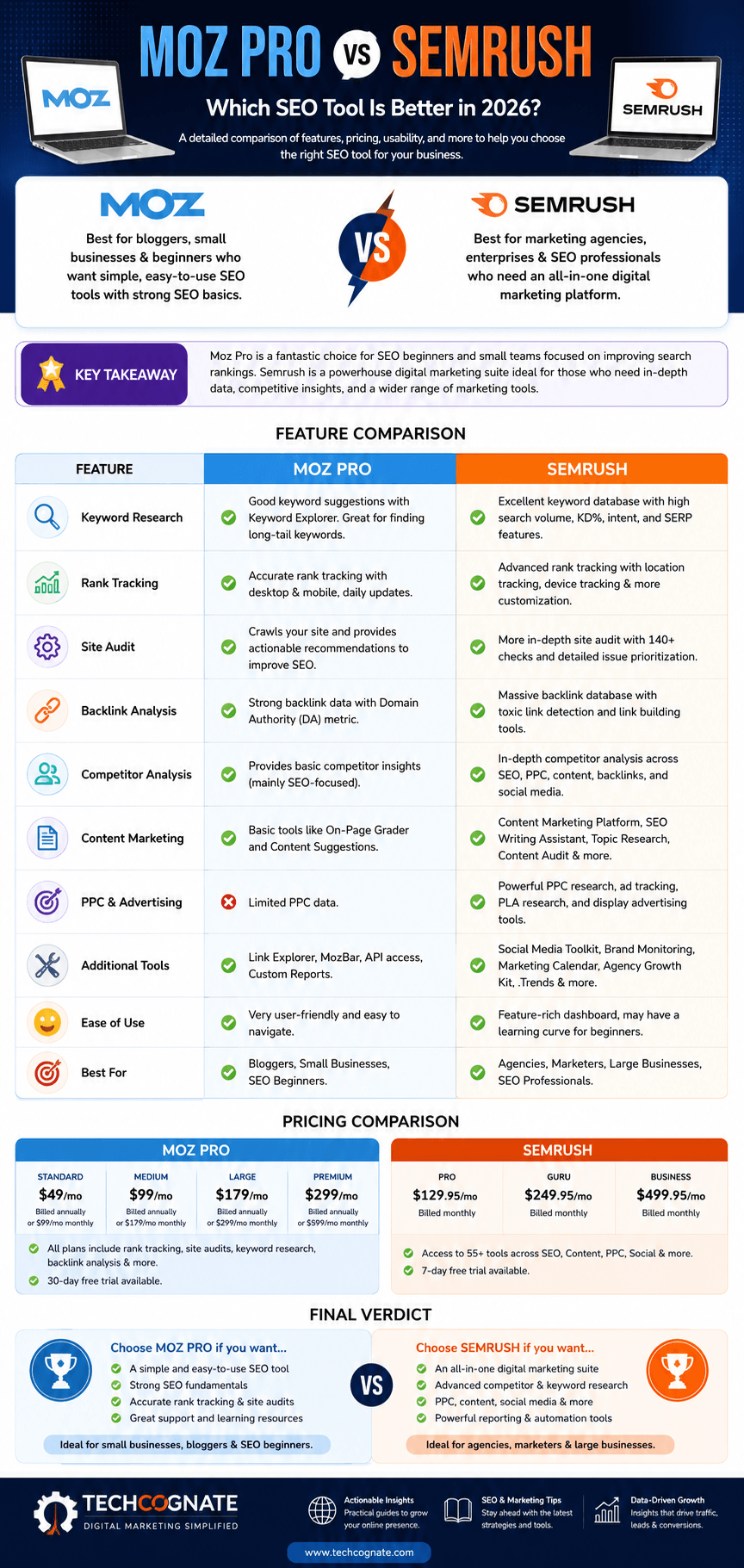
Moz Pro vs Semrush — at-a-glance comparison infographic
Master Comparison Table
| Feature | Moz Pro | Semrush |
| Company | Moz (acquired by iContact, 2021) | Semrush Holdings, Inc. |
| Founded | 2004 (as SEOmoz) | 2008 |
| Headquarters | Seattle, WA | Boston, MA (NASDAQ: SEMR) |
| Entry Price (monthly) | $49/month (Starter) | $139.95/month (Pro) |
| Annual Discount | ~20% off | ~17% off |
| Free Plan | Limited free account | Limited free account |
| Free Trial | 30-day free trial | 7-day free trial |
| Keyword Database | ~500 million keywords | 25+ billion keywords |
| Backlink Database | ~40 trillion links (Moz Link Explorer) | 43.1 trillion backlinks |
| Countries Supported | 170+ | 142 databases |
| Rank Tracking | Daily (higher plans) | Daily (all paid plans) |
| Site Audit | Yes — Moz Site Crawl | Yes — Site Audit (more checks) |
| Technical SEO | Good | Excellent |
| Competitor Research | Limited | Extensive |
| PPC/Paid Research | No | Yes — Advertising toolkit |
| Local SEO | Moz Local (separate product) | Built-in Local SEO toolkit |
| Content Marketing | Basic | ContentShake AI, Topic Research |
| AI Writing Tools | No | ContentShake AI |
| Traffic Analytics | Limited | Full Traffic Analytics module |
| Social Media Tools | No | Yes (post scheduling, tracking) |
| Market Research | No | Market Explorer |
| White-label Reports | No | Yes (Agency plans) |
| Custom Reports | Basic | Advanced — drag-and-drop builder |
| API | Yes (paid add-on) | Yes (from Guru+ or add-on) |
| Chrome Extension | MozBar (free) | Semrush SEO Toolbar (free) |
| Google Analytics Integ. | Yes | Yes |
| Google Search Console | Yes | Yes |
| Integrations | Limited third-party | 50+ integrations |
| Projects / Campaigns | Up to 5 (Pro plan) | Up to 5 (Pro), 50+ (Business) |
| Keywords per Report | 150–1,000 (plan-dependent) | 10,000 (Pro) |
| Crawl Credits/month | 100k–500k URLs | 100k–10M URLs |
| Team Seats | 1 (more as add-ons) | 1 (more as add-ons) |
| Support | Email, chat (business hours) | Email, chat, phone (24/5) |
| Learning Resources | Moz Academy, blog, Whiteboard Friday | Semrush Academy (40+ courses) |
| G2 Rating | 4.3/5 (1,000+ reviews) | 4.5/5 (2,000+ reviews) |
| Trustpilot | 3.6/5 | 4.1/5 |
| Ease of Use | Easier for beginners | Steeper initial curve |
| Best For | Bloggers, small businesses, beginners | Agencies, professionals, enterprise |
| Overall Score | 7.8/10 | 9.1/10 |
What Is Moz Pro?
Moz started in 2004 as a blog called SEOmoz, run by Rand Fishkin and Gillian Muessig out of Seattle. What began as commentary on search engine optimization eventually evolved into one of the most recognized SEO software brands in the world. The pivot from blog to software happened around 2007–2008, and Moz Pro — its flagship subscription product — launched as an all-in-one SEO platform a few years later.
The company is perhaps most famous for two things: Domain Authority (DA), the 0–100 score that attempts to predict a domain’s ranking potential, and Whiteboard Friday, the long-running video series where SEO educators break down concepts at a literal whiteboard. Both helped establish Moz as an educational authority in the SEO space.
In 2021, Moz was acquired by iContact, a marketing technology company. The acquisition didn’t dramatically change the product, but it did raise questions about the platform’s long-term development trajectory compared to publicly-traded Semrush.
| • | Moz Pro — the main SEO suite (keyword research, rank tracking, site audit, link analysis) |
| • | Moz Local — local listing management platform (sold separately) |
| • | MozBar — free Chrome extension with on-page SEO metrics |
| • | Moz API — programmatic access to Moz data |
Moz Pro’s target audience has traditionally been in-house SEO teams at small-to-medium businesses, content marketers, and bloggers who want reliable data without the complexity of a more advanced platform. The interface is clean, approachable, and doesn’t throw 50 reports at you the moment you log in — which is genuinely useful if you’re earlier in your SEO journey.
What Is Semrush?
Semrush launched in 2008 — just four years after Moz — but has evolved into a dramatically different product. Where Moz has stayed focused on core SEO, Semrush has expanded into an all-in-one digital marketing platform. It covers SEO, PPC research, content marketing, competitive intelligence, social media management, local SEO, and more — all under a single subscription.
The company went public on the Nasdaq in 2021 under the ticker SEMR, which is significant. As a publicly traded company, Semrush has the capital and investor pressure to continue expanding its toolset rapidly. It’s been on an acquisition spree — buying Kompyte (competitive intelligence), Backlinko (content), Traffic Think Tank (SEO education), and others.
Semrush now claims a database of 25+ billion keywords across 142 country databases, 43+ trillion backlinks, and 800 million domain profiles. Whether those numbers translate perfectly to real-world data accuracy is worth examining (more on that in the Data Accuracy section), but the scale is genuinely impressive.
| • | SEO Toolkit — keyword research, site audit, rank tracking, link building |
| • | Advertising Toolkit — PPC keyword research, ad copy analysis, CPC data |
| • | Content Marketing Toolkit — ContentShake AI, Topic Research, SEO Writing Assistant |
| • | Competitive Research Toolkit — Traffic Analytics, Market Explorer, Organic Research |
| • | Local SEO Toolkit — listing management, GBP integration, local rank tracking |
| • | Social Media Toolkit — scheduler, analytics, competitor tracking |
| • | Semrush Academy — 40+ free certification courses |
Core Feature-by-Feature Comparison
Keyword Research
Is Semrush better than Moz for keyword research? Short answer: yes, significantly — but Moz is no slouch for foundational research.
Semrush’s Keyword Magic Tool is one of the most powerful free-form keyword research interfaces available. You type in a seed keyword and get segmented results by broad, phrase match, exact match, and related variations — often returning hundreds of thousands of suggestions for competitive topics. Filtering by keyword difficulty, search volume, CPC, SERP features, and intent simultaneously is something you genuinely can’t replicate in Moz.
Moz’s Keyword Explorer is clean and gives you what you need: monthly search volume, keyword difficulty, organic CTR, and a priority score. For a blogger doing standard research for a 20-post content calendar, it’s sufficient. But when you’re trying to map out a topical cluster of 200+ keywords for an enterprise site, you’ll hit Moz’s limitations quickly.
| • | Semrush Pros: 25B+ keyword database, intent filters, keyword gap analysis, question clusters, keyword difficulty at scale |
| • | Semrush Cons: Can feel overwhelming; data for low-volume niche terms is sometimes thin |
| • | Moz Pros: Clean interface, Priority score simplifies decisions, good difficulty scoring |
| • | Moz Cons: Smaller database, fewer filters, no built-in intent classification |
Winner: Semrush — larger database, better filtering, and Keyword Gap analysis alone is worth the subscription.
Backlink Analysis
Both platforms have invested heavily in their backlink indices, and both have genuinely large databases. Semrush claims 43.1 trillion backlinks with daily updates. Moz Link Explorer has processed over 40 trillion links and updates its index regularly, though not quite as frequently.
In practice, both will surface the major backlinks pointing to any given domain. Where Semrush tends to pull ahead is in freshness — newly acquired or recently lost links appear in Semrush’s data faster. For link-building campaigns where you’re monitoring competitor link velocity, that timeliness matters.
Moz’s Domain Authority remains the most widely recognized domain metric in the SEO industry. Most clients, prospects, and marketers understand DA even if they’ve never logged into Moz. That familiarity has real-world value in agency reporting.
| • | Semrush Pros: Fresher index, better toxic link detection, Authority Score, Link Building Tool |
| • | Moz Pros: DA is industry standard, clean interface, good for quick competitor checks |
Winner: Semrush — more comprehensive and fresher index, but Moz’s DA metric remains the industry currency.
Site Audit
Technical SEO auditing is where both tools spend significant engineering resources, and both produce solid results — but Semrush’s Site Audit module is noticeably more thorough.
Semrush crawls your site and returns 140+ checks covering Core Web Vitals, crawlability, HTTPS issues, structured data errors, international SEO problems, duplicate content, internal linking gaps, and more. The results are presented in a clear priority order with impact scores, which helps non-technical clients understand what to fix first.
Moz’s Site Crawl covers the essentials: broken links, redirect chains, duplicate content, missing meta descriptions, thin content, and crawlability issues. It’s comprehensive enough for most websites. The primary limitations show up on large sites (100k+ URLs) where Moz’s crawl limits can slow down your audit cycle.
Winner: Semrush — more checks, larger crawl limits on equivalent plans, and better prioritization of issues.
Rank Tracking
Semrush’s Position Tracking module offers daily keyword rank tracking across desktop and mobile for any target location (down to city or ZIP code level). You can track SERP features — featured snippets, local packs, Knowledge Panels — alongside organic positions. Visibility trend graphs make it easy to spot algorithmic impact and report progress to clients.
Moz’s Rank Tracker is reliable and offers daily updates on higher-tier plans. It tracks visibility scores and trend data, but lacks some of the SERP feature tracking granularity that Semrush offers. For tracking 50–100 keywords on a single client site, it’s perfectly adequate. For tracking 500+ keywords across 20 client projects, Semrush is more efficient.
Winner: Semrush — daily updates, SERP feature tracking, and location granularity across all paid plans.
Competitor Research
This is one of Semrush’s strongest differentiators. The Organic Research module lets you see any domain’s estimated organic traffic, ranking keywords, traffic value, and SERP positions over time. Traffic Analytics adds estimated direct, referral, social, paid, and organic traffic channels — basically a lite version of SimilarWeb built into Semrush.
Moz has competitive keyword analysis through its Keyword Explorer, but it doesn’t have a dedicated competitor traffic analytics module. You can compare link profiles and keyword overlaps, but the depth of competitive intelligence in Semrush simply isn’t matched.
Winner: Semrush — not even close. The competitive intelligence suite is in a different category.
Local SEO
Local SEO is an interesting split. Moz has Moz Local, a purpose-built product for local listing management. It syncs business information across directories, monitors reviews, and tracks local rank positions. However, Moz Local is a separate product — not included in Moz Pro — which adds cost.
Semrush includes a Local SEO toolkit in its platform (available as an add-on) that covers listing management, Google Business Profile integration, review monitoring, and local rank tracking down to specific ZIP codes. The local pack tracking is particularly strong for agency teams managing multiple locations.
Winner: Semrush — fully integrated local toolkit with no need for a separate product subscription.
Content Marketing
Moz has basic content suggestions through its keyword research workflow but doesn’t have a dedicated content marketing toolkit comparable to Semrush.
Semrush has built out a serious content marketing stack: Topic Research for content idea discovery, the SEO Writing Assistant (browser extension and Google Docs integration) for real-time content optimization, ContentShake AI for AI-assisted content drafting, and a Content Audit tool for refreshing existing posts. For a content-heavy operation, this is a compelling all-in-one setup.
Winner: Semrush — Moz doesn’t compete seriously in content marketing tooling.
Reporting
Moz Pro offers basic reporting with PDF exports. Reports cover the standard metrics — rankings, links, site health — and can be scheduled for automatic delivery. Customization is limited.
Semrush’s My Reports module has a drag-and-drop interface for building custom branded reports. You can pull data from any Semrush module, integrate Google Analytics and Search Console data, add client logos and custom color schemes, and schedule delivery. For agencies producing monthly reports for 10–50 clients, this alone can save hours.
Winner: Semrush — custom branded reports with GA/GSC integration are a clear advantage for agencies.
AI Features
Semrush has moved aggressively into AI-assisted SEO. ContentShake AI generates optimized drafts based on competitive data. The Keyword Magic Tool includes AI-powered keyword clustering. Semrush Copilot (launched in 2024) acts as an AI assistant that surfaces insights across your projects — flagging rank drops, linking opportunities, and content gaps automatically.
Moz has integrated some AI-powered suggestions into its platform, including automated keyword recommendations and site health summaries, but the depth doesn’t compare to Semrush’s AI investment.
Winner: Semrush — ContentShake AI and Semrush Copilot represent a meaningfully different category of AI integration.
Database Comparison
| Metric | Moz Pro | Semrush |
| Keyword Database | ~500 million keywords | 25+ billion keywords |
| Backlink Index | 40+ trillion links | 43.1 trillion backlinks |
| Domain Profiles | Not disclosed | 800+ million domains |
| Country Databases | 170+ countries | 142 keyword databases |
| Language Support | Multiple | Multiple |
| Index Freshness | Crawled regularly | Daily updates |
| Historical Data | 12 months (Pro) | 5+ years (varies by tool) |
| Accuracy | Strong for DR metrics | Strong; broader but some gaps |
| SERP Features Data | Limited | Extensive SERP feature tracking |
Pricing Comparison
Pricing is one of the most common decision points, and it’s a real differentiator between the two platforms. Let’s be specific.
Moz Pro Pricing (2026)
| • | Starter: $49/month — 1 user, 1 campaign, 50 tracked keywords, 100k pages crawled |
| • | Standard: $99/month — 1 user, 3 campaigns, 300 tracked keywords, 400k pages crawled |
| • | Medium: $179/month — 2 users, 10 campaigns, 1,500 tracked keywords, 2M pages crawled |
| • | Large: $299/month — 3 users, 25 campaigns, 3,000 tracked keywords, 5M pages crawled |
Annual billing reduces these prices by approximately 20%.
Semrush Pricing (2026)
| • | Pro: $139.95/month — 1 user, 5 projects, 500 tracked keywords, 100k pages crawled |
| • | Guru: $249.95/month — 1 user, 15 projects, 1,500 tracked keywords, 300k pages crawled, historical data, content marketing toolkit |
| • | Business: $499.95/month — 3 users, 40 projects, 5,000 tracked keywords, 1M pages crawled, API access, white-label reports |
Annual billing reduces prices by approximately 17%.
Value Assessment
On pure dollar-per-feature math, Moz’s entry price is lower ($49 vs $139.95). But the gap closes quickly when you factor in what you’re getting. Semrush Pro at $139.95/month includes PPC research, competitor traffic analytics, content marketing tools, and a social media toolkit — features that would require separate subscriptions with Moz.
Winner: Moz — entry-level affordability. Winner for value: Semrush at any plan above basic.
Ease of Use
Moz Pro has always prioritized approachability. The dashboard is clean, the navigation is intuitive, and key metrics like DA, PA, and Spam Score are presented prominently without requiring you to click through multiple layers. A complete beginner can run a keyword search, check site health, and pull a backlink report on day one without watching a single tutorial.
Semrush is more complex. The dashboard puts nearly everything a front — SEO, advertising, content, competitive research, social, all accessible from the left sidebar — which can feel like walking into a cockpit for the first time. Most users need 2–4 weeks of regular use before they feel genuinely comfortable navigating it.
That said, Semrush’s complexity is a feature for experienced users. Once you know where everything is, the efficiency of having all your tools in one platform with shared project data is hard to give up.
Winner: Moz Pro — for beginners. Semrush wins for power users who need speed and depth.
Data Accuracy
Both platforms estimate traffic, and neither is perfectly accurate compared to actual Google Analytics data — this is a limitation of third-party tools, not a specific failure of Moz or Semrush. They’re working from their own crawls, third-party data panels, and statistical modeling.
For keyword search volumes, both tools often show rounded or approximate numbers. High-volume keywords (10k+ monthly searches) tend to be more accurate across both platforms. For niche keywords under 100 monthly searches, the data gets noisy.
For traffic estimates, Semrush’s Traffic Analytics tends to be closer to reality for larger sites with substantial traffic. For small blogs and new sites, both tools frequently over- or under-estimate significantly.
Domain Authority (Moz) and Authority Score (Semrush) are both proprietary metrics that correlate with but don’t directly predict Google rankings. Use them as relative signals, not absolute truths.
Winner: Tie — both tools have comparable accuracy limitations. Semrush slightly edges out for traffic estimates on larger domains.
Pros and Cons
| ✓ | Domain Authority is the most widely understood SEO metric in the industry |
| ✓ | Significantly more affordable entry-level pricing ($49/month) |
| ✓ | Cleaner, simpler interface — easier for beginners and non-technical users |
| ✓ | Excellent keyword research workflow with Priority scoring |
| ✓ | 30-day free trial gives more time to evaluate than Semrush’s 7 days |
| ✓ | MozBar Chrome extension is one of the best free SEO browser tools available |
| ✓ | Spam Score for identifying toxic backlinks is well-regarded |
| ✓ | Strong educational content (Whiteboard Friday, Moz Blog, Moz Academy) |
| ✓ | Page Authority and Link Explorer are solid for quick competitive checks |
| ✓ | Less overwhelming for teams doing focused SEO work |
| ✓ | Good crawl configuration options for excluding parameters |
| ✓ | Organic CTR data gives useful context alongside search volume |
| ✓ | Well-established, trusted brand in the SEO community |
| ✓ | Responsive customer support with good documentation |
| ✓ | On-page SEO grader gives quick actionable recommendations |
| ✕ | Keyword database (~500M) is dramatically smaller than Semrush’s 25B+ |
| ✕ | No PPC or paid search research capabilities |
| ✕ | No dedicated content marketing toolkit |
| ✕ | Traffic analytics are limited compared to Semrush |
| ✕ | Local SEO requires purchasing Moz Local as a separate product |
| ✕ | White-label reporting not available on any plan |
| ✕ | Limited social media tools |
| ✕ | Fewer integration options than Semrush |
| ✕ | Report customization is basic |
| ✕ | No AI writing or content generation tools |
| ✕ | Slower backlink index updates compared to Semrush |
| ✕ | Limited SERP feature tracking in rank tracking module |
| ✕ | No market research or audience analysis tools |
| ✕ | Acquisition by iContact has raised product development questions |
| ✕ | Crawl limits can be restrictive for large enterprise sites |
| ✓ | 25+ billion keyword database — one of the largest in the industry |
| ✓ | All-in-one platform: SEO, PPC, content, social, competitive intel in one dashboard |
| ✓ | Extremely powerful competitor analysis and traffic intelligence |
| ✓ | ContentShake AI and SEO Writing Assistant for AI-assisted content creation |
| ✓ | Semrush Copilot AI surfaces insights automatically across your projects |
| ✓ | White-label reporting available on Business plan — critical for agencies |
| ✓ | Local SEO toolkit built directly into the platform |
| ✓ | 40+ free certification courses through Semrush Academy |
| ✓ | Daily rank tracking updates on all paid plans |
| ✓ | 43+ trillion backlink database with frequent updates |
| ✓ | 140+ site audit checks with clear prioritization |
| ✓ | Keyword Gap analysis is one of the best competitive research tools available |
| ✓ | Custom reporting with GA and GSC integration saves significant time |
| ✓ | Publicly traded company with strong financial backing for continued development |
| ✓ | 50+ third-party integrations |
| ✓ | Phone support available on paid plans (24/5) |
| ✓ | PPC research gives a complete view of paid + organic competitive landscape |
| ✓ | Semrush Sensor monitors Google algorithm updates in real-time |
| ✕ | Entry price of $139.95/month is steep for individuals and small bloggers |
| ✕ | Feature complexity can overwhelm beginners and cause decision paralysis |
| ✕ | API access requires Guru plan or expensive add-on |
| ✕ | Additional users cost extra on all plans |
| ✕ | Some data — particularly for low-traffic sites — can be unreliable |
| ✕ | Local SEO and social media tools cost extra beyond base subscription |
| ✕ | Keyword data for non-English markets thinner than English database |
| ✕ | Traffic Analytics accuracy degrades for smaller or newer sites |
| ✕ | Can feel like paying for features you’ll never use |
| ✕ | Keyword difficulty scores don’t always align with actual ranking difficulty |
| ✕ | Some interface areas (especially reporting) have a learning curve |
| ✕ | Churning through multiple toolkits creates cognitive overload for solo operators |
Real User Reviews: What People Actually Say
Across Reddit, G2, Trustpilot, and Capterra, several patterns emerge consistently for both tools. Here’s a summary of common themes — not individual quotes, but the sentiment that shows up across hundreds of reviews.
| • | Users consistently praise the clean, approachable interface — it’s one of the top-mentioned positives on G2 |
| • | Domain Authority is cited as genuinely useful for client communications and prospect pitches |
| • | 30-day trial is seen as a low-risk way to test the platform |
| • | MozBar gets strong praise as a standalone free tool |
| • | Educational resources (Whiteboard Friday, Moz Blog) earn consistent goodwill |
| • | Many users mention that Semrush’s keyword database makes Moz feel outdated by comparison |
| • | Lack of PPC tools is frequently cited by users who run paid campaigns alongside SEO |
| • | Reporting limitations are a pain point for agency users |
| • | Some Reddit discussions note data freshness concerns for backlinks |
| • | The keyword research depth and competitor analysis tools receive near-universal praise from professional SEOs |
| • | Traffic Analytics is seen as the best alternative to a SimilarWeb subscription |
| • | Semrush Academy gets strong mentions as a bonus that adds real value |
| • | Users on G2 consistently rate Semrush higher for feature breadth |
| • | Agency users specifically call out the reporting and white-label features as time-savers |
| • | Pricing is the single most common complaint — $139.95/month feels high for solo operators |
| • | New users frequently note that the platform has a steep learning curve |
| • | Data accuracy for small or new sites gets called out periodically on Reddit and Trustpilot |
| • | Add-on costs for local SEO, extra users, and social tools can push the real monthly cost significantly higher than the base price |
Real Use Cases: Which Tool Fits Which Situation
Which Tool Fits Your Situation? (Decision Guide)
Work through these scenarios to find your match:
| If… | Choose… |
| Budget under $100/month | Moz Pro (Starter or Standard plan) |
| Need PPC/paid search research | Semrush — Moz has no paid search tools |
| Running an SEO agency with 10+ clients | Semrush Business — white-label reporting alone justifies the cost |
| Beginner who wants a manageable learning curve | Moz Pro — simpler interface, gentler onboarding |
| Need content marketing tools in the same platform | Semrush — ContentShake AI and Topic Research are built in |
| Tracking local SEO for multiple locations | Semrush — integrated local toolkit; Moz Local is a separate product |
| Enterprise site with 1M+ URLs to audit | Semrush Business — higher crawl limits and API access |
| Primarily a blogger with a content calendar focus | Moz Pro Standard — sufficient for core content + SEO needs |
| Doing competitive intelligence on 5+ competitors | Semrush — Traffic Analytics and Organic Research are in a different league |
| Need API access to pull data programmatically | Semrush Guru or Business plan |
| Want the best backlink monitoring | Semrush — fresher index, better toxic link detection |
| Managing Google Ads alongside SEO | Semrush — Advertising Toolkit is unique |
| Just need DA scores for client presentations | Moz — MozBar (free) may be sufficient for this specific use case |
| Building an affiliate site from scratch | Semrush — keyword gaps and competitor research are critical for affiliate strategy |
| Small business owner doing SEO in-house | Moz Pro — approachable and affordable at the Standard tier |
| Social media management integrated with SEO | Semrush — social toolkit included |
| Need rank tracking for hundreds of keywords daily | Semrush — daily updates across all paid plans, better SERP feature tracking |
| Doing market research before entering a new niche | Semrush — Market Explorer and Traffic Analytics built for this |
| Wanting the most keywords for topical authority mapping | Semrush — 25B+ keyword database is unmatched for mapping full topic clusters |
| Looking for white-label reports for client delivery | Semrush Business only — Moz doesn’t offer white-label |
ROI: Which Tool Pays for Itself Faster?
For a solo blogger or small business, Moz Pro at $99/month is easier to justify — you need to rank one or two additional pieces of content per month to offset the cost.
For an agency billing even one client at $1,500/month for SEO retainers, Semrush at $499/month Business is a rounding error. The time savings from automated reporting, competitive analysis, and the breadth of included tools easily represents 20+ hours of manual work per month.
The key ROI question isn’t which tool costs less — it’s which tool helps you generate more revenue or save more billable hours relative to its cost. On that metric, most professional SEOs and agencies find Semrush delivers the better return once they’re billing clients.
Migration Guide
Moving from Moz Pro to Semrush
| • | Export your tracked keywords from Moz’s Rank Tracker as a CSV |
| • | Import those keywords into Semrush’s Position Tracking module — it accepts CSV uploads directly |
| • | Export your backlink data from Moz Link Explorer if you’re referencing specific link lists |
| • | Recreate your campaigns/projects in Semrush — note that project limits differ between plans |
| • | Set up the SEO Writing Assistant and Semrush Copilot integrations during the first week |
| • | Plan 2–3 weeks to learn the new interface before relying on it for client deliverables |
| • | Take advantage of Semrush Academy — the free courses significantly accelerate the learning curve |
Moving from Semrush to Moz Pro
| • | Export your tracked keywords from Position Tracking and import them into Moz Rank Tracker |
| • | Note: you’ll lose access to Traffic Analytics, ContentShake AI, and Advertising Toolkit — confirm you have alternatives |
| • | Rebuild campaigns in Moz’s interface — likely a straightforward process given Moz’s simpler structure |
| • | If you were using white-label reports, build templates in an external reporting tool (Google Data Studio is a common alternative) |
| • | Download and reference historical data from Semrush before canceling — the historical keyword ranking data is useful |
Alternatives to Moz Pro and Semrush
If neither tool feels like the right fit, here’s a quick look at the other major players:
Frequently Asked Questions
Fast, direct answers to the questions SEO professionals ask most often about Moz Pro and Semrush.
Final Verdict
After working with both platforms across dozens of client projects, the honest answer is: Semrush wins on almost every dimension that professional SEOs and agencies care about.
The keyword database is dramatically larger. The competitive research tools are in a completely different category. The content marketing integrations, AI features, and reporting capabilities extend well beyond what Moz Pro offers. If you’re billing clients, growing a business, or doing SEO at any kind of professional scale, Semrush is the more powerful and ultimately more efficient investment.
But Moz Pro isn’t obsolete. It still earns its place for:
| • | Bloggers and content creators with modest budgets who need solid core SEO tools without paying $140+/month |
| • | Beginners who want a gentle introduction to SEO tooling without getting lost in a 50-tool interface |
| • | Teams that use Domain Authority as a primary client-facing metric |
| • | Small businesses doing straightforward SEO who don’t need competitive intelligence depth |
The choice, in simple terms:
Choose Semrush if: you’re a professional, agency, or growing business that needs competitive intelligence, content tools, and a scalable platform.
Comparison Scorecard
| Category | Moz Pro | Semrush |
| Keyword Research | 7/10 | 9/10 |
| Backlink Analysis | 8/10 | 9/10 |
| Site Audit | 7/10 | 9/10 |
| Rank Tracking | 7/10 | 9/10 |
| Local SEO | 6/10 | 9/10 |
| Competitor Research | 5/10 | 10/10 |
| Content Marketing | 3/10 | 9/10 |
| AI Features | 4/10 | 9/10 |
| Reporting | 5/10 | 9/10 |
| Ease of Use | 9/10 | 7/10 |
| Pricing / Value | 8/10 | 7/10 |
| Support | 7/10 | 8/10 |
| Overall | 7/10 | 9/10 |
Content prepared for TechCognate.com — Last updated June 2026