Predictive SEO Analytics: Proven Strategies to Forecast SEO Growth in 2026
Most websites are playing catch-up. By the time they find a trend, write a post, and get it indexed, competitors have already locked up page one. That’s the trap of reactive SEO — and it’s getting worse every year.
AI Overviews, faster content saturation, and zero-click searches have changed the rules. You can’t just find a keyword, write 2,000 words, and wait anymore. The sites winning in 2026 are the ones who saw demand coming before it peaked.
That’s exactly what Predictive SEO Analytics is about. It’s not some futuristic concept reserved for enterprise teams with massive budgets. It’s a practical approach to identifying where search demand is heading — and getting there first.
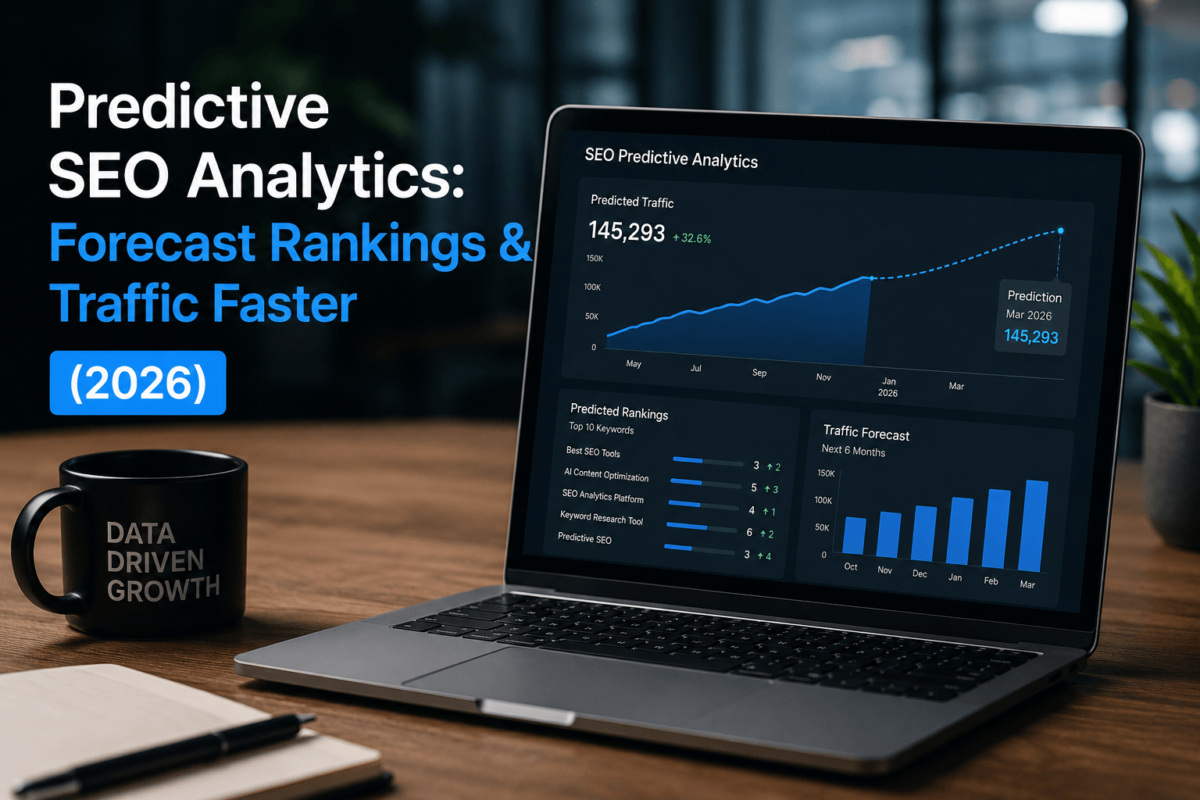
Predictive SEO Analytics is the practice of using historical data, AI tools, behavioral signals, and trend analysis to forecast future search demand — before it shows up in mainstream keyword data. Instead of reacting to what’s already popular, you identify patterns, spot rising intent, and publish content while competition is still low. You’re not chasing demand. You’re positioning ahead of it.
- What Is Predictive SEO Analytics?
- Why Predictive SEO Matters More Right Now
- How Predictive SEO Analytics Actually Works
- The Best Predictive SEO Signals to Watch
- Predictive SEO for Affiliate Marketing
- Predictive SEO and AI Overview Visibility
- Step-by-Step Predictive SEO Framework
- Best Predictive SEO Analytics Tools
- Common Predictive SEO Mistakes
- Predictive SEO vs. Traditional SEO
- Real-World Example
- FAQs About Predictive SEO Analytics
What Is Predictive SEO Analytics? (Quick Answer)
Predictive SEO Analytics is the practice of using historical data, AI tools, behavioral signals, and trend analysis to forecast future search demand — before it shows up in mainstream keyword data.
Instead of reacting to what’s already popular, you’re identifying patterns, spotting rising intent, and publishing content while competition is still low. Think of it as the difference between buying a stock when it’s already viral versus researching it before it trends.
In short: you’re not chasing demand. You’re positioning ahead of it.
Why Predictive SEO Matters More Right Now
Two years ago, you could still publish a solid article on a trending keyword and crack page one within a few months. That window is closing fast. Here’s why.
AI Overviews now absorb a big chunk of clicks before users even reach organic results. Zero-click searches are up. And with AI-assisted content creation, SERPs are filling up faster than ever — sometimes within days of a trend emerging.
“The sites that consistently grow aren’t necessarily the ones with the best content. They’re the ones with the best timing. Predictive SEO is really a timing strategy dressed up as a data strategy.”
If you wait until a keyword peaks, you’re already late. Pair this mindset with a solid AI SEO workflow and you have a genuine first-mover advantage.
How Predictive SEO Analytics Actually Works
The core process isn’t magic — it’s pattern recognition applied to search data before most people are paying attention.
You look at past seasonal patterns, traffic trends, and SERP movements to identify when similar topics spiked and why. AI for SEO data analysis makes this pattern-spotting significantly faster and more accurate.
This goes beyond keyword tools. You’re watching what real people are talking about on Reddit, asking on TikTok, and searching through AI chatbots — signals that appear weeks or months before they show up in SEMrush or Ahrefs.
Modern search isn’t just keywords. Google understands concepts and relationships. Predictive SEO factors in how topics relate to each other, not just individual search terms.
Once you identify a rising topic, you analyze current SERP competition — domain authority, content quality, gaps — to assess how quickly you can rank if you move now.
The real edge comes from combining all four. Any one of them alone is incomplete. For a deeper breakdown of how to set this up end-to-end, see our AI SEO analytics and reporting pillar guide.
The Best Predictive SEO Signals to Watch
Here’s where most SEO guides get lazy and just say “use Google Trends.” That’s table stakes. The real intelligence comes from sources most competitors aren’t monitoring.
Subreddits are goldmines of early intent. When a topic starts generating real discussion — complaints, questions, comparison posts — that’s often 60–90 days ahead of keyword tools catching up.
TikTok’s internal search function is increasingly how younger buyers discover products. A product exploding in TikTok “review” content now will show up in Google searches later.
The comment sections on popular YouTube videos in your niche reveal what viewers actually want to know next. These are pre-formed content ideas with built-in demand.
Prompts people type into ChatGPT and similar tools are becoming early indicators of search intent. What people ask AI today often becomes a Google query tomorrow. See how ChatGPT SEO is reshaping this landscape.
Check new autocomplete suggestions regularly. When fresh phrases start appearing in autosuggest, it usually means volume is building but competition is still low.
Your own impressions data is an underused prediction tool. If a page is gaining impressions but not clicks, the topic may be emerging — worth creating supporting content now.
Key insight: The combination of community signals + platform data + your own analytics is what separates real predictive SEO from just guessing with keyword tools.
Predictive SEO for Affiliate Marketing
This is the area competitors almost completely ignore, and it’s honestly where predictive SEO pays off the most.
Here’s the play: most affiliate SERPs get dominated by authority sites — Forbes, Wirecutter, NerdWallet — within weeks of a product category going mainstream. If you try to rank for “best AI writing tools” now, you’re fighting a losing battle. But if you identified that topic 18 months ago, you’re already sitting on page one while everyone else fights over scraps.
Publishing detailed reviews before a product launches to the mainstream means you capture search traffic at exactly the moment buyer intent spikes. A SaaS product getting buzz on ProductHunt today could be a high-converting keyword next quarter.
“Tool A vs Tool B” comparisons work best when you publish before both tools are household names. Once Ahrefs and Semrush show high volume, you’ve missed the easy window.
If you run an affiliate site in home tech or productivity software, seasonal demand patterns are predictable. Publish “best [category] for remote workers” content in September, not January.
The categories where predictive affiliate SEO is most valuable right now: AI productivity tools, SaaS platforms, creator economy tools, home automation, and anything tied to emerging work trends.
Predictive SEO and AI Overview Visibility
AI Overviews — Google’s AI-generated answer boxes — have changed the click economy significantly. The sites that appear as citations in these answers often get traffic even without a traditional page-one ranking.
Predictive SEO naturally sets you up better for AI Overview inclusion because of how it forces you to structure content. This aligns directly with featured snippets optimization principles and LLM SEO best practices.
Cover a topic thoroughly so Google understands your site as an authoritative entity on the subject.
Build out related subtopics, not just targeting one keyword.
Answer follow-up questions within the content, not just the main query.
Structured, factual, easy for AI to extract and attribute.
The sites getting pulled into AI Overviews aren’t always the highest DA sites. They’re often the most topically thorough ones. Getting in early on a topic gives you time to build that depth before the SERP gets competitive.
Step-by-Step Predictive SEO Framework
Here’s the repeatable system to use whether you’re starting a niche site or expanding content on an existing one. Pair this with a question-based content strategy for the best results.
Trend Discovery
Monitor Reddit, TikTok, YouTube, Google Autosuggest, and tools like Exploding Topics weekly. Look for topics gaining momentum but not yet mainstream. Don’t just look for what’s trending — look for what’s about to trend.
Search Intent Analysis
Once a trend catches your eye, map the intent. Is it informational, commercial, or transactional? What’s the buyer journey? This determines content format and monetization angle before you write a single word.
SERP Competition Check
Run the keyword in Ahrefs or SEMrush. Check domain authority of current top results and review keyword difficulty carefully. If it’s all Forbes and Wirecutter, that topic may already be past the early window for smaller sites.
Content Creation Timing
Publish when signals are strong but keyword tools still show low competition. This is the sweet spot — early enough to rank, late enough that demand is real. Common mistake: publishing so early there’s no audience yet.
Internal Linking Strategy
Connect new predictive content to your existing topical clusters. This reinforces authority signals and helps Google understand context faster. See our guide on advanced SEO strategies for cluster-building frameworks.
Forecast Tracking
Set up Search Console and rank tracking from day one. Watch impression growth — it often precedes click growth by weeks. Use AI SEO dashboards to automate this monitoring, and pair them with automated SEO reports so you never miss an early trend signal. If impressions are climbing, you’re on the right track.
Content Decay Monitoring
Use Search Console and rank trackers to identify pages losing impressions before they lose rankings. Refresh content at the first sign of decline, not after it tanks. This is one of the most neglected parts of a real SEO workflow.
Best Predictive SEO Analytics Tools
You don’t need to use all of these. Pick what fits your workflow and budget.
Underused and surprisingly powerful for spotting seasonal and regional demand shifts. Best used alongside paid tools, not instead of them.
Surfaces trends 6–18 months before they peak. Excellent for affiliate marketers and content creators looking for first-mover opportunities.
The gold standard for keyword research and SERP analysis. The competitor content gap analysis alone is worth it for serious sites.
Strong for traffic forecasting and topic research. The Topic Research tool is useful for identifying related subtopics and building content clusters.
Criminally underused. Your impressions data is your single best early-warning system — most people only check clicks.
Maps out the semantic question landscape around any topic. Useful for structuring content that covers the full intent journey and improves AI Overview eligibility.
Shows where your audience actually spends time online. Helps identify which platforms to monitor for emerging signals before they hit keyword tools.
More enterprise-focused, but its content gap and topical authority scoring is useful for identifying where your cluster strategy has holes.
Common Predictive SEO Mistakes
These come up more than they should.
If there’s no search volume and no community discussion, you’re just guessing. Signals need to be real before you invest production time.
Waiting until a trend shows up in your keyword tool’s “rising” column usually means the first-mover window is already closing.
Traffic forecasting without thinking about monetization is wasted energy. Always ask: if this topic takes off, can I convert that traffic into revenue?
AI trend tools are useful, but they’re trained on historical patterns. Human judgment — especially if you know your niche well — still catches things algorithms miss.
Predictive SEO only works long-term if the topics you’re targeting reinforce your topical authority. Jumping into unrelated trends dilutes your site’s focus and confuses Google’s understanding of what you’re about.
Predictive SEO vs. Traditional SEO
Here’s a quick breakdown of where the two approaches differ in practice:
| Strategy | Predictive SEO | Traditional SEO |
|---|---|---|
| Timing | Publishes before demand peaks | Reacts after trends emerge |
| Competition | Enters early, low saturation | Fights in established SERPs |
| Traffic Potential | Captures surge traffic at launch | Limited by existing competition |
| AI Overview | Higher — structured for AI answers | Variable — keyword-density focus |
| Trend Forecasting | Core strategy | Rarely prioritized |
| Risk Level | Moderate (timing risk) | Low-medium (proven keywords) |
| ROI Speed | Faster when timed correctly | Slower, incremental gains |
| Content Freshness | Refreshed based on decay signals | Often refreshed reactively |
Real-World Predictive SEO Example
Let’s say you run a SaaS affiliate site. In mid-2024, you notice a pattern: multiple threads on Reddit’s r/productivity and r/remotework are discussing frustrations with manual meeting notes. A few AI tools — Otter.ai, Fireflies, Fathom — keep getting mentioned.
You check Exploding Topics. “AI meeting notes” is flagged as a fast-growing term with low mainstream search volume. You run it through Ahrefs. Volume is still modest, and the SERPs are mostly forums and small blogs — not authority sites.
You publish a comparison post: “Best AI Meeting Note Apps for Remote Teams.” You structure it with clear FAQs, entity-optimized headers, and a detailed comparison table. You internally link it to your existing content on AI productivity tools.
That’s the compounding advantage of predictive SEO. The work you do early pays dividends for years. For the full workflow system, see our guide on AI SEO automation systems.
FAQs About Predictive SEO Analytics
Q. What is predictive SEO analytics?
It’s the practice of using trend data, AI tools, behavioral signals, and analytics to forecast future search demand — so you can publish content before competition builds and traffic potential peaks.
Q. Is predictive SEO worth it for small sites?
Absolutely. In fact, smaller sites often benefit more because they can move faster than large editorial teams. A solo blogger who spots a trend early and publishes quickly can outrank authority sites that are still in committee review.
Q. Which tools help most with predictive SEO?
Start with Google Trends and Search Console — both free. Add Exploding Topics for early trend discovery. Ahrefs or SEMrush for competitive analysis. You don’t need all of them from day one.
Q. Does predictive SEO help with AI Overviews?
Yes. Getting in early on a topic lets you build topical depth before the SERP saturates. Thorough, entity-optimized content published while the topic is still emerging tends to get cited in AI Overviews more often than late-entry keyword-stuffed content.
Q. How early should you publish predictive content?
When community discussion is active but keyword tools still show low competition. You want real signals — not just a hunch — but you want to act before mainstream content creators pile in.
Q. Is predictive SEO good for affiliate marketing?
It might be the single best strategy for affiliate publishers. Early reviews, pre-saturation comparison keywords, and seasonal buyer intent forecasting can generate significant revenue if timed correctly.
Q. What industries benefit most from predictive SEO?
Tech, SaaS, creator economy tools, health and wellness, home products, and finance all have strong seasonal and trend-driven demand patterns that predictive SEO works well with. Any industry with recurring trend cycles is a good fit.
Final Thoughts
SEO has always rewarded people who understand their audience. What’s changed is that the window between “trend emerging” and “SERP saturated” has shrunk dramatically. You need to act faster and smarter.
Predictive SEO Analytics isn’t about having better AI tools than your competitors. It’s about building better habits — watching community signals, connecting data patterns, publishing with timing in mind, and refreshing content before it decays.
The biggest takeaway? Stop measuring success by what’s ranking now. Start measuring it by what you’re positioning for three to six months from now. That shift in mindset is what separates the sites that plateau from the ones that compound.
Ready to build out a systematic approach? Explore how no-code SEO automation tools can help you monitor signals at scale, and check out automating content publishing to turn your predictive findings into published posts faster.