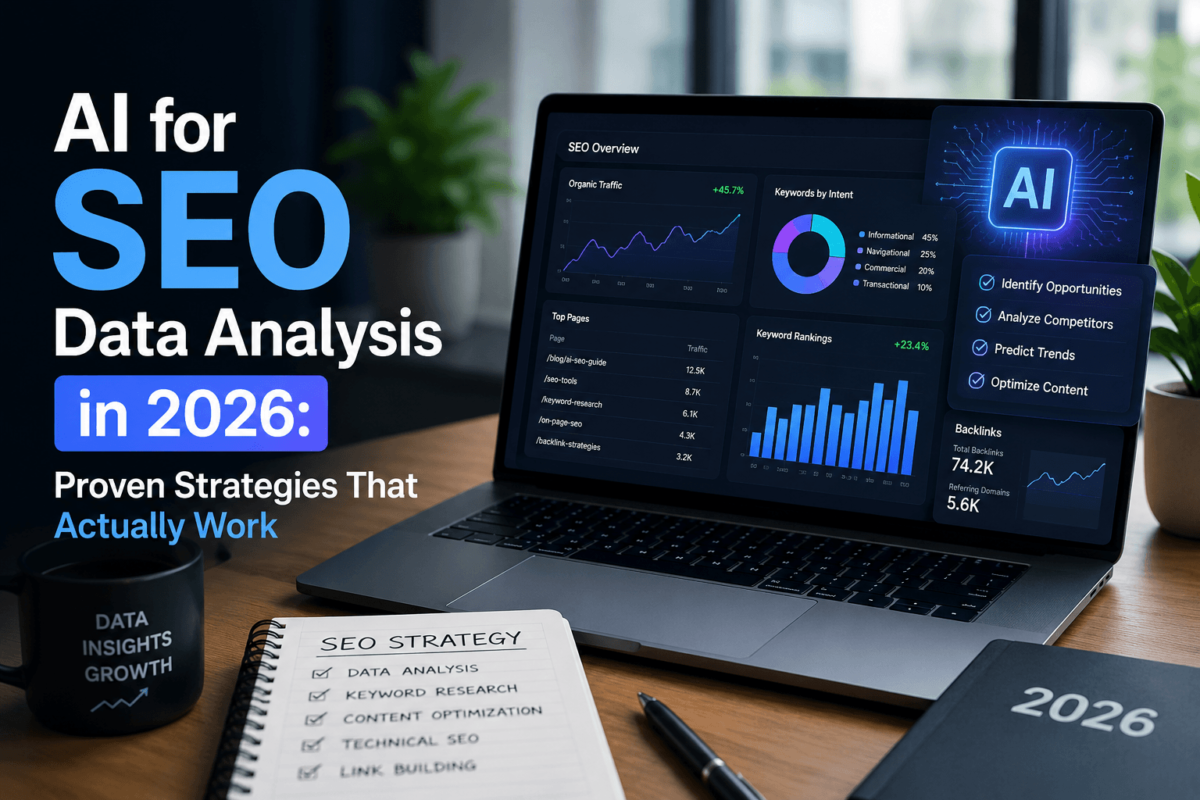
AI for SEO Data Analysis in 2026: Proven Strategies That Actually Work
Rankings alone no longer tell the full story. AI does the heavy lifting so you can focus on what actually moves revenue.
AI for SEO data analysis means using machine learning and AI-powered tools to collect, process, and interpret your search data faster and more accurately than manual methods allow. Instead of spending hours in spreadsheets, AI surfaces patterns, flags traffic drops, clusters keyword intent, and forecasts opportunities — so you can focus on the decisions that actually move revenue.
- ✓AI automates the slow, repetitive parts of SEO analysis — pattern detection, anomaly alerts, competitor tracking
- ✓In 2026, rankings alone are no longer a reliable success metric — AI visibility and click quality matter more
- ✓Key benefits: faster insights, better prioritization, revenue-focused reporting, predictive forecasting
- ⚠Important caution: AI tools still make mistakes, misread intent, and can’t replace strategic human judgment
- ✓Best use cases: traffic drop diagnosis, affiliate page performance, AI Overview tracking, competitor gap analysis
- What Is AI for SEO Data Analysis?
- Why AI SEO Analytics Matters More in 2026
- How AI Changes Traditional SEO Reporting
- Best Ways to Use AI for SEO Data Analysis
- Step-by-Step AI SEO Analysis Workflow
- Best AI SEO Tools for Data Analysis
- The Human + AI Hybrid: What the Hype Gets Wrong
- Common Mistakes With AI SEO Analytics
- The Future of AI SEO Reporting
- Frequently Asked Questions
- Final Thoughts
What Is AI for SEO Data Analysis?
Put simply, it’s using AI to do the heavy lifting in your SEO workflow.
Traditional SEO analysis meant pulling reports from Google Search Console, exporting spreadsheets from Ahrefs or Semrush, and manually piecing together what was happening with your traffic. That process worked fine when datasets were manageable. But in 2026, between Google Search Console data, GA4 events, AI Overview appearances, and multi-platform search behavior, the volume of signals has gotten genuinely overwhelming.
AI-powered analysis handles:
- •Pattern detection across thousands of keywords and pages simultaneously
- •Automated anomaly alerts when traffic, CTR, or rankings shift unexpectedly
- •Keyword intent clustering to group queries by searcher goal, not just topic
- •SEO forecasting based on historical trends and competitive data
- •Natural language report generation — you ask a question, the tool explains what the data means
The goal isn’t to remove SEO strategy from the picture. It’s to stop wasting your analytical hours on work machines do better.
Why AI SEO Analytics Matters More in 2026
Search has fundamentally changed. Google’s AI Overviews now answer millions of queries before a user ever clicks a result. ChatGPT, Perplexity, and other AI engines are directing research traffic that never shows up in your GSC impressions at all.
The result? A lot of marketers are looking at stable or growing impression numbers while their organic traffic quietly drops. One lesson many SEOs learned the hard way in 2025 was that impressions don’t automatically translate into clicks anymore.
- •Search data is more complex — more signals, more platforms, more intent layers
- •Zero-click behavior means you need visibility metrics beyond standard CTR reporting
- •Algorithm updates hit faster and harder than manual monitoring can catch
- •Competitor landscapes shift constantly in AI-generated SERPs
- •Revenue attribution has gotten messier with multi-touch, AI-assisted search journeys
Manual analysis can’t keep up with this environment. AI-assisted analysis can — if you know what to actually look for.
How AI Changes Traditional SEO Reporting
For a full breakdown of the metrics and dashboards that define modern SEO measurement, see our guide to AI SEO analytics and reporting.
You pull rankings weekly, check traffic trends monthly, and identify drops by eyeballing graphs. It’s reactive, slow, and easy to miss context.
Your tools flag a CTR drop the day it starts. They surface competitor pages gaining featured snippets. They cluster declining keywords by intent type so you know exactly where the problem is.
Specific improvements AI brings to SEO reporting:
- Faster trend detection: AI monitors your data continuously, not weekly
- Predictive insights: Forecast which pages are likely to decline before they do — see our full guide to predictive SEO analytics
- Automated anomaly detection: Get alerts on meaningful changes, not just noise
- Intent clustering: Understand why users are searching, not just what they’re searching
- Revenue-focused prioritization: Rank actions by business impact, not just traffic potential
Best Ways to Use AI for SEO Data Analysis
Step-by-Step AI SEO Analysis Workflow
This is the exact workflow that separates teams generating real insights from those drowning in dashboards. Follow it in order — each step builds context for the next. Pair it with our complete AI SEO workflow guide for deeper implementation detail.
Pull SEO Data Sources
Connect Google Search Console, GA4, and your primary SEO platform (Ahrefs, Semrush) into a centralized dashboard. Looker Studio works well for this. Don’t skip GA4 — the event-based tracking gives you conversion context that GSC alone can’t provide.
Use AI to Detect Patterns
Let your AI tool run analysis across your full keyword portfolio. Look for CTR outliers, pages where impressions grew but clicks dropped (AI Overview candidates), and keywords shifting in intent classification.
Identify Revenue Pages
Separate your top-traffic pages from your top-converting pages. They’re often not the same list. Focus your optimization energy where revenue is actually generated.
Analyze CTR Drops
Pages where impressions hold but CTR declines are often being displaced by AI Overviews or SERP features. Flag these for structured data optimization and content reformatting. Learn how featured snippets optimization can recover lost CTR.
Compare Against Competitors
Use AI gap analysis to find content angles, keyword clusters, and backlink opportunities competitors have that you don’t.
Prioritize SEO Actions
Score opportunities by revenue potential, not just traffic volume. Fix high-value pages first.
Build Automated Reports
Set up recurring AI-generated reports so you’re alerted to significant changes without having to manually check dashboards daily. Our complete guide to automating SEO reports walks through the exact setup — from rank tracking feeds to revenue attribution alerts.
Best AI SEO Tools for Data Analysis
No single tool does everything. Here’s an honest breakdown of what each does well — and where it falls short.
| Tool | Best For | Strength | Weakness | Pricing |
|---|---|---|---|---|
| ChatGPT / Claude | Data interpretation, report drafting | Natural language analysis | No direct data access | Free–$$ |
| Semrush | Competitive analysis, keyword research | All-in-one platform | Expensive at scale | $$$ |
| Ahrefs | Backlink analysis, content gaps | Best backlink index | Limited GA4 integration | $$$ |
| Surfer SEO | Content optimization | NLP content scoring | Narrower scope | $$ |
| Screaming Frog | Technical SEO crawling | Deep site audit | Learning curve | Free / $$ |
| Looker Studio | Custom dashboards | Free, highly flexible | Manual setup required | Free |
| GA4 | Conversion tracking | Native Google data | Complex interface | Free |
The Human + AI Hybrid: What the Hype Gets Wrong
A lot of AI SEO content oversells automation. The honest reality is that AI speeds up analysis — it doesn’t replace SEO expertise.
AI tools can surface that your traffic dropped 22% after a core update. They can’t tell you whether your site’s E-E-A-T signals are the underlying problem, whether your niche is being deliberately suppressed, or whether the right response is a site redesign versus targeted content improvements. That call still requires a human who understands the business, the history, and the context.
- •Understanding business context that isn’t in the data
- •Making nuanced calls on brand positioning
- •Knowing when a recommendation doesn’t fit your specific situation
- •Avoiding hallucinated insights when data is incomplete
The best SEO teams in 2026 use AI as an analyst, not a strategist. They use it to get to the right questions faster, not to skip the thinking. For a broader view, explore advanced SEO strategies that combine AI efficiency with human judgment.
Common Mistakes With AI SEO Analytics
AI tools flag opportunities and anomalies. They don’t always understand your business model, your audience, or your competitive positioning. Always apply judgment before acting.
A top-5 ranking that drives no conversions is worth less than a position-8 page bringing in qualified buyers. Focus reporting on outcomes. Check which SEO KPIs actually matter.
If you’re not tracking whether your brand appears in AI Overviews and AI-generated answers, you have a major blind spot in your reporting. This is the biggest gap most teams haven’t filled yet.
Automated reports are useful for monitoring. Automated decision-making without human review is how you end up optimizing for the wrong metrics.
AI analysis is only as good as your data inputs. Broken GA4 tracking, GSC property configuration issues, and missing conversion events produce misleading insights.
The Future of AI SEO Reporting
SEO reporting is evolving from “Did we rank?” to “Did we become part of the answer?”
The shift is already underway. Within the next few years, standard SEO dashboards will likely include:
Answer Engine Optimization tracking — how often your content shapes AI-generated responses
Measuring your visibility specifically in AI search environments. See how GEO vs SEO compares.
Tracking how well search engines and AI systems understand your brand as a trusted entity
Monitoring how frequently AI tools reference your content across ChatGPT, Perplexity, and beyond
Reporting across Google, ChatGPT, Perplexity, and emerging AI search platforms simultaneously. Explore our LLM SEO guide and AI SEO automation systems for where this is heading.
The tools to do all of this cleanly don’t fully exist yet. But the forward-looking SEO teams are already building toward this framework, even if clumsily. The ones who wait for perfect tooling will be playing catch-up.
Frequently Asked Questions
Final Thoughts
AI for SEO data analysis isn’t about replacing the work — it’s about doing the right work faster. The marketers winning right now are the ones using AI to cut through data noise and get to decisions quicker, while keeping human judgment at the center of their strategy.
If you take one thing from this guide: stop measuring SEO success purely by rankings and traffic volume. In 2026, visibility in AI-generated answers, quality of conversion-attributed traffic, and revenue efficiency per page are the metrics that actually tell you whether your SEO is working.
AI tools help you track all of that — if you configure them to. The setup takes effort upfront. But the reporting clarity you get on the other side is worth it.
Explore the full AI SEO toolkit — from workflow automation to dashboards and reporting frameworks.