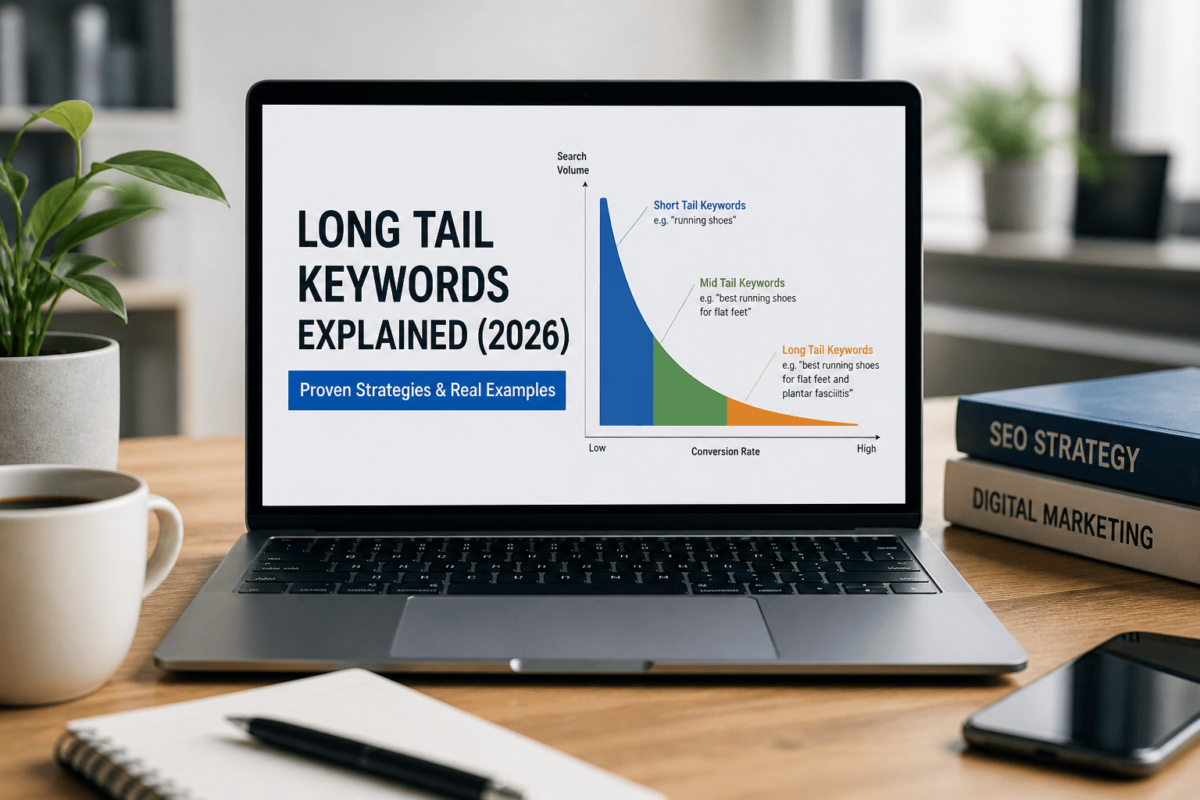
Long Tail Keywords Explained (2026): Proven Strategies, Real Examples & Easy Wins
Long tail keywords are highly specific search phrases — usually three to five or more words — that target a narrow audience with clear intent. They have lower search volume than broad keywords, but they convert dramatically better because searchers using them know exactly what they want. In 2026, with AI-powered search engines changing how people find information, mastering long tail keywords is one of the smartest moves any blogger, affiliate marketer, or business owner can make.
- What Are Long Tail Keywords?
- Why They Matter More in 2026
- Real Examples (by Use Case)
- How to Find Them
- Tools Compared
- Long Tail SEO Strategy
- Step-by-Step Workflow
- Short Tail vs. Long Tail
- Common Mistakes
- For Affiliate Marketers
- Long Tail & AI Search 2026
- E-E-A-T & Long Tail Content
- Programmatic Long Tail SEO
- FAQ
- Final Thoughts
Quick Summary
- Long tail keywords are specific, low-competition search phrases that drive high-intent traffic.
- They make up roughly 70% of all search queries online — the vast majority of how people actually search.
- They convert significantly better than broad, short-tail keywords.
- You can find them using free methods (Google Autocomplete, Reddit, Quora) and paid tools like Ahrefs, Ubersuggest, or KWFinder.
- Long tail SEO in 2026 works hand-in-hand with topical authority and AI search optimization.
- Affiliate marketers and niche bloggers consistently rank faster with long tail keyword targeting.
- Ignoring search intent is the #1 mistake — knowing why someone is searching matters as much as what they type.
- This guide covers everything: definitions, examples, tools, strategy, mistakes, and a full step-by-step workflow.
What Are Long Tail Keywords?
Let’s start simple. A long tail keyword is a search phrase — usually three or more words — that targets a very specific topic or question. These are the kinds of things people type (or speak) into search engines when they know pretty much what they want.
See the difference? The long tail version tells you a ton about the person searching. They want a drip-style machine, they have a budget, and they’re probably new to the coffee world. That specificity is exactly why long tail keywords are so powerful.
The term comes from the “power law distribution” curve — if you plot all keywords by search volume, the most-searched terms form a short “head” on the left, while thousands of low-volume, specific terms form a long “tail” on the right. That tail represents the majority of all searches.
The concept was popularized by Chris Anderson in his 2004 Wired article and later his book The Long Tail, where he described how niche products and content could collectively generate more revenue than a few blockbuster hits. The same principle applies perfectly to SEO.
Why Long Tail Keywords Matter More Than Ever in 2026
You might wonder — with AI search changing the game, do long tail keywords still matter? Here’s the thing: they matter more than ever. Here’s why.
1 Lower Competition Means Faster Rankings
Short-tail keywords like “weight loss” or “make money online” are dominated by massive websites with enormous domain authority. New blogs and niche sites can’t realistically compete on those terms — at least not quickly.
Long tail keywords? Most of them have little to zero competition. You can publish a well-researched post targeting a specific long tail phrase and rank on the first page within days or weeks — not years.
2 Higher Conversion Rates
Someone searching “protein powder” is probably just browsing. Someone searching “best whey protein powder for women over 40 with lactose intolerance” is ready to buy.
Long tail searchers have done their research. They’re further down the buyer’s journey. According to data from WordStream, long tail keywords convert at roughly 2.5x the rate of head terms. For affiliate marketers and e-commerce sites, that difference is everything.
3 AI Search Loves Specificity
Google’s AI-powered features — including Search Generative Experience (SGE) and AI Overviews — pull answers from content that directly addresses specific questions. If your post answers “how to fix a leaking dishwasher door seal without calling a plumber,” you’re exactly the kind of content AI wants to surface.
Vague content targeting broad terms gets passed over in favor of precise, helpful content. Long tail optimization is, effectively, AI search optimization.
4 Voice Search Is Built for Long Tail
People don’t say “best restaurant” into their phone. They say “what’s the best Mexican restaurant near me open right now.” Voice queries are naturally conversational and long-form — which maps directly onto long tail keyword structure.
5 Topical Authority Building
Google’s ranking algorithm increasingly rewards websites that demonstrate deep expertise on a topic — a concept called topical authority. When you create a cluster of content around long tail variations of a topic, you signal to Google that you’re a serious, reliable resource.
A site covering “home coffee brewing” might target dozens of long tail keywords: “how to make pour over coffee at home,” “best coffee grind size for French press,” “why is my espresso too bitter” — and each piece reinforces the others. That’s a content strategy that compounds over time.
Long Tail Keyword Examples (Real & Practical)
Let’s get concrete. Here are long tail keyword examples across different use cases, because the abstract definition only gets you so far.
An affiliate blogger targeting “best VPN for streaming Netflix from outside the US” can write a focused review post, recommend two or three VPNs with affiliate links, and answer exactly what the searcher needs. The traffic may be lower than “best VPN” — but the person clicking is already sold on the idea of buying a VPN. They just want guidance on which one.
How to Find Long Tail Keywords (Proven Methods)
Alright, let’s get into the good stuff. Finding long tail keywords isn’t complicated, but it does require knowing where to look. Here are the most reliable methods, starting with completely free options.
Method 1: Google Autocomplete & People Also Ask
This is the most underrated free keyword research method, full stop. Open a private browser window (so your search history doesn’t influence results), type your seed keyword into Google, and don’t press Enter.
Google will suggest completions — and those suggestions are based on real search data. They’re literally showing you what people are typing. Jot them all down.
Then, scroll down after searching and look at the “People Also Ask” (PAA) box and the “Related Searches” section at the bottom of the page. Both are goldmines for long tail variations that real users are searching.
Method 2: Reddit, Quora & Niche Forums
Forums are where real people ask real questions in their own words — which is exactly the kind of natural language that surfaces in search engines (especially with conversational AI search).
Go to Reddit and search your topic. Look at question posts, post titles, and the specific phrasing people use. Head to Quora and search your seed keyword — filter for “Questions” and you’ll find hundreds of real queries.
Don’t forget niche-specific forums. Bodybuilding.com forums for fitness, Houzz for home improvement, TripAdvisor forums for travel — wherever your target audience hangs out, they’re leaving long tail keyword gold in their wake.
Method 3: Keyword Research Tools (Free + Paid)
Once you’ve gathered seed ideas manually, keyword tools let you scale your research significantly. You’ll find search volume, competition data, and keyword difficulty — all of which help you prioritize which terms to target first.
Free tools to start with:
- Google Keyword Planner — Great for volume ranges, especially for Google Ads users with verified accounts.
- Ubersuggest — Neil Patel’s tool gives limited daily searches for free, with keyword ideas and SEO difficulty scores.
- Answer the Public — Visualizes question-based long tail variations (who, what, when, where, why, how).
- Keyword Surfer — A free Chrome extension that shows search volume right in Google search results.
Paid tools worth the investment:
- Ahrefs — Industry-leading keyword data, excellent for finding long tail opportunities and competitor keyword gaps.
- KWFinder by Mangools — Extremely beginner-friendly, with a clean interface and accurate keyword difficulty scores.
- LowFruits.io — Specifically designed to find low-competition, high-value long tail keywords. Great for niche sites.
- Surfer SEO — Combines keyword research with on-page SEO optimization, excellent for building content clusters.
Method 4: Competitor Gap Analysis
Want to know what keywords are already sending traffic to your competitors? Use a tool like Ahrefs, Ubersuggest, or Moz to plug in a competitor’s URL and see their top-ranking keywords.
Filter for keywords with low difficulty scores and moderate search volume. These are terms your competitor is ranking for that you could target with better-optimized content.
This is one of the fastest ways to find proven long tail opportunities — because if a competitor is ranking for it, the traffic is real. You just need to create something better.
Method 5: AI Tools & ChatGPT Prompting
AI tools have changed the game for long tail keyword brainstorming. You don’t use AI to replace keyword tools — you use it to expand your thinking before you validate with data.
Sample prompts you can use:
- “List 20 long tail keywords a beginner might search when learning about [topic]”
- “What questions do people ask on Reddit about [topic] that aren’t covered well online?”
- “Generate 15 long tail keyword variations of [seed keyword] with buyer intent”
- “Give me 10 long tail keywords targeting [specific audience] for [topic]”
Then take those AI-generated ideas into a real keyword tool to check actual search volume and competition. The combination of AI brainstorming + tool validation is one of the most efficient workflows available in 2026.
Best Long Tail Keyword Research Tools (Free & Paid Compared)
| Tool | Best For | Price | Key Feature |
|---|---|---|---|
| Google Keyword Planner | Volume ranges, beginners | Free | Direct Google data |
| Answer the Public | Question-based keywords | Free (limited) | Visual keyword maps |
| Keyword Surfer | Quick volume check | Free Chrome ext. | In-SERP data overlay |
| Ubersuggest | All-in-one starter tool | Free / $29+/mo | Domain overview + ideas |
| KWFinder (Mangools) | Beginner-friendly research | $29+/mo | Accurate KD scores |
| Ahrefs | Advanced competitor analysis | $99+/mo | Massive keyword database |
| LowFruits.io | Finding easy-win keywords | $25+/mo credit | Competition weakness filter |
| Surfer SEO | Content + keyword planning | $89+/mo | NLP optimization scoring |
Long Tail SEO Strategy: Turning Keywords Into Traffic
Finding long tail keywords is only half the battle. The real advantage comes from how you use them strategically. Here’s how to think about this.
Understand Search Intent First
Every keyword has an intent behind it — what the searcher actually wants to accomplish. Getting this wrong is more damaging than targeting slightly the wrong keyword.
The four main intents:
The format of your content should match the intent. Informational keywords get blog posts and guides. Commercial keywords get comparison posts and reviews. Transactional keywords get product pages or landing pages. Mismatching content type to intent is a fast track to a high bounce rate.
Build Content Clusters Around Pillar Pages
One of the most effective long tail SEO strategies in 2026 is the content cluster model. Here’s how it works:
- Create a comprehensive Pillar Page around a broad topic (e.g., “Home Coffee Brewing”).
- Create Cluster Pages targeting long tail variations: “how to make pour over coffee,” “best coffee grinder for beginners,” “French press vs Aeropress,” etc.
- Internally link all cluster pages to the pillar page and to each other.
This structure signals to Google that your site is a deep, authoritative resource on the topic — not just a collection of loosely related articles. Sites using this model consistently see ranking improvements across all pages in the cluster, not just individual posts.
Internal Linking Strategy
Internal links are one of the most underused SEO tools. When you publish a new long tail keyword post, link to it from relevant existing posts — and link from it back to your pillar pages.
Use your target keyword (or a variation of it) as the anchor text for internal links. This reinforces topical relevance and helps Google understand what each page is about.
Optimize for Featured Snippets & AI Overviews
Long tail question-based keywords are prime real estate for Google’s featured snippets (the answer boxes at the top of search results). To win these:
- Answer the question directly and concisely in the first 40-60 words after the H2/H3 heading.
- Use a clear question as your heading (“What is X?” or “How do you Y?”).
- Use numbered lists or bullet points for process-based answers.
- Define terms clearly and early.
This same structure also increases your chances of being cited in AI-generated answers in tools like Google’s AI Overview, ChatGPT browsing, and Perplexity — a growing traffic source in 2026.
📎 Related Reading on TechCognate
Step-by-Step: How to Find & Use Long Tail Keywords
Let’s put everything together into a repeatable workflow you can follow for any niche.
-
1
Choose Your Niche and Core Topic
Pick the broad topic you want to cover. Don’t try to research keywords without knowing your niche — you’ll get overwhelmed. Example: You run a personal finance blog aimed at millennials. Your core topic might be “budgeting apps” or “how to save money in your 20s.”
-
2
Generate Seed Keywords
Seed keywords are the short, broad terms you’ll expand from. Write down 5-10 seed keywords related to your topic: Budgeting apps, Save money, Personal finance tools, Spending tracker.
-
3
Expand Using Free Methods First
Type each seed keyword into Google (incognito mode) and capture autocomplete suggestions; scrape “People Also Ask” questions; search Reddit and Quora for real phrasing; use Answer the Public for visual variations. You should have 30-50+ potential long tail keyword ideas at this point.
-
4
Validate With a Keyword Tool
Take your list into a keyword tool. Look for: Search volume (ideally 100-2,000 monthly searches), Keyword difficulty (KD) scores under 30 when starting out, and CPC — higher CPC often correlates with commercial intent and monetization potential.
-
5
Analyze the Current SERP
Before writing anything, search your target keyword and study the first page. What kind of content is ranking? How long are the top results? Are there featured snippets or AI Overviews? Are any smaller sites in the top 5? If yes — that’s your green light.
-
6
Create the Content
Include the exact long tail phrase in: title tag, H1, first 100 words, one H2, meta description, and URL slug. Answer the core search intent immediately. Address related PAA questions as H2/H3 subheadings. Include 3-5 internal links and 1-2 external links to authoritative sources.
-
7
Optimize, Publish & Track
Submit the URL to Google Search Console. Share on social or relevant communities. Set a reminder to revisit in 90 days. Monitor rankings — long tail keywords often rank within 2-8 weeks.
Honestly, the update step is where most bloggers fall short. A post that ranks #7 today can reach #1-3 with a solid refresh 6 months later. Don’t set it and forget it.
Short Tail vs. Long Tail Keywords: At a Glance
| Factor | Short Tail Keywords | Long Tail Keywords |
|---|---|---|
| Example | “running shoes” | “best waterproof trail running shoes for wide feet” |
| Avg. Search Volume | 10,000 – 1M+ / month | 100 – 2,000 / month |
| Competition Level | Very High | Low to Medium |
| Ranking Difficulty | Very Hard (years) | Manageable (weeks to months) |
| Conversion Rate | Low (1-2%) | High (3-6%+) |
| Search Intent | Unclear / Broad | Specific & Clear |
| Best For | Brand awareness | Targeted traffic, affiliate, sales |
| AI Search Relevance | Lower | Higher (matches natural queries) |
Common Long Tail Keyword Mistakes to Avoid
Most of the long tail SEO advice out there focuses on the tactics. What they leave out — and what actually costs people rankings — are these common mistakes.
A keyword with zero reported search volume isn’t automatically worthless — sometimes tools just don’t have data on very niche phrases. But if you’re targeting dozens of zero-volume terms without any evidence of search demand, you’re wasting time. Validation rule: if the keyword appears naturally in forum threads, Q&A sites, or social media conversations, that’s a green light even with no tool data. If you invented it yourself and can’t find it anywhere organically — skip it.
You could write the most beautifully optimized post on “best running shoes for plantar fasciitis” and still fail if your article is an informational piece when Google’s SERP shows product pages and roundup reviews. Always match your content format and angle to what Google is already rewarding for that specific keyword.
Google’s algorithms haven’t rewarded keyword stuffing for over a decade. Writing naturally is both better for readers and better for rankings. Mention your long tail keyword naturally 2-3 times in a post. Use semantic variations (synonyms, related phrases) throughout the rest. If your writing sounds awkward because you’re trying to include a phrase too many times, that’s a signal to ease up.
Each page should have one primary long tail keyword and 2-4 closely related secondary keywords. Trying to rank one page for 10 different long tail terms typically results in ranking for none of them. If you have multiple related long tail terms, consider whether they deserve separate posts or can be addressed naturally within one comprehensive guide.
Long tail keywords around evolving topics (technology, health, finance, marketing) need regular updates. Google prioritizes fresh, accurate content. Build a content audit calendar: review and refresh your top-performing posts every 6-12 months. Update statistics, add new examples, and adjust recommendations. This alone can recover rankings that have slipped over time.
Publishing a post and leaving it as an island — no internal links pointing to it, no links going out from it — is a waste of ranking potential. Internal linking is free SEO equity you’re leaving on the table. Every time you publish something new, go back to 3-5 older relevant posts and add a link to the new one. It only takes 10 minutes and consistently improves rankings across your entire site.
Long Tail Keywords for Affiliate Marketing: The Revenue Connection
If you’re building an affiliate site, long tail keywords aren’t just an SEO strategy — they’re a revenue strategy. Here’s how to think about it.
Affiliate conversions happen when searchers have specific, purchase-ready intent. Long tail keywords are the highway to those searchers. The most profitable content types for affiliate sites using long tail SEO include:
- “Best [product] for [specific use case]” postse.g., “best noise-canceling headphones for remote work under $200”
- “[Product A] vs [Product B]” comparisonse.g., “Bluehost vs SiteGround for WordPress beginners”
- “[Product] review” postse.g., “Jasper AI review 2026: is it worth the money?”
- “How to use [product] for [result]” tutorialse.g., “how to use Canva for Instagram Stories without design experience”
- “Is [product] worth it?” postsThese capture buyers at the final decision point — conversion goldmines.
Long Tail Keywords & AI Search in 2026: What’s Changed
The rise of AI-powered search has fundamentally changed how content gets discovered — and long tail keywords are at the center of that shift.
Google’s AI Overviews (launched broadly in 2024 and refined through 2025-2026) pull concise answers from content that directly addresses specific queries. This is long-tail territory by nature. AI doesn’t pull vague, broad content — it pulls precise, well-structured answers.
Perplexity AI, ChatGPT with search, and other AI-powered tools are also increasingly used for research. These tools cite their sources — meaning high-quality content targeting specific long tail questions can earn citations in AI responses, sending traffic without traditional ranking.
Key 2026 Optimizations for AI Search
- Structure your content with clear question-and-answer formats (H2 question → concise answer → detailed explanation).
- Add a well-structured FAQ section to every post — AI tools love pulling from FAQ content.
- Use schema markup (FAQ Schema, HowTo Schema) to make your content machine-readable.
- Build E-E-A-T signals: author bios, credentials, citations from authoritative sources, and first-hand experience.
- Keep content fresh — AI systems deprioritize outdated information.
E-E-A-T and Long Tail Content: Building Trust That Ranks
Google’s quality guidelines emphasize E-E-A-T: Experience, Expertise, Authoritativeness, and Trustworthiness. Long tail keyword content is actually one of the best formats for demonstrating E-E-A-T — because specificity implies expertise.
Here’s how to bake E-E-A-T into your long tail content:
Experience
Include first-hand accounts, personal testing results, or real-world case studies. “I tested 7 standing desks for 90 days” is more credible than generic roundups.
Expertise
Cite data from credible sources. Link to studies, official websites, or recognized experts in your field. Use precise numbers and accurate claims.
Authoritativeness
Build topical depth through content clusters. An author or site covering 50 related articles on a topic signals authority better than one generic overview.
Trustworthiness
Disclose affiliate relationships. Include an author bio. Make your About page honest and detailed. Use HTTPS. Respond to comments and keep content updated.
Long tail content naturally supports E-E-A-T when done right — because answering a specific, niche question in depth is exactly what a genuine expert does.
Programmatic Long Tail SEO: Scaling Your Strategy
Here’s a more advanced concept that’s gaining momentum: programmatic SEO. This is the practice of creating large volumes of content pages around templated long tail keyword patterns.
Sites like Zillow, Nomad List, and TripAdvisor use programmatic SEO to create thousands of pages targeting location-based long tail queries: “apartments for rent in [city],” “cost of living in [city] vs [city],” “best neighborhoods in [city] for young professionals.”
You don’t need to be a large company to use this approach. Here’s how to think about it for smaller sites:
- Identify a repeatable long tail keyword pattern: “[product] for [specific audience],” “[tool] vs [tool] for [use case],” or “best [category] in [city].”
- Build a data source (a spreadsheet or database of variables) that can fill in those templates.
- Create a content template that produces genuinely useful, unique content for each variation — not just thin, duplicated pages.
Frequently Asked Questions About Long Tail Keywords
Final Thoughts: Start Small, Win Big
Here’s the honest truth about long tail keywords: they’re the great equalizer of SEO.
You don’t need a massive domain, a huge team, or thousands of dollars in tools to compete with established sites. You need a specific topic, a clear audience, and the discipline to create genuinely helpful content around the exact phrases your target reader is typing into Google.
That’s it. That’s the entire playbook.
Start with one seed keyword. Run it through Google Autocomplete and Answer the Public. Validate your top ideas in a keyword tool. Pick the one with the right mix of intent, manageable competition, and reasonable search volume. Write a thorough, helpful, honest piece of content — and optimize it properly.
Then do it again. And again.
In 2026, with AI search reshaping how content gets discovered, the advantage belongs to publishers who create specific, trustworthy, expert-level content. Long tail keywords are your roadmap to doing exactly that.
The tail is long. The opportunity is enormous. Start typing.
Further Reading & Resources
Ready to Rank With Long Tail SEO?
TechCognate helps bloggers, affiliates, and businesses build content strategies that drive real, compounding organic traffic.
Get a Free SEO ConsultationThis article is written for informational purposes and reflects best SEO practices as of 2026. Tool pricing and features may change — always verify current details on each tool’s official website. Affiliate links mentioned are for illustrative purposes only.