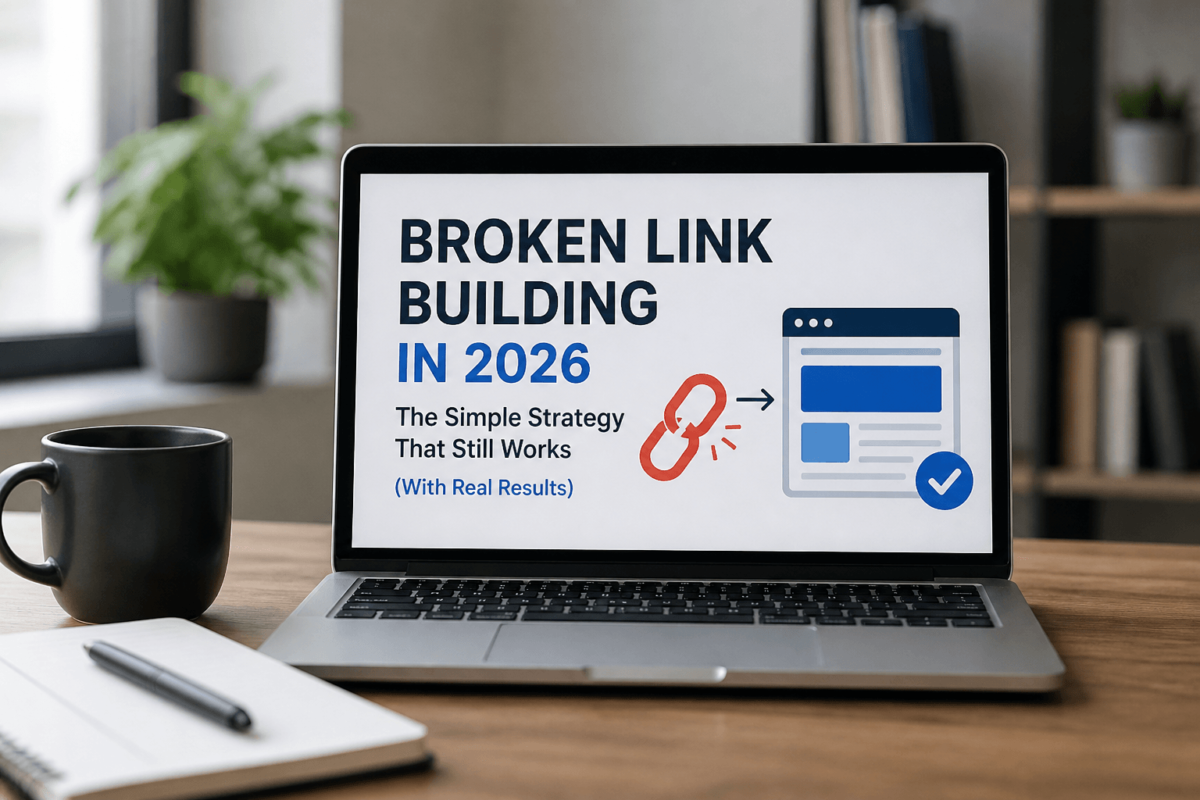
Broken link building is a backlink strategy where you find dead or broken links on relevant websites and suggest your own content as a replacement. It still works in 2026 because website owners genuinely want to fix poor user experiences — and you’re doing them a favor by pointing out the problem. When done right, you get a high-quality contextual backlink, and they get a better page. Everybody wins.
📋 Quick Summary
📖 In This Guide
What Is Broken Link Building?
Let’s cut straight to it. Broken link building is the process of finding hyperlinks on other websites that lead to 404 error pages (dead content), then reaching out to the site owner and suggesting your content as a replacement.
Think of it like being a digital cleanup crew. You’re walking down a street (the web), noticing a pothole (broken link), and calling the city (website owner) to say, “Hey, there’s a problem here — and here’s the fix.”
The website owner gets to repair a bad user experience. You get a contextual backlink from a relevant page. It’s not a trick or a hack. It’s a genuinely useful exchange.
Here’s what makes it different from most other link building strategies: you’re not asking for a favor out of nowhere. You’re solving a real problem. That changes the entire dynamic of your outreach — and your response rates.
Broken links happen all the time. Websites get redesigned. Old content gets deleted. Domains expire. Whole companies shut down. The web is full of dead links just waiting to be replaced. In fact, as AI-generated content floods the internet and older sites get abandoned at higher rates, broken links are becoming more common — not less.
Why Broken Link Building Still Works in 2026
Here’s the truth: a lot of link building tactics that worked five years ago are dead or dying. Guest post farms are getting penalized. Private blog networks are risky. Cold outreach for random backlinks gets ignored.
But broken link building has something the others don’t — it’s inherently helpful. Let me explain why that matters in 2026 specifically.
Google Still Values Contextual Backlinks
Google’s algorithm has evolved, but one thing hasn’t changed: a relevant, contextual backlink from a real website in your niche still moves the needle. Broken link building, by design, earns you exactly that kind of link. You’re replacing a dead link that was already editorially placed. The context was already there — you’re just stepping into it.
Website Owners Hate Broken Links
Nobody wants their site full of 404 errors. It looks sloppy. It hurts user experience. It can even affect their own SEO. When you reach out to tell someone about a broken link on their site, they’re usually grateful — not annoyed. That’s a completely different starting point than asking for a link out of nowhere.
Your Outreach Feels Helpful, Not Spammy
Most link outreach feels transactional and one-sided. “Hey, link to my content because it’s great.” That’s asking for something.
Broken link outreach flips that. “Hey, I noticed something broken on your site — here’s a fix.” That’s giving something. The psychological difference is massive. People respond to value, not pitches.
AI Content Is Creating More Broken Links
A Real-Life Example (So You Can See Exactly How It Works)
Most guides on broken link building stay vague. Let me show you a real scenario so you can see the whole thing in motion.
The Setup
Let’s say you run a website about personal finance. You’ve got a solid article on “How to Create an Emergency Fund from Scratch.”
You search Google for: intitle:"resources" "personal finance" — and you find a personal finance blog with a resources page. You run Check My Links on the page and spot a broken link pointing to an article called “10 Steps to Build Your Emergency Fund” on a site that no longer exists.
The Outreach
You write a short, friendly email to the site owner:
I was checking out your personal finance resources page and noticed one of the links is returning a 404 error — the one pointing to “10 Steps to Build Your Emergency Fund.”
I actually wrote something very similar that might work as a replacement: [Your URL]. It covers the same topic and has been updated with current data.
Either way, thought you’d want to know. Thanks for putting together such a useful page!
The Result
About 60% of the time, the site owner either fixes the link and uses yours, or at minimum thanks you and fixes the dead link. You’re looking at roughly 1 in 5 emails converting to a backlink at the lower end, and 1 in 3 on the higher end — which is exceptional compared to cold guest post pitches.
Tools You Need for Broken Link Building
Let me be honest with you: you can do broken link building for free if you’re just starting out. But if you’re serious about scaling it, a couple of paid tools will save you dozens of hours.
Find link opportunities at scale. Enter a competitor’s URL to see all broken external links. Screaming Frog does the same job with a friendlier interface for beginners.
Chrome extension that highlights all links on a page — green for working, red for broken. Fantastic for manual prospecting on individual resource pages.
Desktop-based crawler for deep site crawls. Free version handles up to 500 URLs — enough for most small-to-medium sites. Perfect for full-site audits before outreach.
Enter a domain and instantly see associated email addresses. Accurate and fast — the free plan gives you enough credits to get started. Alternatives include Snov.io.
Step-by-Step Broken Link Building Strategy for 2026
Alright, here’s where it all comes together. Follow these steps and you’ll have a repeatable system you can run every week.
Find Relevant Websites in Your Niche
Start with Google search operators to find resource pages, link roundups, and reference-heavy content in your niche. Use operators like: your keyword + “useful resources”, your keyword + intitle:”resources”, or your keyword + “links” site:.edu. Also look at your competitors — if they have backlinks from resource pages, those same pages likely have broken links you could fill.
Identify the Broken Links
For manual checking, use the Check My Links Chrome extension — open the target page, run the extension, and scan for red (broken) links. For bulk checking, use Ahrefs’ Site Explorer or SEMrush, filter for 404 errors. For deep dives, use Screaming Frog to crawl the entire site and export the broken links report.
Create (or Match) Replacement Content
This is the step most guides skip — and it’s the most important one. Use the Wayback Machine (web.archive.org) to look up the original content at the dead URL. Check if you already have a matching piece. If not, consider creating one. Update the content for 2026 with recent data and examples. The closer your content matches and improves on the original, the higher your conversion rate.
Write Your Outreach Email
The best outreach emails are short, direct, and genuinely helpful in tone. You’re not selling anything — you’re reporting a problem and offering a solution. Keep it under 150 words, use their first name, lead with the problem (broken link), not your pitch, and make saying yes easy.
I was reading through your [page title/topic] page and noticed one of the links is no longer working — the one pointing to [dead link anchor text or URL]. It’s returning a 404.
I actually have a piece that covers the same ground that might work as a replacement: [Your URL]. It’s been updated recently and goes into [briefly explain what makes it useful].
No worries if it’s not a fit — just wanted to give you a heads up about the broken link either way.
Thanks,
[Your Name]
Follow Up (Once — The Right Way)
Wait 4 to 5 business days after your first email. If no reply, send one short follow-up. That’s it. Short, non-pushy, and friendly. After this, move on — chasing people damages your reputation and wastes your time.
Just bumping this up in case it got buried. Happy to answer any questions about the resource I mentioned.
Thanks,
[Your Name]
Mistakes Beginners Make (And How to Avoid Them)
Most people who try broken link building and quit did one of these things wrong:
Pitching Irrelevant Content
If the broken link was about email marketing and you’re pitching content about social media ads, that’s a mismatch. Site owners notice. Always match the topic of your content to the topic of the broken link as closely as possible.
Targeting the Wrong Pages
Not every page is worth targeting. Resource pages, “best of” lists, and link roundups are goldmines. Blog post body text is harder — editors are less likely to swap out a contextual link mid-article.
Sending Generic Emails
“Dear Webmaster” is a dead giveaway that you didn’t spend 10 seconds on personalization. Use the person’s name. Reference their specific page. Make it obvious you actually read what they wrote.
Giving Up Too Fast
Skipping Content Quality
If your replacement content is weak, thin, or outdated, people will look at it and say no — even if they were initially grateful for the heads up. Your content needs to earn the link. Make it genuinely useful.
How to Scale Broken Link Building
Once you’ve nailed the basics, here’s how to go from 5 to 50+ backlinks per month:
Build Templated Prospecting Workflows
Use spreadsheets or a simple CRM to track every prospect — the website, the broken link URL, the replacement URL, the contact email, and the outreach status. Once you have a system, you can delegate the prospecting and initial email writing to a VA.
Create Content Designed to Replace Broken Links
Here’s an advanced move: instead of only building content and then hunting for broken links, flip it. Find broken links at scale (using Ahrefs on multiple competitor sites), note what topics keep showing up, and create content specifically designed to replace those dead pages. You’re essentially building content with a built-in distribution strategy.
Target High-DA Sites Strategically
Not all backlinks are equal. If you want to move the needle on authority, prioritize broken link opportunities on sites with Domain Authority (DA) 40 and above. Use Ahrefs or Moz to filter prospects by authority before you start outreach.
Use Ahrefs’ Content Explorer
Search your main topic in Ahrefs Content Explorer and filter for pages with broken external links. This gives you a ready-made list of pages in your niche where site owners already have link-fixing to do. Incredibly efficient.
Broken Link Building vs. Other Link Building Strategies
How does broken link building stack up against the alternatives? Here’s an honest comparison:
| Strategy | Difficulty | Time | ROI | Best For |
|---|---|---|---|---|
| Broken Link Building | Medium | Medium | High | Beginners + SEO pros |
| Guest Posting | High | High | Medium | Authority building |
| HARO / Source Requests | High | Unpredictable | High | PR backlinks |
| Skyscraper Technique | High | Long | Medium | Content-heavy niches |
| Resource Page Outreach | Medium | Medium | Medium-High | Niche authority sites |
The bottom line: broken link building sits in a sweet spot — it’s not as time-intensive as guest posting or Skyscraper, and it has better conversion rates than cold link pitching. For anyone who wants a reliable, scalable link building method that doesn’t feel gross to execute, this is it.
The Psychology Behind Why It Works
Let’s take a step back and talk about why this strategy converts so well — because understanding it helps you do it better.
When you tell someone their page has a broken link, you’re doing two powerful things psychologically:
First, you’re triggering reciprocity. You gave them something valuable (a heads-up about a problem). Now they feel a natural pull to give something back. When your replacement link is right there, taking it is the path of least resistance.
Second, you’re positioned as a helper, not a seller. Most people are cynical about link outreach because it’s so clearly one-sided. When you lead with a fix and follow up softly with a suggestion, you’re not a marketer — you’re a colleague who noticed something.
This is why your tone in the email matters so much. You don’t want to sound like you’re barely concealing a sales pitch. Genuine helpfulness comes through in the writing. If you’re actually trying to help them fix a problem — and you happen to have great content that fills the gap — that authenticity is felt.
Frequently Asked Questions
Final Thoughts
Broken link building isn’t flashy. It doesn’t have a fancy acronym or a viral case study attached to it. But it works — consistently, predictably, and at scale — because it’s built on a simple human dynamic: help someone fix a problem, and they’ll often return the favor.
Here’s what I want you to take away from this guide:
- Start small. Find 10 broken link opportunities in your niche this week. Send 10 emails. See what happens.
- Focus on content quality. The replacement you offer is the product. Make it genuinely good.
- Be patient with volume. This is a numbers game, and 100 emails beats 10 every single time.
- Don’t overcomplicate it. The strategy itself is simple. Execution is where most people get tripped up.
You don’t need to master every backlink strategy at once. Master one, do it well, and build from there. Broken link building is one of the best first strategies you can run — and one of the most sustainable ones you can scale.
Get started today. Find one page. Find one broken link. Write one email. That’s all it takes to begin.
Want More Backlinks Without the Guesswork?
TechCognate runs done-for-you link building campaigns — broken link building, digital PR, and resource page outreach.
Let’s Talk Link Building →