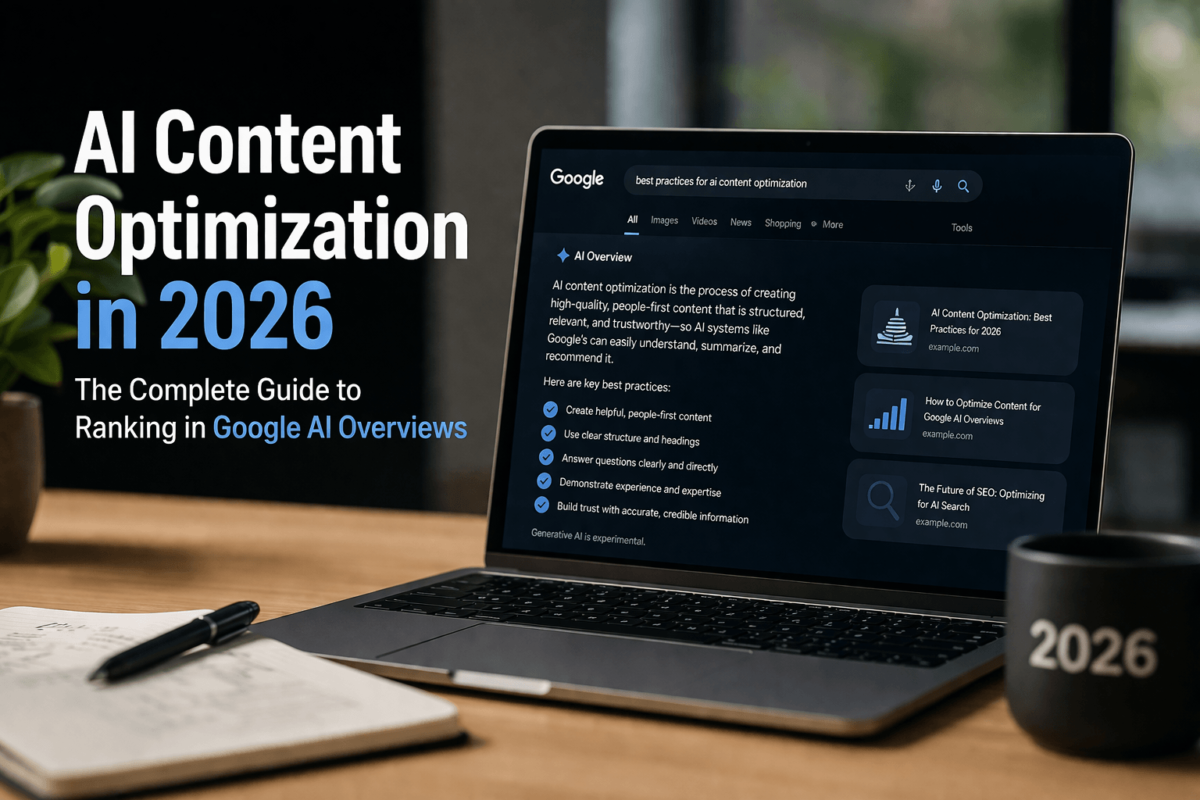
AI content optimization is the practice of structuring, writing, and formatting your content so it gets selected and featured by AI systems — including Google AI Overviews (SGE), ChatGPT, and Perplexity. Unlike traditional SEO that chases keyword rankings, AI content optimization focuses on writing clear, direct, well-structured answers that AI models can extract, quote, and present to users.
In 2026, if your content isn’t optimized for AI systems, you’re missing a massive slice of search visibility — even if you’re ranking on page one.
📋 What You’ll Learn
- What AI Content Optimization actually means
- How Google AI Overviews select content
- Why Traditional SEO Is Not Enough Anymore
- Traditional SEO vs. AI Content Optimization
- Key Principles of AI Content Optimization
- Real Before vs. After Example
- 7-Step Framework to Optimize for AI
- E-E-A-T in the AI Era
- Affiliate Content Optimization for AI
- 7 Mistakes to Avoid
- Tools That Actually Help
- Prompt Frameworks for Better Content
- Frequently Asked Questions
- Final Thoughts
What Is AI Content Optimization? (Plain English Explanation)
Let’s start with the basics, because there’s a lot of confusion around this term.
AI Content Optimization is the process of creating and structuring your content so that AI-powered search tools — Google’s AI Overviews, ChatGPT, Perplexity, Bing Copilot — can easily understand it, extract key information from it, and present it as an answer to user queries.
Here’s the deal: traditional SEO was built around satisfying Google’s algorithm — a crawler that reads keywords, counts backlinks, and measures page load speed. AI content optimization is different. You’re now writing for language models that read your content the same way a smart person would — looking for clear answers, logical structure, credible sources, and genuine expertise.
Think of it this way: if you asked a colleague a question and they responded with a wall of keyword-stuffed text, you’d stop listening. AI models do the same thing. They skip the fluff and surface the content that actually answers the question.
The Three Pillars of AI Content Optimization
- Clarity: Your content must answer the question directly and without ambiguity
- Structure: Information must be organized in a way that AI can extract individual answers
- Authority: The content must demonstrate real experience, expertise, authoritativeness, and trustworthiness (E-E-A-T)
AEO is the practice of structuring content specifically so it appears as a direct answer in AI-generated responses, voice search results, and featured snippets. It’s the next evolution beyond traditional SEO — and in 2026, it’s no longer optional.
How Google AI Overviews Actually Work (The Part Most People Get Wrong)
Google AI Overviews — previously called Search Generative Experience or SGE — launched broadly in 2024 and has been expanding rapidly since. By 2026, they appear on a massive percentage of commercial and informational queries.
Most people assume Google’s AI just scrapes the top-ranked pages. That’s not what’s happening.
Here’s what’s actually going on under the hood:
How the Selection Process Works
- Query Intent Mapping: Google’s AI first classifies the intent behind the search — informational, transactional, navigational, or conversational.
- Entity Recognition: The AI identifies key entities in the query (people, places, products, concepts) and looks for content that clearly addresses those entities.
- Passage-Level Extraction: Google doesn’t read entire pages — it extracts specific passages. If your answer is buried in paragraph 14, it might not get seen.
- Authority Scoring: Pages with strong E-E-A-T signals, relevant backlinks, and clear author credentials get weighted more heavily.
- Freshness: For fast-moving topics, Google heavily weights recently updated content.
- Cross-Source Synthesis: The AI often pulls from multiple sources to build a single answer. Your content doesn’t have to be the only source — it just needs to be the clearest one on your specific angle.
What this means for you: you can appear in AI Overviews even without ranking in the top 3 organic results. The key is writing content that’s structured for extraction, not just optimized for crawlers.
A site ranking #7 organically can appear in a Google AI Overview if its content has a clearer, more direct answer than sites ranking above it. Structure and clarity beat ranking position in the AI layer.
Why Traditional SEO Is Not Enough Anymore
Look, traditional SEO isn’t dead. You still need it. But if that’s all you’re doing in 2026, you’re playing a game that’s already changed.
Here’s what’s shifted:
The Zero-Click Problem Has Gotten Worse
Zero-click searches — where users get their answer directly on the search results page without clicking through — have been rising for years. According to data tracked by researchers at SparkToro and others, a significant portion of Google searches now end without a click. AI Overviews make this even more pronounced because they give a complete answer right at the top of the page.
The old playbook: rank #1, get the click.
The new playbook: get featured in the AI answer, establish authority, and give users a reason to click through for depth.
Keywords vs. Intent
Traditional SEO trained us to think in keywords. AI optimization forces you to think in questions and answers. When someone types ‘best CRM for small business’ into Google today, the AI doesn’t just match keywords — it tries to generate a genuinely useful answer. Your content needs to be that answer.
The shift: stop writing articles that rank for keywords. Start writing articles that answer questions comprehensively.
The E-E-A-T Mandate
Google’s E-E-A-T (Experience, Expertise, Authoritativeness, Trustworthiness) framework has always mattered, but in the AI era, it’s become the primary filter. Generic AI-generated content with no author credentials, no real-world examples, and no trust signals is actively being downgraded.
This is actually great news for people who create content based on real experience. It means authenticity is a competitive advantage again.
Traditional SEO vs. AI Content Optimization
| Factor | Traditional SEO | AI Content Optimization |
|---|---|---|
| Primary Focus | Keyword density and placement | Topic intent, entities, and semantic meaning |
| Success Metric | Page 1 rankings on Google | Visibility in AI Overviews, ChatGPT, Perplexity |
| Content Length | Longer = better (often 2,000+ words) | Clarity and structure > raw length |
| Link Signals | Backlinks drive authority | Entity authority + brand mentions + E-E-A-T |
| Optimization Target | Google crawler algorithms | AI language models + traditional crawlers |
| Formatting Style | Dense long-form paragraphs | Answer-first, scannable, structured with headers |
| Keyword Strategy | Primary + LSI keyword matching | Question-answer pairs, entity relationships |
| Content Updates | Periodic; seasonal refreshes | Frequent; AI models reward freshness |
| User Intent Signal | Search volume + CTR | Conversational queries, voice search phrasing |
| Conversion Path | Click to site from SERP | Direct answer in AI + click for depth |
Key Principles of AI Content Optimization in 2026
1. Answer-First Writing
The single biggest change you can make to your content strategy right now is to put the answer first. Don’t bury your main point. Don’t save it for the conclusion. State it in the first paragraph.
Think of how a journalist writes — inverted pyramid style, most important information at the top. AI models extract the clearest, most direct answer they can find. If your answer is at the top of the page, that’s what gets quoted.
2. Entity-Based Optimization
Entities are people, places, products, organizations, and concepts that have a distinct, identifiable meaning. Google’s Knowledge Graph is built on entities. When you include relevant entities naturally in your content — and when you clearly define the relationships between them — you’re speaking Google’s language.
For example, if you’re writing about email marketing software, the relevant entities aren’t just your target keywords. They include specific tools (Mailchimp, ConvertKit, Klaviyo), related concepts (deliverability, open rates, segmentation), and the audiences served (ecommerce brands, SaaS companies, bloggers).
Use tools like Google’s Natural Language API or simply write comprehensive content that naturally covers a topic’s full semantic landscape.
3. Structured Formatting for AI Extraction
AI models are much better at extracting information from well-structured content. Practically, this means:
- Use clear H2 and H3 headings that directly state the question or answer
- Include short definition paragraphs under each heading
- Use numbered steps for processes and how-tos
- Include comparison tables for product/option comparisons
- Add FAQ sections that directly mirror how people ask questions
- Use bullet-point summaries at the beginning and end of major sections
4. The Humanization Layer
Honestly, this is the one most AI-generated content fails at — and the one that makes the biggest difference.
AI language models are trained to be helpful and accurate. They’re not trained to be authentic. Real content has texture — specific opinions, honest caveats, moments of ‘here’s what I actually found when I tried this,’ and imperfect phrasing that doesn’t sound like it came from a press release.
Add these humanization signals deliberately:
- Share a specific personal experience or result
- Acknowledge when something doesn’t work as advertised
- Use rhetorical questions to mimic how real people think through problems
- Vary sentence length — mix short punchy sentences with longer explanatory ones
- Express genuine opinions, even mild ones
5. Topical Authority, Not Just Page Authority
Google’s AI rewards sites that demonstrate deep, consistent expertise on a topic — not sites that have one great article and nothing else. This is the concept of topical authority, and it’s become one of the most important ranking signals in the AI era.
Building topical authority means creating a content cluster: a comprehensive pillar page on a broad topic, supported by detailed sub-topic pages that link back to it. When Google’s AI sees that your site thoroughly covers every dimension of a subject, it treats your content as a primary source.
Real-Life Example: Before vs. After AI Optimization
Let me show you what this actually looks like in practice. I’ll use the query: ‘How long does it take to see results from SEO?’
SEO is a complex digital marketing strategy that involves many different factors. Search engine optimization has been around since the early days of the internet and continues to evolve. Many businesses today are investing in SEO to improve their online visibility. The time it takes to see results from SEO can vary greatly depending on a number of different factors including your domain age, content quality, competition, and many other variables…
How long does it take to see results from SEO? Most websites see initial SEO results in 3–6 months, with significant results typically appearing in 6–12 months. The exact timeline depends on your domain authority, content quality, competition level, and how aggressively you’re building links.
Months 1–3: Technical fixes, indexing improvements, initial ranking movement on long-tail keywords
Months 3–6: Stronger keyword rankings, increasing organic traffic, content gaining authority
Months 6–12: Compounding traffic growth, top-3 rankings on target keywords, lead/revenue impact
See the difference? The optimized version leads with a direct answer, gives a specific timeline (entities: numbers, timeframes), uses clear structure, and is easily extractable by AI. Google’s AI Overview would lift that first paragraph almost verbatim.
The unoptimized version might still rank on page one — but it’ll never appear in an AI Overview. And in 2026, that’s where a growing share of clicks and trust are being allocated.
How to Optimize Content for Google AI Overviews: 7-Step Framework
Here’s the repeatable framework I use for every piece of content. Run your existing articles through this too — optimization isn’t just for new content.
Map the Topic Intent (Before You Write a Word)
Before touching a keyboard, answer these three questions: What question is the user actually asking? What do they want to do after getting the answer? What related questions will they have next? Tools that help: Google’s ‘People Also Ask’ boxes, AnswerThePublic, and AlsoAsked.com.
Write Answer-First
Your first 100 words should completely answer the primary question. Structure your opening: Sentences 1–2 give a direct answer. Sentences 3–4 add key qualifying details. Sentences 5–6 tell the reader what to do with this information.
Include Key Entities Naturally
Map out all the entities relevant to your topic before writing. For a piece about project management software, your entity map might include: specific tools (Asana, Monday.com, ClickUp), related roles (project manager, team lead), relevant frameworks (Agile, Scrum, Kanban), and key outcomes (deadline management, resource allocation).
Structure for Extraction
Every major section of your content should be independently extractable. Each H2 and H3 should start with a direct definition or answer, not rely on previous sections to be understood, use specific concrete language, and include at least one supporting detail, example, or data point.
Add the Humanization Layer
Once you have your draft, go through and add authenticity signals. Include a specific result you or a client achieved, mention a test you ran and what you found, acknowledge a common misconception and why it persists. One authentic, specific example is worth more than three paragraphs of generic advice.
Build Internal Links Strategically
Internal linking signals topical depth to Google and gives AI models a map of related content to cite alongside yours. Link from every article to your pillar page on that topic cluster. Use descriptive anchor text that clearly states what the linked content covers.
Test in AI Engines
Before you publish — and periodically after — open ChatGPT or Perplexity and ask the primary question your article targets. Does your content appear as a citation? Does the AI’s answer match what you wrote? If not, your structure may be burying the answer. This feedback loop is gold.
E-E-A-T in the AI Era: How to Build Trust Signals That Actually Work
Google’s E-E-A-T guidelines — Experience, Expertise, Authoritativeness, Trustworthiness — have been around since 2022 in their current form, but they’ve become more critical than ever in 2026.
The ‘Experience’ component (the first E, added in late 2022) is the one most people still underutilize. It means demonstrating first-hand experience with the topic — not just research, but actual doing.
Experience Signals That AI Models Recognize
- Specific data: Real numbers, specific results, concrete timelines from your own work
- Process descriptions: Step-by-step accounts of how you actually did something
- Honest limitations: Acknowledging what didn’t work or where your experience is limited
- Author credentials on-page: Byline, bio, links to credentials — clearly visible, not buried in metadata
Authoritativeness and Trustworthiness in Practice
These signals are built over time, but you can accelerate them:
- Cite original research and primary sources (government data, peer-reviewed studies, official reports)
- Get cited by other credible sites in your niche — this builds topical authority signals
- Keep content updated — add a ‘last updated’ date to every article
- Include links to external authoritative sources, such as those from Google Search Central, official product documentation, or academic institutions
Most people think E-E-A-T is about gaming signals. It’s not. It’s about actually being an authoritative source. The best way to build E-E-A-T signals is to create content that genuinely deserves them.
Affiliate Content Optimization for AI: Placing Links Without Losing Featured Status
If you monetize content through affiliate marketing, AI optimization adds a layer of complexity — but also a real opportunity.
Here’s the challenge: AI systems are trained to prioritize helpful, unbiased content. Pages that feel like pure sales pitches get deprioritized for AI Overviews. But that doesn’t mean affiliate content can’t be featured — it just means the helpful content has to come first.
The Affiliate Optimization Framework
- Lead with the genuine answer: Answer the user’s question completely before introducing product recommendations
- Frame products as solutions, not destinations: ‘If you need X, [Tool] handles it well because…’ not ‘Check out [Tool] here!’
- Include honest comparisons: Tell readers when one tool beats another in a specific scenario
- Place affiliate links after the value: After you’ve demonstrated genuine expertise and provided real value, a product recommendation feels natural
- Use comparison tables strategically: Comparison tables for affiliate products work extremely well for AI extraction — they’re structured, scannable, and answer ‘which is better’ questions directly
The golden rule of affiliate content in 2026: if an AI Overview featuring your content would genuinely help the user — including when a product recommendation is part of that help — you’re doing it right.
7 AI Content Optimization Mistakes to Avoid
Mistake 1: Burying the Answer
Writers spend 500 words on backstory and context before getting to the point. AI models don’t wait for your intro — they pull the clearest answer they find. Put your answer in paragraph one.
Mistake 2: Writing for a Single Keyword Instead of a Topic
A page optimized for one exact phrase is thinner than a page that covers the full decision journey: what to look for, how to compare options, which tools work best for specific use cases, and what the setup process looks like. Cover the topic. The keyword is just the entry point.
Mistake 3: Ignoring On-Page Structure
If your content is one long wall of text with no headers, no bullets, and no organized sections, AI models will have a hard time extracting clean, quotable answers. Even if the information is excellent, poor structure is a barrier to AI visibility.
Mistake 4: Publishing Generic AI Content Without a Humanization Pass
Using AI tools to draft content is completely fine — and often efficient. But publishing AI-generated content without adding genuine experience, specific details, honest opinions, and authentic voice is a mistake. It’s detectable, it’s generic, and it doesn’t earn the trust signals AI systems are looking for.
Mistake 5: Skipping E-E-A-T Signals
No author bio. No credentials. No indication that a real human with relevant experience wrote this. In a world where AI-generated content floods every niche, showing that your content comes from a real, credible source is a genuine differentiator.
Mistake 6: Not Updating Old Content
AI systems weight content freshness heavily for competitive and evolving topics. A piece from 2022 that hasn’t been updated with current data, examples, and context is getting outranked by fresher content — even if it was excellent when it was published. Build a content refresh schedule and stick to it.
Mistake 7: Treating AEO as Separate from SEO
Answer Engine Optimization and traditional SEO aren’t competing strategies — they’re complementary. The best approach is to optimize for both simultaneously. Well-structured, entity-rich, experience-based content that answers questions directly tends to rank well in traditional search AND get featured in AI responses. The two reinforce each other.
Tools That Actually Help With AI Content Optimization
I’m going to keep this section lean because there are already a hundred ‘best AI SEO tools’ lists out there. Here are the ones that make a practical difference.
For Research and Structure
AlsoAsked / AnswerThePublic
Shows you the question clusters around any topic — gold for structuring content to match how people actually ask questions.
Google Search Console
Your actual performance data. Shows which queries are bringing impressions vs. clicks — a gap often signals you’re appearing in AI Overviews without getting the click-through.
Frase / Clearscope
Topic modeling tools that show which entities and related terms you should include to match the semantic landscape of top-ranking content.
Claude (Anthropic)
Excellent for drafting structured, answer-first content and running prompt frameworks for consistent output quality.
SurferSEO
Combines NLP analysis with on-page optimization scoring. Useful for checking entity coverage and structural completeness.
ChatGPT / Perplexity
Test your target queries directly. Are you getting cited? Is the answer they give consistent with your article’s position? This is your fastest feedback loop.
Prompt Frameworks: How to Use AI Tools for Better Content Output
If you’re using AI tools to help produce content, the quality of your output depends entirely on the quality of your prompts. Here’s a framework I use consistently:
The keys to effective content AI prompting:
- Specify the audience — not just ‘beginners’ but ‘small business owners with no coding experience’
- Require structure — tell the AI specifically what format you want
- Ask for specificity — ‘include one concrete example’ forces the output to avoid generic statements
- Iterate, don’t accept the first draft — the first output is a starting point, not a finished piece
Frequently Asked Questions
Traditional SEO focuses on keyword rankings, backlinks, and satisfying Google’s crawling algorithm. AI content optimization focuses on structure, clarity, entity coverage, and E-E-A-T signals that help AI systems — like Google AI Overviews, ChatGPT, and Perplexity — extract and surface your content as an answer. In 2026, you need both, but AI optimization addresses a growing share of how content gets discovered.
No — and this is one of the most important points in this guide. Google AI Overviews can feature content from pages that rank #5, #7, or even beyond page one, if that content has a clearer, more direct, and better-structured answer than higher-ranking pages. Structure and answer clarity often matter more than raw ranking position for AI Overview selection.
AI-assisted content can absolutely work — as long as it goes through a genuine humanization and quality pass. The problem with publishing raw AI output is that it lacks the experience signals, specific details, and authentic voice that both Google’s E-E-A-T guidelines and AI overview selection systems reward. Use AI to draft, then add the human layer to make it genuinely authoritative.
For fast-moving topics (AI, marketing, tech, finance), aim to review content every 3–6 months. For evergreen topics, annually is usually sufficient. The key signals to update: statistics and data, product recommendations, any section where the practical advice has changed, and adding new examples or case studies from your own recent experience.
FAQ schema, HowTo schema, and Article schema are the most impactful for AI Overview optimization. FAQ schema is particularly powerful because it directly mirrors the question-answer format that AI systems extract. Implement these using JSON-LD format in your page’s head section, and validate using Google’s Rich Results Test tool.
Yes — affiliate content can appear in AI Overviews, but the content must lead with genuine helpfulness rather than sales intent. Pages where the primary purpose is clearly to inform and help the user, with product recommendations positioned as part of that help rather than the main point, are significantly more likely to be featured. The structure and balance of your content matters more than whether affiliate links are present.
Search for your target queries directly in Google and see if an AI Overview appears — and whether your site is cited. You can also monitor Google Search Console for changes in impressions without corresponding changes in clicks (a classic signal of appearing in AI answers). Third-party tools like SE Ranking and Semrush now have AI Overview tracking features that can automate this monitoring.
Final Thoughts: The Real Competitive Advantage in 2026
Here’s the thing most people are missing: the shift to AI-powered search isn’t a threat to quality content — it’s the best thing that’s happened to it in a decade.
For years, SEO rewarded gaming the algorithm. Exact match domains, keyword stuffing, link schemes, thin content scaled at volume. AI systems are specifically trained to see through all of that. What they reward instead is genuine expertise, clear communication, and content that actually helps people.
If you’re an expert in your field who can write clearly about what you know — or work with someone who is — you have a significant edge over the content farms and AI content spam that’s flooding every niche right now.
The framework in this guide isn’t complicated. Answer the question first. Structure your content for extraction. Cover your topic completely. Add real experience signals. Test in AI engines. Refresh regularly. That’s it.
Most people won’t do all seven steps consistently. The ones who do are going to own AI search in their niches.
Start with one article. Run it through the 7-step framework. Test it in ChatGPT and Perplexity. See what comes back. Then do it again for the next one.
The compounding effect of systematically optimized content is more powerful than any single SEO trick — and in the AI era, it’s the only strategy that consistently works long-term.