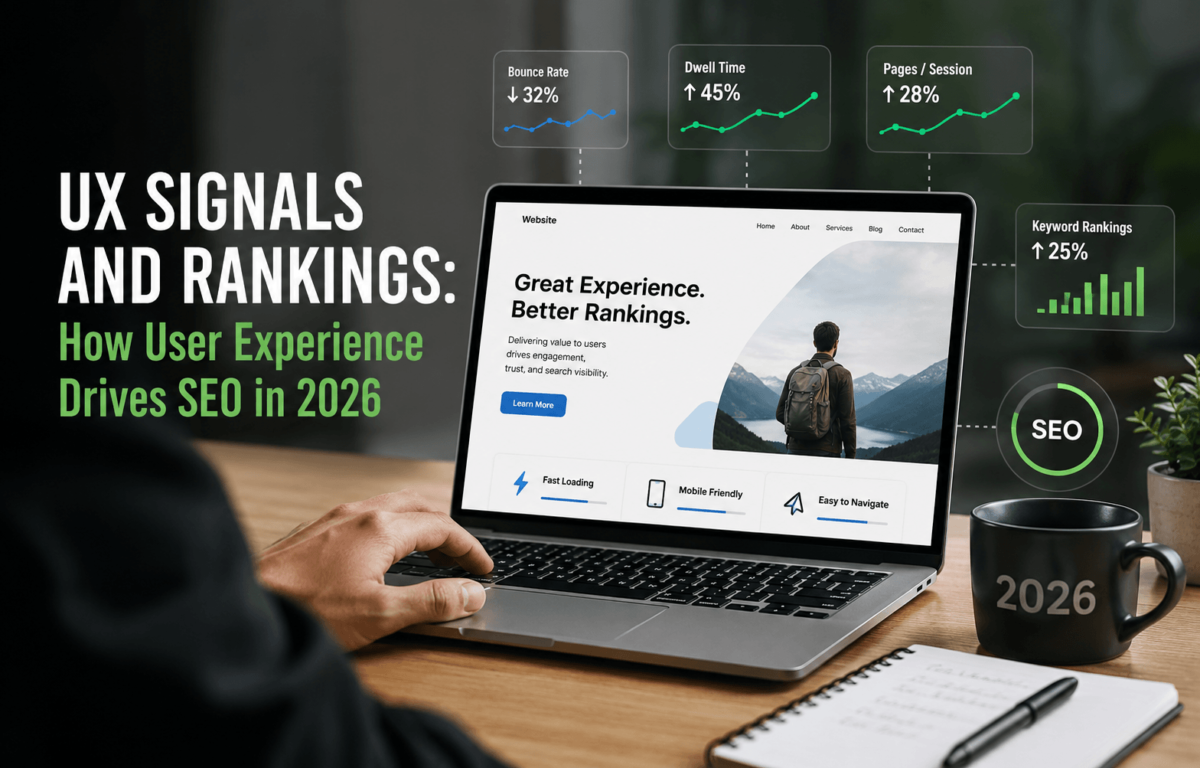
📋 Quick Summary
- UX signals are behavioral and technical indicators that reflect how users engage with a page after arriving from search results.
- Google uses aggregated user behavior patterns—not individual sessions—to assess page quality through machine learning models.
- The most impactful UX signals include dwell time, pogo-sticking, CTR, scroll depth, and Core Web Vitals (LCP, CLS, INP).
- UX signals function as indirect ranking factors: they shape quality scores within AI-driven systems rather than triggering direct ranking boosts.
- A high bounce rate is not inherently negative—context matters. A fast answer on a single-page visit can still signal satisfaction.
- Poor mobile usability and slow page load speed are measurable liabilities that directly suppress rankings in 2026.
- Matching search intent precisely is the single most effective way to improve UX signals organically.
- Regular monitoring via Google Search Console, CrUX data, and heatmapping tools is essential for sustained optimization.
A. What Are UX Signals in SEO?
UX signals are measurable data points that reflect how users interact with a webpage after arriving from a search result. They fall into two broad categories:
- Behavioral signals – Actions users take on your page: how long they stay, how far they scroll, whether they click internal links, or whether they immediately return to search results.
- Technical signals – Performance metrics that shape the perceived experience: page load speed, visual stability, and interactivity responsiveness.
Behavioral data is particularly powerful because it reflects real user intent and satisfaction—not just assumed quality. When users consistently stay on a page, engage with its content, and do not return to search results, it signals that the page answered their query effectively. Conversely, when users quickly exit, it flags a potential mismatch between the page and search intent.
Search engines, particularly Google, have invested heavily in understanding these behavioral patterns at scale. Through systems like RankBrain, Neural Matching, and MUM, Google translates aggregated user behavior into signals of page quality—even if individual sessions are never directly measured.
B. Why UX Signals Matter for Rankings in 2026
The relationship between user experience and search rankings has evolved from correlation to causation—at least in the aggregate. Several converging trends in 2026 make UX signals more consequential than ever.
AI-Driven Ranking Systems
Google’s ranking infrastructure now relies heavily on large language models and machine learning pipelines that interpret quality at a semantic and behavioral level. Systems like RankBrain learn which results satisfy users for a given query type and adjust rankings accordingly over time. Pages with consistently strong UX signals are reinforced; those with poor engagement patterns are gradually demoted. AI-driven UX optimization is increasingly central to staying competitive in this environment.
User Intent Understanding
Modern search engines don’t just match keywords—they model intent satisfaction. A page that technically covers a topic but frustrates users with slow load times, cluttered layouts, or irrelevant content will underperform against a leaner, more targeted competitor. UX signals provide the feedback loop Google needs to identify which pages genuinely satisfy intent.
Indirect vs. Direct Ranking Factors
It’s important to distinguish between direct and indirect ranking factors. Core Web Vitals are a confirmed (though modest) direct signal. Bounce rate and dwell time are indirect—Google doesn’t directly ingest these metrics from your analytics, but they influence user behavior patterns that are measurable through Chrome User Experience Report (CrUX) data, click-through patterns, and search session data.
The practical implication: improving UX signals creates a compounding effect. Better experience leads to longer sessions, lower pogo-sticking, and stronger engagement—all of which feed into Google’s quality assessment over time.
C. Key UX Signals That Influence Rankings
The following signals are the most documented and impactful for SEO purposes in 2026.
| UX Signal | Definition | Ranking Impact |
|---|---|---|
| Dwell Time | Time spent on page before returning to SERP | High positive impact |
| Bounce Rate | % of single-page visits (context-dependent) | Nuanced – depends on query type |
| CTR | % of users who click your result in SERP | Direct signal in search quality |
| Scroll Depth | How far users scroll down the page | Indicates content engagement |
| Pogo-Sticking | Rapid return to SERP after clicking your result | Strong negative signal |
| Core Web Vitals | LCP, CLS, INP technical performance metrics | Confirmed ranking factor |
| Mobile Usability | Ease of use on mobile devices | Critical for mobile-first indexing |
Engagement Metrics
Dwell Time refers to the duration a user spends on your page before returning to the search results page. It is one of the most reliable proxies for content satisfaction. A user who spends four minutes reading your article and then closes the browser (without returning to Google) sends a stronger positive signal than one who bounces back in fifteen seconds.
Example: A 2,500-word guide on mortgage refinancing that earns an average dwell time of 4+ minutes signals to Google that it genuinely addresses user needs—likely outperforming a shorter, shallower competitor over time.
Bounce Rate is the percentage of sessions where a user visits only one page and exits. While often cited as a negative signal, it is highly context-dependent. A user who lands on a recipe page, reads it, and cooks the meal has completed their intent—even if they only visited one page. The metric becomes a red flag when bounce correlates with rapid return to the SERP (pogo-sticking).
Interaction Signals
Click-Through Rate (CTR) is the percentage of search users who click your result versus others shown for the same query. While Google has stated that CTR is complex to use as a direct ranking signal (due to position bias), studies and Google’s own internal research (surfaced through the DOJ antitrust proceedings) confirm that click data influences quality assessments. A significantly above-average CTR for a given position can accelerate ranking gains; a below-average CTR can trigger demotion.
Practical example: Optimizing your title tag and meta description to better match query intent can lift CTR by 20–40%, which compounds into improved ranking position over subsequent weeks.
Scroll Depth measures how far down the page users navigate. Low average scroll depth on a long-form content page suggests the content above the fold is not compelling enough to draw users further—or that the page structure is too dense. Optimizing the first screen of content (the “hook”) is critical for driving scroll engagement.
Experience Metrics
Core Web Vitals are Google’s set of technical performance metrics that directly measure loading, interactivity, and visual stability:
- LCP (Largest Contentful Paint) – Measures loading performance. Target: under 2.5 seconds.
- INP (Interaction to Next Paint) – Replaced FID in 2024. Measures overall responsiveness. Target: under 200ms.
- CLS (Cumulative Layout Shift) – Measures visual stability. Target: under 0.1.
Pages that pass Core Web Vitals thresholds are eligible for a modest ranking boost within the Page Experience signal. More importantly, strong Core Web Vitals reduce friction—making it more likely users stay, scroll, and engage.
Mobile Usability encompasses touch target sizing, viewport configuration, font legibility, and content accessibility on small screens. With Google operating on a mobile-first indexing model, a page that fails mobile usability standards is evaluated at a disadvantage—regardless of its desktop performance.
Content Satisfaction Signals
Pogo-sticking occurs when a user clicks your search result, immediately returns to the SERP, and clicks another result. This is one of the clearest negative UX signals available to Google. It indicates the page failed to satisfy the query—whether due to content mismatch, poor load performance, or confusing layout.
Example: A user searches “how to fix a leaking faucet,” lands on a page that opens with a lengthy brand story instead of a solution, and immediately returns to Google. That pattern, repeated across thousands of users, signals a quality deficit.
Return-to-SERP behavior is closely related but broader. It tracks whether users, after visiting your page, continue searching—suggesting their query went unanswered. Pages that fully satisfy intent result in users abandoning the search session entirely. That “session-ending” pattern is a strong positive signal in Google’s quality models.
D. How Google Interprets UX Signals
A common misconception is that Google reads your Google Analytics data to measure UX signals. This is incorrect. Google does not have access to your GA4 account. Instead, it relies on:
- Chrome User Experience Report (CrUX) – Aggregated, anonymized performance data from real Chrome users, used to power Core Web Vitals scores in Search Console.
- Google Search Console click data – CTR, impressions, and query performance data captured within Google’s own search infrastructure.
- Machine learning models – Systems like RankBrain learn which results correlate with positive user outcomes for specific query types and adjust rankings accordingly.
Crucially, Google evaluates patterns, not individual sessions. A single user with a fast connection who bounces quickly does not penalize your page. It is the aggregate behavior of thousands of users over time that shapes quality assessments. This means short-term fluctuations are normal, but sustained poor UX signals will compress rankings over weeks and months.
E. Common Misconceptions About UX Signals
Misconception 1: UX Signals Are Direct Ranking Factors in Isolation
No single UX metric determines your ranking. Google’s systems evaluate holistic patterns. A high bounce rate combined with short dwell time on a page targeting a complex query is a problem. The same bounce rate on a weather forecast page may be perfectly acceptable. Signals are interpreted in context, weighted against query type, competitive landscape, and content depth.
Misconception 2: A High Bounce Rate Always Hurts Rankings
Bounce rate is meaningless without context. Informational queries (“what is the capital of France?”), tool pages, and contact pages often generate high bounce rates with fully satisfied users. The signal that matters is whether the bounce correlates with rapid return to the SERP and subsequent engagement with a competitor. That pattern—pogo-sticking—is the real problem, not the bounce itself.
Misconception 3: High Time-on-Page Always Indicates Quality
Long page sessions can reflect confusion, slow load times, or walls of unscanned text—not engagement. A user who spends eight minutes on a page because they can’t find the answer they need is not a positive signal. Time-on-page must be interpreted alongside scroll depth, internal link clicks, and conversion behavior to have diagnostic value.
How to Improve UX Signals for Better Rankings
The following eight steps are prioritized by impact and implementation feasibility for most websites in 2026.
Improve Page Load Speed
What: Optimize your Core Web Vitals by compressing images (WebP format), implementing lazy loading, minimizing render-blocking JavaScript, and using a CDN.
Why it matters: LCP and INP directly affect the Page Experience ranking signal. Pages that load in under 2.5 seconds retain significantly more users than those over 4 seconds.
Match Search Intent Precisely
What: Audit the top 5 ranking pages for your target query. Identify the dominant content type (guide, list, tool, definition), format, and angle—then match or exceed it.
Why it matters: Intent mismatch is the leading cause of pogo-sticking. If your page is a lengthy guide but users want a quick definition, no amount of content quality will save your rankings.
Optimize Above-the-Fold Content
What: Ensure the first screen of your page delivers immediate value: the answer, the key takeaway, or a clear hook that earns the scroll.
Why it matters: Scroll depth data consistently shows the largest drop-off in user engagement occurs in the first 20% of the page. If your introduction doesn’t deliver, most users won’t see the rest.
Improve Readability and Content Structure
What: Use short paragraphs (2–4 lines), clear H2/H3 subheadings, bullet points for scannable content, and bold key terms to guide skimmers.
Why it matters: Studies on reading behavior show that 79% of web users scan before they read. Poor formatting forces users to work harder, increasing cognitive load and exit intent.
Use Internal Linking Effectively
What: Link to related, topically relevant pages within your site using descriptive anchor text. Cluster content around pillar topics with clear hierarchical linking.
Why it matters: Internal links increase pages-per-session and reduce single-page exits—positive behavioral signals. They also help Google understand your site’s topical authority structure.
Reduce Intrusive Elements
What: Remove or delay pop-ups, interstitials, and banner ads that appear immediately on page load or obscure primary content on mobile.
Why it matters: Google’s intrusive interstitial penalty (part of the Page Experience signal) targets pop-ups that appear before a user can access content. Beyond penalties, interstitials dramatically increase bounce rates on mobile.
Enhance Mobile Experience
What: Test your site on real mobile devices. Verify touch targets are at least 48×48px, fonts are readable without pinching, and content doesn’t overflow the viewport.
Why it matters: Mobile-first indexing means Google primarily evaluates your mobile version. A page that performs well on desktop but poorly on mobile is evaluated at a disadvantage in all markets.
Use Engaging Visuals and Formatting
What: Incorporate relevant images, diagrams, data tables, and structured formatting (callout boxes, summary tables) that add informational value—not just decoration.
Why it matters: Visual elements increase scroll depth and time-on-page when they clarify content. Custom diagrams and original charts are also strong assets for earning backlinks.
Related Guides on TechCognate
Frequently Asked Questions
Final Thoughts
UX signals represent the clearest signal Google has that a page actually works—not just that it exists. In 2026, the SEO landscape has matured beyond keyword density and link counts into a domain where user-first design is a direct competitive advantage. Sites that prioritize genuine user satisfaction—fast loading, clear intent matching, mobile accessibility, and structured, readable content—are not just optimizing for rankings. They are building the type of digital experience that search engines are explicitly designed to surface.
The most important mindset shift for SEO professionals in this environment is to stop asking “will this rank?” and start asking “will this satisfy the user?” When those two questions converge, rankings follow.
Long-term SEO success in 2026 and beyond belongs to websites that treat UX signal optimization as an ongoing discipline—not a one-time audit. Build systems for monitoring, testing, and iterating on user experience, and your rankings will reflect that commitment.