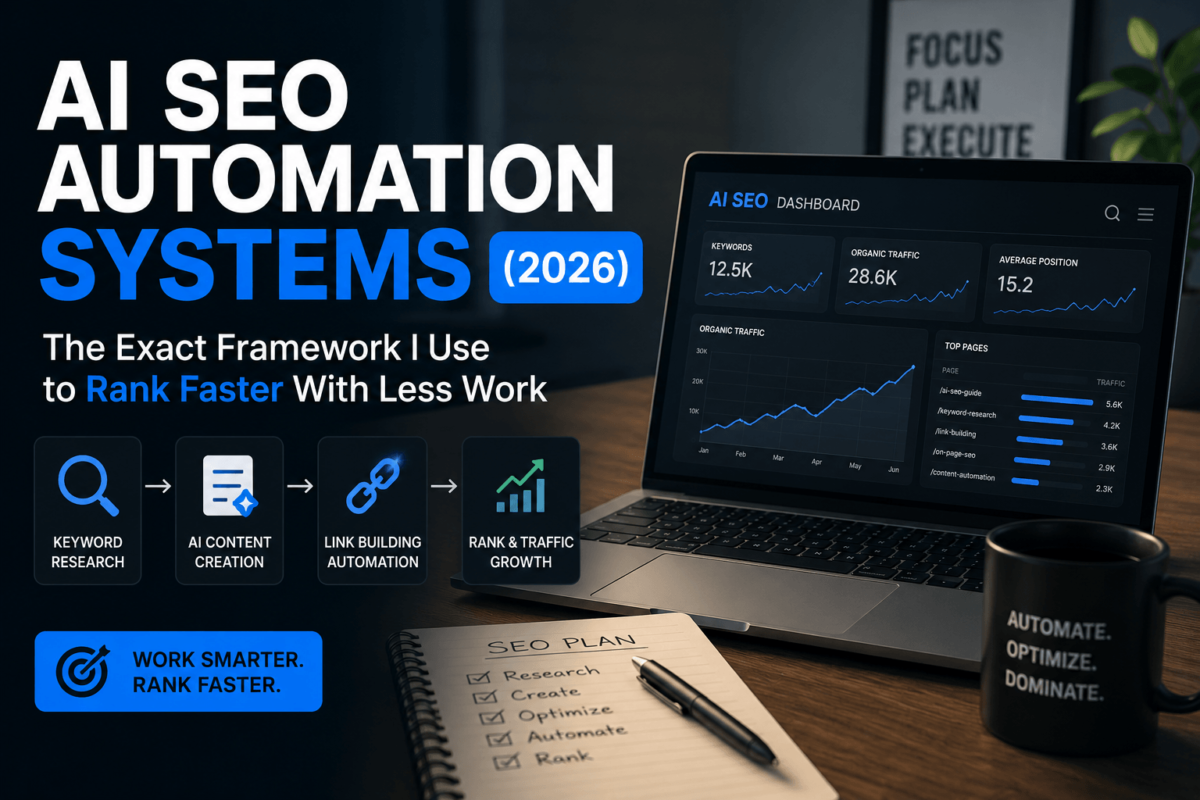
An AI SEO automation system is a connected workflow of AI tools that handles keyword research, content creation, on-page optimization, internal linking, and content updates — without requiring you to do each step manually. In 2026, the marketers and bloggers winning at SEO aren’t just using AI tools in isolation. They’ve built systems where each tool feeds the next, producing a content machine that scales without burning them out.
Quick Summary
- AI SEO automation is about building repeatable systems, not just using individual tools.
- The best setups combine AI for research, drafts, and optimization — with humans for editing and strategy.
- A solo creator using the right stack can realistically publish 20–30 high-quality posts/month.
- Common mistakes include over-automation, skipping human editing, and ignoring search intent.
- In 2026, AI search engines (SGE, Perplexity, ChatGPT) reward structured, entity-rich content.
- Topical authority and content clusters are the long-term SEO moat you should be building right now.
- The right AI SEO stack can cut your content production cost by 60–80% while increasing output 5–10x.
What Is an AI SEO Automation System?
Let’s start with a quick reality check.
Most people hear “AI SEO automation” and think: “Oh, so I just let ChatGPT write all my blog posts and then Google ranks me.” That’s not what this is. That’s a recipe for getting buried.
A real AI SEO automation system is a connected workflow — a series of tools and processes that work together to research, create, optimize, publish, and update content at scale. Think of it like a content assembly line, where each station does one job really well, and the output flows automatically into the next step.
Here’s a simple analogy. Imagine you run a sandwich shop. You could make every sandwich by hand, one at a time. Or, you could set up a system: bread station, meat station, condiments station, wrap and serve. You’re still in the kitchen, but you’re managing the system — not doing everything manually.
That’s exactly what AI SEO automation does for content marketers. You design the system once, feed it inputs (keywords, topics, briefs), and it produces optimized content consistently — with you doing final quality checks, not starting from scratch every time. If you’re not ready to code anything, no-code SEO automation tools make it possible to build a solid system without touching a single line of code.
Why Most People Get AI SEO Wrong
Here’s what I’ve seen happen over and over: someone discovers AI writing tools, gets excited, spins up 50 articles in a weekend, publishes them all, and then… nothing. Traffic doesn’t come. Rankings don’t move. Sometimes the site even gets penalized.
The problem isn’t AI. The problem is the approach.
Mistake #1: Using tools without a system
Jasper, Surfer SEO, Frase, NeuronWriter — these are all great tools. But a tool in isolation is just… a tool. If you’re using them without a defined workflow connecting keyword research to brief creation to draft generation to editing to publishing, you’re just doing manual work faster. Not smarter.
Mistake #2: Publishing without human editing
AI is incredibly good at generating content. It’s not great at understanding your audience, matching your brand voice, adding original opinions, or sensing when something is just… off. Google’s ranking systems in 2026 are getting better at detecting thin, recycled AI content. The sites ranking well aren’t publishing raw AI output. They’re publishing AI-assisted content that a human has refined.
Mistake #3: Ignoring search intent
You can have the most beautifully optimized article in the world, but if it’s answering a question nobody’s asking — or answering the wrong type of query — it won’t rank. AI tools can miss search intent nuances that a real human catches immediately. Always validate intent before you build content around a keyword.
Mistake #4: No topical authority strategy
Publishing random articles across different topics is the old way. In 2026, Google’s systems heavily reward topical authority — meaning you’ve covered a subject deeply and comprehensively. AI makes it easier than ever to build content clusters, but you have to plan it first. More on this in the systems section.
The Core Components of an AI SEO Automation System
Every solid AI SEO system has five core layers. Think of these as the gears that keep the machine running:
1. Keyword Research Automation
This is where it all starts. The goal is to use AI to surface keyword opportunities, cluster them by topic and intent, and prioritize based on competition and traffic potential — without spending days in spreadsheets.
Tools that handle this layer well include Semrush’s AI-powered keyword clustering, Ahrefs’ content gap analysis, and Keyword Insights for bulk clustering. The output should be a structured list of keyword clusters, each representing a content topic with a primary keyword and supporting subtopics.
For a deeper look at how keyword clustering works at scale, Google’s own documentation on how they process topical relevance is a surprisingly good read.
2. Content Brief Generation
Once you have your keyword clusters, the next step is turning each cluster into a detailed content brief. This includes the target keyword, secondary keywords, recommended headers (H2s and H3s), word count targets, questions to answer, and content angle.
Tools like Frase and Surfer SEO can automate most of this by analyzing what’s currently ranking and identifying the gaps. A good brief takes about 5 minutes to generate with the right tool — versus 30–45 minutes manually.
3. AI-Assisted Content Generation
This is the layer everyone knows about, but most people execute poorly. The goal isn’t to let AI write 100% of your content. The goal is to use AI to produce a strong draft — maybe 70–80% of the final article — that a human then edits, personalizes, and polishes.
The workflow that works: feed the brief into your AI writing tool, generate the full draft in sections (intro, H2s, conclusion separately), then review and edit for accuracy, tone, and original insight. Add examples, personal opinions, and data points that AI can’t invent.
4. On-Page SEO Optimization
Once the draft is ready, it needs to be optimized. This means checking keyword density, adding semantic terms, fixing readability, optimizing meta titles and descriptions, and ensuring proper header structure.
Surfer SEO’s Content Editor is excellent for this. You paste your draft in, and it gives you a real-time score based on what’s ranking, along with specific terms to add. NeuronWriter does similar things. The goal is a content score above 70 before you hit publish.
See our guide on AI content optimization for a deeper look at this step.
5. Internal Linking Automation
Internal linking is one of the highest-ROI SEO tasks — and one of the most neglected because it’s tedious to do manually. AI tools can now scan your existing content and automatically suggest or even insert internal links based on anchor text and topical relevance.
Link Whisper (for WordPress) is the most popular tool here. It analyzes your site and suggests internal links as you write or edit. If you’re on a custom CMS, you can build similar logic using AI embeddings to find semantically related content.
6. Publishing and CMS Automation
Why manually copy-paste content into WordPress or your CMS when you can automate it? Tools like Zapier, Make (formerly Integromat), and WordPress’s REST API let you push fully formatted drafts from Google Docs or Notion directly into your CMS — with metadata, categories, featured image alt text, and more. Our full guide on automating content publishing walks through the exact setup step by step.
Our guide on WordPress SEO covers the broader optimization setup in detail.
7. Content Refresh and Updates
Here’s the step 90% of bloggers skip: updating old content. Google loves freshly updated content, especially on competitive keywords. AI can help you identify which posts are losing rankings (using Google Search Console data), generate updated sections, and flag outdated information — so you’re not letting old content decay.
The 7-Step AI SEO Automation Workflow (Start Here)
This is the exact process I recommend for anyone building their first AI SEO system. Follow this in order. For a visual version of this entire flow, see our dedicated AI SEO workflow guide with diagrams and tool-by-tool breakdowns.
- Step 1: Keyword Discovery Find keyword opportunities using Semrush or Ahrefs. Export your target keywords into a spreadsheet.
- Step 2: Cluster Your Keywords Cluster your keywords by topic using a tool like Keyword Insights or Cluster AI. Group related terms together — this is your content roadmap.
- Step 3: Generate Content Briefs Generate content briefs for each cluster using Frase or Surfer SEO. Each brief should include target keyword, supporting terms, H2 structure, and content length.
- Step 4: AI Draft Generation Use an AI writing tool (Claude, ChatGPT-4o, or Jasper) to generate your first draft based on the brief. Write in sections, not all at once.
- Step 5: Human Edit Human-edit the draft. Add personal opinions, examples, data points, and brand voice. Remove anything that sounds generic or off.
- Step 6: On-Page Optimization Optimize with Surfer SEO or NeuronWriter. Hit a content score of 70+ before publishing.
- Step 7: Publish + Schedule Refresh Publish via your CMS automation workflow. Set a content refresh reminder for 6 months out. Review performance in Google Search Console monthly.
Real-Life AI SEO Automation Examples
Theory is great. Let’s talk about what this actually looks like in practice.
Example 1: The One-Person Affiliate Blog
A solo affiliate marketer in the personal finance space was manually writing 4 posts per month. After building an AI SEO system — using Ahrefs for research, Frase for briefs, Claude for drafts, and Surfer SEO for optimization — they scaled to 22 posts per month. One person. No additional hires.
Their process: Monday morning, they’d generate 10 content briefs. Tuesday through Thursday, they’d run AI drafts for 5 articles each day, then spend 30 minutes editing each one. Friday: batch publish, internal link review, and performance check. Total active time per article: about 45 minutes. Output: 5x more content, 40% lower cost per article.
Example 2: The Local SEO System for a Service Business
A local home services company wanted to dominate local search across 12 service areas. Manually, this would have meant creating 60–80 location-specific pages — weeks of work. Using an AI system, they created a template-driven workflow: AI generated location-specific content variations, a human reviewed and localized each one, and Zapier pushed them to WordPress automatically.
Result: 74 location pages published in three weeks. Organic local traffic increased 340% over six months. Read more about local SEO strategies that work in 2026.
Example 3: The SaaS Content Engine
A bootstrapped SaaS founder with zero SEO budget used AI automation to build a content moat. They identified 200+ bottom-of-funnel keywords (comparison pages, alternative pages, use-case pages) using Ahrefs. AI generated first drafts. The founder edited each post for 20–30 minutes, adding product-specific context. In 12 months: 180 articles published, 3 ranking on page one for high-intent commercial keywords.
3 Real AI SEO Automation Stacks (By Use Case)
Stack 1: The Solo Blogger / Affiliate Site
- Keyword research: Ahrefs or Semrush
- Clustering: Keyword Insights
- Brief generation: Frase
- AI writing: Claude or ChatGPT-4o
- Optimization: Surfer SEO
- Internal linking: Link Whisper
- CMS publishing: WordPress + Zapier
- Tracking: Google Search Console + Ahrefs Rank Tracker
Stack 2: The Local Business SEO System
- Keyword research: Semrush Local
- Content templates: Custom Google Docs templates
- AI writing: ChatGPT-4o or Claude
- Optimization: NeuronWriter
- Automation: Make (Integromat) + WordPress API
- Tracking: Google Business Profile Insights + Search Console
Stack 3: The SaaS / Brand Content Engine
- Keyword research: Ahrefs (Content Explorer for topic discovery)
- Brief generation: Surfer SEO + custom templates
- AI writing: Claude (for long-form, nuanced content)
- Optimization: Surfer SEO Content Editor
- Publishing: Contentful or Webflow CMS via API
- Analytics: Google Analytics 4 + Ahrefs
- Content refresh: Search Console data + AI gap analysis
For teams ready to go further, our guide on how to combine APIs for SEO automation shows how to connect these tools programmatically for a fully custom pipeline.
Best AI SEO Tools in 2026 (Honest Breakdown)
I’m not going to list every tool that exists. Here are the ones that actually move the needle — along with what they’re best at and where they fall short.
Surfer SEO
Frase
Ahrefs
Claude (by Anthropic)
Link Whisper
Semrush
For a wider overview of options, check our guide to the best AI SEO tools in 2026.
AI SEO Automation vs. Traditional SEO: Side-by-Side
Here’s how the two approaches stack up in 2026:
| Feature | AI SEO Automation | Traditional SEO |
|---|---|---|
| Content Speed | 10–30 posts/month (1 person) | 2–5 posts/month (1 person) |
| Cost per Article | $5–$20 (AI-assisted) | $50–$300 (freelancer) |
| Scalability | High — scales without headcount | Low — needs more staff |
| Quality Control | Requires human editing layer | Naturally human |
| Learning Curve | Medium (tool setup) | Low (familiar process) |
| Keyword Research | Automated + AI clustering | Manual + spreadsheet work |
| Internal Linking | Automatable via tools | Mostly manual |
| Content Updates | Scheduled AI refresh | Ad hoc / forgotten |
| ROI Timeline | Faster at scale | Slower but predictable |
Bottom line: AI SEO automation wins on speed, volume, and cost. Traditional SEO wins on raw quality control. The smartest approach combines both — AI for scale, humans for quality.
The ROI of AI SEO Automation: Before vs. After
Let’s talk numbers, because this is where it gets interesting.
Before AI Automation (Typical Solo Blogger)
- Content output: 3–5 posts per month
- Time per post: 6–8 hours
- Cost per post (outsourced): $150–$300
- Monthly content spend: $450–$1,500
After AI Automation (Same Solo Blogger)
- Content output: 20–30 posts per month
- Time per post: 45–90 minutes
- Cost per post: $15–$30
- Monthly content spend: $300–$600
The compounding effect matters too. More content means more keyword coverage. More keyword coverage means more organic traffic. More traffic means more affiliate revenue, leads, or product sales. The ROI isn’t just in the time saved today — it’s in the organic growth that content volume creates over 12–24 months. To track all of this in one place, check out our guide to AI SEO dashboards that give you a real-time view of your entire content system’s performance.
Mistakes to Avoid in AI SEO Automation
This section is here because most “AI SEO” content glosses over what can go wrong. Here’s the honest list:
Over-automation = spammy content
The fastest way to tank your site is to fully automate content production with no human review layer. I’ve seen sites get manual actions from Google for publishing hundreds of AI-generated pages with no editing. The content looked fine on the surface but lacked depth, original perspective, and accuracy. Always build a human review checkpoint into your workflow.
Chasing content score over content quality
Surfer SEO scores are useful. They’re not gospel. I’ve seen articles score 85+ that were borderline unreadable because the writer crammed in keywords to hit the number. Write for humans first, optimize second.
Skipping the intent check
Before you generate content for a keyword, open a private browser, search that keyword, and look at the top 10 results. What format are they? Blog posts? Videos? Product pages? Listicles? Match the dominant format or you’re fighting an uphill battle. Our guide on SEO and user experience explains why format alignment matters so much.
No content update process
AI makes it easy to publish. Most people never update. A post that ranked in position 3 for a competitive term will drift to position 12 if you ignore it for 18 months. Set calendar reminders every 6 months to review and refresh your top performers.
Building content without topical authority
Publishing one article on 20 different topics is worse than publishing 20 articles on one topic. Topical authority — meaning your site covers a subject deeply — is one of the strongest ranking signals in 2026. Use your AI system to build content clusters, not random posts.
The Future of AI SEO: What’s Changing in 2026 and Beyond
SEO is not dying. It’s evolving faster than ever. Here’s what you need to be preparing for right now:
AI Search Engines Are Changing How Content Gets Discovered
Google’s AI Overviews (formerly SGE), Perplexity, and ChatGPT are increasingly becoming primary discovery channels. These AI systems pull structured, factual, well-organized content to generate answers. If your content is cited by these systems, you get brand visibility even without a click.
To get cited: write with clear definitions, direct answers early in the piece, structured headings, and factual specificity. Vague, fluffy content doesn’t get cited. Precise, authoritative content does. Our guide on how to rank in AI search engines goes deeper on this.
Entity SEO Is Becoming Critical
Google is shifting from keyword-based understanding to entity-based understanding. This means it’s thinking about people, places, concepts, and brands — not just strings of text. Building entity authority for your site means being consistently associated with specific topics, people, and concepts across your content, your internal linking, and your schema markup.
AI tools can help you identify entity gaps in your content and ensure you’re covering related concepts that build topical relevance. See our primer on schema markup for AI search for the technical side of this.
Topical Authority Over Keyword Stuffing
The era of “write one article per keyword” is over. The sites dominating search results in 2026 have comprehensive content hubs — pillar pages supported by dozens of satellite articles covering every subtopic. AI makes building these hubs dramatically faster. The strategy: identify your core topic, map every related subtopic, build content for each one, and link them together logically.
Zero-Click Search and Brand Visibility
More searches are ending without a click as AI Overviews provide direct answers. This means traffic metrics alone are becoming less meaningful. Brand mentions, citation frequency in AI answers, and engagement metrics are becoming more important signals. Optimize for being referenced and trusted, not just ranked.
Learn more about LLM SEO and how to get your content cited by AI systems.
E-E-A-T and AI Content: How to Stay on Google’s Good Side
Google’s quality guidelines center on Experience, Expertise, Authoritativeness, and Trustworthiness — known as E-E-A-T. AI-generated content, by itself, scores low on all four. Here’s how to fix that:
Add Experience
Include personal examples, case studies from your own work, and specific details that only someone who’s actually done the thing would know. “One of my clients went from 10 to 120 posts/month using this exact workflow” carries far more trust weight than a generic explanation.
Demonstrate Expertise
Cite credible sources. Link to original research, government data, and authoritative publications. Include technical depth that goes beyond surface-level explanations. Add author bios with credentials and experience.
Build Authoritativeness
Authoritativeness comes from external validation — backlinks, mentions, citations. Your AI SEO system should include a link-building or digital PR component. Guest posts, original data studies, and quotable frameworks help other sites reference your content. Our link building strategies guide covers this in full.
Establish Trust
Trust signals include clear authorship, accurate factual claims, regular content updates, transparent affiliate disclosures, and fast-loading, secure websites. These aren’t optional extras — they’re baseline requirements for ranking well on competitive terms.
Google’s Search Quality Evaluator Guidelines (the full document) is publicly available and gives you direct insight into how human raters evaluate content quality.
How to Monetize Your AI SEO System With Affiliate Marketing
If you’re building an AI SEO system for an affiliate site, here’s the framework I’d use to integrate monetization naturally:
Bottom-of-Funnel Content First
The highest-converting affiliate content targets people who are close to a buying decision. Think: “best [product category]”, “[Tool A] vs [Tool B]”, “[Tool] alternatives”, “[Tool] review 2026”. These keywords convert at 3–8x the rate of informational keywords. Use your AI system to build this content first.
Insert Affiliate Links Contextually
Don’t drop affiliate links in random places. Insert them at the moment of highest relevance — right after you’ve explained a problem that the tool solves. Use language like: “This is exactly what [Tool] was built for — and if you’re serious about scaling, it’s worth trying.” That framing converts without feeling pushy.
Build Comparison Content at Scale
Comparison pages (“X vs Y”, “X alternatives”, “best X for Y”) are affiliate gold. They capture high-intent buyers who are in the final decision stage. AI makes it fast to generate well-structured comparison content. Your job is to add honest opinions and real-use-case context.
Track What’s Converting
Use UTM parameters or your affiliate platform’s tracking to identify which articles are driving the most conversions — not just traffic. Then use that data to inform what content to build next. More affiliate content in the categories that convert. Prune or update content that gets traffic but doesn’t convert.
Related: The SEO KPIs that actually matter and how to set up SEO reporting to track this properly.
Frequently Asked Questions
Is AI SEO safe in 2026?
Yes — with caveats. AI-assisted content that’s been properly edited, optimized for search intent, and written with genuine expertise is not only safe, it’s competitive. What Google penalizes is thin, low-effort, mass-produced content with no human value added. The rule of thumb: if a human wouldn’t find your content genuinely useful, don’t publish it.
Can AI replace SEO experts?
No — and the SEO experts saying it can are either being hyperbolic or trying to sell you something. AI is exceptional at research, drafting, and optimization at scale. It’s poor at strategy, original insight, relationship building (link building), and adapting to algorithm changes in real time. Human SEO experts who know how to use AI are more valuable than ever.
What’s the best AI SEO tool in 2026?
There’s no single “best” tool — it depends on what layer of the system you’re building. For content optimization, Surfer SEO is hard to beat. For keyword research, Ahrefs remains the gold standard. For content drafting, Claude handles nuanced long-form content exceptionally well. Build a stack, not a single-tool solution.
How much of my SEO workflow can I actually automate?
Realistically, 60–75% of the mechanical work can be automated: keyword research, brief generation, first drafts, on-page optimization scoring, internal link suggestions, and CMS publishing. What can’t be fully automated: strategy, editorial judgment, original research, link building outreach, and brand storytelling. Keep humans in those lanes.
Does Google penalize AI content?
Google has been clear: they don’t penalize AI content per se — they penalize low-quality content, regardless of how it was produced. The March 2024 core update specifically targeted “unhelpful, unoriginal content” — much of which was AI-generated at scale with no editing. Write content that’s genuinely helpful, well-researched, and human-edited, and you’ll be fine.
How long before AI SEO content starts ranking?
For new sites: typically 3–6 months before meaningful rankings appear, regardless of AI or manual writing. For established sites with domain authority: AI-assisted content can rank in 2–8 weeks on low-to-medium competition keywords. The timeline depends more on your domain’s authority and the competition level than on whether the content was AI-assisted.
Do I need technical skills to set up an AI SEO system?
Not necessarily. Most of the tools mentioned — Surfer SEO, Frase, Link Whisper — are built for non-technical users. The more advanced automation (CMS API integrations, Zapier workflows) requires some setup time but no coding. If you want to build truly custom pipelines, basic familiarity with Zapier or Make is enough to get started.
Final Thoughts: Build the System, Not Just the Content
Here’s the thing nobody tells you about AI SEO automation: the competitive advantage isn’t in having the best AI tool. It’s in having the best system.
Anyone can sign up for Surfer SEO or ChatGPT. Not everyone takes the time to connect those tools into a repeatable workflow, build topical authority intentionally, maintain quality control, and consistently improve based on what the data shows.
That’s the work. And it’s worth doing.
The marketers who build solid AI SEO systems in 2026 are going to look back in two years at traffic numbers that would have seemed impossible to achieve manually. But it starts with the first step: picking your tools, defining your workflow, and publishing your first batch of AI-assisted content.
Start small. Get the process right. Then scale.
Ready to go deeper? Explore our advanced SEO strategies guide and our full AI SEO guide for more frameworks you can apply immediately.