AccuRanker vs Ahrefs: Which SEO Tool Is Better in 2026?
A complete, experience-driven comparison covering rank tracking accuracy, pricing, backlinks, reporting, AI features, and real-world agency workflows
Disclosure: This post contains affiliate links. If you sign up for AccuRanker or Ahrefs through a link on this page, TechCognate may earn a commission at no extra cost to you. This doesn’t affect the opinions or comparisons above.
If you’ve narrowed your SEO tool shortlist down to AccuRanker and Ahrefs, you’re already looking at two of the most respected platforms in the industry. But here’s the thing: they’re not really competing for the same job.
One is a specialist. The other is trying to be your entire SEO department in a browser tab.
AccuRanker lives and breathes rank tracking. That’s it. That’s the whole pitch, and it does that one thing about as well as it can be done.
Ahrefs, on the other hand, wants to be the last SEO tool you ever buy — keyword research, backlinks, site audits, content research, and rank tracking, all bundled into one subscription.
So which one actually deserves your budget?
After working with both platforms across agencies, ecommerce brands, local service businesses, and enterprise sites with tens of thousands of tracked keywords, the honest answer isn’t “pick the one with more features.” It’s closer to “pick the one that matches the job you’re actually doing day to day” — and for a lot of agencies, that ends up being both, used for different things.
This guide breaks down everything: pricing, accuracy, backlinks, reporting, AI features, agency workflows, and which tool wins for specific business types. No fence-sitting, no vague “it depends” non-answers — just a clear breakdown so you can make the call with confidence.
Choose AccuRanker if your priority is highly accurate, fast-refreshing keyword rank tracking with clean, client-ready reporting — especially if you manage SEO for multiple clients or brands.
Choose Ahrefs if you need one platform that handles keyword research, backlink analysis, site audits, content research, and rank tracking together.
For agencies running serious client SEO programs, the strongest setup is often both: Ahrefs for research and link building, AccuRanker for the daily rank-tracking and reporting layer.
AccuRanker vs Ahrefs at a Glance
Before diving into the deep-dive sections, here’s the full side-by-side breakdown. Bookmark this table — it’s the fastest way to settle the debate with a teammate or client who wants the short version.
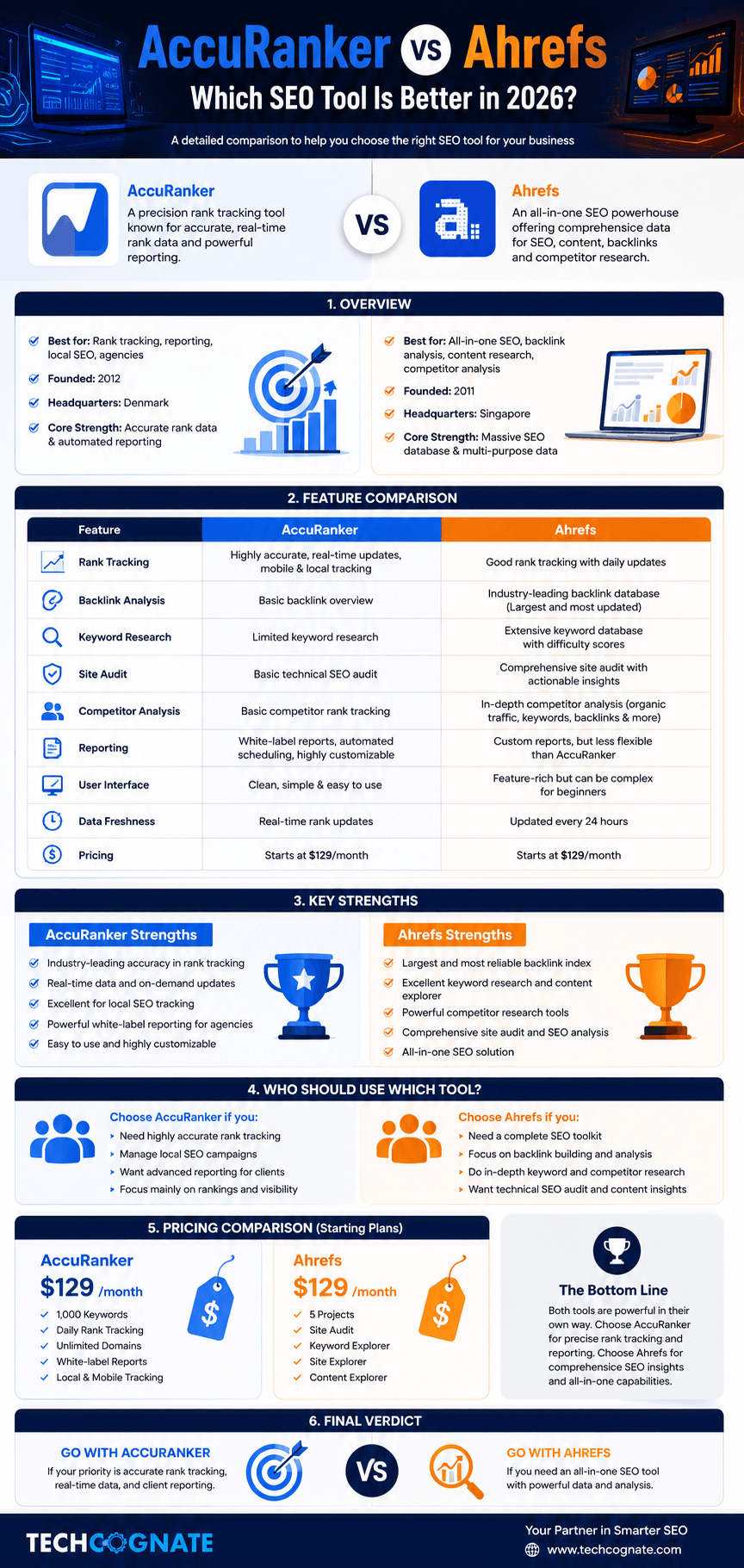
| Category | AccuRanker | Ahrefs |
|---|---|---|
| Core Purpose | Dedicated rank tracking and SERP monitoring | All-in-one SEO suite (keywords, links, audits, content, tracking) |
| Best For | Agencies, enterprises, anyone needing fast/accurate daily rank data | Teams needing one platform for full SEO research and strategy |
| Starting Price | $224/mo (2,000 keywords, Professional) | $29/mo (Starter, no rank tracking) or $129/mo (Lite, with tracking) |
| Keyword Research | Basic; built for tracking, not discovery | Strong; Keywords Explorer with volume, difficulty, intent, SERP data |
| Rank Tracking | Industry-leading; daily + on-demand refresh | Solid; scheduled updates, included in every paid tier |
| Backlink Analysis | Minimal; not a focus area | Excellent; one of the largest live backlink indexes in SEO |
| Site Audit | Not offered | Included from Lite plan upward |
| Content Explorer | Not offered | Included from Standard plan upward |
| AI Features | AccuLLM (AI/LLM visibility tracking), AI CTR, AI Search Volume | Brand Radar (AI visibility, paid add-on), AI keyword clustering |
| Competitor Analysis | Tag-based competitor tracking at keyword level | Deep competitor gap analysis across content and backlinks |
| Reporting | Best-in-class; built for client-facing exports | Strong but spread across multiple modules |
| API Access | Included on Expert/Enterprise tiers, unlimited read | Enterprise-only, or a separate paid API subscription |
| Ease of Use | Simple, single-purpose interface | More learning curve due to feature depth |
| Learning Curve | Low to moderate | Moderate to high |
| Enterprise Features | BigQuery export, raw SERP HTML, dedicated CSM | SSO, audit logs, unlimited seats, custom contracts |
| Integrations | GSC, GA, Looker Studio/Data Studio, BigQuery, API | GSC, GA, Looker Studio (Advanced+), Zapier, API |
| Customer Support | Responsive; phone-based cancellation process | Standard ticket-based support; live chat on higher tiers |
| Rank Data Accuracy | Frequently cited as the most accurate on the market | Reliable but not built primarily for accuracy benchmarking |
| Speed | Near-instant refresh on demand | Scheduled crawl cycles, not real-time |
| Database Size | Keyword-tracking focused, not a discovery database | Massive — tens of trillions of indexed backlinks, billions of pages |
| Free Trial | No free trial; 14-day evaluations available via sales | No traditional free trial; low-cost Starter plan instead |
| Overall Winner | Best dedicated rank tracker | Best all-in-one SEO platform |
A quick note on accuracy before moving on: AccuRanker’s reputation for precision comes largely from its on-demand refresh model and the fact that rank tracking is its only job. Ahrefs’ rank tracker is genuinely solid, but it’s one of five major tools competing for engineering attention inside the platform, which is reflected in how it’s built and how often it updates.
What Is AccuRanker?
AccuRanker is a Denmark-based, dedicated rank tracking platform built for SEO professionals who need precise, fast-refreshing data on where their pages sit in the search results. It was founded with a single, narrow mission: track keyword rankings better and faster than anyone else, and don’t get distracted building ten other tools along the way.
That focus shows up everywhere in the product. There’s no keyword research database to get lost in, no backlink explorer competing for screen space — just rankings, trends, tags, filters, and reporting, built around the workflow of someone who checks rankings constantly and needs to hand that data off to a client or stakeholder without extra formatting work.
History
AccuRanker has been operating since 2013 out of Aarhus, Denmark, and has built its reputation almost entirely on word-of-mouth among agencies who got tired of waiting on slow, inaccurate rank updates from broader SEO suites. It’s not trying to be the next Semrush or Ahrefs — it’s stayed narrow by design, expanding more recently into AI/LLM visibility tracking through a product called AccuLLM rather than chasing backlink or content features.
Core Features
- Daily rank tracking with on-demand refresh — pull fresh SERP data in roughly two seconds without waiting for the next scheduled crawl
- Multi-search-engine tracking, including Google, Bing, YouTube, Yandex, and Baidu
- Granular location tracking down to the city level, useful for local and multi-location SEO
- Desktop and mobile rank tracking tracked separately
- Advanced tagging and filtering for managing thousands of keywords across multiple clients or product lines
- Share of Voice metrics to show visibility trends at a glance
- White-label, client-ready reporting and PDF/Looker Studio export
- AccuLLM, which tracks brand visibility and sentiment across AI tools like ChatGPT, Perplexity, and Google’s AI Overviews
- API access with BigQuery export on higher tiers, useful for piping rank data into a data warehouse
Pros
- Among the fastest and most accurate rank trackers available — on-demand refresh genuinely changes how you work
- Reporting is built for client-facing use out of the box, with minimal extra formatting needed
- Tracks more search engines than most competitors, including Bing, YouTube, Yandex, and Baidu
- Unlimited users and domains on every plan, so agency teams don’t pay per seat
- Can import historical ranking data when migrating from another tracker, which most competitors can’t do
Cons
- No keyword research, backlink analysis, or site audit tools — it does one job only
- Pricing runs noticeably higher per keyword than budget-focused trackers like SE Ranking or Nightwatch
- No self-service downgrade option in the dashboard; plan changes typically require contacting support
- No permission controls for client access, meaning an invited client could technically see other clients’ data inside the same account
- No free trial in the traditional sense — evaluation access happens through a sales conversation
Who Should Use AccuRanker
Agencies running client SEO programs where rank reporting happens weekly or monthly, enterprise in-house teams tracking thousands of keywords across multiple markets, and any team where rank data accuracy directly affects client trust or internal decision-making. If “the data updated overnight” isn’t fast enough for how you work, this is built for you.
Who Should Avoid AccuRanker
Solo bloggers, small local businesses tracking a handful of keywords, or anyone who needs keyword research and backlink data and doesn’t already have another SEO tool to cover those bases. At $224/month minimum, it’s a hard sell if rank tracking is the only feature you’d use.
Unique Strengths
Two things set AccuRanker apart from nearly every competitor, including Ahrefs: true on-demand refresh (most tools, including Ahrefs, run on fixed crawl schedules) and the ability to track search engines beyond Google — Bing, YouTube, Yandex, and Baidu — which matters for brands operating in markets where Google isn’t the dominant search engine.
What Is Ahrefs?
Ahrefs is a Singapore-based, all-in-one SEO platform that’s become one of the default tools in the industry for backlink analysis, keyword research, and competitive research. Where AccuRanker does one thing extremely well, Ahrefs spreads its engineering across five major tools: Site Explorer, Keywords Explorer, Site Audit, Rank Tracker, and Content Explorer, plus newer additions like Brand Radar for AI search visibility.
If you’ve ever heard an SEO say “I just checked Ahrefs,” they could mean almost anything — backlink data, keyword volume, a technical crawl, or a competitor’s top content. That breadth is the entire value proposition. TechCognate’s own in-depth Ahrefs review covers the platform in more detail if you want the full walkthrough.
History
Ahrefs launched in 2010, building its name initially around backlink analysis before expanding into a full SEO suite over the following decade. It’s maintained one of the largest live backlink indexes in the industry, and that database remains the foundation most SEOs associate with the brand, even as the rest of the platform has grown around it.
Core Features
- Site Explorer — backlink profiles, referring domains, anchor text distribution, and competitor link gap analysis
- Keywords Explorer — search volume, keyword difficulty, click metrics, parent topics, and question-based keyword ideas
- Site Audit — technical SEO crawler that flags indexing issues, broken links, performance problems, and on-page errors
- Rank Tracker — keyword position tracking across 190+ countries, desktop and mobile, with visibility into 19+ SERP features including AI Overviews
- Content Explorer — a billion-page content database for finding top-performing content and link-building prospects (Standard plan and up)
- Brand Radar — AI visibility tracking across tools like ChatGPT and Perplexity, available as a paid add-on
- Web Analytics and AI-assisted keyword clustering, rolled out as part of ongoing platform expansion
Pros
- One subscription replaces what would otherwise be four or five separate tools
- Backlink database depth and accuracy are consistently rated among the best in the industry
- Keywords Explorer is genuinely strong for early-stage research, not just rank monitoring
- Site Audit is solid enough that many teams skip buying a separate technical SEO crawler
- Active product development, including AI visibility tools, keeps the platform from feeling stagnant
Cons
- Rank tracking updates on a scheduled basis rather than on-demand, which can feel slow if you’re used to instant refresh
- Credit-based usage limits on Lite and Starter plans can run out faster than expected during a heavy research session
- No traditional free trial, and the entry-level Starter plan doesn’t include rank tracking at all
- API access requires the Enterprise plan or a separate paid subscription, which adds friction for teams that want to pipe data elsewhere
- Tracks Google only for rank tracking, unlike AccuRanker’s multi-search-engine support
Who Should Use Ahrefs
Teams and freelancers who need one platform to cover keyword research, backlink audits, technical SEO, and content strategy without juggling multiple subscriptions. It’s especially strong for link-building workflows and competitor research, where the depth of the backlink index does most of the heavy lifting.
Who Should Avoid Ahrefs
Agencies whose primary need is fast, frequent, client-ready rank reporting across many accounts — Ahrefs’ rank tracker is a feature inside a bigger suite, not the main event, and it shows in the refresh cadence and reporting flexibility.
Unique Strengths
Ahrefs’ backlink index and Content Explorer database are the standout differentiators. No rank tracker, including AccuRanker, attempts to replicate that research depth, which is exactly why so many teams end up running both tools side by side rather than picking one.
AccuRanker vs Ahrefs: Feature-by-Feature Comparison
This is the part most comparison articles rush through. We’re not going to do that. Each feature area below gets its own breakdown, because “Ahrefs is better overall” or “AccuRanker is better overall” genuinely depends on which line item matters most for your work.
Keyword Research
Ahrefs wins keyword research decisively. Its Keywords Explorer pulls search volume, keyword difficulty, click-through metrics, parent topics, and question-based variations from a database covering multiple search engines, not just Google. AccuRanker doesn’t really compete here — it’s not built to discover new keyword opportunities, only to track positions for keywords you’ve already chosen. If keyword discovery — including long-tail keyword opportunities — is part of your workflow, you’ll need Ahrefs or a dedicated research tool regardless of which rank tracker you pick.
Winner: AhrefsRank Tracking
This is AccuRanker’s entire reason for existing, and it shows. Both tools track keyword positions across countries and devices, but the experience of using them day-to-day is genuinely different.
Accuracy
AccuRanker is widely cited across independent reviews and agency case studies as one of the most accurate rank trackers on the market, with user-reported matches to manual Google searches landing in the 98–99% range. Ahrefs’ rank tracker is reliable and broadly trusted, but it isn’t built or marketed around accuracy benchmarking the way AccuRanker’s is — it’s one module among five.
Refresh Speed
This is the single biggest functional difference between the two tools. AccuRanker offers true on-demand refresh — you can pull updated SERP positions in roughly two seconds whenever you want, which matters enormously right after you publish a page or roll out a technical fix. Ahrefs updates rankings on a scheduled cadence tied to your plan tier; there’s no equivalent instant-refresh button.
Keyword Updates
AccuRanker defaults to daily updates across all plans, with on-demand refresh layered on top whenever you need it sooner. Ahrefs’ update frequency depends on your subscription tier, and historically its scheduled updates have run less frequently than AccuRanker’s daily baseline.
Local Rankings
AccuRanker supports rank tracking down to the city level and is frequently recommended for local SEO work because of how granular its location targeting gets. Ahrefs supports country and city-level targeting too, but the depth of hyper-local targeting tends to favor AccuRanker in independent comparisons.
Mobile Rankings
Both platforms track desktop and mobile rankings separately, which is non-negotiable in 2026 given how much positions can shift between device types. Neither tool has a meaningful edge here — both handle this correctly.
SERP Features
Ahrefs tracks visibility across 19+ SERP features, including AI Overviews, directly inside Rank Tracker and Keywords Explorer — a genuinely useful detail for understanding why a keyword’s click-through behavior is changing. AccuRanker tracks SERP features too and has added partial AI Overview coverage, though several independent reviews note that coverage is bolted-on rather than a dedicated AI-search-tracking specialty (that’s what AccuLLM is for).
Historical Data
AccuRanker retains ranking history and, notably, can import historical data from other trackers when you switch platforms — a feature most competitors, including Ahrefs, don’t offer. Ahrefs’ historical data depth depends on plan tier, with full multi-year history reserved for Advanced and Enterprise.
Winner: AccuRanker — by a clear margin for anyone who treats rank tracking as a core, frequent workflow rather than an occasional check-in.Backlink Analysis
Ahrefs built its entire reputation on this category and it remains the strongest part of the platform. Its live backlink index spans tens of trillions of links, with tools to explore referring domains, anchor text distribution, and competitor link gaps in detail. AccuRanker offers little to nothing here — it’s simply not part of the product’s scope. For teams building their own outreach process, TechCognate’s guide to the best link-building tools covers where Ahrefs fits alongside other options.
Winner: AhrefsTechnical SEO
Ahrefs’ Site Audit crawls your site for indexing issues, broken links, performance problems, and on-page errors, and it’s robust enough that many teams don’t buy a separate crawler. AccuRanker has no technical SEO crawling functionality at all. If you’re building your own process regardless of which rank tracker you pick, our technical SEO checklist is a useful companion.
Winner: AhrefsSite Audit
Same story as above. Site Audit is included starting at Ahrefs’ Lite plan, with crawl credit allowances scaling up through Standard, Advanced, and Enterprise. AccuRanker simply doesn’t offer this category of tool, so there’s no real comparison to make. See our SEO audit report framework if you want a repeatable process for turning crawl data into fixes.
Winner: AhrefsCompetitor Research
Ahrefs lets you analyze competitor backlink profiles, top-performing content, and keyword gaps in detail, which is core to its link-building and content-strategy use cases. AccuRanker offers competitor tracking too, but at the keyword level — showing how competitors rank for the same tracked terms, with group, URL, and product-level breakdowns, rather than a full research-style competitive audit.
These solve different problems: Ahrefs tells you why a competitor outranks you; AccuRanker tells you that they currently do, in real time, across your full tracked keyword set. For a deeper framework on this, see our SEO competitor analysis guide.
Winner: Ahrefs for research depth; AccuRanker for ongoing competitive rank monitoring.Content Research
Ahrefs’ Content Explorer (available from the Standard plan) searches a billion-page content database to surface top-performing content and link-building prospects by topic. AccuRanker has no equivalent feature — content discovery isn’t part of its scope.
Winner: AhrefsKeyword Database
Ahrefs maintains a large, multi-search-engine keyword database built for discovery and research. AccuRanker isn’t built around a discovery database at all — its strength is tracking keywords you’ve already selected with speed and precision, not surfacing new ones.
Winner: AhrefsEase of Use
AccuRanker’s interface is simple almost by necessity — with one core job to do, there’s less to navigate. New users tend to find their way around within a day. Ahrefs has considerably more depth, which means a steeper ramp-up, especially for anyone touching Site Explorer, Keywords Explorer, and Content Explorer for the first time in the same week.
Winner: AccuRankerReporting
AccuRanker’s reporting is purpose-built for client delivery: white-label exports, PDF generation, and direct Looker Studio (formerly Google Data Studio) integration come standard. Ahrefs offers solid reporting and export options too, but because its data lives across five separate modules, building a single unified client report often means pulling from multiple tools and stitching the result together yourself — or paying for Looker Studio integration, which requires the Advanced plan or higher. See our notes on building client SEO reports for more on structuring this workflow.
Winner: AccuRankerWhite Label
AccuRanker leans heavily into white-label, agency-friendly reporting as a core selling point. Ahrefs supports branded reporting on higher tiers but it’s not positioned as a primary differentiator the way it is for AccuRanker.
Winner: AccuRankerAgency Workflow
For agencies managing many client accounts, AccuRanker’s unlimited users and domains on every plan, combined with tagging by client, location, or landing page, makes multi-account management considerably smoother. One real caveat worth flagging: AccuRanker doesn’t currently offer permission controls for client logins, meaning an invited client could technically see other clients’ data inside the same account — most agencies work around this by setting up a separate Looker Studio link per client rather than direct dashboard access. Ahrefs supports agency use through Portfolios (Standard plan and up) but is generally considered less purpose-built for the day-to-day rhythm of client rank reporting.
Winner: AccuRanker, with the client-permissions caveat noted above.API
AccuRanker includes unlimited read API access starting at the Expert tier, with unlimited write API and raw SERP HTML access at Enterprise — all without a separate subscription. Ahrefs restricts full API access to the Enterprise plan, or requires purchasing a standalone API subscription that can run anywhere from roughly $500 to $10,000 per month depending on usage, which is a meaningfully higher bar for teams that want to pipe data into their own dashboards.
Winner: AccuRankerIntegrations
Both platforms connect to Google Search Console and Google Analytics. AccuRanker adds Looker Studio and Google BigQuery export on its higher tiers. Ahrefs supports Looker Studio integration too, but only from the Advanced plan upward, and its native integration list is comparatively shorter outside of Google’s own tools.
Winner: AccuRanker, by a narrow marginAI Features
Both companies have moved into AI-search visibility tracking, and it’s one of the more interesting battlegrounds for 2026. AccuRanker’s AccuLLM tracks brand visibility, sentiment, and citation sources across tools like ChatGPT, Perplexity, AI Overviews, and AI Mode, and includes it as a core part of the platform rather than a bolt-on. Ahrefs offers Brand Radar for similar AI-visibility tracking, but it’s a separate paid add-on rather than something bundled into the base subscription.
Outside of AI-search tracking, AccuRanker also offers AI CTR and AI Search Volume modeling on its Expert tier. Ahrefs has rolled out AI-assisted keyword clustering and intent analysis within Keywords Explorer. For more on this shift, see our guide to AI SEO tools.
Winner: AccuRanker, primarily because AccuLLM ships without an extra add-on fee.Data Accuracy
This overlaps with the rank tracking accuracy point above, but it’s worth calling out on its own: AccuRanker’s entire brand positioning rests on data accuracy, and independent reviews consistently back that up with high accuracy ratings. Ahrefs’ broader datasets (backlinks, keyword volume) are also well-regarded for accuracy, but its rank tracking specifically is not where the platform’s accuracy reputation is built.
Winner: AccuRanker for rank data specifically; Ahrefs for backlink and keyword volume data.Performance
AccuRanker’s dashboard stays fast even when tracking thousands of keywords, which matters when you’re tabbing through client accounts all day. Ahrefs performs well too, though the platform’s breadth means some reports (particularly large Site Explorer pulls) take longer to generate than a focused rank-tracking dashboard ever would.
Winner: AccuRankerCustomer Support
Both platforms get generally positive marks for responsiveness. AccuRanker’s notable weak point is its cancellation process, which several independent reviews describe as requiring a phone call to a Danish number rather than a simple self-service cancel button — worth knowing before you commit to anything beyond month-to-month billing. Ahrefs runs a more standard ticket-based support system, with live chat available on higher tiers.
Winner: Roughly even, with AccuRanker’s cancellation friction as a notable asterisk.Learning Curve
Mirrors the Ease of Use section above: AccuRanker’s narrow focus means less to learn. Ahrefs’ five-module structure takes longer to feel fluent in, though most users report getting comfortable within a few weeks of regular use.
Winner: AccuRankerPricing Comparison
Pricing is where this comparison gets genuinely interesting, because the two tools price themselves around completely different value propositions. AccuRanker prices by keyword volume on the assumption that rank data is the product. Ahrefs prices by feature tier and usage limits on the assumption that breadth is the product. Neither is “cheap,” but the value math looks different depending on what you actually use — see our broader look at SEO tool and service pricing for more context.
AccuRanker Pricing
AccuRanker offers three core tiers, all billed by keyword volume rather than user seats — every plan includes unlimited users and domains, which matters a lot for agencies.
| Plan | Starting Price | Keyword Range | Notes |
|---|---|---|---|
| Professional | $224/mo | 2,000–5,000 | Daily updates, keyword research, search intent, tagging, GSC/GA integration, reporting |
| Expert | $764/mo | 10,000–25,000 | Everything in Professional plus dynamic tagging, Tag Cloud, AI CTR, AI Search Volume, Looker Studio, unlimited read API |
| Enterprise | Custom | 25,000+ | Everything in Expert plus BigQuery, unlimited write API, raw SERP HTML, dedicated CSM, enhanced speed |
Annual billing knocks 10% off any plan. There’s no free trial in the self-service sense — you’ll need to book a demo to get evaluation access.
Ahrefs Pricing
Ahrefs runs a five-tier structure (plus a free Webmaster Tools product for your own verified domain), with pricing driven by project limits, usage credits, and feature access rather than keyword volume alone.
| Plan | Starting Price | Projects | Notes |
|---|---|---|---|
| Starter | $29/mo | 1 | Basic keyword research and site audits; no rank tracking included |
| Lite | $129/mo | 5 | Full toolkit for one user; 750 tracked keywords, 500 monthly credits, no Content Explorer |
| Standard | $249/mo | 20 | Adds Content Explorer, Portfolios, batch analysis; 2,000 tracked keywords, unlimited core usage |
| Advanced | $449/mo | 50 | 5 user seats, Looker Studio integration, 5-year historical data, 5,000 tracked keywords |
| Enterprise | From $1,499/mo | 100+ | API access, SSO, audit logs, unlimited seats, custom usage limits |
Annual billing saves roughly 17% (the equivalent of two months free) across Lite, Standard, and Advanced. There’s no traditional free trial, though the $29/month Starter plan functions as a low-cost way to poke around the interface — just know it doesn’t include rank tracking, so it won’t tell you much about the feature most people are comparing against AccuRanker in the first place.
Hidden Costs to Watch For
AccuRanker
- Exceeding your keyword allowance triggers “dynamic keyword usage” overage billing rather than a hard cap — convenient, but it can create budget surprises if usage creeps up unnoticed
- Additional users are free, but extra keywords beyond your tier are not
- Plan downgrades and cancellations reportedly require contacting support directly rather than a self-service toggle
Ahrefs
- Brand Radar (AI visibility) is a separate paid add-on, typically priced as an extra monthly fee on top of your base plan
- API access outside Enterprise requires a standalone subscription that can run from roughly $500 to $10,000 per month depending on data volume
- Additional user seats on Advanced cost extra per seat, unlike AccuRanker’s unlimited-user model
- Site Audit crawl credits and Site Explorer export rows are capped per plan, with overage charges once you exceed them
User Limits and Scaling Costs
AccuRanker scales cleanly for team size — adding ten more people to your account costs nothing extra, only adding more tracked keywords does. That’s a meaningful advantage for agencies with larger internal teams accessing the same client data. Ahrefs scales the opposite way: more projects and more users cost more directly, but your core toolset (Site Explorer, Keywords Explorer, Site Audit) doesn’t get more expensive just because your keyword count grows the way it does with AccuRanker.
Agency Considerations
For agencies billing clients individually, AccuRanker’s unlimited-domain, unlimited-user structure tends to work out more predictably — you know your cost ceiling is tied to total tracked keywords across all clients, full stop. Ahrefs’ Portfolios feature (Standard and up) supports multi-client organization, but project limits per tier mean a fast-growing agency may outgrow Standard and need Advanced sooner than expected, which is a bigger jump ($249 to $449/month) than AccuRanker’s tier increases proportionally represent.
Enterprise Plans
Both tools handle enterprise pricing the same way: contact sales, negotiate. AccuRanker’s enterprise tier centers on keyword volume, BigQuery export, and dedicated account management. Ahrefs’ enterprise tier (starting around $1,499/month on an annual commitment) centers on user seats, SSO, audit logs, and full API access. If your organization needs SSO or compliance-driven audit logging specifically, that pushes the decision toward Ahrefs Enterprise regardless of rank-tracking preferences.
ROI Discussion
The ROI conversation really comes down to what you’d otherwise be paying for separately. If you already have a keyword research and backlink tool in your stack, adding AccuRanker for $224–$764/month buys you materially better rank data and reporting speed — that’s the math agencies most often land on. If you have neither, Ahrefs at $129–$249/month replaces three or four tools you’d otherwise be buying individually, which is very hard to beat on pure cost-per-feature grounds.
Budget Recommendations
- Solo freelancer, tight budget: Ahrefs Lite ($129/mo) covers research and tracking in one place
- Small agency (5–15 clients): Ahrefs Standard ($249/mo) for research, layered with AccuRanker Professional ($224/mo) once client reporting becomes a weekly task
- Growing agency (15–50 clients): Ahrefs Advanced ($449/mo) plus AccuRanker Expert ($764/mo) for serious reporting infrastructure
- Enterprise / multi-market brand: Ahrefs Enterprise or Advanced, paired with AccuRanker Enterprise for BigQuery-level data pipelines
If you’re focused purely on rank tracking and already own a research tool, AccuRanker will likely provide more value per dollar.
If you need a single platform for nearly every SEO task and don’t yet have anything in place, Ahrefs is usually the better starting investment.
Compare current plans and pricing directly on each platform before you commit:
Real-World Use Cases
Generic feature lists only get you so far. Here’s how this decision typically plays out for ten common business types, based on how each tool’s strengths actually line up against real workflows.
Small Business
A small business tracking 50–200 keywords for its own site doesn’t need AccuRanker’s keyword-volume pricing or Ahrefs’ Advanced tier. Ahrefs Lite covers keyword research, basic backlink monitoring, and rank tracking in one $129/month subscription, without needing a second tool.
Winner: AhrefsLocal SEO
Local SEO lives and dies by city-level rank accuracy, and this is one of AccuRanker’s strongest use cases — granular location targeting plus on-demand refresh means you can verify a Google Business Profile change or citation fix the same day you make it. Ahrefs supports city-level tracking too, but with less granularity for hyper-local campaigns.
Winner: AccuRankerAgency
This is the use case where “use both” comes up most often. Agencies need Ahrefs for the research and link-building work that drives strategy, and AccuRanker for the recurring, client-facing rank reports that prove the strategy is working. Running both isn’t redundant here — they’re covering genuinely different parts of the job.
Winner: Both, ideally — Ahrefs for strategy, AccuRanker for reportingFreelancer
Budget matters more for freelancers than almost anyone else on this list. Ahrefs Lite at $129/month delivers research, basic tracking, and backlink monitoring for client work without needing a second subscription. AccuRanker’s $224/month entry price is a tough sell unless rank reporting is specifically what clients are paying for.
Winner: AhrefsEnterprise
Enterprise teams tracking tens of thousands of keywords across multiple markets and brands benefit from AccuRanker’s BigQuery export and dedicated CSM support for rank data specifically, while still needing Ahrefs (or Enterprise-tier Ahrefs, with its SSO and audit logging) for the research and compliance side of the operation.
Winner: Both, run in parallel for different data needsAffiliate Marketer
Affiliate sites live and die by SERP volatility and content gaps. Ahrefs’ Content Explorer and Keywords Explorer are core to finding underserved topics and tracking competitor content performance — tools AccuRanker simply doesn’t offer.
Winner: AhrefsContent Publisher
Publishers managing large content libraries benefit from Ahrefs’ Content Explorer for topic research and its Site Audit for catching technical issues at scale across thousands of pages. Rank tracking matters here too, but usually as a secondary need rather than the primary one.
Winner: AhrefsSaaS
SaaS companies typically need both competitive content research (Ahrefs) and tight rank monitoring on a smaller set of high-intent, high-value keywords where movement directly affects pipeline. AccuRanker’s on-demand refresh is genuinely useful here when launching landing pages tied to a product release.
Winner: Ahrefs for research; AccuRanker for monitoring revenue-critical keywordsEcommerce
Ecommerce SEO often means tracking thousands of product and category page keywords, where AccuRanker’s speed and tagging by product line or category becomes genuinely valuable for spotting drops fast during peak shopping periods. Ahrefs remains essential for the backlink and content side, particularly competitor gap analysis ahead of seasonal campaigns.
Winner: AccuRanker for tracking at scale; Ahrefs for competitive and content strategyInternational SEO
AccuRanker’s support for tracking Google, Bing, Yandex, and Baidu specifically matters for brands operating in markets like Russia or China where Google isn’t dominant. Ahrefs’ rank tracker is Google-only, which is a real limitation for genuinely international SEO programs.
Winner: AccuRankerPros and Cons
AccuRanker
Pros
- Industry-leading rank tracking accuracy and on-demand refresh speed
- Tracks Google, Bing, YouTube, Yandex, and Baidu, not just Google
- Client-ready, white-label reporting built in from day one
- Unlimited users and domains on every plan — no per-seat pricing
- Can import historical ranking data when switching from another tracker
- AccuLLM bundles AI/LLM visibility tracking without a separate add-on fee
Cons
- No keyword research, backlinks, or site audit — it’s rank tracking only
- Entry price of $224/month is steep if rank tracking is your only need
- No self-service cancellation or downgrade; requires contacting support
- No client permission controls for shared dashboard access
- No traditional self-service free trial
Ahrefs
Pros
- One subscription covers keyword research, backlinks, site audit, content research, and rank tracking
- One of the largest live backlink indexes in the industry
- Content Explorer is genuinely useful for topic research and link prospecting
- Lower entry price ($129/mo Lite) than AccuRanker for a broader toolset
- Active, visible product development, including AI search visibility tools
Cons
- Rank tracker updates on a fixed schedule, with no true on-demand refresh
- Credit-based limits on Lite and Starter can run out faster than expected
- Rank tracking covers Google only, not other search engines
- Full API access requires Enterprise or a costly separate subscription
- No traditional free trial
When You Should Choose AccuRanker
A few real scenarios where AccuRanker is clearly the right call:
- You run an agency delivering weekly or monthly rank reports to multiple clients and need those reports to look polished with minimal manual formatting
- You just published a major content update or fixed a technical SEO issue and need to know within minutes, not the next morning, whether it moved rankings
- You manage local SEO campaigns across multiple cities and need rank data accurate down to the neighborhood level
- Your brand operates in markets where Bing, Yandex, or Baidu matter as much as Google
- You already have a keyword research and backlink tool, and the missing piece in your stack is specifically faster, more accurate rank data
- You’re tracking 10,000+ keywords across an enterprise portfolio and need BigQuery-level data export for internal dashboards
When You Should Choose Ahrefs
Scenarios where Ahrefs is the better fit:
- You’re starting from scratch and need one platform to cover keyword research, technical audits, and backlink monitoring without juggling three subscriptions
- Link building is a core part of your SEO strategy and you need deep backlink and anchor text analysis
- You’re researching content gaps and need to see what’s already ranking well for a topic across a billion-page index
- Budget is tight and you need maximum feature coverage per dollar rather than maximum accuracy in one category
- Your rank tracking needs are moderate (checking weekly is fine) rather than needing instant refresh after every site change
- You want technical SEO crawling and rank tracking in the same dashboard you already use for research
Should You Use Both?
For agencies and serious in-house SEO teams, yes — and this isn’t a cop-out answer. The two tools genuinely don’t compete for the same job once you’ve used them both for a while.
A typical combined workflow looks like this:
- Ahrefs handles keyword research, competitor backlink audits, content gap analysis, and technical site crawls
- AccuRanker handles the daily rank-tracking layer, client reporting, and instant verification after a change goes live
- Data from both gets cross-referenced against Google Search Console to validate that ranking movement is translating into actual clicks
The math works out reasonably well for agencies billing multiple clients: Ahrefs Standard ($249/mo) plus AccuRanker Professional ($224/mo) comes to roughly $473/month combined, which is often less than what a single enterprise-tier all-in-one platform would cost — while giving you category-leading tools in both directions instead of one tool that’s merely “good enough” at everything.
The case against running both is purely budget-driven. If you’re a solo operator or a small business managing your own site, paying for two subscriptions rarely makes sense — pick the one tool that matches your most frequent task and live with the gaps.
Best Alternatives
Neither AccuRanker nor Ahrefs is the only option, and depending on your budget or feature priorities, one of these might be a better starting point.
Semrush
Semrush is the closest direct competitor to Ahrefs as an all-in-one suite, adding PPC research and a broader marketing toolkit on top of SEO features. Pricing starts around $139.95/month for Semrush Pro, slightly above Ahrefs Lite, though Semrush includes a free trial that Ahrefs doesn’t offer. Read TechCognate’s full Semrush review for a closer look.
Moz Pro
Moz Pro pioneered the Domain Authority metric and remains a solid, budget-friendlier option starting around $49/month, though its backlink index is smaller than Ahrefs’ and it’s generally considered less powerful for serious link-building work. See our Moz Pro review for the full breakdown.
SE Ranking
SE Ranking is frequently cited as the best accuracy-to-price ratio in the rank tracking space, starting around $103/month with daily updates, white-label reporting, and AI search tracking included rather than as an add-on. For teams that want AccuRanker-style rank tracking without AccuRanker-level pricing, this is the most common recommendation.
Mangools
Mangools (including its SerpWatcher rank tracker) is the most affordable option on this list, but it covers a narrower toolset than either AccuRanker or Ahrefs and is best suited to bloggers and very small sites. Read the full Mangools review for more.
Serpstat
Serpstat positions itself as a budget-friendly all-in-one alternative to Ahrefs, with competitive pricing and a generous project allowance, though its backlink database doesn’t match Ahrefs’ depth.
Wincher
Wincher is a lightweight rank tracker that integrates directly into WordPress via a plugin, starting around $49/month. It’s a reasonable fit for publishers who want rank data inside their existing CMS rather than a separate dashboard.
Nightwatch
Nightwatch is a more budget-conscious dedicated rank tracker, often recommended for teams that want AccuRanker’s specialist focus without the premium price tag, with per-keyword costs converging closer to AccuRanker’s only at very high keyword volumes.
Advanced Web Ranking
Advanced Web Ranking is another specialist rank tracker with strong local SEO and reporting features, often compared directly against AccuRanker for agencies evaluating dedicated tracking tools.
SEO PowerSuite
SEO PowerSuite takes a different approach entirely — a one-time-purchase desktop tool bundling four SEO tools (rank tracking, link research, site audit, and content optimization) for a flat annual fee, which can work out cheaper for solo users who don’t need cloud-based collaboration.
Google Search Console
Worth mentioning because it’s free and first-party: Google Search Console gives you actual click and impression data straight from Google, without sampling. It’s not a substitute for either AccuRanker or Ahrefs in terms of competitive insight, but it should be your baseline reality check against whichever paid tool you choose — if your paid tool’s numbers diverge significantly from GSC, that’s worth investigating before making strategic decisions.
Frequently Asked Questions
Quick, direct answers to the questions that come up most often when teams are deciding between these two platforms.
Is AccuRanker worth it?
If rank tracking accuracy and reporting speed are central to your work — especially for agencies reporting to clients regularly — yes, the premium price is generally justified. If you’d only use it occasionally, a cheaper dedicated tracker like SE Ranking or Nightwatch likely makes more financial sense.
Does Ahrefs track rankings?
Yes. Ahrefs’ Rank Tracker is included in every paid plan starting at Lite ($129/month) and tracks keyword positions across 190+ countries on desktop and mobile, with visibility into SERP features like AI Overviews.
Can Ahrefs replace AccuRanker?
For most small to mid-size needs, yes — Ahrefs’ rank tracker covers the core job. For agencies that need on-demand refresh, multi-search-engine tracking, or AccuRanker-level reporting polish, Ahrefs’ rank tracker isn’t a full substitute.
Which tool has better keyword tracking?
AccuRanker, in terms of speed, accuracy, and refresh flexibility. Ahrefs’ tracking is solid but runs on a fixed schedule rather than on-demand.
Which tool is better for agencies?
It depends on the agency’s primary deliverable. Agencies focused on client rank reporting tend to prefer AccuRanker; agencies focused on strategy, research, and link building tend to prefer Ahrefs. Many run both.
Which has better reports?
AccuRanker, specifically for rank-focused, white-label, client-ready reports. Ahrefs’ reporting is capable but spans multiple modules rather than one unified rank report.
Which has more accurate rankings?
AccuRanker is more frequently cited for rank tracking accuracy specifically, largely due to its on-demand refresh model and singular focus on getting that one data point right.
Can beginners use AccuRanker?
Yes — its narrow focus actually makes it easier to learn than Ahrefs for someone new to SEO, though the price point is a real barrier for beginners without client budgets to justify it.
Can I use Google Search Console instead?
GSC is free and gives you accurate first-party data for your own site, but it won’t show competitor rankings, doesn’t support the granular location tracking either paid tool offers, and limits historical data to 16 months. It’s a great complement, not a replacement, for either tool.
Does Ahrefs update rankings daily?
Update frequency depends on your plan tier. It’s not on-demand the way AccuRanker is, so if you need same-minute verification after a site change, this is a real limitation.
Is AccuRanker enterprise software?
It offers a genuine enterprise tier with BigQuery export, unlimited write API, raw SERP HTML access, and a dedicated customer success manager, so yes, it scales to enterprise use cases, though pricing for that tier is negotiated directly with sales.
Should I use Ahrefs or AccuRanker if I’m just starting out in SEO?
Ahrefs Lite or Standard, almost always. You need keyword research and basic technical auditing more than you need premium rank-tracking precision when you’re just getting started.
Is AccuRanker better than Ahrefs?
Better at one specific job: rank tracking. Ahrefs is better as a complete platform. Neither statement contradicts the other — they’re not solving the same problem.
What’s the AccuRanker pricing compared to Ahrefs?
AccuRanker starts at $224/month for 2,000–5,000 keywords. Ahrefs starts at $129/month for a full toolkit including research, audits, and tracking, or $29/month for a research-only Starter plan without tracking.
Does AccuRanker offer a free trial?
Not in the standard self-service sense. Evaluation access is typically arranged by booking a demo with AccuRanker’s sales team rather than signing up and getting instant trial access.
Does Ahrefs offer a free trial?
No traditional free trial exists. The $29/month Starter plan or the free Ahrefs Webmaster Tools (limited to your own verified site) are the lowest-cost ways to test the platform before committing to a paid tier with full features.
Can AccuRanker track keywords on search engines other than Google?
Yes — it supports Google, Bing, YouTube, Yandex, and Baidu, which is genuinely useful for brands operating in markets where Google isn’t the dominant search engine.
Which tool is better for ecommerce SEO?
AccuRanker tends to win for tracking large product and category keyword sets at scale with fast refresh; Ahrefs wins for the competitive and content research that informs ecommerce SEO strategy. Many ecommerce teams use both.
Final Verdict
Instead of crowning one overall winner, here’s how this actually shakes out by who’s asking.
Best for Beginners
Ahrefs Lite. You need keyword research and basic technical SEO knowledge more than you need premium rank-tracking precision when you’re new to the field, and $129/month buys you the full learning sandbox.
Best for Agencies
Both, run together, if budget allows: Ahrefs for strategy and research, AccuRanker for client-facing rank reporting. If forced to pick one, AccuRanker wins for agencies whose primary client deliverable is a rank report, since reporting polish and refresh speed directly affect client perception of your work.
Best for Freelancers
Ahrefs Lite or Standard, depending on whether Content Explorer matters for your client mix. AccuRanker’s pricing structure isn’t built around solo operators, and most freelancers can’t justify $224/month unless rank reporting is specifically what a client is paying extra for.
Best for Enterprises
Both, almost without exception. Enterprise teams have the budget and the genuine need for AccuRanker’s BigQuery-level rank data pipelines alongside Ahrefs’ (or Ahrefs Enterprise’s) SSO, audit logging, and research depth.
Best for Ecommerce
AccuRanker for tracking large product and category keyword sets with speed; Ahrefs for the competitive and content research that shapes seasonal campaign strategy. Running both tends to pay for itself once you’re tracking several thousand SKUs.
Best Overall Value
Ahrefs Lite, purely on a dollars-per-feature basis. $129/month for keyword research, backlink monitoring, site audits, and rank tracking together is hard to beat if you only have budget for one subscription.
Best All-in-One Suite
Ahrefs, without much debate. Five major SEO functions under one login, with strong execution across all of them, is exactly what “all-in-one” is supposed to mean.
Best Rank Tracker
AccuRanker, clearly. On-demand refresh, multi-search-engine support, and reporting built specifically for client delivery put it ahead of every general-purpose SEO suite’s built-in tracker, including Ahrefs’.
Overall Recommendation
If you had to walk away with one sentence: Ahrefs is the better single tool for most people, but AccuRanker is the better tool for the one specific job of rank tracking — and for agencies and enterprise teams where that job happens daily, paying for both ends up being the smartest move rather than a compromise.
If you’re still unsure, start with Ahrefs. It’s the more versatile foundation, and you’ll know within a month or two of regular use whether rank-tracking speed and reporting polish are pain points significant enough to justify adding AccuRanker on top.
AccuRanker wins on rank tracking speed, accuracy, multi-search-engine support, and client reporting.
Ahrefs wins on keyword research, backlinks, technical SEO, and content research — essentially everything outside of rank tracking itself.
Most serious agencies and enterprise teams end up running both rather than choosing one.
Ready to see which one fits your workflow? Start a plan on either platform: