Ahrefs vs SEMrush (2026): Which SEO Tool Is Actually Worth Your Money?
⚡ Skip the article if you already know what you need
|
Comparison Scorecard (2026)
| Category | Ahrefs | SEMrush | Winner |
|---|---|---|---|
| Keyword Research | 9/10 | 9.5/10 | SEMrush |
| Backlink Database | 9.5/10 | 8.5/10 | Ahrefs |
| Site Audit | 8.5/10 | 9/10 | SEMrush |
| Technical SEO | 8/10 | 9/10 | SEMrush |
| Rank Tracking | 9/10 | 9/10 | Tie |
| Local SEO | 7/10 | 9/10 | SEMrush |
| Content Marketing | 7.5/10 | 9.5/10 | SEMrush |
| PPC Research | 6/10 | 9.5/10 | SEMrush |
| Competitor Analysis | 9/10 | 9/10 | Tie |
| Ease of Use | 9/10 | 7.5/10 | Ahrefs |
| Reporting | 8/10 | 9/10 | SEMrush |
| AI Features | 7/10 | 9/10 | SEMrush |
| API Access | 9/10 | 7/10 | Ahrefs |
| Pricing/Value | 8/10 | 8.5/10 | SEMrush |
| Customer Support | 7.5/10 | 8.5/10 | SEMrush |
| Learning Curve | Gentle | Steep | Ahrefs |
| Agency Features | 8/10 | 9.5/10 | SEMrush |
| Enterprise Features | 8.5/10 | 9/10 | SEMrush |
| Overall | 8.5/10 | 9/10 | SEMrush 🏆 |
Ready to Pick Your Tool?
Prices and trial terms are set by Ahrefs and SEMrush and may change. |
What Is Ahrefs?
Ahrefs is a specialized SEO toolkit built primarily around one thing: backlink data. Founded in 2010 and headquartered in Singapore, it has grown into arguably the most trusted name in link intelligence. AhrefsBot is the second most active web crawler on the internet after Googlebot, processing around 8 billion pages every single day.
Its core tools are Site Explorer, Keywords Explorer, Site Audit, Rank Tracker, and Content Explorer. Everything is built for search professionals who live and breathe organic search. If you want to understand any website’s link profile, organic keyword rankings, or content gaps — Ahrefs is the first tool most SEOs reach for.
As of 2026, Ahrefs has indexed 35 trillion backlinks from 500 million referring domains, and it launched Ahrefs Webmaster Tools as a free product for site owners who want basic backlink and keyword data for their own domains without paying a cent.
What Is SEMrush?
SEMrush (now branded as Semrush) is a comprehensive digital marketing platform that started as a competitive intelligence tool in 2008. It has since expanded into keyword research, site auditing, content marketing, social media management, PPC research, and — in late 2025 — AI search visibility tracking via Semrush One.
With over 10 million registered users and approximately 117,000 paying customers, SEMrush is the broader platform of the two. It holds roughly 25 billion keywords in its database, covers 143 countries, and connects with tools like Google Analytics 4, Google Search Console, Looker Studio, WordPress, and Shopify.
The 2025 launch of Semrush One added AI visibility tracking for platforms like ChatGPT, Perplexity, and Google AI Overviews — a critical differentiator heading into the AI search era.
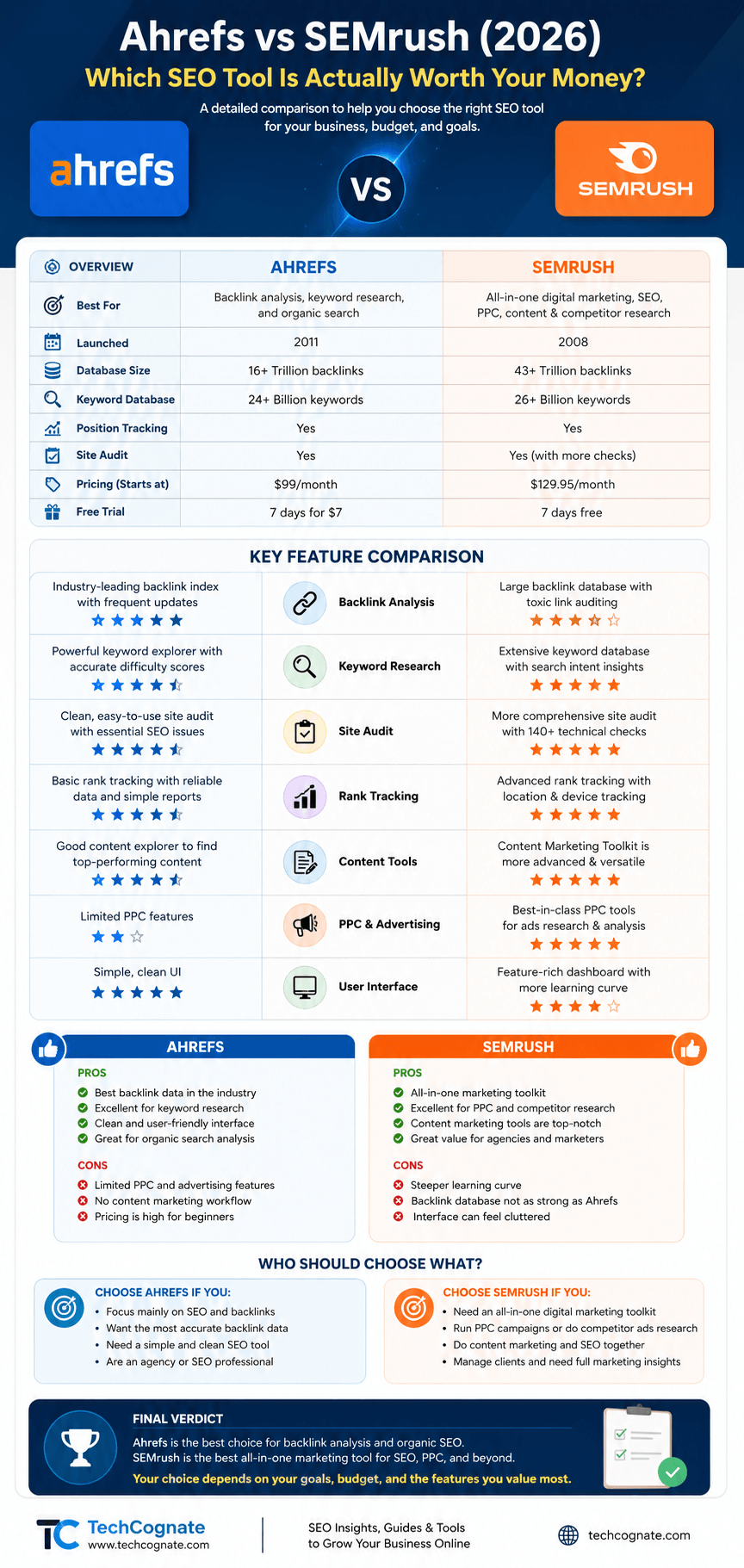
Ahrefs vs SEMrush at a Glance
1Keyword Research
🔍 Quick Answer Both tools are excellent for keyword research, but SEMrush edges ahead with a larger database (25B+ keywords vs Ahrefs’ ~10B), more advanced clustering, and question-based filtering that makes content planning faster. Ahrefs wins on one unique metric: clicks data — showing you how many searchers actually click a result, not just how many search. |
🏆 WINNER: SEMrush (slight edge) — Larger keyword database, advanced clustering, personalized keyword difficulty scores. Ahrefs wins on click-through rate data. |
Ahrefs Keyword Research
Ahrefs Keywords Explorer is clean, fast, and uniquely shows click data alongside search volume. This matters more than most people realize — a keyword with 5,000 monthly searches but only 800 clicks tells you that most searchers never leave the SERP (they read the featured snippet and bounce). Knowing this upfront saves you from chasing traffic that never actually lands.
Ahrefs also shows Traffic Potential — an estimate of how much traffic the top-ranking page gets, not just how many people search the keyword. This is smarter than raw search volume for realistic forecasting.
The Parent Topic feature identifies which broader topic your target keyword falls under, helping you avoid creating separate pages for keywords that Google treats as one intent — a common cause of duplicate content issues.
SEMrush Keyword Research
SEMrush Keyword Magic Tool is the largest single keyword database in the SEO software market at 25+ billion keywords as of 2026. The filtering options are extensive: question-based, broad match, phrase match, exact match, and related keywords — all from one interface.
Keyword clustering is built-in at the Guru plan and above. Instead of manually grouping keywords into topic clusters, SEMrush groups semantically related keywords automatically — useful for teams planning pillar-cluster content architecture.
Personalized keyword difficulty is another differentiator — SEMrush calculates KD based on YOUR domain’s authority, not a generic score. That means a keyword difficulty score of 45 means something different for a new blog than for a five-year-old established site.
Keyword Research — Side by Side
| Feature | Ahrefs | SEMrush |
|---|---|---|
| Keyword Database | ~10B keywords | 25B+ keywords |
| Click Data (CTR Estimates) | ✅ Yes (unique) | ❌ No |
| Traffic Potential Metric | ✅ Yes | ❌ No |
| Personalized KD Score | ❌ No | ✅ Yes |
| Keyword Clustering | ❌ Manual only | ✅ Automated (Guru+) |
| Question-Based Filtering | ✅ Yes | ✅ Yes |
| SERP Overview | ✅ Full SERP data | ✅ Full SERP data |
| Parent Topic Identification | ✅ Yes | ❌ Not directly |
| Historical Data | ✅ Advanced plan+ | ✅ Guru plan+ |
| Countries Covered | 170+ | 143 |
2Backlink Analysis
🔍 Quick Answer Ahrefs has the largest and most frequently updated referring domain index in the industry: 500 million referring domains vs SEMrush’s 390 million. Ahrefs discovers new links faster, which matters for link building outreach and competitor research. SEMrush leads in raw backlink count (43T vs 35T) and has better toxic link identification workflows. |
🏆 WINNER: Ahrefs — Larger referring domain index (500M vs 390M), faster link discovery, cleaner link prospecting. The gold standard for backlink research. |
Ahrefs Backlink Analysis
Ahrefs built its entire reputation on backlink data. Site Explorer lets you analyze any domain, subdomain, or URL with one click. You see every linking domain, anchor text distribution, link velocity over time, and new/lost links updated daily.
The Link Intersect tool is where agencies save hours: enter three to five competitors and Ahrefs immediately shows every site linking to them but not to you. That’s your outreach list, pre-qualified. No scraping, no manual comparison.
Broken link building is also a strength — you can find broken pages on competitor sites with external links, replicate the content, and pitch those linking domains. The workflow is built directly into Site Explorer.
SEMrush Backlink Analysis
SEMrush Backlink Analytics is deep on toxic link detection. It integrates directly with Google Search Console, pulling your disavow file and cross-referencing it with SEMrush’s toxicity scores. For penalty recovery, this saves significant manual work.
The Backlink Audit tool also flags link-building risks proactively: spammy anchors, link farm patterns, and authority imbalances. If you’ve ever inherited a site with a questionable link history, SEMrush’s workflow for cleaning it up is smoother than Ahrefs’. See our full roundup of link building tools for more options.
Where SEMrush falls short is link prospecting speed. Ahrefs simply surfaces referring domains faster and with greater accuracy for competitive intelligence.
Backlink Analysis — Side by Side
| Feature | Ahrefs | SEMrush |
|---|---|---|
| Referring Domains Indexed | 500M (largest) | 390M |
| Total Backlinks Indexed | 35 trillion | 43 trillion |
| Link Discovery Speed | ✅ Fastest | Slightly slower |
| Toxic Link Detection | Basic | ✅ Advanced (GSC integrated) |
| Link Intersect Tool | ✅ Built-in | ✅ Built-in |
| Broken Link Building | ✅ Easy workflow | ✅ Available |
| Anchor Text Analysis | ✅ Deep | ✅ Deep |
| Link Velocity Tracking | ✅ Yes | ✅ Yes |
| Disavow Integration | Manual upload | ✅ GSC sync built-in |
| Historical Link Data | ✅ Extensive | ✅ Extensive |
3Technical SEO & Site Audit
🔍 Quick Answer SEMrush wins on site auditing depth and usability. Its thematic reports organize issues by category (Core Web Vitals, HTTPS, crawlability, internal linking) making remediation faster for non-technical teams. Ahrefs Site Audit is excellent but less actionable for beginners. |
🏆 WINNER: SEMrush — Thematic reports, AI-powered fix recommendations, Core Web Vitals integration, and clearer issue prioritization make it the better technical SEO platform. |
Both tools crawl your website and surface technical issues — broken links, missing meta descriptions, slow pages, crawl depth problems, duplicate content, and more. But the way they present and prioritize those issues differs significantly. For a full breakdown of what to check, see our technical SEO checklist.
SEMrush Site Audit categorizes issues into Errors, Warnings, and Notices, then organizes them into thematic reports: crawlability, HTTPS security, Core Web Vitals, internal linking, and JavaScript rendering. If you manage client sites and need to explain technical issues to non-SEOs, this structure is genuinely helpful.
Ahrefs Site Audit is strong for experienced SEOs who know what they’re looking at. It crawls fast and accurately, surfaces important issues, and lets you set up automated alerts. But the reporting is more raw data than guided remediation.
One area where Ahrefs has an edge: crawl speed. Larger sites get audited faster. For enterprise sites with millions of pages, this difference is real.
Technical SEO — Side by Side
| Feature | Ahrefs | SEMrush |
|---|---|---|
| Issue Categorization | Errors / Warnings / Notices | Thematic (better organized) |
| Core Web Vitals Tracking | ✅ Yes | ✅ Yes (deeper) |
| AI Fix Recommendations | Limited | ✅ Advanced (2025-2026) |
| JavaScript Rendering | ✅ Yes | ✅ Yes |
| Crawl Speed | ✅ Fast (large sites) | Moderate |
| Scheduled Crawls | ✅ Yes | ✅ Yes |
| Log File Analysis | ❌ No | ✅ Yes (Guru+) |
| AMP Validation | ❌ No | ✅ Yes |
| Internal Link Reports | ✅ Good | ✅ Better (structured) |
| GSC Integration | ✅ Yes | ✅ Yes |
4Rank Tracking
🔍 Quick Answer Both tools track keyword rankings accurately across Google and Bing. SEMrush includes daily rank tracking, multi-location tracking (desktop + mobile + city-level), and daily alert notifications in all plans. Ahrefs charges significantly extra for daily notifications — making SEMrush the better value for rank tracking specifically. |
🏆 WINNER: SEMrush — Daily tracking, multi-location, and daily alerts included without surcharges. Ahrefs’ daily notification add-on cost is prohibitive for most users. |
Rank tracking is table-stakes for both tools. What differentiates them is cost and granularity — both feed directly into the SEO metrics you’d track in a monthly report.
SEMrush Position Tracking lets you monitor up to 500 keywords (Pro plan) with daily updates across multiple devices and locations — including city-level tracking for local SEO. This is built in. No add-ons required.
Ahrefs Rank Tracker is equally accurate but has a quirk that frustrates many users: daily email alerts for ranking changes cost extra. If you manage client campaigns and need to be notified when a top 10 ranking drops, you’re paying more than the headline plan price suggests.
5AI Search Visibility (2026 Critical Feature)
🔍 Quick Answer This is where the two tools diverge most significantly heading into 2026. SEMrush One tracks your brand’s presence across ChatGPT, Perplexity, Google AI Overviews, Claude, Gemini, and Microsoft Copilot — and includes brand sentiment analysis. Ahrefs Brand Radar tracks entity presence in AI but is available as a $199/month add-on, not a base feature. |
🏆 WINNER: SEMrush — AI search tracking built into the Semrush One platform with brand perception analysis. Ahrefs Brand Radar requires a $199/month add-on. |
AI search is no longer a future trend — it’s current traffic reality. Google AI Overviews now appear for a significant percentage of queries. Perplexity and ChatGPT are directing meaningful commercial traffic. If your brand isn’t being cited in these AI answers, you’re losing potential visitors without any trace in your Google Analytics 4 dashboard. Our guide on tracking traffic from AI search platforms covers this in more depth.
SEMrush One addresses this directly. You can see how AI engines like ChatGPT, Claude, Gemini, and Perplexity represent your brand, which topics AI associates you with, and whether sentiment is positive or negative. For brand marketers and SaaS companies tracking generative engine optimization (GEO), this is genuinely new value.
Ahrefs Brand Radar is decent at surfacing which topics AI engines associate with a given brand, but it doesn’t include sentiment analysis and costs an additional $199/month on top of your existing subscription. For most users, that’s a hard sell when SEMrush bundles comparable features at a lower price. See how both stack up against dedicated platforms in our guide to ranking in AI search engines.
6Content Marketing Tools
🔍 Quick Answer SEMrush wins decisively here. The Content Marketing Toolkit (Guru+) includes Topic Research, SEO Content Templates, a Writing Assistant, and Content Audit. Ahrefs has Content Explorer — which is excellent for finding high-performing content and link opportunities — but it doesn’t have a writing workflow. |
🏆 WINNER: SEMrush — Full content workflow from topic research through writing assistant to post-publish audit. Ahrefs doesn’t compete on content creation tooling. |
If you run a content-driven SEO strategy — whether for a blog, affiliate site, or SaaS — SEMrush Guru gives you a complete workflow: find a topic, see what the top 10 results cover, get a template with the recommended semantic terms, write in the built-in editor with a real-time SEO score, then audit performance six months later. Many of these workflows now lean on AI SEO tools to speed up production.
Ahrefs Content Explorer is powerful for content research — finding the most-linked and most-shared content in any niche, discovering broken content opportunities, identifying content gaps versus competitors. But once you’ve done that research, you leave Ahrefs to actually write. SEMrush tries to keep you in-platform through the whole cycle.
For affiliate marketers producing review posts and comparison guides, the SEMrush writing assistant’s integration with tools like Clearscope and Surfer SEO-style functionality at no extra cost (versus standalone subscriptions of $79–$149/month) represents real value.
7Local SEO
🔍 Quick Answer SEMrush is the clear winner for local SEO. It offers Listing Management (citation building and monitoring), Google Business Profile integration, local rank tracking at city and ZIP code level, and review management. Ahrefs has virtually no dedicated local SEO features. |
🏆 WINNER: SEMrush — Listing Management, GBP integration, local rank tracking, review monitoring. Ahrefs is not a local SEO tool. |
If you manage local businesses — restaurants, law firms, dental practices, home service companies — SEMrush is the only choice between the two. Listing Management pushes your business information to 70+ directories, tracks citation consistency, monitors Google Business Profile performance, and surfaces review trends. See our local SEO strategies guide for a full playbook, including niche plays like dental SEO and law firm SEO.
Ahrefs cannot do any of this. It has no GBP integration, no citation management, and no city-level rank tracking (SEMrush offers this). Local SEO agencies should evaluate SEMrush alongside dedicated platforms like BrightLocal or Whitespark before deciding.
8PPC & Paid Search Research
🔍 Quick Answer SEMrush dominates paid search research. Its Advertising Research tool shows competitor Google Ads keywords, ad copy, landing pages, CPC data, and budgets. Ahrefs shows some PPC data but it’s limited and not useful for serious Google Ads management. |
🏆 WINNER: SEMrush — Comprehensive Google Ads competitor intelligence — keywords, ad copy, landing pages, CPC, and display ad creative. Ahrefs doesn’t compete here. |
For ecommerce owners, SaaS marketers, and agencies managing Google Ads alongside SEO, SEMrush eliminates the need for a separate PPC spy tool. You can see exactly what keywords a competitor is bidding on, what their ad copy looks like, which landing pages they’re testing, and how their spend has trended over time.
Shopping Ads research is also available for ecommerce — useful for Shopify store owners who want to understand which product keywords competitors are bidding on in Google Shopping.
9Agency Features
🔍 Quick Answer SEMrush is built for agencies. White-label PDF reports, Looker Studio integration, client-facing portals, multi-user management, and an Agency Growth Kit are all available. Ahrefs has multi-user support but no white-label reporting and no client portal. |
🏆 WINNER: SEMrush — White-label reporting, client portals, Looker Studio, Agency Growth Kit. The better agency platform by a clear margin. |
If you’re running an SEO agency, client reporting is half your job. SEMrush’s white-label PDF reports let you brand every report with your agency’s logo and colors, scheduled and delivered automatically. Ahrefs has no equivalent feature — you export data and build reports manually. Our AI SEO toolkit for agencies rounds out the stack many teams pair with these platforms.
The Looker Studio integration (SEMrush Guru+ and Ahrefs Advanced+) opens both tools to custom dashboards. But SEMrush’s deeper integrations — connecting rank data, backlink data, traffic data, and social data in a single Looker Studio view — saves agency reporting teams significant weekly time, and feeds straight into automated SEO reports.
API access is where Ahrefs surprises. It provides API from the Standard plan ($249/month), while SEMrush requires the Business plan ($499.95/month). For agencies building custom dashboards or SEO data pipelines, Ahrefs is meaningfully cheaper for API access.
Pricing Comparison (2026)
Ahrefs Pricing
| Plan | Monthly | Annual/mo | Projects | Users |
|---|---|---|---|---|
| Starter | $29 | N/A | 1 | 1 |
| Lite | $129 | $108 | 5 | 1 |
| Standard | $249 | $208 | 20 | 1 |
| Advanced | $449 | $374 | 50 | 5 |
| Enterprise | $1,499+ | $1,249+ | 100+ | Unlimited |
⚠️ Ahrefs Hidden Costs to Watch
|
| Get Started with Ahrefs → Starter plan from $29/mo — no free trial |
SEMrush Pricing
| Plan | Monthly | Annual/mo | Projects | Keywords |
|---|---|---|---|---|
| Pro | $139.95 | ~$117 | 5 | 500 |
| Guru | $249.95 | ~$208 | 15 | 1,500 |
| Business | $499.95 | ~$417 | 40 | 5,000 |
| Enterprise | Custom | Custom | Custom | Custom |
💡 SEMrush Notes
|
| Start Your Free SEMrush Trial → 7–14 day free trial, no long-term commitment |
Price Comparison at Key Tiers
| Tier | Ahrefs | SEMrush |
|---|---|---|
| Entry Level | Lite: $129/mo | Pro: $139.95/mo |
| Mid Tier | Standard: $249/mo | Guru: $249.95/mo |
| Advanced | Advanced: $449/mo | Business: $499.95/mo |
| Enterprise | $1,499+/mo | Custom (from ~$5,000/mo) |
| API Access | From Standard ($249) | From Business ($499.95) |
| White-label | Not available | From Guru ($249.95) |
| Best Value? | ✅ For pure SEO | ✅ For full marketing stack |
Real User Scenarios: Who Should Buy What?
Best For: Bloggers & Content Creators
Ahrefs: If your blog is monetized primarily through affiliate links and link building is part of your strategy, Ahrefs Standard at $249/month gives you Content Explorer for finding broken link building opportunities plus the full keyword research toolkit.
SEMrush: If you’re growing a blog through content marketing and want a complete workflow — keyword research, content briefs, writing assistant, rank tracking — SEMrush Guru at $249.95/month is the better investment.
🎯 Verdict: Bloggers & Content Creators SEMrush for content-driven blogs. Ahrefs if link building is your primary growth tactic. |
Best For: Affiliate Marketers
Ahrefs: Competitor analysis is the name of the game. Ahrefs Site Explorer lets you reverse-engineer any affiliate site’s top pages, traffic values, and backlink sources in minutes. For affiliate SEO, Ahrefs Standard ($249/mo) is the preferred tool.
SEMrush: SEMrush adds PPC competitor intelligence — useful if you run paid traffic alongside SEO. The Advertising Research tool reveals what affiliate competitors are bidding on in Google Ads.
🎯 Verdict: Affiliate Marketers Ahrefs for pure affiliate SEO. SEMrush if you also run paid traffic. |
Best For: SEO Agencies
Ahrefs: Excellent for deliverables like backlink audits, link building campaigns, and competitor gap analyses. Standard or Advanced tier covers most agency needs. Lacks white-label reporting.
SEMrush: Built for agencies. White-label reports, client portals, multi-project dashboards, and Looker Studio integration make client reporting manageable. Guru or Business plan covers most agency workflows.
🎯 Verdict: SEO Agencies SEMrush for full-service agencies. Ahrefs for specialist link-building agencies. |
Best For: Ecommerce Owners (Shopify / WooCommerce)
Ahrefs: Strong for finding high-intent product keywords and analyzing competitor organic strategies. Shopify and WooCommerce site audits work well. No Shopping Ads data.
SEMrush: Ecommerce keyword research is deeper, includes Shopping Ads competitor data, and the full PPC research suite helps with Google Shopping campaigns. Better choice for stores running paid + organic.
🎯 Verdict: Ecommerce Owners (Shopify / WooCommerce) SEMrush for ecommerce stores running multi-channel marketing. Ahrefs for organic-only ecommerce SEO. |
Best For: SaaS Companies
Ahrefs: Excellent for SaaS content strategy — identifying high-intent transactional keywords, competitor content gaps, and backlink opportunities from high-authority tech publications.
SEMrush: AI visibility tracking in Semrush One is a real advantage for SaaS brands: knowing whether ChatGPT, Perplexity, or Claude recommends your product when users ask related questions is actionable competitive intelligence in 2026.
🎯 Verdict: SaaS Companies SEMrush for SaaS companies prioritizing AI search visibility. Ahrefs for SaaS companies in content-heavy niches. |
Best For: Enterprise SEO Teams
Ahrefs: API access from Standard ($249/mo), huge backlink index, and fast crawls for massive sites. Enterprise plan ($1,499/mo) includes SSO and unlimited users.
SEMrush: Enterprise clients get custom keyword limits, dedicated account management, SSO, and the full digital marketing suite. The AI Overviews tracking and Looker Studio reporting make it the stronger enterprise choice.
🎯 Verdict: Enterprise SEO Teams SEMrush for enterprise teams needing full-stack marketing data. Ahrefs Enterprise for organizations with dedicated link and technical SEO programs. |
Best For: Local SEO Agencies
Ahrefs: Not the right tool. Ahrefs has no local-specific features — no GBP integration, no citation management, no city-level tracking.
SEMrush: The only choice. Listing Management, GBP integration, city-level rank tracking, review monitoring, and local keyword research in one platform.
🎯 Verdict: Local SEO Agencies SEMrush, unambiguously. |
Best For: Freelancers & Solo SEOs
Ahrefs: Ahrefs Lite at $129/month (or $108 annually) covers keyword research, backlink analysis, site audits, and rank tracking for a handful of client sites. The credit cap at 500/month is tight for active client work.
SEMrush: SEMrush Pro at $139.95/month (or ~$117 annually) gives slightly more for comparable money and includes a 14-day trial. Better overall package at entry level.
🎯 Verdict: Freelancers & Solo SEOs SEMrush Pro for most freelancers. Ahrefs Lite if backlinks are your specialty service. |
Ahrefs Pros and Cons
✅ Ahrefs Pros
|
❌ Ahrefs Cons
|
SEMrush Pros and Cons
✅ SEMrush Pros
|
❌ SEMrush Cons
|
Still Deciding? Compare Both Free
Prices and trial terms are set by Ahrefs and SEMrush and may change. |
Alternatives to Ahrefs and SEMrush
| Tool | Price | Best For |
|---|---|---|
| SE Ranking | $49–$349/mo | Best for mid-size agencies needing AI search tracking at an affordable price. Includes white-label, local SEO, and a 14-day free trial. |
| Moz Pro | $99–$599/mo | Good for beginners. Domain Authority (DA) metric is widely recognized. Weaker backlink database than Ahrefs but excellent MozBar Chrome extension. |
| Mangools | $29–$79/mo | Best budget option. KWFinder for keyword research is beginner-friendly. Good for bloggers and small businesses with limited budgets. |
| Majestic | $50–$400/mo | Backlink-only tool. Trust Flow and Citation Flow metrics are used by link-building specialists alongside Ahrefs. Not a full SEO suite. |
| Screaming Frog | $259/yr | Best technical SEO crawler for large sites. Works offline, handles JavaScript rendering, and integrates with Google Analytics/Search Console. Complement, not replacement. |
| Surfer SEO | $79–$239/mo | Content optimization specialist. Generates data-driven content briefs, NLP suggestions, and SERP gap analysis. Best used alongside Ahrefs or SEMrush. |
| Serpstat | $69–$499/mo | Budget alternative with generous project limits. Good for Eastern European markets. Keyword and backlink data decent at lower price points. |
| SpyFu | $39–$79/mo | Excellent Google Ads competitor intelligence at low price. Limited backlink data. Worth considering for PPC-heavy businesses that don’t need deep SEO. |
| Google Search Console | Free | Essential and free. Every site owner should use it before paying for anything else. Limited to your own site data — no competitor research. |
| Google Keyword Planner | Free | Free keyword volume data inside Google Ads. Less granular than Ahrefs/SEMrush but shows actual Google search volumes. No competitor data. |
Expert Verdicts
| Category | Winner | Reason |
|---|---|---|
| Best Overall | SEMrush | Broader platform, stronger content marketing, AI search visibility built-in, better agency features. |
| Best Value | SEMrush | More features per dollar at entry and mid tier. Ahrefs Starter at $29 is cheapest entry point but severely limited. |
| Best Beginner Tool | Ahrefs | Cleaner interface, easier learning curve. SEMrush’s dashboard can overwhelm new SEOs. |
| Best Agency Tool | SEMrush | White-label reports, client portals, multi-project dashboards, phone support. |
| Best Enterprise Tool | SEMrush | AI search tracking, custom data limits, dedicated account management. |
| Best Ecommerce Tool | SEMrush | Shopping Ads research, full PPC data, product keyword tracking. |
| Best Content Marketing | SEMrush | End-to-end workflow: topic research, briefs, writing assistant, audit. |
| Best Backlink Tool | Ahrefs | 500M referring domains, fastest link discovery, cleanest link prospecting workflow. |
| Best Keyword Research | SEMrush | 25B+ keywords, automated clustering, personalized KD, better filtering. |
| Best for Local SEO | SEMrush | Ahrefs has no local features. SEMrush has full GBP + citation management. |
| Best for AI Search (2026) | SEMrush | Semrush One tracks visibility across ChatGPT, Perplexity, AI Overviews, Gemini. |
| Best API Value | Ahrefs | API access from Standard ($249/mo). SEMrush requires Business ($499.95/mo). |
Frequently Asked Questions
Final Recommendation
After testing both tools across dozens of client campaigns and personal projects, here’s the honest bottom line:
🏆 Choose Ahrefs If:
|
🏆 Choose SEMrush If:
|
💡 Choose Neither (For Now) If:
|
The SEO industry’s dirty secret is this: most people buy Ahrefs or SEMrush and use 20% of what they pay for. Before subscribing, write down the five specific SEO tasks you’ll do in month one. Match those tasks to each tool’s feature list. That exercise alone will save you months of paying for the wrong subscription.
Both tools are genuinely excellent. The difference is where they focus. Get that match right and either investment pays for itself within 60 days. |
Make Your Choice
Prices and trial terms are set by Ahrefs and SEMrush and may change. |