Ahrefs vs Semrush vs Moz (2026): Which SEO Tool Is Actually Worth Your Money?
A complete, first-hand decision framework for choosing between three of the most-used SEO platforms on the market
SEO tools are not cheap. Ahrefs, Semrush, and Moz can each run anywhere from $99 to over $1,000 a month once you add the modules most teams actually need, and almost nobody can justify paying for all three at once. That leaves a real decision to make, and it is not an easy one — type ‘Ahrefs vs Semrush vs Moz’ into Google and you will find a different ‘winner’ in nearly every article, usually whichever tool happens to be paying that site’s affiliate commission.
This guide is different in one respect: it is not trying to crown a single winner. After years of running all three platforms side by side on real client sites — audits, link campaigns, content calendars, rank tracking, the whole workflow — the honest conclusion is that each tool earns its subscription fee in a different situation. Ahrefs earns it in backlink-heavy SEO. Semrush earns it when a team needs one platform to cover SEO, PPC, content, and now AI visibility. Moz earns it when budget and simplicity matter more than database size.
What follows is a practical recommendation based on business type, budget, and SEO goals — not a generic feature dump. By the end, you will know which tool fits your situation, why one tool beats another for specific use cases, which option delivers the best return on investment, and when it actually makes sense to run two tools instead of one.
Quick Verdict: Who Wins Each Category
Here is the category-by-category breakdown before we go deep on any one of them:
| Category | Winner |
|---|---|
| Overall Winner | Semrush |
| Best for Agencies | Semrush |
| Best for Bloggers | Moz |
| Best for Enterprise | Semrush |
| Best Value | Moz |
| Best Keyword Research | Semrush |
| Best Backlink Analysis | Ahrefs |
| Best Technical SEO | Semrush |
| Best Local SEO | Moz |
| Best AI Features | Semrush |
| Best Reporting | Semrush |
| Best Ease of Use | Ahrefs |
| Best for Beginners | Moz |
| Best Customer Support | Semrush |
| Best ROI | Ahrefs (solo users) / Semrush (teams) |
Meet the Contenders
Ahrefs
Ahrefs started life in 2011 as a backlink checker and has never really stopped being a backlink tool at heart, even though it has bolted on keyword research, rank tracking, site audits, and — most recently — an AI visibility product called Brand Radar. Its web crawler is the second most active crawler on the internet after Googlebot, which is the entire reason its link data refreshes so quickly and why link builders treat it as close to a default choice.
Market position: Ahrefs sits at the premium end, competing directly with Semrush on price but positioning itself as the more focused, data-first alternative. It does not try to be a full marketing suite — there is no PPC keyword planner, no social media scheduler, no email tool. It does fewer things, but the things it does (backlinks, keyword difficulty, content research) it tends to do with more precision.
Ideal users: link builders, in-house SEO specialists, content researchers, and agencies whose primary deliverable is organic search performance rather than a multi-channel marketing report.
| Strengths: Largest, freshest backlink index of the three; clean and fast interface; strong Content Explorer for research; conservative (more realistic) keyword difficulty scores. | |
| Weaknesses: Credit-based usage system that power users burn through quickly; no native PPC, social, or email tools; AI visibility tracking (Brand Radar) is priced as a premium add-on that can push monthly cost past $800. | |
| Core philosophy: Be the most accurate data source for organic search and let other tools handle everything else. |
Semrush
Semrush launched in 2008 and has spent the years since absorbing adjacent marketing categories — PPC research, content marketing, social media tracking, local SEO, and now AI visibility — into a single login. It is the only one of the three tools that genuinely earns the label “all-in-one”: Position Tracking, Site Audit, the Content Marketing Platform, and the AI Visibility Toolkit are all designed to hand data to one another rather than living in separate silos.
Market position: the broadest platform in the category, and the one most likely to replace two or three smaller subscriptions at once. A 20% price cut in Q1 2026 brought its Pro plan close to parity with Ahrefs Lite, sharpening the competition at the entry tier.
Ideal users: agencies juggling SEO and PPC for multiple clients, in-house marketing teams that need one dashboard for stakeholders, and content-led businesses that want keyword research and content writing assistance under one roof.
| Strengths: Largest keyword database by a wide margin; integrated content, PPC, and social tools; the most developed AI visibility features of the three; strong customer support across phone, email, and live chat. | |
| Weaknesses: The interface can feel cluttered for users who only need core SEO features; per-seat pricing gets expensive for larger teams; several genuinely useful features (Content Toolkit, Trends, AI Visibility Toolkit) are paid add-ons rather than included. | |
| Core philosophy: Be the one platform a marketing team needs, even if that means the core SEO experience is a little less specialized than Ahrefs. |
Moz
Founded in 2004 by Rand Fishkin and Gillian Muessig, Moz is the elder statesman of this comparison and the company that gave the SEO industry its most widely cited authority metric, Domain Authority (DA). Despite Google never using DA in its own algorithm, the metric became so embedded in how agencies report results to clients that it is still requested by name years after Ahrefs and Semrush built their own competing authority scores.
Market position: the budget and education-first choice. Moz Academy, the long-running Whiteboard Friday video series, and the free MozBar browser extension have made it the tool most beginners meet first — and its pricing, starting at roughly a third of what Ahrefs or Semrush charge at entry level, reflects that positioning deliberately.
Ideal users: solo site owners, small businesses, beginners learning SEO fundamentals, and small agencies managing a modest number of straightforward local or content campaigns where DA still carries reporting weight with clients.
| Strengths: Lowest entry price of the three by a significant margin; Domain Authority remains the industry’s most recognized authority metric; genuinely excellent beginner education; transparent, low-cost API access compared to its rivals. | |
| Weaknesses: Smaller keyword database (roughly 1.2 billion keywords versus 26 billion-plus in Semrush); weekly rather than daily rank tracking on most plans; slower site audit crawls; little to no AI visibility or content marketing functionality. | |
| Core philosophy: Make core SEO accessible and understandable rather than chasing every adjacent feature category. |
Comparison Snapshot
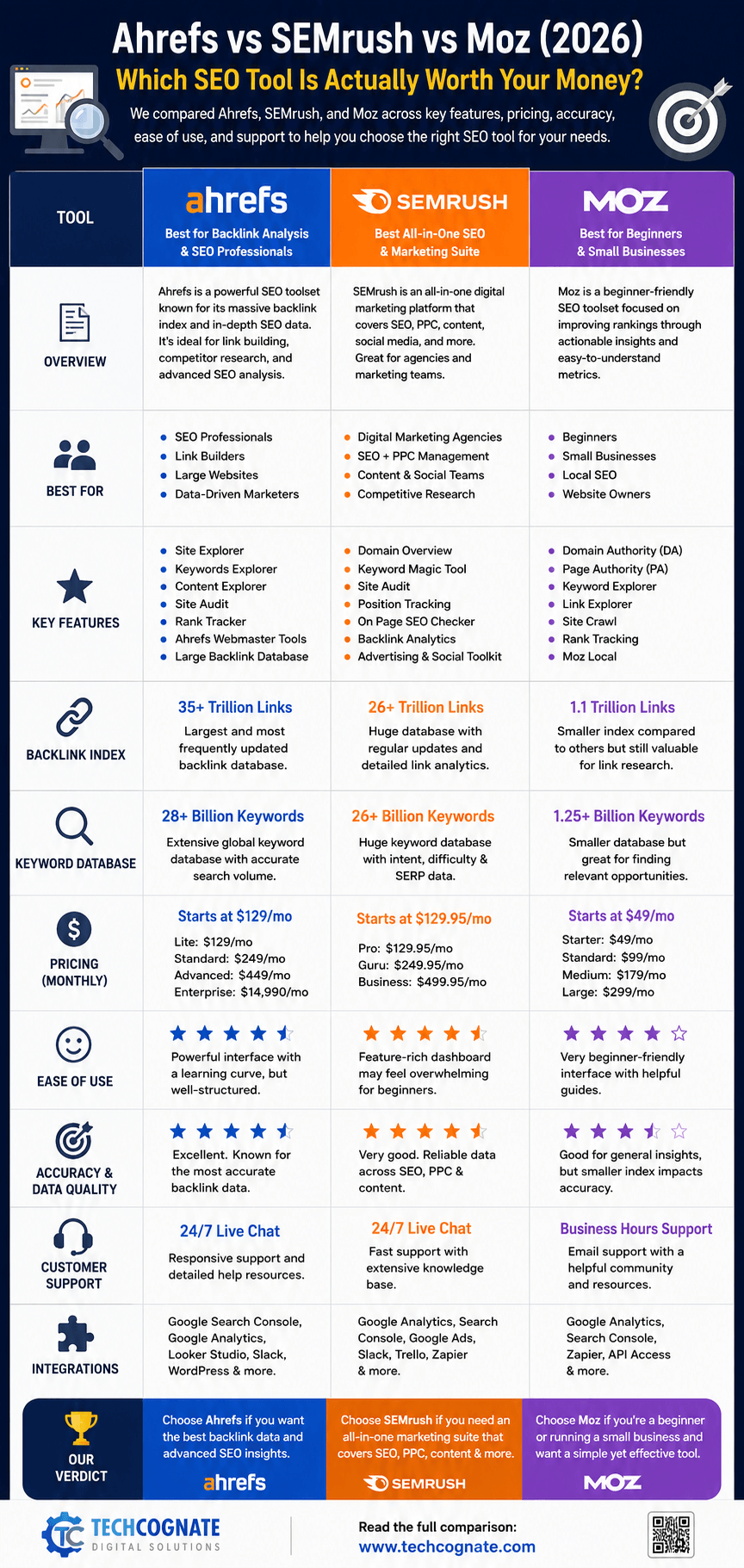
| Feature | Ahrefs | Semrush | Moz |
|---|---|---|---|
| Entry price (monthly) | $129 (Lite) | $119.95 (Pro)* | $49 (Starter) |
| Mid-tier price | $249 (Standard) | $219.95 (Guru)* | $99 (Standard) |
| Top-tier price | $449+ (Advanced) | $449.95 (Business)* | $299 (Premium) |
| Free trial | No (limited free tools) | 7 days | 30 days |
| Keyword database | ~10.8B keywords | 26B+ keywords | ~1.2B keywords |
| Backlink database | Largest, refreshed every 15–30 min | Large, slightly less fresh | Solid, smaller index |
| Rank tracking frequency | Daily | Daily | Weekly (most plans) |
| Site audit depth | Strong, fast crawl | Most comprehensive | Slower, fewer checks |
| AI visibility features | Brand Radar (add-on, $199–$699/mo) | AI Visibility Toolkit (add-on, $99/mo) | Minimal / early-stage |
| Content marketing tools | Content Explorer only | Full Content Marketing Platform | None |
| Local SEO | Limited | Strong (Local add-on) | Strong (core strength) |
| Competitor research | Strong | Strongest breadth | Basic |
| Reporting / white label | Good | Best, most customizable | Basic |
| API access | Enterprise only, costly | Business plan, $499.95/mo+ | From $20/mo, most transparent |
| Enterprise features | Custom Enterprise tier | Business tier + add-ons | Limited |
| Integrations | Limited native, API-based | 60+ app marketplace | Limited |
| Learning curve | Moderate | Steep | Easiest |
| Ease of day-to-day use | Cleanest interface | Powerful but dense | Simplest |
| Customer support | Email/chat | Phone, email, live chat | Email/chat, strong knowledge base |
| Data freshness | Fastest crawl refresh | Daily updates | Weekly updates |
| International SEO | Strong | Strongest (most locales) | Limited |
| Team collaboration | Shared logins (discouraged) | Per-seat, built for teams | Basic seat sharing |
| White label reports | Available | Available, most polished | Available, basic |
User Interface Comparison
Dashboard and navigation
Ahrefs organizes everything around Site Explorer and Keywords Explorer — two search bars that handle the large majority of daily tasks. There is very little hunting through menus; you type a domain or keyword, and the relevant reports are a click away. Semrush takes the opposite approach, spreading SEO, PPC, content, social, and AI visibility across separate toolkits, each with its own sub-navigation. That breadth is genuinely useful once learned, but new users often spend their first week just figuring out where things live. Moz keeps things simplest of all: a single dashboard surfaces Domain Authority, top keyword opportunities, and site crawl issues without much configuration required.
Learning curve and daily workflow
For a solo user doing backlink research every day, Ahrefs’ focus pays off — there is less friction between opening the tool and getting an answer. For an agency account manager who needs to pull a PPC report, a content brief, and a rank tracking update in the same session, Semrush’s breadth saves time even though the initial learning curve is steeper. Moz’s workflow is the lightest of the three, which makes it the best fit for someone checking in on a handful of metrics once a week rather than living inside the tool daily.
Customization and reporting
Semrush offers the deepest customization for client-facing reports — white-label PDF exports, scheduled email reports, and a drag-and-drop report builder. Ahrefs’ reporting is functional but less flexible. Moz’s reporting is the most basic of the three, adequate for a single-site dashboard but limiting for agencies managing several client accounts side by side.
Keyword Research Comparison
Keyword difficulty, search volume accuracy, and trend data are the three numbers most SEOs check first, and the three tools disagree with each other more than you would expect for products pulling from related data sources. Ahrefs’ keyword difficulty score tends to run lower than Semrush’s for the same term, which in practice makes it the more trustworthy of the two — a term that looks easy in Ahrefs is genuinely more likely to be rankable than one that looks easy in Semrush.
Related keywords, question keywords, and SERP intent classification are strong across all three, but Semrush’s keyword clustering and parent topic grouping save real time when planning a content calendar, since they group dozens of related terms into a handful of pages worth writing rather than leaving that grouping work to you manually. Ahrefs’ Parent Topic feature does something similar but with less automation around clustering at scale.
For traffic potential and keyword gap analysis, Ahrefs’ Traffic Potential metric — which estimates the total traffic the top-ranking page receives across all the keywords it ranks for, not just your target term — is genuinely useful for prioritizing content topics. Semrush’s Keyword Gap tool is the more polished interface for comparing your keyword footprint against several competitors side by side. International keyword databases favor Semrush by volume, though Ahrefs covers most major markets adequately for typical use cases. Long-tail discovery and AI-assisted suggestions are where Semrush’s database size shows up most clearly — more long-tail variants surface, even if not every one is worth targeting.
Who should choose it: content teams and agencies building keyword-driven editorial calendars should lean Semrush; solo SEOs and link-focused specialists who want one trustworthy difficulty score should lean Ahrefs.
Competitor Research
| Capability | Ahrefs | Semrush | Moz |
|---|---|---|---|
| Organic competitors | Strong | Strongest | Basic |
| Paid competitors / PPC research | Not available | Strong | Not available |
| Traffic estimation | Strong | Strong | Basic |
| Market Explorer | Not available | Available | Not available |
| Top pages report | Strong | Strong | Basic |
| Content Gap | Available | Available, more polished | Not available |
| Keyword Gap | Available | Available, multi-competitor | Limited |
| Share of Voice | Via Brand Radar (add-on) | Available natively | Not available |
| Historical data | Available, deep history | Available | Limited |
If your competitive research needs to span both organic rankings and paid search — useful for any business running ads alongside SEO — Semrush is the only one of the three that covers both natively. Ahrefs is organic-only but does that job thoroughly, with Top Pages and Content Gap reports that are genuinely useful for finding what a competitor is doing right. Moz’s competitor features exist but feel like an afterthought next to its keyword and link tools.
Backlink Analysis
| Capability | Ahrefs | Semrush | Moz |
|---|---|---|---|
| Backlink index size | Largest | Large | Smallest |
| Refresh speed | Every 15–30 minutes | Daily | Weekly |
| Lost backlinks tracking | Strong | Strong | Available |
| New backlinks tracking | Strongest, fastest | Strong | Available |
| Broken backlinks | Available | Available | Available |
| Anchor text analysis | Strong | Strong | Basic |
| Referring domains | Strongest count | Strong | Solid |
| Link Intersect | Available | Available | Not available |
| Spam detection | Available | Available | Spam Score (unique metric) |
| Historical index | Deepest | Strong | Limited |
| Link quality signals | Domain Rating (DR) | Authority Score | Domain Authority (DA) |
| Digital PR features | Limited | Available via add-ons | Limited |
This is the comparison where the gap is most decisive. Ahrefs was built as a backlink tool first, and its crawler is still the second most active on the web after Googlebot. For anyone doing link prospecting, monitoring a competitor’s link velocity, or auditing their own backlink profile before a disavow, that speed advantage translates directly into seeing new links — good or bad — before the other two tools register them.
Semrush’s backlink database is large and perfectly serviceable for the majority of use cases, but independent testing consistently finds it missing some of the niche or newly created links that show up in Ahrefs first. Moz’s Link Explorer is solid and built on the same index that powers Domain Authority, but its smaller size and weekly refresh make it a secondary tool rather than a primary one for serious link work.
One nuance worth flagging: Domain Rating (Ahrefs), Authority Score (Semrush), and Domain Authority (Moz) are three different proprietary metrics measuring a similar concept, and they do not always agree on the same domain. Moz’s DA remains the most recognized in client conversations purely because of its first-mover status, even though Ahrefs’ underlying link data is generally considered more current.
Technical SEO
| Capability | Ahrefs | Semrush | Moz |
|---|---|---|---|
| Site Audit depth | Strong, fast | Most comprehensive | Slower, fewer checks |
| Core Web Vitals | Available | Available, integrated with GSC | Limited |
| JavaScript crawling | Available | Available | Limited |
| Internal linking analysis | Available | Available, more detailed | Basic |
| Redirect detection | Available | Available | Available |
| Duplicate content | Available | Available | Available |
| Structured data checks | Basic | Strong | Basic |
| Orphan pages | Available | Available | Limited |
| Broken links (on-site) | Available | Available | Available |
| Crawl scheduling | Flexible | Flexible | Limited |
| Issue prioritization | Good | Best, weighted scoring | Basic |
Semrush’s Site Audit tends to win head-to-head technical comparisons because it checks more individual factors — over 140 technical and on-page issues at last count — and weights them by estimated impact rather than just listing every issue with equal urgency. That prioritization matters more than raw issue count for a team trying to decide what to fix first with limited developer time.
Ahrefs’ Site Audit crawls fast and integrates cleanly with its other tools, which makes it a reasonable secondary check even for teams whose primary technical audits run through Semrush. Moz’s crawler is the clear laggard here: independent testing consistently finds slower crawl completion times and fewer detected issues compared to its two rivals, which is one of the more concrete reasons Moz struggles to be recommended for professional technical SEO work in 2026.
Rank Tracking
| Capability | Ahrefs | Semrush | Moz |
|---|---|---|---|
| Desktop rank tracking | Daily | Daily | Weekly |
| Mobile rank tracking | Daily | Daily | Weekly |
| Local rankings | Limited | Strong (with Local add-on) | Strong |
| Global rankings | Strong | Strongest, most locales | Limited |
| Competitor tracking | Available | Available, side-by-side | Available |
| Visibility score | Available | Available | Available |
| SERP features tracking | Available | Available, most detailed | Basic |
| Historical tracking | Strong | Strong | Limited |
Daily versus weekly tracking sounds like a minor detail until a site experiences a sudden ranking drop after a Google update and the team has to wait days for confirmation instead of checking the next morning. That single difference — daily updates on Ahrefs and Semrush versus weekly on most Moz plans — is one of the more practical reasons Moz struggles to be a primary tool for active SEO management, even though its other features hold up reasonably well.
Local SEO
For a local business — a dentist, a plumber, a single-location retailer — local SEO features matter more than backlink index size or keyword database breadth. Moz built local SEO into its core product early and it remains one of the few areas where Moz beats both Ahrefs and Semrush outright rather than competing on price alone. See our local SEO strategies guide for a deeper breakdown of tactics beyond tool selection.
| Google Business Profile: Moz and Semrush both offer GBP monitoring and optimization suggestions; Ahrefs does not. | |
| Citation management: Moz Local (built into Moz Pro plans) tracks and helps correct business listings across directories; Semrush requires its Local add-on for comparable functionality. | |
| Review monitoring: Available in Moz and Semrush’s Local toolkit; not a core Ahrefs feature. | |
| Local ranking and location tracking: Both Moz and Semrush support geo-specific rank tracking down to the city or zip code level; Ahrefs’ location tracking is more limited. |
AI Features Comparison
| Capability | Ahrefs | Semrush | Moz |
|---|---|---|---|
| AI visibility tracking | Brand Radar (add-on) | AI Visibility Toolkit (add-on) | Minimal |
| AI platforms covered | 6 (Google AIO/AI Mode, ChatGPT, Perplexity, Gemini, Copilot) | Multiple, dashboard-style reporting | None natively |
| AI writing / content generation | Not available | Content Toolkit (add-on) | AI content brief generator |
| AI SEO recommendations | Content grader | Content grader, more developed | Basic, via keyword suggestions |
| Topic clustering | Basic | Strong | Not available |
| Search intent analysis | Available | Available, more granular | Available, basic |
| Entity extraction | Limited | Available | Not available |
| Predictive SEO / forecasting | Limited | Available | Not available |
| Pricing for AI add-on | $199/platform or $699 bundled, monthly | $99/month standalone | Included, limited scope |
Ahrefs Brand Radar
Brand Radar is Ahrefs’ answer to AI visibility tracking, and it leans on the company’s core strength: scale. It draws from a database of more than 200 million search-backed prompts and tracks six engines — Google AI Overviews, Google AI Mode, ChatGPT, Perplexity, Gemini, and Microsoft Copilot. The methodology of using real, search-backed prompts rather than fabricated ones is a genuine point in its favor, and historical visibility data is a differentiator most newer AI-visibility-only tools cannot match.
The catch is price and depth. Brand Radar requires an active Ahrefs base subscription starting at $129/month, and the AI indexes themselves cost $199/month per platform or $699/month bundled across all six — pushing a realistic full setup to $828 or more per month. Independent reviewers have also flagged accuracy gaps in the ChatGPT and Perplexity modules, where the snapshot-based methodology can miss how quickly AI answers change between sweeps. It is also data-only: Brand Radar shows you where you are mentioned but does not generate suggestions, briefs, or content to improve that visibility.
Semrush AI Visibility Toolkit
Semrush takes a more dashboard-centric approach, built around metrics stakeholders can actually read in a meeting: Brand Performance (share of voice, sentiment, perception drivers), Prompt Tracking (up to 500 prompts daily on higher tiers), and Prompt Research, which treats prompts the way Semrush treats keywords — with topic difficulty and volume estimates. At $99/month standalone, it is roughly a third of the cost of Ahrefs’ fully bundled Brand Radar, and it slots naturally alongside Semrush’s existing SEO and content tools rather than living as a separate premium product.
The honest limitation: Semrush’s content generation output, produced by its Content Toolkit, has been criticized in independent reviews as reading like generic AI-written copy rather than genuinely differentiated content. The AI visibility data is strong; turning that data into content that actually improves visibility still requires real editorial work on top of what Semrush produces. For a deeper look at optimizing for AI-driven search specifically, see our AI SEO guide.
Moz and AI: the honest gap
Moz offers little in this category beyond a basic AI-powered content brief generator and some AI-assisted keyword suggestions. There is no dedicated AI visibility tracking product comparable to Brand Radar or the AI Visibility Toolkit. For a tool company that has otherwise kept pace reasonably well on core SEO fundamentals, this is the clearest area where Moz has fallen behind — and it matters more every quarter as AI Overviews and chatbot answers absorb a growing share of search traffic.
Future roadmap: both companies are investing heavily here — Ahrefs is piloting beta tracking across YouTube, TikTok, and Reddit to capture where AI-cited content originates upstream, while Semrush continues expanding prompt volume and stakeholder-facing reporting. Expect this category to keep moving quickly through 2026 and beyond; whatever tool you choose, budget for this feature set to change.
Content Marketing Features
| Capability | Ahrefs | Semrush | Moz |
|---|---|---|---|
| Topic research | Content Explorer | Topic Research tool | Not available |
| Content templates / SEO writing | Not available | SEO Content Template, AI writer | Basic brief generator |
| Content scoring | Not available | Available, real-time | Not available |
| On-page optimization | Basic | Strong, detailed recommendations | Basic |
| Internal link suggestions | Limited | Available | Not available |
| Content decay tracking | Available via traffic data | Available | Not available |
| Content audit | Manual, via Site Explorer | Built-in Content Audit tool | Not available |
If content production is a meaningful part of your SEO strategy — publishing regularly, optimizing existing pages, tracking which articles are losing traffic over time — Semrush’s integrated Content Marketing Platform removes the need for a separate tool like SurferSEO or Clearscope for most teams. Ahrefs’ Content Explorer is excellent for finding what content already performs well on a topic, but it is a research tool, not a writing or optimization tool.
Data Accuracy
Search volume is the number most people check first and trust least once they have used these tools for a while. All three vendors estimate volume rather than report it directly from Google, and the three estimates frequently disagree for the same keyword — sometimes by a wide margin for lower-volume or seasonal terms. Keyword difficulty scores diverge even more, since each platform weights link signals, content quality, and SERP features differently in its proprietary formula.
| Search volume: Semrush’s larger database produces more granular long-tail estimates but can run optimistic; Ahrefs tends toward more conservative, sometimes more realistic figures. | |
| Keyword difficulty: Ahrefs’ scores are widely considered the more conservative and trustworthy of the two larger tools; Semrush’s can understate difficulty for competitive terms. | |
| Traffic estimates: Independent comparisons against real Google Search Console data have found Semrush’s organic traffic estimates running noticeably higher than actual traffic for some sites — always cross-check estimated traffic against your own GSC or GA4 data before reporting it to a client. | |
| Backlink freshness: Ahrefs’ 15–30 minute crawl refresh is the fastest of the three and the most defensible claim to accuracy in this entire comparison. | |
| Index size and update frequency: Semrush leads on keyword index size; Ahrefs leads on backlink index freshness; Moz trails both on size and update cadence. | |
| Known limitations: All three platforms estimate rather than measure click-through and conversion data, and none should replace direct Google Search Console or GA4 data for reporting actual site performance. |
The practical takeaway: use these tools for discovery, prioritization, and competitive comparison — not as a substitute for your own first-party analytics when reporting results to a client or stakeholder.
Pricing Comparison
| Plan tier | Ahrefs | Semrush | Moz |
|---|---|---|---|
| Entry / Starter | $129/mo (Lite) | $119.95/mo (Pro) | $49/mo (Starter) |
| Mid-tier | $249/mo (Standard) | $219.95/mo (Guru) | $99/mo (Standard) |
| Top tier | $449/mo (Advanced) | $449.95/mo (Business) | $299/mo (Premium) |
| Enterprise | Custom, $1,499+/mo typical | Custom, Business+add-ons | Not offered separately |
| Annual discount | ~17% | ~20% | ~20% |
| Free trial | None (free limited tools only) | 7 days | 30 days |
| Extra users | Shared login (discouraged) | $49–$80/mo per seat | $40–$80/mo per seat |
| API access | Enterprise tier only | From $499.95/mo (Business) | From $20/mo |
| AI visibility add-on | $199–$699/mo | $99/mo | Included, limited |
| Content tools add-on | Not applicable | Content Toolkit, ~$60/mo extra | Not applicable |
Hidden costs to budget for
| Ahrefs’ credit system: credits deplete quickly on comprehensive audits — a full competitor analysis can consume 150 credits, meaning only 3–4 deep analyses per month on the entry plan. Power users typically need the Advanced plan ($449/month, 10,000 credits) to avoid running dry mid-month. | |
| Semrush add-ons: the Trends add-on for market research runs $289/month, API access requires the Business plan ($499.95/month), and historical data beyond one year needs a premium plan. Per-seat costs ($150–$200/month per additional user on some plans) add up fast for larger teams. | |
| Moz overage fees: exceeding data query limits triggers overage charges, and even the $299/month Premium plan caps out at 15,000 keyword queries and 70,000 backlink queries monthly — a fraction of Ahrefs’ or Semrush’s equivalent allowances. | |
| Annual lock-in: annual billing saves 17–20% across all three vendors but commits you for a full year without a typical refund path if your needs change. |
Value for money and ROI
Ahrefs tends to offer the best value for solopreneurs and specialists who need deep data without team collaboration features. Semrush’s per-seat cost becomes manageable for agencies once distributed across five or more client accounts — the Guru tier ($219.95/month) covers most agency needs without forcing an upgrade to Business. Moz suits budget-conscious users who can accept narrower data in exchange for predictable, low-cost pricing.
Customer Support
| Support area | Ahrefs | Semrush | Moz |
|---|---|---|---|
| Documentation | Good | Extensive | Extensive, beginner-focused |
| Knowledge base | Good | Extensive | Strong |
| Academy / training | Limited | Semrush Academy, certifications | Moz Academy, Whiteboard Friday |
| Community | Active forum | Active community | Long-running, beginner-friendly |
| Support channels | Email, live chat | Phone, email, live chat | Email, live chat |
| Response times | Moderate | Fast on paid plans | Moderate |
| Certification programs | Not offered | Available | Available |
If structured learning matters — onboarding a junior team member, building internal SEO literacy — Moz Academy and Semrush Academy both offer real, well-regarded courses and certifications. Ahrefs leans more on its blog and YouTube content, which is genuinely high quality but less structured as a formal curriculum.
Integrations
| Integration | Ahrefs | Semrush | Moz |
|---|---|---|---|
| Google Analytics | Available | Available | Available |
| Google Search Console | Available | Available, deeply integrated | Available |
| Looker Studio | Via API | Native connector | Via API |
| WordPress | Limited | Available via app | Limited |
| Google Ads | Not applicable (no PPC tools) | Native, deep integration | Not applicable |
| Slack | Via API | Available | Not available |
| Zapier | Via API | Available | Limited |
| API | Enterprise tier only | Business tier, $499.95/mo+ | From $20/mo, most transparent |
| CRM integrations | Limited | Available via app marketplace | Not available |
Semrush’s app marketplace, containing more than 60 third-party apps as of early 2026, is the clearest integration advantage in this comparison — most offer enhanced analytics or data exports and range from roughly $19 to $349 per month depending on the app. Neither Ahrefs nor Moz offers anything comparable; both expect you to build your own connections via their respective APIs if you want custom integrations.
On API pricing specifically, Moz is the surprising winner: its API starts at $20/month for 3,000 rows, scaling up to $10,000/month for 40 million rows, with transparent published pricing throughout. Ahrefs offers no meaningful API access below its Enterprise tier, and Semrush’s API requires at minimum the $499.95/month Business plan — making Moz the only realistic option for a developer who wants programmatic access without an enterprise budget.
Best Tool By Use Case
Pros and Cons
Generic pro/con lists rarely help a real purchasing decision, so each table below focuses on practical day-to-day usage rather than restating features already covered in earlier sections.
Ahrefs
| Ahrefs — Pros | Ahrefs — Cons |
|---|---|
| Fastest backlink data refresh (15–30 min) | Credit system burns through quickly for power users |
| Cleanest, fastest day-to-day interface | No native PPC, social, or email marketing tools |
| Conservative, generally trustworthy keyword difficulty | AI visibility (Brand Radar) priced as a premium add-on, up to $699/mo |
| Strong Content Explorer for content research | No API access below Enterprise tier |
| Unlimited verified domains on higher plans | Weaker local SEO feature set than Moz or Semrush |
Semrush
| Semrush — Pros | Semrush — Cons |
|---|---|
| Largest keyword database (26B+ keywords) | Interface can feel cluttered, steeper learning curve |
| True all-in-one: SEO, PPC, content, AI visibility | Per-seat pricing gets expensive for larger teams |
| Most developed and affordable AI visibility toolkit | Several genuinely useful tools are paid add-ons (Trends, Content Toolkit, API) |
| Strongest reporting and white-label options | Organic traffic estimates can run higher than actual GSC data |
| Phone, email, and live chat support | Q1 2026 price cut still leaves Business tier at a premium ($449.95/mo) |
Moz
| Moz — Pros | Moz — Cons |
|---|---|
| Lowest entry price of the three ($49/mo) | Smallest keyword database (~1.2B vs 26B+ for Semrush) |
| Domain Authority remains the industry’s most recognized authority metric | Weekly rank tracking on most plans, not daily |
| Strong built-in local SEO (GBP, citations, reviews) | Slower site audit crawls, fewer detected technical issues |
| Best beginner education (Moz Academy, Whiteboard Friday) | Minimal AI visibility and no content marketing platform |
| Most affordable, transparent API pricing (from $20/mo) | Reporting and customization options are the most basic of the three |
Real-World Scenarios
Expert Buying Advice
When Ahrefs is worth paying for
Choose Ahrefs when link building, competitor backlink monitoring, or content research built on what already ranks well are central to your SEO process. The credit system is a real friction point, but the data quality behind it is the best available in this comparison for that specific job.
When Semrush justifies its cost
Choose Semrush when you need SEO, content, and competitive research in one login, especially across a team or multiple client accounts. The Q1 2026 price cut makes its Pro and Guru tiers genuinely competitive with Ahrefs at similar price points, while delivering meaningfully more breadth.
When Moz is enough
Choose Moz when you are a beginner, a solo operator, or a local business where Domain Authority and built-in local features matter more than database size. Do not choose Moz if you need daily rank tracking, deep content marketing tools, or serious AI visibility tracking — it is not currently competitive in those areas.
When to combine tools
Running Ahrefs for link building alongside Semrush for content and reporting is a common and defensible combination for agencies above a certain size, even though it roughly doubles the SEO tooling line item. It rarely makes sense to run all three simultaneously — Moz’s feature set overlaps too heavily with whichever of the other two you choose to justify a third subscription in most cases.
When cheaper alternatives make sense
If your SEO needs are genuinely simple — one site, a handful of target keywords, occasional technical checks — it is worth asking whether you need any $99-plus-per-month tool at all. Google Search Console, free keyword research tools, and Moz’s free MozBar extension cover a meaningful slice of basic SEO work at zero cost before a paid platform becomes necessary.
Common purchasing mistakes
| Buying the most expensive tier before confirming you will actually use the features it unlocks, especially Ahrefs’ credit allocation or Semrush’s add-on modules. | |
| Choosing a tool based on Domain Authority or Domain Rating alone, when neither metric is used by Google’s actual ranking algorithm. | |
| Committing to annual billing before testing the tool for at least one full month, since refund policies across all three vendors are limited once a contract is signed. | |
| Underestimating per-seat costs when scaling a team on Semrush, which can make the “cheaper” monthly plan more expensive than Ahrefs’ credit system at scale. | |
| Assuming AI visibility add-ons (Brand Radar, AI Visibility Toolkit) are must-haves immediately, when for many businesses core SEO fundamentals still deliver more return in 2026. |
Frequently Asked Questions
These questions cover the comparisons people search for most often when weighing these three platforms against each other.
Final Verdict
After running all three side by side across real client work, the conclusion that holds up is not a single winner but a set of clear lanes: Ahrefs in link-building and content research, Semrush in breadth and team workflows, Moz in price and accessibility. Trying to force one tool to do another’s job — running Moz for a content-heavy agency, or Ahrefs for a local-only small business — is where most dissatisfaction with these platforms actually comes from, not a fundamental quality problem with any of the three.
| Choose Ahrefs if… your work centers on backlink analysis, link building, or content research built on what already ranks, and you can manage its credit system. | |
| Choose Semrush if… you need one platform covering SEO, content, PPC, and AI visibility for a team or multiple client accounts. | |
| Choose Moz if… you are a beginner, a solo operator, or a local business prioritizing budget and built-in local SEO over database size. | |
| Choose Ahrefs + Semrush if… you are an agency running both serious link-building campaigns and content operations at a scale that justifies two subscriptions. | |
| Choose Semrush + Moz if… you need Semrush’s breadth but also want Domain Authority specifically for client reporting alongside Semrush’s Authority Score. | |
| Choose all three if… you are an SEO software reviewer, consultant comparing tools for clients, or an agency large enough that the combined cost is genuinely justified by client billing — this is the rare exception, not the rule. |
Budgets, team sizes, and SEO priorities all push toward different answers here, and that is the honest takeaway: the best SEO tool in 2026 is the one that matches your specific situation, not the one with the highest star rating on a review site.
Related Reading
For deeper dives into specific parts of this comparison, the related guides below cover individual tools and adjacent SEO topics in more depth: