HomeResourceAI

AI SEO Checklist (2026)

By Jaykishan PanchalJuly 12, 202639 min read
The 2026 AI SEO Playbook

The Complete Step-by-Step Framework to Rank in Google, ChatGPT, AI Overviews & Search Everywhere.

Quick Answer

An AI SEO checklist for 2026 covers three layers at once: the technical and on-page fundamentals that have always mattered, structured data and entity clarity that help machines understand your content, and retrieval & citation optimization (GEO/AEO) that gets you cited inside ChatGPT, Perplexity, Gemini, Claude, and Google AI Overviews. This guide walks through every one of those layers, checklist by checklist.

SEO Has Changed Forever

Let me be blunt with you: the SEO playbook you used three years ago isn’t going to cut it anymore. Not even close.

I’ve been doing SEO for over 20 years. I’ve survived Panda, Penguin, Hummingbird, RankBrain, BERT, and every core update Google has thrown at us. But what’s happening right now with AI-powered search is the biggest structural shift I’ve ever seen.

Here’s the new reality. When someone searches for something today, they might get an AI Overview at the top of Google that answers their question before they ever click a link. They might ask ChatGPT, Perplexity, Claude, Gemini, or Microsoft Copilot directly — and get a cited answer without visiting a single website. Voice search, conversational queries, and multimodal AI are rewriting how information is discovered.

The question isn’t whether AI is changing SEO. It already has. The question is: is your website ready to be found, cited, and trusted by both search engines and AI models?

That’s exactly what this guide is for.

This AI SEO Checklist covers every dimension of modern SEO you need to master in 2026 and beyond:

Traditional Technical SEO — the foundation that never goes away
On-Page and Content Optimization — writing for humans and machines
Entity SEO and Semantic SEO — how AI understands what your content is about
Schema Markup — giving search engines explicit data to work with
Generative Engine Optimization (GEO) — getting cited in AI-generated answers
Answer Engine Optimization (AEO) — winning featured snippets and voice search
AI SEO — optimizing for ChatGPT, Gemini, Perplexity, Claude, and Copilot
Programmatic SEO, Local SEO, Ecommerce SEO, EEAT, Link Building
CRO, Analytics, Monthly Maintenance, and Common Mistakes

Use this checklist as your implementation roadmap. Work through it systematically. Bookmark it. Share it with your team. And revisit it quarterly — because this space evolves fast.

Let’s get into it.

What Is AI SEO?

AI SEO is the practice of optimizing your website and content to be discovered, understood, cited, and ranked by both traditional search engines and AI-powered platforms — including Google AI Overviews, ChatGPT, Perplexity, Gemini, Claude, and Microsoft Copilot.

Traditional SEO focused primarily on ranking in the ten blue links. AI SEO extends that goal to include retrieval by large language models (LLMs), visibility in AI-generated summaries, citation in conversational AI responses, and discoverability across the emerging AI search ecosystem.

Think of it this way: traditional SEO gets you into the library. AI SEO gets you cited in the answer.

Traditional SEO vs. AI SEO: Key Differences

DimensionTraditional SEOAI SEO
Primary GoalRank in search resultsRank + be cited by AI systems
AudienceHuman searchers clicking linksHumans + AI models retrieving content
Content FormatKeyword-optimized pagesEntity-rich, chunk-optimized, retrievable
Success MetricOrganic clicks and rankingsRankings + AI citations + answer visibility
Focus AreaKeywords and backlinksEntities, context, authority, and structure
Search SurfaceGoogle 10 blue linksGoogle + ChatGPT + Perplexity + Gemini + Claude
Content DepthKeyword coverageTopical authority and comprehensive answers
Technical LayerCrawlability and speedCrawlability + AI crawler access + schema + LLM-readiness
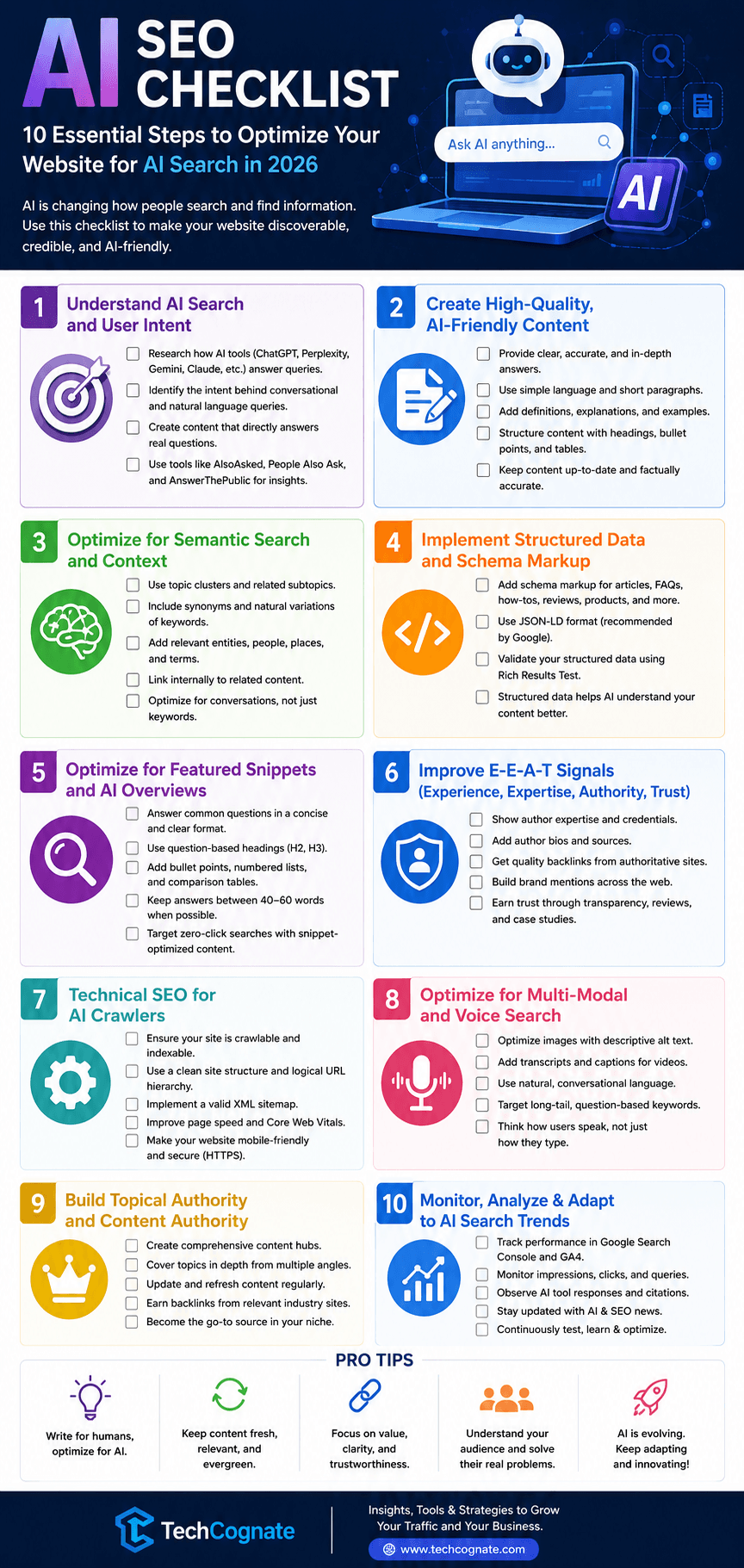
AI SEO Checklist 2026 infographic summarizing technical SEO, schema markup, entity SEO, GEO, and AEO optimization steps for ranking in Google and AI search engines

The 2026 AI SEO Checklist at a glance: technical, on-page, schema, GEO, and AEO essentials.

AI SEO isn’t a replacement for traditional SEO — it’s an evolution of it. The fundamentals still matter: great content, technical excellence, strong authority, and good user experience. What AI SEO adds is a new layer of optimization designed for how AI models discover, retrieve, and cite information.

Why Traditional SEO Alone Isn’t Enough Anymore

Here are the hard numbers: Google AI Overviews now appear in roughly 15–20% of all searches and are growing rapidly. ChatGPT crossed 200 million weekly active users. Perplexity is being integrated into browsers. Voice search on smart devices continues to grow. Zero-click searches — where users get their answer without ever clicking — have crossed 60% of all queries.

The traffic model that SEO was built on is changing. Here’s why traditional SEO alone no longer works:

1. Google AI Overviews Absorb Clicks

When Google generates an AI Overview, the top of the page is dominated by an AI-synthesized answer. Organic results get pushed down. Studies show that click-through rates on traditional organic results drop significantly when an AI Overview appears. Your content needs to be the source that feeds the AI Overview — not just the link below it.

2. Conversational Search Is Growing

People are increasingly asking questions in full sentences — both on Google and on AI platforms. ‘What’s the best CRM for a 10-person startup that already uses Slack?’ is not a keyword. It’s a conversation. Content that’s structured as answers wins in this environment.

3. LLMs Have Their Own Retrieval Preferences

Large language models don’t just look at meta tags and backlinks. They’re trained on vast datasets and updated with real-time retrieval. They favor content that is well-structured, factually dense, entity-rich, clearly attributed, and formatted for easy extraction. A page buried in marketing fluff gets ignored.

4. Zero-Click Searches Are the New Normal

Featured snippets, knowledge panels, People Also Ask boxes, and AI Overviews all deliver answers directly in the search results. If you’re not optimizing for those surfaces, you’re invisible to a growing portion of your potential audience.

5. AI Platforms Are New Discovery Channels

A significant portion of research and product discovery now begins on ChatGPT, Perplexity, or Gemini rather than Google. If your brand isn’t represented in those ecosystems, you’re missing traffic that’s increasingly hard to recover through organic Google SEO alone.

The solution isn’t to abandon what works — it’s to layer AI optimization on top of your existing SEO foundation.

AI SEO Checklist Overview

Before diving into individual sections, here’s your master checklist. Use this as a quick-reference scorecard during audits and planning sessions.

Technical SEO

Website architecture is flat with clear hierarchy
XML sitemap submitted and error-free
robots.txt configured properly
Core Web Vitals pass all thresholds
HTTPS enabled across entire site
Mobile-first and responsive design
Page speed below 2.5s LCP
Crawl budget managed for large sites

Content & On-Page

Search intent matched for every target page
Primary and semantic keywords used naturally
Headings structured logically (H1 → H2 → H3)
Meta titles under 60 characters
Meta descriptions compelling and under 160 characters
Images have descriptive alt text
Content depth matches or exceeds top SERP competitors
Original research, data, or first-hand insights included

Schema Markup

Organization schema on homepage
Article/BlogPosting schema on all posts
FAQPage schema on FAQ sections
BreadcrumbList schema sitewide
Product schema for ecommerce pages
Person schema for author pages

Entity SEO

Author entities established with consistent profiles
Organization entity verified in Google Knowledge Graph
Key topic entities mapped and covered
Semantic relationships between entities built through interlinking

AI & GEO

Content uses clear definitions and direct answers
Key points are in extractable bullet or list format
Statistics and facts are cited with sources
Content is organized into logical, retrievable chunks
AI crawlers (GPTBot, ClaudeBot, PerplexityBot) are allowed in robots.txt

AEO

Question-first headings used throughout content
Featured snippet targets identified and optimized
FAQ sections added to key pages
Voice search query formats addressed

Internal Links

Hub-and-spoke structure implemented
Contextual links use descriptive anchor text
Orphan pages have been eliminated
Navigation reflects site topic clusters

Performance & Conversion

CTA present above the fold
Lead magnets or email capture active
Trust signals (reviews, badges, testimonials) visible
Heatmaps and session recordings implemented

Analytics & Monitoring

Google Analytics 4 configured with conversion events
Google Search Console verified and monitored
AI referral traffic tracked via UTM parameters
Rank tracking for primary keywords active
Content decay audit scheduled quarterly

Technical SEO Checklist

Technical SEO is the foundation of everything else. No amount of great content or smart AI optimization will help if search engines can’t crawl, render, and index your pages. Here’s what to audit and fix.

Website Architecture

A clean site architecture helps search engines understand your content hierarchy — and helps users navigate your site without frustration. After two decades of auditing sites, I can tell you that architecture problems are among the most common and most damaging SEO issues out there.

Flat Architecture

Every important page should ideally be reachable within 3 clicks from the homepage. Deep site structures push PageRank away from your key pages and make crawling less efficient.

Keep category depth to a maximum of 3 levels (Home > Category > Article)
Avoid burying important pages 5–6 clicks deep
Use breadcrumbs to establish hierarchy signals

Topic Clusters and Pillar Pages

Modern SEO is built around topical authority — demonstrating comprehensive expertise across a subject area. Topic clusters are the architecture for that.

Identify 5–10 pillar topics aligned to your audience’s core needs
Create a long-form pillar page for each core topic
Build cluster articles around subtopics, all internally linked back to the pillar
Ensure pillar pages link out to cluster content

URL Structure

URLs should be short, descriptive, and lowercase
Use hyphens to separate words (not underscores)
Avoid dynamic parameters where possible (/page?id=123 is worse than /page-title/)
Include the primary keyword in the URL when natural
Don’t change URLs of ranking pages without 301 redirects

Crawlability

robots.txt is present, valid, and doesn’t block critical pages
XML sitemap is submitted to Google Search Console and Bing Webmaster Tools
Sitemap contains only canonical, indexable URLs
Image sitemap for heavy image sites (news, ecommerce)
Video sitemap for sites with video content
News sitemap for news publishers
RSS feed is live for blog and content updates
Server returns correct HTTP status codes (200, 301, 404, 410)
No crawl traps (infinite pagination, session parameters)

Struggling to get pages crawled or indexed at all? Our website indexing issues guide walks through every diagnostic step, from Search Console coverage reports to soft 404s.

Important note for 2026: AI crawlers have their own user agents. GPTBot (OpenAI), ClaudeBot (Anthropic), PerplexityBot, and Google-Extended all crawl your site separately. Make sure your robots.txt isn’t blocking them — unless you have a specific reason to do so. If your key content relies on JavaScript to render, also check our JavaScript SEO guide, since many AI crawlers don’t execute JS the way Googlebot does.

Pro Tip

Check your robots.txt for “Disallow: /” accidentally applied sitewide. I’ve seen this tank entire domains. Always test with Google Search Console’s robots.txt tester after any change.

Indexability

Canonical tags implemented correctly on all pages
No duplicate content issues (same content on multiple URLs)
Pagination handled with proper rel=next/prev or standalone pages
Noindex used intentionally on thin, duplicate, or private pages
Faceted navigation controlled via robots.txt or noindex to prevent parameter bloat
Hreflang implemented correctly for multilingual sites
404 pages return a true 404 status code (not a soft 404)

Core Web Vitals

For the full breakdown of each metric, testing methods, and exact fixes, see our Core Web Vitals guide.

MetricWhat It MeasuresTarget Threshold
LCP (Largest Contentful Paint)Loading speed of main contentUnder 2.5 seconds
CLS (Cumulative Layout Shift)Visual stability as page loadsUnder 0.1
INP (Interaction to Next Paint)Responsiveness to user inputUnder 200ms
Compress and properly size all images (WebP format preferred)
Implement lazy loading for images below the fold
Enable browser caching and server-side compression (Gzip/Brotli)
Use a CDN for global audiences
Eliminate render-blocking JavaScript and CSS
Minimize third-party scripts (especially analytics and ad tags)
Implement HTTP/2 or HTTP/3 for faster connections
Set explicit width and height attributes on all images to prevent CLS

Common Mistake

Relying solely on PageSpeed Insights scores. Lab scores and field data (CrUX) differ significantly. Always check your Core Web Vitals in Google Search Console under the ‘Core Web Vitals’ report for real-user data.

Content Optimization Checklist

Content quality is the single biggest determinant of long-term SEO success. Not keyword density. Not meta tags. Content that genuinely answers questions, demonstrates expertise, and provides value at a level competitors can’t easily replicate.

Search Intent Matching

Every page must match the search intent of its target keyword — this is non-negotiable. I’ve seen sites with thousands of pages producing zero traffic simply because they matched the wrong intent.

Intent TypeWhat Users WantBest Content Format
InformationalLearn about a topicBlog posts, guides, definitions, tutorials
NavigationalFind a specific websiteHomepage, brand pages
CommercialResearch before buyingComparison pages, reviews, listicles
TransactionalMake a purchase/conversionProduct pages, landing pages, service pages

Content Depth and Comprehensiveness

Analyze the top 5–10 SERP results for your target keyword
Identify subtopics, questions, and angles they cover
Cover all relevant subtopics your competitors cover — then add more
Include original data, case studies, or firsthand observations they don’t have
Add expert quotes, statistics with sources, and practical examples

Content Freshness

Add a ‘Last Updated’ date to evergreen posts and actually update them
Refresh outdated statistics and examples at least annually
Add new sections as the topic evolves
Monitor content decay using Google Search Console impressions over time

Visuals and Media

Add original screenshots, diagrams, or custom images (not stock photos)
Include comparison tables for complex multi-option topics
Use charts or graphs to visualize data
Add video embeds where they enhance understanding
Ensure all images have descriptive, keyword-relevant alt text

Readability and Structure

Write short paragraphs (2–4 sentences maximum)
Use subheadings every 200–400 words to break up content
Include a table of contents on long-form content
Use bold text to highlight key points (but don’t over-use it)
Add summary boxes, key takeaways, and quick-reference sections
Aim for a Flesch-Kincaid Grade Level of 8–10 for most audiences

Readability isn’t just cosmetic — it directly shapes the UX signals that increasingly influence rankings, from time-on-page to scroll depth.

Keyword Research Checklist

Keyword research in 2026 is about understanding topics, questions, and conversational intent — not just matching exact phrases. Here’s a comprehensive approach.

Core Keyword Research

Identify 3–5 primary keywords for each key page
Research secondary keywords and semantic variations
Target long-tail keywords with specific intent
Map question keywords from People Also Ask (PAA) boxes
Include conversational queries as they appear in voice search

AI-Era Keyword Research

Modern keyword research goes beyond keyword tools. Here’s where the best opportunities hide:

Mine Reddit and Quora for how real users phrase their questions
Extract PAA questions from target SERPs
Use keyword tools to find ‘prompt-like’ queries (long, specific questions)
Research what ChatGPT and Perplexity surface when you ask your core topic
Identify ‘vs’ and ‘alternative’ keywords for commercial intent

Keyword Clustering and Mapping

Group keywords into topic clusters (pillar + supporting keywords)
Assign one primary keyword per page — never target the same keyword on multiple pages (cannibalization)
Map keywords to stages of the buyer journey (awareness → consideration → decision)
Identify featured snippet opportunities (definition questions, how-to queries, comparison questions)

Expert Insight

The best keyword research in 2026 combines traditional tools (Semrush, Ahrefs) with AI platform research. Search your topic on ChatGPT and Perplexity and note the subtopics, questions, and cited sources. Those sources represent the content standards you need to match or beat.

If you’re still choosing a keyword research platform, our Ahrefs vs KWFinder and Long Tail Pro vs Ahrefs comparisons break down pricing, keyword databases, and AI search features side by side.

On-Page SEO Checklist

This applies whether you’re on a headless stack or plain WordPress — the fundamentals below hold regardless of platform.

Title Tags

Primary keyword appears near the beginning of the title tag
Title tag is between 50–60 characters (will not be truncated in SERPs)
Title is compelling and click-worthy — not just keyword-stuffed
Each page has a unique title tag

Meta Descriptions

Meta description is 120–155 characters
Includes primary keyword and a value proposition or CTA
Unique for every page on the site
Reads like ad copy — it’s your organic ad text

Headings

One H1 per page (exactly one — not zero, not two)
H1 includes the primary keyword naturally
H2s used for major sections, H3s for sub-sections
Headings read as logical outline when skimmed top-to-bottom
Question-format headings used where appropriate (great for featured snippets)

Images

Descriptive filenames (not DSC1234.jpg — use seo-checklist-2026.jpg)
Alt text describes the image and includes keyword where natural
Images are compressed and in WebP format
Proper width and height attributes set

Internal Links

At least 3–5 contextual internal links on every long-form post
Anchor text is descriptive and keyword-relevant (not ‘click here’)
Links to pillar pages and related cluster content
No broken internal links (audit monthly with Screaming Frog or Sitebulb)

Featured Snippet Optimization

Target question-format H2s and H3s for featured snippets
Provide a concise 40–60 word definition or answer immediately after the question heading
Use numbered lists for step-by-step processes
Use tables for comparison data
Place the target snippet answer in the first 100 words of a section

Entity SEO Checklist

This is one of the most underutilized areas in SEO right now, and one of the most important for AI search. Entities — the people, places, organizations, concepts, and things that Google and AI models understand — are the building blocks of modern search.

Google’s Knowledge Graph contains billions of entities and the relationships between them. When AI models are trained and updated, they’re learning about entities and their attributes. If your brand, your authors, and your key topics aren’t established as clear entities, you’re invisible to a critical layer of how AI search works.

What Are Entities?

An entity is any uniquely identifiable thing — a person, organization, product, place, concept, or event. Google’s NLP (Natural Language Processing) systems identify entities in your content and use those signals to understand what your page is about beyond just keywords.

Organization Entity Checklist

Organization schema on homepage with complete structured data
Consistent NAP (Name, Address, Phone) across all platforms
Google Business Profile verified and fully complete
Wikipedia page or Wikidata entry (if business is notable enough)
Crunchbase, LinkedIn, and industry directories match exactly
Official social profiles linked from homepage
About page clearly describes who you are, what you do, and who you serve

Author Entity Checklist

Every content author has a detailed author page with bio, credentials, and photo
Author pages are linked from every article that author has written
Author has profiles on LinkedIn, Twitter/X, and relevant professional networks
Person schema on author pages
Author has their own Google Knowledge Panel (achieved via consistent entity signals)
Author is quoted or cited on authoritative external sites

Topic Entity Optimization

Identify the core entities your content should be associated with
Use Google’s Natural Language API to check entity detection on your key pages
Ensure your primary entity appears in your first 100 words
Build semantic relationships between entities through interlinking (e.g., ‘SEO’ → ‘keyword research’ → ‘search intent’)
Reference related entities naturally within your content
Cite authoritative sources when discussing entities (Wikipedia, official sites, research papers)

The Entity Authority Framework

Think of entity SEO as building a reputation across three dimensions: 1) Entity Existence (you are known), 2) Entity Attributes (your attributes are accurate and complete), and 3) Entity Relationships (your connections to other entities are clear). Build all three.

Semantic SEO Checklist

Semantic SEO is about context, meaning, and topic relationships — not keyword repetition. Search engines now understand language at a deep level. Your job is to create content that is semantically complete across a topic, not just keyword-dense for a single phrase.

Topic Cluster Strategy

Map your site’s content into clear topic clusters (pillar + supporting articles)
Ensure every cluster article links back to its pillar page
Each pillar page covers the topic comprehensively and links out to all cluster articles
Avoid creating single standalone articles on topics that should be part of a cluster

Semantic Content Coverage

Use LSI (Latent Semantic Indexing) keywords and semantic variations, not keyword stuffing
Cover all major subtopics, questions, and angles within your target topic
Use a tool like SurferSEO, Clearscope, or Frase to ensure semantic coverage
Reference related concepts, tools, and entities naturally
Include synonyms and varied phrasing throughout the content

NLP and Vector Search Optimization

Modern search uses vector embeddings to match content meaning to query meaning. This means:

Content that’s semantically deep ranks better than content that’s keyword-dense
Use clear, declarative sentences — they’re easier for NLP to parse
Avoid ambiguous pronouns and unclear references
Define key terms explicitly in your content
Use a consistent vocabulary for your core topic across all cluster content

Schema Markup Checklist

Schema markup is the clearest signal you can send to search engines and AI models about what your content means. Don’t skip it. For a full JSON-LD-by-JSON-LD walkthrough, see our schema markup guide.

Essential Schema Types

Organization — homepage, sitewide
WebSite — homepage with SearchAction for sitelinks search box
BreadcrumbList — sitewide for navigation
Article or BlogPosting — all editorial content
Person — author pages
FAQPage — pages with FAQ sections
HowTo — step-by-step tutorials and guides
Product — ecommerce product pages
AggregateRating / Review — where reviews are displayed
Video — pages with embedded video content
ImageObject — for important images

Advanced Schema Types

SoftwareApplication — SaaS and app pages
Course — educational content and training
Event — events and webinars
LocalBusiness — local business pages
Service — service description pages
Speakable — mark content ideal for voice assistants to read
Dataset — data and research pages
CollectionPage — category and archive pages
ItemList — top list articles and comparison pages
MedicalWebPage — health content (must comply with YMYL guidelines)

Schema Implementation Best Practices

Use JSON-LD format (preferred by Google and AI crawlers)
Validate all schema using Google’s Rich Results Test
Use Schema.org vocabulary — never invent custom types
Nest related schema types (e.g., Article with Author as Person)
Keep schema data consistent with visible on-page content
Monitor Rich Results in Google Search Console regularly

On WordPress, a plugin like Rank Math (see our Rank Math review) can generate most of this automatically — just never run two schema plugins at once, since conflicting output creates duplicate blocks.

2026 Note

AI crawlers increasingly use schema markup to understand content structure and relationships. FAQPage and Speakable schema are particularly valuable for GEO and AEO optimization.

GEO: Generative Engine Optimization Checklist

Generative Engine Optimization (GEO) is the practice of optimizing your content to be retrieved and cited by AI-generated answers in platforms like Google AI Overviews, ChatGPT, Perplexity, Gemini, and others. It’s the newest frontier in SEO — and the one most people are behind on.

Here’s what I call the Retrieval-Ready Content Framework: content that is factually dense, well-structured, clearly sourced, and organized into retrievable chunks gets cited. Content that buries its insights in marketing fluff doesn’t.

Content Structure for AI Retrieval

Organize content into clear, self-contained sections (each H2/H3 section should answer a specific question)
Place the most important answer or definition within the first 2–3 sentences of each section
Use bullet points and numbered lists to make key information easy to extract
Include tables for comparative and structured data
Add ‘Key Takeaway’ or ‘Summary’ boxes at the end of major sections

Factual Density and Citations

Include specific statistics, numbers, and data points (not vague statements)
Cite sources for all statistics and claims (links to primary research, official data)
Include dates for statistics and research findings
Reference expert opinions and authoritative sources
Avoid filler content — every paragraph should add information value

Entity-Rich Writing

Name specific tools, platforms, people, and organizations — don’t be vague
Define technical terms explicitly within your content
Connect entities to each other (e.g., ‘Google’s RankBrain algorithm…’)
Use consistent naming for your key entities across all content

AI Crawler Access

GPTBot (OpenAI) is NOT blocked in robots.txt
ClaudeBot (Anthropic) is NOT blocked in robots.txt
PerplexityBot is NOT blocked in robots.txt
Google-Extended is allowed (controls Google AI training, separate from Search)
CCBot (Common Crawl) is allowed
Content is not behind a login, paywall, or JavaScript that AI crawlers can’t render

The AI Visibility Pyramid

Think of AI visibility as a pyramid with three levels:

Level 1 (Foundation): Your content is crawlable and indexable by AI crawlers
Level 2 (Recognition): Your content is factually dense enough for AI to cite
Level 3 (Authority): Your brand is mentioned and cited across multiple authoritative sources, making AI models trust you as a primary source

Framework

The Citation Optimization System — 1) Create citable facts (original data, clear definitions, step-by-step processes). 2) Structure them for extraction (clear headings, bullets, tables). 3) Build your citation profile (external citations signal trust). 4) Monitor AI citations (track when AI platforms reference your brand or content).

Want to see where you actually stand today? Our GEO Scorecard benchmarks AI search visibility across ChatGPT, Gemini, Perplexity, Claude, and Google AI Overviews, and shows how your citation rate compares to category norms.

AEO: Answer Engine Optimization Checklist

Answer Engine Optimization focuses on optimizing content to appear in direct answer formats — featured snippets, People Also Ask boxes, voice search results, and AI Overviews. Here’s the Answer Layer Framework: every major section of your content should function as a standalone answer to a specific question.

Question-First Content Structure

Use question-format headings for all informational content
Provide a concise 40–60 word answer immediately after each question heading
Follow the concise answer with expanded explanation and supporting detail
Target ‘what is’, ‘how to’, ‘why’, ‘when’, and ‘which’ question formats

FAQ Optimization

Add FAQ sections to all key commercial and informational pages
Target questions from People Also Ask in Google SERPs
Use FAQPage schema on pages with FAQ sections
Answers should be 40–100 words — concise and complete
Include both basic and advanced questions to capture different intent levels

Voice Search Optimization

Target conversational, long-tail question keywords
Structure answers in natural spoken language
Optimize for local voice queries (‘near me’, ‘open now’, ‘best [X] in [city]’)
Use schema markup for business hours, addresses, and services

Featured Snippet Targeting

Use Semrush or Ahrefs to identify featured snippet opportunities in your niche
Format content to match the snippet type (paragraph, list, or table)
Include the target keyword in the heading immediately above your answer
Write snippet content at a 6th–8th grade reading level for clarity

AI SEO: Platform-Specific Optimization Checklist

Each major AI platform has different content preferences, update cycles, and citation patterns. Here’s what you need to know.

ChatGPT Optimization (OpenAI)

Ensure GPTBot is allowed in robots.txt
Content should be factual, well-structured, and clearly attributed
Aim to be cited in external sources that ChatGPT uses as training data
Build brand presence on high-authority sites (Wikipedia, authoritative industry sites)
Create comprehensive content that defines concepts in your niche

Perplexity Optimization

Perplexity cites sources in real-time — fast-loading pages help
Content must be clearly indexed and publicly accessible
Structure content with clear headings and bullet points
Perplexity favors content from established, authoritative domains
Ensure your page titles and meta descriptions clearly indicate the topic

Google AI Overviews

Be in the top 10 organic results for target queries (most AI Overview sources rank there)
Use structured data to make content relationships explicit
Answer questions concisely in dedicated sections
High EEAT signals correlate strongly with AI Overview citations
Keep pages fast — Google AI Overviews are generated in real-time

Claude (Anthropic) Optimization

Ensure ClaudeBot is not blocked in robots.txt
High-quality, well-sourced, factually accurate content performs best
Clear organization and logical flow improve retrieval
Author credentials and EEAT signals matter significantly

Gemini (Google) Optimization

Gemini uses Google Search as its primary data source — traditional SEO matters
Schema markup helps Gemini understand structured data
Authority and trust signals align with Google’s core ranking factors
SGE/AI Overview optimization strategies apply equally to Gemini
AI PlatformPrimary Content SignalsKey Optimization Action
ChatGPTTraining data coverage, external citationsBe cited on authoritative external sources
PerplexityReal-time web crawl, authority, structureFast site, clear structure, allow PerplexityBot
Google AI OverviewsTop organic rankings + EEAT + schemaRank well + structured content + schema
ClaudeQuality, accuracy, structureAllow ClaudeBot, high-quality EEAT content
GeminiGoogle Search signalsTraditional SEO + schema + EEAT
CopilotBing index + web crawlOptimize for Bing, allow BingBot

Programmatic SEO Checklist

Programmatic SEO is the practice of creating large numbers of pages at scale using templates and data, targeting long-tail keyword clusters that would be impractical to write manually.

When Programmatic SEO Makes Sense

Location-based pages (e.g., ‘SEO services in [city]’)
Comparison pages (e.g., ‘[Tool A] vs [Tool B]’)
Category and collection pages for ecommerce
Industry-specific landing pages
Template-based guides (e.g., ‘[Job Title] interview questions’)

Quality Safeguards

Every programmatic page must provide genuine, unique value
Avoid thin pages with no meaningful content beyond the template
Include unique data, user-generated content, or dynamic data per page
Review a random sample of 50+ pages quarterly for quality
Implement noindex on any page that doesn’t have enough substance

Technical Implementation

Canonicalize similar pages where appropriate
Set up robust internal linking between related programmatic pages
Monitor for indexation issues (Google doesn’t need to index every page)
Implement crawl budget management for very large sites (100k+ pages)

Internal Linking Checklist

Internal linking is one of the most underused SEO levers available. Done correctly, it distributes page authority, reinforces topical relevance, helps search engines discover new content, and improves user experience.

Hub-and-Spoke Architecture

Identify your hub (pillar) pages — the comprehensive resources at the center of each topic cluster
Ensure every cluster article links back to its hub page
Hub pages link out to all relevant cluster articles
Navigation and category pages serve as authority hubs

Contextual Linking

Every long-form article should have 3–8 contextual internal links
Link from high-authority pages to pages you want to boost
Use descriptive, keyword-rich anchor text (not generic ‘click here’)
Vary anchor text — don’t use the exact same anchor text repeatedly
Place links where they add genuine value to the reader’s journey

Orphan Page Elimination

Run a crawl audit (Screaming Frog, Sitebulb) to identify orphan pages
Every published page should receive at least one internal link
Add new content to relevant hub pages and navigation menus

Our own SEO audit framework includes a dedicated orphan-page detection pass as part of every technical review — it’s one of the highest-ROI fixes on this whole list.

Link Equity Flow

High-authority pages (lots of backlinks) should link to pages you want to rank
Avoid linking to pages with noindex tags
Monitor anchor text distribution to avoid over-optimization

EEAT Checklist

EEAT — Experience, Expertise, Authoritativeness, and Trustworthiness — is Google’s framework for evaluating content quality, and it’s become increasingly important as AI-generated content floods the web. AI search platforms also use EEAT-like signals to determine which sources to cite.

Experience

Content reflects first-hand, direct experience with the topic
Include personal observations, lessons learned, and specific examples
Add photos, screenshots, or original media that demonstrate hands-on experience
Case studies and real-world examples establish experience credibility

Expertise

Authors have verifiable credentials and professional experience
Author bios prominently display credentials, experience, and qualifications
Expert authors are cited or linked to from external authoritative sources
Content demonstrates depth of knowledge beyond surface-level coverage

Authoritativeness

Site has earned backlinks from respected industry publications
Brand is mentioned on authoritative third-party sites
Authors contribute to respected external publications
Organization is recognized by industry associations and directories

Trustworthiness

Site has a clear About page with company information
Contact page with accessible contact details
Privacy policy and terms of service are published
Editorial policy or methodology is explained
Sources and citations are linked for all factual claims
Corrections policy for when errors are identified
HTTPS enabled sitewide
Secure, legitimate payment processing for ecommerce

Link Building Checklist

Links still matter. Quality over quantity — always. Here’s a framework for sustainable, white-hat link acquisition. For the full playbook with outreach scripts and cost breakdowns, see our 11 proven link building strategies guide.

Content-Driven Link Acquisition

Create original research studies with citable data
Build free tools, calculators, and interactive resources
Publish comprehensive statistics roundup pages
Write definitive guides that become reference resources in your industry
Create visual assets (infographics, diagrams) that others want to embed

Digital PR

Respond to journalist requests (HARO alternatives: Qwoted, Terkel, ProfNet)
Issue press releases for genuine company news
Partner with industry publications for contributed articles
Be featured in industry podcasts with show notes links

Relationship-Based Links

Build genuine relationships with industry peers and thought leaders
Participate in expert roundups and contribute meaningfully
Seek co-marketing opportunities with complementary brands
Sponsor relevant industry events and communities

Technical Link Acquisition

Identify and reclaim unlinked brand mentions
Find and replace competitor broken links with your content
Get listed in relevant resource pages and industry directories
Audit lost links and work to recover high-value ones

Local AI SEO Checklist

Local SEO is increasingly influenced by AI — especially with Google AI Overviews now appearing for local search queries and AI assistants answering ‘best [X] near me’ questions.

Google Business Profile is verified, complete, and regularly updated
NAP (Name, Address, Phone) is exactly consistent across all citations
LocalBusiness schema on homepage and all location pages
GeoCoordinates included in schema
Reviews actively managed and responded to on all platforms
Local landing pages created for each service area
Location-specific content goes beyond just replacing the city name
Local entity associations (Chamber of Commerce, local directories)
Service area pages are unique and locally relevant — not copy-paste
Geo entities referenced naturally in content (neighborhood names, local landmarks)

Ecommerce AI SEO Checklist

Ecommerce SEO has its own demands — managing product schemas, duplicate content across variants, and optimizing for both shopping and informational intent.

Product Page Optimization

Unique, comprehensive product descriptions for every product
Product schema with all required properties (name, image, price, availability, SKU)
AggregateRating schema for products with reviews
Offer schema with pricing, currency, and availability
MerchantReturnPolicy schema for return information
ShippingDetails schema for shipping options

Category and Collection Pages

Unique, keyword-optimized category page descriptions (at least 150 words)
CollectionPage schema on category pages
Faceted navigation controlled to prevent duplicate content
Product filters don’t create crawlable parameter pages

Ecommerce Content Strategy

Buying guides for major product categories
Comparison pages for key product decisions
FAQ pages addressing pre-purchase questions
User-generated content (reviews, Q&A) integrated on product pages
Video content for product demonstrations

Merchant Center and Shopping

Google Merchant Center feed is accurate and complete
Product data includes GTINs, MPNs, and brand information
Supplemental feeds used to add missing attributes
Custom labels applied for campaign segmentation
Image quality meets Google’s requirements

AI Content Quality Checklist

AI writing tools are now standard in content production. The challenge is using them without creating generic, undifferentiated content. Here’s how to use AI responsibly while maintaining quality and authenticity.

Responsible AI Content Use

AI-generated content is always reviewed and edited by a human expert
Factual claims are verified — AI models hallucinate, and publishing false data is damaging
Original insights, opinions, and firsthand experience are added by human authors
AI-generated content is not published verbatim without significant human editing
Unique examples, case studies, and perspectives are added that AI can’t provide

Quality Signals in AI-Edited Content

Content sounds like it was written by a specific human voice, not a generic AI
No generic transitions like ‘In conclusion’ or ‘Moreover’ without good reason
Statistics and data are accurate and from credible, linkable sources
Technical claims are verified against authoritative references
Content passes an ‘expert review’ — would a subject matter expert find this accurate and valuable?

Important

Google’s helpful content system doesn’t penalize AI-assisted content — it penalizes unhelpful content. AI-assisted content that demonstrates expertise, provides genuine value, and shows firsthand knowledge ranks well. AI content that’s generic, repetitive, and adds nothing new does not.

CRO (Conversion Rate Optimization) Checklist

SEO gets visitors to your site. CRO turns them into leads and customers. Both disciplines need to work together.

Page Design and CTAs

Primary CTA is visible above the fold without scrolling
CTA text is specific and action-oriented (not just ‘Submit’ — try ‘Get Your Free SEO Audit’)
CTA button contrasts visually with the page background
One primary CTA per page — don’t confuse visitors with multiple competing actions

Trust Signals

Testimonials and reviews near key CTAs
Trust badges (SSL, payment security, industry associations) visible on relevant pages
Case studies and results data on commercial pages
Author credentials visible on content pages
Social proof indicators (subscriber counts, client numbers) if strong

Lead Generation

Lead magnets (guides, templates, tools) offered in exchange for email
Email capture forms are short (name + email is the sweet spot)
Content upgrades relevant to specific posts
Exit-intent popups tested for performance

Testing and Optimization

Heatmap and session recording tools installed (Hotjar, Microsoft Clarity)
A/B tests running on key landing pages
Form analytics tracking where users abandon
Page-level revenue attribution tracked in GA4

Analytics & Monitoring Checklist

Core Analytics Setup

Google Analytics 4 installed with proper conversion event configuration
Google Search Console verified with primary and secondary domains/subdomains
Bing Webmaster Tools verified
GA4 linked to Google Search Console for combined reporting
Key events tracked: form submissions, CTA clicks, file downloads, purchases

AI Traffic Tracking

Traditional referral tracking often doesn’t capture AI-driven traffic accurately. Much of this monitoring can be automated — see our guide on combining APIs for SEO automation for a working pipeline. Here’s how to monitor it manually:

Check referral sources in GA4 for chatgpt.com, perplexity.ai, claude.ai, and bard.google.com
Create UTM parameters for any trackable links on AI platforms
Monitor Google Search Console for branded queries increasing (indicates AI brand building)
Track ‘dark social’ traffic spikes that may come from AI platform referrals

SEO Performance Monitoring

Primary keyword rankings tracked weekly (Semrush, Ahrefs, or Rank Tracker)
Organic traffic trends monitored weekly in GA4
Click-through rates (CTR) monitored in Google Search Console
Core Web Vitals monitored in Search Console
Crawl errors checked weekly in Search Console

For the specific numbers worth tracking and why, see our 17 SEO KPIs that actually matter in 2026.

Content Decay Monitoring

Monthly report on pages losing impressions or rankings
Quarterly audit of evergreen content for freshness
Identify and refresh content drops of 20%+ in organic traffic

Monthly AI SEO Maintenance Checklist

Weekly Tasks

Review Google Search Console for crawl errors and manual actions
Monitor Core Web Vitals reports
Check primary keyword rankings
Review GA4 for traffic anomalies
Publish new content or update existing content

Monthly Tasks

Full crawl audit to identify broken links and 404 errors
Review and respond to all online reviews
Check for content decay (significant ranking drops)
Audit internal link structure for new content
Review AI referral traffic in GA4
Update statistics or examples in top-performing posts
Submit updated sitemap to Search Console after major content additions

Quarterly Tasks

Full technical SEO audit (crawlability, indexability, speed, schema)
Review and update schema markup across key page types
Keyword gap analysis vs. top competitors
Content audit: identify and consolidate thin content
Backlink audit: disavow toxic links if necessary
Review and update AI crawler access in robots.txt
Test site on new AI platforms to see how your brand is represented

Annual Tasks

Comprehensive EEAT audit across all content
Review and refresh all evergreen pillar content
Competitive landscape analysis
SEO tool subscription and workflow review
Update author bios and credentials

30 Common AI SEO Mistakes to Avoid

After auditing hundreds of websites, these are the mistakes I see most often. Learning from them is faster than making them yourself.

1
Blocking AI crawlers in robots.txt — GPTBot, ClaudeBot, PerplexityBot need access to your content to cite you.
2
Publishing AI-generated content without human editing — generic AI writing fails the helpful content test.
3
Targeting keywords without matching search intent — even perfect content fails if intent is wrong.
4
Ignoring entity optimization — brands without established entity signals are invisible to AI search.
5
No schema markup — you’re giving up structured data signals that competitors are using.
6
Keyword cannibalization — multiple pages competing for the same keyword splits your authority.
7
Thin category pages with no unique content — a heading and a product grid doesn’t rank.
8
Using exact-match anchor text for all internal links — this looks unnatural and over-optimized.
9
Not having author pages or author schema — critical for EEAT signals in competitive niches.
10
Ignoring Core Web Vitals — page experience signals affect rankings and user engagement.
11
No FAQPage schema on pages with FAQ sections — low-hanging GEO and AEO fruit.
12
Duplicate meta descriptions across pages — every page needs a unique, compelling meta description.
13
Orphan pages with no internal links — they don’t rank because they receive no authority.
14
Outdated content without freshness signals — add ‘Last Updated’ dates and actually update.
15
Ignoring featured snippet optimization — structured question-answer format wins snippets.
16
Not monitoring AI referral traffic — you can’t measure what you don’t track.
17
Blocking faceted navigation parameters without auditing — you might be hiding valuable pages.
18
Treating every page as equally important — prioritize crawl budget on high-value pages.
19
Not having a clear editorial policy — trust signals matter more than ever with AI content.
20
Ignoring Bing and alternative search engines — Bing powers Copilot and is growing in AI search relevance.
21
No mobile optimization — Google indexes mobile-first; AI crawlers also prioritize mobile-responsive content.
22
Using JavaScript for critical content without SSR — many AI crawlers don’t execute JavaScript.
23
Inconsistent NAP data — local businesses suffer from this more than they realize.
24
Not conducting regular link audits — toxic links can accumulate and drag rankings.
25
Ignoring content decay — a post that was great two years ago might be failing today.
26
No clear topic clusters — scattered content without architecture loses to focused competitors.
27
Publishing content that adds nothing new — depth and originality differentiate in AI search.
28
Not citing sources for statistics — uncited claims reduce trust for both humans and AI models.
29
Forgetting about CRO — more traffic means nothing if it doesn’t convert.
30
Treating AI SEO as a one-time project — it requires ongoing attention as the landscape evolves.

AI SEO Tools Reference

CategoryToolsBest For
Keyword ResearchSemrush, Ahrefs, Moz Pro, UbersuggestFinding and clustering keywords, competitor gaps, PAA mining
Technical SEOScreaming Frog, Sitebulb, DeepCrawlSite audits, crawl analysis, duplicate content detection
Content OptimizationClearscope, SurferSEO, Frase, MarketMuseSemantic coverage, NLP optimization, topic depth scoring
Schema MarkupSchema App, RankRanger, WordLiftSchema generation, validation, entity markup
Entity AnalysisGoogle NLP API, WordLift, InLinksEntity detection, knowledge graph building, internal link optimization
Internal LinkingLinkWhisper, InLinks, SitebulbAutomated suggestions, orphan page detection, anchor text analysis
Rank TrackingSemrush, Ahrefs, AccuRanker, SERPWatcher — see our Ahrefs vs Semrush vs Moz vs SpyFu comparisonDaily/weekly rank monitoring, SERP feature tracking
AI OptimizationSearch Atlas, Otterly.ai, ProfoundAI citation monitoring, GEO/AEO analysis
AnalyticsGoogle Analytics 4, Hotjar, Microsoft ClarityTraffic analysis, heatmaps, conversion tracking
Local SEOBrightLocal, Moz Local, WhitesparkCitation management, review monitoring, local ranking

Frequently Asked Questions

What is AI SEO and how is it different from traditional SEO?

AI SEO is the practice of optimizing your website to be found and cited by both traditional search engines and AI-powered platforms like ChatGPT, Perplexity, and Google AI Overviews. Traditional SEO focuses on ranking in organic search results. AI SEO extends that goal to include being retrieved and cited by language models. The fundamentals overlap — quality content, technical excellence, and authority matter for both — but AI SEO adds optimization layers for content structure, entity clarity, schema markup, and AI crawler access.

Does AI SEO replace traditional SEO?

No. AI SEO builds on top of traditional SEO — it doesn’t replace it. Technical SEO, quality content, backlinks, and user experience are still foundational. AI SEO adds new optimization layers for the AI search ecosystem. Sites that master both will outperform those that focus on only one.

How do I get my content cited in ChatGPT or Perplexity?

You need three things: 1) Your content must be crawlable by the AI’s crawler (GPTBot for ChatGPT, PerplexityBot for Perplexity — check your robots.txt). 2) Your content must be authoritative — cited by other reputable sources, well-structured, and factually accurate. 3) Your content must be formatted for easy extraction — clear headings, bullet points, definitions, and structured answers. Being cited on authoritative external sites that AI models trust is one of the most powerful signals.

Should I block AI crawlers in my robots.txt?

In most cases, no. Blocking AI crawlers prevents your content from being cited in AI-generated answers — which is increasingly valuable traffic. The exception might be if you have a content business model that relies on keeping content gated, or if you’re concerned about AI training on your proprietary content. If you want to prevent training use specifically, you can block Google-Extended (controls AI training, not Search), but allow AI search crawlers.

What is GEO (Generative Engine Optimization)?

GEO is the practice of optimizing content to be retrieved and cited by AI-generated answer systems like Google AI Overviews, ChatGPT, and Perplexity. Key GEO techniques include creating factually dense, well-sourced content, using clear headings and bullet points, including specific statistics and definitions, and building authority through external citations. GEO focuses on making your content the best possible source for AI systems to cite.

What is AEO (Answer Engine Optimization)?

AEO focuses on optimizing content to appear in direct answer formats — featured snippets, People Also Ask boxes, voice search results, and knowledge panels. Key AEO techniques include using question-format headings, providing concise 40–60 word answers immediately after question headings, adding FAQPage schema, and targeting ‘what is’, ‘how to’, and ‘why’ style queries.

How important is schema markup for AI SEO?

Very important. Schema markup provides explicit, machine-readable context about your content that both search engines and AI crawlers can use without interpretation. FAQPage schema helps AI systems identify question-answer pairs. Organization and Person schema establish entity signals. Article schema signals content freshness. JSON-LD is the preferred format. Validate all schema in Google’s Rich Results Test and monitor performance in Search Console.

What is entity SEO and why does it matter?

Entity SEO is the practice of ensuring that the key entities in your content — your brand, your authors, your key topics, and related concepts — are clearly identified and connected in ways that search engines and AI models can understand. Google’s Knowledge Graph and AI language models both use entity relationships to understand content meaning. Sites with well-established entity signals rank better and get cited more in AI search.

How do I optimize for Google AI Overviews?

Google draws most AI Overview sources from the top 10 organic results — so ranking well matters. Beyond that: use FAQPage and Speakable schema, structure content with clear question-answer formats, provide concise and accurate answers, build strong EEAT signals, and use entity-rich content with schema markup. Monitoring your AI Overview appearances in Search Console and Semrush can help identify what’s working.

How should I use AI writing tools responsibly for SEO?

Use AI tools for research, outlines, drafts, and ideation — but always edit, fact-check, and add human expertise. Google’s systems evaluate content quality, not the tool used to create it. AI-assisted content that’s accurate, demonstrates expertise, and provides genuine value ranks well. AI-generated content published without editing, full of generic statements and unverified claims, does not.

What Core Web Vitals thresholds should I be targeting?

LCP (Largest Contentful Paint) under 2.5 seconds, CLS (Cumulative Layout Shift) under 0.1, and INP (Interaction to Next Paint) under 200ms. These are Google’s ‘Good’ thresholds. Target them using field data from Google Search Console’s Core Web Vitals report — lab scores from PageSpeed Insights don’t always reflect real user experience.

What is topical authority and how do I build it?

Topical authority is the degree to which your site is recognized as a comprehensive, trustworthy source on a specific subject area. You build it by creating content clusters — a pillar page on the main topic, supported by cluster articles on every related subtopic — with robust internal linking between them. The goal is to have the most complete coverage of your topic area of any site on the web within your niche.

How do I track traffic coming from AI platforms?

In Google Analytics 4, check your Acquisition > Traffic Acquisition report for referral sources including chatgpt.com, perplexity.ai, claude.ai, and gemini.google.com. This traffic is often underreported because some AI platforms strip referral data. Monitor branded search query volume in Google Search Console as a proxy — AI visibility tends to drive branded searches upward. Tools like Otterly.ai and Profound are emerging specifically for AI citation tracking.

How often should I update my SEO strategy?

Core technical and content fundamentals change slowly, but AI search evolves rapidly. Review your technical setup quarterly, refresh key content annually (or when rankings drop), and monitor the AI search landscape monthly. Major Google algorithm updates, new AI platform launches, and changes in SERP features can all require strategic adjustments.

What is the most impactful thing I can do for AI SEO right now?

If I had to pick one thing: create genuinely comprehensive, original, well-structured content on your core topics and ensure it’s accessible to AI crawlers. More than any other single factor, the combination of content quality + AI crawlability determines whether you get cited in AI search results. Everything else — schema, entities, internal links — amplifies that foundation.

Conclusion: Build for Both Humans and AI

SEO is evolving — but it’s not dying. What’s changing is the landscape you’re competing in. Your content no longer just needs to rank in 10 blue links. It needs to be retrieved by AI models, cited in AI Overviews, answered by voice assistants, and discovered across a growing ecosystem of AI-powered search experiences.

The good news: the fundamentals that made great SEO work before still work now. Comprehensive, original, authoritative content. Technical excellence. Strong trust signals. Smart internal linking. These aren’t going anywhere.

What AI SEO adds is a new layer: entity clarity, structured data, AI crawler access, retrieval-ready formatting, and optimization for the specific preferences of each major AI platform. Sites that master both dimensions — traditional SEO and AI SEO — will be positioned to win regardless of how search evolves.

Here’s the mindset shift I’d encourage: stop thinking about ranking in a search result and start thinking about being the best answer available on your topic. In a world where AI synthesizes answers from multiple sources, being the authoritative, well-structured, widely-cited source is more valuable than being #1 for a single keyword.

Use this checklist as a living document:

Run through the full checklist at least once a quarter
Use it to prioritize your highest-impact SEO actions
Share it with your content team, developers, and stakeholders
Revisit it as AI search continues to evolve

The websites that will dominate AI search in 2026 and beyond are those being built today — with great content, technical precision, and a deep understanding of how AI systems discover and trust information.

Start with one section. Build momentum. Stay consistent. SEO still rewards the patient and the thorough.

— Jaykishan Panchal, TechCognate

Complete AI SEO Audit Checklist

Use this as your master audit worksheet. Work through each category and check off items as you confirm they’re implemented correctly.

Technical SEO

Flat site architecture (3 clicks or fewer to key pages)
robots.txt valid and not blocking important pages
XML sitemap submitted and error-free
HTTPS enabled sitewide with valid certificate
LCP under 2.5 seconds
CLS under 0.1
INP under 200ms
Images compressed and in WebP format
No orphan pages
No broken links
No crawl traps
Canonical tags implemented correctly
AI crawlers (GPTBot, ClaudeBot, PerplexityBot) allowed

Content & On-Page

Every page targets a single primary keyword
Title tags 50–60 characters with primary keyword
Meta descriptions 120–155 characters, unique, compelling
One H1 per page with primary keyword
Subheadings used every 200–400 words
Images have descriptive alt text
Content depth matches or exceeds competitors
Original data, examples, or insights included
Content matches search intent of target keyword

Schema Markup

Organization schema on homepage
Article/BlogPosting schema on all editorial content
FAQPage schema on pages with FAQ sections
BreadcrumbList schema sitewide
Person schema on author pages
Product schema on ecommerce product pages
All schema validated in Rich Results Test

Entity & EEAT

Author pages created for all content contributors
Author pages have schema and link to all articles
About page clearly establishes organization identity
Contact page accessible from navigation
Privacy policy and terms of service published
Sources cited for all factual claims
Brand mentioned on authoritative external sites

AI & GEO

AI crawlers allowed in robots.txt
Content uses question-first headings
Concise definitions provided for key concepts
Statistics cited with source links
Key information in bullet or list format
FAQPage schema implemented
AI referral traffic tracked in GA4

Internal Linking

Topic clusters implemented with hub pages
Every cluster article links to hub page
Hub pages link to all cluster articles
3–8 contextual internal links per long-form post
Descriptive anchor text used throughout
No broken internal links

Analytics & Monitoring

Google Analytics 4 installed with conversion events
Google Search Console verified and linked to GA4
Primary keyword rankings tracked weekly
Core Web Vitals monitored in Search Console
AI referral sources monitored in GA4
Content decay audit scheduled quarterly
About the Author

Jaykishan

Collaborator & Editor

Leave a Reply

Related articles

We would love to learn more about your digital goals.

Book a time on my calendar and you will receive a calendar invite.

Scale Your Business