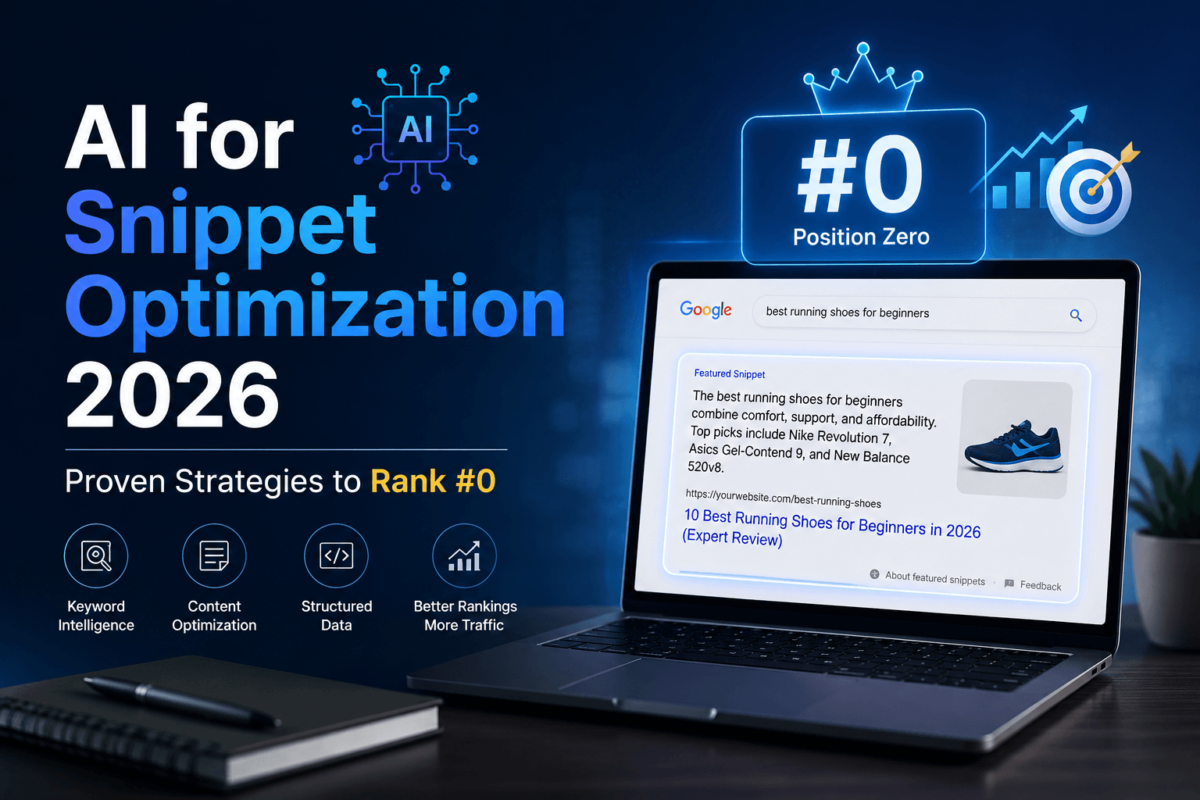
AI snippet optimization is the practice of structuring your content so that Google, ChatGPT, Perplexity, and SGE can instantly extract and display your answer above all other results. In 2026, ranking #0 is no longer about keywords alone — it’s about writing in a format AI models can parse, trust, and cite. Get this right, and one page can dominate both traditional search and every major AI engine at once.
- ✓ AI models choose answers based on structure and clarity, not keyword density
- ✓ Featured snippets, SGE panels, and ChatGPT citations all pull from the same content signals
- ✓ The most effective snippet content uses direct answer blocks, numbered steps, and definition-style formatting
- ✓ Most blogs fail because they bury answers — AI rewards content that leads with the answer
- ✓ Tools like Surfer SEO, Clearscope, and AI writing assistants help you identify and format snippet opportunities faster
- ✓ Optimizing for AEO (Answer Engine Optimization) and GEO (Generative Engine Optimization) is no longer optional in 2026
- ✓ A single well-optimized page can earn #0 on Google and appear verbatim in ChatGPT, Perplexity, and SGE panels simultaneously
- What Is AI Snippet Optimization?
- How AI Chooses Featured Snippets
- Types of Snippets You Can Target
- Why Most Content Fails to Rank #0
- Proven AI Strategies to Win Featured Snippets in 2026
- Step-by-Step: How to Optimize Any Page for Snippet Ranking
- Traditional SEO vs AI Snippet Optimization
- FAQs
- Final Thoughts
What Is AI Snippet Optimization?
Here’s the thing — most people still think snippet optimization is just about adding an H2 with a question and answering it below. That was 2019 thinking. In 2026, the game is completely different.
AI snippet optimization means formatting your content so that large language models and search algorithms can instantly identify, extract, and present your answer. It covers Google Featured Snippets (the #0 position), AI Overviews in Search Generative Experience (SGE), and citations inside ChatGPT and Perplexity responses.
The core idea: AI doesn’t read your page the way a human does. It scans for structure. If your answer is buried in paragraph three after two sentences of intro fluff, it gets skipped. If your answer leads the paragraph, is under 60 words, and uses clear sentence structure — it gets pulled.
How AI Chooses Featured Snippets (This Is What Most People Miss)
From experience, this is the section that changes everything for people. Google and AI tools don’t pick snippets randomly. They use a predictable set of signals.
- → A direct answer to the question within the first 1–2 sentences of a section
- → Content length between 40–60 words for paragraph snippets
- → Numbered or bulleted lists for “how to” and “best of” queries
- → Tables for comparison queries
- → Definition-style formatting for “what is” queries
- → Pages that already rank in positions 1–5 for the target keyword
💡 Why does this matter? Google’s algorithm and AI chat tools both use similar extraction logic. If you write for one, you’re writing for all of them. That’s the leverage point.
Types of Snippets You Can Target
Why Most Content Fails to Rank #0
Most people get this wrong: they write for humans first, AI second. In 2026, you need to do both simultaneously — and it’s easier than it sounds.
- Burying the answer: Two paragraphs of context before the actual answer. AI skips it.
- Vague headings: “Tips for Better SEO” tells AI nothing. “How to Optimize for Google Featured Snippets in 2026” is extractable.
- Walls of text: No breaks, no bullets, no structure. Machines hate it.
- Over-optimized keywords: Keyword stuffing signals low quality to AI models.
- No answer block: Content that explains but never directly answers the core question.
“SEO has changed a lot over the years. With the rise of AI and machine learning, search engines are getting smarter. In this post, we’ll explore some strategies that might help you get better rankings…”
“AI snippet optimization is the process of formatting web content so search engines and AI models can extract and display it as a direct answer. To rank #0, lead with a 40–60 word answer, use clear structure, and target question-based queries.”
Proven AI Strategies to Win Featured Snippets in 2026
A The Answer Block Formula
Every section targeting a snippet should start with what I call an Answer Block: a 40–60 word paragraph that directly answers the question posed in the heading above it. No preamble. No “great question.” Just the answer.
Format: [Topic] is/means/works by [direct explanation]. [One sentence of supporting context]. [One practical implication].
B AI-Friendly Formatting Rules
- → Use question-based H2s (“How does X work?” not “Understanding X”)
- → Follow every H2 with an Answer Block
- → Use numbered lists for any process with more than 2 steps
- → Keep paragraphs to 2–3 sentences maximum
- → Bold the core term in the first sentence of definition sections
- → Add a comparison table wherever you compare two or more options
C Reverse-Engineering Snippets
What actually works is starting from the snippet you want to win, not the keyword. Search your target query on Google. If there’s already a featured snippet, that’s your benchmark. Note the word count, format, and sentence structure — then write something clearer, more direct, and better structured. Tools like Surfer SEO or Clearscope can help you identify semantic gaps faster.
D Optimizing for ChatGPT and Perplexity Citations
Honestly, this one surprised me when I first tested it. ChatGPT and Perplexity pull from web sources that have: high domain authority, clean structure, modular paragraphs, and direct answers.
✅ You don’t need to do anything different — the same content that wins Google’s #0 also gets cited by AI chat tools. One format, multiple wins.
Step-by-Step: How to Optimize Any Page for Snippet Ranking
Find a question-based keyword your page already ranks for (positions 3–10). These are the easiest snippet wins.
Search the query. Is there a featured snippet? If yes, reverse-engineer its format. If no, there’s an open opportunity.
In 40–60 words, answer the query directly. This goes directly under your H2 targeting that question.
Follow the Answer Block with 2–3 short paragraphs, a list, or a table — depending on query type.
Every H2 should be a question or a keyword-rich statement. No clever headlines — clarity wins.
Use tools like Surfer, Clearscope, or paste your content into an AI writing assistant to check structure and semantic coverage.
Use snippet tracking tools to monitor your #0 positions weekly. If a competitor steals your snippet, identify what they did differently and improve your Answer Block.
Traditional SEO vs AI Snippet Optimization
| Approach | Focus | Result | Tools Used | Effectiveness 2026 |
|---|---|---|---|---|
| Traditional SEO | Keywords & backlinks | Blue link ranking | Ahrefs, Semrush | Declining |
| AI Snippet Optimization | Structure & direct answers | #0 + AI citations | Surfer, Clearscope, Claude | High ✓ |
FAQs
Final Thoughts
Let me show you the big picture: in 2026, the search landscape is split between people who write for AI engines and people who don’t know they should be. Featured snippets, SGE panels, ChatGPT citations — they all reward the same thing: direct answers in clean, structured, extractable formats.
The good news? This isn’t harder than what you’ve been doing. It’s actually simpler. Answer first. Structure clearly. Format for extraction. Repeat across every page on your site, and you’ll start seeing snippet wins within weeks — not months.
Stop writing like a textbook. Start writing like a search engine’s best friend. Structure is the new keyword, and clarity is the new backlink.