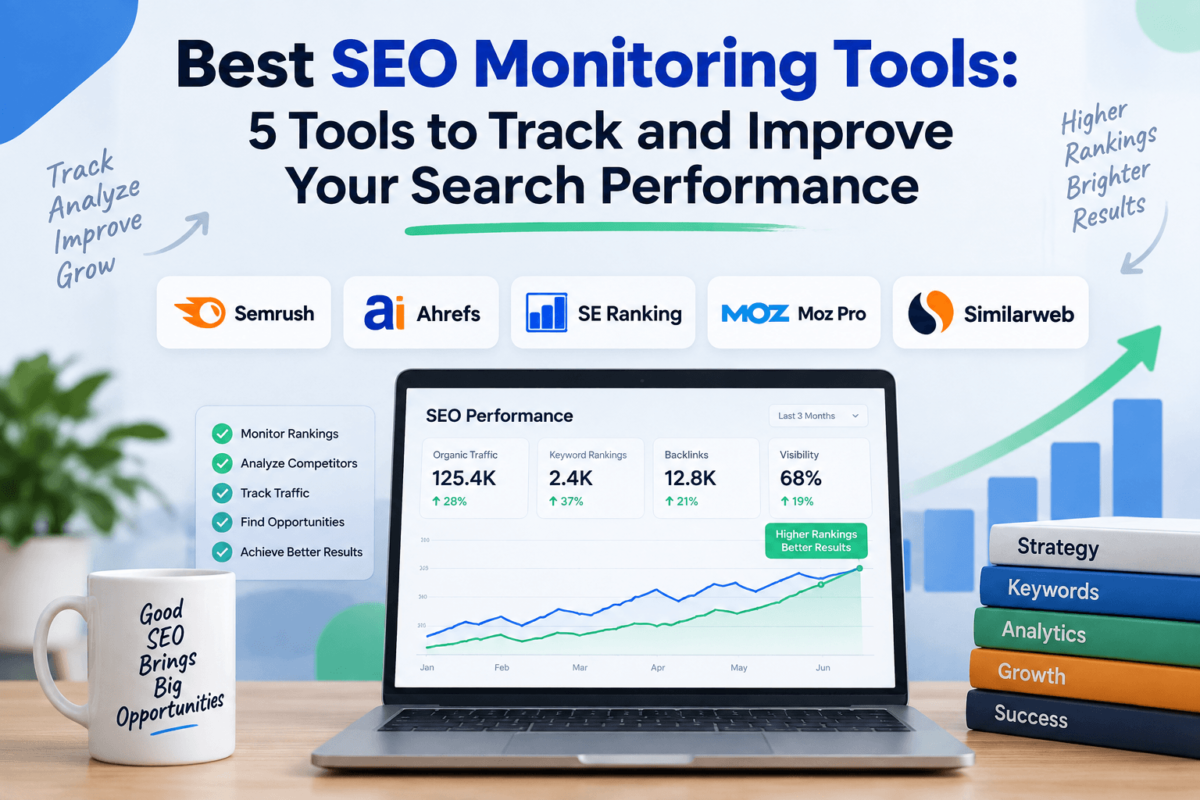
Best SEO Monitoring Tools: 5 Tools to Track and Improve Your Search Performance
Updated: September 2026
SEO can feel like a moving target. Rankings shift overnight, a competitor publishes a page that outranks yours, backlinks quietly disappear, and a botched deploy can tank your Core Web Vitals without anyone noticing for weeks. If you’re not watching for these changes, you find out about them the hard way — usually when traffic has already dropped.
That’s the job of an SEO monitoring tool: it watches your site (and your competitors’) so you don’t have to check manually every day. This guide compares five of the most established options — Semrush, Ahrefs, SE Ranking, Moz Pro, and Similarweb — and breaks down which one actually fits your situation, whether you’re running a single blog or managing a dozen client accounts. For a broader look at the category, our roundup of the best SEO tools covers tools outside this list too.
Quick Answer
The best SEO monitoring tool depends on what you’re tracking and how big your budget is. Semrush is the strongest all-around pick for most businesses because it covers rankings, technical audits, backlinks, and competitor research in one platform. Ahrefs is the better choice if backlink data and content research matter more to you than an all-in-one suite. SE Ranking is the best value for solo marketers and small agencies. Moz Pro suits teams that want a simpler, easier-to-learn tool built around Domain Authority. Similarweb is different from the other four — it’s built for traffic and market intelligence, not day-to-day rank tracking.
What Are SEO Monitoring Tools?
SEO monitoring tools are software platforms that track changes in your website’s search visibility, rankings, technical health, backlinks, competitors, and other SEO signals. Instead of manually checking your Google rankings or crawling your site by hand, these tools run on a schedule and flag what’s changed.
Depending on the platform, SEO monitoring can cover:
- Keyword rankings and local rank tracking
- Organic visibility and search traffic trends
- Technical SEO issues, including Core Web Vitals and crawl errors
- Backlink growth and loss
- Competitor movements and SERP changes
- Site health and crawlability
- Content performance and keyword opportunities
Not every tool on this list covers every item on that list equally well. Similarweb, for example, is much stronger on traffic and market intelligence than on granular rank tracking, while Ahrefs and Moz Pro don’t offer the paid-search or content-marketing modules Semrush bundles in. That’s the whole point of comparing them side by side.
Why SEO Monitoring Matters
If a page that normally ranks in the top three suddenly falls to page two, you’d rather know about it this week than three months from now, when the traffic loss shows up in a quarterly report and nobody remembers what changed.
In practice, ongoing monitoring helps you:
- Catch ranking drops before they turn into revenue drops
- Spot technical problems — broken pages, slow load times, indexing issues — early
- Track keyword progress against real targets instead of guessing
- Watch what competitors are ranking for that you aren’t
- Measure whether a specific SEO campaign actually moved the needle
- Report results to a client or a boss with real numbers instead of a hunch
Here’s the catch: monitoring rankings is only useful if you know what to do when they move. A tool that just shows you a red arrow isn’t much better than no tool at all — the platforms worth paying for pair the alert with enough context (which page, which keyword, what changed on the SERP) to actually act on it.
Quick Comparison: Semrush vs. Ahrefs vs. SE Ranking vs. Moz Pro vs. Similarweb
| Tool | Best For | Key Strength | Ideal User |
|---|---|---|---|
| Semrush | Overall SEO monitoring | All-in-one visibility, technical audits, and reporting | Businesses that want one platform for SEO, content, and PPC |
| Ahrefs | Backlink monitoring and content research | Large, frequently updated backlink index | SEOs who prioritize link data and content gaps |
| SE Ranking | Budget-conscious rank tracking | Strong feature set relative to price, white-label reporting | Freelancers, small agencies, small businesses |
| Moz Pro | Beginners and simpler workflows | Easy-to-read Domain Authority metric, approachable UI | Teams new to SEO or wanting a lighter learning curve |
| Similarweb | Traffic and competitor intelligence | Estimated traffic data across any website, not just your own | Marketing and strategy teams doing market research |
01Semrush
Semrush is the closest thing to a one-stop shop on this list. Alongside rank tracking and site audits, it bundles keyword research, backlink analytics, content tools, and paid-search data into a single subscription — which is why it’s usually the first recommendation for businesses that don’t want to stitch together three separate tools. See how it stacks up directly against the runner-up in our Semrush vs. Ahrefs comparison.
Why We Recommend Semrush
Semrush’s Position Tracking tool monitors keyword rankings across desktop and mobile, and its Site Audit crawls for technical issues on a recurring schedule. Its keyword and competitor databases are among the largest of any tool on this list, and the platform layers in AI visibility tracking through Semrush One for brands that also want to know how they show up in AI search answers.
Key Features
- Position Tracking for daily rank monitoring across locations and devices
- Site Audit for recurring technical SEO health checks
- Backlink Analytics and toxic link detection
- Keyword research and content optimization tools
- Built-in competitor tracking and traffic estimates
Best For
Pros and Cons
|
Pros
|
Cons
|
Pricing
Semrush’s core SEO Toolkit runs three plans: Pro at $139.95/month, Guru at $249.95/month, and Business at $499.95/month, with roughly 17% off if you pay annually. Semrush has also introduced Semrush One bundles that add AI visibility tracking at separate price points. Pricing on these tiers has shifted more than once in 2026, so confirm current numbers on Semrush’s official pricing page before you buy.
Our Take
Semrush earns its higher price tag by replacing several separate subscriptions. If you’re monitoring more than just rankings — technical health, content performance, and competitors too — it’s the least likely of the five to leave a gap.
Semrush
02Ahrefs
Ahrefs built its reputation on backlink data, and that’s still its strongest monitoring feature. Rank Tracker, Site Audit, and Alerts round out a platform that’s leaner than Semrush but very well regarded for link and content research. See the full breakdown in our Ahrefs vs. SE Ranking comparison.
Why We Recommend Ahrefs
Ahrefs’ Site Explorer and backlink index are frequently cited as among the most current and comprehensive in the industry, which makes it particularly good for spotting new or lost links before a competitor does. Rank Tracker handles keyword monitoring, and Alerts can notify you automatically when new backlinks, lost backlinks, or new ranking keywords appear.
Key Features
- Site Explorer for backlink and organic traffic research
- Rank Tracker for keyword position monitoring
- Site Audit for technical crawl issues
- Content Explorer for finding high-performing content by topic
- Automated Alerts for backlink and ranking changes
Best For
Pros and Cons
|
Pros
|
Cons
|
Pricing
Ahrefs runs a tiered structure that’s changed a few times in 2026: a limited Starter plan around $29/month, Lite around $129/month, Standard around $249/month, and Advanced around $449/month, plus a custom Enterprise tier. Reported figures vary slightly across sources depending on when they were last updated, so check Ahrefs’ own pricing page for the current numbers.
Our Take
If backlinks are the SEO signal you care about monitoring most closely, Ahrefs is hard to beat. It’s a narrower tool than Semrush, but what it does, it does very well.
Ahrefs
03SE Ranking
SE Ranking covers most of the same ground as Semrush and Ahrefs — rank tracking, site audits, backlink monitoring, competitor research — at a noticeably lower price point, which is why it shows up often in comparisons for freelancers and small agencies. We go deeper on this in our SE Ranking review.
Why We Recommend SE Ranking
SE Ranking’s rank tracker updates daily and supports granular location targeting, which matters if you’re monitoring rankings for multiple cities or regions. Its white-label reporting is a standout for agencies that need to send branded reports to clients without paying agency-tier prices elsewhere.
Key Features
- Daily rank tracking with local and mobile targeting
- Website Audit for recurring technical checks
- Backlink Checker and Competitive Research modules
- White-label reporting for agencies
- On-page SEO checker with prioritized fix recommendations
Best For
Pros and Cons
|
Pros
|
Cons
|
Pricing
SE Ranking renamed its plan lineup in 2026, and pricing has moved since — currently landing somewhere around $129/month for its entry paid plan and $279/month for its mid-tier plan, with a custom Enterprise tier above that. Because the plan names and prices have changed more than once this year, treat these as approximate and check SE Ranking’s official pricing page for the current lineup.
Our Take
SE Ranking is the pick if you want Semrush-adjacent monitoring without a Semrush-sized bill. Just budget time to double-check current plan details before you commit, since the lineup has been in flux.
SE Ranking
04Moz Pro
Moz Pro is one of the original SEO suites, and it still leans on the metric it made famous: Domain Authority. It trades some of the depth you’ll find in Semrush or Ahrefs for a simpler, easier-to-learn interface. See how it holds up in our Moz Pro vs. Semrush comparison.
Why We Recommend Moz Pro
Moz Pro’s Domain Authority and Page Authority scores remain widely used shorthand for link-building and competitive strength, even outside Moz’s own platform. Its Campaigns feature tracks rankings, site health, and backlinks over time, and the interface is generally considered friendlier to new users than Semrush’s or Ahrefs’.
Key Features
- Rank tracking through Moz Campaigns
- Domain Authority and Page Authority scoring
- Link Explorer for backlink research
- Site Crawl for technical issue detection
- Keyword Explorer with AI-assisted keyword suggestions
Best For
Pros and Cons
|
Pros
|
Cons
|
Pricing
Moz Pro’s current lineup runs roughly Starter at $49/month ($39/month billed annually), Standard at $99/month, Medium at $179/month, and Large at $299/month, with lower effective rates on annual billing. Moz Pro also offers a 7-day free trial on its Standard and Medium plans and a free Moz Community account with limited tool access. As with the other tools here, confirm exact current pricing on Moz’s official page.
Our Take
Moz Pro won’t out-muscle Semrush or Ahrefs on raw data volume, but for a team that just wants clean rank tracking and site health monitoring without a steep learning curve, it does the job without overwhelming anyone.
Moz Pro
05Similarweb
Similarweb doesn’t play quite the same game as the other four tools. Instead of tracking your own keyword rankings day to day, it estimates traffic and engagement across any website — yours or a competitor’s — which makes it more of a market-intelligence tool than a rank tracker. It pairs well with a dedicated SEO tool rather than replacing one; see the comparison in our Semrush vs. Similarweb breakdown.
Why We Recommend Similarweb
Similarweb’s traffic estimates cover any domain, not just ones you own, which is genuinely useful for benchmarking against competitors who won’t hand you their analytics. It also breaks down traffic by channel — organic, paid, referral, social, and increasingly AI chatbot referral traffic — giving a wider view of where a site’s visibility comes from.
Key Features
- Traffic and engagement estimates for any website
- Marketing channel breakdown (organic, paid, social, referral)
- Competitor benchmarking and audience overlap analysis
- Keyword generator and organic search overview on higher tiers
- AI agent and generative-analysis features on business plans
Best For
Pros and Cons
|
Pros
|
Cons
|
Pricing
Similarweb offers a limited free tier, with paid plans starting around $199/month for Starter and $399/month for its Team/Professional tier. Higher plans, including Enterprise, are custom-quoted and require talking to sales. Because most of the useful monitoring features sit on custom-priced tiers, get a live quote from Similarweb rather than relying on a published number.
Our Take
Similarweb is worth adding alongside one of the other four tools, not instead of one, unless your monitoring needs are mostly about traffic and competitive intelligence rather than rankings.
Similarweb
Semrush vs. Ahrefs vs. SE Ranking vs. Moz Pro vs. Similarweb
Put side by side, the differences come down to breadth versus focus. Semrush and SE Ranking both aim to be all-in-one platforms, but at very different price points. Ahrefs and Moz Pro are narrower, backlink-and-rankings-focused tools — Ahrefs with a deeper data set, Moz Pro with a gentler learning curve. Similarweb sits apart from all four, since it’s built around estimated traffic and market share rather than keyword-level tracking. For a deeper look at how three of these stack up together, see Ahrefs vs. Semrush vs. Moz.
- Best overall: Semrush, for the breadth of monitoring in one subscription
- Best for backlinks: Ahrefs, for index size and update frequency
- Best for agencies: SE Ranking, for white-label reporting at a lower cost per client
- Best for beginners: Moz Pro, for its simpler interface and Domain Authority benchmark
- Best for competitor traffic research: Similarweb, for estimating any site’s traffic and channel mix
- Best value: SE Ranking, for the amount of monitoring coverage per dollar
Which SEO Monitoring Tool Should You Choose?
Choose Semrush if…
You want one platform that monitors rankings, technical health, backlinks, and competitors — and you’re willing to pay more for not having to juggle separate tools.
Choose Ahrefs if…
Backlink monitoring and content research matter most to your workflow, and you don’t need a bundled PPC or content-marketing suite.
Choose SE Ranking if…
You’re a freelancer, small agency, or small business that needs core rank tracking, audits, and client-ready reports without an enterprise-level price tag.
Choose Moz Pro if…
You’re newer to SEO monitoring, want a shorter learning curve, or your team already reports on Domain Authority as a benchmark metric.
Choose Similarweb if…
Your priority is understanding competitors’ traffic, channel mix, and market share — not tracking your own keyword-by-keyword rankings.
Quick Answers for Common Questions
What is the best SEO monitoring tool overall?
Semrush is the best overall SEO monitoring tool for most businesses because it combines rank tracking, technical audits, backlink monitoring, and competitor research in a single platform, reducing the need for multiple subscriptions.
What is the best SEO monitoring tool for beginners?
Moz Pro is the best fit for beginners because its interface is simpler than Semrush’s or Ahrefs’, and its Domain Authority metric gives new users an easy-to-understand benchmark.
What is the best SEO monitoring tool for agencies?
SE Ranking is a strong choice for agencies because it offers white-label reporting and multi-client management at a lower cost per project than Semrush or Ahrefs, while dedicated SEO reporting tools can complement it for client-facing dashboards.
What is the best tool for monitoring keyword rankings?
Semrush and Ahrefs both offer reliable, frequently updated rank tracking, with Semrush covering more locations and devices out of the box and Ahrefs pairing rank data closely with its backlink index.
What is the best SEO monitoring tool for competitor research?
Similarweb is the strongest choice specifically for competitor traffic and market intelligence, while Semrush and Ahrefs offer deeper competitor keyword and backlink research within their broader toolsets, similar to the tools covered in our best competitor analysis tools guide.
Frequently Asked Questions About SEO Monitoring Tools
What is an SEO monitoring tool?
An SEO monitoring tool is software that tracks changes in your website’s search rankings, technical health, backlinks, and competitor activity on an ongoing basis, so you can react to problems or opportunities without checking everything manually.
What should an SEO monitoring tool track?
At minimum, it should track keyword rankings, organic traffic trends, and technical site health. More complete platforms also monitor backlinks, competitor movements, and content performance.
How often should you monitor SEO rankings?
Most tools on this list update rankings daily or every few days. For most sites, checking weekly trends is enough to catch meaningful movement without overreacting to normal day-to-day fluctuation.
Can SEO monitoring tools track Google rankings?
Yes. All five tools in this guide track Google rankings, and several also support Bing and other search engines to varying degrees.
What is the best SEO monitoring tool for small businesses?
SE Ranking and Moz Pro both offer lower entry prices than Semrush or Ahrefs, making them more accessible starting points for small businesses that don’t need enterprise-scale data volumes.
Are SEO monitoring tools worth paying for?
For any site that depends on organic search traffic, yes — catching a ranking drop or a technical issue early is usually far cheaper than losing weeks or months of traffic before noticing. Free tools like Google Search Console cover some of this, but paid tools add automation, competitor data, and historical trends that free tools don’t.
Can SEO monitoring tools monitor competitors?
Yes. Semrush, Ahrefs, SE Ranking, and Similarweb all include competitor tracking features, ranging from keyword and backlink comparisons to full traffic and channel benchmarking.
What’s the difference between SEO monitoring and SEO auditing?
An SEO audit is typically a one-time, in-depth review of a site’s technical health and content. SEO monitoring is ongoing — it tracks changes over time and alerts you when something shifts, rather than giving you a single snapshot.
Can I use SEO monitoring tools for multiple websites?
Yes, though the number of projects or domains you can monitor depends on your plan. Agency-focused tools like SE Ranking and higher Semrush and Ahrefs tiers generally support more projects than entry-level plans.
Which SEO monitoring tool is best for agencies?
SE Ranking’s white-label reporting makes it a common pick for smaller agencies, while larger agencies managing bigger client rosters often lean on Semrush’s or Ahrefs’ higher-tier plans for the added data depth, sometimes alongside SEO automation tools to handle recurring reporting.
Final Verdict: The Best SEO Monitoring Tools
All five of these tools can monitor SEO performance well — the right one depends on what you’re tracking and who’s paying for it:
- Best overall: Semrush
- Best for backlink monitoring: Ahrefs
- Best value: SE Ranking
- Best for beginners: Moz Pro
- Best for competitive traffic intelligence: Similarweb
If you’re only picking one, start with what you’re actually trying to catch — ranking drops, lost backlinks, technical breakage, or competitor moves — and match it to the tool built for that job rather than the one with the most features on paper. Most of these platforms also offer free trials, so testing the interface with your own site before committing is worth the extra day it takes.
This article may contain affiliate links. If you purchase through one of these links, we may earn a commission at no additional cost to you.