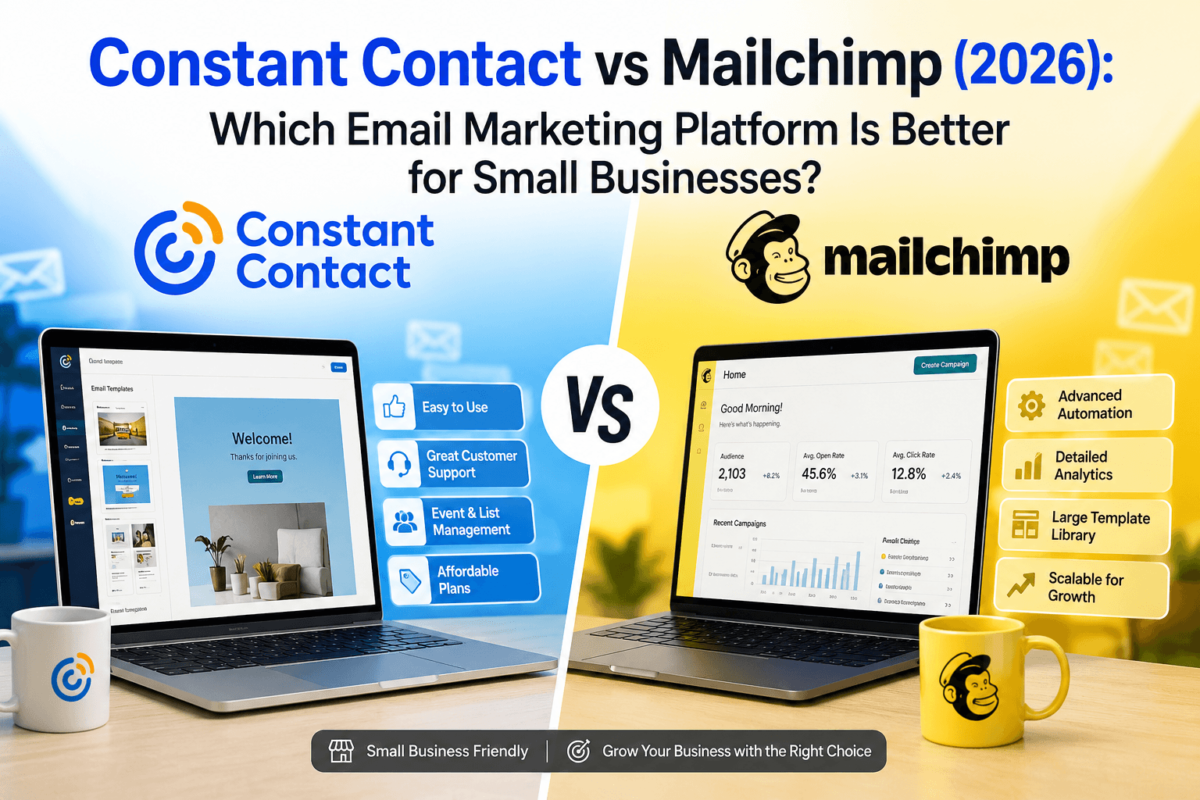
Constant Contact vs Mailchimp (2026): Which One Wins?
Quick answer: Mailchimp is the better all-around pick for most small businesses in 2026 thanks to its stronger free plan, deeper ecommerce integrations, and more advanced automation and AI tools. Constant Contact is the better choice if you want a simpler learning curve, live phone support, and built-in event and fundraising tools—especially for nonprofits, local businesses, and first-time email marketers.
If you’re an ecommerce brand or agency that needs serious automation, lean Mailchimp. If you want to launch your first campaign this afternoon without a learning curve, lean Constant Contact.
Quick Summary
- Best overall: Mailchimp, for its balance of features, integrations, and scalability
- Best for beginners: Constant Contact, thanks to its simpler dashboard and guided setup
- Best for ecommerce: Mailchimp, with deeper Shopify and WooCommerce tools
- Best automation: Mailchimp, with more advanced customer journey builders
- Best value: Constant Contact, for straightforward pricing with fewer surprises as your list grows
- Best customer support: Constant Contact, with live phone support included on every plan
Constant Contact vs Mailchimp at a Glance
Before we get into the details, here’s a side-by-side snapshot of how these two platforms stack up on the features that matter most to small business owners.
| Feature | Constant Contact | Mailchimp |
|---|---|---|
| Best for | Beginners, nonprofits, event-based businesses | Ecommerce brands, agencies, growth-focused teams |
| Starting price | Paid plans start around the low end for small lists | Paid plans start around a similar range, scaling with contacts |
| Free plan | No free plan (trial only) | Yes, limited free plan available |
| Email automation | Solid, but fewer trigger options | Advanced, with multi-step customer journeys |
| Templates | Large template library, easy editing | Large template library with more design flexibility |
| Landing pages | Included on most plans | Included, with more customization |
| Ecommerce | Basic Shopify/WooCommerce support | Deep Shopify, WooCommerce, and BigCommerce integration |
| CRM | Basic contact organization | Built-in CRM-style contact profiles |
| AI tools | Basic AI content suggestions | More developed AI subject lines and content optimization |
| Deliverability | Generally strong | Generally strong |
| Ease of use | Very beginner-friendly | Beginner-friendly, slightly steeper for advanced features |
| Customer support | Phone, chat, email on most plans | Chat and email; phone on higher tiers only |
| Reporting | Solid standard reporting | More detailed analytics and revenue tracking |
| Integrations | Good selection of common tools | Wider integration marketplace |
| Mobile app | Yes | Yes |
| Overall rating | 4.2/5 for ease of use and support | 4.5/5 for features and scalability |
Pricing and feature availability change frequently. Always confirm current details on the official Constant Contact and Mailchimp websites before purchasing.
What Is Constant Contact?
Constant Contact has been around since the early days of email marketing, and it built its reputation on being approachable for people who’ve never touched a marketing tool before. It’s a favorite with local businesses, nonprofits, and event organizers who need to send a newsletter or promote a fundraiser without hiring a specialist.
Its strengths are simplicity, guided onboarding, and support you can actually talk to on the phone. Where it falls short is advanced automation and ecommerce depth—if you’re running a fast-growing online store with complex customer journeys, you’ll likely outgrow it. The ideal Constant Contact customer is a small business owner, coach, or nonprofit that wants to get a professional-looking campaign out the door quickly and doesn’t need heavy automation logic.
What Is Mailchimp?
Mailchimp started as a simple newsletter tool and has grown into a full marketing platform with automation, CRM features, and ecommerce integrations built in. It’s widely used by online stores, agencies, and content creators who need more than just “send an email.”
Its strengths are automation depth, design flexibility, and how well it plugs into Shopify, WooCommerce, and other ecommerce platforms. The tradeoff is that its free plan and entry-level pricing come with tighter feature limits than they used to, and some advanced automation features require a learning curve. The ideal Mailchimp customer is an ecommerce brand, agency, or growing business that wants room to scale its email strategy over time.
Feature-by-Feature Comparison
Ease of Use
Constant Contact’s dashboard is built around a clear, linear workflow: pick a template, add content, choose your list, send. There’s very little guesswork, which is exactly why it’s a go-to recommendation for beginners. Mailchimp’s dashboard is also approachable, but it exposes more options up front—audience segments, journey builders, content studio—which can feel like a lot if you’ve never used an email tool before.
Email Editor
Both platforms offer drag-and-drop editors with large template libraries. Constant Contact’s editor is straightforward and reliable, but customization options are somewhat limited once you move outside a template’s default structure. Mailchimp’s editor gives you more granular control over layout, blocks, and brand styling, which agencies and design-conscious brands tend to appreciate.
Automation
Constant Contact covers the basics well: welcome series, birthday emails, and simple triggered sends. Mailchimp’s automation builder goes further, letting you map out multi-step customer journeys with branching logic based on behavior, purchase history, or engagement—closer to what you’d expect from a dedicated marketing automation tool.
AI Features
Both platforms have leaned into AI-assisted content over the past couple of years. Constant Contact offers AI writing suggestions to help draft subject lines and body copy. Mailchimp’s AI tools go a step further, offering content recommendations and predictive insights that factor in past campaign performance.
Ecommerce Features
If you sell products online, this is one of the biggest differentiators. Mailchimp’s Shopify, WooCommerce, and BigCommerce integrations support abandoned cart emails, product recommendations, and purchase tracking baked right into your campaigns and automations. Constant Contact supports Shopify and WooCommerce too, but the ecommerce-specific automation and reporting are noticeably lighter. For a deeper look at optimizing an online store beyond email, our guide to ecommerce SEO and our Shopify SEO guide are worth a read.
Contact Management
Constant Contact keeps contact management simple with tags and basic segmentation. Mailchimp’s contact profiles function more like a lightweight CRM, tracking purchase history, engagement scores, and custom fields you can use to build highly targeted segments.
Reporting & Analytics
Both platforms report the essentials: opens, clicks, bounces, and unsubscribes. Mailchimp adds revenue tracking for ecommerce sends and more detailed A/B testing and benchmarking against industry averages. Constant Contact’s reporting is clean and easy to read but doesn’t go quite as deep on the ecommerce side.
Integrations
Constant Contact connects with common tools like Shopify, WooCommerce, Canva, and Eventbrite—a natural fit given its event and fundraising use cases. Mailchimp’s integration marketplace is larger, covering Zapier, Salesforce, Stripe, Google Analytics, and Facebook, which matters more once your marketing stack gets complex.
Customer Support
This is where Constant Contact pulls ahead. Live phone support is included on most plans, alongside chat and email—a real advantage if you want to talk to a person when something breaks. Mailchimp offers chat and email support broadly, but phone support is typically reserved for higher-tier plans.
Pricing
Both platforms price based on your contact list size and the features you need, and both have moved away from simple flat pricing toward tiered plans. Mailchimp offers a limited free plan, which is useful if you’re just starting out and want to test the platform before committing. Constant Contact doesn’t have a permanent free plan but offers a free trial instead.
| Plan Type | Constant Contact | Mailchimp |
|---|---|---|
| Free plan | Not available (free trial only) | Available with limited contacts and sends |
| Entry paid plan | Affordable for small lists, scales with contacts | Affordable for small lists, scales with contacts |
| Mid-tier plan | Adds automation and segmentation features | Adds advanced automation, A/B testing, and journeys |
| Top-tier plan | Adds phone support and advanced features | Adds premium support and deeper reporting |
| Hidden costs to watch | Costs rise as list size grows | Costs rise as list size grows; some features gated to higher tiers |
If you’re watching every dollar and want predictable costs as your list grows slowly, Constant Contact’s pricing tends to feel more straightforward. If you’re comfortable starting free and paying more as you unlock advanced automation, Mailchimp’s free plan gives you room to test before you commit.
Start Mailchimp FreePros and Cons
| Constant Contact | |
|---|---|
| Pros | Cons |
| Very beginner-friendly interface | No permanent free plan |
| Live phone support included | Lighter ecommerce automation |
| Strong event and fundraising tools | Fewer advanced integrations |
| Simple, predictable pricing structure | Automation triggers are more basic |
| Mailchimp | |
|---|---|
| Pros | Cons |
| Free plan available for small lists | Phone support limited to higher tiers |
| Deep ecommerce integrations | Steeper learning curve for advanced features |
| Advanced automation and journeys | Costs can climb quickly with list growth |
| Strong reporting and revenue tracking | Some features gated behind premium plans |
Real-Life Examples
Local Restaurant
A neighborhood restaurant sending weekly specials and holiday promotions doesn’t need complex automation—it needs a quick, reliable way to reach regulars. Constant Contact’s simple editor and event tools (handy for promoting tastings or private bookings) make it the easier fit here.
Online Clothing Store
An ecommerce brand running abandoned cart emails, post-purchase follow-ups, and product recommendation flows needs the deeper Shopify integration and automation logic that Mailchimp provides. This is a clear case where Mailchimp’s ecommerce depth pays off.
Marketing Agency
An agency managing email for multiple clients benefits from Mailchimp’s broader integrations, more detailed reporting, and flexible design controls—features that make it easier to tailor campaigns to different client brands at scale.
Nonprofit Organization
A nonprofit running donor newsletters and fundraising event invites will likely lean toward Constant Contact, thanks to its Eventbrite integration, simpler setup, and live support when a campaign needs to go out under time pressure.
Personal Blogger
A blogger sending a monthly roundup to a modest list can start on Mailchimp’s free plan and grow into paid automation later, making it a practical low-cost entry point. For more platform options at this stage, see our roundup of the best newsletter platforms.
Who Should Choose Constant Contact?
- You’re new to email marketing and want a short learning curve
- You run a nonprofit, local business, or event-driven organization
- You want live phone support included in your plan
- You don’t need advanced, multi-step automation
Who Should Choose Mailchimp?
- You run an ecommerce store on Shopify, WooCommerce, or BigCommerce
- You want to start on a free plan before committing to a paid tier
- You need advanced automation with branching customer journeys
- You want deeper reporting, including revenue tracking
Who Should Avoid Constant Contact?
If you need advanced ecommerce automation, complex customer journeys, or a permanent free plan, Constant Contact will likely feel limiting. Ecommerce brands and agencies managing multiple complex campaigns are usually better served by Mailchimp or a dedicated automation platform like ActiveCampaign.
Who Should Avoid Mailchimp?
If you find yourself overwhelmed by options and just want to send a simple, professional-looking newsletter without a learning curve, Mailchimp’s broader feature set can feel like more than you need. In that case, Constant Contact or a lighter tool built for creators, like Kit, may be a better starting point.
How to Choose the Right Email Marketing Platform
- Identify your business type. A local service business has very different needs than an online store.
- Estimate subscriber growth. Both platforms price by list size, so plan for where your list will be in a year, not just today.
- Determine automation needs. If you only need welcome emails and newsletters, don’t overpay for a journey builder you won’t use.
- Consider ecommerce requirements. If you sell products online, prioritize the platform with deeper store integration.
- Compare pricing over time. Look at what you’ll pay at 1,000, 5,000, and 10,000 contacts, not just the starting price.
- Test both free trials before deciding. Nothing beats spending 20 minutes building a real campaign in each tool.
Best Alternatives
Constant Contact and Mailchimp aren’t the only options worth considering. Here’s a quick look at a few alternatives, depending on what you need:
- Brevo — a strong option if you want email and SMS marketing combined with generous free-tier sending limits.
- Kit (formerly ConvertKit) — built with creators and bloggers in mind, with simple automation and strong landing pages.
- ActiveCampaign — the go-to choice if you want serious CRM and automation power beyond what Mailchimp offers.
- AWeber — a reliable, budget-friendly option for small lists and straightforward newsletters.
- GetResponse — worth a look if you want webinars and funnel-building tools bundled with email marketing.
Frequently Asked Questions
Is Constant Contact better than Mailchimp?
It depends on your needs. Constant Contact is better for beginners and event-driven businesses that want simplicity and phone support. Mailchimp is better for ecommerce brands and businesses that need advanced automation and reporting.
Which is cheaper, Constant Contact or Mailchimp?
Both scale pricing with your contact list size, and entry-level costs are similar. Mailchimp has a free plan for small lists, while Constant Contact offers a free trial instead of a permanent free tier. Check both providers’ current pricing pages before deciding, since plans change often.
Which has better automation, Constant Contact or Mailchimp?
Mailchimp has more advanced automation, including multi-step customer journeys with branching logic. Constant Contact covers the basics well but doesn’t go as deep.
Which is easier for beginners?
Constant Contact is generally considered easier for beginners because of its guided, linear workflow and simpler dashboard.
Which is best for nonprofits?
Constant Contact tends to be a better fit for nonprofits because of its Eventbrite integration, fundraising-friendly templates, and live phone support.
Which has better customer support?
Constant Contact offers live phone support across most plans, while Mailchimp generally reserves phone support for higher-tier plans.
Which works better with Shopify?
Mailchimp has a deeper Shopify integration, with support for abandoned cart emails, product recommendations, and purchase tracking built into automations.
Which has higher email deliverability?
Both platforms generally report strong deliverability rates. Actual results depend on your list quality, sending practices, and content, so it’s worth monitoring your own metrics after switching.
Can I switch from Mailchimp to Constant Contact?
Yes. Both platforms support contact list imports, and Constant Contact offers migration assistance to help move your lists and campaign history over.
Which platform is better in 2026?
For most small businesses, Mailchimp remains the stronger all-around platform in 2026 due to its ecommerce depth and automation tools. Constant Contact remains the better choice for beginners, nonprofits, and businesses that value simplicity and live support over advanced features.
Final Verdict
- Best Overall: Mailchimp
- Best Value: Constant Contact
- Best for Ecommerce: Mailchimp
- Best for Beginners: Constant Contact
- Best for Agencies: Mailchimp
- Best for Nonprofits: Constant Contact
Neither platform is objectively “better” for everyone. If you’re an ecommerce brand, agency, or growing business that wants room to scale automation and reporting, Mailchimp is the stronger long-term investment. If you’re new to email marketing, running a nonprofit or local business, or simply want a straightforward tool with a human on the phone when you need help, Constant Contact is the more comfortable fit. The smartest move is to run both free trials, build one real campaign in each, and see which workflow actually feels right for how you work.
Try Constant Contact Free