⚡ Quick Answer
Google Business Profile optimization is the process of fully completing, strategically updating, and actively managing your GBP listing to maximize visibility in Google’s Local Pack and Maps results. In 2026, it’s the single highest-ROI local marketing activity most businesses still haven’t done properly — directly impacting calls, direction requests, and local revenue.
Quick Summary
• GBP optimization = completing and maintaining your Google listing for maximum local visibility
• In 2026, GBP feeds Google AI Overviews, Gemini responses, and voice search results
• Top ranking factors: relevance (categories/services), proximity, and prominence (reviews/citations)
• Biggest mistakes: wrong primary category, no photos, ignoring reviews, sparse services list
• Realistic timeline: meaningful ranking improvements in 4–8 weeks with consistent effort
What Is Google Business Profile and Why It Matters More in 2026
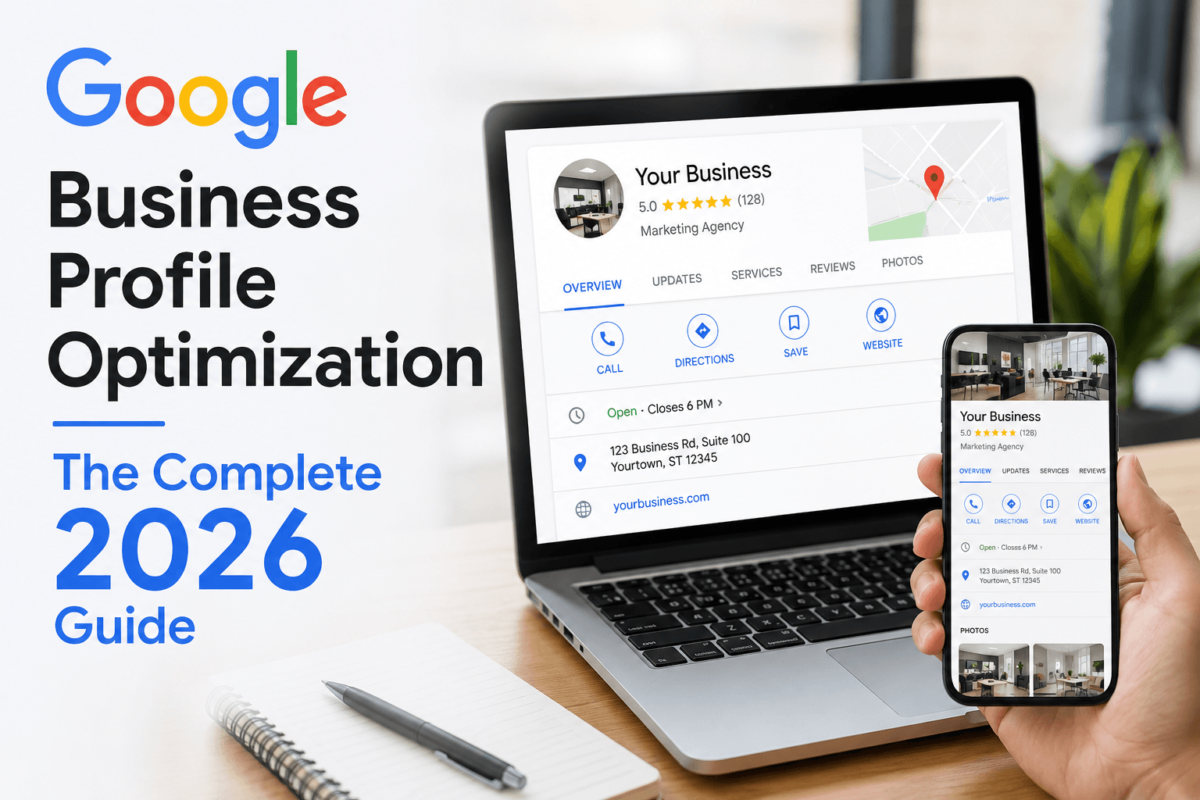
Google Business Profile (GBP) is your free business listing on Google — the card that appears in Maps, the Local Pack (those 3 results above organic listings), and increasingly in AI-powered search features like Google AI Overviews and Gemini responses.
Here’s what most business owners don’t realize: a fully optimized GBP listing outperforms a mediocre website almost every time for local searches. Think about the last time you searched “plumber near me” or “best pizza downtown.” You probably clicked one of the top 3 map results before scrolling to organic listings. That’s the Local Pack — and GBP optimization is how you get there.
In 2026, the stakes are higher than ever. Google’s AI Overviews now pull structured data directly from GBP listings to answer local queries. Voice search through Google Assistant and smart speakers reads GBP data aloud. Gemini cites business information from profiles when recommending local services. If your profile is thin or incomplete, you’re invisible to these systems.
Consider a few numbers: roughly 46% of all Google searches have local intent. Businesses that appear in the Local Pack capture 44% of local search clicks. Mobile “near me” searches have grown over 150% in the past three years. And here’s the kicker — the majority of your competitors still haven’t fully optimized their profiles. That’s your opportunity.
💡 Expert Tip
GBP isn’t set-and-forget. Google actively rewards businesses that treat their profile like a living digital storefront — posting regularly, responding to reviews, updating services, and adding fresh photos.
GBP vs. Google My Business: What Changed
Google rebranded Google My Business to Google Business Profile in late 2021 — but the changes went deeper than just a name swap. Here’s how the two compare:
| Feature | Google My Business (old) | Google Business Profile (2026) |
|---|---|---|
| Management | Separate app required | Managed directly in Search & Maps |
| Mobile Experience | Companion app | Fully mobile-first in Google Maps app |
| Products | Limited/beta | Full product catalog with pricing |
| Services | Basic menu | Detailed service categories + descriptions |
| Messaging | Via app only | Direct in Search, Maps & mobile |
| Performance Data | Basic Insights | Enhanced performance metrics & trends |
| AI Integration | None | Feeds AI Overviews & Gemini responses |
| Verification | Postcard-dominant | Video, phone, email & Search Console |
The move to mobile-first management matters because Google now expects businesses to engage with their profile in real time — responding to reviews from Search, updating hours during holidays directly from Maps, and posting offers from a smartphone. Businesses still treating GBP as a one-time setup are leaving serious ranking power on the table.
Step 1 — Claiming and Verifying Your Profile
You can’t optimize what you don’t control. Verification proves to Google that you’re the legitimate owner of the business — and it unlocks every optimization feature. Here are the verification methods available in 2026:
Video Verification
Now the most common method. Google asks you to record a short video showing your business location, signage, equipment, and yourself. It’s reviewed by a human or AI within a few days. Prepare by filming your storefront sign, interior, and any branded vehicles or equipment.
Phone Verification
Available for businesses with a verified phone number. Google calls or texts a code instantly. Quick, but not always offered — especially for new listings or businesses in competitive niches.
Email Verification
Google sends a code to your business email. Available to some accounts, particularly those with a matching Google Workspace domain. Takes minutes.
Live Video Call Verification
A Google agent conducts a live video call with you to verify the location in real time. Used for higher-risk categories like locksmiths or home services. Requires scheduling in advance.
Search Console Verification
If your website is already verified in Google Search Console and the domain matches your GBP, Google may offer instant verification. This is the fastest path for established websites.
Bulk Verification
For businesses managing 10+ locations. Requires submitting a spreadsheet through Google’s Business Profile Manager. Ideal for chains, franchises, and multi-location agencies.
| Method | Speed | Difficulty | Best For |
|---|---|---|---|
| Video Verification | 2–5 days | Medium | Most new businesses |
| Phone Verification | Instant | Easy | Established businesses |
| Email Verification | Minutes | Easy | Domain-matched Google accounts |
| Live Video Call | Scheduled | Medium-High | Home services & sensitive categories |
| Search Console | Instant | Easy | Websites already in GSC |
| Bulk Verification | 1–2 weeks | High setup | 10+ location businesses |
🔧 Troubleshooting Tip
If your verification keeps failing, check that your business address exactly matches what’s listed on your website and in your Google account. Inconsistencies in suite numbers, abbreviations (St. vs Street), or business name variations are the #1 reason verifications get flagged.
Step 2 — Choosing the Right Business Categories
Your primary category is arguably the most important ranking decision you’ll make. Google uses it to determine which searches your business is eligible to appear for. Get it wrong and you’re competing in the wrong lane — or no lane at all.
Primary Category Rules:
• Pick the category that most precisely describes your core business, not your aspirational one
• If you’re a personal injury law firm, choose “Personal Injury Attorney” not “Law Firm”
• If you sell pizza and pasta, choose “Pizza Restaurant” if that’s 80% of your revenue
• Google has over 4,000 categories — use Google’s autocomplete to find exact matches
Secondary categories expand your eligibility without diluting your primary focus. Most businesses should use 3–5 secondary categories that cover additional services they genuinely offer.
Category Examples by Industry:
| Business Type | Primary Category | Secondary Categories |
|---|---|---|
| Dentist | Dentist | Cosmetic Dentist, Emergency Dental Service, Teeth Whitening Service |
| Roofer | Roofing Contractor | Gutter Cleaning Service, Siding Contractor, Waterproofing Service |
| Law Firm | Personal Injury Attorney | Car Accident Lawyer, Workers’ Compensation Attorney |
| HVAC | HVAC Contractor | Air Conditioning Repair Service, Furnace Repair Service, Heating Contractor |
| Restaurant | Italian Restaurant | Pizza Restaurant, Wine Bar, Catering Food & Drink Supplier |
Common Category Mistakes:
• Choosing a broad category (“Contractor”) instead of a specific one (“Roofing Contractor”)
• Adding unrelated categories to “cast a wider net” — this dilutes relevance signals
• Not revisiting categories annually — Google adds new ones regularly
⚡ Quick Take
Check your top 3 local competitors’ categories using Google Maps. Click on their listing, scroll to “About,” and note their primary category. If they’re all using the same specific category and ranking well, that’s a strong signal you should match it.
Step 3 — Writing an Optimized Business Description
Your business description is a 750-character opportunity to tell Google and potential customers who you are, what you do, where you serve, and why you’re trustworthy. Most businesses waste it.
What to Include:
• Primary service or product (within the first sentence)
• Location served (city, neighborhood, or service area)
• Key differentiators (years in business, certifications, specialties)
• One or two natural keyword mentions — never stuff
• A trust signal (awards, guarantees, accreditations)
Bad Example
We are a company that provides many different services to our valued customers in the local area. We have been in business for many years and offer great prices. Call us today for all your needs!
Good Example
Chicago Rooter is a licensed plumbing company serving Chicago’s North Side since 2008. We specialize in emergency drain cleaning, water heater replacement, and sewer line repair — with same-day service guaranteed. Our team of 12 certified plumbers has completed over 8,000 service calls across Lincoln Park, Wicker Park, and Lakeview. BBB A+ rated. Available 24/7.
Copywriting Formula
[Business Name] is a [category] serving [location] since [year]. We specialize in [core services]. [Trust signal or differentiator]. [Service area mention]. [Call to action or availability].
Step 4 — Adding Services and Products
Here’s something I see constantly: a business fills out their categories and description, then completely ignores the Services section. That’s a major missed opportunity. Services are one of the clearest relevance signals you can send Google — and they’re directly indexed for local search.
Services Optimization Framework:
• List every service you offer, no matter how obvious
• Use the exact terms customers search for (“roof replacement” not “reroof”)
• Add descriptions for each service — 300 characters of keyword-rich context
• Group services into categories that match your GBP categories
• Update services seasonally (snow removal in winter, AC tune-ups in spring)
The Products section is genuinely underutilized, especially for service businesses. A law firm can list “Free Case Consultation” as a product. A dentist can list “Teeth Whitening” or “Invisalign Consultation.” A plumber can list “Water Heater Installation.” Each product listing adds a photo, description, and price range — creating additional indexable content Google can surface.
💡 Expert Tip
When adding service descriptions, write them as if answering a customer question: “What does your emergency drain cleaning service include?” This naturally incorporates long-tail keywords and creates content AI systems can extract and summarize.
Step 5 — Photo Strategy: Types, Frequency, and Geo-Tagging
Businesses with 100+ photos get significantly more direction requests and phone calls than businesses with under 10. Photos aren’t just decoration — they’re trust signals, engagement drivers, and ranking factors.
Exterior Photos
Show your storefront from multiple angles, at different times of day, and in different seasons. Include your sign, parking area, and entrance. Customers use these to verify they’ve found the right place — and Google uses them to confirm your location.
Interior Photos
Showcase your waiting room, workspace, equipment, or dining area. For service businesses, show your truck, tools, or workshop. Anything that says “this is a real, active business.”
Team Photos
Put faces to your business. A photo of your team in branded gear or uniforms builds trust faster than any description. Include your owner, technicians, or staff in action where possible.
Service and Project Photos
Before-and-after photos are powerful for trades, medical, legal, and home services. A roofing company’s portfolio of completed jobs, a dentist’s smile gallery, or a landscaper’s project photos all drive conversion and demonstrate expertise.
Practical Photo Recommendations:
• Upload 5–10 new photos every month — frequency signals an active, credible business
• Use descriptive filenames before uploading (chicago-emergency-plumber-team.jpg)
• Minimum resolution: 720px × 720px; Google recommends at least 1200px wide
• Mix professional and authentic candid photos — don’t make it look too polished
EXIF Data & Geo-Tagging: What’s Real
There’s a popular myth that embedding GPS coordinates in photo EXIF data directly boosts GBP rankings. Google strips most EXIF data when photos are uploaded, so this isn’t a reliable ranking tactic. What does matter: uploading photos consistently, having Google tag your business photos to your location, and earning customer photos through active review requests.
Step 6 — Google Posts: Templates, Frequency, and Topics That Work
Google Posts show up directly on your GBP listing and sometimes in Local Pack results. They’re an underused content channel that most businesses either ignore or use inconsistently. Posts keep your profile fresh, signal activity to Google, and give customers a reason to engage.
Promotional Post Template
Headline:
[Offer or Service] — [Deadline or Reason to Act Now]
Body:
[What you’re offering] + [Who it’s for] + [What they get] + [How to claim it]
CTA:
Call now / Book online / Get offer
Example:
“HVAC Tune-Up — $79 Spring Special (Limited to 30 Spots). Our licensed technicians will clean coils, check refrigerant, and inspect your system before summer. Book online today.”
Educational Post Template
Headline:
[Question your customer is Googling]
Body:
[2–3 sentence answer] + [Why it matters for them] + [How you help]
Example:
“How do you know if your roof needs replacing? Look for granules in your gutters, curling shingles, or daylight through the attic. If you’re seeing any of these, call us for a free inspection.”
Event Post Template
Use for grand openings, community events, workshops, or seasonal campaigns. Include date, location, and registration link. Event posts expire automatically — Google removes them after the event date.
Recommended Posting Frequency:
• Minimum: 2 posts per month
• Ideal: 1 post per week
• Never go more than 30 days without a new post — inactivity signals an abandoned profile
Step 7 — Q&A Management: Pre-Populating and Monitoring
The Q&A section is the most overlooked section of any GBP listing. Customers ask questions there publicly — and anyone can answer them, including your competitors or random Google users. If you’re not seeding and managing this section, you’re handing over your brand narrative.
How to Seed Your Q&A:
• Log into your GBP profile
• Ask the question yourself (as a Google user — not your business account)
• Switch to your business account and answer it comprehensively
• Upvote your own Q&A pairs to push them to the top
Questions Worth Pre-Populating:
• “Do you offer free estimates/consultations?”
• “Are you open on weekends?”
• “Do you serve [specific area]?”
• “What payment methods do you accept?”
• “How quickly can you respond to emergencies?”
• “Are you licensed and insured?”
Monitor your Q&A weekly. Set up Google Alerts for your business name and check the profile manually. Unanswered questions that go stale for weeks signal a passive, unresponsive business — the opposite of what Google wants to rank.
Step 8 — GBP Attributes: Accessibility, Payment, Health & More
Attributes are the checkboxes and labels that appear on your listing — things like “Wheelchair accessible,” “Accepts credit cards,” “Women-owned,” or “Outdoor seating.” They seem minor, but they serve two purposes: filtering (Google shows your business for attribute-based searches) and trust (customers scan these before calling).
Attribute Categories to Complete:
• Accessibility: Wheelchair accessible entrance/parking, accessible restroom
• Payment options: Credit cards, debit cards, NFC payments, checks
• Identity: Women-owned, veteran-owned, LGBTQ+ friendly
• Service options: Online appointments, online estimates, in-store pickup, delivery
• Health & safety (still relevant in many healthcare/food service categories)
• Amenities: Wi-Fi, outdoor seating, parking, live music (where applicable)
Fill out every attribute that applies honestly. Attributes that filter for voice search (“Is this business wheelchair accessible?”) are increasingly important as Google Assistant and Gemini answer these queries directly from GBP attribute data.
GBP for Service Area Businesses vs. Storefront Businesses
Service Area Businesses (SABs) — plumbers, HVAC technicians, mobile dog groomers, IT consultants — face a different optimization challenge than brick-and-mortar storefronts. Here’s how the key factors compare:
| Factor | Service Area Business (SAB) | Storefront Business |
|---|---|---|
| Address Display | Hidden (private address) | Visible address required |
| Service Areas | List specific cities/regions/zips | Defaults to local radius |
| Ranking Range | Can rank across wide service area | Strongest near physical address |
| Verification | Video or postcard to unlisted address | Standard methods available |
| Photos | Team, vehicles, job-site photos | Interior, exterior, team |
| Best Practices | NAP consistency in citations critical | Consistent address formatting key |
For SABs: hide your home address if you work from home — displaying it is optional and hiding it doesn’t hurt rankings. Focus your service areas on the cities and ZIP codes where you actually want to rank. Don’t add 50 service areas hoping to blanket a state — Google caps your competitive range based on business prominence. For a deeper look at local SEO strategies for service businesses, see our complete guide.
How AI Overviews and Gemini Use Your GBP Data
This is where 2026 optimization diverges sharply from older GBP advice — and where most competitor guides fall short. Google’s AI systems don’t just check if your profile is complete; they use GBP data to build structured entity profiles that power AI-generated answers across Search, Maps, and the Google ecosystem.
What AI Systems Extract from GBP:
• Business name, categories, and services → used for entity classification
• Description and Q&A → extracted as natural language summaries in AI Overviews
• Reviews (quantity, recency, sentiment, keywords) → used to assess authority and reputation
• Photos → used to visually confirm entity type, quality, and legitimacy
• Attributes → surfaced in conversational responses (“does this business offer X?”)
• NAP data → cross-referenced with Knowledge Graph for entity consistency
Here’s what that means practically: when someone asks Google “who’s the best emergency plumber in Denver?” — Gemini is synthesizing review sentiment, service keywords, category relevance, and entity prominence into a ranked answer. Your GBP isn’t just a listing; it’s a structured data feed for AI reasoning. Understanding Generative Engine Optimization (GEO) is increasingly critical here — and understanding how SEO, GEO, AEO and LLMO interact in modern search gives you a significant edge.
📌 Bottom Line
Write your business description, Q&A answers, and service descriptions as if you’re writing for an AI that needs to clearly summarize what you do, where you do it, and why you’re trustworthy. Use clear, factual language. Define your niche precisely. Repeat your core service terms naturally across multiple fields.
Practical AI Optimization Recommendations:
• Use your primary keyword in your business description’s first sentence
• Mirror your GBP service descriptions to your website’s service page copy
• Seed Q&A with questions that include your target keywords (“Do you offer emergency roof repair in Dallas?”)
• Maintain review velocity — AI systems weight recency heavily; get reviews monthly, not in bursts
• Ensure NAP (name, address, phone) is identical across GBP, website, and all citations
Tracking GBP Performance: Insights, Calls, Directions, Views
GBP’s built-in performance dashboard has improved significantly in 2026. Understanding your core SEO metrics starts here. These are the key data points and what they actually tell you:
| Metric | What It Measures | KPI Target |
|---|---|---|
| Discovery Searches | Found via generic category/service search | Growing month-over-month |
| Branded Searches | Found via business name search | Consistent baseline |
| Maps Views | Profile impressions in Google Maps | Increasing after optimization |
| Search Views | Profile impressions in Google Search | Correlated with posting frequency |
| Calls | Direct calls from GBP listing | Rising after review/photo work |
| Direction Requests | Navigation requests from Maps | Proxy for purchase intent |
| Website Clicks | Traffic to your site from GBP | UTM-trackable in GA4 |
Discovery Searches vs. Branded Searches is a critical ratio. If 80%+ of your visibility is branded, you’re only being found by people who already know you — your GBP isn’t doing new business development. A healthy, well-optimized profile should show growing discovery searches as you expand category relevance and review authority.
Add UTM parameters to your GBP website URL (e.g., ?utm_source=google&utm_medium=gbp&utm_campaign=local) to track GBP-driven conversions in GA4. This is the single most underused tracking feature in local SEO.
GBP Optimization Checklist for 2026
Setup & Verification
✅ Claim and verify your GBP listing
✅ Set correct primary category
✅ Add 3–5 relevant secondary categories
✅ Enter complete address or service area
✅ Set accurate business hours (including holidays)
✅ Add primary phone number matching your website
✅ Add website URL with UTM parameters
Content Optimization
✅ Write a 750-character keyword-rich business description
✅ List all services with descriptions
✅ Add products or service packages where relevant
✅ Complete all applicable attributes
✅ Upload 20+ photos across all categories
Reviews & Engagement
✅ Respond to every review (positive and negative)
✅ Set up a review request workflow
✅ Aim for minimum 1 new review per week
✅ Post on GBP at least twice per month
Q&A & Monitoring
✅ Seed 8–10 common customer Q&As
✅ Monitor and answer new questions weekly
✅ Check for and remove spam reviews
✅ Verify no duplicate listings exist
AI & Advanced Optimization
✅ Ensure NAP consistency across all citations
✅ Mirror GBP services to website service pages
✅ Add LocalBusiness schema markup to your website
✅ Track GBP metrics in monthly reporting
Common GBP Mistakes and How to Fix Them
| Mistake | Why It Hurts | Fix |
|---|---|---|
| Keyword stuffing business name | Violates Google guidelines; risks suspension | Use exact legal/operating name only |
| Wrong primary category | Miss most relevant searches | Research competitors; use most specific match |
| Duplicate listings | Splits ranking signals; confuses Google | Report duplicates via GBP dashboard or merge |
| Ignoring reviews | Damages trust; signals inactive profile | Respond to every review within 48 hours |
| Zero or few photos | Lower CTR; appears untrustworthy | Upload 20+ photos; add 5 monthly |
| Outdated hours | Leads to bad experiences; negative reviews | Update hours seasonally and for holidays |
| Sparse services list | Misses long-tail ranking opportunities | List every service with a keyword-rich description |
| Inconsistent NAP | Contradicts entity signals; hurts AI citations | Audit all citations; use a single canonical format |
Advanced Google Business Profile Optimization Tactics Most Businesses Ignore
Review Velocity Strategy
Don’t send a review request blast to 200 past customers in one week — Google may filter reviews that arrive in an unnatural surge. Instead, build a system: text customers a review link 24 hours after service completion, every single time. Consistent velocity (3–5 reviews per week) is more powerful than a one-time spike of 50. See our guide on how Google reviews help SEO rankings for the full breakdown.
Service Area Expansion
SABs can expand ranking reach by building citations, landing pages, and earning reviews that mention specific service area cities. If you’re a plumber in Austin wanting to rank in Round Rock, create a service area page for Round Rock on your website, build citations mentioning that city, and encourage customers from that area to mention the location in reviews.
Local Entity Reinforcement
Google’s Knowledge Graph tracks entities — your business as a structured data object. Strengthen your entity by ensuring your business name, address, phone, categories, and website appear consistently across your GBP, website, Facebook, Yelp, BBB, and industry directories. Inconsistency creates entity confusion; consistency creates entity authority.
UTM Tracking
Add UTM parameters to your GBP website link and appointment booking link. This separates GBP-driven traffic in GA4, letting you measure actual ROI — not just vanity impressions. Example: https://yoursite.com?utm_source=google&utm_medium=gbp&utm_campaign=local_pack
Local Landing Page Alignment
Your GBP and website should mirror each other. If your GBP lists “Emergency Water Heater Replacement” as a service, your website should have a page titled “Emergency Water Heater Replacement in [City].” This alignment is a strong relevance signal — and it makes your business description and services machine-readable for AI systems.
Structured Data Support
Add LocalBusiness schema markup to your website to reinforce your GBP signals. Here’s an example:
{
  "@context": "https://schema.org",
  "@type": "Plumber",
  "name": "Chicago Rooter",
  "address": {
    "@type": "PostalAddress",
    "streetAddress": "1234 N Clark St",
    "addressLocality": "Chicago",
    "addressRegion": "IL",
    "postalCode": "60614"
  },
  "telephone": "+1-312-555-0100",
  "url": "https://www.chicagorooter.com",
  "openingHours": "Mo-Su 00:00-24:00",
  "areaServed": ["Chicago", "Lincoln Park", "Wicker Park"],
  "priceRange": "$$"
}
Real Examples of GBP Optimization Wins
GBP Elements: Ranking & Conversion Impact
| GBP Element | Ranking Impact | Conversion Impact | Priority |
|---|---|---|---|
| Primary Category | Very High | High | Critical |
| Reviews (Quantity & Rating) | Very High | Very High | Critical |
| NAP Consistency | High | Medium | Critical |
| Services List | High | High | High |
| Business Description | Medium | High | High |
| Photos | Medium | Very High | High |
| Google Posts | Low-Medium | Medium | Medium |
| Q&A Section | Medium | High | Medium |
| Attributes | Medium | Medium | Medium |
| Products | Low-Medium | High | Medium |
| Secondary Categories | Medium | Low | Medium |
Frequently Asked Questions
Conclusion: Your Google Business Profile Action Plan
Here’s the honest truth: Google Business Profile optimization isn’t complicated — but it requires consistency, attention to detail, and an understanding that your profile is a living asset, not a one-time form to fill out.
Most of your competitors have incomplete profiles, stale photos, no Q&A, and a handful of old reviews. That means a well-optimized profile stands out immediately — and in local SEO, standing out in the Local Pack can mean doubling your inbound leads without spending a dollar on ads.
Start here, in this order:
1. Verify your listing if you haven’t — nothing else matters without control of your profile
2. Fix your categories — primary category is the highest-leverage ranking decision you can make
3. Complete your services list — every service you skip is a keyword you can’t rank for
4. Build your review system — not a one-time blast, but a repeatable process for every customer
5. Add photos consistently — 5 new photos per month, every month, indefinitely
📌 Bottom Line
Google Business Profile optimization in 2026 is about more than ranking in Maps. It’s about feeding Google’s AI systems with structured, consistent, entity-rich data that powers AI Overviews, Gemini responses, and voice search results. The businesses that treat GBP as a content platform — not just a listing — will dominate local search for years to come.
Start with one section this week. Nail it. Then move to the next. Consistent progress on a complete GBP will outperform a perfect profile that stays untouched. Local SEO rewards the active, not the perfect.