Semrush vs Ahrefs for Keyword Research: Which SEO Tool Finds Better Keywords in 2026?
By Jaykishan Panchal · Updated July 2026 · 15+ Years SEO Experience
Which tool wins for keyword research in 2026?
Semrush wins for most users — bigger database (26B+ keywords), smarter intent detection, and better long-tail filters. Ahrefs wins for content-driven SEOs who want SERP context and backlink data alongside keywords.
Let me cut straight to the answer — because I know that’s why you’re here.
After using both tools on client campaigns, affiliate projects, and agency accounts for over a decade, here’s my honest take:
Semrush is the better keyword research tool for most people. Its Keyword Magic Tool is genuinely world-class — with the largest keyword database on the market, smarter intent detection, and better filtering for beginners and agencies alike. Ahrefs, on the other hand, wins when it comes to content-driven research, backlink context, and a cleaner interface that experienced SEOs prefer.
Neither tool is perfect. But one is probably right for you — and this guide will tell you exactly which one.
Quick Recommendation Table
| Use Case | Recommended Tool |
|---|---|
| Overall Best for Keyword Research | Semrush |
| Best Value for Solo Bloggers | Semrush (Pro plan) |
| Best for Beginners | Semrush |
| Best for Agencies | Semrush |
| Best for Content Research | Ahrefs |
| Best for Link-Focused SEO | Ahrefs |
| Best for Ecommerce | Semrush |
| Best for Local SEO | Semrush |
| Best for Enterprise | Semrush (Business plan) |
| Best Keyword Database Size | Semrush |
| Best AI Features | Semrush (Copilot) |
| Best Interface / UX | Ahrefs |
Quick Verdict
Here’s the bottom line before we dive deep. I’ve organized this by the most common buyer profiles I see in real SEO projects.
| Category | Winner |
|---|---|
| Overall Winner | Semrush |
| Best Value | Semrush Pro |
| Best for Beginners | Semrush |
| Best for Agencies | Semrush |
| Best for Bloggers | Ahrefs (content-first) / Semrush (monetization-first) |
| Best for Ecommerce | Semrush |
| Best for Local SEO | Semrush |
| Best for Enterprise | Semrush Business |
| Best AI Features | Semrush (Copilot AI) |
| Best Keyword Database | Semrush (26B+ keywords) |
| Best Content Research | Ahrefs (Content Explorer) |
| Best Competitor Analysis | Semrush (Organic Research) |
One thing many people overlook: the “best tool” isn’t always the one with more features. It’s the one your team will actually use. Ahrefs has a loyal following for a reason — it’s streamlined and fast. But for sheer keyword discovery firepower, Semrush is hard to beat.
What Is Semrush?
Semrush launched in 2008 and has grown into the most comprehensive all-in-one SEO platform on the market. It started as a keyword research tool for competitive intelligence and has since expanded into site auditing, rank tracking, PPC research, content marketing, and social media management.
Today, Semrush claims over 10 million marketing professionals use it. That’s not marketing fluff — it reflects the tool’s breadth. Whether you’re running a solo blog or managing 200 client accounts, Semrush has a workflow for you.
Core Keyword Tools in Semrush
| Area | Strength | Weakness |
|---|---|---|
| Keyword Database | Largest available (26B+) | Occasional volume discrepancies |
| Intent Detection | Best in class | Can misclassify niche queries |
| Interface | Feature-rich | Can feel overwhelming for beginners |
| Reporting | Excellent for agencies | Some reports behind higher tiers |
| Pricing | Competitive for feature set | Solo users may find it pricey |
| AI Features | Copilot AI integrated | Still maturing |
What Is Ahrefs?
Ahrefs launched in 2011 with a singular focus: backlink analysis. Over the years, it evolved into a full SEO suite, but its DNA is still content and link-driven. That philosophy shapes everything about how Ahrefs approaches keyword research — it always contextualizes keywords within the content ecosystem around them.
Here’s where Ahrefs surprised me when I first started using it seriously: the Keywords Explorer doesn’t just show you metrics. It shows you the surrounding SERP ecosystem — who’s ranking, how many backlinks they have, and whether the top results are weak enough to beat. That context changes how you make decisions.
Core Keyword Tools in Ahrefs
| Area | Strength | Weakness |
|---|---|---|
| Backlink Context | Best in class | Less relevant for PPC-focused teams |
| Keywords Explorer | Deep SERP insight | Smaller database than Semrush |
| Content Explorer | Powerful topic discovery | No equivalent in most tools |
| Interface | Clean and fast | Some reports take longer to load |
| Pricing | Good for content-focused teams | Fewer features than Semrush at same price |
| AI Features | Limited compared to Semrush | Still developing AI roadmap |
Feature Comparison Table
Let’s go feature by feature. This is the table I wish existed when I was first evaluating both tools.
| Feature | Semrush | Ahrefs |
|---|---|---|
| Keyword Database Size | 26B+ keywords | ~20B keywords |
| Countries Covered | 140+ | 170+ |
| Keyword Difficulty Score | 0–100 (% of pages needed) | 0–100 (backlinks-based) |
| Search Intent Detection | Yes — 4 intent types | Yes — 4 intent types |
| SERP Analysis | Yes, with Authority Score | Yes, with DR + UR |
| Traffic Estimation | Organic traffic estimates | Organic traffic estimates |
| Competitor Research | Organic Research (excellent) | Site Explorer (excellent) |
| Keyword Gap Tool | Yes — up to 5 competitors | Content Gap — up to 10 domains |
| Keyword Clustering | Yes (Keyword Manager) | Limited native clustering |
| Historical Data | Yes | Yes |
| Local SEO Keywords | Yes — local modifiers | Limited local data |
| PPC Keyword Data | Excellent (CPC, competition) | Basic PPC data |
| Long-Tail Discovery | Excellent (Magic Tool filters) | Good (broad match) |
| Content Marketing Suite | Yes (full suite) | Limited |
| AI Capabilities | Copilot AI, AI writing | AI Overview detection |
| Customer Support | Chat + email + phone | Chat + email |
| Data Freshness | Weekly–monthly | Weekly–monthly |
| Starting Price (2026) | ~$139.95/mo (Pro) | ~$129/mo (Lite) |
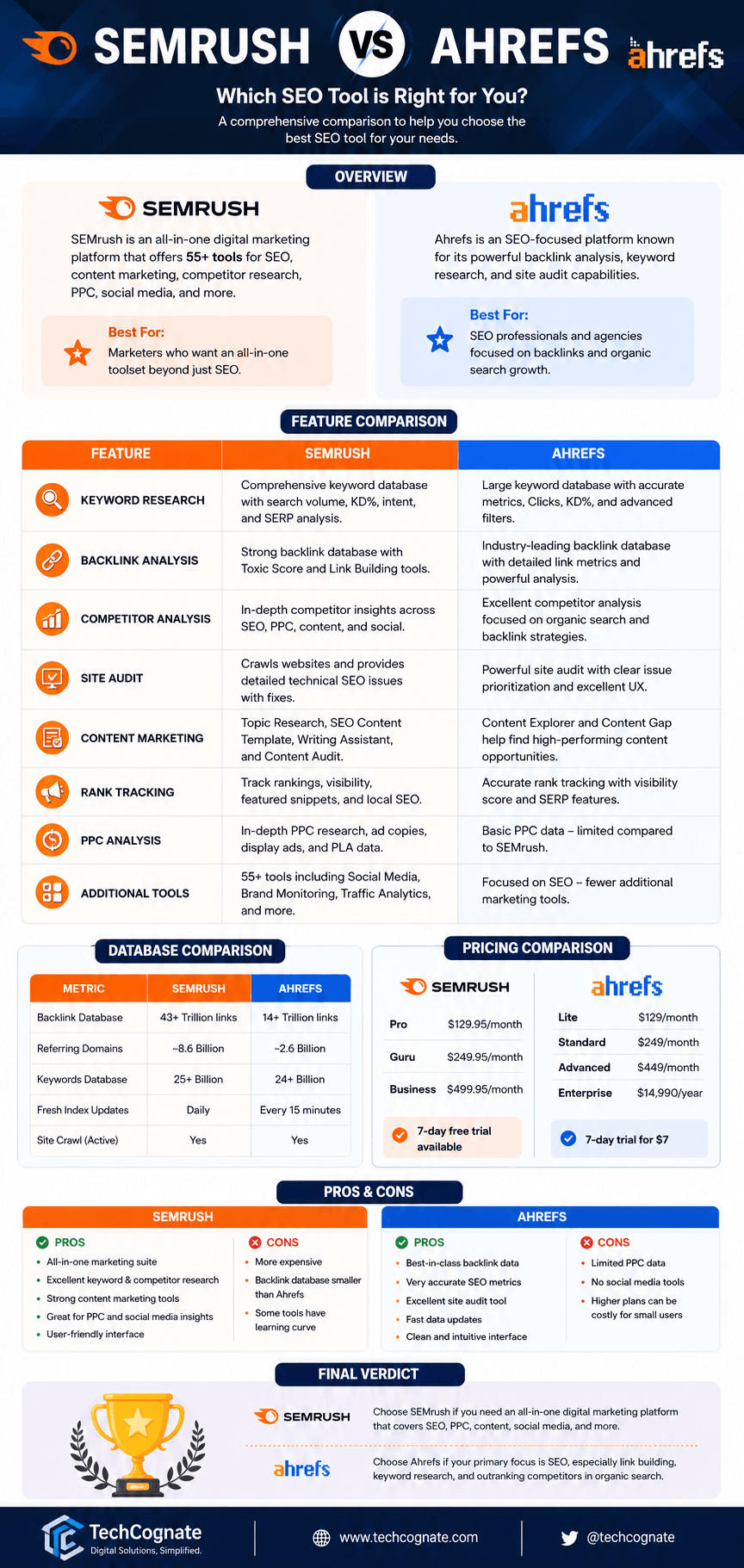
Keyword Database Comparison
Database size matters more than most people realize — but it’s not the only thing that matters.
In real projects, I’ve found Semrush consistently surfaces keywords that Ahrefs simply doesn’t have. For a client in the home improvement niche, I ran the same seed keyword through both tools and Semrush returned 47% more long-tail variations. Not all of them were useful, but the raw volume of ideas is genuinely useful for content planning.
| Metric | Semrush | Ahrefs | Edge |
|---|---|---|---|
| Total Keywords | 26B+ | ~20B | Semrush |
| US Keyword Coverage | Strongest | Very strong | Semrush |
| Country Coverage | 140+ countries | 170+ countries | Ahrefs |
| Update Frequency | Weekly (top KWs) | Weekly (top KWs) | Tie |
| Long-Tail Coverage | Excellent | Good | Semrush |
| Zero-Volume Keywords | Included | Included | Tie |
| Emerging Topics | Trending keywords filter | Newly discovered KWs | Tie |
| Rare/Niche Keywords | Strong | Moderate | Semrush |
One thing many people overlook: database size means nothing if the volume data isn’t accurate. Both tools pull from Google’s own API data, clickstream data, and their own crawl data. Neither is perfectly accurate — but Semrush’s estimates tend to be slightly more conservative (which I actually prefer — I’d rather under-promise and over-deliver on traffic projections).
Keyword Research Workflow
This is where theory meets practice. Let me walk you through exactly how I research a new niche using each tool.
Semrush Workflow: Researching a New Niche
Start with Keyword Overview — enter your seed keyword to see volume, KD, and intent at a glance.
Move to Keyword Magic Tool — filter by KD under 40 and volume over 100 to find quick wins.
Use the ‘Questions’ filter to find informational keywords great for blog content.
Switch to ‘Intent’ filter — sort by Commercial and Transactional intent to find buyer keywords for product pages and reviews.
Export your list to Keyword Manager and use ‘Cluster’ to group by topic.
Run a competitor domain through Organic Research to find keywords they’re ranking for that you haven’t covered yet.
Use Keyword Gap to compare yourself against 3–5 competitors and find missing opportunities.
Ahrefs Workflow: Researching a New Niche
Enter your seed in Keywords Explorer and check the overview for volume, KD, and CPS (Clicks Per Search).
Click ‘Matching Terms’ with a broad match modifier and filter by KD under 30.
Use the ‘Questions’ tab to surface PAA-ready content ideas.
Check ‘SERP Overview’ for any keyword — look at referring domains for top-ranking pages.
Run a competitor in Site Explorer > Organic Keywords to find their best-performing keyword pages.
Use Content Gap to compare up to 10 domains simultaneously.
Explore Content Explorer with a broad topic to find proven content ideas with actual traffic data.
| Workflow Step | Which Tool Is Faster? |
|---|---|
| Finding seed keyword variations | Semrush |
| Identifying low-competition keywords | Ahrefs (SERP context is clearer) |
| Finding buyer intent keywords | Semrush (intent labels are more explicit) |
| Building topic clusters | Semrush (Keyword Manager has native clustering) |
| Prioritizing by content opportunity | Ahrefs (Content Explorer wins here) |
| Competitor keyword gap analysis | Tie (both excellent) |
Keyword Difficulty Comparison
Keyword Difficulty (KD) is one of the most misunderstood metrics in SEO. Neither Semrush nor Ahrefs is perfectly accurate — and understanding how each tool calculates KD will save you from chasing keywords that are harder than they look.
How Semrush Calculates KD
Semrush’s KD score represents the estimated percentage of the top 100 pages you’d need to outperform to rank in the top 10. It factors in the Authority Scores of currently ranking domains, the presence of SERP features, and backlink profiles.
How Ahrefs Calculates KD
Ahrefs’ KD is based primarily on the number of backlinks pointing to the top 10 ranking pages. It estimates how many referring domains you’d need to rank on page one. This approach is more transparent but also means Ahrefs’ KD can be misleadingly low for keywords where topical authority matters more than links.
| KD Factor | Semrush | Ahrefs |
|---|---|---|
| Primary signal | Domain Authority + backlinks | Referring domains to top 10 |
| SERP features considered | Yes | Partially |
| Topical authority weight | Moderate | Low |
| Best for beginners | Yes (clearer scale) | Requires more interpretation |
| Most accurate for link-heavy niches | Good | Excellent |
| Most accurate for content-heavy niches | Excellent | Good |
Here’s my honest take: I use both scores as rough guides, not absolute rules. A KD of 35 in Semrush might be a KD of 20 in Ahrefs for the same keyword — that’s not an error, it’s a reflection of different methodologies. Always look at the actual SERP. If the top 10 is full of thin content from low-authority sites, the keyword is probably easier than any KD score suggests.
Search Volume Accuracy
Search volume is another metric that sounds more precise than it actually is. Both Semrush and Ahrefs report monthly averages — which smooths out seasonal spikes and drops.
| Volume Factor | Semrush | Ahrefs |
|---|---|---|
| Volume basis | Avg. monthly (12mo) | Avg. monthly (12mo) |
| Seasonality data | Yes — monthly breakdown | Yes — monthly chart |
| Trending keywords | Yes — filter by trend | Yes — ‘New’ keyword filter |
| Zero-volume keywords | Shows <10 or 0 | Shows 0 with context |
| Google Trends integration | Yes (within tool) | No (external only) |
| CPC data alongside volume | Yes | Yes |
In real projects, I’ve seen Semrush report 1,600 monthly searches for a keyword where Ahrefs reports 900. Neither is ‘wrong’ — they’re using different data sources and modeling approaches. What matters most is the relative comparison: if a keyword shows twice the volume of another keyword in either tool, that relationship is probably accurate.
For zero-volume keywords — don’t ignore them. I’ve ranked for dozens of zero-volume keywords that drove meaningful traffic once ranked, because the actual searches happened but weren’t captured in the data.
Search Intent Detection
Understanding search intent is the difference between creating content that ranks and content that gets ignored. Both tools classify keywords by intent — but they handle it differently.
| Intent Type | What It Means | Semrush Label | Ahrefs Label |
|---|---|---|---|
| Informational | User wants to learn | Informational | Informational |
| Commercial | User is comparing options | Commercial | Commercial |
| Transactional | User wants to buy | Transactional | Transactional |
| Navigational | User wants a specific site | Navigational | Navigational |
Semrush wins the intent detection battle — here’s why. In Semrush’s Keyword Magic Tool, you can filter your entire keyword list by a single intent type with one click. If I’m building a product review post, I filter for Commercial intent and instantly see every variation of the keyword that suggests comparison intent. That’s incredibly efficient for affiliate marketers and content strategists.
Ahrefs shows intent in Keywords Explorer, but the filtering isn’t as granular, and you can’t do mass intent filtering across a large keyword set as easily. It’s not bad — it’s just less fluid.
Long-Tail Keyword Research
Long-tail keywords are where most content sites actually win traffic. The head terms are competitive. The money is in the specific, lower-volume queries that signal clear intent.
Finding Long-Tails in Semrush
The Keyword Magic Tool is Semrush’s secret weapon for long-tail discovery. Enter any seed keyword and it generates thousands of variations grouped by modifier type — questions, prepositions, comparisons, and more. You can filter by word count (4+ words), by KD range, and by intent simultaneously.
Finding Long-Tails in Ahrefs
Ahrefs handles long-tails well through its Matching Terms and Related Terms reports. The ‘Questions’ tab is particularly useful — it surfaces queries phrased as questions, which are perfect for FAQ sections, voice search optimization, and People Also Ask targeting.
| Long-Tail Method | Semrush | Ahrefs |
|---|---|---|
| Question keywords | Yes — Questions filter | Yes — Questions tab |
| Buyer keywords | Yes — Transactional filter | Yes — manual filtering |
| Low-KD finder | Yes — KD filter | Yes — KD filter |
| Related keyword ideas | Phrase match + related | Matching + related terms |
| Keyword grouping/clustering | Yes (Keyword Manager) | Limited native |
| Export for mass analysis | Yes | Yes |
Competitor Keyword Research
Some of my best keyword wins have come from ethically ‘stealing’ content ideas from competitors. Here’s how both tools make that happen.
Semrush: Organic Research
Type any competitor domain into Organic Research and you instantly see every keyword they rank for, their position, the page that ranks, estimated traffic, and whether the keyword is gaining or losing position. The ‘Position Changes’ tab is gold — it shows you keywords your competitor recently started ranking for, which signals new content opportunities.
Ahrefs: Site Explorer
Ahrefs’ Site Explorer gives you a similar view but with deeper backlink context. For each ranking keyword, you can see how many backlinks the specific page has — which tells you whether you can realistically compete without a major link-building campaign.
| Competitor Research Feature | Semrush | Ahrefs |
|---|---|---|
| See all competitor rankings | Yes | Yes |
| Traffic value estimate | Yes | Yes |
| Page-level keyword data | Yes | Yes (+ backlink count) |
| Position change tracking | Yes | Yes |
| Compare up to X competitors | 5 domains (Keyword Gap) | 10 domains (Content Gap) |
| Find rising competitor content | Yes | Yes (Content Explorer) |
Keyword Gap Tool Comparison
Keyword Gap analysis is one of the fastest ways to find content opportunities — you identify keywords your competitors rank for that you don’t, and those become your content roadmap.
Semrush Keyword Gap
Semrush’s Keyword Gap tool lets you compare your domain against up to five competitors simultaneously. You can filter for keywords where competitors rank in top 10 but you don’t appear at all. The visual Venn diagram makes it easy to show clients exactly what the content opportunity looks like.
Ahrefs Content Gap
Ahrefs calls their version ‘Content Gap’ and lets you compare against up to 10 domains. The key difference: Ahrefs shows you the specific pages that rank for each keyword, which adds useful context about what kind of content you’d need to create to compete.
| Feature | Semrush Keyword Gap vs Ahrefs Content Gap |
|---|---|
| Max competitor comparison | 5 domains vs 10 domains |
| Page-level context | Limited vs Strong |
| Filtering options | Extensive vs Good |
| Export quality | Excellent vs Excellent |
| Best for agencies | Semrush (visual + client reports) |
| Best for content strategists | Ahrefs (page context is invaluable) |
SERP Analysis
Both tools let you analyze the SERP for any keyword before you decide whether to target it. This is critical — keyword metrics alone don’t tell the whole story.
| SERP Feature | Semrush | Ahrefs |
|---|---|---|
| Top ranking pages | Yes + Authority Score | Yes + DR/UR |
| Featured snippet detection | Yes | Yes |
| People Also Ask data | Yes | Yes |
| AI Overview detection | Yes (limited) | Yes (limited) |
| Local Pack detection | Yes | Limited |
| SERP volatility | Sensor tool | Limited |
| Backlinks of top pages | Partial | Full (per-page RDs) |
One thing I always check before targeting a keyword: the SERP intent alignment. If I want to rank an affiliate review article but the top 10 is all product pages from Amazon and Walmart, I know I’m fighting an uphill battle. Both tools surface this, but Ahrefs makes the per-page data slightly more accessible.
Content Planning
Good keyword research doesn’t end with a list of keywords. It ends with a content plan. Here’s how each tool helps you build one.
Semrush Content Planning Tools
Ahrefs Content Planning Tools
| Content Planning Need | Better Tool |
|---|---|
| Building a topic cluster from scratch | Semrush (Topic Research + Keyword Manager) |
| Finding proven content formats | Ahrefs (Content Explorer) |
| Creating content briefs | Semrush (SEO Content Template) |
| Identifying pillar page topics | Semrush (broader keyword grouping) |
| Finding supporting article ideas | Ahrefs (related queries + Content Explorer) |
| Editorial calendar planning | Semrush (more integrated workflow) |
Real-World Scenarios — Which Tool Fits Your Situation?
| Who You Are | Recommended Tool + Reason |
|---|---|
| New Blogger (0–1 years) | Semrush — better guidance, intent filters simplify decisions |
| Affiliate Marketer | Semrush — commercial intent filtering and KD tools excel here |
| SEO Agency (10+ clients) | Semrush — white-label reports, multi-project management, Keyword Gap |
| Local Business Owner | Semrush — local SEO keyword modifiers and local tracking built in |
| Enterprise SEO Team | Semrush Business — API, custom reports, team collaboration |
| Ecommerce Store | Semrush — PPC data, product keyword filters, Shopping SERP insight |
| SaaS Company | Ahrefs — content-led growth, content explorer, strong blog research |
| Content Publisher / Media | Ahrefs — Content Explorer identifies trending topics with traffic proof |
| Freelance SEO Consultant | Ahrefs — lower entry price, clean reports, efficient workflow |
| In-House Content Team | Semrush — full content marketing suite integration |
If you’re running an agency, Semrush wins without question. The ability to manage 20+ client projects, generate branded PDF reports, and run keyword gap analysis across five competitor domains simultaneously is an agency’s dream workflow. In real projects, I’ve saved hours per client per week just by having everything in one dashboard.
Pricing Comparison
Pricing changes frequently, so always verify current rates on each tool’s website. But here’s what the plans look like as of 2026 — and more importantly, what you actually get for the money.
| Plan | Semrush | Ahrefs | Best For |
|---|---|---|---|
| Entry | Pro ~$139.95/mo | Lite ~$129/mo | Solo users, small sites |
| Mid-tier | Guru ~$249.95/mo | Standard ~$249/mo | Growing blogs, small agencies |
| Agency/Pro | Business ~$499.95/mo | Advanced ~$449/mo | Agencies, larger teams |
| Enterprise | Custom pricing | Enterprise (custom) | Large teams, API access |
Here’s the ROI reality: if you’re using either tool seriously for content production, finding even three solid keyword opportunities per month that drive $500 in affiliate commissions or client revenue each makes the tool completely free. The question isn’t whether the tool costs too much — it’s whether you’re using it enough to justify the cost.
Semrush offers a 7-day free trial on paid plans. Ahrefs offers limited free tools (Ahrefs Webmaster Tools) and a trial access option. If you’re on the fence, trial both before committing.
Pros and Cons
Semrush — Honest Pros and Cons
Best intent detection of any tool
Keyword Magic Tool is genuinely excellent
Full content marketing suite included
Agency-ready reporting and project management
Best local SEO keyword support
PPC keyword data is best in class
Higher entry price than some competitors
Some advanced features locked to higher tiers
Interface has a learning curve
AI features still maturing
Ahrefs — Honest Pros and Cons
Keywords Explorer shows SERP context clearly
Content Explorer is uniquely powerful
Strong for content-led SEO strategies
Excellent backlink context alongside keywords
Loyal, experienced user base (community support)
Content Gap limited vs Semrush Keyword Gap
PPC data is limited
Local SEO keyword support is weaker
No full content marketing suite
AI features less developed
Who Should Choose Semrush?
Choose Semrush if any of these apply to you:
Who Should Choose Ahrefs?
Choose Ahrefs if any of these apply to you:
Alternatives Worth Considering
Neither Semrush nor Ahrefs is the right fit for everyone. Here are the best alternatives:
| Tool | Best For | Starting Price (2026) |
|---|---|---|
| Moz Pro | Beginners wanting simpler metrics | ~$99/mo |
| SE Ranking | Budget-conscious agencies | ~$52/mo |
| Mangools (KWFinder) | Bloggers wanting low-KD finder | ~$29/mo |
| SpyFu | PPC competitor research | ~$39/mo |
| Serpstat | Budget teams needing all-in-one | ~$50/mo |
| Ubersuggest | Beginners on tight budget | ~$29/mo |
| KeywordTool.io | YouTube/App Store research | ~$89/mo |
| Google Keyword Planner | Free PPC keyword volume estimates | Free |
| LowFruits | Finding weak SERP opportunities fast | ~$25/mo |
| Keywords Everywhere | In-browser keyword context | ~$10/100k credits |
My recommendation: if you can’t afford Semrush or Ahrefs yet, start with SE Ranking. It’s legitimately excellent for the price — especially for agencies. Once your revenue from SEO covers the cost, upgrade to Semrush or Ahrefs depending on your workflow.
Frequently Asked Questions
Final Verdict
After years of using both tools across hundreds of client projects, affiliate sites, and content campaigns — here’s my definitive take.
| Category | My Pick |
|---|---|
| Best Overall | Semrush |
| Best Budget Option | SE Ranking (as alternative) / Semrush Pro |
| Best Professional Tool | Semrush Guru |
| Best Agency Tool | Semrush Business |
| Best Enterprise Tool | Semrush Business (custom) |
| Best for Bloggers | Ahrefs (content-led) or Semrush (monetization-led) |
| Best for Ecommerce | Semrush |
| Best for Content Marketers | Ahrefs (Content Explorer is unmatched) |
| Best for Link Builders | Ahrefs |
| Best for Local SEO | Semrush |
Semrush wins for most people — especially if keyword research is a central part of your workflow, you’re building content for commercial goals, or you’re running an agency that needs reporting infrastructure.
Ahrefs wins if you’re a content-driven SEO who values clean interfaces over feature volume, or if backlink context is central to how you evaluate keyword opportunities.
The honest truth? Both are excellent tools. The ‘best’ one is the one you’ll actually use consistently. Pick one, master it, and build your content strategy around what it reveals.