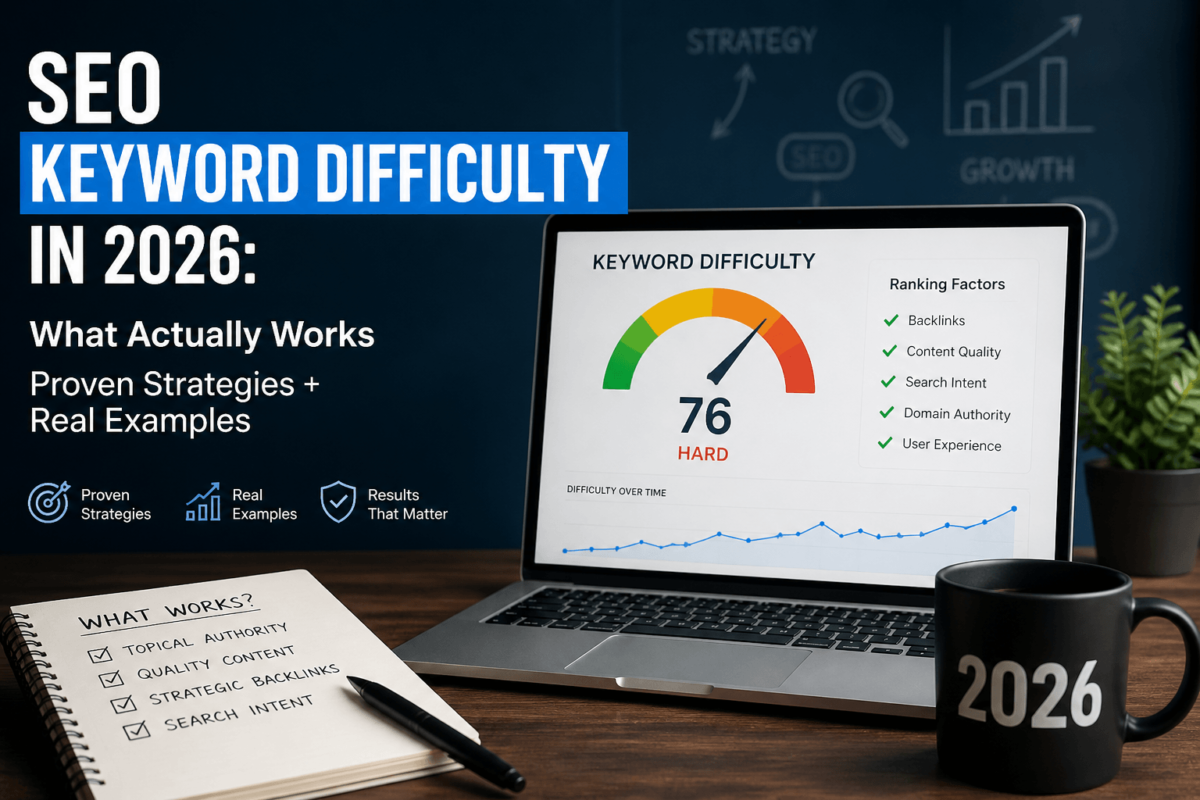
SEO Keyword Difficulty in 2026: What Actually Works
Proven Strategies + Real Examples
Keyword Difficulty (KD) is a score — typically from 0 to 100 — that estimates how hard it is to rank on page one of Google for a specific keyword. The higher the score, the more competitive the keyword is. But here’s the thing: KD is just one piece of the puzzle. Smart SEOs use it as a starting point, not a final verdict.
- KD 0–30 = Low competition. Great for new sites and affiliate blogs just getting started.
- KD 31–60 = Medium. Doable with solid content and a few quality backlinks.
- KD 61–100 = High. Requires authority, links, and a long-term strategy.
- Different tools (Ahrefs, SEMrush, Moz) calculate KD differently — always cross-check.
- Low KD does NOT always mean easy money. Search intent matters more than you think.
- High KD keywords can still be worth chasing — if you have the right content strategy.
- The best keywords combine manageable KD, strong buyer intent, and decent search volume.
- What Is Keyword Difficulty? (Explained Simply)
- Why Keyword Difficulty Matters in 2026
- How Is Keyword Difficulty Calculated?
- Why KD Scores Are Often Misleading
- Types of Keywords Based on Difficulty
- Real-Life Examples
- Step-by-Step Keyword Strategy
- Keyword Difficulty Comparison Table
- The Affiliate Strategy Side
- Common Keyword Difficulty Mistakes
- Frequently Asked Questions
- Final Thoughts
What Is Keyword Difficulty? (Explained Simply)
Let’s start from scratch — no jargon, no fluff.
Keyword Difficulty (KD) is a metric used by SEO tools to tell you how competitive it is to rank for a specific search term. Think of it like real estate. Trying to open a coffee shop in midtown Manhattan? Good luck — that’s a KD 90 keyword. Opening one in a quiet suburb in Ohio? Much easier. That’s KD 15.
Most tools score KD on a scale of 0 to 100. The closer to 100, the more authority, backlinks, and content quality you’ll need to compete. It sounds simple, and in theory it is — but in practice, there’s a lot more going on underneath.
KD is primarily based on the strength of the pages currently ranking on page one. If page one is packed with articles from Forbes, HubSpot, and NerdWallet, you’re looking at a tough climb. But if the top results are thin blog posts from sites with low authority? That’s your window.
Bottom line: KD tells you who you’re up against. It does NOT tell you whether you’ll make money, get traffic, or convert readers into buyers. That’s your job to figure out — and that’s exactly what this guide is about.
Why Keyword Difficulty Matters — Especially in 2026
SEO in 2026 is not what it was three years ago. AI-generated content has flooded the internet. Every niche has more competition. And Google’s ranking systems have gotten significantly smarter about evaluating topical authority, user experience, and content depth.
Here’s why KD matters more than ever right now:
- AI content saturation: Tools like ChatGPT have made it easier than ever to produce content at scale. This means more pages competing for every keyword — which pushes difficulty up across the board.
- SERP features: Featured snippets, People Also Ask boxes, and AI Overviews eat into organic click-through rates. Even if you rank #1 for a low-KD keyword, you might not get the traffic you expected.
- Topical authority: Google now rewards sites that cover a topic deeply and consistently. Targeting random low-KD keywords without a topical strategy is a recipe for slow growth.
- E-E-A-T signals: Experience, Expertise, Authoritativeness, and Trustworthiness are baked into how Google evaluates pages. High-KD keywords often demand real credibility.
The bottom line? In 2026, knowing your KD isn’t optional — it’s the foundation of a smart content strategy. Without it, you’re just guessing.
How Is Keyword Difficulty Calculated?
Here’s where most blogs get vague. Let’s actually break this down.
Every SEO tool has its own formula, but the core inputs are usually the same:
1. Backlink Profile of Ranking Pages
The number one factor. Tools analyze how many referring domains are pointing to the top-ranking pages. More backlinks = more authority = higher KD. A page with 500 links from trusted sites is going to be much harder to beat than one with 20 links from random blogs.
2. Domain Authority of Competing Sites
If the pages ranking on page one belong to sites with a Domain Rating (DR) of 80+, that’s a strong signal that KD will be high. A newer site with a DR of 20 will struggle to compete — at least in the short term.
3. Content Quality and Relevance
Some tools (especially newer ones) now factor in on-page signals like content length, keyword usage, semantic relevance, and engagement metrics. A page that perfectly answers the query will hold its position even against link-heavy competitors.
4. Search Intent Alignment
If all the top results are targeting the same intent — say, listicle-format “best X” posts — and your content is a how-to guide, you may struggle to rank regardless of KD. Misaligned intent can make an “easy” keyword much harder than it looks.
Tools like Ahrefs, SEMrush, and Moz each use slightly different algorithms. Ahrefs weighs linking root domains heavily. SEMrush factors in more on-page data. Moz focuses on Page Authority and Domain Authority. Always cross-check KD scores across at least two tools before making a final call.
Why KD Scores Are Often Misleading (This Is What Competitors Miss)
Most people take KD scores at face value. That’s a mistake.
Here’s the truth: KD is a backward-looking metric. It tells you what the competition looks like right now. It doesn’t account for whether you can produce something significantly better than what’s currently ranking. And sometimes, you absolutely can.
Reason 1: Tools Don’t Measure Content Quality
A keyword might have a KD of 45 because five mediocre blog posts are ranking — not because the topic is inherently hard. If you can produce the definitive guide on that topic, you have a real shot, even if the score suggests otherwise.
Reason 2: Tools Ignore Your Unique Angle
A fresh perspective, proprietary data, or a personal story can differentiate your content in ways no algorithm can measure. I’ve seen a KD 60 post crack page one simply because it had original research and screenshots that no competitor had.
Reason 3: Brand New SERPs Are Unstable
Let’s be real: Google doesn’t always have great content for niche-specific queries. When a search term is relatively new or underserved, the results can be thin. A low KD score on a new keyword doesn’t mean it’s easy — it might mean no one has tried yet.
Reason 4: KD Doesn’t Reflect Your Site’s Niche Authority
If you run a personal finance blog with 200 posts on budgeting and credit, and you’re targeting a KD 50 keyword about savings accounts, your topical authority gives you an edge that no tool’s KD score accounts for. You might rank in weeks. A general lifestyle blog targeting the same keyword might take a year.
Always ask: ‘Is the current content on page one actually good?’ If the answer is no — that’s your real competitive advantage, not the KD number.
Types of Keywords Based on Difficulty (With Real Examples)
Entry Points
Perfect for new sites, niche affiliate blogs, and local businesses.
- “best budgeting apps for college students” (KD ~18)
- “how to save money on groceries for one” (KD ~22)
- “what is a high-yield savings account” (KD ~25)
Sweet Spot
Require more effort — solid content and a few backlinks.
- “best credit cards for beginners” (KD ~42)
- “how to invest $1000” (KD ~50)
- “debt snowball vs avalanche” (KD ~38)
Long-Term Play
Dominated by Forbes, Investopedia, NerdWallet. Need authority.
- “best credit cards” (KD ~85)
- “how to save money” (KD ~72)
- “personal finance tips” (KD ~68)
Low KD keywords rarely go viral, but they build traffic consistently over time. Stack 50 of them and you’ve got a real audience. High KD keywords aren’t impossible — but they’re long-term plays. Don’t start here. Build there.
Real-Life Examples: What Keyword Difficulty Looks Like in Practice
Example 1: The Affiliate Blog (Starting From Zero)
Imagine you’re launching a new blog in the personal finance space. You have zero backlinks, a fresh domain, and $0 in SEO budget. What do you target?
You go after KD 10–25 keywords with transactional intent. Something like “best cash envelope wallets for beginners” (KD 12) or “Chime vs Ally bank for students” (KD 19). These posts take 2–3 months to start ranking, but when they do, every click is a potential affiliate commission.
Outcome: In 6 months, a smart affiliate blogger targeting 30 low-KD keywords can build 5,000–10,000 monthly visitors — without a single paid backlink.
Example 2: The Established Niche Site (Going Mid-Range)
Now say you’ve been publishing for two years. Your DR is 35, you have a few hundred posts, and you’re seeing consistent traffic. You can now start competing for KD 35–55 keywords.
A target like “best credit cards for cash back” (KD 47) is now within reach — especially if you write a genuinely comprehensive, comparison-style post with updated data and real screenshots.
Outcome: A well-executed mid-range keyword post on an established site can rank in 3–6 months and generate significant passive income through credit card affiliate programs (some paying $100–$200 per approved referral).
Example 3: The High KD Chase (When It’s Worth It)
Let’s say you run a large personal finance site with DR 60+. You decide to go after “best credit cards” (KD 85). You spend three months creating the most detailed, up-to-date, visually polished comparison post on the internet. You promote it aggressively, earning 40+ quality backlinks.
Outcome: You crack page one, but at position 7–8. Still, the keyword gets 500,000+ monthly searches. Even at position 8, you’re pulling 8,000–12,000 monthly visitors. At a 2% affiliate conversion rate and $150 per lead — do the math. That’s serious money.
How to Choose the Right Keywords: Step-by-Step Strategy
Most people skip half these steps. Don’t.
- Honestly assess your current authority level. If your site is brand new (DR 0–20), stay in the KD 0–30 range. If you’ve been around for a year or more (DR 20–40), you can test KD 30–50. Be realistic. Ego is expensive in SEO.
- Enter your seed keyword into at least two tools. Check KD in both Ahrefs and SEMrush. If they widely disagree (say, KD 30 vs KD 65), treat it as a medium-difficulty keyword and dig deeper.
- Manually check the SERP. Google the keyword yourself. Who’s ranking? Are the top results from authority giants like Forbes or WebMD? Or are smaller, independent blogs showing up? The SERP tells you more than any tool score.
- Evaluate search intent. What is the user actually looking for? Informational (“what is X”), navigational (“X brand login”), or commercial (“best X for Y”)? If your content format doesn’t match intent, you won’t rank — period.
- Check the backlink gap. Look at how many referring domains the top 3 results have. If they each have 200+ links and you have none, that’s a red flag unless your content will be exceptional AND you have a promotion plan.
- Decide — go for it or skip it. Green light if: KD is within your range, intent is clear, SERP has weaker competition than the score suggests, AND you can create clearly better content. Red light if: KD is way above your authority level, all top results are mega-brands, and you have no link-building plan.
Target keywords where your Domain Rating is within 10–15 points of the average DR of the top 5 results. Go too far above that gap and you’re playing a long game that could take years.
Keyword Difficulty Comparison Table
Use this as a quick reference when evaluating keywords for your content strategy:
| Keyword Type | KD Range | Traffic Potential | Ranking Time | Best For |
|---|---|---|---|---|
| Long-tail Informational | 0–20 | Low–Medium | 1–3 months | Brand new sites |
| Long-tail Commercial | 15–35 | Medium | 2–4 months | Affiliate starters |
| Mid-range Informational | 30–50 | Medium–High | 3–6 months | Growing sites (DR 25+) |
| Mid-range Commercial | 35–55 | High | 4–8 months | Affiliate earners |
| Competitive Informational | 55–70 | Very High | 6–18 months | Established sites (DR 45+) |
| Head Keywords | 70–100 | Massive | 1–3+ years | Authority domains only |
The Affiliate Strategy Side of Keyword Difficulty (Most Blogs Ignore This)
Here’s something that almost every KD guide misses: keyword difficulty without monetization context is useless.
Let’s be real: the goal isn’t just to rank. The goal is to rank AND make money. And not all keywords — even low-KD ones — are created equal when it comes to revenue.
Informational vs. Commercial Keywords
“How to budget” is a KD 30 keyword with 50,000 monthly searches. Sounds great, right? But the user searching that term is a total beginner. They’re not ready to buy anything yet. You might get tons of traffic and make almost nothing.
“Best budgeting apps” is a KD 42 keyword with 18,000 monthly searches. The user is actively looking for a solution and is close to making a purchase decision. Affiliate programs for budgeting apps (like YNAB or Mint alternatives) pay $15–$30 per signup. One well-written post can generate $500–$2,000/month.
The Profitability Formula
When evaluating a keyword for affiliate potential, ask:
- Does it have buyer intent? Look for words like ‘best,’ ‘vs,’ ‘review,’ ‘alternatives,’ ‘top,’ ‘cheapest’
- Is there a product or service to promote? Credit cards, software, courses, and financial products pay the best.
- What’s the CPC? High cost-per-click on Google Ads signals strong commercial value. Advertisers pay $5–$50+ per click in finance. Follow their money.
- Can you realistically rank in 6–12 months? A high-value keyword that takes 3 years to rank isn’t worth prioritizing today.
“Best credit cards for beginners” (KD 42, CPC $8.50) beats “how to use a credit card” (KD 20, CPC $0.80) for affiliate purposes — even though it’s harder to rank for. The revenue potential is night-and-day different.
Common Keyword Difficulty Mistakes (And How to Avoid Them)
Mistake 1: Only Chasing Low KD Keywords
Most beginners do this, and it’s understandable. But here’s the problem: low KD doesn’t always mean low competition in the real world. Some KD 15 keywords have been picked clean by micro-niche affiliate sites that created thin, just-barely-passing content.
✅ The Fix: Look at search volume AND the quality of existing content. Low KD with low-quality competition is gold. Low KD with solid, comprehensive content on page one? Move on.Mistake 2: Ignoring Search Intent
Most people get this wrong. You can write the best 3,000-word guide on “how to start a budget” and still never rank if Google’s SERP is full of YouTube videos and quick-tip listicles. Always analyze what format Google is serving for a keyword before you write a single word.
✅ The Fix: Before writing, Google the keyword in incognito mode. Match the dominant format and intent before you even start outlining.Mistake 3: Trusting Tool Scores Blindly
Tools are smart, but they’re not perfect. Ahrefs might show KD 55 for a keyword where the page one results are four years old, poorly written, and haven’t been updated since 2021. In reality, that’s a KD 30 opportunity for someone willing to write something genuinely fresh.
✅ The Fix: Always manually audit the SERP. Content age, depth, and engagement all tell a story that no KD number can.Mistake 4: Targeting Keywords Above Your Authority Level
This is the “get-rich-quick” trap of SEO. A new blogger sees that “best credit cards” gets 500,000 monthly searches and thinks, “I’ll write the definitive guide!” Three years pass and they’re still on page 6. Start small. Build authority. Then level up.
✅ The Fix: Stick to the DR ±10–15 rule. Build topical authority systematically before climbing the difficulty ladder.Mistake 5: Forgetting to Update Rankings Over Time
SEO isn’t set-it-and-forget-it. A keyword you ranked for 18 months ago might now face tougher competition. Revisit your keyword strategy every quarter. Update top-performing posts. Stay current.
✅ The Fix: Schedule quarterly keyword and content audits. Use Google Search Console to find pages with declining impressions and refresh them proactively.Frequently Asked Questions (FAQs)
For brand new sites, aim for KD 0–30. These keywords are realistic to rank for without an established backlink profile. Once you’ve been publishing for 6–12 months and have built some domain authority, you can start targeting KD 30–50 keywords. Think of it as leveling up in a game — start with the easier quests before you tackle the boss.
Yes, absolutely — but it takes time, resources, and strategy. The key is to have a content asset that’s measurably better than everything currently on page one. You also need a real backlink acquisition plan, not just “hoping Google notices you.” High-KD keywords are long-term plays. Budget 12–24 months before expecting consistent rankings.
Not even close. Low KD is better for getting traffic faster. But if that traffic doesn’t convert — because the keyword has no buyer intent — you’ll be sitting on a lot of visitors and very little revenue. Always evaluate KD alongside commercial intent and affiliate opportunities. The best keywords combine manageable difficulty with real earning potential.
It depends on four things: your domain authority, your content quality, your backlink profile, and how competitive the keyword actually is (not just what the KD tool says). A KD 20 keyword on a DR 30 site can rank in 6–10 weeks. A KD 50 keyword on a DR 20 site might take 8–14 months. These are rough estimates — SEO is never guaranteed.
Ahrefs is widely regarded as having the most reliable KD scores, especially for backlink-heavy calculations. SEMrush offers strong data for commercial keywords and tends to factor in more on-page signals. Moz is solid for beginners but can underestimate difficulty in competitive niches. For the best results, use at least two tools and manually verify the SERP before making your final decision.
Keyword difficulty (KD) refers to organic search competition — how hard it is to rank in Google’s unpaid results. Keyword competition often refers to paid search competition — how many advertisers are bidding on a term in Google Ads. Both matter, but for different reasons. KD guides your content strategy; paid competition helps you gauge commercial value.
Yes — if you can create something genuinely better. Look at the top-ranking post for your target keyword. Is it outdated? Does it miss key subtopics? Are the examples weak or generic? If the answer is yes, you have an opportunity. Create a clearly superior version, promote it aggressively, and earn the links that will push you up the rankings over time.
Final Thoughts: KD Is a Guide, Not a Rule
Here’s the take-away from all of this:
Keyword Difficulty is a compass, not a destination.
It gives you a directional sense of what you’re up against. But the SEOs who actually win aren’t the ones who only pick KD 10 keywords and play it safe forever. They’re the ones who understand the full picture — domain authority, content quality, search intent, monetization potential, and competitive gaps — and make smart, strategic bets.
The biggest mistake I see bloggers and marketers make is treating KD as a hard yes or no filter. “Oh, it’s over 50? Skip it.” That mindset leaves a lot of money and traffic on the table. Some of the best opportunities in SEO are medium-to-high KD keywords where the existing content is lazy, outdated, or just plain bad.
Most people get this wrong because they’re playing not to lose. The SEOs who win are playing to win — using KD as one data point among many, trusting their judgment, and doing the actual work to out-create their competition.
In 2026, the sites that will dominate aren’t the ones with the most content. They’re the ones with the right content — strategically chosen, genuinely helpful, and built with a clear plan for ranking and revenue.
Now you have that plan.
Tools to get started: Ahrefs, SEMrush, Ubersuggest, Moz Keyword Explorer, and Google’s own Search Console are all solid starting points. Use them together. Trust your instincts. And go create something worth ranking.
Happy ranking. 🚀
🚀 Want a Free SEO Audit for Your Site?
Our team at TechCognate identifies exactly which issues are holding your rankings back — and builds a clear plan to fix them.
Get Your Free SEO Audit →