Enterprise SEO in 2026: What Actually Works (From $100M Sites)
⚡ Quick Answer
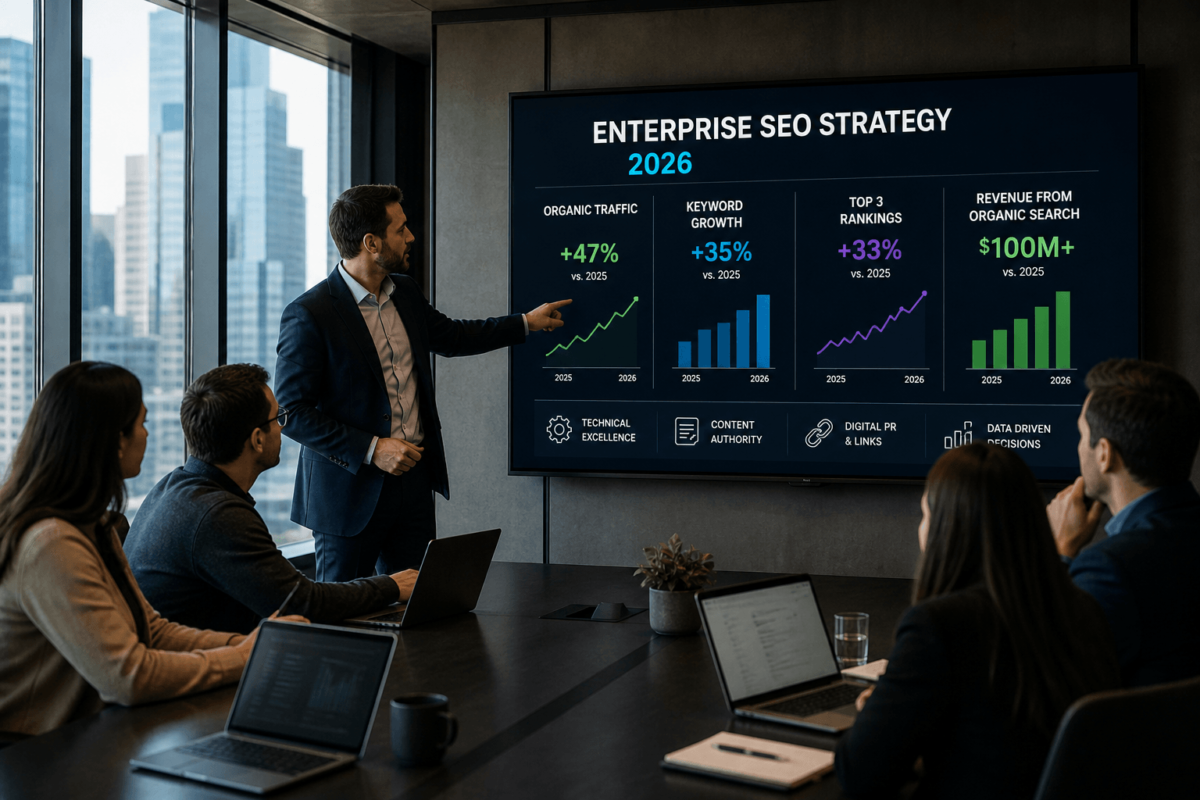
Enterprise SEO is the practice of managing and scaling search engine optimization across large websites — typically hundreds of thousands to millions of pages — while coordinating across multiple teams, stakeholders, and tech systems. It’s different from regular SEO because the challenges aren’t just algorithmic; they’re organizational, technical, and operational. Done right, enterprise SEO drives compounding organic traffic growth that no paid channel can match at scale.
📋 Quick Summary
- Enterprise SEO is about scale + systems: You’re not just optimizing pages — you’re building processes, getting dev buy-in, and managing crawl budgets across millions of URLs.
- Technical SEO is non-negotiable: Core Web Vitals, crawl budget, log file analysis, and site architecture are the foundation — ignore them and content won’t rank.
- AI is reshaping the workflow in 2026: The best enterprise teams use AI for content briefing, internal link recommendations, and search intent clustering — not to replace writers, but to scale 10x faster.
- Internal linking is the most underrated lever: Most enterprise sites are sitting on massive PageRank trapped in siloed pages. Fix this before you publish another word.
- Biggest mistake: treating SEO like a one-team job: SEO at scale requires Engineering, Content, Product, Legal, and Leadership to be aligned. If they’re not, nothing ships.
- Tool stack matters: Botify or Lumar for crawl intelligence, Ahrefs/SEMrush for research, Clearscope or Surfer for content optimization, and a solid analytics layer like Looker or GA4.
- Results take time — but compound: Enterprise SEO typically takes 6–12 months to show significant organic growth, but the ROI curve is steep once it starts.
- Content pruning is a hidden quick win: Removing or consolidating thin, outdated, or duplicate content regularly improves crawl efficiency and domain authority signals.
- Budget reality check: Enterprise SEO investment ranges from $10K/month (lean in-house + tools) to $500K+/year for global programs with agencies and large teams.
- AEO and GEO are now essential: With AI-powered search dominating in 2026, optimizing for Answer Engines and Generative AI summaries isn’t optional — it’s where the clicks are going.
What Is Enterprise SEO (Without the Fluff)
Let’s skip the textbook definition. Enterprise SEO is what happens when SEO stops being a one-person job and starts being a company-wide challenge.
You’re dealing with websites that have anywhere from 50,000 to 50 million pages. You’ve got product teams that don’t want to change templates. You’ve got legal teams that need to approve every meta description. You’ve got engineering sprints that your SEO fixes never quite make it into.
That’s enterprise SEO. Not just “big site SEO” — it’s cross-functional, high-stakes, and deeply intertwined with how the business actually operates.
The Real-World Context
Think about an e-commerce company with 2 million product pages, a B2B SaaS platform with 300 landing pages and a 40,000-page help center, or a news publisher pushing out 500 articles a day. Each of these has a completely different SEO challenge set — but they share one thing: the problems can’t be solved by one person with a spreadsheet.
Enterprise SEO teams are typically 5–50 people, sometimes more. They manage tools that cost tens of thousands per month. They sit in quarterly business reviews explaining organic traffic trends to the CMO. And they’re constantly fighting for engineering resources.
Most enterprise SEO guides talk about strategy but skip the part where you have to convince a VP of Product to prioritize a title tag fix over a new feature. That’s the real work.
Why Enterprise SEO Is Different (And Way Harder)
If you’ve only done SEO for small or mid-size sites, enterprise will feel like a different sport. Here’s why:
Scale Changes Everything
On a 10-page site, you can manually review every URL. On a site with 500,000 pages, you need automated auditing, templated SEO rules, and systems to catch regressions before they tank organic traffic. A single bad deploy — like accidentally adding a no-index tag to your entire product catalog — can wipe out millions in revenue overnight.
Team Dependencies Are the Real Bottleneck
Here’s something most guides won’t tell you: the biggest SEO bottleneck at an enterprise company usually isn’t Google’s algorithm — it’s the development sprint cycle. You can have a perfect technical SEO fix ready, but if it’s not prioritized in the next sprint, it waits two weeks. Multiply that by dozens of fixes and you’re looking at months of delays.
Successful enterprise SEO leads understand this and build relationships with engineering leads, product managers, and content directors. They learn to speak in business outcomes, not SEO jargon.
Technical Complexity at Scale
A small site might have a handful of technical SEO issues. An enterprise site can have hundreds of thousands of broken internal links, canonicalization conflicts across locales, JavaScript rendering issues that block indexing, and crawl budget problems that keep entire content sections invisible to Google.
Approval Layers and Governance
Want to update the H1 on a category page? Cool, you’ll need sign-off from Content, Legal (especially for regulated industries), Brand, and sometimes Product. A simple on-page change that would take 5 minutes on a startup site can take 6 weeks at a Fortune 500.
Building an SEO governance framework — clear ownership, defined workflows, and documented standards — is just as important as any keyword strategy.
Core Pillars of Enterprise SEO
Every successful enterprise SEO program is built on five pillars. Skip one and the whole thing wobbles.
Technical SEO at Scale
Technical SEO for enterprise sites goes way beyond fixing broken links and adding alt text. We’re talking about:
- Crawl budget management — making sure Googlebot spends its time on pages that actually matter
- Log file analysis — seeing exactly what Google is (and isn’t) crawling
- Core Web Vitals at scale — fixing LCP, INP, and CLS across hundreds of page templates
- JavaScript SEO — ensuring server-side rendering or proper pre-rendering so dynamic content gets indexed
- XML sitemap architecture — segmented sitemaps for products, categories, blog, and locale variants
- Canonicalization across faceted navigation, parameters, and hreflang implementations for international sites
The goal here isn’t perfection — it’s scalable technical hygiene. You need systems and templates that make it nearly impossible for technical SEO issues to go undetected.
Content Operations
Enterprise content isn’t about publishing more — it’s about publishing smarter. In 2026, the best enterprise content operations look like:
- Intent mapping at scale: Clustering thousands of keywords by search intent and matching them to existing or planned content
- Templatized content briefs: AI-assisted briefs that writers can execute consistently without reinventing the wheel
- Content velocity workflows: Editorial pipelines that move content from ideation to publish in days, not months
- Quality control at scale: Automated checks for thin content, duplicate meta, missing schema, and keyword cannibalization
Internal Linking Systems
This is the most underrated lever in enterprise SEO. Seriously — most large sites have millions of dollars worth of PageRank trapped in pages that are barely linked to from anywhere. An intelligent internal linking strategy can lift rankings without touching a single external backlink.
The key is automation. You can’t manually add 50,000 internal links. You need tools or custom scripts that identify linking opportunities based on topical relevance and page authority, then surface those to your content or dev teams for implementation.
Automation & AI
In real life, it works like this: your enterprise SEO team is too small for the amount of work on their plate. That’s why automation isn’t a “nice to have” in 2026 — it’s survival.
- Automated meta tag generation for product pages using structured data
- AI-generated first drafts for high-volume content types (FAQs, product descriptions, location pages)
- Scheduled technical audits with automatic Jira/Asana ticket creation for critical issues
- Rank tracking alerts integrated into Slack so the team knows immediately when something drops
- Search intent clustering using LLM-based tools to group thousands of keywords in minutes
Data & Reporting
If you’re running a large site, you’ve probably seen this: leadership wants monthly SEO reports, but nobody can agree on which metrics matter. Organic sessions? Revenue attributed to organic? Share of voice? All of the above?
Build a single source of truth. This usually means connecting GSC, GA4, your rank tracker, and your CRM into a dashboard (Looker, Tableau, or even a well-built Google Data Studio report) that shows organic’s contribution to pipeline and revenue. That’s what gets SEO taken seriously in the boardroom.
Proven Enterprise SEO Strategies for 2026
Programmatic SEO
This is one of the highest-leverage strategies for large sites. Programmatic SEO means building templated, data-driven pages at scale — think location pages, comparison pages, use-case landing pages, or integration directories.
The key is unique value at scale. Google has gotten very good at identifying thin programmatic content. To win, each page needs genuinely useful, differentiated information — not just a slightly reworded template.
A SaaS company built 8,000 integration landing pages with real product data, user reviews, and setup guides. Within 14 months, those pages drove 40% of total organic traffic.
AI-Assisted Content Workflows
Most guides won’t tell you this, but the real competitive advantage in 2026 isn’t whether you use AI — it’s how well you’ve integrated AI into your workflow without sacrificing quality. The best enterprise SEO teams use AI to:
- Generate detailed content briefs from keyword clusters in seconds
- Produce first drafts that subject matter experts then edit and enhance
- Identify content gaps by analyzing competitor pages at scale
- Rewrite underperforming content sections based on search intent signals
- Create FAQ sections optimized for featured snippets and Google’s AI Overviews
The teams that win aren’t replacing writers — they’re letting AI handle the 80% and having humans own the 20% that actually differentiates the content.
Content Pruning at Scale
Most enterprise content teams are so focused on publishing new content that they never look back at what’s already there. Big mistake. A site with 200,000 pages probably has 60,000+ that are doing nothing — or actively hurting — organic performance.
Content pruning means auditing your existing content and making one of three decisions for each page: Keep (it’s performing), Improve (it has potential but needs work), or Consolidate/Remove (it’s thin, duplicate, or outdated). The SEO impact of removing or consolidating low-quality content is consistently underestimated.
Search Intent Clustering
Keyword research for enterprise sites doesn’t work the way it does for a blog with 50 posts. You might be targeting 50,000 keywords across dozens of topic areas. Search intent clustering uses NLP and AI to group those keywords by underlying user intent, so you can map them to the right content types and avoid cannibalization.
Tools like Positional, Keyword Insights, or custom scripts using OpenAI’s API can automate this process at scale — something that used to take a team of analysts weeks now takes hours.
AEO and GEO: The 2026 Imperative
Answer Engine Optimization (AEO) and Generative Engine Optimization (GEO) aren’t buzzwords — they’re the response to a real shift in how people find information. Google’s AI Overviews, ChatGPT search, Perplexity, and other AI-powered discovery tools now intercept significant search traffic before it ever hits your site.
To win in this environment, your content needs to:
- Be structured with clear definitions, direct answers, and FAQ schema
- Demonstrate expertise, authoritativeness, and trustworthiness (EEAT) with cited sources, author bios, and original data
- Include concise, quotable definitions that AI systems can pull into summaries
- Use structured data (FAQ, HowTo, Article schema) consistently across content types
- Be cited and referenced by other authoritative sources in your industry
The goal of GEO isn’t just to rank — it’s to be cited inside AI-generated answers. That’s where discovery is happening in 2026.
Enterprise SEO Tools: What Actually Gets Used
There are a lot of SEO tools out there. Here’s the honest breakdown of what enterprise teams actually use, what each is best for, and rough pricing context.
Crawl Intelligence & Technical SEO
Botify and Lumar (formerly DeepCrawl) are the go-to tools for serious enterprise technical SEO. They’re built for sites with millions of pages and offer log file analysis, crawl budget insights, and actionable prioritization — things Screaming Frog can’t do at that scale, though Screaming Frog remains excellent for smaller crawls and ad-hoc audits.
If you’re serious about scaling technical SEO, Botify’s ROI analysis and Lumar’s reporting layer are worth the investment (typically $2,000–$6,000+/month depending on site size).
Keyword Research & Competitive Intelligence
Ahrefs and SEMrush dominate this space, and for good reason — both offer deep keyword databases, content gap analysis, backlink intelligence, and rank tracking. Most enterprise teams use one as their primary and the other for cross-validation.
SEMrush tends to win on breadth of features (PPC, social, content marketing). Ahrefs wins on backlink data depth and keyword explorer accuracy. Either works — just pick one and go deep rather than bouncing between both.
Content Optimization
Clearscope, Surfer SEO, and MarketMuse are the leading content optimization tools. They analyze top-ranking pages for a keyword and tell you which topics, entities, and terms your content should cover to compete. For enterprise content teams producing dozens of pieces per month, these tools dramatically reduce the research phase and improve content relevance.
Clearscope has the cleanest UI and integrates well with Google Docs — great for distributed content teams. Surfer SEO offers a solid content editor with more granular scoring. MarketMuse shines for content strategy at scale with its topic modeling features.
Enterprise SEO Platforms
BrightEdge and Conductor are the dominant all-in-one enterprise SEO platforms — designed specifically for large organizations with multiple stakeholders. They offer automated recommendations, reporting dashboards, competitive tracking, and workflow integration with tools like Salesforce and Adobe Analytics. The price tag matches: expect $3,000–$10,000+/month.
These platforms make the most sense for Fortune 1000 companies where the SEO team needs to demonstrate ROI to leadership and coordinate across business units. For leaner enterprise teams, a combination of best-in-class point solutions often delivers better value.
Tool Comparison at a Glance
| Tool | Best For | Price Range | Enterprise Ready | Key Limitation |
|---|---|---|---|---|
| Botify | Crawl budget & log analysis | $2K–$6K/mo | Yes | Steep learning curve |
| Lumar | Technical audits at scale | $1.5K–$5K/mo | Yes | Less log file depth vs Botify |
| Ahrefs | Backlinks & keyword research | $500–$1,500/mo | Mostly | Limited content workflow features |
| SEMrush | All-in-one research | $500–$1,200/mo | Mostly | Data can be inconsistent |
| Clearscope | Content optimization | $170–$1,200/mo | Yes | No rank tracking |
| Surfer SEO | Content briefs & scoring | $89–$395/mo | Partially | Less robust for huge teams |
| BrightEdge | Enterprise SEO platform | $3K–$10K+/mo | Yes | High cost, complex onboarding |
| Conductor | SEO + content operations | $2K–$8K/mo | Yes | Can be over-featured for small teams |
| Screaming Frog | Ad-hoc site crawls | $259/yr | Partially | Not scalable for 1M+ pages |
Real-Life Example: From 800K to 3.2M Monthly Organic Visits
Let me walk you through a scenario that mirrors what we’ve seen repeatedly in the real world. Identifying details are intentionally generalized.
📌 Case Study
The Situation
A large B2C e-commerce company — roughly 1.8 million product pages, 12 category levels deep — had plateaued at around 800,000 monthly organic sessions for two years. They’d been publishing blog content consistently but saw no meaningful growth. The SEO team was frustrated; leadership was questioning the channel.
The Diagnosis
- Crawl budget was being eaten by infinite URL parameters (filter combinations on category pages) — Googlebot was spending 60% of its crawl quota on non-indexable faceted navigation URLs
- 78,000 product pages had duplicate or near-duplicate meta titles and descriptions generated by a broken template
- The internal linking structure was essentially random — high-authority blog content wasn’t passing equity to relevant category or product pages
- 4,200 thin blog posts (under 300 words) with no traffic or backlinks were diluting crawl efficiency and topical authority
The Solution (12-Month Sprint)
- Month 1–2: Fixed parameter handling via robots.txt and canonicals — freed up crawl budget almost immediately
- Month 2–4: Rebuilt meta tag templates using structured product data, eliminating duplication at scale
- Month 3–6: Implemented programmatic internal linking using a content graph tool — added 2.1M contextual internal links
- Month 4–8: Pruned or consolidated 3,800 thin blog posts into 400 comprehensive cluster pages
- Month 6–12: Launched a programmatic content program targeting long-tail buying intent keywords
Most enterprise sites don’t need more content. They need to fix what’s already there and unlock the equity that’s already on the domain.
Step-by-Step: How to Improve Enterprise SEO
This is the part where we get tactical. Here’s a practical, sequenced process for improving enterprise SEO — one that accounts for the organizational realities of working in a large company.
-
Full Technical Audit
Before anything else, you need a clear picture of where you stand technically. Use Botify, Lumar, or Screaming Frog (for smaller sites) to crawl your entire site and categorize issues by severity and impact. Pull log files to understand crawl behavior. Map out your URL architecture visually. This audit becomes your roadmap.
-
Fix Crawl Budget Leaks
Identify and fix the biggest crawl wasters first: URL parameters, session IDs, infinite scroll pagination, faceted navigation generating millions of near-duplicate URLs, and soft 404s. These fixes often show measurable improvement in GSC’s Coverage report within 30–60 days.
-
Audit and Fix Template-Level SEO Issues
On enterprise sites, most pages are generated by templates. A single template fix can improve meta tags, heading structure, schema markup, or canonical tags across hundreds of thousands of pages simultaneously. Identify your highest-traffic templates first and prioritize fixes accordingly.
-
Prioritize High-Impact Pages
Don’t try to fix everything at once. Segment your pages by current organic traffic + potential (using rank gap analysis). Focus your first 90 days on pages that are ranking in positions 5–20 for high-volume terms — these have the highest short-term upside.
-
Build Scalable Content Systems
Develop content templates and briefs for each major content type on your site. Define SEO requirements (word count ranges, required entities, target intent, internal linking rules, schema type) for each template. This makes it possible to maintain quality as you scale content production.
-
Implement Internal Linking at Scale
Run a content graph analysis to identify your strongest pages and your most commercially important pages. Build an internal linking plan that channels authority from strong content toward money pages. Use automation tools to implement and maintain links — manual internal linking doesn’t scale.
-
Launch or Refine Content Pruning Program
Set up a quarterly content audit process. Export all indexed URLs, overlay with GSC click data, and apply the Keep/Improve/Consolidate/Remove framework. For large sites, this is an ongoing program, not a one-time project.
-
Set Up Real-Time Monitoring & Reporting
Implement rank tracking, traffic anomaly alerts, and Core Web Vitals monitoring with clear escalation paths. Build a reporting cadence — weekly for the SEO team, monthly for leadership — with clear metrics tied to business outcomes (revenue, pipeline, brand visibility).
-
Integrate AI into Your Workflow
Identify the highest-volume, most repetitive content tasks on your team. Start piloting AI-assisted workflows for those tasks — whether that’s content brief generation, FAQ writing, meta description creation, or keyword clustering. Measure quality and iterate.
-
Build Internal Alignment and Governance
Create an SEO standards document that all content creators and developers reference. Establish a regular SEO ↔ Engineering sync (even bi-weekly) to review and prioritize fixes. Make sure leadership understands SEO’s contribution to revenue — this determines how much resource you get.
Strategy Comparison: What Works at Enterprise Scale
| Strategy | Small Sites | Enterprise | Difficulty | Expected ROI |
|---|---|---|---|---|
| Programmatic SEO | Sometimes | Yes — essential | High | Very High |
| Content pruning | Yes | Yes — critical | Medium | High |
| Technical template fixes | Yes | Yes — massive scale | High | Very High |
| Manual link building | Yes | Partially | Medium | Medium |
| Internal linking automation | No | Yes — essential | Medium | Very High |
| AI-assisted content | Yes | Yes — required | Medium | High |
| Search intent clustering | Partially | Yes — at scale | Medium | High |
| AEO / GEO optimization | Yes | Yes — growing | Medium | High (growing) |
| Crawl budget optimization | Rarely needed | Yes — critical | High | Very High |
| Influencer/PR-driven links | Yes | Yes | High | Medium |
Common Enterprise SEO Mistakes (And How to Avoid Them)
These are the mistakes that show up again and again at large organizations. Some of them are surprisingly hard to avoid — knowing they exist is half the battle.
Over-indexing on content without fixing technical debt
Publishing 500 new articles on a site that Google is struggling to crawl is like putting new furniture in a house with a broken foundation. Get the technical fundamentals right before scaling content.
Ignoring crawl budget on large sites
If you have more than 100,000 pages, crawl budget is a real constraint. Google won’t crawl and index everything. Make sure it’s spending its time on pages that matter. See our crawl budget optimization guide for a full breakdown.
Treating SEO as a siloed function
SEO can’t succeed if Engineering doesn’t implement fixes, Content doesn’t follow the strategy, and Product doesn’t build SEO-friendly templates. Build bridges early and often.
Poor internal linking by default
Most CMSs generate pages with no thought to internal linking. Left unchecked, enterprise sites end up with thousands of orphan pages — well-written content that Google never finds because nothing links to it.
Slow implementation cycles killing momentum
If your average time from SEO recommendation to live implementation is 8 weeks, you’ll lose to competitors who move faster. Fight for faster cycles — even getting to 2–3 weeks can be transformational.
Keyword cannibalization across large catalogs
When multiple pages target the same keyword, they compete against each other and dilute authority. Conduct regular cannibalization audits, especially after major content pushes.
Neglecting search quality signals
High bounce rates, low dwell time, and poor click-through rates are signals that Google weighs. If your content ranks but doesn’t satisfy searchers, expect rankings to erode over time.
Underestimating the impact of site speed
At enterprise scale, even a 200ms improvement in LCP across all pages can translate to significant organic ranking improvements — and measurable conversion rate gains. Core Web Vitals are table stakes, not optional.
FAQ: Enterprise SEO in 2026
What is enterprise SEO vs regular SEO?
Regular SEO typically focuses on a single website with a manageable number of pages, handled by one person or a small team. Enterprise SEO operates at a completely different scale — millions of pages, multiple teams, significant technical complexity, and organizational dependencies. The strategies overlap, but the execution, tooling, and organizational challenges are fundamentally different.
How much does enterprise SEO cost?
It varies widely. A lean in-house team with a solid tool stack might run $10,000–$30,000/month all-in. Full-scale enterprise programs at large companies — with dedicated teams, premium platforms, and external agency partners — can exceed $500,000/year. The more relevant question is ROI: enterprise SEO, done well, typically delivers the lowest cost-per-acquisition of any digital channel at scale.
What are the best tools for enterprise SEO?
For technical SEO at scale: Botify or Lumar. For research and competitive intelligence: Ahrefs or SEMrush. For content optimization: Clearscope or Surfer SEO. For all-in-one enterprise management: BrightEdge or Conductor. For tracking and reporting: GA4, Google Search Console, and a BI tool like Looker or Tableau.
How long does enterprise SEO take to show results?
Typically 6–12 months for meaningful organic traffic growth, though technical fixes can show improvements in crawl and indexation within weeks. The compounding nature of SEO means results accelerate over time — year two is usually dramatically better than year one, assuming consistent execution.
Can AI replace enterprise SEO teams?
No — and this question slightly misses the point. AI is a force multiplier for enterprise SEO teams, not a replacement. AI tools can handle content briefs, first drafts, keyword clustering, and automated audits. But strategic thinking, stakeholder management, creative problem-solving, and judgment calls on complex technical issues still require experienced humans. The teams that win in 2026 are using AI to do 5x the work with the same headcount.
What is AEO and why does it matter for enterprise SEO?
Answer Engine Optimization (AEO) is the practice of structuring content to appear in direct answer features — like Google’s featured snippets, AI Overviews, and responses from AI tools like ChatGPT and Perplexity. As more search queries are answered directly by AI without a click, being cited as a source in those AI-generated answers becomes a critical visibility driver. For enterprise sites with high-volume informational content, AEO is now a core pillar alongside traditional SEO.
How do you measure enterprise SEO success?
The most meaningful metrics are: organic-attributed revenue and pipeline (the CMO metric), organic share of voice in your category, indexed page coverage, Core Web Vitals pass rates, and organic click-through rate trends in GSC. Vanity metrics like raw keyword rankings matter less than whether organic traffic is converting and contributing to business goals.
Final Thoughts: Enterprise SEO in 2026 Is a Systems Game
Here’s the real talk: enterprise SEO isn’t complicated in concept. Crawl what Google needs to crawl. Index what deserves to rank. Create content that genuinely serves your audience better than any competitor. Build authority through relevance, structure, and trust.
But executing that at scale — across millions of pages, a dozen cross-functional teams, quarterly board reviews, and an AI-transformed search landscape — that’s where it gets hard. And that’s exactly why most large companies are still leaving enormous organic growth on the table.
The companies winning at enterprise SEO in 2026 aren’t the ones with the biggest budgets. They’re the ones with the clearest systems, the strongest cross-functional relationships, and the willingness to keep fixing the fundamentals even when shiny new tactics are more tempting.
If you’re managing enterprise SEO right now, start with the technical foundation, build your automation layer, and create a reporting structure that earns you the organizational trust to actually implement your recommendations. The rest follows.
Organic search is still the highest-ROI channel at scale. Earn it systematically, and it compounds for years. That’s the enterprise SEO opportunity in 2026 — and it’s massive for those willing to do the work.
📚 Keep Reading — More SEO Resources
🚀 Ready to Scale Your Enterprise SEO?
Our team at TechCognate builds enterprise SEO systems that actually ship — from technical audits to content programs and reporting dashboards.
Get a Free SEO Consultation →