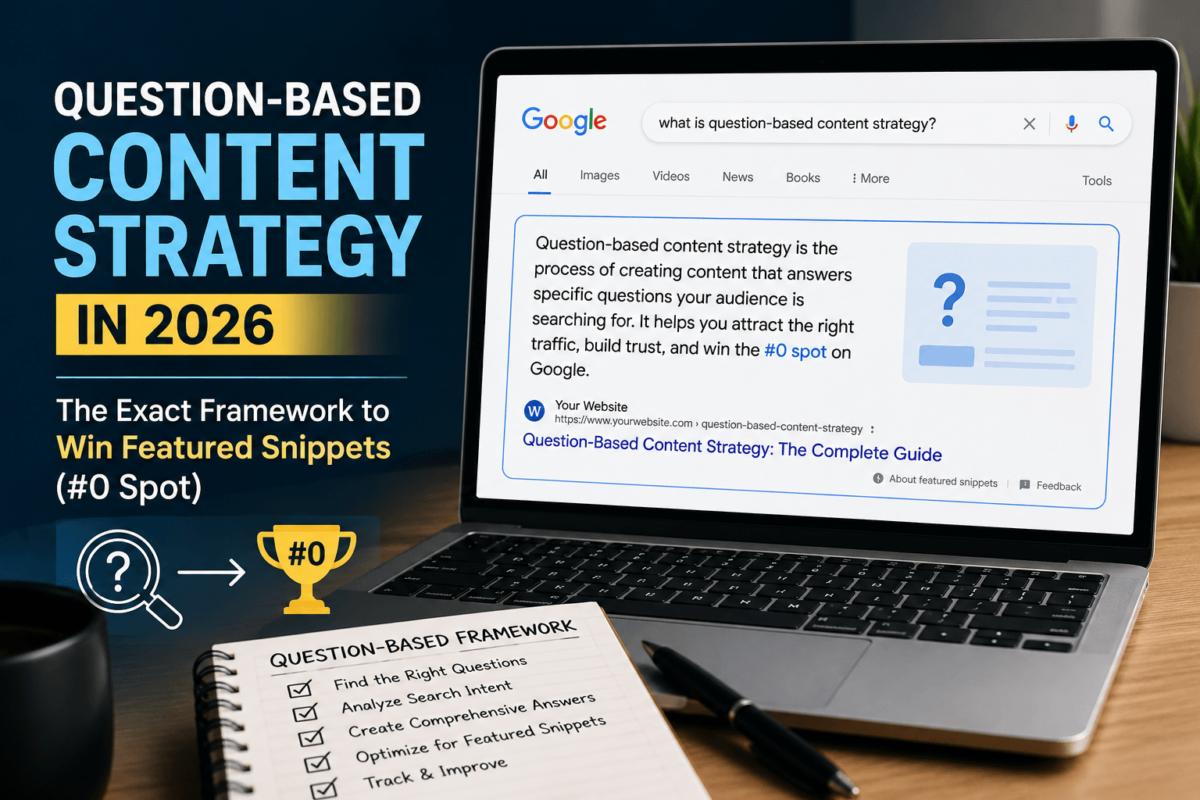
Question-Based Content Strategy in 2026: The Exact Framework to Win Featured Snippets (#0 Spot)
Question-based content strategy means building your content around the exact questions your audience types into Google. In 2026, this is the single most reliable way to capture Featured Snippets, show up in AI Overviews, and rank #0 — the spot above all organic results.
- Target ‘People Also Ask’ questions to own multiple SERP positions
- Capture Featured Snippets by structuring 40–60 word direct answers
- Increase CTR without building more backlinks
- Rank in AI Overviews (SGE) by making your content easily quotable
- Turn question-based traffic into affiliate revenue with intent-matched offers
- Build topical authority using content clusters around core questions
- What Is Question-Based Content Strategy?
- Why It Dominates in 2026
- Types of Questions That Actually Rank
- The Psychology Behind Question-Based Content
- How to Structure Content for Featured Snippets
- The Affiliate Marketing Angle
- Real-Life Example: A Case Study
- Step-by-Step: How to Build Your Strategy
- Question-Based vs. Traditional SEO
- FAQs
- Final Thoughts
What Is Question-Based Content Strategy?
Think of it like this: it’s answering exactly what someone types into Google before they click anything. Instead of writing generic blog posts about broad topics, you build content around specific questions — ‘What is the best laptop for college students?’ or ‘How do I fix a slow website?’
Each piece of content targets one real question with a clear, direct answer. Google (and now AI search tools) reward this format heavily because it matches what users actually want. You’re not guessing. You’re responding.
This approach feeds directly into your long-tail keyword strategy — question-based queries are almost always long-tail by nature, which means lower competition and higher intent.
Why Question-Based Content Dominates in 2026
Google has changed. A lot. Here’s what the SERP looks like now:
- Featured Snippets appear before position #1, snagging clicks away from traditional top results
- AI Overviews (SGE) pull direct answers from structured, question-formatted content
- Voice search queries are almost entirely phrased as questions
- Zero-click searches are rising — and question-based content is what gets shown
Here’s the thing most blogs won’t tell you: if your content isn’t formatted around questions, you’re invisible in all four of these spaces. You could have great backlinks and still lose traffic to a smaller site that answered questions better. A solid featured snippets optimisation process is what turns that structural advantage into consistent #0 rankings.
Understanding how search engine positioning has evolved makes this crystal clear — the SERP is now dominated by answer-first content, not just the highest-authority domains.
Types of Questions That Actually Rank
“What is…” — Definition Intent
Informational goldmines. Google loves surfacing clean, direct definitions.
Example ‘What is a featured snippet?’ — structure your answer in 2–3 sentences and you have a strong shot at the #0 position.“How to…” — Process Intent
Step-by-step content fits perfectly into Featured Snippet boxes. Use numbered lists, keep steps short, and always start with a one-sentence summary.
Example ‘How to optimize a blog post for Google’ — leads naturally into a numbered list Google can pull directly.“Best…” — Commercial Intent
This is where affiliate marketing gets exciting. ‘Best’ questions carry buyer intent. Someone asking is already close to purchasing.
Example ‘Best budget DSLR camera under $500’ — targets readers who are ready to buy. Insert affiliate links naturally here.“Why…” — Curiosity Intent
‘Why’ questions often trigger paragraph-style snippets. These work well for thought leadership and trust-building content.
Example ‘Why does page speed affect SEO?’ — explain it clearly in 50 words and Google may display your answer directly.“Is/Can…” — Decision Intent
People in decision mode ask these. They want a yes/no with context — strong angle for beginners deciding whether to invest time in a strategy.
Example ‘Can you rank without backlinks?’ — perfect for SEO content targeting readers weighing their options.Knowing the four types of keyword intent helps you match the right question format to the right content structure every single time.
The Psychology Behind Question-Based Content
This is the part most content guides completely skip.
Curiosity Gap
A question creates an open loop in the reader’s brain. They need the answer. That’s why question-based headlines get clicked more consistently.
Intent Clarity
When you know the question, you know exactly what the reader wants — no guessing. This lets you write tighter, more useful content.
Cognitive Ease
Questions feel familiar. They mirror how we think and speak. Content structured around questions is easier to read and remember.
Google’s Preference
Google’s algorithm is trained on human behavior. People ask questions. Content that answers them directly gets rewarded with better rankings and snippet placement.
How to Structure Content for Featured Snippets
This isn’t complicated, but you have to be intentional about it.
If you want to go deeper on the mechanics, our full guide on how to rank in featured snippets covers every format — paragraph, list, table, and video — with worked examples for each. Pairing that with solid meta tag optimisation ensures your snippet-ready content also wins the click when it does surface in position #0.
The Affiliate Marketing Angle (Your Competitive Edge)
I’ve seen this work over and over again — question-based content paired with affiliate offers is one of the cleanest monetization setups in content marketing.
Here’s the strategy: target buyer-intent questions and insert affiliate links naturally within the answer.
Target: ‘What is the best laptop for students under $800?’
- Answer the question directly in the intro (snippet bait)
- Provide a comparison of 3–4 options with your affiliate links embedded
- Add a clear recommendation at the end (‘Our top pick: [Product]’)
The magic here is that someone searching ‘best laptop for students’ is already in purchase mode. You’re not convincing them to buy — you’re helping them choose. That’s a completely different (and much more effective) selling environment.
This connects tightly to AI content optimisation — structuring your affiliate posts so they’re both snippet-ready and AI Overview-eligible doubles your surface area without doubling your workload.
Real-Life Example: A Case Study
Let’s say Sarah runs a personal finance blog. She shifts her content strategy to focus entirely on question-based keywords.
She targets: ‘What is the best high-yield savings account in 2026?’ — a question with commercial intent and clear affiliate potential.
She structures her post with a 55-word direct answer at the top, a comparison table of 5 accounts, and affiliate links to each bank’s sign-up page.
The post ranks in the Featured Snippet position. It attracts 4,200 monthly visitors. With a 3% conversion rate on affiliate links at $30 per referral:
Not every post performs like this. But the compounding effect of 20–30 well-optimised question posts is what builds real traffic and income.
Step-by-Step: How to Build a Question-Based Content Strategy in 2026
-
Find your questions. Think like your reader. What would you type into Google if you had this problem? Also look at ‘People Also Ask’ boxes, YouTube comment sections, and Reddit threads for raw, unfiltered questions.
-
Group by intent. Sort questions into: informational (what/why/how), commercial (best/top), and decision-based (is/can/should). Each group needs a slightly different content structure.
-
Build content clusters. Create a pillar page around a broad topic, then write supporting posts for specific questions. This builds topical authority fast. See how B2B SEO strategy uses this exact cluster model to compound authority over time.
-
Answer upfront — always. Your very first paragraph should answer the core question directly. This is your snippet bait. Don’t save the answer for the end.
-
Optimise your formatting. Use H2s for questions. Use numbered lists for steps. Keep paragraphs to 2–4 lines max. White space is not your enemy.
-
Add internal links strategically. Link from question-based posts back to your pillar pages and to other relevant question posts. This keeps users on-site and boosts page authority. A solid SEO reporting workflow helps you track which internal links are driving the most engagement.
-
Monetise with intent-matched offers. For informational questions, use display ads or email opt-in CTAs. For commercial and decision questions, use affiliate links or product recommendations.
-
Update for AI snippets. Every 3–6 months, revisit your top posts. Refresh the direct answer section, update statistics, and ensure the formatting still aligns with what Google is currently pulling into snippets. Our guide to AI snippet optimisation walks through exactly how to reformat existing content so it gets picked up by AI Overviews.
Question-Based Content vs. Traditional SEO Content
Here’s how the two approaches stack up across the metrics that actually matter in 2026:
| Factor | Question-Based | Traditional SEO |
|---|---|---|
| Ranking Speed | Fast (weeks) | Slow (months) |
| Traffic Quality | High — intent-matched visitors | Mixed intent |
| CTR | High — snippet exposure boosts clicks | Standard — lower without snippets |
| AI Visibility | Strong — AI pulls directly | Moderate |
| Monetisation | Intent-driven, affiliate-ready | Broad, lower conversion |
| Backlinks Needed | Low to moderate | High |
| Content Structure | Q&A / answer-first | Topic overview |
The backlinks advantage is particularly significant. Understanding how to build backlinks without outreach alongside a question-based strategy means you can reduce dependency on off-page SEO entirely. And once your snippets start winning, use dedicated snippet tracking tools to monitor which positions you hold and flag any that drop — so you can re-optimise before traffic takes a hit.
FAQs
Final Thoughts
Question-based content strategy isn’t a trend — it’s a structural shift in how search works. Google, AI tools, and voice search have all moved toward answering questions, not ranking pages. If your content isn’t built around questions, you’re playing a different game than the algorithm.
The blueprint is simple: find the questions your audience is already asking, answer them directly and clearly, format for snippets, and match your monetisation to the reader’s intent. Do that consistently across 20–30 posts and you’ll have a content asset that compounds in value over time.
In 2026, the websites winning aren’t necessarily the ones with the most backlinks or the biggest budgets. They’re the ones that answer questions better than anyone else. That’s a winnable game — and now you know exactly how to play it.
Ready to put this into practice? Start with a proper SEO competitor analysis to identify which questions your competitors are already owning — then go answer them better.