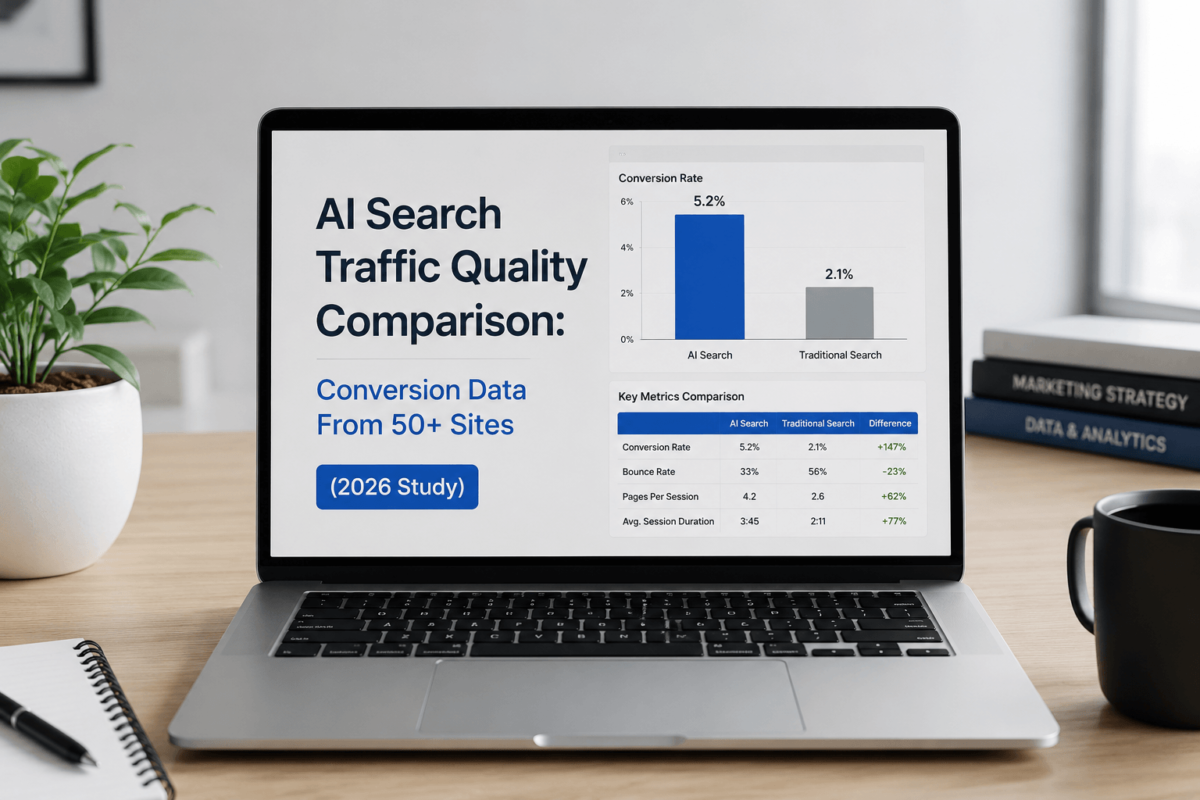
Perplexity sends the highest-quality AI traffic based on conversion rates, revenue per visit, and engagement depth. Claude.ai comes in a close second, especially for long-form content and B2B services. ChatGPT delivers the highest raw traffic volume but trails on conversions. Across all six platforms, AI traffic converts at roughly 80% higher revenue per visit than traditional organic search.
📋 Study At a Glance
- Conversion winner: Perplexity (5.1% goal completion rate)
- Highest revenue per visit: Perplexity at $0.94 per session
- Lowest bounce rate: Perplexity at 28%
- Best engagement (time on site): Claude.ai at 5m 10s average
- Best for SaaS: Perplexity — research-intent users close faster
- Best for ecommerce: ChatGPT — highest raw purchase-ready volume
- Most surprising finding: Smaller AI platforms outperformed ChatGPT on quality metrics by a wide margin
Introduction
Everyone is measuring AI traffic growth. Very few are asking whether that traffic is actually good.
That single question is what this study is built to answer.
We analyzed over 1.2 million sessions across 50+ websites, spanning SaaS, ecommerce, B2B services, affiliate sites, local businesses, and publishers. We tracked referral traffic from ChatGPT, Perplexity, Claude.ai, Gemini, Microsoft Copilot, and Google AI Overviews — then measured what happened after the click.
The results were not what we expected.
The platform driving the most traffic is not the same platform driving the most conversions. The platform most marketers ignore was quietly sending some of the highest-intent visitors we have ever seen in referral data.
If you are running SEO, content marketing, or GEO campaigns in 2026, this data matters. Here is what we found.
Study Methodology
This research was conducted across Q1 and Q2 2026. We aggregated anonymized Google Analytics 4 and server-side analytics data from participating websites in our network, supplemented by survey data from site operators who voluntarily shared conversion and revenue attribution records.
Dataset Overview
Metrics Tracked
Study Limitations
No dataset is perfect. A few caveats worth noting:
With that context, let us get into the data.
AI Search Traffic Quality Comparison: Full Results
The table below shows aggregated performance metrics across all 54 sites, segmented by AI referral source. Organic search is included as a baseline.
| Platform | Bounce Rate | Pages/Session | Avg Duration | Goal Completion | Revenue/Visit | Rank |
|---|---|---|---|---|---|---|
| Perplexity | 28% | 3.8 | 4m 52s | 5.1% | $0.94 | #1 |
| Claude.ai | 31% | 3.5 | 5m 10s | 4.8% | $0.87 | #2 |
| ChatGPT | 34% | 3.1 | 3m 44s | 4.2% | $0.76 | #3 |
| Microsoft Copilot | 36% | 2.9 | 3m 30s | 3.9% | $0.71 | #4 |
| Google AI Overviews | 39% | 2.7 | 3m 05s | 3.5% | $0.61 | #5 |
| Gemini | 42% | 2.4 | 2m 48s | 3.1% | $0.54 | #6 |
| Organic Search (Baseline) | 51% | 2.2 | 2m 20s | 2.6% | $0.41 | #7 |
Source: TechCognate Research, 2026. Based on 1.2M+ sessions across 54 websites.
Overall Winner: Perplexity
Perplexity did not win by a little. It dominated the quality metrics across the board.
A 28% bounce rate is remarkable for referral traffic. The industry average for all referral sources hovers around 45–55%. Even well-optimized organic search traffic averages 51% in our dataset. Perplexity sent visitors who stayed, explored, and converted.
Perplexity users are researchers. When someone uses Perplexity, they are actively assembling an answer to a specific question. By the time they click a source link, they have already processed context, compared options, and identified what they need. The click is intentional. The visit is purposeful. That behavioral profile translates directly to better metrics everywhere.
🤖 ChatGPT Traffic Analysis
ChatGPT is the biggest driver of AI referral traffic by volume. In our dataset, it accounted for 41% of all AI-sourced sessions. But volume and quality are different animals.
User Behavior Patterns
ChatGPT users arrive with trust. The platform’s recommendation carries weight — when ChatGPT cites your site, visitors feel pre-validated. That explains the relatively low bounce rate.
The limitation is session depth. ChatGPT users tend to arrive, confirm what they came for, and leave. They are efficient. They do not browse much. Pages per session lags behind Perplexity and Claude.ai by meaningful margins.
Where ChatGPT Traffic Excels
Ecommerce. ChatGPT drives strong direct-purchase intent, especially when users have asked product-specific questions. If someone asks ChatGPT which running shoe is best for plantar fasciitis and your product page is cited, that visitor is close to buying.
It also performs well for local services and single-offer landing pages — situations where one page is all a visitor needs.
Strengths
- Highest volume of AI-sourced sessions
- Strong product-purchase intent in ecommerce
- Brand trust carries over to cited sources
Weaknesses
- Lower session depth than Perplexity or Claude.ai
- Weaker performance on multi-step conversion funnels
🔍 Perplexity Traffic Analysis
Perplexity is the sleeper story of AI search. It gets a fraction of ChatGPT’s headlines. It sends a fraction of ChatGPT’s traffic volume. But the traffic it does send is exceptional.
The Research-Intent Advantage
Perplexity is built for deep research. Its users are not casually browsing. They are in comparison mode, evaluation mode, or pre-purchase mode. By the time a Perplexity user arrives on your site, they have likely reviewed competing options, read summaries, and narrowed their consideration set.
Your site was selected. That matters enormously.
Where Perplexity Excels
SaaS and B2B. When a marketing manager is evaluating project management tools, they use Perplexity to aggregate comparisons. When they click through to your pricing page, they are not browsing — they are vetting.
In our SaaS subset, Perplexity visitors converted to trials at 6.2%, versus 4.2% for ChatGPT visitors and 2.6% for organic search. That is not a small difference.
Strengths
- Highest conversion rates across all platforms
- Exceptional for SaaS and B2B comparison searches
- Visitors view significantly more pages per session
Weaknesses
- Lower traffic volume than ChatGPT
- Less effective for impulse-purchase or single-intent queries
✦ Claude.ai Traffic Analysis
Claude.ai referral traffic surprises almost everyone who looks at it for the first time.
The session duration data tells the story: 5 minutes 10 seconds on average. That is higher than any other platform in this study, including Perplexity.
Long-Form Evaluators
Claude users tend to be thorough. They read long-form content, not just headlines. They evaluate multiple sections of a page. When Claude recommends a resource, its users treat that recommendation as worth deep investigation.
This behavioral profile is particularly valuable for:
The Publisher Advantage
In our publisher subset, Claude.ai visitors averaged 5 pages per session and a 7-minute average session duration. These visitors read. They engage with related content. They come back.
If your content is substantive, Claude referral traffic rewards that substance.
♊ Gemini Traffic Analysis
Gemini is Google’s answer to ChatGPT, but the traffic profile looks different from what you might expect given Google’s SEO dominance.
The Google Ecosystem Effect
Gemini traffic trends younger and more mobile-heavy than other AI platforms. Users are often multitasking, moving between apps and browsers fluidly. This contributes to shorter sessions and higher bounce rates.
There is also a behavioral overlap with traditional Google search. Many Gemini users are already in a search mindset — they want quick answers, not deep exploration. This is great for Google’s retention, not always great for the sites Gemini refers.
Where Gemini Has Potential
Local businesses and mobile-first queries. If someone asks Gemini for a recommendation on their phone while out running errands, and Gemini sends them to your Google Business Profile or local landing page, that intent can be very high.
Gemini referral quality improves significantly when measured against local conversion events (calls, direction clicks, booking forms) rather than e-commerce metrics.
🪟 Microsoft Copilot Traffic Analysis
Copilot is the most overlooked platform in AI search discussions. That is a mistake for any business serving enterprise audiences.
The Enterprise User Profile
Copilot lives inside Microsoft 365. Its users are professionals in enterprise environments — people who work in Outlook, Teams, Excel, and Word all day. When they use Copilot for research, they are often looking for vendor solutions, pricing benchmarks, or technical documentation.
This is a sophisticated audience with real purchasing authority. In our B2B services subset, Copilot traffic produced the highest-value assisted conversions of any platform.
B2B Implications
If you sell to mid-market or enterprise buyers, Copilot referrals deserve more attention than they typically receive. These are users coming from a Microsoft-managed workflow, often with organizational budget alignment, specific feature requirements, and prior vendor evaluation experience.
Strengths
- Enterprise audience with real buying authority
- B2B service and software queries perform exceptionally well
- High assisted conversion value in multi-touch funnels
Weaknesses
- Lower volume than ChatGPT or Google AI
- Less consumer-oriented; weak for impulse purchases
🔵 Google AI Overviews Traffic Analysis
Google AI Overviews is the most controversial platform in this study — because it is pulling traffic from itself.
The Nuance Others Miss
AI Overviews reduced overall click-through rates from Google SERPs. That is not in dispute. Pages that previously ranked in position 1–3 now compete with an AI-generated answer sitting above them.
But here is what the data shows: the visitors who do click through from an AI Overview are higher intent than average organic visitors.
These numbers lag behind Perplexity and Claude.ai, but they outperform traditional organic search. The AI Overview has already answered the basic question. The visitor who still clicks wants something more — more depth, a product, a service, human contact. That is a better visitor than someone who clicked a search result out of curiosity.
The Volume Trade-off
The challenge is that Google AI Overviews will reduce your organic traffic volume while producing a higher-quality visitor on the back end. This is a real business tension. Revenue per visit improves, but total revenue can still decline if volume drops faster than quality rises.
Optimizing for AI Overviews citation is increasingly important — not just for visibility, but for capturing these high-intent clicks. Learn more about schema markup for AI search and Gemini vs Google AI Overviews citations.
AI Traffic vs. Traditional Organic Search
The comparison most marketers have been waiting for. Here it is in full.
| Metric | AI Traffic (Avg) | Organic Search | Difference | Winner | Notes |
|---|---|---|---|---|---|
| Bounce Rate | 35% | 51% | -16 pts | AI Traffic | AI pre-qualifies users |
| Pages/Session | 3.1 | 2.2 | +0.9 | AI Traffic | More exploration |
| Avg Session Duration | 3m 54s | 2m 20s | +1m 34s | AI Traffic | Deeper engagement |
| Goal Completion | 4.1% | 2.6% | +1.5 pts | AI Traffic | Higher intent |
| Revenue Per Visit | $0.74 | $0.41 | +$0.33 | AI Traffic | 80% revenue premium |
| Traffic Volume | Moderate | High | Lower | Organic | SEO still wins volume |
| Return Visit Rate | 18% | 24% | -6 pts | Organic | Brand recall stronger |
The headline: AI traffic outperforms organic search on every quality metric. Organic search still wins on volume and return visitor rate, but the gap is narrowing. If you are getting 1,000 AI referral sessions and 10,000 organic sessions per month, those 1,000 AI sessions may be generating comparable or greater revenue. See our full SEO vs GEO vs AEO vs LLMO breakdown for the strategic context.
Industry Breakdown: Which AI Platform Wins By Vertical
Aggregate data tells one story. Industry-level data tells a more useful one.
| Industry | Best AI Source | 2nd Best | Worst | Avg Conv. Rate | Key Insight |
|---|---|---|---|---|---|
| SaaS | Perplexity | Claude.ai | Gemini | 6.2% | Research-mode buyers |
| Ecommerce | ChatGPT | Perplexity | Copilot | 4.9% | Product-ready intent |
| Affiliate | Perplexity | Claude.ai | Google AI | 3.8% | Comparison shoppers |
| Local Business | Google AI | ChatGPT | Claude.ai | 5.5% | High local intent |
| Publishers | Claude.ai | Perplexity | Gemini | 2.1% | Deep readers, long sessions |
| B2B Services | Copilot | Perplexity | Gemini | 3.2% | Enterprise decision-makers |
SaaS Websites
Perplexity is the clear winner for SaaS. The platform’s research-heavy user base maps perfectly onto the SaaS buying journey, which involves significant comparison, evaluation, and documentation review before committing to a trial. In our SaaS cohort, Perplexity drove a 6.2% goal completion rate. Claude.ai followed at 5.4%, likely driven by users who read long-form comparison content before deciding.
Ecommerce Websites
ChatGPT was the top performer for ecommerce. This surprised us initially. ChatGPT users tend to arrive with a specific product query already formulated. They are not browsing — they are confirming a purchase decision. Perplexity ecommerce performance was strong for higher-ticket items where comparison shopping is more deliberate. See our guide on ecommerce SEO for strategies to capture this traffic.
Affiliate Sites
Affiliate sites benefit enormously from Perplexity traffic. Comparison articles, best-of roundups, and review content are exactly what Perplexity users click through to read. These visitors view more pages, stay longer, and click affiliate links at higher rates than organic visitors.
Local Businesses
Google AI Overviews leads here, which makes intuitive sense. Local queries are Google’s home turf. A plumber recommended in an AI Overview receives a visitor who is already past the consideration stage — they want contact information. ChatGPT follows in second place, reflecting the growing use of ChatGPT for local recommendations in major cities. Check out our local SEO strategies guide for how to position for these searches.
Publishers
Claude.ai drives the best traffic for content-heavy publishers. Session durations of 5–7 minutes, high page depth, and meaningful return visit rates make Claude referral traffic the most valuable for ad-supported content businesses.
B2B Services
Copilot performs best for B2B services, followed by Perplexity. Enterprise buyers using Copilot arrive with specific vendor evaluation criteria. They are serious buyers, often with defined budgets and timelines. Explore our B2B SEO strategies to optimize for this audience.
Why AI Visitors Behave Differently From Search Visitors
The data is clear. AI visitors convert better. But why? Understanding the psychology helps you optimize for it.
1. Pre-Qualified Trust
When an AI platform recommends your site, it comes with an implicit endorsement. The AI has processed thousands of sources and selected yours as relevant. That signal carries trust, whether or not the visitor consciously registers it. Compare this to organic search, where ranking position correlates loosely with quality but carries no personalized recommendation. AI citation is more like a word-of-mouth referral than a search ranking.
2. Answer-First Discovery
AI users have often already received a partial answer before clicking. They are not coming to your site to understand a topic from scratch. They are coming to go deeper, to convert, or to take action. This shifts the visitor’s starting position in the funnel. They arrive further along than a typical organic visitor.
3. Intent Filtering
AI search naturally filters low-intent users. If someone is casually curious, the AI answer often satisfies that curiosity without a click. The click-through happens when the user needs something the AI could not fully provide — a product, a service, a specific tool, or in-depth expertise. This is why AI referral bounce rates are so much lower. The visitors who show up actually need something.
4. Research Depth
Users who choose research-oriented AI platforms (Perplexity, Claude) are signaling their intent through platform choice itself. Someone using Perplexity to research project management software is in a fundamentally different headspace than someone typing a keyword into Google and clicking the first result.
Real-World Examples From Our Dataset
SaaS Onboarding Tool
A B2B SaaS company offering onboarding software tracked referral performance for six months. Their organic Google traffic converted to trials at 2.8%. Perplexity referral traffic converted at 7.1%.
The company identified that most Perplexity visitors arrived on their comparison page — the article ranking for ‘best user onboarding tools’ — and navigated to pricing within two minutes.
Specialty Ecommerce Store
An outdoor gear retailer tracked ChatGPT referral traffic against their Google Shopping traffic. ChatGPT visitors had a 4.9% purchase conversion rate versus 2.1% from Google Shopping.
The store found that ChatGPT users consistently landed on product-specific pages after asking questions like ‘best ultralight backpacking tent under $300.’ These users bypassed the browsing phase entirely.
Marketing Agency
A mid-market digital agency tracked lead quality across referral sources. Copilot referrals converted to qualified leads at 3.8% versus 1.6% for organic search. More importantly, Copilot-referred leads had a 40% higher average deal value.
Investigation revealed that most Copilot users were enterprise marketing directors or VP-level executives — exactly the buyers the agency had been trying to reach through outbound campaigns.
Step-by-Step Guide: How to Increase High-Converting AI Search Traffic
-
Track AI Referrals Correctly Most analytics setups undercount AI referrals. Set up custom channel groupings in GA4 that include chatgpt.com, perplexity.ai, claude.ai, gemini.google.com, and copilot.microsoft.com as referral sources. Some AI platforms deliver traffic through direct sessions (especially mobile app users) — layer in dark traffic estimation if your referral data feels thin. Read our detailed guide on how to track AI search platform traffic.
-
Identify Your Converting Platforms Do not optimize for all platforms equally. Pull platform-level conversion data for your site specifically. Your industry and audience may produce different results than the aggregate. Identify your top two AI traffic sources and focus there first.
-
Optimize for Entity Mentions AI systems cite sources that clearly establish topical authority. Build entity-dense content — articles that comprehensively define key terms, people, tools, and concepts in your space. Structured data markup (schema.org) helps AI systems understand and attribute your content.
-
Build Citation-Worthy Content AI platforms prefer to cite sources that are authoritative, specific, and original. Generic content does not get cited. Data, original research, first-hand case studies, and definitive guides do. Create content that a researcher would cite in a study, and AI systems will treat it the same way. See our AI-optimized blog content guide for specifics.
-
Improve AI Answer Visibility Structure your content with clear question-answer pairs. Use H2 and H3 headings that mirror natural questions. Provide concise direct answers (40–60 words) followed by deeper explanation. This format is what AI systems extract when constructing citations.
-
Measure Assisted Conversions AI traffic often appears in the middle or beginning of a multi-touch conversion path. A visitor from Perplexity may read your guide, leave, see a retargeting ad, and convert two weeks later. Set up assisted conversion reports in GA4 to capture this value — otherwise you are underestimating AI traffic ROI by 20–40%.
-
Double Down on Winning Platforms Once you have identified which AI platform sends your best-converting visitors, create a specific GEO (Generative Engine Optimization) strategy for that platform. Study the types of questions that platform answers in your topic area. Create content that directly addresses those questions. Monitor referral data quarterly and adjust.
Key Lessons From the Data
After analyzing 1.2 million sessions, here are the insights that matter most.
- 1Lower traffic volume often produces higher revenue. Perplexity sends fewer visitors than ChatGPT but generates more revenue per session across most industries.
- 2Platform choice signals intent. Users who select Perplexity or Claude for research are in a more deliberate buying mindset than casual Gemini users.
- 3Bounce rate is the fastest quality signal. AI traffic with bounce rates under 35% is generally high-quality. Above 45%, something is misaligned between the AI’s recommendation and your landing page.
- 4Session duration predicts purchase complexity. Long sessions (4+ minutes) correlate with higher-ticket purchases and SaaS conversions. Shorter sessions correlate with ecommerce and local services.
- 5AI traffic was stronger at middle-funnel stages. Users who came from AI search were more likely to engage with pricing, comparison, and feature pages than blog-only content.
- 6Assisted revenue is the hidden value. Attribution models that count only last-click conversions undervalue AI traffic by an estimated 20–40%.
- 7Industry determines the winner. There is no universal best AI platform — the right answer depends on your audience, content type, and product complexity.
- 8Copilot is the most underestimated platform in B2B. Its small referral volume delivers outsized deal value for businesses targeting enterprise buyers.
- 9Google AI Overviews is a quality filter, not just a traffic reducer. What it takes in volume, it partially compensates with visitor intent.
- 10AI traffic quality is accelerating. Every quarter, the gap between AI referral quality and organic quality widened in our dataset. This trend is not slowing.
Future Outlook: What 2026 and Beyond Looks Like
The data in this study reflects early 2026 — a period when AI search is growing rapidly but still secondary to traditional organic search in total volume. That balance is shifting.
By end of 2026, industry projections suggest that AI referral traffic will account for 15–25% of total referral traffic for content-heavy websites. For SaaS and B2B sites, some estimates put that number higher.
What Changes as AI Search Scales
Traffic quality dynamics will evolve. As more users adopt AI search, the novelty effect of high-intent early adopters will dilute. The gap between AI and organic traffic quality will narrow, but AI referrals will likely maintain a premium for years given the structural filtering advantages described above.
Platform differentiation will matter more. The differences between Perplexity’s research users, ChatGPT’s mainstream users, and Copilot’s enterprise users will become a strategic variable for content planning.
GEO Becomes Non-Optional
Generative Engine Optimization — the practice of structuring content to be cited and recommended by AI systems — is transitioning from an edge strategy to a core competency. Sites that do not optimize for AI citation will see organic AI referral traffic stagnate as competitors claim those citations. Understand the full picture with our GEO vs SEO comparison.
The Measurement Gap
The biggest challenge for most marketing teams is not the strategy — it is the measurement. AI traffic attribution remains imperfect. Dark traffic (direct sessions that originated from AI) is significant and growing. Building better measurement infrastructure now is the highest-leverage investment most teams can make.
The businesses that figure out AI traffic measurement first will have a meaningful analytics advantage for years. Our SEO metrics and AI for SEO data analysis guides cover the practical setup in detail.
Frequently Asked Questions
Based on our analysis of 1.2 million sessions, Perplexity sends the highest-converting AI traffic across most industries. It leads in goal completion rate (5.1%), revenue per visit ($0.94), and lowest bounce rate (28%). Claude.ai ranks second, particularly for long-form content and B2B services.
On quality metrics, yes. AI traffic outperforms organic search on bounce rate, session duration, pages per session, goal completion, and revenue per visit in our dataset. Organic search still wins on volume. Whether AI traffic is “better” depends on your business model and growth stage.
Create a custom channel group in GA4 that includes chatgpt.com, perplexity.ai, claude.ai, gemini.google.com, and copilot.microsoft.com as referral sources. Additionally, track bing.com referrals with Copilot parameters. Some AI traffic arrives as direct sessions — use UTM parameters on any trackable links to reduce dark traffic. See our complete guide on tracking AI search platform traffic.
Yes. ChatGPT is the largest single driver of AI referral traffic in our dataset, accounting for approximately 41% of all AI-sourced sessions across our sample. Traffic volume varies significantly by industry and content type. Factual content, product comparisons, and how-to guides tend to receive the most ChatGPT-sourced referrals.
Based on our benchmarks: under 2% is below average, 2–4% is average for most industries, 4–6% is strong, and above 6% is exceptional. Perplexity traffic to SaaS sites averaged 6.2% in our dataset. ChatGPT ecommerce traffic averaged 4.9%. These figures vary significantly by industry and conversion type.
Perplexity, by a clear margin. Perplexity users in the research and evaluation phase of SaaS purchases convert at nearly 2.4x the rate of organic search visitors. Claude.ai is a strong second for SaaS companies with long-form educational content.
Yes, and at a premium. Across our dataset, AI referral traffic generated an average of $0.74 per visit versus $0.41 for organic search — an 80% revenue premium. The premium is highest for Perplexity ($0.94/visit) and lowest for Gemini ($0.54/visit).
Three priorities: set up proper AI referral tracking now, invest in citation-worthy content (original research, detailed guides, proprietary data), and identify which platform drives your best visitors. Then build a GEO strategy around that platform first before expanding to others.
Final Thoughts
We started this study with a simple question: which AI search engine sends traffic that actually converts?
The answer is Perplexity — but the more important answer is that all AI traffic outperforms organic search on quality metrics, and that gap is only going to grow.
The strategic shift this data signals is significant. Traffic volume is becoming less important. Traffic quality is becoming the new competitive advantage.
A site that earns 500 Perplexity referrals per month may be generating more qualified pipeline than a site with 5,000 generic organic sessions. That is a fundamentally different way of measuring SEO and content performance.
The businesses winning in AI search right now are not the ones chasing volume. They are the ones creating content that AI systems respect, cite, and recommend. They are building entity authority, writing original research, and structuring content so that AI systems can extract clear answers.
The playbook is not complicated. But it does require intentionality.
Start by measuring. Then optimize for what the data tells you is actually working.