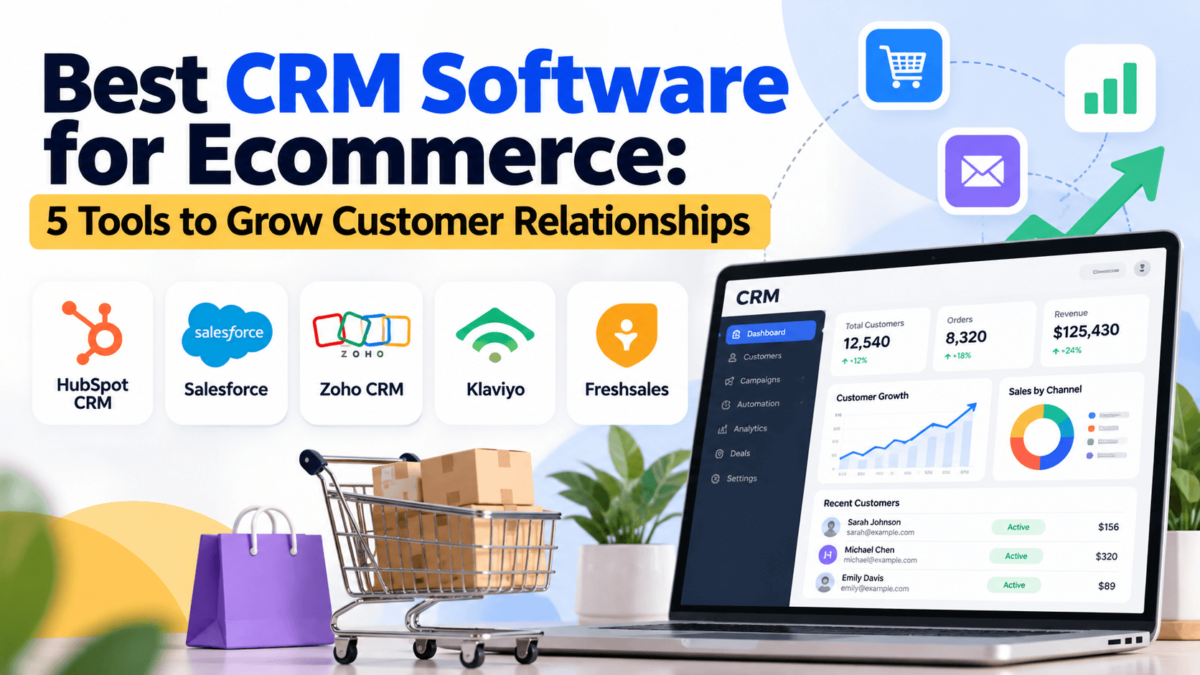
Best CRM Software for Ecommerce: 5 Tools to Grow Customer Relationships
We compared pricing, Shopify compatibility, automation, and ease of use so you can pick a CRM that fits your store.
Affiliate disclosure: Some links in this article may be affiliate links, which means we may earn a commission if you purchase through them, at no additional cost to you. It does not change which tools we recommend.
Picture a Shopify store that has outgrown its first spreadsheet. Order history sits in Shopify. Subscribers live in an email platform. Support conversations are in a helpdesk, wholesale inquiries are in a shared inbox, and the VIP list is a Google Sheet that nobody fully trusts. Then someone asks a simple question: which customers bought twice in the last 90 days and haven’t heard from us since? Answering it takes an afternoon of exports.
That is the problem a CRM solves. An ecommerce CRM (customer relationship management software) stores customer contact details, purchase history, conversations, and behavior in one place, so you can segment audiences, automate follow-ups, and see what each customer is actually worth.
Below, we compare five tools that cover the realistic options for online stores: HubSpot, Salesforce, Zoho CRM, Klaviyo, and Freshsales. They are not interchangeable. Some are sales CRMs, one is really a retention marketing platform, and the right pick depends on how your store makes money. If you also need the surrounding stack, see our guides to email marketing software and customer support software for ecommerce.
Quick Answer
For most growing ecommerce businesses, HubSpot is the best overall CRM because it combines a free CRM, sales tools, marketing automation, reporting, and an official Shopify integration in one platform. Choose Klaviyo if email and SMS retention drive your revenue, Zoho CRM if budget comes first, Freshsales if you want the simplest setup, and Salesforce if you need deep customization at scale.
Best CRM Software for Ecommerce at a Glance
Prices are per user per month unless noted and reflect publicly listed plans as of October 2026. Always confirm on the vendor’s pricing page before you buy.
| CRM | Best For | Starting Price | Ecommerce Strength | Ease of Use | Free Option |
|---|---|---|---|---|---|
| HubSpot CRM Best overall |
Most growing stores | Free CRM; paid seats from about $15–$20 | Official Shopify Data Sync app | Easy | Free CRM |
| Salesforce Best for scale |
Complex, growing teams | $25 (Starter Suite) | Strong platform; Shopify via third-party connectors | Steeper learning curve | Free Suite (2 users) |
| Zoho CRM Best budget pick |
Cost-conscious stores | $14, billed annually | Shopify extension in Zoho Marketplace | Moderate | Free (3 users) |
| Klaviyo Best for retention |
Email and SMS-led stores | Free to 250 profiles; paid from about $20/mo | Native Shopify integration, purchase-based flows | Easy for marketers | Free (250 profiles) |
| Freshsales Best for simplicity |
Small teams, quick setup | $9, billed annually | Shopify integration with order sync | Easy | Free plan |
Want to see which CRM fits your store?
Check out HubSpot’s current plans and features, including the free CRM.
Check HubSpot plans1. HubSpot CRM: Best Overall Ecommerce CRM
HubSpot is a CRM and customer platform that combines sales, marketing, service, and content tools around a shared customer database. Its CRM is free, which makes it the lowest-risk place to start.
Why We Recommend HubSpot
For most stores, HubSpot has the best balance of power and approachability. You can begin on the free CRM, connect Shopify, and upgrade only when you need more automation. The data stays in one place as you grow, which matters more than any single feature.
Key Features
- Contact and customer profiles: a timeline of emails, orders, and activity for each customer.
- Shopify sync: HubSpot’s Shopify app syncs contacts and products both ways and pulls orders and abandoned checkouts into HubSpot one way. See HubSpot’s own setup guide.
- Deal pipeline: useful for wholesale, B2B, and high-ticket orders.
- Email marketing and automation: workflows for welcome series, post-purchase follow-ups, and win-back campaigns. The most capable options sit on paid tiers.
- Segmentation and reporting: build lists from purchase data and track results in dashboards.
Pros and Cons
Pros
- Free CRM with a gentle learning curve
- Official Shopify integration
- Marketing, sales, and service tools share one database
- Large library of free training and integrations
Cons
- Costs climb quickly once you need advanced automation
- Professional tiers carry a one-time onboarding fee
- Branding stays on the free tier
- Deeper ecommerce flows are less specialized than Klaviyo’s
Pricing
Starting at
Free CRM
Paid Starter seats run roughly $15–$20 per seat per month depending on billing term. Professional plans are listed around $90–$100 per seat per month, with a one-time onboarding fee (listed at $1,500 for Sales Hub Professional).
Pricing varies by plan, hub, and seat type. Check HubSpot’s pricing page for current rates.
Who Should Use HubSpot?
Stores with a small team that want sales, email, and reporting under one roof, plus anyone who sells wholesale or B2B alongside retail. If you’re comparing it with a heavier system, our HubSpot vs Salesforce comparison goes deeper.
Who Should Avoid HubSpot?
Here’s the catch: if your whole strategy is high-volume retention email and SMS, HubSpot’s Professional marketing tiers can get expensive. A store with a big B2C list and thin margins may get more for the money from Klaviyo.
Our Verdict
HubSpot is the safest all-round choice for ecommerce. Start free, prove the workflows, and upgrade when the data tells you to.
Ready to try HubSpot?
See the latest CRM plans and how the Shopify sync works.
See HubSpot’s CRM plans2. Salesforce: Best for Growing Ecommerce Businesses
Salesforce is a cloud CRM platform best known for Sales Cloud, with Service, Marketing, and Commerce products built around the same customer data. It is the most customizable option here, and the most demanding.
Why We Recommend Salesforce
If your business has multiple sales channels, wholesale accounts, custom processes, or a team that will live in the CRM daily, Salesforce can model nearly anything. That flexibility is the reason enterprises standardize on it.
Key Features
- Contact, account, and opportunity management with deep customization.
- Pipeline and forecasting on higher tiers.
- Automation and reporting that scale with plan level; Pro and Enterprise add much more than Starter.
- Ecosystem: a large marketplace of connectors. Shopify syncing typically relies on third-party apps rather than a first-party connector.
- Commerce and marketing products sold separately for stores that want to stay inside the Salesforce family.
Pros and Cons
Pros
- Extremely customizable
- Scales to large teams and complex processes
- Huge partner and app ecosystem
Cons
- Costs rise sharply from Starter ($25) to Pro ($100) and Enterprise ($175)
- Shopify sync usually needs a paid connector
- Often needs an admin or consultant to get value
- Overbuilt for a typical small store
Pricing
Starting at
$25 per user per month
Listed editions: Starter Suite $25, Pro Suite $100, Enterprise $175 per user per month, billed annually (higher tiers exist). Add-ons, implementation, and connectors are extra.
Pricing varies by edition and add-ons. Confirm current rates on Salesforce’s pricing page.
Who Should Use Salesforce?
Established brands with dedicated operations or sales-ops staff, multi-channel sellers, and companies with wholesale or enterprise accounts that need custom workflows.
Who Should Avoid Salesforce?
Most stores under a few employees. You’ll pay for flexibility you won’t use, and the setup time is real. A smaller team will move faster with HubSpot or Freshsales.
Our Verdict
Salesforce is the right call when complexity is the problem, not when simplicity is the goal. Treat it as an investment in a system, not a quick fix.
Thinking about scale?
Review Salesforce’s current editions before you map out your workflows.
Explore Salesforce3. Zoho CRM: Best Budget-Friendly CRM for Ecommerce
Zoho CRM is a customer relationship management product from Zoho, a company that sells dozens of connected business apps. It offers one of the lowest paid entry prices among full sales CRMs.
Why We Recommend Zoho CRM
You get automation, analytics, and customization at prices well below Salesforce, and a free edition for very small teams. If you also want accounting, helpdesk, or email from the same vendor, Zoho’s wider suite is a real advantage.
Key Features
- Lead, contact, and deal management with customizable modules.
- Shopify extension: Zoho documents an official Shopify extension that syncs customers, products, and orders into the CRM.
- Workflow automation and process tools that grow stronger at higher tiers.
- Analytics and AI assistance on upper editions.
- Wider Zoho ecosystem for email, support, and finance.
Important: One integration firm reports that the Shopify extension needs the Enterprise edition or higher. Zoho’s own help page doesn’t make that clear, so confirm the required edition before you budget around the $14 price.
Pros and Cons
Pros
- Low entry price and a free edition
- Strong feature depth for the cost
- Connects to other Zoho apps
Cons
- Interface and settings take time to learn
- Ecommerce integration may require a higher tier
- Monthly billing costs more than annual
- Less polished marketing flows than Klaviyo
Pricing
Starting at
$14 per user per month
Listed annual rates: Standard $14, Professional $23, Enterprise $40, Ultimate $52. Monthly billing is higher ($20, $35, $50, $65).
Pricing varies by edition and billing term. Check Zoho’s pricing page for current rates.
Who Should Use Zoho CRM?
Small and mid-sized stores that want control and automation without Salesforce pricing, and teams already using other Zoho apps. For a wider shortlist, see our guide to the best CRM for small business.
Who Should Avoid Zoho CRM?
Teams that want the simplest possible setup. If nobody on your staff enjoys configuring software, Freshsales or HubSpot will feel friendlier.
Our Verdict
Zoho CRM is the best value if you’re willing to spend a little time on setup. Check the Shopify edition requirement first.
Want more CRM for less?
See Zoho CRM’s editions and which one includes the Shopify extension.
Try Zoho CRM4. Klaviyo: Best for Ecommerce Marketing and Customer Retention
Klaviyo is a marketing automation platform for email and SMS that positions itself as a B2C CRM. It is built around store data rather than sales-team pipelines, which is exactly why ecommerce brands like it.
Why We Recommend Klaviyo
If retention drives your margins, Klaviyo is hard to beat. It treats purchase history and on-site behavior as first-class data, so abandoned cart, browse abandonment, post-purchase, and win-back campaigns are quick to build.
Key Features
- Customer profiles that combine orders, browsing, and email or SMS engagement.
- Segmentation based on real purchase data, such as repeat buyers or lapsed customers.
- Prebuilt flows for abandoned cart, welcome, and post-purchase sequences.
- Email and SMS in one platform, with revenue reporting by campaign and flow.
- Shopify integration that is the main reason most stores choose it.
Pros and Cons
Pros
- Excellent ecommerce segmentation and automation
- Free plan to get started
- Email and SMS together
- Clear revenue attribution
Cons
- Not a sales pipeline CRM
- Price climbs with your list size
- SMS is billed through credits on top of the subscription
- Best value assumes you actually run campaigns
Pricing
Starting at
Free to 250 profiles
Email plans start at about $20 per month for roughly 500 active profiles; Email + SMS starts at about $35. As an example, expect around $150 per month at roughly 10,000 profiles on the email plan.
Pricing varies by active profiles and usage, and SMS costs extra. Check Klaviyo’s pricing page.
Who Should Use Klaviyo?
Shopify and DTC stores whose revenue depends on repeat buyers and lifecycle email or SMS. Stuck choosing between marketing platforms? Our Klaviyo vs Omnisend comparison breaks it down.
Who Should Avoid Klaviyo?
B2B and wholesale-heavy businesses that need deal tracking, and very small stores that don’t plan to run campaigns yet. You’d be paying for a marketing engine you aren’t using.
Our Verdict
Klaviyo is the best choice for ecommerce retention. Pair it with a lightweight sales CRM only if you also manage wholesale accounts.
Ready to turn buyers into repeat customers?
See what Klaviyo can do for your store, starting with the free plan.
See what Klaviyo can do for your store5. Freshsales: Best Easy-to-Use CRM for Ecommerce
Freshsales is the sales CRM from Freshworks, built for fast setup and clean day-to-day use, with calling, email, and automation included.
Why We Recommend Freshsales
It does the basics well without making you read a manual. For a small team, a short learning curve is worth real money.
Key Features
- Visual pipeline and contact records that are quick to set up.
- AI-assisted lead scoring on paid plans.
- Shopify integration: Freshworks documents real-time syncing of customer data and order events from Shopify into the CRM. It is one-directional, and custom fields can’t pass through. See the Freshworks help article.
- Built-in phone and email for outreach and follow-ups.
- Sales sequences and more advanced automation start on higher plans.
Pros and Cons
Pros
- Very low entry price and a free plan
- Quick to learn
- Shopify order data flows into the CRM
Cons
- Weaker than Klaviyo for ecommerce marketing flows
- Shopify sync is one-way
- Better features sit on Pro and above
Pricing
Starting at
$9 per user per month
Listed annual rates: Growth $9, Pro $39, Enterprise $59. Monthly billing is higher ($11, $47, $71). AI add-ons cost extra.
Pricing varies by plan and add-ons. Check Freshworks’ pricing page for current rates.
Who Should Use Freshsales?
Lean teams, new stores moving off spreadsheets, and businesses that call or email customers directly, such as wholesale and high-ticket sellers.
Who Should Avoid Freshsales?
Stores that need advanced segmentation and lifecycle marketing. That’s Klaviyo territory, and Freshsales won’t replace it.
Our Verdict
Freshsales is the best pick for simplicity. It’s the one you’re most likely to keep using after the first month.
Want a CRM your team will actually use?
See Freshsales plans and what is included at each level.
Explore FreshsalesHow to Choose the Best CRM for Your Ecommerce Business
The best ecommerce CRM is not necessarily the one with the most features; it is the one that connects customer data to the workflows your business actually uses. Judge each option against these six points.
Ecommerce Integrations
Check how the CRM connects to your store (Shopify, WooCommerce), payments, email, support, and analytics. Look at what syncs, which direction, and which plan unlocks it. If you’re still choosing a store platform, our Shopify vs BigCommerce comparison can help. Many stores also extend their stack with apps from our best Shopify apps for ecommerce roundup.
Customer Data and Segmentation
Good segmentation separates first-time buyers, repeat customers, high spenders, and lapsed shoppers. The CRM should store purchase history and behavior, not just names and emails.
Marketing Automation
Think abandoned-cart follow-ups, post-purchase emails, win-back campaigns, and lead nurturing for wholesale inquiries. Check whether these workflows are included in the plan you can afford. For more options, browse our marketing automation software guide.
Ease of Use
A powerful CRM that nobody on your team opens is a wasted subscription. If setup takes weeks, adoption suffers.
Pricing and Scalability
Look at total cost, not the headline price. Per-seat tools get expensive as your team grows, while profile-based tools like Klaviyo get expensive as your list grows. Add onboarding fees, connectors, and SMS credits.
Reporting and Analytics
Track repeat purchase rate, customer lifetime value, average order value, churn or time between orders, and revenue by campaign. If you need more reporting depth, our ecommerce analytics software guide covers dedicated tools.
CRM vs Ecommerce Platform vs Marketing Automation Software
These tools overlap, which is why buyers get confused. A quick way to separate them: your ecommerce platform sells, your CRM remembers, your marketing automation tool communicates, and your support platform resolves.
| Tool Type | Main Purpose | Example |
|---|---|---|
| Ecommerce platform | Runs your online store, products, and checkout | Shopify |
| CRM | Manages customer records and relationships | HubSpot, Zoho CRM |
| Marketing automation | Automates email, SMS, and lifecycle campaigns | Klaviyo |
| Customer support | Manages tickets and service conversations | Zendesk |
Some products blur the lines. HubSpot spans CRM, marketing, and service, while Klaviyo calls itself a CRM but is centered on marketing. Pick based on the job you need done first.
Do Ecommerce Businesses Really Need a CRM?
Yes, many growing ecommerce businesses can benefit from a CRM, especially when customer data, sales activity, marketing, and support interactions become difficult to manage across separate systems.
A CRM earns its keep when you:
- Sell both retail and wholesale or B2B
- Run repeat-purchase or subscription campaigns
- Have several people touching the same customers
- Can’t easily answer who your best customers are
A very small store may not need a dedicated CRM yet. If Shopify plus a basic email tool covers your needs, the added complexity isn’t worth it. A free CRM tier is a low-risk way to test the idea.
Which CRM Is Best for Different Ecommerce Businesses?
| If you want… | Choose | Why |
|---|---|---|
| Best overall | HubSpot | Free start, official Shopify sync, room to grow |
| Best for enterprise or complex growth | Salesforce | Deep customization and scale |
| Best affordable option | Zoho CRM | Low per-user prices and a free edition |
| Best for marketing and retention | Klaviyo | Purchase-based flows for email and SMS |
| Best for simplicity | Freshsales | Fast setup and an easy interface |
Frequently Asked Questions
What is the best CRM software for ecommerce?
What is the best CRM for Shopify?
Is HubSpot good for ecommerce?
Is Salesforce good for ecommerce?
Is Zoho CRM good for small ecommerce businesses?
Is Klaviyo a CRM?
How much does ecommerce CRM software cost?
Can a CRM improve ecommerce customer retention?
Do small ecommerce businesses need a CRM?
What should I look for in an ecommerce CRM?
Which Ecommerce CRM Should You Choose?
If you want one answer, choose HubSpot. It’s easy to start, connects with Shopify, and scales without forcing a platform change. The others win in specific situations.
| Your Situation | Best Pick |
|---|---|
| Most ecommerce businesses | HubSpot |
| Small businesses | Freshsales or HubSpot’s free CRM |
| Growing businesses | HubSpot or Zoho CRM |
| Enterprise businesses | Salesforce |
| Ecommerce marketing and customer retention | Klaviyo |
| Budget-conscious businesses | Zoho CRM or Freshsales |
| Ease of use | Freshsales |
Bottom line: Match the CRM to how you make money. Retention-led stores should start with Klaviyo, while sales-led or mixed stores should start with HubSpot.
Ready to organize your customer data?
Start with HubSpot’s free CRM and connect your Shopify store.
Start with HubSpot’s free CRMPricing and features reflect publicly available information as of October 2026 and can change. Confirm details on each vendor’s website before purchasing.