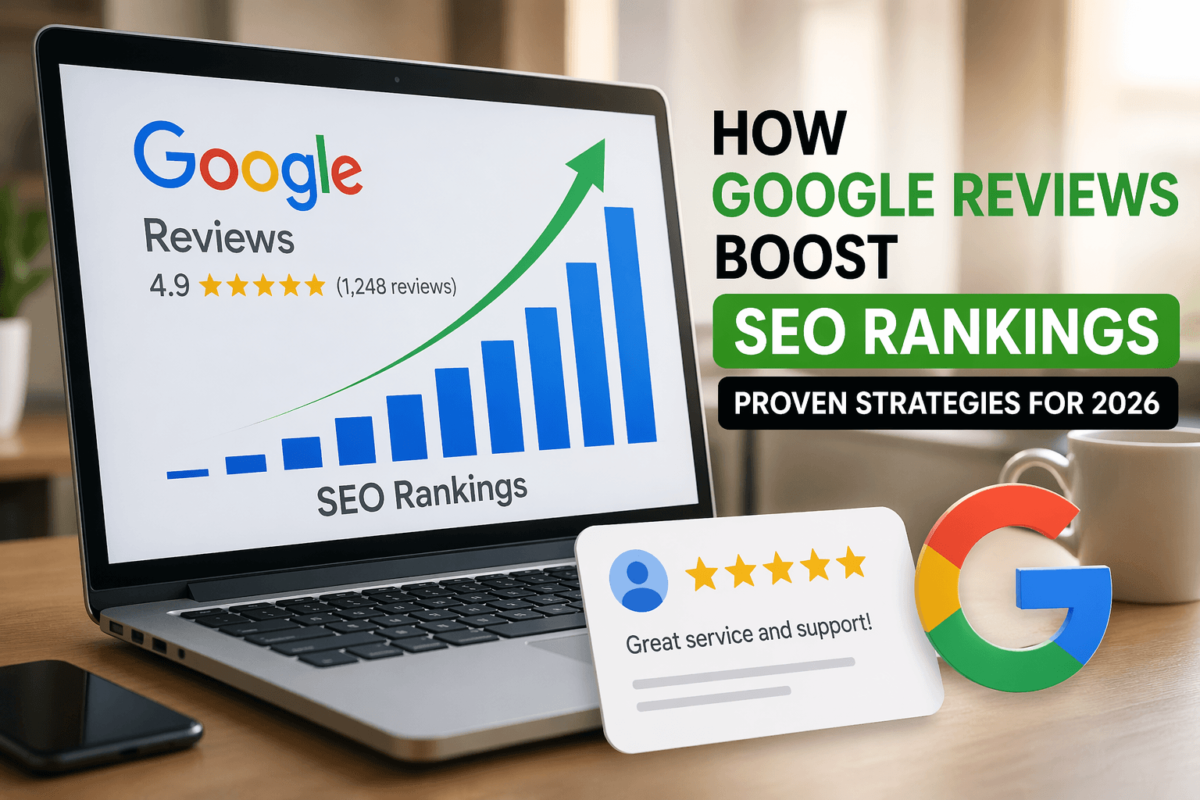
Yes — Google reviews directly impact your local SEO rankings. Google uses the number of reviews, how recent they are, the overall star rating, and even the words customers use in their reviews to decide how high you show up in local search results. If you want more customers finding your business online, getting more Google reviews isn’t optional anymore — it’s one of the most important things you can do.
📋 Quick Summary
- Google reviews are a confirmed local SEO ranking factor — more reviews = better visibility.
- The quality, recency, and quantity of reviews all matter to Google’s algorithm.
- Keywords in review text can actually help you rank for specific search terms.
- Responding to reviews (even the bad ones) signals engagement and boosts trust.
- Businesses with 50+ reviews get significantly more clicks and calls than those with fewer.
- Fake reviews can get your listing penalized or removed — don’t risk it.
- There are simple, free steps you can take today to start collecting more reviews legitimately.
- Tools exist to automate review requests and manage your online reputation at scale.
📑 Table of Contents
Let’s Talk About Why This Matters
Think about the last time you searched for a local plumber, dentist, or restaurant. What did you look at first?
Chances are, you looked at the stars. You probably read a few reviews. And if one business had 4 reviews and another had 180 — you already made your choice before even clicking a link.
Your customers are doing the exact same thing. But here’s what most business owners don’t realize: those reviews aren’t just influencing buyers. They’re influencing Google too.
Google is watching how many reviews you have, what people are saying, how fresh those reviews are, and how you respond to them. All of that feeds into where you show up in search results.
This guide breaks it all down — no fluff, no technical jargon. Just practical stuff that actually works in 2026.
Why Google Reviews Matter for SEO
Honestly, most people treat reviews as a reputation thing. “Oh, five stars — great!” And then they move on. But they’re missing the bigger picture.
Google’s entire job is to show users the most relevant, trustworthy results for any search. When someone types “best HVAC company near me” or “dentist in Chicago,” Google doesn’t just pick the business that paid the most or has the fanciest website.
It looks for signals of trust. And reviews are one of the strongest trust signals out there.
Real Trust Signals Google Cares About
- How many reviews you have
- Your overall star rating
- How recently reviews were posted
- What specific words and phrases people used
- Whether you respond to reviews
- How consistent your review activity is over time
Let me give you a real example. A family-owned HVAC company in Dallas had about 14 Google reviews and was barely showing up in the Local Pack (those top 3 map results). They started asking every single customer for a review — by text, by email, even with a small sign at checkout.
Within four months, they had 160+ reviews. Their average rating held at 4.7 stars. And their ranking in the Local Pack jumped from page two to the top three results. More visibility = more clicks = more calls.
That’s not a coincidence. That’s reviews doing exactly what they’re designed to do.
How Google Uses Reviews in Rankings
Google’s local ranking algorithm has three main pillars: relevance, distance, and prominence. Reviews primarily affect prominence — basically, how well-known and trusted your business appears to be.
Here’s how Google actually processes your reviews:
1. Review Count and Velocity
Volume matters. A business with 200 reviews will almost always outrank one with 20 — all else being equal. But it’s not just about the total number. Google also looks at review velocity — how consistently you’re getting new reviews.
If you got 50 reviews three years ago and nothing since, that’s a red flag. Businesses that get a steady stream of new reviews signal that they’re active, relevant, and still in business.
2. Star Rating
Your average star rating affects both your ranking and your click-through rate. Most users won’t even consider a business under 4.0 stars. Google knows this, and businesses with higher ratings tend to get more traffic — which Google interprets as a positive signal.
Aim for 4.2 to 4.8 stars. Believe it or not, a perfect 5.0 can actually look suspicious to some users.
3. Review Content and Keywords
This one surprises a lot of people. When customers mention specific services or locations in their reviews, Google reads those keywords and uses them to match your business to relevant searches.
If a bunch of your customers write things like “best emergency plumber in Phoenix” or “affordable teeth whitening downtown,” Google starts associating your business with those exact phrases. Over time, that can help you rank for those searches without any extra SEO work.
4. Review Responses
Responding to reviews — yes, even the negative ones — shows Google (and your future customers) that you’re engaged and professional. Google’s own guidelines suggest that responding to reviews can improve your local ranking.
Plus, when you respond to a negative review thoughtfully, you often win over the people reading it — even if the original reviewer stays upset.
Key Ranking Factors Related to Reviews
Let’s lay this out clearly. Here’s a breakdown of the major review-related factors and how much they matter for local SEO:
| Ranking Factor | Impact Level | Why It Matters |
|---|---|---|
| Number of reviews | High | More reviews = more trust signals for Google |
| Overall star rating | High | Affects both rankings and click-through rates |
| Review recency | Medium-High | Fresh reviews show you’re still active and relevant |
| Keywords in reviews | Medium | Helps Google match you to specific search terms |
| Review responses | Medium | Shows engagement and professionalism |
| Review consistency | Medium | Steady growth looks more natural than spikes |
| Review diversity (sources) | Low-Medium | Reviews from multiple platforms add credibility |
Notice that review count and star rating are at the top. Those are your two biggest levers. If you’re not actively working to grow both of those right now, you’re leaving rankings on the table.
Real-Life Examples: Before and After
Numbers and theory are great, but let’s talk about what this actually looks like for real businesses.
The Local Dentist
A dental practice in suburban Ohio had a decent website and ran some Google Ads. They showed up for branded searches but were invisible for “dentist near me” or “teeth cleaning Columbus.” They had 22 Google reviews; their competitors in the Local Pack had 85, 130, and 200+ reviews respectively.
After six months of actively requesting reviews from every patient — via email follow-ups and text reminders — they hit 118 reviews with a 4.6-star average. They entered the Local Pack for their main keywords and saw a 34% increase in new patient inquiries. They didn’t change their website. They didn’t spend more on ads. Reviews did the heavy lifting.
The Restaurant That Turned It Around
A pizza place in Austin was sitting at 3.2 stars after a rough stretch of inconsistent service. The owner started responding to every review — thanking the good ones and genuinely addressing the bad ones. They fixed the issues that kept coming up.
Over eight months, their rating climbed to 4.4 stars. They went from being buried in search results to showing up in the top three for “pizza delivery near me.” Foot traffic increased noticeably. The lesson? Even if your reviews aren’t great right now, you’re not stuck. Engagement and improvement move the needle.
The Solo Contractor
A handyman in Miami had zero Google presence. No reviews, no photos, barely any info on his Google Business Profile. He started asking every client for a review and added a simple link on his invoice.
Within three months he had 31 reviews and a 4.9-star rating. He started getting calls from Google searches alone — something that had never happened before. His comment: “I was spending money on flyers that did nothing. Reviews were completely free and actually worked.”
How to Get More Google Reviews: Step-by-Step
Here’s a simple, repeatable system that works:
Claim and Optimize Your Google Business Profile
If you haven’t done this yet, stop everything and do it right now. Go to business.google.com, claim your listing, and fill out every single field — hours, services, photos, website, phone number. An incomplete profile tells Google you’re not paying attention. A complete profile signals you’re a legitimate, active business.
Create a Direct Review Link
Google lets you generate a short link that takes customers directly to your review form. You can find this in your Google Business Profile dashboard under “Get more reviews.” Save that link. You’re going to use it everywhere.
Ask at the Right Moment
Timing is everything. Ask for a review when your customer is happiest — right after a great service, at checkout, or immediately after a positive interaction. Don’t wait a week. The moment passes. Emotions fade. Ask while the experience is fresh.
Make It Easy
Don’t just say “please leave a review.” People don’t know where to go or what to write. Give them the direct link. You can even suggest they mention the specific service they had done. A text message that says: “Hey [Name], it was great working with you today! If you have 60 seconds, we’d really appreciate a quick Google review — here’s the link: [link]. It helps us a ton!” — that message gets results.
Follow Up (Once)
If they didn’t leave a review after the first ask, send one follow-up a few days later. Keep it short and friendly. Don’t be pushy — one follow-up is plenty.
Respond to Every Review
Every single one. Thank the positive reviews by name and with a personal touch. Address the negative ones with empathy and a genuine response. This shows Google and future customers that you’re engaged. It also makes people more likely to leave reviews when they see you actually respond.
Use Tools to Scale It
Once you’re doing this manually and it’s working, consider using reputation management software to automate the process. Tools like Birdeye, Podium, or NiceJob can send automated review requests via text or email after every job, dramatically increasing your review volume without you lifting a finger.
Common Mistakes to Avoid
Now that you know what to do, let’s talk about what NOT to do. Some of these are obvious, some aren’t.
🚫 Buying Fake Reviews
Please don’t. Seriously. Google has gotten really good at detecting fake reviews. If they catch you, your listing can get penalized — or worse, removed entirely. The short-term boost isn’t worth losing your entire Google presence. And even if Google doesn’t catch it right away, customers often can. Nothing kills trust like a bunch of suspiciously generic five-star reviews all posted in the same week.
🎁 Incentivizing Reviews
Offering discounts, free stuff, or any kind of compensation in exchange for reviews violates Google’s policies. You can ask people to leave reviews — you just can’t offer them something in return.
🙈 Ignoring Negative Reviews
Leaving a 1-star review with no response is worse than the review itself. Potential customers see that and wonder why you didn’t even bother to address it. Respond professionally to every negative review.
📈 Asking in Bulk
Getting 40 reviews in one week after years of having none looks unnatural to Google and can trigger a filter. Grow your reviews steadily and consistently instead of in sudden spikes.
📋 Forgetting to Update Your Profile
Your Google Business Profile isn’t a “set it and forget it” thing. Keep your hours updated, add new photos regularly, and make sure your info is accurate. An outdated profile undermines the trust your reviews are building.
The Connection Between Reviews and Your Overall Online Reputation
Google reviews don’t exist in a vacuum. They’re part of your broader online reputation — and that reputation affects everything from your rankings to your ability to get business financing, insurance rates, and partnerships.
Here’s something most people overlook: your online reputation directly impacts how much new customers trust you before they ever set foot in your door or call your number.
How Reviews Build Business Credibility
Businesses with strong review profiles often find it easier to get approved for business credit lines and loans — lenders do their due diligence online just like customers do. Some business reputation management platforms integrate directly with credit monitoring services to help you track and protect your business identity.
Insurance providers also consider your online reputation in some contexts — a business with a history of complaints and poor reviews may face higher premiums or stricter underwriting.
Tools like Birdeye, Reputation.com, or even Google’s own tools can help you monitor your reputation across platforms, automate review requests, and flag issues before they become crises.
Google Reviews vs. Other Review Platforms for SEO
You might be wondering — do Yelp reviews, Facebook reviews, or industry-specific review sites matter for SEO too? Here’s the honest answer:
| Platform | SEO Impact | Best For |
|---|---|---|
| Google Reviews | Very High | Local SEO, Google Maps rankings |
| Yelp | Medium | Restaurants, home services, healthcare |
| Facebook Reviews | Medium-Low | Brand trust, social proof |
| Trustpilot | Medium | E-commerce, SaaS, online businesses |
| Industry-Specific Sites | Medium-High | Niche trust (e.g., Healthgrades for doctors) |
| BBB (Better Business Bureau) | Low-Medium | Trust signaling for service businesses |
Google Reviews are the clear winner for local SEO. That said, having a strong presence on Yelp or Facebook reinforces your overall reputation and can contribute to branded search results.
For most small businesses, the priority order should be: Google first, then focus on whichever other platform makes most sense for your industry.
What 2026 Has Changed About Reviews and SEO
Local SEO has evolved a lot in the past few years, and 2026 is no exception. Here’s what’s different now compared to even two years ago:
AI-Powered Search Results
Google’s AI Overview features are now prominent in search results. These AI summaries pull from highly-reviewed, well-structured local businesses. If your reviews frequently mention specific services, locations, or outcomes, you’re more likely to appear in these AI-generated summaries.
This is what some call GEO — Generative Engine Optimization. Writing in a way that’s clear, structured, and easy for AI to summarize now matters for your visibility. Learn more in our guide on What is Generative Engine Optimization (GEO).
Review Authenticity Signals
Google has significantly improved its ability to detect fake or incentivized reviews in 2026. They’re using AI to analyze language patterns, reviewer history, and timing. Don’t try to game it — focus on authentic reviews from real customers.
Photo and Video Reviews
Reviews that include photos or short videos are weighted more heavily than text-only reviews in Google’s current algorithm. Encourage your customers to snap a photo of their experience.
Review Sentiment Analysis
Google isn’t just counting your stars anymore — it’s reading your reviews. Sentiment analysis means Google can tell whether reviews are genuinely enthusiastic or lukewarm. The words matter. Encourage customers to be specific and descriptive.
Affiliate-Friendly Opportunities: Tools That Can Help
If you’re serious about growing your review count and managing your online reputation at scale, there are some great tools worth knowing about. These aren’t paid endorsements — just genuinely useful resources:
Review Generation and Management
- Birdeye — Automates review requests across Google, Facebook, and 200+ review sites. Great for multi-location businesses.
- Podium — Text-based review collection that’s particularly effective for service businesses with lots of one-on-one customer interactions.
- NiceJob — Automated review campaigns with excellent integrations for service-based businesses.
- GatherUp — Specifically designed for local businesses with solid analytics on review performance.
Business Reputation and Credit Monitoring
- Nav — Business credit monitoring with insights into how your overall business profile (including online reputation) affects creditworthiness.
- Reputation.com — Enterprise-level reputation management platform used by franchises and multi-location businesses.
Local SEO Tools
- BrightLocal — Track your local rankings, monitor reviews across platforms, and audit your citations all in one place.
- Whitespark — Local citation finder and rank tracker specifically designed for local SEO.
- Semrush Local — Integrates review monitoring with broader SEO tools for a complete local SEO picture.
Most of these tools have free trials, so it’s worth testing a couple to see which fits your workflow. For a broader view of local search, also check our Local SEO Strategies guide.
FAQs: Your Questions Answered
Final Thoughts
Here’s the bottom line: Google reviews are one of the most powerful, most accessible, and most underused tools in local SEO. They cost you nothing except a little time and a willingness to ask.
A lot of business owners are out here spending thousands of dollars on ads and ignoring the free trust signals sitting right in front of them. Don’t be that person.
Start simple. Set up your Google Business Profile properly. Create your direct review link. Start asking every happy customer. Respond to every review. Repeat.
It won’t happen overnight. But three months from now, six months from now — you’ll look back and realize that this was one of the best things you did for your business’s online visibility.
The businesses showing up at the top of Google Maps in your area? They’re not smarter than you. They just started asking sooner.
Now go ask for that review.
Want to Grow Your Local Rankings Faster?
Explore our full library of Local SEO guides, strategies, and tools — built for real businesses.
Explore Local SEO Strategies →