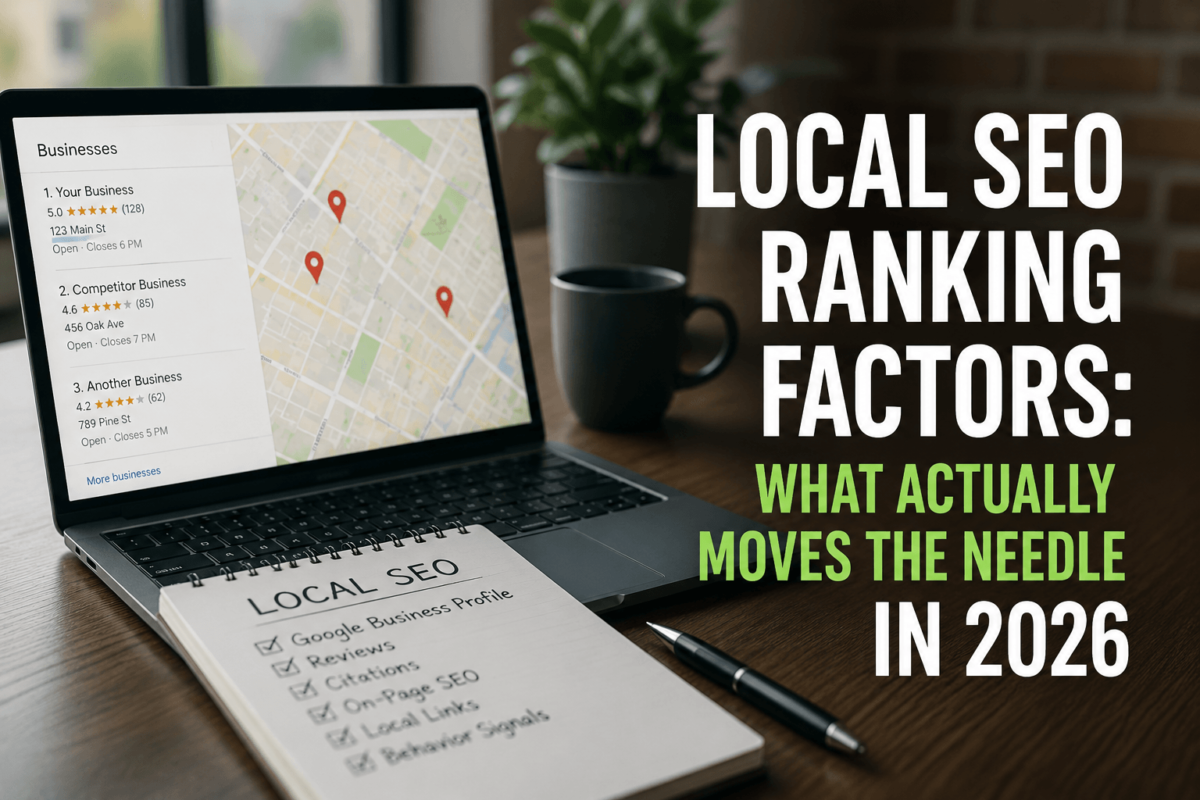
Here’s the short version before we get into the weeds:
- Proximity remains the strongest single ranking factor — and it’s the one you can least control.
- Google Business Profile (GBP) signals carry roughly a quarter of the ranking weight in most studies.
- Reviews influence both consumer trust and Google’s internal sense of your business’s prominence.
- Your website’s SEO fundamentals — content, schema, technical health — still matter, especially for organic local visibility.
- Quality links outperform citation volume; most businesses are over-invested in citations and under-invested in links.
- Behavioral signals (clicks, calls, direction requests) are an increasingly important — though still debated — piece of the puzzle.
- AI search tools like Google AI Overviews, Gemini, and ChatGPT lean on many of the same trust and entity signals as traditional local SEO.
Need help making sense of where your business stands? A professional local SEO audit can reveal exactly which of these factors are holding you back.
The Three Core Factors Google Uses (Relevance, Distance, Prominence — Updated for 2026)
Google has said for years that local rankings boil down to three things: relevance, distance, and prominence. That hasn’t changed. What has changed is how aggressively Google measures each one, and how much weight shifts between them depending on the search.
Local SEO ranking factors are the signals Google’s algorithm uses to decide which businesses appear in the Local Pack and Maps results for a given search. They generally fall into three buckets: how well a business matches what someone is searching for, how close it is to the searcher, and how well-known or trusted it is overall.
Relevance
Relevance is about matching. Does your business profile and website actually describe what the searcher is looking for? If someone searches “emergency plumber near me,” Google wants to know: does this business do emergency plumbing, and does its content, categories, and reviews reflect that?
In our experience, relevance problems are usually self-inflicted. A business picks the wrong primary category, writes generic “we do everything” descriptions, and then wonders why they don’t show up for their highest-value searches.
Distance
Distance is exactly what it sounds like — how far the business is from the searcher (or from the location implied in the search). Google has gotten much better at estimating this precisely, even for searches that don’t include a city name.
Example: someone in downtown Austin searching “coffee shop” will see different Local Pack results than someone in the suburbs, even with the identical query. Distance does the heavy lifting in that ranking shift.
Prominence
Prominence is Google’s catch-all for how well-known and trustworthy a business appears to be — both online and offline. Reviews, links, citations, news mentions, and overall web presence all feed into this.
We’ve consistently seen that prominence is where most of the controllable ranking improvement actually happens. You can’t move your office closer to every customer, but you can absolutely build prominence over time.
The set of signals — including relevance, distance, prominence, Google Business Profile completeness, reviews, website authority, and behavioral data — that Google’s algorithm evaluates to determine which local businesses appear in the Local Pack and Google Maps for a given search.
One pattern that appears across industries: businesses that win in competitive local markets rarely have one standout factor. They’re solid across all three — close enough, relevant enough, and prominent enough — and that combination compounds.
Whitespark 2026 Local Search Ranking Factors: Key Findings
Every year, Whitespark surveys a panel of roughly 47 local SEO experts and aggregates their views on which factors move local rankings the most. It’s not a perfect science — it’s expert opinion, not raw algorithm data — but when 47 people who run local SEO campaigns for a living broadly agree, it’s worth paying attention.
The big-picture takeaways from the most recent study line up with what we see in client accounts:
- Google Business Profile signals account for roughly 25% of the ranking weight — the single largest controllable category.
- Review signals (volume, recency, sentiment, and responses) make up roughly 16–20%.
- Proximity influences the majority of which businesses are even eligible to appear in the Local Pack for a given search.
- Link signals remain a meaningful share of the prominence calculation, more than most business owners assume.
What does this mean in practice? If you’re a business owner with limited time and budget, the data points you toward two places first: your Google Business Profile and your review generation process. Those two areas alone influence somewhere in the neighborhood of 40–45% of your ranking potential — and they’re also the areas you have the most direct control over.
Unsure which factors are holding your business back? A quick audit usually surfaces 3–5 fixes that move the needle within weeks.
Factor #1: Proximity — The Uncontrollable 55% (and How to Maximise the Remaining 45%)
Proximity is the factor business owners hate hearing about, because it’s the one thing you genuinely cannot change without moving your business. Google increasingly weights how close a business is to the searcher (or to the location they’re searching in) above almost everything else for “near me” and implicit-local queries.
In local SEO, proximity refers to the physical distance between a searcher’s location (or the location referenced in their search) and a business’s address. It’s one of the most heavily weighted factors in determining Local Pack visibility for a given query.
Why Proximity Dominates
Google’s job is to return the most useful result, and for most local searches, useful means “close enough to actually visit.” A searcher isn’t going to drive 40 minutes for a haircut when there are three salons within five minutes. So Google biases hard toward businesses that are physically near the searcher, especially in dense urban areas.
This plays out differently depending on the industry:
- Dentist: Patients overwhelmingly choose dental practices within a short drive of home or work. A dental practice in a different part of the city — even with a flawless GBP and hundreds of reviews — will rarely outrank a mediocre but nearby competitor for a “dentist near me” search.
- Lawyer: Less proximity-dependent than a dentist, but still significant for practice areas tied to local courts, like family law or personal injury. Searchers in a specific county or city tend to see attorneys based there first.
- HVAC contractor: Extremely proximity-sensitive, especially for emergency searches (“AC repair near me”). Google assumes urgency and prioritises contractors who can realistically respond fast.
How Businesses Can Compensate for the Other 45%
You can’t shrink the distance between you and every customer, but you can absolutely outcompete closer rivals on every other factor. We’ve seen businesses several miles outside a city centre consistently outrank closer competitors because they were dramatically stronger everywhere else.
Here’s where that compensation comes from:
- A more complete, better-optimised Google Business Profile — every field filled in, accurate categories, regularly updated photos and posts.
- A stronger review profile — not just more reviews, but more recent, more detailed, and better-responded-to reviews.
- Greater overall authority — quality backlinks, press mentions, and a website that Google trusts. See our guide to link building strategies for practical starting points.
- Tighter relevance — content, services pages, and GBP categories that map precisely to what people in your area are searching for.
We worked with an HVAC contractor located about six miles outside the core service area where most of their competitors were clustered. Their GBP had been neglected for years. After a focused six-month push — full GBP overhaul, a structured review request process, and a handful of locally relevant backlinks — they began appearing in the Local Pack for searches in zip codes closer to their competitors than to themselves. Proximity didn’t change. Everything else did.
If proximity is working against you, the fix isn’t moving — it’s out-executing nearby competitors on every other factor. That’s exactly the kind of gap analysis a local SEO audit is built for.
Factor #2: Google Business Profile Signals (~25%)
If proximity is the factor you can’t control, your Google Business Profile is the factor you have the most direct control over — and according to most ranking studies, it’s worth roughly a quarter of the total ranking weight. This is where I tell business owners to spend their first hour of effort.
The set of ranking factors derived directly from a business’s GBP listing, including category selection, profile completeness, photos, posts, attributes, and the keywords used in the business description and services sections.
Categories
Your primary category is one of the highest-leverage decisions you’ll make in local SEO, and most businesses get it wrong. Google uses your primary category to understand, broadly, what kind of business you are and which searches you’re eligible to appear for.
In our experience, the most common mistake is picking a category that’s too broad (“Restaurant” instead of “Italian Restaurant”) or too narrow in a way that excludes relevant searches. Secondary categories matter too — they expand your eligibility for adjacent searches, but stacking irrelevant categories “just in case” tends to dilute relevance rather than help.
Completeness
Google has been explicit that complete profiles perform better, and our own account audits back this up. A profile with gaps signals to Google — and to potential customers — that the business isn’t actively maintained.
The fields that matter most:
- Business description — a clear, keyword-natural explanation of what you do and where you do it.
- Services and products — listed individually, not bundled into one vague paragraph.
- Hours — including holiday hours, which Google increasingly checks against actual customer behaviour.
- Attributes — things like “wheelchair accessible,” “women-owned,” or “online appointments,” which feed into both relevance and the searcher’s decision-making.
Keywords
Natural keyword inclusion in your business description, services, and posts helps Google understand relevance — but this is one of the areas where older tactics have aged badly. We’ve consistently seen businesses try to stuff their business name or description with keywords (“Joe’s Plumbing — Best Plumber Plumbing Services Emergency Plumber”). This doesn’t just look spammy to customers — it can trigger suspensions or suggested edits that strip the keywords entirely. Write your description the way you’d describe your business to a person, using the terms customers actually use, and let the structure (categories, services, attributes) do the heavy lifting for keyword relevance.
A Google Business Profile audit is one of the fastest ways to find quick wins — most profiles we review are missing at least 3–4 completeness fields that take minutes to fix.
Factor #3: Review Signals (16–20%)
Reviews sit at an interesting intersection: they’re a major ranking factor, but they’re also the thing that most directly influences whether a customer actually picks up the phone. Get reviews right and you’re improving rankings and conversion at the same time. Our dedicated guide on how Google reviews help SEO rankings covers this in more depth.
Review Volume
More reviews generally help, but the relationship isn’t linear. Going from 5 reviews to 50 matters enormously. Going from 250 to 300 matters much less. What Google — and customers — seem to care about more is whether the volume looks healthy relative to your competitors and your business size.
Review Velocity
Velocity is how quickly new reviews come in, and it’s one of the more underrated signals. A business that earns 2–4 new reviews a month, consistently, sends a much stronger signal of an active, trustworthy operation than one that got 40 reviews in a single month three years ago and nothing since.
Review Recency
Recent reviews carry more weight than old ones — both for Google and for customers scanning a profile. A business whose most recent review is from 14 months ago looks stale, even if the overall rating is excellent.
Review Sentiment
Star rating is the obvious signal, but the text of reviews matters too. Reviews that mention specific services, locations, or staff names help reinforce relevance — a review that says “Sarah did a great job fixing our water heater in Round Rock” is doing SEO work, even though that’s not why the customer wrote it.
Review Responses
Responding to reviews — especially negative ones — signals an actively managed business. We’ve consistently seen that businesses which respond to most or all reviews tend to have healthier overall profiles across every other metric too. It’s as much a marker of an engaged business as it is a direct ranking factor.
A local landscaping company we worked with had a strong 4.8-star rating but had gone nearly a year without a new review. Their visibility had quietly slipped behind two competitors with lower ratings but much more recent activity. We set up a simple post-job review request workflow — nothing complicated, just a text message sent the day after each job. Within four months, review velocity went from roughly one every two months to four to five per month, and their Local Pack position recovered.
Why Steady Acquisition Beats Review Spikes
A sudden spike — say, 30 reviews in one week from an email blast to old customers — can actually do more harm than good. It looks unnatural, can trigger review filtering, and creates a velocity cliff afterward when things go quiet again. A slow, steady drip of reviews tied to actual recent customer interactions is far more durable, and far less likely to draw scrutiny.
If your reviews have gone quiet, a simple, automated request process is usually the single highest-ROI fix we recommend — often before touching anything else on this list.
Factor #4: On-Page SEO Signals
Your website still matters — a lot, especially for organic local rankings (as opposed to the Local Pack, which leans more heavily on GBP). A weak website caps how far your other efforts can take you. Our technical SEO checklist is a useful companion resource here.
Title Tags
Your title tags should clearly communicate what you do and where you do it, without becoming a keyword list. “Emergency Plumber in Round Rock, TX | Joe’s Plumbing” tells both Google and the searcher exactly what they’re getting. See our full meta tags SEO guide for best practices.
Local Landing Pages
If you serve multiple areas, dedicated landing pages for each major service area — with genuinely unique content, not a find-and-replace city name — help Google understand the geographic scope of your business and give you more entry points into local search.
NAP Consistency
Your Name, Address, and Phone number (NAP) should match exactly across your website, GBP, and every citation. Inconsistencies don’t usually tank rankings outright, but they introduce friction in how confidently Google can verify your business identity.
LocalBusiness Schema
Structured data won’t single-handedly boost rankings, but it removes ambiguity — it explicitly tells Google your business name, address, hours, phone number, and service area in a machine-readable format. We treat it as a baseline requirement, not a competitive advantage. Read our deep-dive on schema markup for AI search for implementation guidance.
Helpful Content
Genuinely useful content — service pages that answer real customer questions, FAQs based on what people actually ask, location pages with real local detail — builds the entity relevance that ties your website to your GBP and your local market. Thin, templated content does the opposite: it tells Google your site isn’t a strong match for anything specific.
Entity relevance — the degree to which Google understands your business as a specific, well-defined “thing” (a particular type of business, in a particular location, serving particular needs) — is built cumulatively across your website, GBP, citations, and reviews. Every piece of consistent, specific information adds to that picture.
A local SEO audit typically flags 5–10 on-page issues — many of them quick fixes with outsized impact on organic visibility.
Factor #5: Link Signals
Links remain one of the most powerful — and most neglected — local ranking factors. Most local businesses have a handful of directory citations and nothing else. That’s a missed opportunity, because link signals carry meaningfully more weight in the prominence calculation than most owners assume. Our guide on link building strategies covers both local and traditional link acquisition.
Local Authority Links
These are links from sources tied to your geographic community — and they’re often easier to earn than business owners think.
- Chamber of Commerce membership pages
- Local newspaper coverage — sponsorships, community involvement, or even local business roundups
- Sponsorships of local events, sports teams, or charities, which often come with a website link back
Traditional Authority Links
These are the more familiar “SEO” links — coverage from industry publications or niche websites relevant to your field.
- Industry publications covering your trade or sector
- Niche websites and blogs that review or recommend businesses like yours
Which Produces Bigger Local Ranking Impact?
In our experience, local authority links tend to punch above their weight for local ranking purposes specifically. A link from your city’s Chamber of Commerce or local newspaper does double duty — it builds general authority and reinforces geographic relevance at the same time. Traditional authority links are valuable too, especially for broader visibility, but for the Local Pack specifically, the local links often move the needle faster.
A handful of genuinely local links — five or six from real community sources — has, in our experience, outperformed dozens of generic directory citations for businesses trying to break into a competitive Local Pack.
Factor #6: Citation Signals
Citations — your business name, address, and phone number listed on directory sites — used to be a cornerstone of local SEO. They still matter, but the “more is better” approach that dominated a decade ago is now mostly wasted effort.
Online mentions of a business’s name, address, and phone number on directories, review sites, and platforms. Citation quality and consistency contribute to local ranking prominence, though their impact has declined relative to reviews and links.
Why 500 Directory Submissions Are Useless
We still see businesses that have paid for citation packages promising hundreds of directory listings — most of which are low-quality, rarely-visited sites that Google barely indexes. Beyond a core set of trusted directories, additional citations provide diminishing — often negligible — returns, and in some cases create NAP inconsistency problems if the data isn’t kept current.
Why Trusted Citations Still Matter
A small set of major, high-trust platforms — think Apple Maps, Bing Places, Yelp, and industry-specific directories relevant to your field (legal directories for lawyers, healthcare directories for medical practices) — are still worth getting right. These tend to be sources Google actually trusts and cross-references.
A multi-location retail client had over 200 citations from a legacy submission service, many duplicated or outdated. Cleaning up and consolidating to roughly 15–20 accurate, high-trust citations — and fixing the inconsistencies that had built up across years of moves and rebrands — had a more noticeable impact than the original 200 listings ever did.
If you’ve ever paid for a bulk citation package, it’s worth checking what’s actually live and accurate — outdated citations can quietly work against you.
Factor #7: Behavioral Signals
Behavioral signals — how people actually interact with your Google Business Profile and website — have grown in importance, though this is also one of the most debated areas in local SEO.
Data reflecting how searchers interact with a business listing or website, including click-through rate, phone calls, direction requests, website visits, and photo views. These are believed to influence local rankings, though the extent of direct causation is debated.
- Click-through rate — how often people click your listing relative to how often it’s shown
- Calls — phone calls initiated directly from your GBP listing
- Direction requests — how often people tap “Directions” from your profile
- Website visits — clicks through to your site from the listing
- Photo engagement — views and interactions with your business photos
Correlation vs. Causation
Here’s where I want to be careful, because this is an area where a lot of local SEO advice overstates what’s actually known. Businesses that rank well tend to also get more clicks, calls, and direction requests — simply because they’re more visible. That makes it genuinely hard to separate “this behaviour caused the ranking” from “the ranking caused this behaviour.”
What we can say with more confidence: a profile that generates strong engagement is, at minimum, a signal of a relevant, trustworthy business — and Google has every incentive to use that data somehow, even if the exact mechanism isn’t publicly confirmed. We’d treat behavioral signals as a likely contributing factor and a useful health indicator, not as a lever you can directly and predictably pull.
The practical takeaway: improving the things that drive behavioral signals — better photos, a complete profile, accurate hours, a compelling description — is good for business regardless of whether Google directly rewards the resulting clicks.
Local Pack Rankings vs. Organic Rankings
“Local SEO” actually covers two related but distinct ranking systems: the Local Pack (the map and three-business box that appears for local searches) and traditional organic results for local queries. They’re influenced by overlapping but differently-weighted factors.
The set of (typically three) businesses displayed with a map in Google’s local search results, ranked primarily by relevance, distance, and prominence derived largely from Google Business Profile data, reviews, and proximity.
| Signal | Local Pack | Organic Local SEO |
|---|---|---|
| Proximity | Very high impact | Lower impact |
| Reviews | High impact | Moderate impact |
| GBP Optimisation | Very high impact | Low direct impact |
| Links | Moderate impact | High impact |
| Content | Low–moderate impact | Very high impact |
| Technical SEO | Low impact | High impact |
| Citations | Moderate impact | Low impact |
The practical implication: if your goal is to appear in the three-pack on Maps, prioritise GBP, reviews, and proximity-related factors. If your goal is to rank organically for informational or research-stage local searches, content, links, and technical SEO carry more weight.
Most businesses need both — but if you’re choosing where to start, the Local Pack tends to drive more immediate, high-intent traffic for service businesses.
AI Search Visibility Factors
Local SEO no longer ends at Google’s traditional results. Google AI Overviews, Gemini, and tools like ChatGPT increasingly answer local questions directly — “what’s a good Italian restaurant near downtown” or “who’s a reliable electrician in my area” — sometimes without the searcher ever seeing a traditional Local Pack.
How AI Tools Handle Local Intent Queries
These systems pull from a mix of sources: Google’s existing local index (including GBP data and reviews), broader web content, and in some cases real-time data feeds. A business that’s strong in traditional local SEO has a real head start here, because much of the underlying data overlaps.
That said, a few factors seem to matter disproportionately for AI-generated answers:
- Entity authority — how clearly and consistently a business is represented across the web as a specific, well-defined entity (same name, same details, same description, everywhere)
- Reviews — AI systems frequently surface review sentiment and volume as part of their reasoning, often summarising what reviewers say
- Website trust — sites with clear, well-structured, genuinely useful content seem more likely to be referenced or summarised
- Brand mentions — being mentioned (even without a link) across local publications, forums, and review sites appears to reinforce an AI system’s confidence in recommending a business
GEO: Generative Engine Optimisation
GEO — Generative Engine Optimisation — is the emerging discipline of optimising for how AI systems summarise, cite, and recommend businesses, as distinct from traditional ranking-based SEO. For local businesses, GEO and local SEO overlap heavily: the entity consistency, review management, and helpful content that improve traditional rankings also make a business easier for AI systems to understand and recommend confidently. We cover the full landscape of what GEO means and how it differs from traditional SEO in separate guides.
In our experience, businesses that have neglected entity consistency — different business names, descriptions, or categories across platforms — show up inconsistently or not at all in AI-generated local recommendations, even when their traditional rankings are reasonable. Cleaning this up is quickly becoming as important as the traditional citation cleanup work we described earlier.
AI search visibility is still early, but the businesses preparing now — by tightening entity consistency and review management — are positioning themselves ahead of a shift that’s only going to grow.
Myths Debunked
Local SEO advice has a long shelf life — tactics that worked five or six years ago keep getting repeated as gospel long after they’ve stopped mattering, or even started backfiring. Here are the ones we hear most often.
Myth: GBP Posts Improve Rankings
GBP Posts — the little update snippets you can publish to your profile — are often pitched as a ranking lever. Sterling Sky has run tests on this repeatedly, and the consistent finding is that posts have little to no measurable direct effect on rankings.
That doesn’t mean posts are useless — they can support engagement and give returning customers something to see — but if you’re choosing between spending an hour on weekly GBP posts versus an hour on review requests or category optimisation, the data is clear about which one matters more for rankings.
Myth: More Citations Always Help
Piling up citations on low-quality directories doesn’t move rankings, and can actively create NAP inconsistency problems when those listings go stale. A focused set of accurate, high-trust citations beats a large pile of unmanaged ones every time.
Myth: Fake Reviews Work
Fake or incentivised reviews are against Google’s policies, and Google has gotten meaningfully better at detecting unnatural review patterns — sudden spikes, repetitive language, reviewer accounts with no other activity. Beyond the rankings risk, fake reviews actively damage the thing that makes reviews valuable in the first place: customer trust. We’ve seen businesses lose entire review sections to a filtering sweep after a fake review push, wiping out years of genuine feedback in the process.
Myth: Exact-Match Keywords Guarantee Rankings
Stuffing your business name or description with exact-match keywords (“Best Cheap Emergency Plumber Round Rock TX”) doesn’t guarantee anything — and it can trigger Google suggested-edit flags or even suspensions for businesses that put keywords in their actual business name field. Relevance today comes from a broader pattern: accurate categories, natural language, consistent entity information, and content that genuinely matches what people search for.
Local Ranking Factor Priority Matrix
If you’ve made it this far, you’ve got a lot of information. Here’s how we’d prioritise it if we were starting from scratch with a new client.
| Priority | Ranking Factor | Impact | Difficulty |
|---|---|---|---|
| High | Google Business Profile optimisation | Very High | Low |
| High | Review generation & management | High | Low–Medium |
| High | Website on-page SEO & content | High | Medium |
| Medium | Link building (local + traditional) | Medium–High | Medium–High |
| Medium | Citation cleanup & consolidation | Medium | Low–Medium |
| Lower | GBP Posts & minor profile tweaks | Low | Low |
Notice the pattern: the highest-impact items are also among the lowest-difficulty. That’s not a coincidence — it’s why GBP optimisation and reviews should almost always come first. The medium-impact items (links, citations) take more sustained effort but compound over time. The lower-impact items are fine to do, but shouldn’t be where your time goes first.
Not sure where your business currently sits on this matrix? That’s exactly what a local SEO audit is designed to map out.
Step-by-Step Local SEO Improvement Plan
Here’s the order we’d actually work through this, if you’re tackling it yourself or briefing an agency.
-
1
Audit your Google Business Profile Check every field — categories, hours, attributes, services, description — against what’s actually accurate today. Most profiles drift out of date as businesses evolve.
-
2
Optimise your categories Confirm your primary category is the most specific accurate option, and add secondary categories that genuinely reflect services you offer — not aspirational ones.
-
3
Improve your reviews Set up a simple, consistent request process (a text or email sent shortly after service). Respond to existing reviews, especially older unanswered ones and any negative reviews.
-
4
Fix your website SEO Make sure title tags, schema markup, and NAP details are accurate and consistent. Build or improve location pages if you serve multiple areas, and make sure content actually answers customer questions.
-
5
Earn local links Start with low-effort wins — Chamber of Commerce membership, local sponsorships, community involvement that comes with a website mention. Layer in industry-relevant links over time.
-
6
Monitor rankings Track your Local Pack position for your most important search terms across your service area — not just from your office address, since rankings vary by location.
-
7
Improve engagement Add fresh, genuine photos regularly, keep hours accurate (especially around holidays), and make sure your profile gives searchers a reason to click, call, or get directions.
This isn’t a one-time project — it’s a cycle. Most of the meaningful gains come from steps 1–4 done well and then maintained consistently, with steps 5–7 layered in as ongoing habits rather than one-off tasks.
Frequently Asked Questions
Proximity has the largest overall influence on which businesses are even eligible to appear for a given search, but it’s not controllable. Among the factors you can actually influence, Google Business Profile optimisation carries the most weight, accounting for roughly a quarter of the ranking factors in most expert studies.
Yes. Review signals — including volume, recency, sentiment, and how consistently a business responds — are estimated to make up roughly 16–20% of local ranking factors. Reviews also strongly influence whether searchers click through and convert, so the impact compounds beyond rankings alone. See our full guide on how Google reviews help SEO rankings.
Proximity is consistently cited as the strongest single factor in determining Local Pack results, particularly for “near me” and implicit-local searches. However, businesses can offset proximity disadvantages by being significantly stronger across GBP optimisation, reviews, and overall authority compared to closer competitors.
It’s possible to appear in the Local Pack with just a well-optimised Google Business Profile, since GBP signals carry significant weight on their own. However, a website strengthens entity relevance, supports organic local rankings, and gives you a destination for the on-page content, schema, and local landing pages that round out a complete local SEO presence. We’d recommend one for any business serious about long-term visibility.
Testing — including repeated studies by Sterling Sky — has consistently found little to no direct ranking impact from GBP Posts. They may support engagement and give customers something to see, but they shouldn’t be prioritised over higher-impact work like category optimisation or review generation.
Some changes — like fixing GBP categories or completeness gaps — can show movement within weeks. Others, particularly review velocity improvements and link building, tend to compound over three to six months before producing noticeable ranking shifts. In our experience, businesses that stay consistent typically see meaningful, durable improvement within four to six months.
A core set of accurate, high-trust citations remains worthwhile, particularly for NAP consistency and supporting your overall prominence. However, large-volume citation submissions to low-quality directories provide minimal additional benefit and can create consistency problems if those listings aren’t maintained.
AI search tools like Google AI Overviews, Gemini, and ChatGPT lean on many of the same underlying signals as traditional local SEO — particularly entity consistency, reviews, and overall website trust. Businesses with strong, consistent local SEO fundamentals have a head start in AI-generated local recommendations, though entity consistency across platforms appears to matter even more in this context. Our guide on SEO vs GEO vs AEO vs LLMO explores this landscape further.
Conclusion: Where to Focus and What’s Next
If you take one thing away from this guide, make it this: the factors that move local rankings in 2026 are largely the same factors that have mattered for years — relevance, distance, and prominence — but the businesses winning today are the ones executing on the controllable pieces with real consistency, not chasing shortcuts.
The biggest opportunities for most businesses are sitting in plain sight: a Google Business Profile that hasn’t been fully optimised, a review process that’s gone quiet, and a website that hasn’t been updated to reflect what the business actually offers today. None of these require a massive budget — they require attention and consistency.
Looking ahead, AI search visibility is going to keep growing in importance, and the good news is that the work — entity consistency, genuine reviews, helpful content — overlaps almost entirely with traditional local SEO fundamentals. Businesses that get the basics right aren’t just preparing for how Google ranks them today; they’re preparing for how AI systems will describe and recommend them tomorrow. If you’re thinking about the full picture, our guide to AI SEO is worth reading alongside this one.
Your Practical Next Step
Pick one thing from the priority matrix above and start this week. For most businesses, that’s either a full Google Business Profile audit or setting up a simple, consistent review request process. Both are low-effort, high-impact, and entirely within your control — which, in local SEO, is exactly where you want to be spending your energy.
Ready to find out exactly where your business stands? A professional local SEO audit can identify your highest-impact opportunities in a single session.