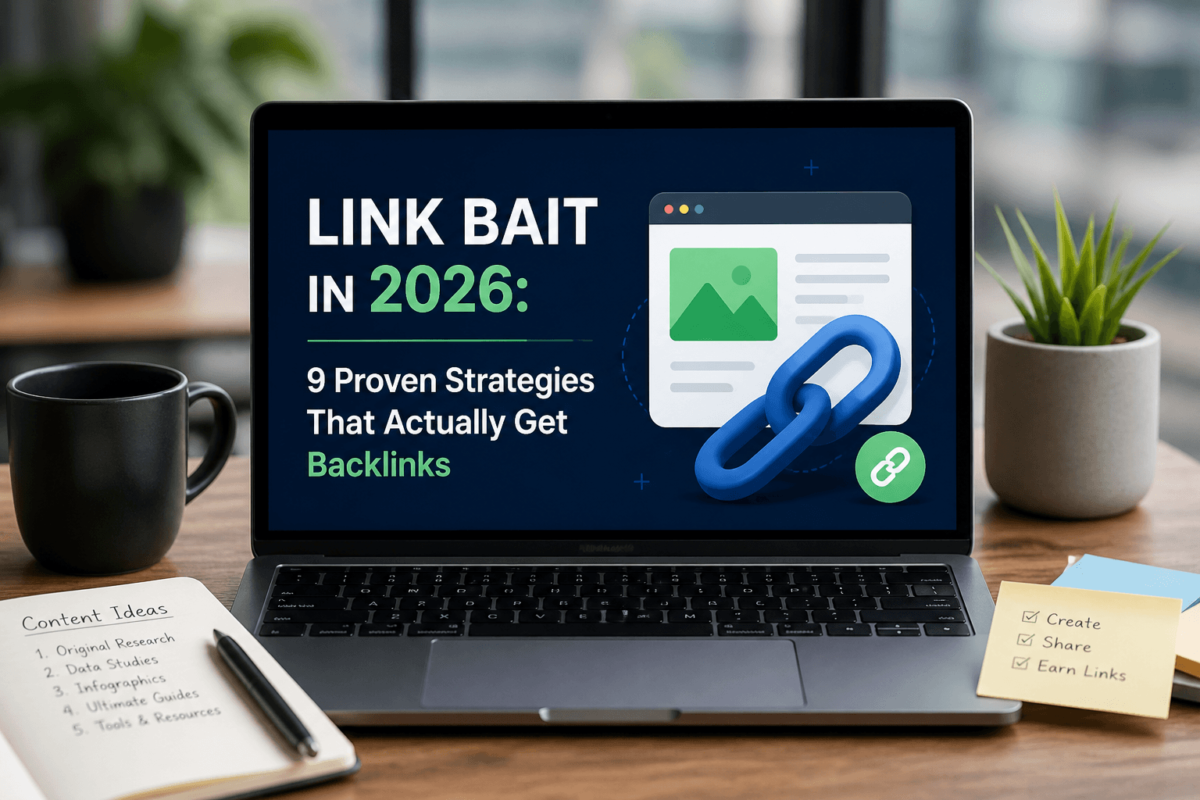
Link Bait in 2026: 9 Proven Strategies That Actually Get Backlinks (No Guesswork)
How to create content that earns backlinks naturally — and converts that traffic into affiliate income.
Link bait is content specifically crafted to earn backlinks naturally — because it’s so useful, surprising, or quotable that other websites can’t help but reference it. In 2026, it matters more than ever because AI-generated content has flooded the internet, making truly original, data-backed, or resource-rich content a rare and highly linkable asset. Done right, link bait doesn’t just build SEO authority — it drives real traffic you can convert into affiliate income.
📋 Quick Summary
- Link bait = content people link to naturally, not because you begged them
- Backlinks remain one of Google’s top 3 ranking factors in 2026
- The best formats: original data, ultimate guides, free tools, case studies, ego bait, and controversial takes
- Psychology drives linking — authority, ego, and curiosity gaps are your levers
- Link bait converts: use it to funnel traffic into email lists and affiliate offers
- Avoid: generic listicles, clickbait without substance, and unoriginal regurgitations
- Beginners can absolutely do this — you don’t need a huge budget, just a smart angle
- Outreach speeds things up, but great content can earn links passively over time
What Is Link Bait (Explained Like You’re Talking to a Friend)
Okay, here’s the truth: the term ‘link bait’ sounds a little shady, like you’re tricking people into clicking something. But in the SEO world, it’s actually one of the most legitimate strategies out there.
Think of it this way. You know that one friend who always shares the most useful stuff in your group chat? The article that makes everyone go, ‘Wait, I didn’t know that’ or ‘Bookmarking this forever’? That’s link bait. It’s content so good — so useful, so surprising, so quotable — that other websites and blogs naturally want to reference it.
Here’s the SEO angle: when another website links to your content, that’s called a backlink. And Google treats backlinks like votes of confidence. The more high-quality sites linking to you, the more Google trusts your site, the higher you rank.
Link bait is the art of creating content that earns those votes — without begging, paying, or gaming the system.
If regular content is a decent song on the radio, link bait is a certified banger that DJs play without being asked. You made it; they want to share it.
What does link bait actually look like in practice? It could be:
- A study showing that 74% of bloggers who publish weekly earn more from affiliates than those who don’t
- A free savings calculator that personal finance bloggers link to every time they write about budgeting
- A controversial post arguing why SEO is dead for beginners (when done with real data)
- A massive, updated guide that outranks every competitor because it covers everything they missed
The common thread? They all give people a reason to link. Not because they were asked — because the content earns it.
Why Link Bait Still Works in 2026
Let’s be honest: 2026 is a weird time for content creators. AI tools can write a 2,000-word blog post in 30 seconds. Every niche is flooded. Half the articles on Google’s first page look like they were written by the same robot.
So you’d be forgiven for thinking, ‘Does any of this even matter anymore?’ Here’s the thing — it matters MORE.
Here’s why link bait isn’t just surviving in 2026, it’s thriving:
Google’s internal documentation — confirmed by multiple leaks and updates — continues to treat backlinks as one of the strongest signals of trust and relevance. Even with the rise of AI Overview summaries and Search Generative Experience (SGE), links remain the currency of the web. You want to rank? You need links. You want links? You need content worth linking to.
Here’s the irony: because everyone is churning out AI slop, original content has become genuinely rare. A blog post that contains real survey data, actual tested experience, or a unique perspective stands out like a lighthouse in a fog machine.
When other bloggers and journalists need to cite a statistic or example, they’re looking for sources they trust. If your content is that source, you win the link. And in 2026, there’s less competition for that spot than you’d think — because most creators are still playing the volume game.
Google’s AI-powered search features pull content that is authoritative, structured, and cited by others. When your content is the one being cited across the web, it’s more likely to be included in SGE snapshots, featured snippets, and AI answer boxes. Link bait doesn’t just earn backlinks — it signals to AI search engines that your content is the definitive reference. That’s compounding authority.
The old playbook was ‘publish more.’ The 2026 playbook is ‘publish better.’ A single piece of exceptional link bait can earn hundreds of backlinks over months and years, driving consistent organic traffic that converts long after you hit publish. That’s the leverage game.
Types of Link Bait That Actually Work (With Examples)
Not all content is created equal. Here are the formats that consistently earn links — and exactly why they work.
What it is
Content that presents original statistics, survey results, or compiled industry data that didn’t exist anywhere else before you published it.
Why it works
People love citing numbers. Bloggers, journalists, and content creators constantly need data to support their arguments. If you own the stat, you own the backlink.
Real-life example
Say you run a personal finance blog. You survey 500 Americans about their credit card debt habits and publish the results in a post titled ‘2026 Credit Card Debt Survey: What 500 Americans Really Owe.’ Every personal finance blogger who writes about credit cards now has a reason to link to you. And if you use an affiliate link to a debt consolidation service or a budgeting app, that traffic is already warm and intent-driven.
Pro tip: You don’t need a massive budget to run a survey. Google Forms is free. Promote it on Reddit or social media and you can collect 100–200 responses easily.
What it is
The most comprehensive resource on a topic that exists — period. Think 5,000+ words, organized with clear headings, covering every angle a reader could want.
Why it works
When a blogger needs to link to a resource on a topic, they want to send their readers somewhere trustworthy and complete. If your guide is the best one on the internet, it becomes the default citation.
Real-life example
A blogger in the side hustle niche writes ‘The Complete Guide to Starting a Blog in 2026: From Domain to First Dollar.’ It covers hosting, WordPress, design, SEO, monetization, and affiliate strategy. Every ‘how to start a blog’ post that comes after it links back to it as a reference. If they recommend hosting via an affiliate link (like Bluehost or SiteGround), even a 1% conversion rate across thousands of monthly visitors adds up fast.
What it is
A post that takes a bold, counterintuitive stance on a widely accepted idea — backed by real reasoning or data.
Why it works
Controversy sparks debate. People share it to agree. They share it to disagree. Either way, it gets links, social shares, and attention. The key word is ‘evidence’ — this isn’t clickbait, it’s a defensible argument.
Real-life example
‘Why Keyword Research Is Overrated for New Bloggers in 2026’ — a post arguing that beginners should focus on topic authority and audience building first, with data showing that new sites ranking via keyword targeting alone take 18+ months to see results. SEO bloggers link to it. Some agree. Some rebut it. You get links either way.
Warning: Controversial doesn’t mean offensive. Stay in the lane of professional debate — challenge ideas, not people.
What it is
A calculator, template, checklist, or downloadable resource that solves a real problem.
Why it works
Tools get linked to constantly because they’re practically useful. Once someone uses your mortgage calculator or budget spreadsheet and loves it, they recommend it. Bloggers link to useful tools in their content all the time.
Real-life example
A finance blogger builds a free ‘Credit Score Simulator’ — enter your current score and actions you plan to take, and see your estimated score in 6 months. Every credit score article in the niche links to it. You add an affiliate offer for a credit monitoring service right next to the tool. Contextual, non-pushy, and highly converting.
What it is
A detailed breakdown of a real experience — what you did, what happened, and what you learned — with specific numbers.
Why it works
Real results are credible and rare. In a world full of vague advice, a case study with actual income screenshots, traffic graphs, or conversion numbers is like gold. People link to it to prove a point.
Real-life example
‘How I Grew My Blog from 0 to 12,000 Monthly Visitors in 8 Months (With a $200 Budget)’ — a transparent breakdown of every strategy used. Bloggers writing about blogging success, SEO, or side hustles reference it constantly. Add affiliate links to the tools you used (hosting, keyword tools, email marketing platforms) and you’ve built a passive income engine inside a link magnet.
What it is
Content that features other people — experts, bloggers, influencers — in a way that makes them want to share and link to it.
Why it works
People are wired to promote content that features them. It’s not vanity — it’s human nature. When you include an expert’s quote and link to their site, they almost always share and link back to you.
Real-life example
’27 Affiliate Marketing Experts Share Their #1 Monetization Tip for 2026.’ You reach out to 30 bloggers asking for one paragraph. 25 respond. They each tweet it, share it in newsletters, and often link to it from their own posts. One post. 25 potential backlinks. Minimal content creation required from you.
What it is
Finding the best-performing content on a topic and creating something objectively better — more current, more comprehensive, better designed, with more data.
Why it works
Sites that currently link to the outdated version have an obvious reason to update their link to yours. You’re offering a straight upgrade.
What it is
A ‘best of’ list curating the top tools, posts, or resources in a niche — with genuine editorial curation, not just padding.
Why it works
Everyone on the list has a reason to share it. Each resource you feature earns a potential share or link from that creator. Plus, readers love saving a well-curated list as a bookmark. Pair each recommended tool with an affiliate link and this becomes a quiet revenue machine.
The Psychology Behind Why People Link
Here’s something most SEO guides skip entirely: understanding why someone actually decides to link to a piece of content. If you get this right, you can engineer linkability into everything you create.
Authority Bias
People link to sources that feel credible and established. This is why data, citations, and professional presentation matter. A well-designed post with original statistics from a reputable-looking site earns more links than the exact same content on a poorly designed blog. Perception of expertise drives linking behavior.
💡 Invest in a clean design. Cite your sources. Use real numbers. Position yourself as a researcher, not just a writer.
Social Proof
If a piece of content already has backlinks, social shares, and comments, new readers assume it’s worth linking to. This is why early promotion matters so much. Getting a handful of links from your network early can snowball into dozens more over time.
💡 Share your content in relevant communities (Reddit, Facebook groups, niche forums) before you start link outreach. Social signals validate the content before others link to it.
Ego Triggers
When someone is mentioned, featured, or quoted in your content, they feel a natural desire to reciprocate — not out of obligation, but because the content now has personal relevance to them. This is the engine behind expert roundups, contributor spotlights, and ‘best blogs’ lists.
💡 Even if you’re not doing a full roundup, tag relevant people when you share the content. Sometimes simply mentioning their work in the article is enough to earn a link or share.
Curiosity Gaps
A headline that promises information the reader doesn’t have yet — and needs — triggers a psychological itch that only gets scratched by reading (and sometimes sharing). The gap between ‘what I know’ and ‘what this claims to reveal’ is one of the most powerful forces in content marketing.
💡 Write headlines that withhold just enough. Make sure the content actually delivers — a curiosity gap without payoff destroys trust.
Reciprocity and Generosity
When your content genuinely helps someone — solves a problem, saves time, teaches something valuable — they feel a subtle sense of gratitude. That gratitude often expresses itself in a share, a mention, or a link. This is why free tools and genuinely helpful guides earn so many organic backlinks.
💡 Ask yourself before publishing: does this content make someone’s life meaningfully better? If the honest answer is yes, links will come. If it’s just filler, they won’t.
How to Turn Link Bait Into Affiliate Income
Here’s the section most SEO guides completely ignore — and it’s arguably the most important one if you’re building a monetized blog.
Getting backlinks is great. But backlinks that bring you traffic you can’t convert are just a vanity metric. The goal is to build a link bait machine that feeds your affiliate revenue — consistently.
Where to Insert Affiliate Links Naturally
The golden rule: affiliate links should feel like recommendations, not ads. The best placements inside link bait content are:
- Inside case studies — ‘I used [Tool X] to track my results, and it’s honestly been worth every penny. Here’s my affiliate link if you want to try it.’
- Next to free tools — embed a CTA like ‘Love this calculator? The full version is inside [App Name], which I use and recommend.’
- Inside ultimate guides — when you mention a tool or resource, link it. Naturally. No hard sell.
- In your email follow-up sequence — which brings us to the funnel.
The Link Bait Funnel: Traffic to Revenue
This is the sequence that actually makes money:
Reader discovers your link bait via Google or a referral link
Organic discovery driven by your earned backlinks and rankings.
They get genuine value from the content
Trust is built through quality — not through sales pressure.
A content upgrade or lead magnet captures their email
Example: ‘Download the free template from this post.’
Your email sequence delivers more value — and introduces affiliate offers contextually
Warm, trust-based recommendations convert far better than cold ads.
Sales happen via email, not just the blog post itself
Most blog visitors don’t buy on the first visit. The email list is your second (and third, and fourth) chance to convert them.
Content Upgrade Ideas for Link Bait Posts
- Data post: ‘Download the full dataset as a spreadsheet’
- Ultimate guide: ‘Get the one-page cheat sheet version’
- Case study: ‘Download the exact strategy roadmap I used’
- Expert roundup: ‘Get all 27 tips compiled into a PDF’
- Free tool: ‘Get the advanced version with more features (email required)’
Recommended Tools to Mention (and Link via Affiliates)
- SEO tools: Ahrefs, Semrush, or Ubersuggest for keyword research and backlink tracking
- Email marketing: ConvertKit, Mailchimp, or Beehiiv for building your list
- Content tools: SurferSEO or Frase for optimization, Canva for visuals
- Hosting: Bluehost, Kinsta, or WP Engine for bloggers just getting started
The key: only recommend tools you actually use or have genuinely researched. Authenticity is what makes affiliate recommendations convert — and what makes readers trust you enough to keep coming back.
Common Link Bait Mistakes That Kill Results
Most people get this wrong. Here are the traps to avoid:
If your link bait is just a rehash of what already exists, no one has a reason to link to it over the original. Originality is the price of entry in 2026. Before you write, ask: what’s the unique angle? What does this add to the conversation?
A headline that promises the world and delivers a generic 500-word post destroys credibility instantly. People share bad experiences just as readily as good ones. If your content fails to deliver, it won’t just fail to earn links — it’ll earn your site a reputation you don’t want.
Building link bait without a plan for converting the traffic is like building a retail store with no cash register. Before you write, map out: where do affiliate links fit? What’s the lead magnet? What’s the email sequence?
‘Build it and they will come’ is a myth. Even the best content needs a kickstart. Without initial promotion — community posts, social shares, outreach to people you featured — content dies quietly no matter how good it is.
People skim before they read. If your link bait is a wall of text with no headers, bullets, or visual breaks, most readers will bounce before they get to the value. That means no social shares, no links, no conversions. Format for the skimmer first, the reader second.
A data post from 2023 stops being link-worthy by 2025. The best link bait gets refreshed annually — updated stats, new examples, current tools. This keeps the backlinks coming and signals to Google that your content is evergreen and authoritative.
How to Create Link Bait: Step-by-Step
Ready to actually build something? Here’s the exact process — no fluff, just execution.
Find a Link-Worthy Topic
Use Ahrefs or Semrush to identify content in your niche that already has backlinks. This tells you what people are already willing to link to. Look for: topics with high linking root domains but outdated content (easy skyscraper target), questions that appear frequently in Reddit, Quora, or niche forums but have no definitive answer, and data gaps — topics where everyone cites old stats because no fresh data exists.
Choose Your Link Bait Format
Match the format to your resources and the topic. If you can run a survey, go data-driven. If you have a compelling personal story with numbers, do a case study. If you’re starting out with limited time and a network, start with an ego bait roundup — it’s the lowest barrier to entry and still generates real links.
Add a Unique Angle
This is where most people stop short. Don’t just cover the topic — cover it in a way that no one else has. That could mean original data or survey results, a counterintuitive argument backed by evidence, a framework or system you invented, or a combination of topics no one has connected yet.
Write a Headline That Sparks Curiosity
Your headline is the first thing a potential linking site sees when someone shares your content. It needs to promise value and spark curiosity simultaneously. Use proven structures like: ‘[Number] [Topic] That [Surprising Outcome] (With Data)’, ‘Why [Widely Accepted Belief] Is Wrong in [Year]’, ‘The [Topic] Strategy Most [Audience] Miss Completely’, ‘[Number] [Audience] Share [Insight]: Here’s What We Learned’.
Structure for Skimmability
Format as if you’re designing for someone who’s reading on their phone at 11pm with one eye closed. That means short paragraphs (2–4 lines maximum), clear H2 and H3 headings every few paragraphs, bullet points for lists, bold key phrases so skimmers get the gist, and tables for comparisons instead of dense text blocks.
Add Visual Data Points
Screenshots, charts, infographics, and custom diagrams all increase the chance of being linked. They’re also more likely to be shared on social media. Even a simple bar chart showing your survey data elevates the content from ‘blog post’ to ‘resource worth referencing.’ Use Canva or Datawrapper — both are beginner-friendly and free.
Build in Your Monetization Before You Publish
Don’t add affiliate links as an afterthought. While you’re writing, note every place where a tool recommendation fits naturally. Set up your lead magnet and content upgrade before launch. Have your email sequence ready. The moment traffic starts flowing from your first backlinks, your monetization should already be working.
Promote Strategically
On publish day (and the week after): share in 3–5 relevant online communities (Reddit, Facebook groups, LinkedIn), email everyone you quoted or featured — they’ll likely share, reach out to 10–15 bloggers who have linked to similar content and let them know yours exists, pin it on Pinterest if it’s visual and evergreen, and add it to your email list with a personal note about why you created it.
Link Bait Type Comparison
Not sure which format to start with? Use this table to match your situation to the right strategy.
| Type of Link Bait | Difficulty | Traffic Potential | Monetization Potential | Best For |
|---|---|---|---|---|
| Data-Driven Posts | Hard | Very High | Very High | Established bloggers |
| Ultimate Guides | Hard | Very High | High | Any niche blogger |
| Free Tools / Calculators | Very Hard | Extremely High | Very High | Tech & finance niches |
| Controversial Opinions | Medium | High | Medium | Opinion leaders |
| Case Studies | Medium | High | Very High | Service/product niches |
| Ego Bait / Expert Roundups | Easy | Medium | Medium | Beginners & networkers |
| Skyscraper Guides | Hard | Very High | High | Competitive niches |
| Curated Resource Lists | Easy | Medium | High | Affiliate bloggers |
Frequently Asked Questions
Absolutely — arguably more effective than ever. With AI content flooding every niche, original and genuinely useful content is rarer than it was three years ago. Backlinks remain one of Google’s top ranking signals. Content that earns natural links from authoritative sites still has a massive advantage in search rankings. The bar is higher, but so are the rewards.
It depends on your promotion strategy and domain authority. A well-promoted piece of link bait from an established blog might earn its first backlinks within days. For a newer site with limited promotion, it can take weeks to months. The good news: great link bait compounds over time. A piece published today can continue earning links 12, 18, or 24 months from now — especially if you refresh it regularly.
Yes — and ego bait and expert roundups are the perfect starting point. You don’t need an established audience or a big budget. Reach out to 30 bloggers or experts in your niche, ask for a short contribution, publish the roundup, and let the contributors promote it. You’ll get social shares, potential backlinks, and your first wave of real traffic. It’s the lowest barrier-to-entry link bait format that still produces meaningful results.
Some types do. A free tool, a viral data post, or a well-SEO’d ultimate guide can earn organic links without any outreach — people just stumble across it, find it valuable, and link to it. But outreach dramatically accelerates the process. Think of it this way: organic links are the long game; outreach is the kickstart. The smartest approach combines both — build something worth linking to, then let the right people know it exists.
Clickbait promises something it doesn’t deliver — it manipulates curiosity to drive clicks, then disappoints. Link bait delivers something so genuinely valuable that people want to share it and link to it. The headline might use some of the same psychological triggers (curiosity, numbers, bold claims), but link bait always backs it up with real substance. Clickbait earns a bounce. Link bait earns a bookmark — and a backlink.
Based on consistent patterns across industries, the top three formats for earning backlinks in 2026 are: (1) original research and data posts — because they provide citable statistics that don’t exist elsewhere; (2) free tools and interactive resources — because they’re bookmarked and referenced constantly; and (3) ultimate guides — because they become the definitive reference that others link to instead of creating their own. The best link bait often blends two or more of these formats.
Keep Reading
Final Thoughts
Here’s the thing most people get wrong about link bait: they treat it like a trick. It isn’t.
It’s a mindset shift. Instead of asking ‘what do I want to write?’ you start asking ‘what would make someone stop mid-scroll, think this is incredible, and send it to five people?’ That question — and obsessively finding the answer — is what separates the blogs that quietly compound authority over time from the ones that publish forever and never seem to gain traction.
You don’t need a team, a budget, or years of experience to create link bait that works. You need a genuine insight, a useful format, a headline that earns the click, and a promotion strategy that gets it in front of the right people.
Start with one format. Run a small survey. Interview five experts. Build a simple calculator. Publish your actual results from something you tried. Make it the best version of that thing that exists on the internet.
Then tell people about it.
The backlinks — and the affiliate income that follows — will come.
Your Next Move
Pick one link bait format from this guide. Commit to one piece. Set a publish deadline 4 weeks from today. That single post, done right, could be linking back to your bank account for years.