Quick Answer
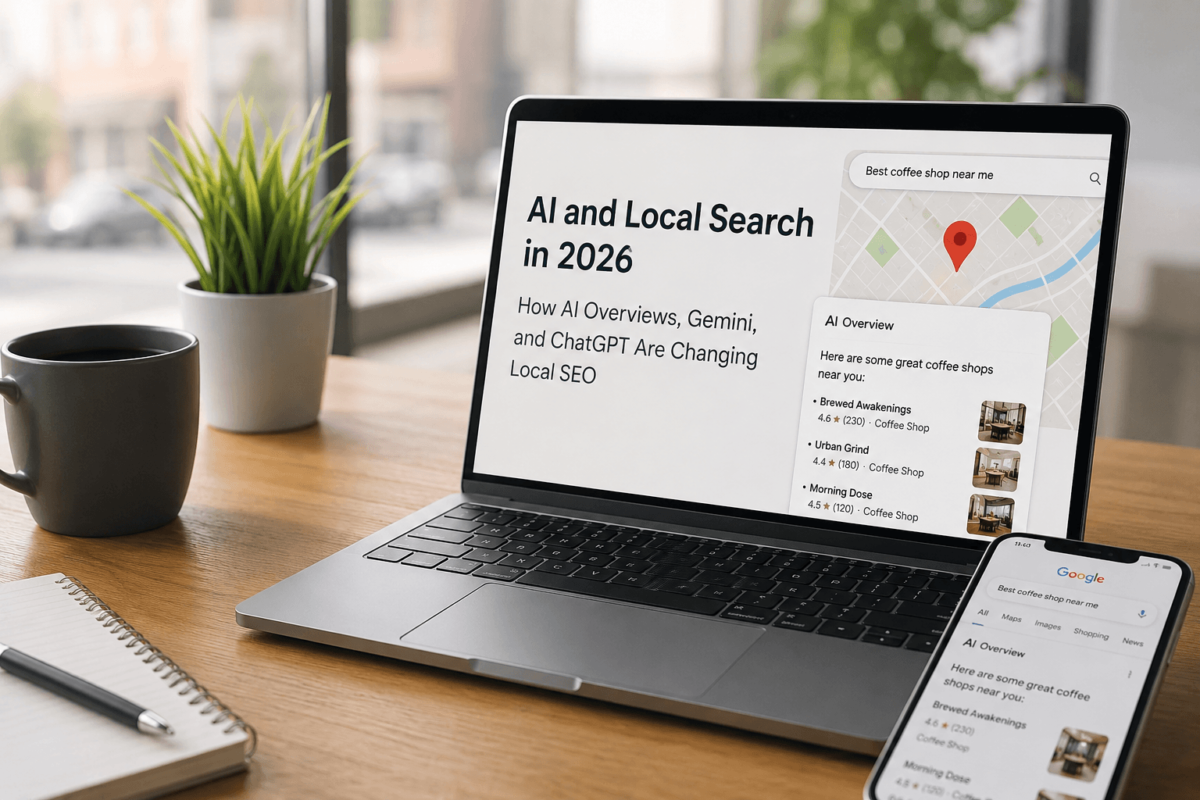
AI Overviews now appear for the majority of local informational searches on Google, fundamentally shifting how businesses earn visibility. Google Gemini increasingly determines which businesses get featured in AI-generated answers — not just in blue-link rankings. In 2026, local SEO requires a dual strategy: optimizing for traditional search rankings and ensuring AI systems understand, trust, and confidently recommend your business.
What You Need to Know — At a Glance
Five years ago, local SEO was mostly about ranking in Google’s Local Pack. In 2026, that’s no longer the whole game. Today, businesses aren’t just competing for rankings — they’re competing to become the answer AI systems trust.
If you run a local business or manage local SEO for clients, you’ve probably noticed something different happening in Google search results. Summaries appear at the top before any links. Recommendations are generated dynamically. Users get answers before they ever visit a website. This isn’t a minor tweak. It’s a structural shift in how local search works.
This guide breaks down everything you need to know about AI local search SEO in 2026 — what’s changed, what still matters, and exactly how to position your business or your clients for maximum visibility across both traditional and AI-driven search.
How AI Has Changed Local Search Results (The 2026 Reality Check)
Not long ago, optimizing for local search meant three things: get your Google Business Profile right, build local citations, and earn some reviews. Rank in the 3-Pack and you were set. That formula still has relevance, but it’s no longer sufficient on its own.
The big shift is conversational search. People no longer type fragmented keyword strings into Google. They ask full questions the way they’d ask a friend. Instead of typing “dentist Austin TX,” someone now asks, “What’s the best family dentist near me that takes Delta Dental?” Instead of searching “HVAC company,” they ask, “Who’s the most trusted HVAC contractor in Austin?” Emergency searches have become especially intent-rich: “Best emergency plumber open right now in Denver” is a complete question with urgency, location, and intent baked in. These long-tail, conversational queries are exactly what AI systems are built to interpret.
These conversational queries trigger AI Overviews. Google’s AI systems interpret the full intent behind the question, pull signals from multiple sources, and generate a synthesized answer — often before showing any organic links. For local businesses, this means the AI either includes you in that answer or it doesn’t. There’s no middle ground.
Traditional Ranking vs. AI Inclusion
Traditional local SEO was about climbing positions. AI search is about earning inclusion. A business that ranks #4 in traditional results might get cited first in an AI Overview. A business ranking #1 organically might not appear in the AI answer at all if its signals are inconsistent or its content doesn’t directly address the query.
User behavior has also shifted significantly. Search users increasingly read the AI-generated summary and either click through to a cited source or take action directly — calling a business, visiting a website, or requesting directions — without scrolling to organic results. Zero-click behavior is rising, and local businesses need to understand that impression without click is now a real and common outcome.
AI Overviews vs. Traditional Local Pack: What’s Replacing What
It’s important to be clear: AI Overviews are not fully replacing the traditional Local Pack. Both formats coexist in Google search results. But they serve different functions and appear under different conditions. Understanding the distinction matters enormously for strategy. If you want the broader picture, our guide on how to rank in Google’s AI Overviews goes deeper on the mechanics.
Why do some businesses lose visibility despite maintaining rankings? Because AI Overviews don’t simply mirror the traditional 3-Pack. A business with great rankings but thin review content, outdated GBP information, or no schema markup may be invisible to AI systems — even while holding a strong map position. The signals that earn AI inclusion overlap with, but go significantly beyond, traditional local ranking factors.
Businesses that help AI understand them clearly will outperform businesses that simply optimize for keywords.
How Often AI Overviews Appear for Local Queries (Data Breakdown)
AI Overviews don’t appear for every search. Google’s systems decide when a generated summary adds value — and local queries are increasingly in that category. Industry tracking in 2026 shows AI Overviews appearing across a broad range of local informational searches, with rates especially high for queries involving recommendations, comparisons, and how-to questions related to local services.
Where AI Overviews Are Most Common in Local Search
The pattern is clear: the more your query resembles a question a human would ask a knowledgeable friend, the more likely AI Overviews are to appear. This is precisely the behavior shift local businesses need to prepare for. Hybrid-intent searches — queries that blend informational and transactional intent, like “best orthodontist in Austin that accepts Medicaid” — are particularly strong triggers for AI-generated summaries. Mapping these against the four core keyword intent types helps you predict where Overviews will show up.
For local businesses, the implication is direct: if your target customers are asking recommendation-style questions about your category, AI Overviews are almost certainly appearing for those searches. Your job is to be included in the answer.
How Gemini Decides Which Local Businesses to Feature
Google’s Gemini AI doesn’t simply rank businesses — it evaluates confidence. Think of it less like a traditional ranking algorithm and more like a knowledgeable advisor deciding who to recommend. Gemini pulls from multiple signals simultaneously to assess which businesses it can confidently endorse for a given query. Our breakdown of Gemini vs. Google AI Overview citations covers how these signals translate into being named.
Business Relevance
Gemini evaluates whether your business clearly and specifically serves the need expressed in the query. A general contractor who mentions plumbing in passing will lose to a dedicated plumber when someone asks about emergency pipe repair. Category specificity and service clarity are foundational.
Review Quality and Content
Review quantity matters far less than review substance. Gemini reads reviews to understand what customers actually say about the experience — the specific services received, the emotions involved, the problems solved. A business with 50 detailed, keyword-rich reviews will typically outperform one with 200 generic five-star ratings in AI recommendations.
Authority Signals
How established is this business as a trusted entity online? Gemini looks at third-party mentions, links from local publications, citations across directories, and the consistency of information across sources. A business that local news outlets have covered, that appears in community publications, and that has consistent data everywhere carries more authority than one that only appears in its own GBP.
GBP Completeness
An incomplete Google Business Profile creates uncertainty for AI systems. If your hours aren’t filled in, if your service categories are vague, if your business description is generic — Gemini has less information to work with. Incomplete profiles are risky in the AI era because the AI may simply recommend a competitor whose profile gives clearer signals.
Website Trust Signals
Gemini reads your website as a supporting document. Thin pages, generic content, no local specificity, and missing technical elements (schema, clear NAP, service pages) all weaken the AI’s confidence in recommending you. Your website needs to clearly communicate what you do, where you do it, and why you’re the right choice.
Brand Mentions Across the Web
This is an underappreciated signal. When your business is mentioned in local guides, directories, industry publications, community websites, and social platforms — even without direct links — those mentions build entity authority. Gemini recognizes your business as a real, established, talked-about entity rather than a profile in a database.
AI is evaluating confidence, not simply rankings. Build the signals that let AI trust your business enough to recommend it by name.
Your GBP as an AI Data Source: What Gemini Is Actually Reading
Your Google Business Profile isn’t just a listing anymore — it’s a structured data feed that AI systems actively read, interpret, and use as a primary source for local recommendations. Every field you fill in (or leave empty) shapes how AI understands your business.
Categories
Primary and secondary categories tell AI exactly what type of business you are. Being overly broad (“contractor”) rather than specific (“kitchen remodeling contractor”) makes it harder for Gemini to recommend you for targeted queries. Use all relevant secondary categories available.
Services
The Services section is one of the most underutilized parts of GBP — and one of the most important for AI visibility. Each service you list is a signal about what your business does. List specific services with clear names and descriptions. Don’t just write “plumbing” — write “emergency pipe repair,” “water heater installation,” “drain cleaning.”
Business Description
Your GBP description should read like a clear, factual overview of what makes your business the right choice. Include your primary service area, your core services, and one or two specific differentiators. Avoid marketing fluff. AI systems respond better to factual, structured language.
Reviews
As covered above, reviews are a major input for AI recommendations. But the GBP review section is where Gemini does a lot of its reading. Reviews that mention specific services, staff names, problem descriptions, and outcomes are especially valuable.
Photos
Photos signal that this is a real, active business. AI systems also use photo metadata and descriptions (where available) to understand business context. Post photos of your work, your team, and your location regularly.
Q&A
The Q&A section of your GBP is an often-ignored goldmine. Seed it with questions your customers genuinely ask and provide clear, factual answers. These question-and-answer pairs are exactly the format AI systems love — structured, specific, and directly addressing user queries.
Updates / Posts
Regular GBP posts signal that your business is active and engaged. They also give Gemini fresh content about your current offers, seasonal services, and business activity. A business that hasn’t posted in six months sends a negative freshness signal.
Operating Hours
Hours need to be accurate and complete — including holiday hours. Emergency queries in particular are heavily influenced by availability. If your hours are wrong or missing, AI systems may hesitate to recommend you for urgent queries.
Consider this scenario: a family searches for “best pediatric dentist in Nashville open on Saturdays.” A dental practice with complete Saturday hours listed, detailed services including pediatric dentistry, recent photos of the office, and reviews mentioning “so gentle with kids” is far more likely to appear in an AI recommendation than a competitor with a sparse profile — regardless of traditional ranking position. (If you’re in this niche, our dental SEO guide goes further.)
ChatGPT, Perplexity, and Claude for Local Business Discovery
Google isn’t the only AI system your potential customers are using. ChatGPT has become a genuine local search tool for millions of users. Perplexity is growing fast as a research-first alternative. And other AI systems are increasingly being used for what was once a purely Google use case: finding local businesses. Optimizing for these engines is the heart of ChatGPT SEO.
Each system has its own data sources, citation behaviors, and business discovery logic. Here’s how the major players stack up for local business recommendations:
The practical implication: optimizing only for Google is no longer enough. Businesses with strong Yelp profiles, consistent Tripadvisor listings, and active presence across review platforms have better cross-platform AI visibility. ChatGPT users asking for local recommendations get results influenced by Yelp data. Perplexity users get synthesized results from multiple review aggregators.
The common thread across all these platforms is the same: clear business information, strong review signals, consistent data across the web, and content that directly answers the questions users are asking. This is the foundation of generative engine optimization (GEO).
AEO (Answer Engine Optimization) for Local Businesses
AEO — Answer Engine Optimization — is the practice of structuring your content, your business information, and your digital presence so that AI systems can extract and present your business as the answer to a user’s question. It’s the local SEO evolution that 2026 demands. If you’re mapping the terminology, our comparison of SEO vs. GEO vs. AEO vs. LLMO clears up where each fits.
Traditional SEO asks: “How do I rank higher?” AEO asks: “How do I become the answer?” The mindset shift is significant, but the tactics are learnable.
Direct Answers
The most basic AEO principle: if a user might ask a question about your business or category, your website and GBP should provide a direct, clear answer. Not a rambling paragraph — a specific sentence. “We offer same-day HVAC repair in Nashville, including weekends and holidays.” That’s AEO-ready copy.
FAQs
Structured FAQ content is one of the most powerful AEO tools available to local businesses. Create FAQ pages and FAQ sections on service pages that mirror the exact questions your customers ask. Use natural language questions as the headings: “Do you offer emergency plumbing at night?” rather than “Emergency Plumbing Services.” AI systems love structured Q&A content. A question-based content strategy makes this systematic.
Entity Optimization
In AI search, your business is an entity — a named, recognizable thing with a set of known attributes. Entity optimization means making those attributes as clear and consistent as possible everywhere your business appears online. Your name, address, phone, category, service area, founding year, owner names, and key specialties should appear consistently across your website, GBP, directories, and social profiles.
Local Topical Authority
Businesses that publish consistently useful content about their local service area and industry niche build topical authority — a signal that AI systems use to identify trustworthy sources. An HVAC company that publishes guides about maintaining air conditioning in humid climates, seasonal maintenance tips, and local energy efficiency resources builds topical authority that general competitors lack.
Content Clusters
Rather than publishing isolated blog posts, local businesses benefit from content clusters: a central pillar page about your main service, supported by detailed articles about related topics, FAQs, local guides, and case studies. This cluster architecture signals to AI that you’re a comprehensive, authoritative resource on your specialty — not just a business with a website.
AEO isn’t about tricking AI systems. It’s about communicating so clearly that AI has no reason to recommend anyone but you.
Structured Data and Schema: The AI Readability Advantage
Think of schema markup as labeling every drawer in a filing cabinet. Without labels, a filing cabinet still holds all the same documents — but finding the right one requires opening every drawer. Schema markup tells machines exactly what each piece of information is, making it dramatically easier for AI systems to understand, categorize, and use your business information. For implementation specifics, see our guide on schema markup for AI search.
For local businesses, several schema types are particularly valuable:
LocalBusiness Schema
This is the foundation. LocalBusiness schema tells search engines and AI systems your business name, address, phone number, hours, categories, and service area in a machine-readable format. It’s the single most important schema type for local AI visibility. Use specific subtypes where possible — “DentalClinic,” “Plumber,” “AutoRepair” — rather than the generic “LocalBusiness.”
Organization Schema
Organization schema builds your business entity profile. It includes your official name, logo, social profiles, founding date, and other identity signals. This schema helps AI systems confidently identify your business as a known, established entity.
Review Schema
Review schema allows AI systems to read and interpret your review data in structured form. While Google primarily uses its own review data, review schema on your website (using reviews you’ve legitimately collected) reinforces your reputation signals.
FAQ Schema
FAQ schema is one of the highest-ROI schema types for AEO. When you mark up your FAQ content with structured data, AI systems can easily extract specific question-and-answer pairs and use them in generated responses. This is a direct path to AI citation.
Service Schema
Service schema lets you explicitly list the services your business provides, with descriptions, prices (where applicable), and service areas. This gives AI systems precise information about what you offer, which directly improves your relevance for service-specific queries.
Schema doesn’t just help with Google. Perplexity, Bing-based AI systems, and other crawlers all read schema markup. Implementing it comprehensively is one of the highest-leverage technical investments a local business can make in 2026 — and it pairs naturally with a tight technical SEO foundation.
Review Signals in the AI Era: Why Quality Beats Quantity
The old local SEO advice was simple: get more reviews. Five stars, lots of them. In 2026, that’s still somewhat true — but it’s a fraction of the full picture. AI systems don’t just count reviews. They read them. For the ranking side of this, see how Google reviews help SEO rankings.
Review Sentiment Analysis
AI systems analyze the overall sentiment of your review corpus. This goes beyond star ratings. A business with 100 four-star reviews that consistently mention words like “responsive,” “professional,” and “fixed the problem fast” sends different signals than a business with 100 five-star reviews that say “great!” and nothing else.
Review Specificity
Specific reviews are worth exponentially more than generic ones for AI visibility. When a customer writes, “They replaced our water heater on a Sunday morning and had it running within two hours — absolutely saved us,” that review tells AI systems specific things: the service (water heater replacement), the timing (emergency/Sunday), the outcome (problem solved quickly). Generic “5 stars, would recommend” reviews provide almost none of this signal.
Trust Indicators
Owner responses to reviews are a significant trust signal that many businesses overlook. AI systems recognize when businesses are actively engaged with their customers. A consistent pattern of thoughtful, professional responses to both positive and negative reviews demonstrates business quality and reliability.
Review Freshness
A business with 300 reviews from 2021 and nothing recent sends a staleness signal. AI systems, like users, want to know that a business is currently operational and currently serving customers well. Consistent new reviews throughout the year are far more valuable than a spike followed by silence.
Customer Language
Here’s a practical insight: encourage your customers to mention the specific service they received, the location, and the outcome in their reviews. Not by scripting them — but by making the review request specific. “Could you mention what brought you in and how it went?” produces richer, more AI-readable review content than “Please leave us a review!”
Low-value vs. High-value Review
Low value: “Amazing service! Will be back.”
High value: “Called on a Friday night for a clogged drain emergency. The plumber arrived within an hour, identified a root blockage, and had everything cleared before midnight. Pricing was fair and the team was professional throughout. Would absolutely call them again.”
The second review is an AI asset. The first barely registers.
How to Appear in AI Overview Local Packs
Here’s the practical playbook — a comprehensive checklist of what it actually takes to earn inclusion in AI-generated local recommendations.
GBP Optimization Checklist
Review Acquisition Checklist
Schema Implementation Checklist
Content Authority Checklist
Brand Mentions & Entity Authority Checklist
Businesses Experiencing 50%+ Visibility Drops: What Went Wrong
Some local businesses have seen dramatic visibility declines since AI Overviews became the norm — not because their rankings dropped, but because they’ve been excluded from AI-generated recommendations. The patterns are consistent. Several map back to the biggest SEO mistakes businesses still make.
Thin Websites
Imagine a plumbing company that’s been operating for 20 years, has great offline reputation, but has a 5-page website with generic content. Their “Services” page says “We do plumbing” with no specifics. Their homepage has a stock photo and a phone number. AI systems see almost nothing to work with. A competitor with detailed service pages, FAQ sections, and local content edges them out in AI recommendations — even if the veteran company technically ranks higher in traditional results.
Outdated GBP Profiles
A business that set up their GBP four years ago and has never touched it since. No recent posts. Wrong hours listed (they changed their Saturday hours but forgot to update GBP). Services section barely filled out. This profile sends every wrong signal: unclear category, stale information, no engagement. AI systems move on to businesses that send clearer signals.
Weak Reviews
500 reviews from five years ago, all generic. Nothing recent. No owner responses. AI systems view this as a stale, potentially inactive business. The review corpus provides almost no specific information about what the business actually does or how well it does it. Meanwhile, a competitor with 80 recent, detailed reviews is getting included in AI recommendations for nearly every relevant query.
No Schema Markup
Without structured data, AI systems have to guess at what your business information means. They might figure it out from context, but they might not. Businesses that implement schema give AI a clear, unambiguous read of their information — which translates directly to more confident recommendations.
No Local Content
A business with no content beyond their service pages — no blog, no guides, no local resources — lacks the topical authority signals that AI systems use to identify trusted, comprehensive resources. In competitive local markets, content authority increasingly determines which businesses AI chooses to cite.
Inconsistent NAP Data
A dental practice has five different phone numbers listed across various directories because they changed numbers twice over the years. Their address is listed differently in some places (Suite 200 vs #200). This inconsistency reduces AI confidence in their entity information. Is this the same business? The AI isn’t sure. The competitor with perfectly consistent data across all platforms gets the recommendation.
5-Step AI Search Optimization Playbook for Local Businesses
Ready to take action? Here’s a structured playbook that any local business or SEO professional can implement, ordered by priority and impact.
Before optimizing, understand where you stand. Search for 10-15 queries your target customers use — conversational queries, recommendation queries, and emergency queries. Note whether your business appears in AI Overviews. Screenshot what appears. Use tools like BrightLocal or Whitespark to audit your current citation profile and identify inconsistencies.
Based on your audit findings, close every gap in your GBP. This is the single highest-impact action most local businesses can take. Prioritize: complete services listing, detailed business description, accurate hours, active Q&A seeding, and a commitment to posting twice monthly.
Implement a systematic review request process. After every positive service interaction, follow up with a personal request asking the customer to share their experience. Make the request specific: “We’d love it if you could mention what brought you in and how things went.” Track your monthly review acquisition rate and aim for consistent volume throughout the year.
Entity authority is about becoming a clearly recognized, consistently described entity across the web. Audit your citations, fix inconsistencies, pursue new citations in industry-specific directories, and actively seek local press mentions and community coverage.
Build content specifically designed to be cited by AI systems. Start with FAQ pages for each core service. Then create local guides, comparison articles, how-to content, and case studies. Implement schema markup across all content. Use natural question-style headings and clear, direct answer paragraphs.
Measuring Your AI Search Visibility (Tools and Benchmarks)
Measuring AI search visibility is newer territory than traditional rank tracking — the tools are evolving, but here’s what’s available and practical today. For the wider metric set, see our guide to the SEO metrics that matter.
AI Overview Tracking
Tools like SE Ranking, BrightLocal, and Semrush are adding AI Overview tracking features. You can manually monitor by running target queries in an incognito browser and noting AI Overview appearances. Some enterprise tools now provide automated AI Overview monitoring at scale.
Brand Mention Monitoring
Tools like Google Alerts, Mention.com, and BrandMentions track when and where your business name appears across the web. Increasing brand mention frequency and diversity is a measurable proxy for growing entity authority.
GBP Insights
Google Business Profile’s built-in analytics show you how customers find your listing (direct searches vs discovery searches), what actions they take (website clicks, direction requests, calls), and how your photo views and search appearance trends. Growing discovery search impressions often correlates with improving AI visibility.
Google Search Console
Search Console remains essential. Monitor your branded vs non-branded query split, track impressions for conversational queries you’re targeting, and watch for click-through rate changes that might indicate AI Overview appearances are capturing clicks before they reach organic results.
Citation Health Monitoring
Tools like Moz Local, BrightLocal, and Yext provide citation audit reports showing consistency scores across directories. A citation health score of 90%+ across major directories is a reasonable benchmark for strong entity consistency.
Benchmark Targets for 2026
The Future of Local Search: 2026–2027 Predictions
Where is all this heading? Here are thoughtful predictions grounded in current trajectory — not hype, not pessimism.
More AI-Generated Recommendations, Fewer Traditional Clicks
The direction is clear: Google is investing heavily in AI-generated answers, and local search is a core use case. Expect AI Overview appearance rates for local recommendation queries to continue growing. Traditional organic clicks for informational local queries will likely decline further as AI summaries become more comprehensive.
Stronger Entity-Based Ranking Systems
Google’s Knowledge Graph and entity understanding systems are maturing rapidly. By 2027, businesses with strong, consistent entity signals — clear category, complete attributes, wide mention footprint — will have a significant structural advantage over businesses that rely purely on traditional on-page optimization.
AI Agents Making Decisions for Consumers
One of the more transformative shifts on the horizon: AI agents that autonomously handle tasks for users. “Book me a dentist appointment within 10 miles that takes Blue Cross” is the kind of instruction an AI agent might receive and act on without the user ever seeing search results. Businesses that are AI-visible and well-described will be chosen by agents. Businesses that aren’t will be invisible to this entire channel.
Greater Emphasis on Reputation Signals
As AI systems become better at natural language understanding, review quality and brand reputation signals will carry more weight. The days of gaming reviews with quantity alone are numbered. Authentic, specific, high-quality review content will be one of the most durable competitive advantages a local business can build.
Voice and Multimodal Local Search
Voice search has been “the next big thing” for a decade, but AI systems are finally making it genuinely powerful. Multimodal search — using images, voice, and text together — is advancing rapidly with tools like Google Lens integrated into AI search. Businesses with strong visual content (professional photos, video walkthroughs) and voice-friendly FAQ content will have advantages in these emerging search modes.
Frequently Asked Questions
Can my business appear in Google AI Overviews for local searches?
Yes, absolutely. Any local business can appear in Google AI Overviews if it sends the right signals. Focus on GBP completeness, review quality, schema markup, and answer-focused content. There’s no paid placement — inclusion is earned through relevance and trust signals.
Is local SEO dead because of AI Overviews?
No — local SEO is not dead. Traditional ranking factors still matter for map pack visibility and organic results, which continue to drive significant traffic. AI Overviews add a new layer, requiring businesses to optimize for AI understanding alongside traditional SEO. Think of it as expansion, not replacement.
How do I get featured in AI-generated local summaries?
Optimize your GBP completely, build high-quality review content with specific service details, implement LocalBusiness and FAQ schema, create answer-focused content on your website, and ensure consistent NAP data across all directories. There’s no shortcut — it’s about becoming genuinely trustworthy and clearly understood by AI.
Do AI systems like ChatGPT recommend local businesses?
Yes. ChatGPT with web browsing enabled can recommend local businesses based on Yelp data, web content, and other sources. Perplexity actively aggregates local business information from multiple review platforms. Maintaining strong profiles on Yelp, Google, and industry directories improves cross-platform AI visibility.
Does AI change which local ranking factors matter most?
AI search amplifies the importance of review quality (not just quantity), GBP completeness, schema markup, brand mentions, and content authority. It somewhat de-emphasizes pure keyword density and link volume as standalone signals. The overall effect is that trust and clarity matter more, and thin optimization matters less.
What is the difference between local SEO and AEO?
Local SEO focuses on ranking in traditional search results — map pack, organic listings, Google Business Profile visibility. AEO (Answer Engine Optimization) focuses on becoming the direct answer in AI-generated summaries, chatbot responses, and voice search results. In 2026, businesses need both — they are complementary, not competing strategies.
Are reviews more important in AI search?
Yes, significantly. AI systems analyze review content, not just ratings. Specific, detailed reviews that mention services, outcomes, and experiences are valuable AI training signals. Review freshness also matters — consistent new reviews signal an active, currently-operating business. Building a rich, ongoing review corpus is one of the highest-ROI investments in AI search visibility.
Conclusion: The New Local Search Playbook
AI is transforming local search in ways that are already visible and will only accelerate. AI Overviews are appearing for more local queries every month. Gemini is actively choosing which businesses to recommend based on trust, clarity, and authority signals. ChatGPT and Perplexity are becoming genuine local discovery tools. The landscape has fundamentally shifted.
The good news: traditional local SEO still matters. Your GBP still drives map pack visibility. Citations still build trust. Great content still earns rankings. None of that goes away. What’s new is the additional layer of AI understanding — making it essential to optimize not just for algorithms, but for comprehension. Our broader AI SEO guide ties these layers together.
Businesses that win in this environment will be the ones that make it easy for AI systems to understand exactly who they are, what they do, where they do it, and why they’re the best choice. That means complete GBP profiles, high-quality reviews, comprehensive schema markup, consistent entity signals, and answer-focused content.
The playbook isn’t impossibly complicated. But it requires intentionality. Most of your competitors are still thinking about local SEO the way they did in 2020. Getting ahead means making the shift now.
The winners in local search over the next few years won’t necessarily be the businesses ranking first. They’ll be the businesses AI understands, trusts, and confidently recommends.