SOFTWARE COMPARISON
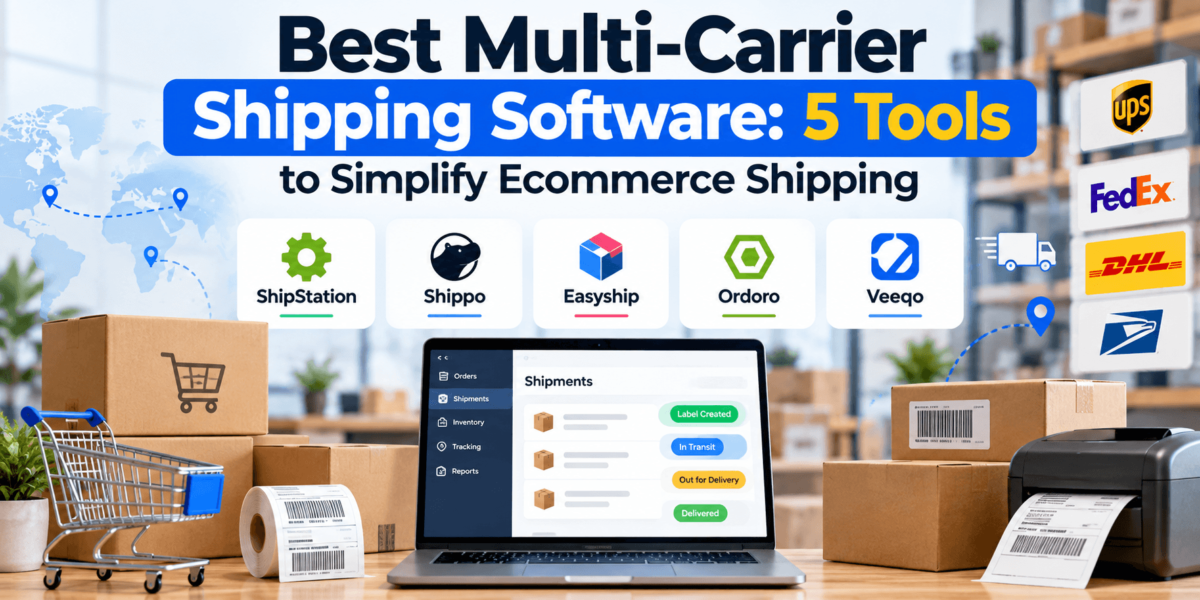
Best Multi-Carrier Shipping Software: 5 Tools to Simplify Ecommerce Shipping
ShipStation, Shippo, Easyship, Ordoro, and Veeqo compared on carriers, rate shopping, automation, integrations, and what you will actually pay.
Last reviewed: October 7, 2026 | Pricing checked October 2026
Disclosure: This article may contain affiliate links. If you buy through one of them, we may earn a commission at no extra cost to you. Our comparisons are based on each vendor’s published plans and product pages.
Picture the routine. You print a UPS label, notice USPS would have been cheaper for that two-pound parcel, then log into FedEx for the heavy order. That works at ten orders a week. At ten a day, it eats your afternoon.
Multi-carrier shipping software pulls your orders, carriers, rates, labels, and tracking into one dashboard. The real payoff is rate shopping: the software compares carriers for each parcel, so you choose the cheapest or fastest option instead of guessing.
We compared five platforms: ShipStation, Shippo, Easyship, Ordoro, and Veeqo. Four of them have a free way in, and they differ more than their marketing suggests. ShipStation suits complex operations, Easyship suits cross-border sellers, Veeqo gives away its shipping features, and Ordoro adds inventory. For a wider look at the category, see our guide to the best shipping software for ecommerce.
QUICK ANSWER
The best multi-carrier shipping software depends on how you sell. ShipStation is the strongest all-rounder for growing multichannel stores. Shippo suits low-volume sellers who want a free start. Easyship is built for international shipping. Ordoro fits sellers who want inventory management alongside shipping. Veeqo offers free shipping features, especially useful if you sell on Amazon.
Quick Comparison: Best Multi-Carrier Shipping Software
| Software | Best for | Carrier support | Key strength | Starting price |
|---|---|---|---|---|
| ShipStation | Growing multichannel sellers | USPS, UPS, FedEx, DHL, and more | Automation, returns, and inventory in one platform | From $14.99/mo; 30-day free trial |
| Shippo | Low-volume and small sellers | USPS, UPS, FedEx, DHL Express, and more | Free plan with discounted rates | Free (30 labels/mo); Pro from $17/mo |
| Easyship | International shipping | USPS, UPS, FedEx, DHL, plus hundreds more couriers | Duties, taxes, and checkout rates | Free (50 shipments/mo); paid from $29/mo |
| Ordoro | Shipping plus inventory or dropshipping | USPS, UPS, FedEx, DHL, and more | Modular apps that grow with you | Free shipping plan; paid from $59/mo |
| Veeqo | Amazon-heavy multichannel sellers | USPS, UPS, FedEx, DHL, OnTrac, Amazon Shipping | Free shipping features, unlimited orders | Free shipping; inventory from $19/mo |
Prices are monthly list prices checked in October 2026 and exclude postage. They change often, so confirm on each vendor’s pricing page before you commit.
Check ShipStation’s current plansSee what Shippo offers
1. ShipStation
BEST FOR GROWING MULTICHANNEL SELLERSREVIEW 1 OF 5
| Best for | Stores and marketplaces shipping hundreds to thousands of orders a month |
| Carriers | USPS, UPS, FedEx, DHL Express, GlobalPost, Canada Post, Royal Mail, Amazon, and more |
| Sells on | Shopify, WooCommerce, BigCommerce, Squarespace, Wix, Amazon, eBay, Etsy, Walmart, TikTok Shop |
| Starting price | $14.99/mo (Starter, 50 shipments); 30-day free trial, no card required |
ShipStation is the most complete platform in this group. Rate shopping, automation rules, returns, inventory, and even LTL freight live in one login. The catch is complexity: it asks more of you during setup, and the price climbs with shipment volume.
Key features
- Automated rate shopping that picks the cheapest, fastest, or best-value service per order
- Automation rules that batch, route, and print labels (unlimited rule types from the Standard plan)
- Combine and auto-split orders, plus bring-your-own carrier accounts, from Standard
- Return labels on every plan; a branded returns and exchanges portal from Standard
- Branded tracking pages and notification emails from Standard
- Parcel and LTL freight rate comparison in the same workflow
Carrier Support and Integrations
ShipStation lists USPS, UPS, FedEx, DHL Express, GlobalPost, Canada Post, Royal Mail, Australia Post, and Amazon among its carriers. On the selling side it connects to Shopify, WooCommerce, BigCommerce, Squarespace, Wix, Amazon, eBay, Etsy, Walmart, and TikTok Shop. If you sell on a hosted builder, our roundup of the best website builders for ecommerce shows where shipping fits in the stack, and our Shopify apps list covers the add-ons that pair well with it.
Pricing
Starter begins at $14.99 a month for 50 shipments with three users. Standard begins at $29.99 and adds ten users, unlimited automations, API access, and phone support. Premium begins at $349.99 and adds advanced inventory and warehouse tools. Each plan steps up in price as your monthly shipment tier rises, and annual billing saves 20%. Postage and insurance are billed separately.
Pros
- One platform for parcel, freight, returns, and inventory
- Deep automation once you reach Standard
- Very wide store, marketplace, and carrier coverage
- 30-day free trial and a 90-day satisfaction promise
Cons
- Starter lacks own-carrier accounts, branded tracking, a returns portal, and API access
- Phone support starts at Standard
- Cost scales with shipment volume, so it gets pricey as you grow
- Reviewers describe a learning curve, which fits a tool this broad
Who Should Use ShipStation?
Choose ShipStation if you sell across several channels, ship a few hundred orders a month or more, and want rules that print labels without you touching each order. It also makes sense if you ship the occasional pallet alongside parcels.
Our Take
If you ship a few dozen orders a month, you are paying for more platform than you need. Once volume and channels grow, ShipStation is the safest long-term bet here because you rarely outgrow it.
2. Shippo
BEST FOR LOW-VOLUME SELLERSREVIEW 2 OF 5
| Best for | New stores and small sellers shipping under a few hundred parcels a month |
| Carriers | USPS, UPS, FedEx, DHL Express, and 40+ carriers in total |
| Sells on | Shopify, WooCommerce, Square, Wix, BigCommerce, Squarespace, Magento, Walmart, Amazon |
| Starting price | Free for up to 30 labels/mo; Pro from $17/mo |
Shippo is the easiest way to get discounted multi-carrier rates without a monthly bill. Its free Starter plan covers up to 30 labels a month and still includes discounted USPS, UPS, FedEx, and DHL Express rates. Why pay for a heavy platform when you only send 20 orders a week?
Key features
- Side-by-side rate comparison across its carrier network
- Bulk label editing and printing, manifests, and pickup scheduling
- Automations, order tags, and a connected address book
- Customs forms and commercial invoices for international orders
- Return labels and shipment tracking on every plan
- Branded tracking pages, notification emails, and packing slips on Pro
Carrier Support and Integrations
Shippo gives you discounted USPS, UPS, FedEx, and DHL Express labels and lets you connect your own carrier accounts too. Its store connections include Shopify, WooCommerce, Square, Wix, BigCommerce, Squarespace, Magento, Walmart, and Amazon. WooCommerce merchants should also browse our list of the best WooCommerce plugins for ecommerce.
Pricing
Starter is free for up to 30 labels a month with one user. Connecting your own carrier account costs 5 cents per label on Starter and nothing on paid plans. Pro starts at $17 a month and scales by label volume up to 10,000 labels, with up to five users, free own-carrier connection, branded tracking, and chat and phone support. Beyond 10,000 labels, overage is $0.08 per label. Premier is custom-quoted.
Pros
- A genuinely free plan with discounted carrier rates
- Fast setup and a clean interface
- Free own-carrier connection on Pro and Premier
- Branded tracking and phone support on Pro
Cons
- Free plan is limited to 30 labels and one user
- No inventory management
- Own-carrier labels carry a 5-cent fee on the free plan
- Volume-tier pricing is harder to predict than a flat fee
Who Should Use Shippo?
Shippo fits new Shopify, WooCommerce, or Square stores that want rate shopping without a commitment. It also works for sellers who ship internationally now and then and need customs paperwork handled.
Our Take
Treat Shippo as the low-risk starting point. You will likely outgrow the free plan quickly if the store takes off, but moving to Pro is simple, and you never pay for features you are not using.
Pro tip
During any free trial, run your ten most typical parcels through each tool’s rate shopper. A package that is cheap on USPS in Zone 2 can flip to UPS or FedEx in Zone 6, and your own order mix tells you more than any pricing page.
3. Easyship
BEST FOR INTERNATIONAL SHIPPINGREVIEW 3 OF 5
| Best for | DTC brands and marketplace sellers shipping across borders |
| Carriers | USPS, UPS, FedEx, DHL, and hundreds of other couriers (Easyship cites 550+) |
| Sells on | Shopify, WooCommerce, Squarespace, Amazon, eBay, Etsy, Wix, TikTok Shop, BigCommerce |
| Starting price | Free up to 50 shipments/mo; paid plans from $29/mo; 14-day trial on paid plans |
Easyship is the international specialist. It combines courier rate comparison with duty and tax calculations, HS code tools, and automatically generated customs documents. That is a lot less guesswork when a customer in Canada or Germany reaches checkout.
Key features
- Rate comparison across a very large courier network, with Easyship citing discounts of up to 83% off daily UPS rates and up to 91% on international rates
- Checkout rates and delivery estimates for Shopify and WooCommerce stores
- Duty and tax calculation, HS code tools, and auto-generated customs documents
- Branded checkout and tracking pages, notifications, returns, and insurance
- Connect your own DHL Express, FedEx, or UPS account on paid plans
- Analytics, multi-user workflows, and an optional global fulfillment network
Carrier Support and Integrations
USPS, UPS, FedEx, and DHL are all available, and Easyship also supports regional couriers such as Canada Post and Royal Mail. Store integrations include Shopify, WooCommerce, Squarespace, Amazon, eBay, Etsy, Wix, TikTok Shop, and BigCommerce. If duties and sales tax are a headache for you, pair it with one of the tools in our guide to the best tax software for ecommerce.
Pricing
Easyship’s Free plan covers up to 50 shipments a month. According to third-party pricing breakdowns checked in July 2026, Plus runs $29 a month for 500 shipments, Premier $69 for 2,500, and Scale $99 for 5,000, with roughly 20% off for annual billing. Enterprise is custom. The same breakdowns note that linking your own courier account carries a per-label fee on paid plans and is not available on Free, so confirm details on the Easyship plans page.
Pros
- Strongest cross-border toolkit in this comparison
- Duties, taxes, and customs paperwork handled in the workflow
- Real free plan with no card required
- Checkout rates for Shopify and WooCommerce
Cons
- Free plan cannot link your own courier accounts
- Own-courier labels carry a per-label fee on paid plans
- No inventory management
- More capability than a domestic-only store needs
Who Should Use Easyship?
Easyship makes sense if a meaningful share of your orders leave the United States, or if you want customers to see landed costs before they pay. Domestic-only sellers can skip it.
Our Take
This is the one to test first for cross-border selling. For purely domestic shipping, ShipStation, Shippo, or Veeqo will likely feel more focused.
4. Ordoro
BEST FOR SHIPPING PLUS INVENTORYREVIEW 4 OF 5
| Best for | Multichannel sellers who want shipping now and inventory or dropshipping later |
| Carriers | USPS (via Pitney Bowes), UPS, FedEx, DHL, DHL eCommerce, Amazon Shipping, Canada Post |
| Sells on | Shopify, BigCommerce, WooCommerce, Magento, Squarespace, Amazon, eBay, Etsy |
| Starting price | Free Shipping plan; paid shipping plans from $59/mo; 15-day trial, no card |
Ordoro splits its platform into three apps: Shipping, Inventory, and Dropshipping. Start with the free Shipping plan, then add the others when your operation needs them. That modular approach is Ordoro’s biggest selling point.
Key features
- Discounted carrier rates, logos on labels, quick ship, and barcode pack verification
- Return labels on every plan; full returns management on Premium
- Automation rules, presets, and batch processing from Advanced
- Branded tracking pages, kitting, QuickBooks Online, and API access on Premium
- Separate Inventory app covering kitting, bundling, and warehouse transfers
- Separate Dropshipping app with order routing and supplier tools
Carrier Support and Integrations
Ordoro supports USPS through Pitney Bowes, UPS, FedEx, DHL, DHL eCommerce, Amazon Shipping, and Canada Post, with additional carriers available through Shippo. Cart and marketplace integrations include Shopify, Shopify Plus, BigCommerce, WooCommerce, Magento, Squarespace, Amazon, eBay, and Etsy. If you are deciding whether you need stock control at all, compare the options in our list of the best inventory management software.
Pricing
Shipping Essentials is free for up to 100 labels a month, one sales channel, and one user. Advanced costs $59 a month for up to 3,000 labels, five sales channels, unlimited users, automation, and phone support. Premium costs $149 a month for unlimited labels and channels, plus own carrier accounts, returns management, and API access. The Inventory app starts at $349 a month and Dropshipping at $299.
Pros
- Free shipping plan with discounted rates and return labels
- Add inventory or dropshipping only when you need them
- Unlimited users on paid shipping plans
- Barcode pack verification helps cut mis-ships
Cons
- The free plan locks temporarily if you pass 100 labels in a month
- Own carrier accounts only on Premium, with an extra fee after the first 1,000 labels
- Inventory and Dropshipping start at $349 and $299 a month
- Capterra reviewers report mixed experiences with bugs and sync issues
Who Should Use Ordoro?
Ordoro suits sellers who expect to need real inventory control, kitting, or dropshipping routing and would rather not stitch separate tools together. Pure label printers can pick something simpler.
Our Take
The free plan is a fair way to test it, but the real value shows up when you add Inventory. Budget for that price jump before you commit to the ecosystem.
5. Veeqo
BEST FOR AMAZON-HEAVY SELLERSREVIEW 5 OF 5
| Best for | Multichannel sellers, especially those selling on Amazon, who want free shipping software |
| Carriers | USPS, UPS, FedEx, DHL, OnTrac, and Amazon Shipping |
| Sells on | Amazon, Shopify, eBay, Walmart, WooCommerce, Rithum, TikTok Shop |
| Starting price | Shipping is free; Inventory plan from $19/mo; High Volume from $350/mo |
Veeqo is owned by Amazon, and its shipping features are free: unlimited orders, users, products, and warehouses. Veeqo says it earns a small commission on labels bought through the platform, which is how it pays the bills.
Key features
- Pre-negotiated rates with UPS, USPS, FedEx, DHL, OnTrac, and Amazon Shipping
- Up to 5% back in Veeqo Credits on labels you buy
- Bulk ship up to 100 orders in one click, with customizable printing templates
- Profit Analyzer plus shipping and sales reports
- Inventory plan: cross-channel stock sync, demand forecasting, scanner, and picking-path optimization
- A rate shopping API on the free Shipping plan
Carrier Support and Integrations
The carrier list covers USPS, UPS, FedEx, DHL, OnTrac, and Amazon Shipping. Veeqo connects to Amazon, Shopify, eBay, Walmart, WooCommerce, Rithum, and TikTok Shop. Amazon FBA orders do not count toward chargeable volume on the paid plans, which helps sellers who split orders between FBA and their own warehouse. It is also a natural fit for Shopify merchants shopping through our list of Shopify apps.
Pricing
The Shipping plan is free. The Inventory plan starts at $19 a month, with the price set by your monthly order volume. High Volume starts at $350 a month and adds NetSuite integration, priority support, an account manager, and API consulting.
Pros
- Free shipping features with no order, user, or SKU caps
- Veeqo Credits reduce future label costs
- Strong marketplace coverage, including Amazon and Walmart
- Inventory sync available when you outgrow shipping alone
Cons
- Amazon ownership is a dealbreaker for some sellers, though Veeqo states it does not share your data with other Amazon business units
- Shopify App Store reviews are mixed, with a few sellers reporting inventory sync problems
- We could not confirm returns or branded tracking features on its pricing page
- Its income depends on label purchases, so rates are the product
Who Should Use Veeqo?
Veeqo is a strong match for sellers who ship a lot of marketplace orders and want to keep software costs near zero. If branded tracking and a returns portal are must-haves, check the fine print first.
Our Take
Free is hard to beat, and the label credits are a real perk for high shippers. Test the inventory sync carefully before you trust it with live stock.
Which Multi-Carrier Shipping Software Is Best for You?
The right choice depends heavily on order volume and how many places you sell. Here is how we would match each type of seller.
Best for Small Ecommerce Businesses
Shippo for stores under 30 labels a month, and Ordoro’s free Shipping plan for up to 100. Veeqo is also free if you do not mind its Amazon ties.
Best for Growing Shopify Stores
ShipStation gives you automation and room to scale, while Easyship adds checkout rates if international customers are part of the plan.
Best for Multichannel Sellers
ShipStation has the widest channel coverage. Veeqo is the budget pick for Amazon, eBay, Walmart, and Shopify combinations.
Best for International Shipping
Easyship, thanks to duty and tax calculations, customs documents, and a huge courier network.
Best for High-Volume Merchants
ShipStation offers volume tiers up to 100,000 shipments a month, Veeqo’s High Volume plan adds an account manager and NetSuite, and Shippo Premier offers unlimited shipments on custom pricing.
Best for Shipping Automation
ShipStation offers unlimited automation rules from Standard. Ordoro adds automation rules and batch processing on Advanced.
Best for Businesses That Need Inventory Management
Ordoro and Veeqo both sell dedicated inventory plans, and ShipStation Premium adds purchase orders and forecasting. Automating the rest of your back office? See our roundup of the best workflow automation software.
Feature Comparison: ShipStation vs. Shippo vs. Easyship vs. Ordoro vs. Veeqo
| Feature | ShipStation | Shippo | Easyship | Ordoro | Veeqo |
|---|---|---|---|---|---|
| USPS | ✓ | ✓ | ✓ | ✓ | ✓ |
| UPS | ✓ | ✓ | ✓ | ✓ | ✓ |
| FedEx | ✓ | ✓ | ✓ | ✓ | ✓ |
| DHL | ✓ | ✓ | ✓ | ✓ | ✓ |
| Shipping labels | ✓ | ✓ | ✓ | ✓ | ✓ |
| Rate shopping | ✓ | ✓ | ✓ | ✓ | ✓ |
| Automation | ✓ | ✓ | ✓ | ✓ | ✓ |
| Tracking | ✓ | ✓ | ✓ | ✓ | — |
| Returns | ✓ | ✓ | ✓ | ✓ | — |
| Shopify | ✓ | ✓ | ✓ | ✓ | ✓ |
| WooCommerce | ✓ | ✓ | ✓ | ✓ | ✓ |
| Amazon | ✓ | ✓ | ✓ | ✓ | ✓ |
| eBay | ✓ | — | ✓ | ✓ | ✓ |
| Inventory management | ✓ | — | — | ✓ | ✓ |
| International shipping | ✓ | ✓ | ✓ | — | — |
| Reporting | ✓ | ✓ | ✓ | ✓ | ✓ |
✓ = confirmed on the vendor’s own pricing or product pages as of October 2026. — = not a core feature, or we could not confirm it there. Verify any must-have feature before you buy, especially in a free plan.
Compare Ordoro’s plansExplore Easyship’s shipping options
How to Choose Multi-Carrier Shipping Software
A feature checklist only gets you so far. Work through these ten questions in order, and the shortlist usually cuts itself down.
01 — Carrier coverage. Confirm the platform covers the carriers you already use or want, including regional ones like OnTrac, and whether you can bring your own negotiated accounts.
02 — Shipping rates. Look at the discounts on offer and whether the software earns money from labels. Veeqo, for example, is transparent that it does.
03 — Ecommerce integrations. Check every store and marketplace you use today, not just the headline ones. A missing eBay or Walmart connector can end the evaluation.
04 — Automation. Decide whether you need rules that choose a service, print labels, and tag orders without you. This often sits on a higher plan.
05 — Order volume. Count orders per month and per peak week. Free plans cap out fast: Shippo at 30 labels, Easyship at 50, Ordoro at 100.
06 — International shipping. If you ship abroad, look for customs documents, duty and tax estimates, and delivered-duty-paid options.
07 — Returns. Printing return labels is common. A branded portal and returns management usually costs more.
08 — Tracking. Customer notification emails are standard; branded tracking pages are often a paid feature.
09 — Inventory management. If you oversell or run several warehouses, favor a platform with inventory sync rather than bolting one on later.
10 — Pricing. Add the subscription, per-label fees, own-carrier fees, and extra users, then compare that to your expected order volume.
Worth knowing
When a package problem hits your support inbox, returns and tracking details matter more than automation. Our guide to the best customer support software for ecommerce covers tools that pair well with your shipping stack.
Multi-Carrier vs. Single-Carrier Shipping Software
What is multi-carrier shipping software?
It is a platform that lets you ship with USPS, UPS, FedEx, DHL, and other carriers from one account. A single-carrier tool, such as a carrier’s own web portal, only covers that carrier.
Why use multiple carriers?
No carrier is cheapest for every package. Weight, size, destination zone, and delivery speed all change the winner, so comparing carriers per order saves money and gives you backup when one carrier has delays.
Is multi-carrier shipping cheaper?
Often, but not always. Savings depend on your package mix and the discounts each platform offers. Test your real parcels during a free trial before assuming a number.
Can Shopify stores use multiple carriers?
Yes. All five tools here list a Shopify integration. If you are still choosing a platform, our comparison of Shopify vs. WooCommerce and Shopify vs. BigCommerce covers how each handles shipping.
Can small businesses benefit?
Yes, especially when a free plan is available. Even at 30 to 100 orders a month, label discounts and a single dashboard can pay off.
What are the disadvantages?
More software means more setup and, on paid plans, another subscription. Pricing can also get confusing once per-label fees and volume tiers enter the picture.
What Multi-Carrier Shipping Software Really Costs
Two bills matter here, and mixing them up is the most common budgeting mistake. The software subscription is what you pay the platform each month. The shipping and label cost is postage, which you pay the carrier, whether through the software or directly. Postage is usually the bigger number.
What affects the subscription price
- Monthly subscription: from free (Shippo, Easyship, Ordoro, Veeqo) to hundreds of dollars for advanced plans
- Per-shipment or per-label fees: Shippo charges 5 cents on own-carrier labels in its free plan, and Ordoro charges $30 per 1,000 labels above its Premium allowance
- Premium features: branded tracking, returns portals, API access, and own-carrier accounts often sit on higher tiers
- User limits: Shippo’s free plan has one user; ShipStation Starter has three
- Order-volume limits: plans are capped by labels, shipments, or orders per month
- Enterprise pricing: Shippo Premier, Easyship Enterprise, and Ordoro Dropshipping Premium are custom-quoted
Budget for fees on the payment side too. Our guide to the best payment gateways for ecommerce shows how processing costs stack on top of shipping.
Pro tip
Model one month of real orders. Count your labels, your own-carrier labels, and your users, then price each platform against that. The cheapest sticker price is rarely the cheapest bill.
Reporting also affects how you judge cost. If you want to see shipping spend next to revenue, look at our list of the best ecommerce analytics software.
Multi-Carrier Shipping Software FAQs
What is multi-carrier shipping software?
Multi-carrier shipping software is a platform that lets ecommerce businesses manage shipments across carriers such as USPS, UPS, FedEx, and DHL from one system. It helps compare rates, print labels, automate shipping workflows, track packages, and manage orders without logging into each carrier separately.
What is the best multi-carrier shipping software?
ShipStation is the best all-around option for growing multichannel sellers. Shippo suits low-volume stores, Easyship leads for international shipping, Ordoro fits sellers who want inventory too, and Veeqo is a strong free choice for Amazon sellers. The best pick depends on your order volume, channels, and destinations.
Is multi-carrier shipping software worth it?
Usually yes once you ship regularly. Rate shopping can reduce postage, automation saves time, and one dashboard replaces several carrier portals. If you ship only a handful of orders a month, a free plan from Shippo, Ordoro, or Veeqo can give you most of the benefit at no cost.
Can I use multiple shipping carriers with Shopify?
Yes. ShipStation, Shippo, Easyship, Ordoro, and Veeqo all list Shopify integrations. Orders sync into the platform, you choose a carrier and service, print the label, and tracking information goes back to your store and customer.
Can shipping software compare UPS, FedEx, and USPS rates?
Yes. Rate shopping is a core feature of these platforms. You enter package weight and destination, and the software shows prices and delivery times across carriers so you can choose the cheapest, fastest, or best-value option. ShipStation and Veeqo can also apply rules automatically.
What is the best shipping software for small businesses?
Shippo is a good fit under 30 labels a month, Ordoro’s free Shipping plan covers up to 100 labels, and Veeqo’s shipping features are free. Easyship’s free plan covers 50 shipments a month. Pick the one whose integrations and limits match how you sell.
What is the best shipping software for high-volume ecommerce?
ShipStation is a strong choice, with volume tiers up to 100,000 shipments a month and automation, warehouse, and inventory tools. Veeqo’s High Volume plan adds NetSuite integration and an account manager, and Shippo Premier offers unlimited shipments on custom pricing.
Can multi-carrier shipping software automate shipping labels?
Yes. ShipStation offers automation rules that batch, route, and print labels, with unlimited rule types from Standard. Ordoro adds automation rules and batch processing on Advanced, and Shippo includes automations on its plans. Automation usually requires setup time but pays off quickly at higher volumes.
Can shipping software handle international shipments?
Yes. Easyship is the strongest here, with duty and tax calculations, HS code tools, and automatic customs documents. ShipStation and Shippo also support international shipping and customs forms. Check each platform’s carrier list for the countries you ship to most.
Does shipping software integrate with Amazon and eBay?
ShipStation, Easyship, Ordoro, and Veeqo list both Amazon and eBay integrations. Shippo lists Amazon among its store connections, but we could not confirm eBay on its pages, so verify before you rely on it. Veeqo, as an Amazon company, is especially strong with Amazon.
Final Verdict
There is no single winner, which is the honest answer. Match the tool to your situation:
- ShipStation if you sell on several channels, ship hundreds of orders a month, and want automation that scales.
- Shippo if you are just starting and want discounted rates without a monthly fee.
- Easyship if international customers and duties are part of your business.
- Ordoro if you want shipping now and inventory or dropshipping later.
- Veeqo if you sell on Amazon and want free shipping software.
Most of these offer a free plan or trial, so the cheapest way to decide is to run a week of real orders through your top two. Compare the current plans below and see which one feels right.
BOTTOM LINE
Ready to compare your options?
Start with the plan that matches your order volume, and test it on real parcels before you commit.
Check ShipStation’s current plansSee what Shippo offersExplore Easyship’s shipping optionsCompare Ordoro’s plansSee whether Veeqo fits your workflow
Plans, features, and prices change frequently. Details in this article reflect vendor pages we checked in October 2026, and some figures (noted in the text) come from third-party breakdowns. Confirm everything on the vendor’s site before you buy.