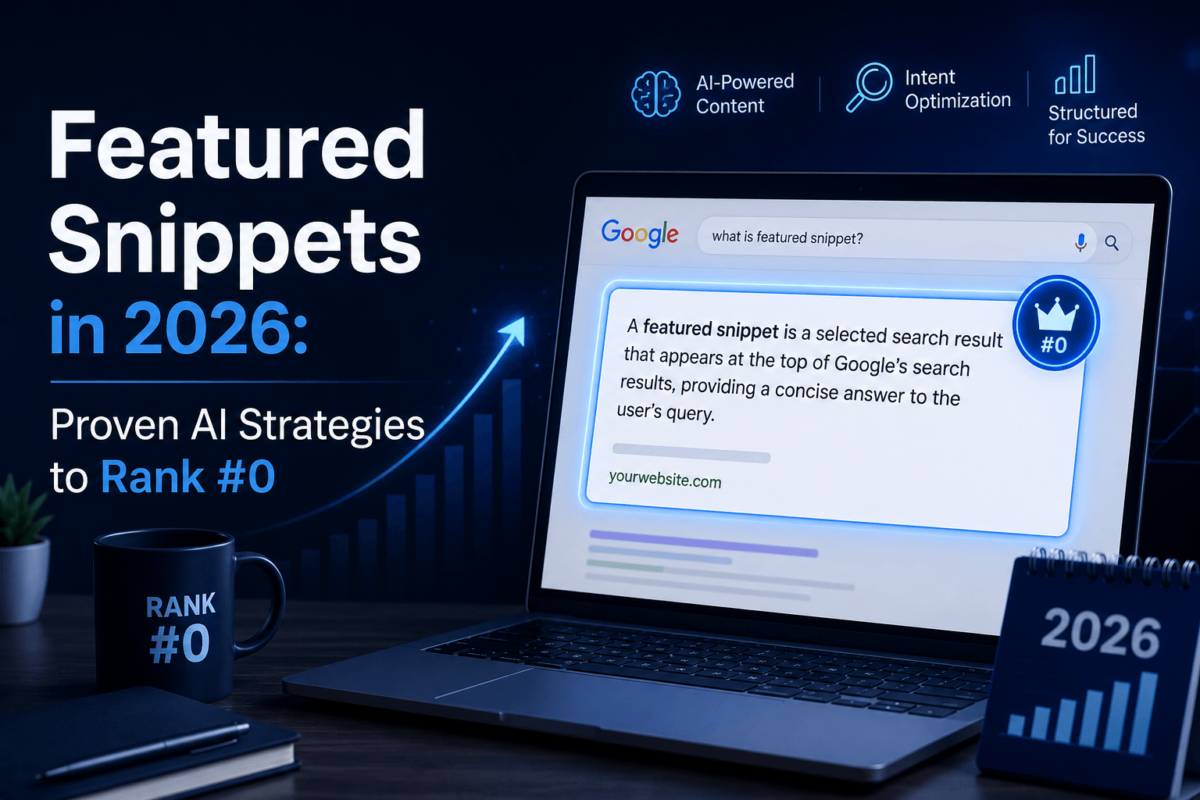
Featured snippets are short, highlighted answers that Google displays at the very top of search results — above all organic links (position #0). To rank for them in 2026, structure your content with a clear question + a direct 40–60 word answer directly below it, then support that answer with lists, tables, or step-by-step instructions. With AI-powered search (Google SGE, ChatGPT, Perplexity) pulling answers directly from these snippets, optimizing for them is no longer optional — it’s one of the highest-ROI moves in modern SEO.
- Position #0 = prime real estate: Featured snippets appear above all organic results. They capture 8–12% of all clicks on average, and for informational queries it can be much higher.
- Four main types: Paragraph, List (bulleted/numbered), Table, and Video snippets — each triggered by different query formats and content structures.
- AI search has raised the stakes: Google SGE, ChatGPT Browse, and Perplexity all pull heavily from snippet-optimized content. If you’re not structured for snippets, you’re invisible to AI answers.
- The ‘snippet bait’ method works: Place a bold question as an H2 or H3, immediately follow it with a concise 40–60 word answer, then expand below. Google loves this pattern.
- Small sites can absolutely win snippets: Google cares about the best-formatted, clearest answer — not just domain authority. A well-optimized page on a new domain can beat a Forbes article for the right query.
- Track your snippet wins: Use Google Search Console, Ahrefs, or SEMrush to monitor which queries trigger your snippets and to spot displacement opportunities.
- Refresh matters: Google periodically rotates snippet sources. Regular content updates signal freshness and help you retain the position.
- What Are Featured Snippets?
- Types of Featured Snippets
- How AI Is Changing Featured Snippets in 2026
- How to Optimize for Featured Snippets
- Advanced Strategies
- Step-by-Step Guide to Rank
- How to Track Featured Snippets
- Strategy Comparison Table
- E-E-A-T and Featured Snippets
- Affiliate Monetization
- Content Refresh Strategy
- FAQs
- Final Thoughts
What Are Featured Snippets?
Let’s start with the basics — but go deeper than every blog post that just says ‘it’s a box at the top of Google.’
A featured snippet is a special search result that Google displays at position #0 — above all the normal blue links. Google automatically extracts a short answer from a webpage and showcases it in a highlighted box. The user gets an immediate answer without clicking. The source gets massive visibility (and often a big traffic spike).
But here’s what most guides skip: Google doesn’t just pick the most popular page. It picks the page with the clearest, best-structured answer to the searcher’s exact intent. That’s the whole game.
Why Google Shows Featured Snippets
Google’s mission is to organize the world’s information and make it universally accessible and useful. Featured snippets are Google delivering on that mission at lightning speed. When a user types a clear question — ‘how long does it take to boil an egg’ or ‘what is a 401k’ — Google tries to surface an instant answer rather than making them wade through 10 links.
From a business standpoint, this keeps users on Google longer (great for ad revenue) and builds trust in the search engine. For you as a publisher, it’s a double-edged sword: you might get traffic even without a click, or you might lose traffic because the user got their answer without visiting your site. We’ll talk about how to turn that into a win later.
The Position #0 Reality
The term “Position #0” came about because featured snippets sit above the first organic result. Studies by Ahrefs and Moz have found that the featured snippet result gets anywhere from 7% to 23% of total clicks on a given SERP, depending on the query. For branded and navigational queries the click-through rate can be lower. For informational queries — ‘how to,’ ‘what is,’ ‘best way to’ — it’s often the dominant traffic source on that page.
Entity-Based Selection: How Google Really Picks a Snippet
Here’s the nuance that almost nobody talks about: Google’s snippet selection is heavily tied to its Knowledge Graph and entity understanding. When you search ‘What is compound interest,’ Google knows the entities involved (interest, principal, time, investment) and looks for content that comprehensively addresses those entities in a clear hierarchy.
This means semantic completeness matters just as much as formatting. You can have the perfect H2 question + concise answer structure, but if your content misses key related concepts, Google will choose a competitor that covers all the angles. We’ll cover how to nail both in the optimization section.
Types of Featured Snippets (With Real Examples)
Not all featured snippets are the same. Google surfaces different formats depending on the query type and the content structure it finds. Here are the four main types you need to know — and how to earn each one.
1. Paragraph Snippets
Triggered by: ‘What is,’ ‘Who is,’ ‘Why does,’ ‘How does’ queries
This is the most common type. Google extracts a 40–60 word paragraph that directly defines or explains something. The key is that the answer must be self-contained — it should make complete sense without any surrounding context.
Snippet-worthy answer: ‘Semantic SEO is the process of optimizing content around topics, entities, and user intent rather than individual keywords. It involves building topical authority by covering related concepts comprehensively, helping search engines understand the full context of your content and match it to a wider range of relevant queries.’
2. List Snippets
Triggered by: ‘Best,’ ‘Top,’ ‘Steps to,’ ‘Ways to,’ ‘How to’ queries
Google loves pulling bulleted or numbered lists for process-oriented and comparison queries. These appear in two forms:
- Bulleted lists: Used for unordered items (‘best practices for X,’ ‘tools for Y’)
- Numbered lists: Used for sequential processes (‘steps to do X,’ ‘how to set up Y’)
3. Table Snippets
Triggered by: Comparison queries, pricing queries, specification queries (‘X vs Y,’ ‘pricing plans for Z,’ ‘requirements for A’)
Table snippets are underused and, honestly, one of the easiest to win. If you’re writing comparison content and you don’t have an HTML table, you’re leaving positions on the table (pun intended). Google extracts the table directly — columns, rows, and all — and shows it in the SERP.
4. Video Snippets
Triggered by: ‘How to’ queries where a video would be more helpful than text (‘how to change a tire,’ ‘how to do a deadlift’)
Google usually pulls these from YouTube. The snippet shows a video thumbnail, title, and often a timestamp jumping directly to the relevant portion. If you’re doing video SEO, optimizing your chapter markers and video descriptions is critical for earning these.
When Does Each Snippet Type Appear?
| Snippet Type | Typical Query Format | Content You Need | Win Difficulty |
|---|---|---|---|
| Paragraph | What is, Who is, Why does | 40–60 word direct answer paragraph | Medium |
| Bulleted List | Best, Top, Ways to | Unordered HTML list with clear items | Low–Medium |
| Numbered List | How to, Steps to | Ordered HTML list with sequential steps | Low–Medium |
| Table | X vs Y, Pricing, Specs | Proper HTML table with headers | Low (underused) |
| Video | How to (visual tasks) | YouTube video with timestamps + transcript | Medium–High |
How AI Is Changing Featured Snippets in 2026
This is where it gets really interesting — and where most ‘featured snippets guides’ completely drop the ball.
We’re not in 2019 anymore. The search landscape has been fundamentally reshaped by AI. Understanding this shift is the difference between an SEO strategy that works today and one that’s already outdated.
Google’s Search Generative Experience (SGE)
Google SGE — now simply part of Google Search — generates an AI-written answer at the top of many SERPs before you even see organic links. These AI overviews pull content from multiple sources and synthesize them. The sources that get cited most often are snippet-optimized pages.
Why? Because snippet-optimized content is structured exactly the way an LLM can parse and trust: clear definitions, logical hierarchy, direct answers, entity coverage. If your content is snippet-worthy, it’s also AI-citation-worthy.
ChatGPT, Perplexity, and Other AI Search Engines
ChatGPT with web browsing, Perplexity AI, Microsoft Copilot — these tools are querying the live web and synthesizing answers from pages they find. And guess which pages are easiest for them to parse and cite? The ones with clear question-answer structures, short punchy paragraphs, and well-organized HTML.
This is the core of AEO (Answer Engine Optimization) and GEO (Generative Engine Optimization) — the new acronyms that sit alongside traditional SEO. The goal: make your content so clearly structured and authoritative that AI systems choose to quote it.
Entity-Based Ranking + NLP Signals
Google (and AI search engines) have become incredibly good at understanding topics, not just keywords. They use Named Entity Recognition (NER), entity relationships, and semantic embeddings to determine which content is the most authoritative and complete answer for a given intent cluster.
What this means practically: you need to cover not just the main keyword but all related entities and subtopics. A page about ‘what is a mortgage’ that doesn’t mention ‘principal,’ ‘interest rate,’ ‘amortization,’ ‘down payment,’ and ‘escrow’ will lose to one that does — even if the loser has better backlinks.
Tools like Surfer SEO and Clearscope analyze top-ranking pages and identify which entities and NLP terms you’re missing. Worth investing in if you’re serious about snippet domination.
Zero-Click Searches and What They Mean for You
Here’s the honest truth about featured snippets that many SEO gurus gloss over: a significant chunk of snippet impressions result in zero clicks. The user reads the answer and moves on. For queries like ‘what is the boiling point of water,’ that makes sense.
But that doesn’t mean you should avoid optimizing for snippets. Here’s why:
- Brand awareness: Millions of users see your brand name and URL at the top of Google, even without clicking. That’s free advertising.
- Voice search: Voice assistants (Alexa, Siri, Google Assistant) almost exclusively read featured snippet content when answering queries. Huge for local and mobile traffic.
- AI citations: SGE, ChatGPT, and Perplexity link back to sources. Being cited by AI generates referral traffic.
- Query intent matters: For ‘how to’ and ‘best X’ queries, snippets get substantial click-through because users want the full guide. Optimize for these over pure definition queries.
How to Optimize for Featured Snippets: The Practical Framework
Alright — let’s get into the actual tactics. This is the section you came here for.
The ‘Snippet Bait’ Method
This is the core technique, and it works every single time when executed correctly. For a complete deep-dive, see our AI Snippet Optimization guide. The structure is simple:
- Ask the question as a heading (H2 or H3): Use the exact phrasing a searcher would type. ‘What Is a Featured Snippet?’ or ‘How Do Featured Snippets Work?’
- Immediately follow it with a direct 40–60 word answer: No preamble. No ‘Great question!’ No fluff. Just the answer, in plain English, in one paragraph.
- Expand below with supporting details: Lists, tables, examples, step-by-step breakdowns. This is your supporting context that earns entity-completeness signals.
Before vs. After: Snippet Bait in Action
| Element | Before (Not Optimized) | After (Snippet-Optimized) |
|---|---|---|
| Heading | Featured Snippets Overview | What Are Featured Snippets? |
| Opening | In this section, we’ll explore the fascinating world of featured snippets and how they work in the context of modern search engine optimization… | Featured snippets are highlighted answer boxes that appear at the top of Google search results (position #0). Google automatically extracts a 40–60 word answer from a webpage to directly answer a user’s query without requiring a click. |
| Word count of answer | ~50 words of fluff, 0 words of answer | ~55 words, fully self-contained answer |
| Snippet eligible? | No — too vague, no direct answer | Yes — clear, concise, quotable |
Formatting Best Practices
- Use question-based H2/H3 headings: Start headings with ‘What,’ ‘How,’ ‘Why,’ ‘When,’ ‘Can,’ ‘Is,’ or ‘Does.’
- Keep answer paragraphs to 40–60 words: Google’s sweet spot. Under 40 words can seem incomplete; over 60 may get truncated.
- Use proper HTML structure: <h2>, <h3>, <p>, <ul>, <ol>, <table> — not bold text or manually inserted bullets.
- Define terms early: If your H2 asks ‘What Is X?’, start the answer with ‘X is…’ — this matches Google’s expected pattern.
- Include the target keyword in the answer: Not stuffed — naturally. ‘Featured snippets are…’ not just ‘They are…’
Semantic SEO and Entity Coverage
Once you have your snippet bait structure in place, zoom out and audit your topic coverage. Ask yourself: ‘What would a true expert on this topic cover that I haven’t?’
Run your main keyword through Google’s ‘People Also Ask’ (PAA) section and note every related question. Each PAA question is a potential H2/H3 heading for your article — and each one is a snippet opportunity. See our Question-Based Content Strategy guide for a full framework on building out these Q&A structures.
Also check the ‘Related Searches’ at the bottom of the SERP. Those terms represent the semantic context Google expects around your topic. Naturally weave them into your content.
Content Hierarchy That Google Loves
| Level | Element | Purpose |
|---|---|---|
| Top | H1 + intro + Quick Answer box | Primary snippet target — the main query |
| Middle | H2 sections with question headings + 40–60 word answers | Secondary snippet targets — related queries |
| Lower | H3 subsections, lists, tables | Tertiary snippet targets — long-tail queries |
| Base | Examples, data, FAQs, links | Entity completeness + E-E-A-T signals |
Advanced Strategies: How to Rank for Featured Snippets
Strategy 1: Target Pages Already Ranking on Page 1
You can’t win a featured snippet from page 5. Google almost always pulls snippets from results already on page 1. So your first job is identifying pages you already have in positions 1–10 — these are your best snippet opportunities. Use Google Search Console to filter for queries where your page appears in the top 10 but no featured snippet is shown (or where a competitor has the snippet). Those are your quick wins.
Strategy 2: Steal Snippets From Competitors
Competitor has the snippet? Great — that means a snippet exists for that query. Now your job is just to write a better, more structured answer. Analyze the current snippet:
- What’s the word count? Match or slightly exceed it with more precision.
- Is it a paragraph or list? Match the format, but make yours more scannable.
- What entities or terms does it cover? Cover all of them, plus 2–3 more.
- Does it directly answer the question in the first sentence? If not — yours should.
Strategy 3: NLP Optimization
Natural Language Processing (NLP) optimization means writing in a way that’s easy for machines — and humans — to parse. Tools like Surfer SEO, Clearscope, and MarketMuse analyze the top-ranking pages for your target keyword and show you which terms and entities are statistically important.
- Write in short, declarative sentences: Avoid passive voice and nested clauses.
- Use the subject early: ‘Featured snippets appear at position #0’ beats ‘At position #0, you will find featured snippets.’
- Answer questions directly: ‘Yes, small sites can win featured snippets. Here’s how…’ beats ‘It depends on…’
Strategy 4: Search Intent Stacking
One of the most powerful — and underutilized — snippet strategies is structuring a single page to target multiple intent layers simultaneously.
For example, a page targeting ‘featured snippets’ can stack:
- Definitional intent: ‘What are featured snippets?’ → Paragraph snippet
- Process intent: ‘How do I optimize for featured snippets?’ → List snippet
- Comparison intent: ‘Featured snippets vs. PAA vs. Knowledge Panel’ → Table snippet
- Query intent: ‘Do featured snippets increase traffic?’ → Paragraph snippet (FAQ)
Each section becomes its own snippet target, giving you multiple shots at position #0 across dozens of related queries.
Strategy 5: Schema Markup Synergy
While schema markup doesn’t directly cause featured snippets, it reinforces the structured signals Google uses to understand your content. Relevant schema types:
- FAQPage schema: Marks up Q&A pairs explicitly. Works beautifully with your snippet bait sections.
- HowTo schema: Marks up step-by-step instructions. Boosts eligibility for list snippets.
- Article schema: Signals authorship, date, and content type — important for E-E-A-T.
Use Google’s Rich Results Test to validate your schema implementation. For a deeper dive, see our guide: Schema Markup for AI Search.
Step-by-Step Guide: How to Rank for Featured Snippets
Here’s the full process from keyword research to tracking. For even more detail on each step, check our companion guide: How to Rank #0 on Google.
Find Snippet Keyword Opportunities
Open Google Search Console → Performance → Search Results. Filter by ‘Position’ and look for queries where you rank 1–10. Export to a spreadsheet and sort by impressions. High-impression, position 3–10 queries = snippet goldmines. Use Ahrefs → Site Explorer → Organic Keywords and filter for keywords that trigger a featured snippet where it’s NOT yours. Use SEMrush‘s Position Tracking → Featured Snippets report to see which keywords you’re eligible for but not winning.
Analyze the Current Snippet
Go to Google and search the target query. Screenshot the current snippet. Note: type (paragraph/list/table), word count, entities covered, sentence structure. Visit the source page. Note: how is the content structured? Where does the snippet text appear on the page? What surrounds it?
Structure Your Answer
Add the target question as an H2 or H3 heading — verbatim if possible. Write a 40–60 word direct answer immediately below. Start with the subject. No preamble. Make it completely self-contained — it should make sense without reading anything else on the page.
Add Supporting Context
Below your snippet bait answer, expand with detail: examples, sub-bullets, a table, or additional Q&A sections. Cover all entities Google expects for this topic. Use People Also Ask and Related Searches as your checklist. Aim for topical authority — not word count padding.
Optimize Formatting
Use proper semantic HTML (h2, h3, ul, ol, table — not bolded text as fake headers). Add FAQPage or HowTo schema where appropriate. Ensure your page loads fast and is mobile-friendly — Google will not pull snippets from poor UX pages. Check our Technical SEO Checklist and Core Web Vitals Guide.
Track and Improve
Wait 2–4 weeks after publishing/updating. Check GSC for impression and CTR changes. Use Ahrefs or SEMrush to confirm whether you’ve captured the snippet. If not, analyze what changed or what the snippet source is doing differently. Adjust and repeat. Set a quarterly calendar reminder to refresh your snippet-targeting pages — Google rotates sources, and fresh content has an edge.
How to Track Featured Snippets
You can’t improve what you don’t measure. Here’s how to build a solid tracking system for your snippet positions. For a full tool-by-tool breakdown, see our dedicated Snippet Tracking Tools guide.
Google Search Console (Free)
GSC is your baseline. Go to Google Search Console → Performance → Search Results. Enable the ‘Search Appearance’ filter and select ‘Featured Snippets.’ This shows which queries are showing your featured snippets, along with impressions, clicks, and CTR.
Limitation: GSC doesn’t show which snippets you’re missing — just the ones you have. For competitive analysis, you’ll need a paid tool.
Ahrefs
In Ahrefs Site Explorer → Organic Keywords, filter by SERP feature ‘Featured Snippet’ and check ‘Where target doesn’t rank.’ This shows you keywords where a snippet exists and you’re not the one holding it. Pure gold for prioritizing optimization efforts.
SEMrush
SEMrush’s Position Tracking tool lets you monitor specific keywords and shows a Featured Snippet badge next to any keyword where a snippet is shown. You can filter to see ‘Featured Snippet Opportunities’ — your tracked keywords where a competitor holds the snippet.
Manual SERP Checks
For your highest-priority keywords, do a weekly manual check. Search the query in an incognito browser and note whether your snippet is still there. This catches snippet displacement quickly, before your ranking reports update.
Tracking Dashboard: Key Metrics to Monitor
| Metric | Tool | Why It Matters | Target |
|---|---|---|---|
| Snippet impressions | GSC | Volume of exposure at position #0 | Upward trend MoM |
| Snippet CTR | GSC | Are users clicking through? | > 8% (vary by query) |
| Snippets won | Ahrefs / SEMrush | Total number of snippets you hold | Track weekly |
| Snippets lost | Ahrefs / SEMrush | Displacement = content refresh needed | Alert on any loss |
| PAA appearance | Manual / SERP tools | Google expanding your topical authority | Growing |
Strategy Comparison: Traditional SEO vs. Snippet Optimization vs. AI Optimization
| Strategy | Works for Snippets | Works for AI Answers | Difficulty | Long-Term ROI |
|---|---|---|---|---|
| Traditional SEO (links + keywords) | Partially | Partially | Medium | Medium |
| Snippet Optimization (structured answers) | Yes — core method | Yes — AI relies on it | Low–Medium | Very High |
| AI / AEO / GEO Optimization | Yes — complementary | Yes — purpose-built | Medium | Very High |
| Schema Markup only | Indirect | Indirect | Low | Medium |
| Content length / pillar only | Partially | Partially | High | Medium |
E-E-A-T and Featured Snippets: What Google Really Wants
Google’s E-E-A-T framework — Experience, Expertise, Authoritativeness, and Trustworthiness — directly influences which pages are eligible for featured snippets. Google doesn’t officially confirm this, but the evidence is overwhelming: pages from established, trusted sources with clear authorship consistently win and retain snippets.
Here’s what you can do to strengthen E-E-A-T for your snippet-targeting pages:
- Add a clear author byline: Include the author’s name, credentials, and a link to their bio. ‘Written by Jane Smith, Certified SEO Professional with 10 years of experience’ signals expertise.
- Include original data, examples, or case studies: ‘Experience’ in E-E-A-T means first-hand experience. Before/after screenshots, your own test results, or original research dramatically boost credibility.
- Cite authoritative sources: Link out to Google’s own documentation, peer-reviewed research, and trusted publications. This signals you’re part of the authoritative conversation, not just repeating what others say.
- Keep content updated: Add a visible ‘Last updated’ date. Stale content gets displaced from snippets by fresher alternatives.
- Build topical authority: A site that has 50 in-depth articles about SEO is more likely to earn snippets for SEO-related queries than a generalist blog that has one. Topical clusters matter.
Affiliate Monetization Within Snippet-Friendly Content
Here’s something most SEO blogs never address: you can absolutely monetize snippet-optimized content through affiliate marketing — without ruining the content quality that earned the snippet in the first place.
The key is natural integration, not forced insertion. Here’s how it works in practice:
Tool Mentions in Context
When discussing how to track featured snippets, mention the specific tools you use and link to them with an affiliate link. This is genuinely useful to readers and feels earned — because it is. SEO tools like Ahrefs, SEMrush, and Surfer SEO all have affiliate programs. A recommendation placed after demonstrating the tool’s value converts well.
Comparison Tables
Table snippets — ironically — work brilliantly as affiliate vehicles. A well-structured comparison table of SEO tools, with your affiliate links on each tool name, provides real value to readers researching options and generates commissions. The table format is exactly what earns the table snippet, so it’s win-win.
What NOT to Do
- Don’t put affiliate links inside the 40–60 word snippet bait answer. Google may suppress snippet eligibility for over-commercialized content.
- Don’t use tracked redirect URLs (like bit.ly) in visible link text — this looks spammy and can flag E-E-A-T issues.
- Don’t write reviews that are clearly just affiliate pitches. Google’s Helpful Content system will penalize thin affiliate content.
The rule of thumb: would you recommend this tool even if there was no affiliate program? If yes, link it. If no, don’t mention it.
Content Refresh Strategy: How to Retain Your Snippets
Winning a featured snippet is great. Keeping it for 12+ months is better.
Google routinely rotates snippet sources — often when a new competitor publishes better-optimized content or when your content starts to feel stale. Here’s how to stay on top:
- Set quarterly refresh reminders: Every 3 months, revisit your most important snippet-holding pages. Update statistics, add new examples, refresh any outdated information.
- Expand your PAA coverage: The ‘People Also Ask’ section changes over time as search behavior evolves. New questions = new H2/H3 snippet bait opportunities on the same page.
- Monitor competitor moves: If a competitor publishes a new post targeting the same queries, run a quick comparison and see if you need to update your answer structure or depth.
- Update the published date honestly: Only change the date if you’ve made meaningful content updates. Google is savvy about this.
- Add new media: A new chart, comparison table, or short video on an existing page can reinvigorate its snippet eligibility.
FAQs About Featured Snippets
Final Thoughts: The Future of Featured Snippets
Let’s be honest: the search landscape is changing faster than most SEO guides can keep up with. AI-generated answers, voice search, and zero-click SERPs are reshaping how users interact with Google. Featured snippets are right at the center of that change.
Here’s my take: snippets aren’t going away — they’re evolving. What started as a simple ‘answer box’ has become the primary interface through which AI systems surface web content. Optimizing for snippets is no longer just about the blue-linked SERP. It’s about being the source that Google, ChatGPT, Perplexity, and every future AI search engine trusts to answer questions on your topic.
That’s a much bigger opportunity than most people realize.
The playbook is actually simpler than all the jargon makes it sound: write for humans who need a clear, trustworthy answer. Structure it logically. Cover the topic completely. Keep it fresh. That’s it.
The sites that win position #0 consistently in 2026 and beyond won’t be the ones with the most backlinks or the biggest content teams. They’ll be the ones that respect their readers enough to answer questions directly — and understand search engines well enough to signal that clearly.
Start with one page. Find a query you’re on page 1 for. Add a question-based H2 and a 55-word direct answer below it. Then track what happens in the next 30 days. That single change has transformed rankings for countless pages. It’ll work for yours too. Go get your position #0.
Need Help Winning Position #0?
TechCognate’s SEO team helps businesses structure their content for featured snippets, AI citations, and long-term organic growth.
Get a Free SEO Consultation