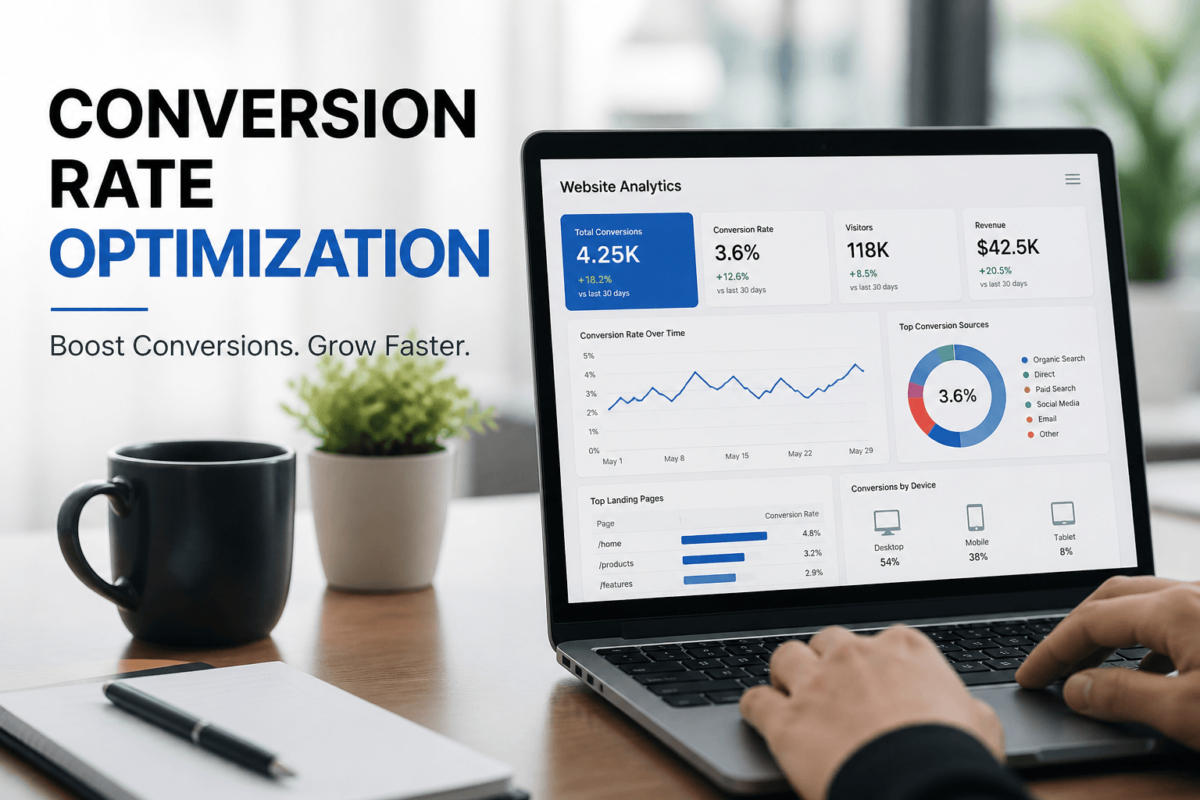
What Is Conversion Rate Optimization?
(2026 Guide to Boost Conversions Fast)
⚡ Quick Summary
- CRO = the process of turning more of your existing website visitors into customers or leads
- It matters because driving traffic is expensive — CRO makes every visitor count
- Formula: Conversion Rate = (Conversions ÷ Total Visitors) × 100
- A “good” conversion rate is typically 2%–5%, but varies widely by industry
- Key strategies: better headlines, faster pages, A/B testing, trust signals, mobile optimization
- Top tools: Google Analytics 4, Microsoft Clarity, Hotjar, Optimizely, VWO, and more
What Is Conversion Rate Optimization (CRO)?
Here’s the truth most marketing blogs won’t tell you: getting traffic to your website is only half the battle. The other half — the part that actually makes you money — is what happens after people arrive.
Conversion Rate Optimization (CRO) is the systematic process of improving your website or landing page so more visitors complete a specific, desired action. That action — called a conversion — could be anything:
- Purchasing a product
- Signing up for a free trial
- Filling out a contact form
- Downloading a lead magnet
- Clicking an affiliate link
- Calling your business
A Real-World Analogy
Think of a retail store. If 500 people walk in and only 10 buy something, that’s a 2% conversion rate. A smart store owner doesn’t just run more ads to get 1,000 people in. They also fix the layout, train the staff better, add clearer price tags, and make checkout faster. That’s exactly what CRO does — but for your website.
Why CRO Matters in 2026
Digital advertising costs have skyrocketed. The average cost-per-click across industries increased significantly over the past five years. Businesses can no longer afford to throw money at traffic and hope for the best.
CRO shifts the equation. Instead of asking “how do we get more visitors?”, smart marketers ask “how do we get more value from the visitors we already have?”
Why CRO Matters More Than Ever in 2026
Ad Costs Are Out of Control
According to industry data, average CPCs on Google and Meta have climbed steadily year over year. For competitive niches like finance, insurance, and SaaS, a single click can cost $10–$50 or more. If your conversion rate is only 1%, you’re burning through budget at an alarming pace.
CRO is your profit lever. Improving your conversion rate from 1% to 2% — while keeping traffic the same — effectively cuts your customer acquisition cost in half.
Traffic Doesn’t Equal Revenue
Most people miss this: a website with 10,000 monthly visitors and a 5% conversion rate outperforms one with 100,000 visitors and a 0.3% rate. Every time.
| Scenario | Monthly Visitors | Conversion Rate | Conversions |
|---|---|---|---|
| Site A (high traffic, low CRO) | 100,000 | 0.3% | 300 |
| Site B (less traffic, better CRO) | 10,000 | 5% | 500 |
Site B wins — by 200 conversions — with 90% less traffic. That’s the power of CRO.
ROI Focus Is the New Growth Strategy
In an era where investors and business owners demand return on every dollar spent, CRO is one of the highest-ROI marketing activities available. Unlike paid ads, the improvements you make through CRO are permanent. A better-converting page keeps performing even when you pause your ad campaigns.
How to Calculate Your Conversion Rate
The formula is simple:
Step-by-Step Example
Let’s say you run a financial planning blog and your goal is to get people to download your free budget template:
- Total visitors last month: 8,000
- People who downloaded the template: 240
- Conversion Rate = (240 ÷ 8,000) × 100 = 3%
That’s a solid rate! But if only 40 people downloaded it, your rate would be 0.5% — a clear signal that something on the page needs work.
What Counts as a Conversion?
It depends entirely on your goals. In a finance blog context, common conversions include:
- Newsletter sign-ups
- Affiliate link clicks (e.g., to a credit card or investment app)
- Free consultation bookings
- Course or product purchases
- Lead form submissions
Pro tip: Always define your primary conversion and secondary conversions before you start optimizing. Chasing too many goals at once waters down your results.
What Is a Good Conversion Rate? (2026 Industry Benchmarks)
“What’s a good conversion rate?” is one of the most-asked questions in digital marketing — and the honest answer is: it depends.
That said, here are general benchmarks to give you a baseline:
| Industry | Average Conversion Rate | Top Performers |
|---|---|---|
| E-commerce (general) | 1% – 3% | 4% – 8% |
| Finance / Insurance | 5% – 10% | 15%+ |
| SaaS / Software | 2% – 5% | 8% – 12% |
| Lead Generation | 5% – 15% | 20%+ |
| Affiliate Blogs | 0.5% – 3% | 5% – 10% |
| Real Estate | 2% – 5% | 8%+ |
| Healthcare | 3% – 5% | 8%+ |
Sources: WordStream, Unbounce, and HubSpot industry reports.
CRO vs SEO vs Paid Ads: What’s the Difference?
Ever wonder why so many sites focus only on SEO or paid ads and completely ignore CRO? It’s one of the biggest mistakes in digital marketing. Here’s how they stack up:
| CRO | SEO | Paid Ads | |
|---|---|---|---|
| Primary Goal | Convert existing visitors | Attract more organic visitors | Drive traffic fast |
| Time to Results | Days to weeks | Months | Immediate |
| Ongoing Cost | Low (after setup) | Medium | High (ongoing) |
| Scales With Budget? | Not directly | Partially | Yes |
| Long-term Impact | Permanent improvements | Yes (if maintained) | Stops when you pay |
| Best For | Maximizing ROI on traffic | Brand building & organic reach | Fast testing & launch |
The smartest marketers use all three — but CRO multiplies the value of your SEO and paid ad investments. Think of it this way: SEO and ads fill the funnel, CRO makes sure the funnel doesn’t leak.
Proven CRO Strategies That Actually Work in 2026
Here are the CRO strategies that consistently move the needle — especially for finance blogs, affiliate sites, and content-driven businesses.
Speed Up Your Website (Seriously)
What it is: Reducing your page load time so visitors don’t bounce before they see your content.
Why it works: Google’s research shows that as page load time goes from 1 to 3 seconds, the probability of a bounce increases by 32%. For mobile users, it’s even worse. And in finance niches, a slow page is a trust destroyer.
Real-life example: A financial comparison site reduced their average load time from 4.2 seconds to 1.8 seconds using image compression and a CDN. Their affiliate click-through rate jumped 27% within 30 days.
How to fix it: Use Google PageSpeed Insights (free) to identify issues. Common quick wins include compressing images with tools like TinyPNG, enabling lazy loading, and switching to a faster hosting provider. For WordPress sites, plugins like WP Rocket make this surprisingly straightforward.
Write Headlines That Stop the Scroll
What it is: Crafting headlines that immediately communicate value and speak to the reader’s specific pain point or desire.
Why it works: David Ogilvy — the godfather of advertising — once said that on average, five times as many people read the headline as read the body copy. If your headline doesn’t grab them, nothing else matters.
Real-life example: A personal finance blog changed their article headline from “How to Save Money” to “How I Saved $14,400 in 12 Months on a $52,000 Salary (Step-by-Step).” Their average time on page increased by 2.3 minutes and newsletter sign-ups doubled.
Copywriting frameworks to try:
- 4 U’s Formula: Useful, Unique, Ultra-specific, Urgent
- PAS: Problem → Agitate → Solution
- Before/After/Bridge: Show the transformation
Optimize Your Calls-to-Action (CTAs)
What it is: Improving the buttons, links, and prompts that tell visitors what to do next.
Why it works: A weak CTA is like a sales rep who never asks for the sale. Every word matters — including color, placement, and copy.
Real-life example: A SaaS company changed their CTA from “Submit” to “Get My Free Report” and saw a 32.5% increase in sign-ups — same page, same traffic, just different button text.
CTA best practices:
- Use first-person language: “Start My Free Trial” vs. “Start Your Free Trial”
- Be specific: “Download My Budget Template” beats “Download”
- Use contrasting colors — your CTA should never blend in
- Place CTAs above the fold AND after long-form content
Build Trust With Social Proof and Trust Signals
What it is: Using reviews, testimonials, certifications, and social proof elements to reduce buyer anxiety.
Why it works: People don’t trust strangers — especially online. According to BrightLocal’s Consumer Review Survey, 91% of consumers read online reviews before making a purchase decision. In finance, where trust is everything, this is non-negotiable.
Real-life example: An affiliate site promoting financial apps added star ratings and a “Trusted by 50,000+ readers” badge near their CTA buttons. Affiliate conversion rate improved by 19% in 45 days.
Trust signals to add:
- Customer testimonials with real names and photos
- Industry certifications and credentials (especially for finance — mention CFP, CPA designations where applicable)
- Security badges (SSL, Norton Secured)
- Media mentions: “As seen in Forbes, Investopedia”
- Real-time stats: “Join 12,000 subscribers who get our weekly money tips”
Use Heatmaps and User Behavior Analytics
What it is: Recording how visitors actually interact with your pages — where they click, how far they scroll, and where they drop off.
Why it works: Most of us build pages based on assumptions. Heatmaps replace assumptions with data. You’ll be shocked at what you find — like visitors clicking on images that aren’t links, or never seeing your CTA because they stop scrolling halfway down.
Real-life example: Using Microsoft Clarity (free), a finance blogger discovered that 70% of mobile users never scrolled past the second paragraph. She moved her opt-in form to the top of the page and grew her email list 3x in two months.
Tools to use: Microsoft Clarity (free and excellent), Hotjar (paid, more features), Lucky Orange — these tools give you session recordings and heatmaps in minutes.
A/B Test Everything (But One Thing at a Time)
What it is: Running controlled experiments where you show version A of a page to half your visitors and version B to the other half, then measuring which performs better.
Why it works: Your gut feeling is often wrong. A/B testing removes opinion from the equation and lets data make the decision.
Real-life example: A financial services company tested two versions of their landing page — one with a long-form sales letter and one with a short-form video. The video version converted 41% better among mobile users.
A/B testing rules:
- Change one variable at a time (headline, CTA, image, layout)
- Run tests for at least 2–4 weeks or until you hit statistical significance
- Use a tool like Google Optimize (free), VWO, or Optimizely
- Document every test — wins AND losses teach you something
Optimize for Mobile — Your Majority Audience
What it is: Ensuring your website delivers an excellent experience on smartphones and tablets.
Why it works: In the US, over 60% of web traffic now comes from mobile devices. Finance searches like “best savings account 2026” or “how to invest $1,000” are heavily mobile-driven. If your site is hard to navigate on a phone, you’re leaving serious money on the table.
Real-life example: A personal finance newsletter grew mobile subscriber conversions by 45% after implementing a sticky mobile CTA bar that followed users as they scrolled.
Mobile CRO checklist:
- Tap targets (buttons) should be at least 48px × 48px
- Use large, legible font sizes (minimum 16px body text)
- Eliminate pop-ups that are hard to dismiss on mobile
- Test your pages on real devices, not just desktop browser simulations
- Prioritize above-the-fold content — mobile screens are small
Reduce Friction in Forms and Checkout
What it is: Simplifying any process that requires the visitor to take action — especially opt-in forms, checkout pages, and sign-up flows.
Why it works: Every extra field, step, or click is a reason for someone to abandon the process. The fewer barriers between intent and action, the higher your conversion rate.
Real-life example: A financial advisory firm reduced their contact form from 9 fields to 4. Lead generation increased by 62% without any change to traffic or ad spend.
Friction reduction tactics:
- Remove unnecessary form fields — name and email is often enough
- Use single-column form layouts on mobile
- Add autofill support for forms
- Show progress bars on multi-step forms
- Offer social login options (Google, Apple)
Use AI and Personalization Tools
What it is: Leveraging artificial intelligence to deliver personalized experiences, smart recommendations, and dynamic content based on user behavior.
Why it works: Personalization creates relevance. When a visitor sees content tailored to their situation — like a first-time investor vs. a seasoned trader — they’re far more likely to engage and convert.
Real-life example: A robo-advisor platform used AI-driven personalization to show different homepage headlines based on whether a user had visited their “retirement planning” or “short-term savings” pages. Conversions increased 33%.
AI-powered CRO tools to explore:
- Dynamic Yield — personalization at scale
- Mutiny — B2B website personalization
- Optimizely — AI-powered experimentation
- Perplexity and ChatGPT — for generating copy variations to test
Leverage Behavioral Psychology Triggers
What it is: Applying principles of human psychology — like urgency, scarcity, social proof, and reciprocity — to motivate action.
Why it works: We’re wired to respond to these triggers. Robert Cialdini documented them in his book Influence, and they’ve been validated by countless digital marketing experiments since.
Key psychological triggers for CRO:
- Scarcity: “Only 3 spots left in our free coaching session”
- Urgency: “Offer expires Friday at midnight”
- Reciprocity: Offer a free, high-value resource before asking for anything
- Authority: Cite credentials, expert endorsements, and data-backed claims
- Loss Aversion: “Don’t miss out on an average savings of $3,200/year”
Real-Life CRO Examples With Numbers
E-Commerce Example
An online retailer selling home security products was getting 50,000 monthly visitors but converting at just 0.9%. Their CRO audit revealed three problems: slow mobile load times, a confusing product page layout, and no trust badges at checkout.
After fixing all three over 60 days, their conversion rate climbed to 2.4% — a 167% improvement. On an average order value of $180, that added roughly $135,000 in monthly revenue without a single new paid acquisition.
SaaS Example
A B2B budgeting software company struggled with a 1.8% free trial sign-up rate. They ran a 30-day A/B test changing two things: the headline (from feature-focused to outcome-focused) and adding a video testimonial from a CFO.
The new version converted at 4.1%. That’s a 128% lift. At $99/month per customer, the test effectively generated hundreds of thousands of dollars in ARR from the same traffic.
Finance Blog / Affiliate Example
A personal finance blog was reviewing high-yield savings accounts but converting affiliate clicks at only 1.2%. The blogger ran a heatmap analysis and discovered readers were clicking on a comparison table column header — not the affiliate CTA button.
She made the table cells themselves clickable affiliate links and added a clear “Best For: High Earners” label. Affiliate conversion rate jumped to 4.8% — a 4x improvement — without writing a single new article.
Best CRO Tools in 2026 (Organized by Category)
If you’re serious about improving conversions, you need the right tools in your corner. Here’s a breakdown of the best options by category:
Analytics & Tracking
- Google Analytics 4 (GA4) — Free, essential. Track goals, funnels, and user journeys.
- Microsoft Clarity — Free. Session recordings and heatmaps with incredible depth. No data sampling.
- Mixpanel — Event-based analytics. Great for SaaS and app-based businesses.
Heatmaps & Session Recording
- Hotjar — Industry-leading heatmaps, scroll maps, and user session recordings. Plans start free.
- Microsoft Clarity — A strong free alternative to Hotjar with AI-generated insights.
- Lucky Orange — Includes live chat and conversion funnels alongside heatmaps.
A/B Testing & Experimentation
- VWO (Visual Website Optimizer) — Full-featured A/B and multivariate testing. Great for serious CRO programs.
- Optimizely — Enterprise-grade experimentation used by some of the world’s biggest brands.
- Convert.com — Privacy-first A/B testing with GDPR compliance baked in.
Landing Page Builders
- Unbounce — Drag-and-drop builder with built-in A/B testing and AI-generated copy. Built for CRO.
- Instapage — High-converting landing pages with personalization features.
- Leadpages — Great for small businesses and finance bloggers running lead gen campaigns.
Email Marketing & Lead Nurturing
- ConvertKit — The go-to for content creators and finance bloggers. Easy automation and segmentation.
- ActiveCampaign — Advanced automation with CRM capabilities for higher-volume operations.
- Klaviyo — Best-in-class for e-commerce email personalization and revenue attribution.
AI-Powered CRO Tools
- Mutiny — AI personalization for B2B websites. Personalizes pages dynamically based on firmographic data.
- Intellimize — Uses machine learning to automatically optimize page variations in real time.
- Personyze — AI-driven personalization for web and email across the full funnel.
How to Improve Your Conversion Rate: Step-by-Step (Beginner-Friendly)
This is the section most CRO guides skip. Let’s walk through exactly how to run a CRO program from scratch.
Audit Your Current Data
Before you change anything, understand what’s happening. Log into Google Analytics 4 and review: bounce rate by page, average session duration, pages with high traffic but low conversion, and drop-off points in your sign-up or checkout funnel. You’re looking for the gap between traffic and conversions. That gap is your opportunity.
Identify Your Biggest Drop-Off Points
Use GA4’s Funnel Exploration report to visualize your conversion funnel. Where are people leaving? If 80% of visitors drop off after the pricing page, that’s where your effort belongs — not on the homepage.
Install a Heatmap Tool
Install Microsoft Clarity or Hotjar on your drop-off pages. Let it run for at least 500–1,000 sessions. Then review click maps, scroll maps, and session recordings. This is where the magic happens. You’ll spot issues that would never show up in your analytics data alone.
Form a Hypothesis
Based on your data, form a testable hypothesis using this format:
Example: “Because our heatmap shows that mobile visitors don’t see the CTA button (which is below the fold), I believe that adding a sticky mobile CTA bar will increase mobile conversions by 20% for new visitors.”
Test One Change at a Time
Set up your A/B test using a tool like VWO, Optimizely, or even Google Optimize. Run the control (original) versus the variation (changed version) simultaneously. Critical: Only change one element per test. If you change the headline AND the button color at the same time and conversions go up, you won’t know which change did it.
Wait for Statistical Significance
Don’t call a winner too early. Most tests need at least 2–4 weeks to gather reliable data, and you typically want at least 100 conversions per variation. Use a statistical significance calculator (free tools available at ABtestguide.com or CXL Institute) to confirm your results are real, not random.
Implement the Winner and Document Everything
When your test reaches 95%+ statistical significance, implement the winning variation permanently. Document the test, the hypothesis, the result, and the lift percentage in a shared log. This test log becomes your most valuable CRO asset over time.
Scale What Works
If a specific CTA style won on your pricing page, test it on your homepage. If a trust badge improved conversions on your lead form, add it to your checkout page. Good CRO insights scale across your entire site.
CRO Strategy Comparison: Difficulty vs. Impact
| Strategy | Difficulty | Impact | Time to Results | Best For |
|---|---|---|---|---|
| Improve page speed | Medium | High | Days | All sites |
| Better headlines | Low | High | Immediate | Blogs, landing pages |
| CTA optimization | Low | High | Days | All sites |
| A/B testing | Medium | Very High | Weeks | Medium+ traffic sites |
| Heatmap analysis | Low | Medium-High | Days (setup) | All sites |
| Trust signals | Low | High | Immediate | Finance, e-commerce |
| Mobile optimization | Medium | Very High | 1–2 weeks | Mobile-heavy audiences |
| Reduce form friction | Low | High | Immediate | Lead gen, SaaS |
| AI personalization | High | Very High | Months | Scale-stage businesses |
| Psychology triggers | Low | Medium-High | Immediate | All sites |
Common CRO Mistakes to Avoid
Mistake 1: Ignoring Mobile Users
Over 60% of US web traffic is mobile. If you’re only optimizing for desktop, you’re optimizing for the minority. Always run mobile-specific heatmaps and test your changes on actual devices.
Mistake 2: Guessing Instead of Testing
“I think the button should be green” is not a CRO strategy. Every change should be hypothesis-driven and validated with data. Trust your analytics, not your instincts.
Mistake 3: Too Many CTAs Competing for Attention
When everything is a priority, nothing is. Having five different CTAs on a single page creates decision paralysis. Pick your primary conversion goal and make everything else secondary.
Mistake 4: Ending Tests Too Early
I’ve seen this happen a lot — a marketer sees their variation winning after three days and declares victory. Three days is almost never enough data. Calling early creates false positives and leads to bad decisions.
Mistake 5: Ignoring Post-Click Experience
CRO doesn’t stop at the click. If someone clicks your affiliate link or CTA and lands on a slow, confusing, or irrelevant page, they’ll bounce. Optimize the full journey, not just your own pages.
Mistake 6: Copying Competitors Blindly
Your audience is unique. What works for a competitor’s site may bomb on yours. Study competitors for ideas, then test those ideas with your own audience before committing.
E-E-A-T and CRO for Finance Blogs
For finance blogs, Google’s E-E-A-T framework (Experience, Expertise, Authoritativeness, Trustworthiness) isn’t just an SEO consideration — it’s a CRO factor too. Visitors to finance sites have higher skepticism than those visiting lifestyle or entertainment pages. They need to trust you before they’ll convert.
Experience: Share personal finance stories and results. “After paying off $37,000 in debt using the debt avalanche method, here’s what I learned” beats a generic article every time.
Expertise: Cite authoritative sources like the IRS, Federal Reserve, CFPB, and peer-reviewed financial research. Link to primary sources, not other blogs.
Authoritativeness: Display author credentials clearly. If the author is a CPA, CFP, or has a finance degree, say so. Add an author bio with a professional photo and links to credentials or media coverage.
Trustworthiness: Include a clear editorial disclosure for affiliate content, a detailed privacy policy, and an up-to-date date stamp on all articles. Show readers when content was last reviewed.
Frequently Asked Questions About CRO
What is a good conversion rate for a finance blog?
For email opt-ins on a finance blog, 2%–5% is considered average and 8%–15% is excellent. For affiliate link conversions, 1%–4% is typical, with top performers reaching 8%–12% on highly targeted content like product reviews and comparisons. Rates vary based on your offer, traffic quality, and how specific the visitor’s search intent was.
How long does CRO take to show results?
Quick wins like fixing a slow page or improving a CTA can show results within days. A/B tests typically need 2–6 weeks to reach statistical significance. Full CRO programs — auditing, testing, iterating — deliver compounding results over 3–6 months. Think of it like investing: slow to start, but the returns build over time.
Is CRO better than SEO for finance blogs?
It’s not an either/or question — they complement each other. SEO brings the visitors, CRO converts them. That said, if you already have decent traffic (5,000+ monthly visitors) but low conversions, investing in CRO will almost always give you a faster, higher ROI than adding more SEO effort. Start where the leverage is highest.
Can CRO increase sales without more traffic?
Absolutely — that’s the entire point. If you have 10,000 monthly visitors converting at 1% and you improve that to 2%, you’ve effectively doubled your revenue from the same traffic. Many businesses run successful CRO programs and increase revenue by 30%–100% without spending an extra dollar on traffic acquisition.
What CRO tools are best for beginners?
Start simple: Google Analytics 4 for tracking + Microsoft Clarity for heatmaps (both free). These two tools alone will show you where visitors are dropping off and how they’re behaving on your pages. Once you’ve identified a winning hypothesis, try a free trial of Hotjar or VWO for A/B testing. Don’t pay for enterprise tools until you’ve built your testing muscle.
Do I need a lot of traffic for CRO to work?
You need enough traffic to reach statistical significance in your tests — generally at least 100 conversions per variation per test. That means a site with 1,000 monthly visitors and a 2% conversion rate (20 conversions/month) would take months to complete one test. For low-traffic sites, focus on qualitative research — user interviews, session recordings, and customer surveys — to identify friction points before running experiments.
Final Thoughts: Start Optimizing Today
Here’s the bottom line: most websites are leaving an enormous amount of money on the table simply because they’ve never asked, “Why aren’t more of my visitors converting?”
Conversion Rate Optimization isn’t a one-time project. It’s a mindset — a commitment to continuously understanding your audience, testing ideas, and making data-driven improvements. The businesses that adopt this mindset don’t just grow; they compound their growth over time.
You don’t need a massive budget or an enterprise CRO team to get started. You need Google Analytics, a free heatmap tool, a testable hypothesis, and the willingness to be wrong and learn from it.
Whether you’re running a finance blog, an affiliate site, a SaaS product, or an e-commerce store — CRO is the highest-leverage marketing investment you can make right now.
Go make your website work harder. Your traffic is already there. You just need to convert it.
Ready to Grow Your Website’s Conversions?
TechCognate helps businesses turn more visitors into leads and customers — with data-driven SEO and CRO strategy.
Let’s Talk Strategy →