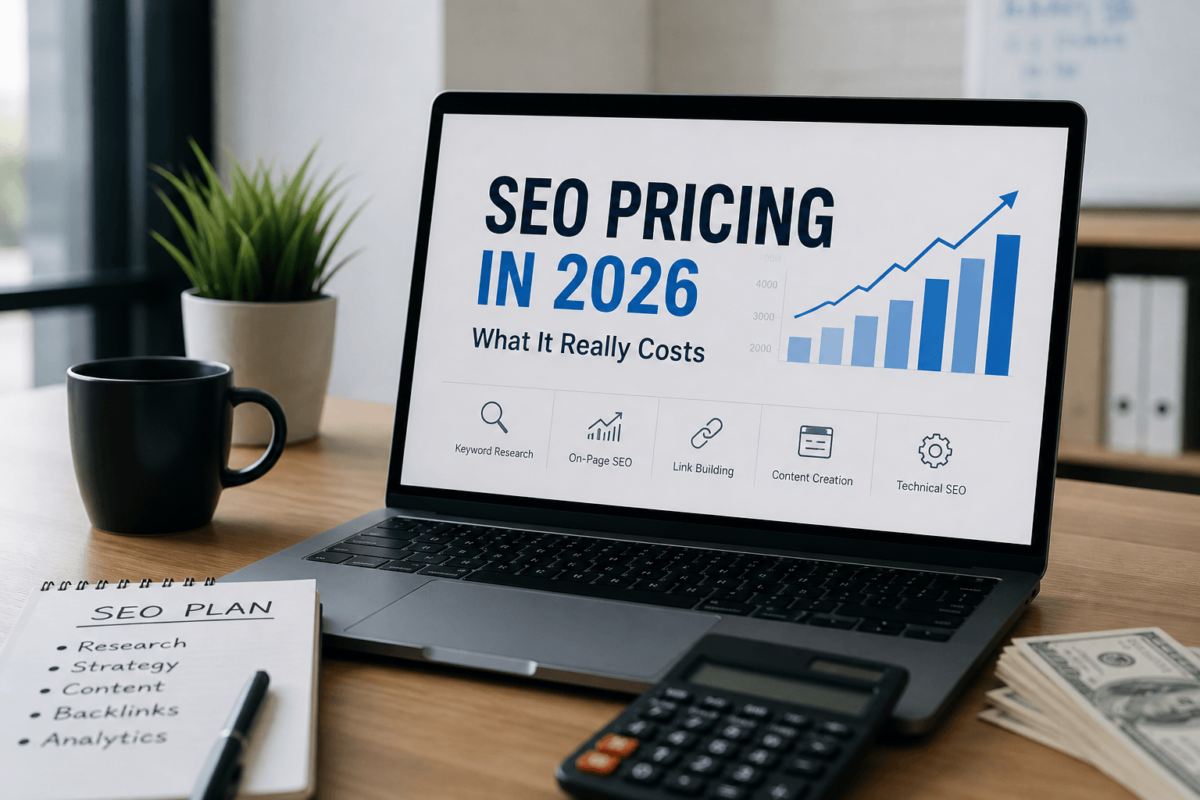
SEO Pricing in 2026: What It Really Costs (And What You Should Pay)
⚡ Quick Answer
SEO in 2026 typically costs $500 to $10,000+ per month, depending on your goals, industry competition, and whether you hire a freelancer, boutique agency, or full-service firm. Most small businesses spend $1,000–$3,000/month, while ecommerce brands and SaaS companies often invest $5,000–$10,000+/month. The honest truth? Cheap SEO rarely works — and expensive SEO isn’t automatically great. What matters most is finding the right fit for your budget and goals.
📌 Quick Summary
- Average monthly SEO cost: $1,000 – $10,000+ depending on scope and provider
- Freelancer rates: $300 – $1,500/month (or $75–$150/hr)
- Small-to-mid agency: $1,500 – $5,000/month
- Enterprise agency: $8,000 – $25,000+/month
- Key warning: Avoid anyone promising “guaranteed #1 rankings” — it’s a major red flag
- Best approach: Match your budget to realistic goals; start small and scale up based on ROI
- 2026 note: AI-driven SEO and Generative Engine Optimization (GEO) are adding new cost layers
📋 In This Guide
- What Is SEO Pricing, Really?
- Average SEO Costs in 2026: A Realistic Breakdown
- SEO Pricing Models Explained
- What Actually Impacts SEO Cost?
- Real-Life SEO Pricing Examples
- Cheap SEO vs. Premium SEO: The Honest Truth
- Understanding SEO ROI: The Long Game
- Ecommerce SEO Pricing: Why It Costs More
- AI SEO and GEO Pricing in 2026
- E-E-A-T and Why It Affects Your Budget
- SEO Scams and Red Flags to Watch For
- How to Choose the Right SEO Package
- Recommended SEO Tools Worth Paying For
- Frequently Asked Questions
- Final Thoughts
What Is SEO Pricing, Really?
Let’s start with the basics, because this trips people up more than you’d think.
SEO — Search Engine Optimization — is the practice of improving your website so it ranks higher on Google (and increasingly, on AI-powered answer engines like ChatGPT, Perplexity, and Google’s AI Overviews). When it works, it drives consistent, free, organic traffic to your site without paying for every click.
SEO pricing is what you pay someone — a freelancer, agency, or in-house team — to do that work for you. The confusion is that SEO isn’t one thing. It’s a bundle of activities: technical fixes, content creation, link building, keyword research, and more. Each of these has a cost, and different providers bundle them differently.
Understanding what’s included — and what isn’t — in any SEO quote is the first step to not getting burned.
Average SEO Costs in 2026: A Realistic Breakdown
Here’s what the market actually looks like right now. I’ve aggregated data from industry surveys, client conversations, and agency pricing pages to give you the most honest picture possible.
📊 SEO Pricing Comparison Table
| SEO Type | Monthly Cost | Best For | Pros | Cons |
|---|---|---|---|---|
| Freelancer | $300 – $1,500 | Small biz, startups | Affordable, flexible | Limited bandwidth, inconsistent |
| Small Agency | $1,000 – $3,000 | Local, SMBs | Full team, reporting | Cookie-cutter packages |
| Mid-Tier Agency | $3,000 – $7,000 | SaaS, growing biz | Strategy + execution | Higher cost |
| Enterprise Agency | $8,000 – $25,000+ | Enterprise, ecommerce | Full-service, dedicated team | Very expensive |
| In-House SEO | $4,000 – $10,000/mo salary | Scaling companies | Fully aligned, available | Benefits, management overhead |
| DIY SEO Tools | $100 – $500/mo (tools) | Solopreneurs | Low cost, full control | Steep learning curve |
SEO Pricing Models Explained
Not all SEO is priced the same way. Here are the four main pricing structures you’ll encounter — and what to watch out for with each.
| Model | Typical Range | Best For | Watch Out For |
|---|---|---|---|
| Monthly Retainer | $1,000 – $10,000+/mo | Ongoing campaigns, steady growth | Long lock-in contracts |
| Hourly Rate | $75 – $300/hr | Consulting, audits, quick fixes | Costs spiral without a scope |
| Project-Based | $1,500 – $30,000 | One-time audits, site migrations | Vague deliverables |
| Performance-Based | Base + % of revenue/leads | Risk-tolerant clients | Misaligned incentives |
What Actually Impacts SEO Cost?
Two businesses in the same industry can get quotes that differ by $5,000/month. Why? Here’s what’s actually driving the price:
1. Industry Competition
Trying to rank for ‘personal injury lawyer in New York’ or ‘best credit card 2026’? You’re competing against massive budgets. More competitive niches require more content, more backlinks, and more time — all of which cost money.
A local bakery can see results in 3–6 months with $800/month. A SaaS startup in the project management space might need 12–18 months and $4,000+/month to see meaningful movement.
2. Website Size and Technical Health
A 10-page website is easier to optimize than a 10,000-page ecommerce store. Technical issues — slow load times, crawl errors, duplicate content, broken internal links — add hours of work before you even touch keyword strategy.
3. Content Needs
Content is often the biggest line item. A single well-researched, SEO-optimized blog post costs anywhere from $150 (outsourced, lower-quality) to $800+ (expert-written, well-researched). If you need 8 posts a month? Do the math.
In 2026, with AI content flooding every niche, quality content is more important than ever. Google’s ranking systems — and AI answer engines — are getting better at distinguishing genuine expertise from filler.
4. Link Building
Backlinks — links from other websites pointing to yours — are still one of Google’s most important ranking signals. Good link building is expensive because it’s labor-intensive. A single quality guest post or digital PR placement can cost $200–$1,000+.
Agencies that promise “100 backlinks for $99” are almost certainly using spammy tactics that will hurt you. This is one area where cheap will 100% come back to bite you.
5. Geographic Targeting
Local SEO is cheaper than national, which is cheaper than international. If you’re targeting multiple countries with different languages? You’re looking at significantly higher costs for translation, localized content, and regional link building.
6. Goals and Timeline
“We want to double organic traffic in 6 months” costs more than “let’s slowly build authority over 2 years.” Aggressive timelines require more resources. Full stop.
Real-Life SEO Pricing Examples
Theory is fine, but let’s talk about what this actually looks like in practice. Here are three real-world scenarios I’ve seen play out.
- Budget
- $800 – $1,200/month
- What They Get
- Google Business Profile optimization, 2–3 blog posts per month, local citation building, monthly reporting.
- Expected Timeline
- First page rankings for core keywords in 4–6 months.
- Budget
- $3,000 – $5,000/month
- What They Get
- Full keyword strategy, 4–6 content pieces/month targeting mid-funnel and bottom-funnel keywords, technical SEO, link building outreach, competitor analysis.
- Expected Timeline
- Meaningful organic traffic growth in 6–9 months; ROI usually visible in months 9–12.
- Budget
- $5,000 – $10,000/month
- What They Get
- Full technical SEO audit + implementation, category page optimization, product schema markup, content strategy for blog + collection pages, aggressive link building.
- Expected Timeline
- Noticeable gains in 6 months; significant ROI in 12–18 months.
Cheap SEO vs. Premium SEO: The Honest Truth
Here’s the truth most agencies won’t tell you: cheap SEO doesn’t just fail — it can actively hurt you.
What Cheap SEO ($99–$500/month) Actually Gets You
- Mass-produced content with no subject matter expertise
- Backlinks from link farms and low-quality directories
- Keyword stuffing and outdated on-page tactics
- Copy-paste audits with no real implementation
- Possible Google penalties that take months to recover from
I’ve seen businesses come to me after spending $500/month for 12 months with a “budget” agency — and their organic traffic had actually declined because of spammy backlinks. The recovery took another 6 months of work.
When Cheap SEO Is Okay
There are situations where lower-cost options make sense:
- You’re a solopreneur with a tiny site and very low competition keywords
- You’re using an affordable tool (like Ahrefs or Semrush) and doing it yourself
- You need a one-time audit from a freelancer, not ongoing work
The bottom line: If someone charges $99/month and promises the moon, that’s not SEO — it’s a scam. Budget providers are fine for one-off tasks, but for ongoing strategy, you get what you pay for.
What Premium SEO ($3,000+/month) Looks Like
- A documented strategy tied to your specific business goals
- Expert-written content that actually demonstrates E-E-A-T
- White-hat link building with real editorial placements
- Regular strategy calls, detailed reporting, and transparent communication
- Proactive adaptation to algorithm updates
Understanding SEO ROI: The Long Game
One of the reasons SEO feels expensive is that it doesn’t pay off in week one. But here’s how to think about the math:
The SEO ROI Calculation
Let’s say you pay $2,000/month for SEO. Over 12 months, that’s $24,000 invested.
If that investment drives 3,000 new visitors/month by month 12, and you convert at 2%, that’s 60 new leads/customers per month. If each customer is worth $500 to your business, that’s $30,000/month in revenue — from content and rankings that continue to produce results long after you’ve stopped paying.
According to data from BrightEdge, organic search drives over 53% of all trackable website traffic — more than any other channel. That’s why the ROI, even when it takes 12–18 months to materialize, is often far better than paid alternatives.
SEO vs. Paid Ads: A Quick Comparison
- Paid ads: Immediate traffic, but you pay for every click. Stop paying = stop traffic.
- SEO: Slower to start, but traffic compounds over time. Great long-term ROI.
- Best approach: Run paid ads while SEO builds, then gradually shift budget as organic picks up.
Ecommerce SEO Pricing: Why It Costs More
If you’re running an online store, expect to pay more — and for good reason. Ecommerce SEO is fundamentally more complex than standard SEO.
Why Ecommerce SEO Is Different
- Scale: Hundreds or thousands of product and category pages all need to be optimized
- Technical complexity: Site speed, crawl budget, canonicalization, duplicate content from filters and variants — all critical
- Structured data: Product schema, review markup, and breadcrumbs help Google display rich results
- Competitive niches: Retail and ecommerce are among the most competitive spaces in search
- Seasonal demands: Holiday seasons require different strategies and faster execution
Typical Ecommerce SEO Costs
| Store Size | Monthly Cost |
|---|---|
| Small shop (under 100 products) | $1,500 – $3,000/month |
| Mid-size store (100–1,000 products) | $3,000 – $7,000/month |
| Large store (1,000+ products) | $7,000 – $20,000+/month |
For platforms like Shopify and WooCommerce, look for agencies with platform-specific experience. There are unique technical nuances (like Shopify’s canonical URL handling) that generalist SEOs may miss.
AI SEO and GEO Pricing in 2026: The New Layer
Honestly, this is where SEO is getting really interesting — and more expensive.
AI Overviews (Google’s AI-generated answers at the top of search results) and tools like ChatGPT, Perplexity, and Claude are changing how people find information. More searches now end without a click to a website — which means ranking #1 in the old sense isn’t enough anymore.
Generative Engine Optimization (GEO) is the emerging practice of optimizing your content to appear in these AI-generated answers. It requires:
- Extremely clear, well-structured content with direct answers
- Strong E-E-A-T signals (more on this below)
- Structured data markup so AI systems can parse your content
- Content that genuinely answers questions better than competitors
Some agencies are now offering GEO as an add-on ($500–$2,000/month extra) while others are baking it into their standard SEO work. When comparing agencies, ask specifically how they’re adapting to AI search — any agency that hasn’t thought about this isn’t keeping up.
E-E-A-T and Why It Affects Your SEO Budget
Google’s quality guidelines emphasize E-E-A-T: Experience, Expertise, Authoritativeness, and Trustworthiness. In 2026, this is more important than ever — especially with AI-generated content flooding the web.
Building E-E-A-T into your SEO strategy costs more upfront because it requires:
- Real expert writers with verifiable credentials (not just cheap content mills)
- Author bio pages and bylines linking to credentials
- Third-party mentions, citations, and backlinks from authoritative sources
- Customer reviews, case studies, and transparent business information
Agencies that take E-E-A-T seriously charge more. But this investment directly impacts your ability to rank for competitive, high-value keywords — especially in YMYL (Your Money or Your Life) niches like health, finance, and legal.
SEO Scams and Red Flags to Watch For
I’ve been doing this for over a decade, and the scams have gotten more sophisticated. Here’s what to look out for:
No one can guarantee a specific ranking. Google’s algorithm updates constantly, competition shifts, and results vary by location and search history. Any agency that promises “guaranteed page 1” is either lying or planning to use tactics that will get you penalized.
If an agency quotes you $199/month for “full SEO services,” they are not doing real SEO. Real SEO requires time — for research, strategy, content creation, outreach, and analysis. The math simply doesn’t work at that price point.
Every legitimate SEO agency should provide regular, detailed reports showing keyword rankings, traffic changes, conversions, and work completed. If an agency can’t show you what they’ve done and why, that’s a serious problem.
A good SEO agency should be able to explain, in plain English, exactly what they’re doing and why. If they’re vague or use buzzwords without substance, be very cautious.
Make sure your website, Google Analytics, Google Search Console, and any content created are owned by you — not the agency. Some shady agencies retain ownership as a way to lock you in.
Legitimate SEO has no secrets. If someone tells you they have a proprietary method they can’t share details about, they’re almost certainly doing something black-hat.
How to Choose the Right SEO Package: A Step-by-Step Framework
Let’s make this practical. Here’s exactly how I’d approach hiring an SEO provider if I were starting from scratch today.
Are you trying to drive local foot traffic? Generate B2B leads? Increase ecommerce revenue? Your goal determines the type of SEO you need and what success looks like.
The industry average is $2,500/month for small businesses. If you can only afford $500/month, be honest with yourself — you’ll need to either DIY more, focus on a very narrow niche, or wait until you have more budget.
Use Google, LinkedIn, or referrals from trusted peers. Look at their own website’s rankings — if an SEO agency can’t rank for their own target keywords, that tells you something.
How will you measure success? What does month 1, month 3, and month 6 look like? Who specifically will work on my account? What’s your link-building approach?
Don’t just accept generic success stories. Ask for examples from your industry or a similar business size.
If possible, begin with a one-time audit ($500–$2,000) before committing to a 6–12 month retainer. It lets you assess their quality and communication style with less risk.
Look for: contract length, cancellation terms, who owns assets, and what happens to your work if you part ways.
SEO takes time, but you should see progress in the right direction within 90 days — improved rankings for long-tail keywords, more content published, technical issues resolved.
Recommended SEO Tools Worth Paying For
Whether you’re doing SEO yourself or working with an agency, knowing the best tools helps you stay informed and hold your provider accountable.
The gold standard for keyword research, backlink analysis, and competitor research.
All-in-one platform great for keyword tracking, site audits, and content optimization.
The best tool for technical SEO audits. Free version covers 500 URLs.
Free and essential. Tells you exactly how Google sees your site and which queries drive traffic.
Also free. Connect it to Search Console for a full picture of organic performance.
In my experience, a combination of Google Search Console (free), Ahrefs or Semrush (paid), and Screaming Frog gives you 90% of what you need to make smart decisions.
Frequently Asked Questions About SEO Pricing
For most small businesses, $1,000–$3,000/month is a reasonable starting budget that can get you real results. If you’re in a very competitive niche or running an ecommerce store, expect to invest $3,000–$10,000+/month. The key is matching your budget to realistic goals — not looking for the cheapest option.
Yes — more than ever. With the cost of paid advertising continuing to rise, organic search is one of the highest-ROI channels available. The key shift in 2026 is that SEO now extends beyond just Google; you need to optimize for AI-powered search engines and answer tools as well.
Real SEO involves a lot of specialized labor: content strategists, writers, technical SEOs, link builders, and analysts. A quality 2,000-word article might take 8–12 hours to research, write, and optimize. Link building outreach can take dozens of emails to secure one quality placement. The cost reflects the actual work required — and the ongoing nature of SEO means that work never really stops.
Absolutely — especially if you’re just starting out or working in a low-competition niche. The learning curve is real, but tools like Google Search Console, Ahrefs (or even their free version), and resources like Google’s own Search Essentials can get you far. Many successful content sites are built entirely by their founders doing their own SEO. The honest caveat: DIY SEO works great for content-driven sites and simple local businesses. For technical ecommerce SEO or highly competitive industries, professional help is usually worth it.
The industry-standard answer is 3–6 months for initial results, 6–12 months for meaningful traffic growth, and 12–24 months for competitive keywords. A new website in a competitive niche might take even longer. Anyone promising results in 30 days is either targeting very niche keywords or using risky tactics.
Local SEO ($300–$1,500/month) focuses on ranking in a specific geographic area — like ‘dentist in Chicago.’ It involves Google Business Profile optimization, local citations, and geo-targeted content. National SEO ($2,000–$10,000+/month) competes across the entire country, requiring more content, more backlinks, and a longer timeline. The price difference reflects the level of competition and the scope of work.
It depends on your needs. A freelancer is more affordable and often more flexible — great for specific projects or early-stage businesses. An agency brings a full team of specialists and is better for complex, multi-faceted campaigns. My suggestion: start with a freelancer for an audit, then decide if you need the broader capabilities of an agency.
Not Sure What SEO Budget Makes Sense for Your Business?
TechCognate works with small businesses, SaaS startups, and ecommerce brands to build ROI-driven SEO strategies that fit real budgets.
Get a Free SEO Consultation →Final Thoughts: Spend Smart, Not Just More
After a decade in this industry, here’s what I know for certain: the businesses that get the best results from SEO aren’t always the ones who spend the most. They’re the ones who are strategic, patient, and honest about what they need.
Don’t chase the cheapest option — but don’t assume the most expensive agency is the right fit either. Look for someone who asks about your business goals before talking about keywords. Someone who shows you their work transparently. Someone who can explain why they’re recommending specific tactics.
SEO in 2026 is more sophisticated than ever — with AI search, E-E-A-T requirements, and GEO adding new dimensions. But the fundamentals haven’t changed: create genuinely useful content, earn quality links, fix technical issues, and be patient.
Take your time finding the right partner. Ask hard questions. And remember: real SEO is an investment, not an expense — but only if you invest wisely.