⚡ Quick Answer: What is Product Page SEO?
Product page SEO is the practice of optimizing individual ecommerce product detail pages to rank in search engines, attract buyers actively searching for what you sell, and convert that traffic into sales.
It matters because product pages target transactional intent — users at the purchase stage. Ranking well here directly drives revenue, not just visibility.
Results typically take 3–6 months for competitive terms, 4–8 weeks for long-tail product queries.
Who needs it: every ecommerce store owner, digital marketer, or SEO professional managing product catalogues on Shopify, WooCommerce, Magento, BigCommerce, or any custom platform.
📋 TL;DR: 15 Key Takeaways
- Product pages need real content: a title, a few images, and a price tag won’t rank in 2026. Google wants substance.
- Ditch manufacturer descriptions: write original, benefit-driven copy that no other site has.
- Structured data is non-negotiable: Product, Offer, Review, and BreadcrumbList schema are the baseline.
- AI search optimization is now essential: structure answers so ChatGPT, Perplexity, and Google AI Overviews can cite them.
- Keywords must match buyer intent: target transactional and commercial terms, not informational queries.
- Product FAQs unlock PAA rankings: 20+ well-answered questions on a product page is not overkill — it’s competitive advantage.
- Reviews are ranking signals: star ratings, review count, and recency all influence where you appear.
- Internal linking is underutilized: most stores link to product pages far too rarely from category pages, blogs, and buying guides.
- Core Web Vitals affect product pages directly: LCP, INP, and CLS issues on product pages cost rankings and conversions simultaneously.
- Image SEO is a significant traffic channel: Google Image Search and Google Shopping are undervalued organic sources.
- Entity SEO is the new frontier: optimize your product pages as entities with attributes, not just keyword-targeted documents.
- EEAT signals must be visible: brand story, return policies, product expertise, and author credentials all matter.
- Platform constraints are real: Shopify, WooCommerce, and Magento each have unique SEO limitations that must be addressed.
- Measure product page SEO separately: GA4, Search Console, and Merchant Center provide the specific data signals you need.
- The future belongs to agentic commerce: AI agents will shop on behalf of users. Your product data needs to be machine-readable today.
What is Ecommerce Product Page SEO?
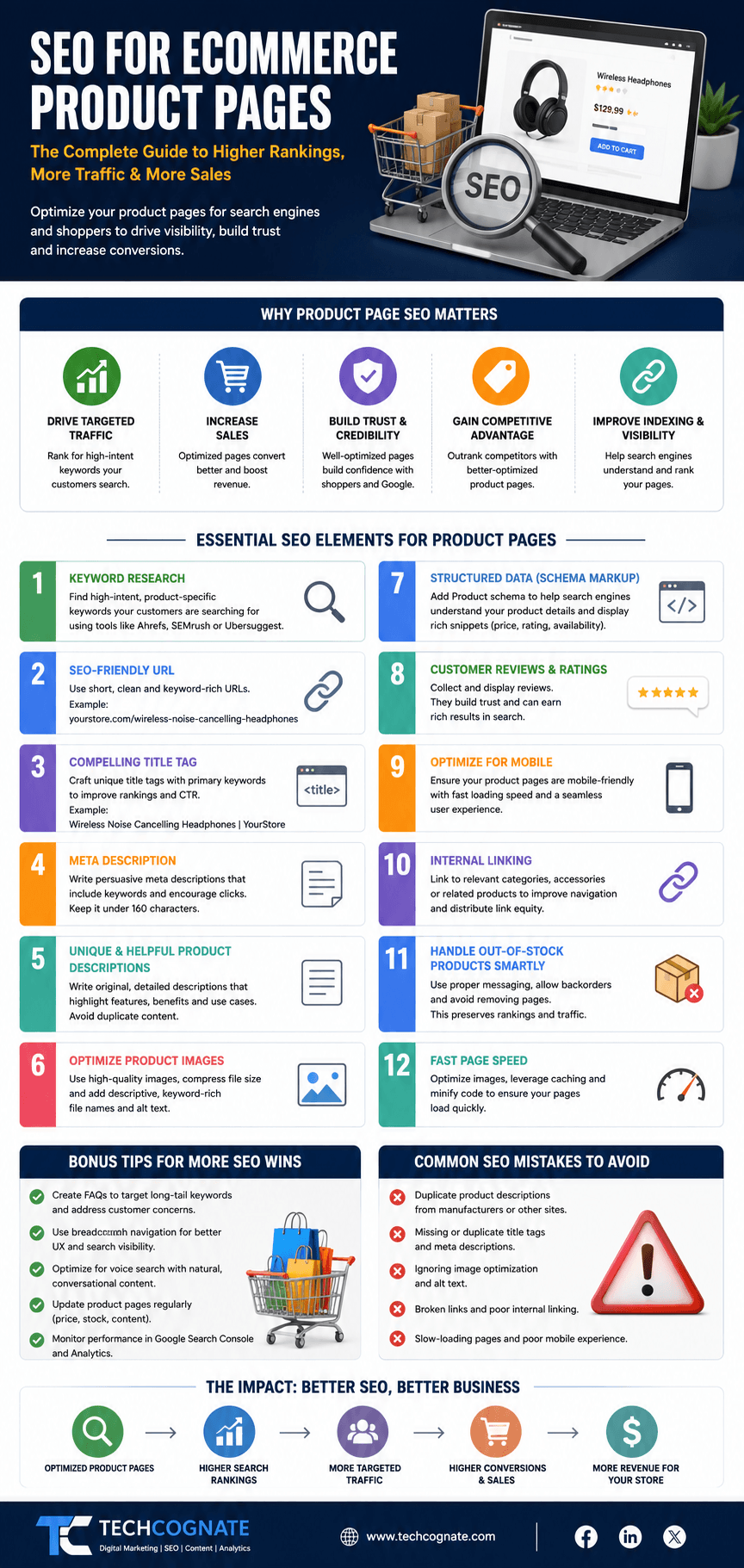
Ecommerce product page SEO is the discipline of optimizing individual product detail pages (PDPs) so they rank prominently in search engine results pages for the exact queries that buyers use when they’re ready to purchase.
It sits at the intersection of technical SEO, on-page content optimization, structured data implementation, conversion rate optimization, and — increasingly — AI search visibility. A well-optimized product page doesn’t just rank; it satisfies the complete intent of a buyer, earns click-throughs from rich results, and converts those visits into orders. This is the natural next step after getting the fundamentals of ecommerce SEO right site-wide.
How Product Page SEO Differs From Other SEO Types
| Type | Primary Intent | Primary Goal |
|---|---|---|
| Category Page SEO | Navigational / Commercial Investigation | Help users browse and filter product ranges |
| Product Page SEO | Transactional / Commercial Investigation | Convert ready-to-buy users into customers |
| Blog / Content SEO | Informational / Educational | Build topical authority, capture top-of-funnel traffic |
| Homepage SEO | Branded / Navigational | Reinforce brand identity, distribute PageRank |
The most important distinction is intent. When someone searches “best noise-cancelling headphones” they’re still comparing options — that’s a category or guide page query. When they search “Sony WH-1000XM5 black Friday deal” or “buy Sony WH-1000XM5 free shipping” they’re in buying mode. That’s your product page’s territory.
How Search Engines Understand Product Pages
Search engines evaluate product pages across several distinct dimensions simultaneously: the textual content (titles, descriptions, specifications), the structured data markup (schema types), the behavioral signals (click-through rate, dwell time, bounce rate), the entity relationships (brand, product category, manufacturer, materials), and the merchant trust signals (reviews, return policies, pricing consistency).
In 2026, Google’s Shopping Graph — a specialized knowledge base of over 35 billion product listings — plays an increasingly direct role in how product pages are evaluated and ranked. Getting your product data into this graph via Google Merchant Center, Product schema, and strong entity relationships is no longer optional for competitive ecommerce SEO.
Why Product Pages Fail to Rank
Understanding why product pages underperform is the fastest path to fixing them. These are the 13 most common root causes — ranked roughly by how often they appear in SEO audits.
- 1
Thin Content
The average ecommerce product page contains fewer than 300 words. The average first-page result for a competitive product keyword contains 1,200 words or more. Thin content fails the helpful content test and provides Google with insufficient signal to understand, categorize, or rank the page with confidence.
Fix: Treat each product page as a mini buying guide. Add specifications, use cases, sizing guidance, care instructions, compatibility information, and FAQs. Give Google a page worth ranking.
- 2
Duplicate Manufacturer Descriptions
If you copied the manufacturer-provided product description, so did every other retailer selling that product. Google doesn’t reward duplicate content — it picks one version to rank and ignores the rest. If you’re not the original source, your version is almost never the one chosen.
Fix: Write every product description from scratch. Use the manufacturer’s specs for accuracy, but write your own narrative around benefits, use cases, and differentiators.
- 3
Weak Internal Linking
Product pages buried three or four clicks from the homepage with no contextual links from related content receive minimal crawl budget and PageRank signals. Google can’t rank what it can’t confidently understand and value. If your product pages are invisible in your own internal link architecture, they’ll be invisible in search results too.
- 4
Poor Keyword Targeting
Many store owners default to the manufacturer’s product name or their own marketing copy rather than researching how customers actually search. “Terra Blu Alpine Series Hiking Footwear” might be your brand name, but buyers are searching “men’s lightweight waterproof hiking boots under $150.” The disconnect between brand language and search language is one of the most common — and most correctable — reasons product pages don’t rank.
- 5
No Structured Data
Without Product schema, Offer schema, and Review schema, Google has to infer product details from unstructured HTML. This means missing out on price snippets, availability labels, review stars, and Merchant Center integration — all of which significantly improve click-through rates in search results.
- 6
No Customer Reviews
User-generated reviews send multiple simultaneous signals: content freshness, product relevance, social proof, and behavioral trust. Pages without reviews miss review-rich snippets, can’t compete for “best” and “top-rated” modifier queries, and fail to satisfy users who rely on social proof at the purchase stage.
- 7
Poor User Experience
Google’s Core Web Vitals — Largest Contentful Paint (LCP), Interaction to Next Paint (INP), and Cumulative Layout Shift (CLS) — directly influence rankings. Product pages with slow hero image loads, unstable layouts caused by late-loading reviews or pop-ups, and unresponsive interactive elements consistently underperform in organic search.
- 8
Slow Page Loading
Every additional second of load time on a product page costs you both rankings and conversions. For mobile users — who account for 60%+ of ecommerce traffic — anything beyond 2.5 seconds on LCP is a measurable ranking disadvantage. Unoptimized product images are the single most common cause. Our Core Web Vitals Guide covers this in full.
- 9
Missing FAQs
Product-specific questions generate a huge volume of purchase-stage long-tail searches. “Does the Sony WH-1000XM5 work with Xbox?” “Is the Patagonia Nano Puff machine washable?” These are high-intent queries that product page FAQs can capture. Without them, you’re invisible for an entire class of buyer queries.
- 10
Poor Images
Google Vision AI reads and evaluates your product images. Blurry, inconsistently cropped, unoptimized, and poorly labeled images signal low quality. Beyond rankings, poor images are the top reason users bounce from product pages — worsening the behavioral signals Google uses to evaluate page quality.
- 11
Missing Trust Signals
Return policies, security badges, satisfaction guarantees, and transparent shipping information aren’t just conversion elements. They’re quality signals that reinforce EEAT at the page level, particularly for products in categories where user safety, authenticity, or financial commitment is involved.
- 12
Weak EEAT
For supplements, medical devices, financial products, and other YMYL-adjacent categories, Google applies heightened scrutiny to Experience, Expertise, Authoritativeness, and Trustworthiness signals. An anonymous storefront with no brand story, no credentials, and no verifiable expertise will consistently lose to established brands with strong entity signals.
- 13
Poor Crawlability
Faceted navigation that generates thousands of parameter-based URLs, JavaScript-rendered product content that Googlebot can’t easily parse, infinite scroll that prevents crawlers from reaching product links, and missing or incorrect canonical tags all prevent Google from properly indexing your product pages. No index = no ranking. If this sounds familiar, start with our indexing issues guide.
How Google Understands Product Pages
Google doesn’t read your product pages the way a human does. It builds a multi-dimensional understanding of each page by combining textual analysis, structured data, behavioral signals, entity recognition, and cross-referencing against its Shopping Graph and Knowledge Graph. Here’s how each layer works and why it matters for your SEO strategy.
Entities and the Knowledge Graph
Google’s Knowledge Graph is a massive database of real-world entities — products, brands, people, places, organizations — and the relationships between them. When Google crawls your product page, it attempts to identify and connect entities: the product itself, the brand that makes it, the category it belongs to, the materials it’s made from, the use cases it serves.
A page about Nike Air Max 90 sneakers in white leather isn’t just a page with the words “Nike,” “Air Max 90,” “sneakers,” “white,” and “leather” — it’s an entity (the product) with attributes (colorway, material, silhouette) and relationships (parent brand, product line, footwear category). The more clearly your page signals these entity relationships, the more confidently Google can rank it for the complete range of related queries.
The Shopping Graph
Google’s Shopping Graph is a product-specific layer of the Knowledge Graph containing over 35 billion product listings. It pulls data from Google Merchant Center feeds, Product schema markup, retailer websites, manufacturer databases, and behavioral signals. When a user searches for a product, Google surfaces results partly based on the Shopping Graph — which means your product data quality in this system directly affects your organic visibility.
To get your products into the Shopping Graph: submit a Google Merchant Center feed, implement comprehensive Product schema with all required and recommended attributes, maintain consistent pricing and availability data, and ensure your brand entity is well-established across the web.
Product Schema and Merchant Center
These two systems are complementary. Product schema on your product page tells Google’s crawler the key attributes of your product in machine-readable format. Google Merchant Center provides a structured feed that keeps your product data current and synchronized. Used together, they maximize your visibility in both organic search results and Shopping surfaces.
Reviews as Trust and Quality Signals
Aggregate review data — star rating, review count, recency — feeds into Google’s understanding of product quality and merchant trustworthiness. Review schema surfaces this data in rich results. But the underlying signal goes deeper: Google correlates review patterns with click-through rates, return visit rates, and conversion signals to assess whether a product page genuinely serves users.
Brand Signals and Behavioral Data
How often do users search for your brand name? Do they add your site name to their queries? Do they click, stay, and convert — or do they bounce back to search results? These behavioral signals are inputs into Google’s ranking system. Strong branded search volume and positive engagement signals reinforce your authority on your own product category.
The Ecommerce SEO Funnel: Where Product Pages Fit
Product pages don’t operate in isolation — they’re the bottom-funnel destination in a broader SEO architecture. Understanding the full funnel helps you see why product page optimization must work in concert with your category pages, buying guides, and blog content.
| Funnel Stage | Content Type | Example Keyword |
|---|---|---|
| Awareness | Blog posts, guides, listicles | “best hiking boots for beginners” |
| Consideration | Category pages, comparison guides | “waterproof hiking boots for men” |
| Comparison | Buying guides, versus articles | “Salomon vs Merrell hiking boots” |
| Purchase | Product pages | “Salomon X Ultra 4 GTX men’s size 11” |
| Retention | FAQ, knowledge base, how-to content | “how to clean Salomon hiking boots” |
Product pages are the destination for users who have completed their research and are ready to buy. This is why their SEO optimization differs fundamentally from top-of-funnel content. They don’t need to educate — they need to confirm, reassure, and convert.
However, product pages also receive traffic from users still in the comparison stage. Someone searching “Salomon X Ultra 4 GTX review” might land on your product page if it has strong review content and FAQ coverage. This is why a comprehensive product page — one that answers questions, provides specifications, and includes comparison context — can capture traffic across multiple funnel stages simultaneously.
Keyword Research for Product Pages
Keyword research for product pages requires a different mindset than blog or category page keyword research. You’re not looking for high-volume informational queries — you’re mapping the exact language that buyers use when they’re ready to purchase a specific product.
Commercial and Transactional Keywords
These are your primary targets. Commercial investigation keywords signal that a user is seriously considering a purchase (“best 4K monitor under $500”, “Sony A7IV vs Canon R6”). Transactional keywords signal they’re ready to buy right now (“buy Sony A7IV body only”, “Sony A7IV free shipping”).
Both types belong on well-optimized product pages, because even transactional pages benefit from comparison context — and because Google evaluates commercial intent signals when ranking product pages.
Keyword Modifiers That Drive Long-Tail Traffic
| Modifier Type | Examples |
|---|---|
| Color / Finish | “matte black”, “rose gold”, “navy blue” |
| Size / Dimensions | “XL”, “king size”, “12-inch”, “wide fit” |
| Material | “genuine leather”, “100% merino wool”, “carbon fibre” |
| Use Case | “for office use”, “for beginners”, “for hiking” |
| Brand | “Nike”, “Sony”, “Patagonia” |
| Price Signal | “under $100”, “cheap”, “budget”, “deal” |
| Availability | “in stock”, “next day delivery”, “free shipping” |
| Seasonality | “Black Friday”, “Christmas gift”, “summer sale” |
This is the same long-tail logic covered in our long-tail keywords guide — applied specifically to buyer-ready product queries.
Finding the Right Keywords
Start with your own product catalog. For each product, ask: what would someone type into Google if they knew exactly what they wanted and were ready to buy it right now? Build from the core product name outward — add modifiers for color, size, material, and use case. Then validate search volume and competition data with Ahrefs, Semrush, or Google Search Console.
Don’t ignore your existing Search Console data. Filter for product page URLs and look for queries that are already driving impressions but have low average position (11–30). These are your quickest wins — you’re already on page two for these terms, and targeted optimization can push you to page one.
Tool Pick
Validate Every Keyword Before You Target It
Product-page keyword research lives or dies on real search volume and competition data — guessing wastes months of content work. Ahrefs is the tool we reach for first when mapping buyer-intent keywords at the product level.
Read Our Ahrefs Review →AI-Assisted Keyword Research
AI tools have become genuinely useful for expanding keyword lists and identifying semantic variants. Use them to generate lists of related questions buyers ask, synonyms for your product attributes, and long-tail modifier combinations you might not have considered. Validate every AI-generated keyword against real search data before targeting it.
Programmatic Keyword Opportunities
If you have a large product catalog, programmatic SEO can scale your keyword targeting. Create template-driven product pages that automatically populate location-based, size-variant, and color-variant keywords from your product database. Done well, this can generate thousands of indexed product pages targeting highly specific long-tail terms — each with genuine purchase intent.
Search Intent Mapping for Product Pages
Not every search that lands on a product page has the same intent. Understanding the subtle variations helps you write product page content that satisfies the broadest possible range of buyer states.
| Intent Type | What This Buyer Needs |
|---|---|
| Ready to buy | Confirm the right product, see the price, check availability, complete purchase |
| Comparing options | Differentiation from alternatives, reasons to choose this over competitors |
| Price-sensitive | Best value signals, discount availability, price-match guarantees |
| Luxury / premium | Quality cues, brand heritage, craftsmanship details, exclusivity signals |
| Brand-aware | Specific model confirmation, authenticity assurance, official retailer signals |
| Brand-neutral | Clear USPs, comparison tables, review aggregates, value proposition |
| Urgency-driven | Stock availability, delivery speed, sale end date, limited quantity signals |
The most successful product pages satisfy all of these intent states simultaneously. Your title and hero section serve the ready-to-buy user. Your specifications and comparison context serve the comparing user. Your pricing and promotion information serves the price-sensitive user. Your brand story and imagery serves the premium buyer.
Intent mismatches — where your product page talks about “exploring the heritage of our brand” when the user searched for a specific model number — are a common reason for high bounce rates and poor ranking performance.
Product URL Best Practices
Product page URLs are both a user experience factor and a technical SEO signal. Clean, descriptive, stable URLs improve click-through rates from search results, make your link profile easier to build, and reduce canonicalization complexity.
Clean URL Structure
A good product page URL includes the primary keyword, avoids unnecessary parameters and session IDs, and reflects the site hierarchy clearly.
Handling Product Variants
Product variants (different sizes, colors, materials) require careful URL handling. The most common approach: use a canonical URL on the base product page, with variant-specific URLs for variants that have meaningfully different keyword targets. A navy blue and a white version of the same shoe rarely need separate pages. A children’s version and an adult version of the same shoe often do.
Faceted Navigation and Parameter URLs
Faceted navigation (filtering by size, color, price range) generates enormous numbers of parameter-based URLs that can dilute crawl budget and create duplicate content. Standard solutions include: using rel=canonical to point filtered URLs back to the base category or product page, using noindex on parameter-generated pages, or using JavaScript-based filtering that doesn’t modify the URL at all. See our full canonical tag guide for the implementation details.
Pagination
For products with many reviews or large image galleries, use standard pagination best practices: self-referencing canonicals on page 1, numbered URLs (/product/reviews?page=2) rather than infinite scroll for content that needs indexing, and a “view all” option if the complete content should be indexed as one page.
Writing SEO Product Titles
Your product title tag is the most heavily weighted on-page element for keyword ranking. It’s also the most visible element in search results — it determines whether a user clicks. Getting it right is one of the highest-ROI activities in product page SEO.
The Optimal Title Formula
Product Title Formula
[Primary Keyword] | [Key Attribute] | [Brand Name] | [Store Name]
Example: Men’s Waterproof Hiking Boots | Salomon X Ultra 4 GTX | Free Shipping | OutdoorGear.com
Shorter version (under 60 characters): Salomon X Ultra 4 GTX Men’s Waterproof Hiking Boots
Note: Keep titles under 60 characters to avoid truncation in search results. Prioritize primary keyword at the front.
Common Title Mistakes to Avoid
- Front-loading brand name: “Nike – Air Max 90 – Men’s Sneakers – White Leather” — the brand name at the front wastes your most valuable title real estate on a term users didn’t search.
- Stuffing modifiers: “Best Cheap Affordable Waterproof Hiking Boots Men’s Trail Running” — keyword stuffing in titles hurts click-through rates and can trigger quality filters.
- Omitting key attributes: “Salomon Hiking Boots” tells Google almost nothing that distinguishes this page from hundreds of other Salomon hiking boot pages.
- Ignoring seasonality: Not updating titles to include “Black Friday deal” or “Holiday gift” during high-purchase seasons misses CTR-boosting opportunities.
Title Templates by Product Type
| Product Type | Title Template |
|---|---|
| Apparel | [Gender] [Material] [Product] | [Brand] | [Key Feature] |
| Electronics | [Brand] [Model] [Product Type] | [Key Spec] | [Connector] |
| Home & Garden | [Product] for [Use Case] | [Size/Capacity] | [Brand] |
| Beauty | [Product] for [Skin Type/Concern] | [Key Ingredient] | [Brand] |
| Tools / Hardware | [Brand] [Product] [Specification] | [Application] |
Title and meta description writing overlaps heavily with on-page SEO fundamentals — see our full meta tags SEO guide if you want the deeper mechanics.
Writing Product Descriptions That Rank
A product description that ranks in 2026 must do three things simultaneously: give Google enough substance to understand and categorize the product, satisfy the buyer’s questions and objections, and do so in language that feels human — not like it was written by a content template.
The Fundamental Rule: Original Copy Only
This bears repeating because it’s the most violated rule in ecommerce content: never use the manufacturer-provided description. Every major retailer selling that product has the same description. Google has already indexed dozens of copies. Your version provides no new information and will never be chosen over an authoritative source.
Write every product description from scratch. Use the manufacturer’s specification sheet for accuracy, but write your own narrative. This is the work — and it’s the work your competitors are skipping. This is the same original-content discipline we cover in our SEO copywriting guide.
Structure: From Hook to Specification
The most effective product description structure follows a natural buyer journey: lead with the core benefit (what this product does for the user), follow with the key features that deliver that benefit, address the most common objections and questions, and close with use case scenarios that help the user visualize the product in their life.
Writing Technique: Benefits Before Features
Features describe what a product has. Benefits describe what it does for the user. The classic example: “waterproof GORE-TEX membrane” (feature) versus “keeps your feet dry all day in wet conditions without making them sweat” (benefit). Users think in benefits. Google increasingly rewards content that reflects how users actually think and talk about products.
Semantic Keyword Integration
Modern product descriptions should include natural variations of your primary keyword, related semantic terms (co-occurring phrases that Google associates with your product category), and entity attributes (brand, material, use case, audience). Don’t force keywords — write naturally about the product and the keywords will appear organically.
Ideal Length by Product Category
| Product Category | Recommended Description Length |
|---|---|
| Commodity products (cables, accessories) | 300–500 words |
| Apparel and footwear | 500–800 words |
| Electronics and technology | 700–1,200 words |
| Supplements and health products | 800–1,500 words |
| High-consideration purchases (furniture, appliances) | 1,000–2,000 words |
| Complex or technical products (industrial, B2B) | 1,500–3,000+ words |
Human-First Writing Standards
The Google Helpful Content System specifically evaluates whether content was written to serve users or written primarily to rank in search engines. Product descriptions that use unnatural keyword repetition, have no clear intended reader, provide no genuine value beyond what a manufacturer spec sheet contains, or read like they were assembled from a content template will be suppressed.
Write for one specific person: your ideal buyer. What do they care about? What are they worried about? What would make them confident enough to click “Add to Cart”? Answer those questions in your product description.
Product Features vs. Benefits
The feature/benefit distinction is one of the most important concepts in both product copywriting and product SEO. Features are factual attributes. Benefits are the human outcomes those attributes enable. The most effective product pages present both — features to satisfy the specification-focused buyer, benefits to emotionally engage the outcome-focused buyer.
| Feature (What it has) | Benefit (What it does for you) | Category |
|---|---|---|
| 1,200mAh battery | 30 hours of continuous playback on a single charge | Electronics |
| GORE-TEX waterproof membrane | Your feet stay dry even in heavy rain or stream crossings | Footwear |
| 400-thread-count Egyptian cotton | Hotel-quality softness that gets better with every wash | Home |
| Borosilicate glass construction | Won’t crack from sudden temperature changes, dishwasher safe | Kitchen |
| Tungsten carbide cutting edge | Stays sharp 10x longer than standard steel — fewer sharpenings | Tools |
| ISO 9001 certified manufacturing | Every unit meets the same quality standard, guaranteed consistent performance | Industrial |
The copywriting formula “[Feature] so you can [Benefit]” is a reliable way to connect specifications to user outcomes. “Adjustable lumbar support so you can work all day without back pain.” It’s simple, but it works.
Product Specifications: Structured for Search
Product specifications are one of the most undervalued SEO assets on a product page. When structured as a proper HTML table (or definition list), they provide Google with clearly labeled, factual product attributes that can be extracted for rich results, Merchant Center, and Knowledge Panel data.
Every specification that differs between competing products is a potential differentiating keyword — the user searching “4K monitor 144hz 1ms response time 27 inch” is querying a specification, not a brand name. If your specification table includes all of those attributes, you can rank for that query.
Product Images SEO
Image SEO for product pages is one of the most underutilized ranking opportunities in ecommerce. Google Image Search and Shopping image results drive meaningful organic traffic — but only if your images are properly optimized at every layer.
File Naming
Image file names are a small but consistent ranking signal. Rename every product image from “IMG_4821.jpg” to a descriptive, keyword-rich filename before uploading. “salomon-x-ultra-4-gtx-mens-hiking-boot-black.webp” is infinitely more useful to Google than “product_image_1.jpg”.
Alt Text
Alt text serves two simultaneous purposes: accessibility (screen readers describe the image to visually impaired users) and SEO (Google uses alt text to understand image content). Write descriptive, specific alt text that describes what’s in the image and includes relevant keywords naturally. Avoid keyword stuffing — write for a blind user first, then add keyword context.
Image Format and Compression
WebP format is the current standard for product images — it delivers 25–35% smaller file sizes than JPEG at equivalent quality, with broad browser support. If you’re still serving JPEG or PNG as your primary image format, switching to WebP is one of the most impactful things you can do for both Core Web Vitals (LCP) and crawl efficiency.
Target file sizes: under 100KB for thumbnail images, under 300KB for standard product views, under 500KB for high-resolution hero images. Use responsive images (srcset) to serve appropriately sized images to different device types.
Image Schema
ImageObject schema on product images provides additional structured data signals. Include the image URL, a description, the content URL, and embed URL where applicable.
Additional Image Types That Improve Rankings
- 360-degree product views: dramatically reduce bounce rates and improve dwell time — both positive behavioral ranking signals.
- Lifestyle images: show the product in use. Google Visual Search and Shopping prioritize contextually-used product images.
- Infographic specs: create visual specification comparisons. These earn backlinks and shares naturally.
- User-generated images: customer photos embedded in the review section add authenticity and content freshness.
Product Videos
Product videos are a significant and underutilized ranking factor for product pages. Pages with embedded video have higher average dwell time, lower bounce rates, and are more frequently featured in Google’s video-enhanced rich results. This directly supports the dwell time signals Google increasingly weighs.
For SEO purposes, what matters most is: hosting the video on YouTube (Google’s own platform, which gets preferential indexing), embedding it on your product page, adding VideoObject schema markup, providing a full written transcript (which creates indexable text content and improves accessibility), and including a descriptive, keyword-rich title and description on the YouTube video itself.
The types of videos that work best for product page SEO: unboxing videos, how-to/setup guides, product comparison videos, and user testimonial videos. Keep them under 5 minutes — product page visitors have high intent and want information efficiently.
Internal Linking Strategy for Product Pages
Internal linking is one of the most underutilized levers in ecommerce SEO. Most online stores have a reasonable category-to-product link structure, but very few maximize the full internal link potential that can dramatically improve product page rankings.
Links Into Your Product Pages
Every relevant page on your site should link to your most important product pages. This includes category pages (the primary source), buying guide blog posts, comparison articles, FAQ pages, and your homepage for hero products. The more contextual, anchor-text-rich links pointing at a product page from relevant content, the stronger its rankings.
Links Out From Your Product Pages
- Related products: link to 3–6 related products based on complementary use, similar category, or “frequently bought together” patterns.
- Accessories: if your product requires accessories or consumables (camera battery, replacement filter, compatible case), link to those product pages. This improves the shopping experience and distributes PageRank across your catalog.
- Buying guides: link from the product page to relevant buying guides. “Not sure which hiking boot is right for you? Read our complete hiking boot buying guide.”
- Category page: always include a clear breadcrumb that links back to the parent category page.
Breadcrumbs as Internal Links
Breadcrumb navigation (Home > Footwear > Hiking Boots > Salomon X Ultra 4 GTX) serves triple duty: it helps users understand site structure, it provides Google with clear hierarchy signals, and it creates consistent internal links from every product page back up the site architecture. Implement BreadcrumbList schema to ensure these appear as rich results in search.
Product Page Schema: Complete Breakdown
Schema markup is the most direct way to communicate product details to Google in a format it can understand and use. A fully marked-up product page can earn price snippets, availability labels, star ratings, shipping information, and return policy details in search results — all of which dramatically improve click-through rates. See our Schema Markup Guide for the full syntax reference.
Here is every schema type that belongs on a well-optimized product page and what each contributes.
Product Schema (Required)
The core schema type for product pages. Required properties: name, description, image, brand. Highly recommended: sku, gtin13/gtin8, mpn, color, size, material, audience, category, url.
Offer Schema (Required for Rich Results)
Nested inside Product schema. Required for price snippets and availability labels in search results. Include: price, priceCurrency, availability (InStock / OutOfStock / PreOrder), url, seller, shippingDetails, hasMerchantReturnPolicy.
AggregateRating Schema
Displays star ratings in search results. Requires: ratingValue, ratingCount. This is the most visible rich result enhancement for product pages and consistently improves CTR by 15–35%.
Review Schema
Individual user reviews. Each review includes: author, datePublished, reviewBody, reviewRating. Nest multiple Review items under the Product entity.
ShippingDeliveryTime and OfferShippingDetails
Added in 2023–2024, these schema types enable delivery time estimates in search results. Include: deliveryTime, shippingDestination, shippingRate, doesNotShip. These are now a meaningful differentiator in competitive product categories.
MerchantReturnPolicy
Return policy details in schema form. Google can display these in rich results and Merchant Center. Include: returnPolicyCategory, merchantReturnDays, returnMethod.
BreadcrumbList
Essential for rich results and site structure clarity. Maps the full navigation path from homepage to the current product page.
FAQPage Schema
For product page FAQ sections. Each FAQ item includes a Question and an Answer. This schema type enables FAQ rich results in search, which expand your SERP real estate and capture People Also Ask placements.
VideoObject
For embedded product videos. Include: name, description, thumbnailUrl, uploadDate, contentUrl, embedUrl.
Organization and Brand
Establish your brand as a trusted entity. Include organization schema with name, url, logo, contactPoint, sameAs (links to your social profiles, Wikipedia page, Wikidata entry, etc.).
☑ Schema Implementation Checklist
- Product schema with all required and recommended properties
- Offer schema with current price, currency, and availability
- AggregateRating schema if you have reviews
- Individual Review schema items
- ShippingDeliveryTime / OfferShippingDetails
- MerchantReturnPolicy schema
- BreadcrumbList schema
- FAQPage schema for product FAQ section
- VideoObject schema for any embedded video
- ImageObject schema on main product images
- Validate all schema in Google Rich Results Test before publishing
WordPress / WooCommerce Shortcut
Let a Plugin Generate This Schema For You
Hand-coding JSON-LD for every product is slow and error-prone at scale. If you’re on WooCommerce, Rank Math auto-generates Product, Offer, and BreadcrumbList schema — you just fill in the fields.
Read Our Rank Math Review →AI Search Optimization for Product Pages
AI-powered search surfaces — Google AI Overviews, ChatGPT shopping, Perplexity, Claude, and Bing Copilot — are now a meaningful and growing source of ecommerce discovery traffic. Optimizing for these systems requires a different approach than traditional SERP optimization, but many of the principles reinforce each other. This is the product-page application of the strategy in our full AI SEO Guide.
How AI Search Systems Evaluate Product Pages
AI search systems pull product page content and synthesize it into direct answers, comparison tables, and recommendations. They favor pages that: answer questions directly and specifically, provide factual, verifiable information, use clear structure (headings, bullets, tables), have strong entity signals and brand credibility, and are cited by other authoritative sources.
Google AI Overviews
Google AI Overviews appear for a significant percentage of commercial and transactional queries. To appear as a cited source: structure your product descriptions so that the most important information appears in the first 100–150 words of each section. Answer specific product questions with direct, factual statements. Include comparison context. Maintain strong on-page EEAT signals.
ChatGPT Shopping Recommendations
ChatGPT’s shopping recommendations are informed by Bing’s index and browsing capabilities, review aggregator data, and structured product data. Ensure your products have strong review profiles on major platforms (Amazon, Trustpilot, Google Shopping), maintain accurate product data in Bing Webmaster Tools, and produce content that directly answers the questions buyers ask ChatGPT (“best noise-cancelling headphones under $300”, “most durable hiking boots for rocky terrain”). More on this in our ChatGPT SEO guide.
Perplexity
Perplexity crawls the live web and prioritizes sources with clear, concise, factual information. Structured content with numbered lists, comparison tables, and direct answers to product questions perform best. Perplexity is particularly likely to cite independent review sites and buying guides that reference your products — so earning coverage in these external sources is as important as optimizing your own product pages.
Claude and Gemini
Both prioritize high-quality, authoritative sources. Strong domain authority, comprehensive product information, accurate specifications, and consistent E-E-A-T signals across your site improve the likelihood of being cited. Neither system will cite pages with thin content, duplicate descriptions, or obviously AI-generated text with no original insight. Our LLM SEO guide covers how each major model actually sources answers.
Structuring Content for AI Citations
The single most effective tactic for AI search visibility is structured directness: open every major section with a one-sentence direct answer to the question that section addresses. Follow with supporting detail. Close with a summary statement. This “answer first, detail second” structure is exactly how AI systems extract and synthesize cited information.
Entity SEO for Product Pages
Entity SEO treats your products not as keyword-targeted documents but as real-world objects with attributes, relationships, and context in Google’s Knowledge Graph. This shift in perspective leads to fundamentally different — and more effective — optimization decisions.
The Product as an Entity
A product entity has: a name (the product’s specific title), identifiers (SKU, GTIN, MPN), attributes (color, size, material, weight), relationships (brand, manufacturer, product category, compatible products), and signals (reviews, price, availability, imagery).
The more completely you define these entity attributes through structured data, content, and consistent cross-web signals, the more confidently Google can understand, categorize, and rank your product.
Brand Entity Optimization
Your brand is an entity too. Build its Knowledge Graph presence by: maintaining a consistent brand name across your website, Google Business Profile, social media, and third-party directories; earning mentions and links from authoritative industry sources; creating an “About” page that clearly describes your brand’s expertise, history, and authority; and ensuring your brand has accurate entries in major knowledge bases (Wikidata, Crunchbase, LinkedIn Company pages).
Attribute Completeness
For every product, identify and document every relevant attribute: color options, size range, materials, weight, dimensions, compatibility, certifications, country of origin, warranty terms. Each attribute is a potential entity relationship in Google’s Shopping Graph and a potential keyword match for a specific long-tail query.
E-E-A-T for Ecommerce Product Pages
Google’s E-E-A-T framework — Experience, Expertise, Authoritativeness, and Trustworthiness — applies to ecommerce product pages just as it does to health or finance content. For product pages, the signals are different but no less important.
Firsthand Use
Original photography, honest owner notes, real testing comparisons, and video showing the product in real-world use. AI-generated content with no genuine human experience scores poorly here.
Specialist Depth
Detailed technical specs, gear comparison guides, advice on choosing the right product for specific conditions, and content authored or reviewed by credentialed professionals.
Third-Party Recognition
Press coverage, expert reviews, industry awards, authoritative backlinks, social proof at scale, and consistent brand presence across the web.
Explicit Signals
Clearly stated return policy, secure payment badges, money-back guarantee, authentic reviews, accurate stock info, transparent pricing, contact information, physical address.
This is the most directly actionable E-E-A-T dimension for ecommerce: explicit trust signals on your product pages — clearly stated return policy, secure payment badges, money-back guarantee, authentic customer reviews, accurate stock information, transparent pricing (no hidden fees), contact information, and physical business address for your store.
Product Reviews SEO
Customer reviews are simultaneously a conversion tool, a content freshness signal, a trust indicator, and a rich result opportunity. Neglecting review generation and optimization is one of the most common gaps in ecommerce SEO strategy.
Why Reviews Improve Rankings
Reviews add unique, user-generated content to your product pages — content that includes natural language descriptions of the product, use cases, and product attributes that you might not have written yourself. A product with 500 reviews has a much richer body of content than a product with 5. Google recognizes this content freshness and semantic richness. This overlaps directly with how Google reviews help SEO rankings more broadly.
Review Schema and Rich Results
Implement AggregateRating and Review schema correctly to earn star ratings in search results. These are the most visible rich result enhancement for product pages — consistently shown to improve CTR by 15–30%.
Review Authenticity
Google has become increasingly sophisticated at identifying fake reviews, review manipulation, and incentivized review programs that violate its guidelines. Authentic reviews — including negative ones handled professionally — are more valuable than a suspiciously uniform 5-star rating across hundreds of products. Real reviews have natural language variation, discuss specific product attributes, and include a range of ratings.
Customer Photos and Video Reviews
User-generated images and video reviews are gold for product page SEO. They add visual content diversity, demonstrate authentic product use, and are extremely difficult for competitors to replicate. Build systems to encourage customers to add photos when leaving reviews.
Responding to Reviews
Store responses to reviews — particularly to negative reviews handled constructively — signal active merchant engagement. This is an EEAT signal: it demonstrates that a real, attentive business is behind the product.
Product FAQs: 20+ Questions That Capture Long-Tail Traffic
A well-crafted FAQ section is one of the single highest-ROI additions you can make to a product page. It captures long-tail question-based queries, earns People Also Ask placements, feeds AI Overview citations, and improves dwell time. Here are 20 foundational FAQ categories and example questions that belong on most product pages.
| FAQ Category | Example Questions |
|---|---|
| Shipping & Delivery | How long does shipping take? Do you offer free shipping? Can I get next-day delivery? Do you ship internationally? |
| Returns & Refunds | What is your return policy? How do I return an item? How long do refunds take? Can I exchange for a different size? |
| Product Compatibility | Does this work with [device/system]? What accessories are compatible? Is this compatible with [competing product]? |
| Sizing & Fit | How does this product run — true to size, large, or small? What size should I order if I’m between sizes? Is there a size guide? |
| Materials & Care | What materials is this made from? Is this product machine washable? How do I clean and maintain this product? |
| Warranty & Guarantee | What warranty does this product come with? What does the warranty cover? How do I make a warranty claim? |
| Technical Specifications | What are the exact dimensions/weight/capacity? What is the power requirement? What is the battery life? |
| Availability & Stock | Is this product currently in stock? When will it be back in stock? Can I pre-order? |
| Bulk Orders & Business | Do you offer bulk pricing? Can I order for my business? Is there a minimum order quantity? |
| Installation & Setup | How difficult is this to set up? Is installation included? Do I need any tools or special equipment? |
Write FAQ answers that are direct and complete — typically 50–100 words per answer. This length gives AI systems enough to work with for citations while being concise enough for users to scan quickly. Implement FAQPage schema on every FAQ section. For general placement tactics, see how to rank in featured snippets.
Technical SEO for Product Pages
Technical SEO issues disproportionately affect large ecommerce catalogs because the same implementation decision — how URLs are structured, how JavaScript renders content, how canonical tags are applied — repeats across thousands of pages simultaneously. Start with our full Technical SEO Checklist if you haven’t audited site-wide yet.
Core Web Vitals
Product pages are typically the worst performers in an ecommerce site’s Core Web Vitals audit. The primary culprit: unoptimized product images, third-party scripts (review widgets, chat tools, social proof popups), and heavy JavaScript frameworks that delay First Contentful Paint and Interaction to Next Paint.
Focus on LCP first: the hero product image is almost always the LCP element. Optimize it to WebP, preload it in the document head, and ensure it’s not blocked by render-blocking scripts.
JavaScript SEO
If your product page content is rendered client-side (common in React, Vue, or Angular ecommerce builds), ensure critical content is server-side rendered or available in the initial HTML payload. Product title, description, price, availability, and structured data should not require JavaScript execution to be visible to Googlebot. Our JavaScript SEO guide covers rendering strategies in depth.
Canonical Tags
Every product page should have a self-referencing canonical tag. Variant pages (different colors, sizes) should canonical to the main product page unless they have meaningful SEO differentiation that warrants independent indexing. Consistent canonical implementation across your entire product catalog prevents duplicate content dilution.
Mobile Optimization
Mobile-first indexing means Google primarily uses the mobile version of your product pages for ranking. Product pages commonly fail mobile optimization in these specific ways: images that don’t load quickly on mobile networks, add-to-cart buttons that are too small to tap accurately, text that requires horizontal scrolling, and popups that trigger before the user can see the product.
Crawl Budget
Large ecommerce catalogs must manage crawl budget carefully. Disallow URL parameters and faceted navigation variants that create duplicate content. Ensure your product pages are not more than 3 clicks from the homepage. Submit accurate XML sitemaps that include product pages but exclude URL variants, filters, and session IDs. See our Crawl Budget Optimization guide for a full walkthrough.
CRO Optimization for Product Pages
Conversion Rate Optimization and SEO are not competing disciplines — on product pages, they reinforce each other. Pages that convert well send positive behavioral signals (low bounce rate, high dwell time, completion events) back to Google. Better conversions mean better behavioral signals mean better rankings. For the fundamentals, see what is conversion rate optimization.
CTA Design and Placement
Your primary CTA (“Add to Cart” or “Buy Now”) should be visible above the fold on both desktop and mobile without scrolling. Use high-contrast button colors. Make the button large enough to tap on mobile. Test button copy — “Add to Cart” consistently outperforms “Buy Now” for most product categories, because it’s a lower-commitment action.
Trust Badges and Security Signals
Place security and trust signals near your CTA: SSL badge, accepted payment methods, money-back guarantee badge, security certification logos. These directly address the final hesitation point before purchase — “is this safe?” — and measurably improve conversion rates.
Scarcity and Urgency Signals
Authentic scarcity signals (“Only 3 left in stock” when it’s true) and urgency signals (“Order within 2 hours for same-day dispatch”) improve conversion rates significantly. The key word is authentic — fake scarcity destroys trust when users notice it, and Google’s trust evaluation increasingly accounts for deceptive patterns.
Shipping and Returns Prominently Placed
Don’t bury your shipping and returns information in a footer link. State your delivery time and return policy clearly on the product page itself, near the CTA. Studies consistently show these are top decision factors — buyers who can see this information without hunting for it convert at higher rates.
Social Proof Placement
Product review stars and review count should appear in the product title area, near the price, and again at the top of the review section. Multiple exposures to social proof through the scroll journey reinforce buyer confidence at every decision point.
Platform-Specific Product Page SEO
Shopify Product SEO
Shopify is the most popular ecommerce platform for small-to-mid-size stores, and it comes with a range of built-in SEO features — and a few structural limitations that require specific solutions. Our full Shopify SEO guide covers the platform end-to-end.
- Duplicate URLs: Shopify creates two URLs for every product: one under the collection (yourstore.com/collections/boots/products/salomon-x-ultra) and one direct (yourstore.com/products/salomon-x-ultra). Shopify canonicals the collection URL, but this is configurable and should be audited to ensure it aligns with your SEO strategy.
- Metafields: Use Shopify metafields to add structured product attributes (material, fit guide, care instructions) that feed into schema markup and product descriptions. Apps like Metafields Guru make this manageable at scale.
- Schema limitations: Shopify’s built-in schema is minimal. Use a dedicated SEO app (like TinyIMG, JSON-LD for SEO, or Yoast for Shopify) to implement complete Product, Offer, Review, BreadcrumbList, and FAQ schema.
- Image optimization: Shopify stores product images at their uploaded resolution. Always compress and rename images before upload, then use a Shopify image optimization app to serve WebP format and apply lazy loading.
WooCommerce Product SEO
WooCommerce on WordPress offers the most flexibility for product page SEO, with the Yoast SEO or Rank Math plugins providing comprehensive on-page optimization support. See our dedicated WooCommerce SEO guide.
- Schema: Yoast WooCommerce SEO and Rank Math WooCommerce automatically generate Product, Offer, and BreadcrumbList schema. Supplement with custom JSON-LD for Review and FAQ schema.
- Performance: WooCommerce stores are notoriously prone to slow load times due to plugin conflicts, unoptimized images, and shared hosting limitations. Invest in a dedicated WooCommerce hosting environment and implement aggressive caching.
- Canonical issues: product variations generate separate URLs by default. Ensure correct canonical tags are applied to all variation URLs.
Magento (Adobe Commerce) SEO
Magento is the enterprise standard, with the highest ceiling for technical customization — and the most complex SEO challenges.
- Layered navigation: Magento’s layered navigation (faceted filtering) generates enormous numbers of URL combinations. Implement canonical tags on all filtered URLs and use robots.txt to disallow the most problematic parameter combinations.
- Canonical tags: Magento has built-in canonical tag configuration, but the default settings often create conflicts with category pages and product pages. Audit carefully.
- Crawl efficiency: large Magento catalogs frequently suffer from crawl budget waste. Monitor via Google Search Console and implement proactive sitemap and robots.txt management.
BigCommerce SEO
BigCommerce has strong built-in SEO foundations — automatic sitemaps, clean URL structures, and native Google AMP support — but similar challenges around structured data completeness.
- Product schema: BigCommerce generates Product and Offer schema, but Review and FAQ schema typically require custom implementation.
- URL customization: BigCommerce URLs are highly customizable. Structure them to include primary keywords and maintain consistent, crawlable patterns.
30+ Common Ecommerce Product Page SEO Mistakes
These are the mistakes that appear most often in product page SEO audits across stores of all sizes. Each represents a ranking opportunity being left on the table.
Content Mistakes
- 1. Copy-pasted manufacturer descriptions — the most common and most costly mistake.
- 2. No benefits-focused copy — features listed without connecting them to user outcomes.
- 3. Missing product specifications — fails both SEO and buyer confidence.
- 4. No FAQ section — leaving long-tail question queries uncaptured.
- 5. Thin content under 300 words — insufficient for competitive ranking.
- 6. Generic, interchangeable copy — could describe any product in the category, not this one specifically.
- 7. No use case context — doesn’t help the buyer visualize the product in their life.
- 8. Ignoring seasonal modifiers — not updating copy for “Black Friday” or “Christmas gift” seasons.
Technical Mistakes
- 9. Missing or incorrect canonical tags — especially on variant pages.
- 10. Duplicate title tags — same title across multiple product variants.
- 11. Faceted navigation creating unlimited URLs — crawl budget killer in large catalogs.
- 12. JavaScript-only product content — invisible to Googlebot if not server-side rendered.
- 13. Missing XML sitemap entries — new product pages not indexed.
- 14. Broken internal links — common after product discontinuation or URL restructuring.
- 15. Missing HTTPS on all page variations — mixed content warnings.
- 16. Slow LCP caused by unoptimized hero images — the most common Core Web Vitals failure on product pages.
Schema Mistakes
- 17. No Product schema — missing the fundamental requirement for rich results.
- 18. Incorrect price format — price must be a number without currency symbols in schema.
- 19. Static availability in schema — stating “InStock” in hardcoded schema when the product is actually out of stock.
- 20. No Review schema despite having reviews — leaving star ratings out of search results.
- 21. Incorrect schema nesting — Offer schema must be nested within Product schema.
- 22. Outdated price in schema vs. page — inconsistency triggers Search Console warnings.
Image Mistakes
- 23. Generic file names (IMG_4821.jpg) — zero SEO value.
- 24. Missing or empty alt text — accessibility violation and missed ranking signal.
- 25. Serving JPEG when WebP is available — unnecessary bandwidth and LCP impact.
- 26. No image sitemap — product images not submitted for Google Image Search indexing.
- 27. Images not lazy-loaded — slows initial page load unnecessarily.
CRO and UX Mistakes
- 28. CTA not visible above the fold on mobile — buyers scroll past it or give up.
- 29. Shipping and returns buried in footer — top conversion driver left hidden.
- 30. No social proof near the CTA — reviews visible only at the bottom of the page.
- 31. Fake scarcity signals — “Only 3 left!” that never changes destroys trust.
- 32. No related product links — missed internal linking and upsell opportunity.
Product Page SEO Checklist: 150 Points
Use this checklist when building new product pages or auditing existing ones. Grouped by category for efficient team delegation.
Measuring Product Page SEO Success
Measuring the right metrics — at the right level of granularity — is what separates ecommerce SEOs who continuously improve from those who guess. For product pages, these are the metrics that matter. See also our broader SEO metrics guide.
Google Search Console
Filter Search Console by URL to track impressions, clicks, CTR, and average position for individual product pages. Pay attention to CTR relative to position — if a product page ranks position 4 with only 2% CTR, your title tag and meta description need work. Monitor Rich Result status to confirm your schema is generating star ratings and price snippets.
Google Analytics 4
In GA4, create custom segments for product detail page URLs. Track: sessions, engaged sessions, purchase events, purchase revenue, and add-to-cart events per product page. Calculate revenue per visitor per page to identify your highest-value organic product pages.
Google Merchant Center
Monitor product approval status, data quality issues, and price discrepancies. Products flagged in Merchant Center for data quality issues can lose Shopping rich result eligibility — which directly impacts both Shopping and organic CTR.
Key Metrics Dashboard
| Metric | Tool | What to Look For |
|---|---|---|
| Organic Impressions | Search Console | Growing trend over 90 days |
| Organic CTR | Search Console | Above 3% at position 1–3 |
| Average Position | Search Console | Movement toward top 5 for target keywords |
| Conversion Rate | GA4 | Benchmark vs site average; improve with CRO |
| Revenue per Visit | GA4 | Highest-value pages for additional investment |
| Rich Result Status | Search Console | All key pages showing product rich results |
| Core Web Vitals | Search Console / PageSpeed | All product pages passing thresholds |
| Merchant Center Health | Google Merchant Center | Zero critical errors; all products approved |
Tool Pick
Track Rankings Without Guessing
Search Console tells you what already happened. Position tracking tells you where you stand today against competitors, product by product. SEMrush is our pick for ongoing rank and visibility tracking at the product-page level.
Read Our SEMrush Review →The Future of Ecommerce Product Page SEO
Search and ecommerce are converging at unprecedented speed. The product pages that rank, convert, and earn citations from AI systems in 2026 will look fundamentally different from those built in 2020. Here’s what’s coming and how to prepare now.
- AI Agents Shopping on Your Behalf: Agentic commerce is not a distant concept — it’s emerging now. Users will increasingly instruct AI assistants to “find me the best ergonomic office chair under $500 with free returns” and let the AI handle the entire purchase. The stores whose product data is clean, complete, and machine-readable will appear in these agent-mediated searches. Those with incomplete data, inaccurate stock information, and schema errors will be invisible.
- Visual Search: Google Lens and Pinterest Visual Search already drive meaningful product discovery. As camera-first search behavior grows — especially among younger buyers — product pages with multiple high-quality images in distinctive contexts will earn more discovery traffic from visual search.
- Voice Commerce: Voice assistants prioritize a single best answer. Pages structured as direct, factual, entity-rich answers to specific product questions will increasingly win voice-referred traffic. Speakable schema and FAQ sections optimized for spoken-word answers are the tools.
- Personalized Search Results: Google is moving toward increasingly personalized results, where purchase history, location, and behavioral patterns influence which product pages rank for a given user. Building strong behavioral signals (high CTR, strong dwell time, low bounce) across a broad audience is the foundation for ranking in a personalized world.
- Real-Time Product Data: Availability, price changes, and new reviews happening in real-time will increasingly matter to AI-powered search systems that continuously crawl and update their product knowledge. Invest in real-time inventory sync with Google Merchant Center and automated schema updates.
Expert Tips: 25 Quick Wins for Product Page SEO
- 1
Run a “product description audit” in Search Console: find product pages with 0 clicks but 500+ impressions — these are keyword-ranking pages where your title or description is failing the click. Fix the title first.
- 2
Add “(current year) Review” to product pages that also serve comparison intent — this simple modifier can double CTR from users looking for fresh, current information.
- 3
Every product page with reviews should have AggregateRating schema. If you have 50 reviews averaging 4.7 stars and they’re not showing in search results, you’re losing 20–30% of your potential CTR.
- 4
Rename your product images before uploading. It costs nothing, takes 30 seconds per image, and is a consistent signal that compounds across thousands of products.
- 5
Check your product pages in Perplexity and ChatGPT by searching for key product queries. What shows up? If competitors appear and you don’t, study their content structure — not just their keywords.
- 6
Use Merchant Center to spot price discrepancies. If your schema says $89 and your page says $94, Google will flag it and your rich results will disappear.
- 7
Build an internal linking spreadsheet: every buying guide you publish should link to 3–5 specific product pages. These contextual links are significantly more valuable than footer links.
- 8
Install heatmap software (Hotjar or Microsoft Clarity) on your top product pages. You’ll find users stopping at the product specifications section more often than anywhere else — that’s where the purchase decision happens. Optimize it.
- 9
For Shopify stores: the collection URL canonical is set automatically but check it on every product. If products are in multiple collections, each collection URL needs to canonical to the same target URL.
- 10
Your product page loading speed has a direct, measurable impact on conversion rate. Every 100ms improvement in LCP typically corresponds to a 0.5–1% improvement in conversion rate. Measure both.
- 11
Include the return policy on the product page itself — not just in the footer. Studies consistently show this is a top-3 decision factor for online buyers.
- 12
Add a “Compare” section to high-competition product pages: a simple 3-column table comparing your product to 2 competitors on the metrics buyers care about. This captures comparison-stage intent queries.
- 13
FAQ sections should answer the exact questions in Google’s “People Also Ask” box for your product. Search your product keywords, find the PAA questions, and answer them on your product page.
- 14
Test your product pages on a 3G mobile connection monthly. If it feels slow to you, it’s costing you rankings and conversions.
- 15
For seasonal products, update your title tags and meta descriptions at least 3 weeks before the peak season. Google needs time to re-crawl and re-rank.
- 16
Don’t delete discontinued product pages — 301 redirect them to the most relevant in-stock alternative or to the parent category. The link equity these pages have accumulated is real.
- 17
Use Google Search Console’s URL Inspection tool on your most important product pages quarterly. Check that the canonical is correct, the page is indexed, and the last crawl date is recent.
- 18
Video reviews embedded on product pages can increase dwell time by 40%+. If you have a YouTube presence, embedding your own product video is a direct ranking and conversion signal.
- 19
Product pages that rank for their own brand + model queries should also be optimized for the generic category term. If you rank #1 for “Nike Air Max 90” and #23 for “white leather sneakers men,” there’s a significant untapped traffic opportunity.
- 20
Implement pagination correctly on product review sections. Don’t let infinite scroll prevent Google from crawling reviews on page 2+. Reviews are content, and more content means more indexable text.
- 21
Schema errors compound in large catalogs. Run the Google Rich Results Test across a representative sample of product pages monthly, not just at launch.
- 22
Add “Frequently Bought Together” sections with internal links. These improve both UX and the internal linking graph simultaneously.
- 23
Shopify stores: use the Google & YouTube Shopify app to sync your catalog with Google Merchant Center. Real-time inventory sync prevents out-of-stock products from collecting clicks that can’t convert.
- 24
Write at least one new product description from scratch per week. Over a year, you’ll have 52 significantly improved product pages — a substantial compounding SEO investment.
- 25
Check your product pages’ meta descriptions in Search Console. If Google is auto-generating them from your page content instead of using your written description, your description isn’t compelling enough — rewrite it.
Case Study: Product Page SEO Transformation
The Store
Mid-size outdoor gear retailer, WooCommerce store, ~1,200 product pages, primarily targeting UK customers. Category: hiking footwear, waterproof jackets, camping equipment.
The Problem (Before)
Despite competitive pricing and quality products, most product pages ranked below position 30 for their target keywords. Organic traffic had plateaued for 18 months. The store was heavily reliant on paid search for revenue.
An audit revealed: 94% of product descriptions were copied from manufacturer websites, zero schema markup on any product page, product images averaging 800KB each and served as PNG files, no FAQ sections on any product pages, and an internal linking structure that left most product pages with under 3 internal links.
The Solution (Changes Made)
Foundation
Rewrote product descriptions for the top 100 revenue-driving products. Added comprehensive schema (Product, Offer, AggregateRating, BreadcrumbList) via Yoast WooCommerce SEO. Compressed and converted all images to WebP. Built a technical SEO foundation: fixed canonical issues, sitemap update, and disallowed faceted navigation parameter URLs.
Content & Linking
Added FAQ sections (15–20 questions) to the top 100 product pages. Implemented internal linking from 30 existing blog posts to relevant product pages. Added FAQ schema to all FAQ sections. Built a structured buying guide linking to 12 hero product pages.
Optimization at Scale
Optimized product title tags for CTR based on Search Console data. Added comparison tables to the 20 highest-competition product pages. Synced Google Merchant Center with the WooCommerce catalog via a real-time product feed.
The Results (After 6 Months)
Key Lesson
The transformation required no technical revolution, no platform migration, and no major budget investment. It required disciplined execution of fundamentals: original content, correct structured data, optimized images, and intelligent internal linking. These are the foundations of product page SEO that remain stable regardless of how search algorithms evolve.
Final Summary: Your 90-Day Product Page SEO Roadmap
Product page SEO is not a project with an end date — it’s an ongoing practice that compounds over time. But the 90-day roadmap below gives any ecommerce store a structured path from audit to measurable results.
Foundation
- Complete a full technical SEO audit using Google Search Console and PageSpeed Insights
- Fix canonical tags, sitemap issues, and crawl errors
- Implement complete Product, Offer, BreadcrumbList, and AggregateRating schema across your top 50 product pages
- Convert all product images to WebP and optimize for Core Web Vitals
- Identify the top 20 product pages by impression volume with low CTR — fix their title tags
Content
- Rewrite product descriptions for your top 50 revenue pages — original copy only
- Add 15–20 FAQ questions with answers to every top product page
- Implement FAQPage schema on all updated pages
- Build 5 new internal links from existing blog content to each hero product page
- Audit and update alt text on all product images
Authority and Scale
- Set up Google Merchant Center and sync your product catalog
- Implement comparison tables on your 10 most competitive product pages
- Launch a review generation campaign — email post-purchase review requests
- Build or update buying guides that link to product pages
- Set up monthly rank tracking and GA4 reporting for product page revenue
🎯 Take the Next Step
Audit Your Product Pages Today
Audit your product pages: use the 150-point checklist above to identify your biggest SEO gaps. Our SEO Audit Template and SEO Audit Report guide can help you run it properly.
Start with structured data: if you have zero schema markup, that’s your first priority. The rich result CTR lift alone justifies the implementation time.
Rewrite your top 10 product descriptions this week: choose your 10 highest-impression, lowest-CTR product pages and write new, original descriptions. Track the results over 60 days.
Get a Free Product Page SEO Consultation →